

The  first conditional   is a structure used for talking about possibilities in the present or in the future. This presentation will explain how the first conditional is formed, and when to use it.
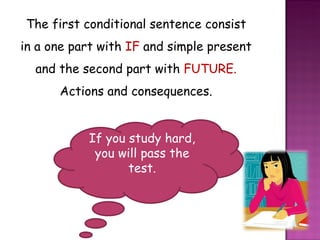
The first conditional sentence consist in a one part with  IF  and simple present and the second part with  FUTURE. Actions and consequences. If you study hard, you will pass the test.
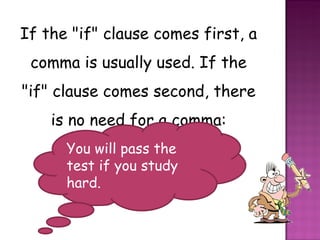
If the "if" clause comes first, a comma is usually used. If the "if" clause comes second, there is no need for a comma: You will pass the test if you study hard.
MORE EXAPLES If it's sunny, we'll go to the park.  Paula will be sad if Juan leaves.  If you cook the supper, I'll wash the dishes.
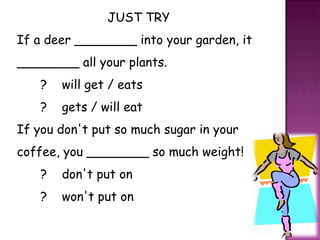
JUST TRY If a deer ________ into your garden, it ________ all your plants.    ?    will get / eats    ?    gets / will eat If you don't put so much sugar in your coffee, you ________ so much weight!    ?    don't put on    ?    won't put on

First conditional

  • 1.
  • 2.
    The firstconditional is a structure used for talking about possibilities in the present or in the future. This presentation will explain how the first conditional is formed, and when to use it.
  • 3.
    The first conditionalsentence consist in a one part with IF and simple present and the second part with FUTURE. Actions and consequences. If you study hard, you will pass the test.
  • 4.
    If the "if"clause comes first, a comma is usually used. If the "if" clause comes second, there is no need for a comma: You will pass the test if you study hard.
  • 5.
    MORE EXAPLES Ifit's sunny, we'll go to the park. Paula will be sad if Juan leaves. If you cook the supper, I'll wash the dishes.
  • 6.
    JUST TRY Ifa deer ________ into your garden, it ________ all your plants.    ?    will get / eats    ?    gets / will eat If you don't put so much sugar in your coffee, you ________ so much weight!    ?    don't put on    ?    won't put on