The document discusses the first conditional, which is used to talk about possible situations in the present or future. The first conditional uses an "if" clause with a simple present verb and a main clause with "will" plus a verb. Some examples are provided to illustrate possible situations, such as "If it's sunny, we'll go to the park" and "If you cook the supper, I'll wash the dishes." The document also provides exercises for readers to practice forming first conditional sentences on their own.
The firstconditional is a structure used for talking about possibilities in the present or in the future. This page will explain how the first conditional is formed, and when to use it.
3.
if clause If you study hard, main clause you will pass the test.
4.
main clause Youwill pass the test if clause if you study hard .
5.
if clauseif + subject + simple present verb main clause subject + will + verb
6.
Using the firstconditional The first conditional is used to talk about things which are possible in the present or the future -- things which may happen :
7.
Example If it'ssunny, we'll go to the park. Explanation: Maybe it will be sunny -- that's possible.
8.
EXAMPLE: Paula willbe sad if Juan leaves. EXPLANATION: Maybe Juan will leave -- that's possible.
9.
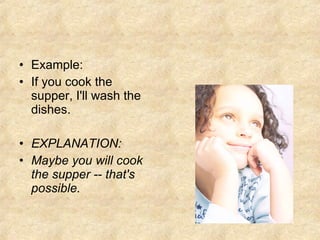
Example: If youcook the supper, I'll wash the dishes. EXPLANATION: Maybe you will cook the supper -- that's possible.
10.
11.
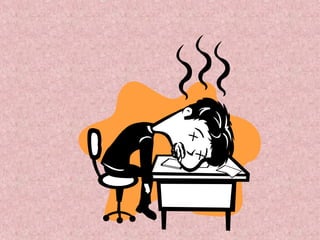
If you don´tsleep well, you will get asleep in the classroom.
12.
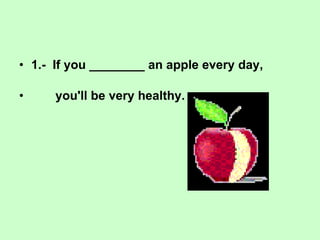
1.- Ifyou ________ an apple every day, you'll be very healthy.
13.
2 If wedon't protect the elephant, it ________ extinct.
14.
3 She ________completely different if she cuts her hair .( LOOK)
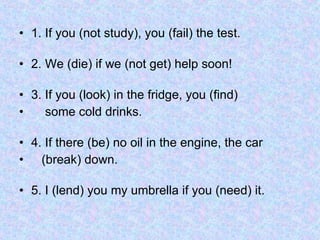
1. If you(not study), you (fail) the test. 2. We (die) if we (not get) help soon! 3. If you (look) in the fridge, you (find) some cold drinks. 4. If there (be) no oil in the engine, the car (break) down. 5. I (lend) you my umbrella if you (need) it.
25.
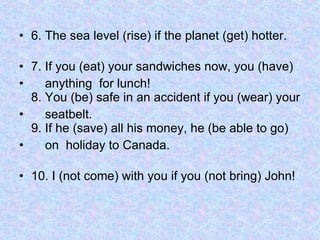
6. The sealevel (rise) if the planet (get) hotter. 7. If you (eat) your sandwiches now, you (have) anything for lunch! 8. You (be) safe in an accident if you (wear) your seatbelt. 9. If he (save) all his money, he (be able to go) on holiday to Canada. 10. I (not come) with you if you (not bring) John!