HEMIPLEGIA 
Jinu Janet Varghese 
Group: 4 
Year: 3rd 
Tbilisi State Medical University
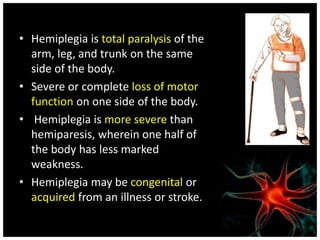
• Hemiplegia is total paralysis of the 
arm, leg, and trunk on the same 
side of the body. 
• Severe or complete loss of motor 
function on one side of the body. 
• Hemiplegia is more severe than 
hemiparesis, wherein one half of 
the body has less marked 
weakness. 
• Hemiplegia may be congenital or 
acquired from an illness or stroke.
Signs & Symptoms 
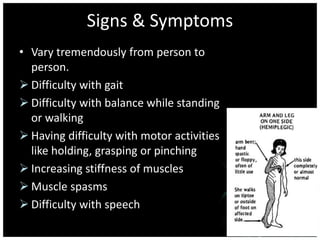
• Vary tremendously from person to 
person. 
 Difficulty with gait 
 Difficulty with balance while standing 
or walking 
 Having difficulty with motor activities 
like holding, grasping or pinching 
 Increasing stiffness of muscles 
 Muscle spasms 
 Difficulty with speech
 Difficulty swallowing food 
 Significant delay during standing, 
smiling, crawling or speaking 
 The majority of children who develop 
hemiplegia also have abnormal mental 
development. 
 Behaviour problems like anxiety, anger, 
irritability, lack of concentration or 
comprehension 
 Emotions — depression 
 Shoulder pain
Causes 
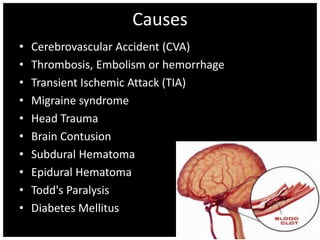
• Cerebrovascular Accident (CVA) 
• Thrombosis, Embolism or hemorrhage 
• Transient Ischemic Attack (TIA) 
• Migraine syndrome 
• Head Trauma 
• Brain Contusion 
• Subdural Hematoma 
• Epidural Hematoma 
• Todd's Paralysis 
• Diabetes Mellitus
• Brain Tumor 
• Infection 
• Subdural empyema 
• Meningitis 
• Nonketotic hyperosmolar coma 
• Vasculitis 
• Acute necrotizing myelitis 
• Hereditary disease 
• Leukodystrophies
Common Causes by etiology 
• Vascular: cerebral 
hemorrhage,stroke, diabetic 
neuropathy 
• Infective: encephalitis, meningitis, 
brain abscess 
• Neoplastic: glioma-meningioma 
• Demyelination: disseminated 
sclerosis, lesions to the internal 
capsule
• Traumatic: cerebral lacerations, 
subdural hematoma rare cause of 
hemiplegia is due to local 
anaesthetic injections given intra-arterially 
rapidly, instead of given 
in a nerve branch. 
• Congenital: cerebral palsy 
• Disseminated: multiple sclerosis 
• Psychological: parasomnia 
(nocturnal hemiplegia)
Pathogenesis 
The exact cause of hemiplegia is not 
known in all cases. 
 Brain is deprived of oxygen and this 
results in the death of neurons. 
When the corticospinal tract is 
damaged, the injury is usually 
manifested on the opposite side of the 
body. This happens because the motor 
fibres of corticospinal tract, which take 
origin from the motor cortex in brain, 
cross to the opposite side in the lower 
part of medulla oblangata and then
descend down in spinal cord to 
supply their respective muscles. 
 Depending on the site of lesion in 
brain, the severity of hemiplegia 
varies. 
A lesion in internal capsule where all 
the motor fibres are condensed in a 
small area, will cause dense 
hemiplegia i.e complete loss of power 
of all muscles of one half of body while 
a lesion at cortical or subcortical level 
will cause varied amount of weakness 
of one half of the body.
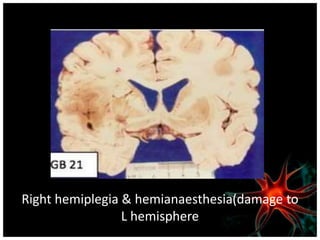
Right hemiplegia & hemianaesthesia(damage to 
L hemisphere
CT-scan obtained 2 hours after the onset of symptoms 
in a 65-year-old woman with left hemiplegia
Clinical Picture 
Onset and course :- 
- Acute onset and regressive 
course(vascular, infective & 
traumatic lesions). 
- Gradual onset & progressive 
course(neoplastic lesions). 
- Remittent & relapsing course(D.S.)
Diagnosis 
Hemiplegia is identified 
by clinical examination by a health 
professional, such as a 
physiotherapist or doctor. 
Radiological studies like 
a CT scan or magnetic resonance 
imaging of the brain should be used 
to confirm injury in the brain and 
spinal cord, but alone cannot be used 
to identify movement disorders. 
Individuals who develop seizures may 
undergo tests to determine where the 
focus of excess electrical activity is.
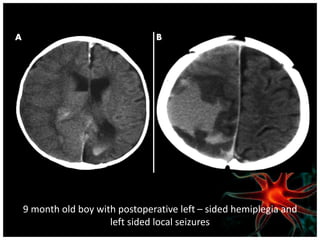
9 month old boy with postoperative left – sided hemiplegia and 
left sided local seizures
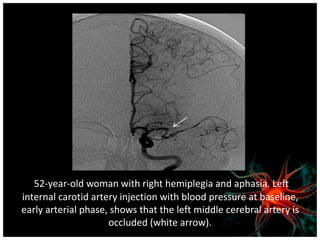
52-year-old woman with right hemiplegia and aphasia. Left 
internal carotid artery injection with blood pressure at baseline, 
early arterial phase, shows that the left middle cerebral artery is 
occluded (white arrow).
Hemiplegia patients usually show a 
characteristic gait. The leg on the 
affected side is extended and 
internally rotated and is swung in a 
wide, lateral arc rather than lifted in 
order to move it forward. The upper 
limb on the same side is also 
adducted at the shoulder, flexed at 
the elbow, and pronated at the wrist 
with the thumb tucked into the palm 
and the fingers curled around it.
Treatment 
• Treatment should be based on 
assessment by the relevant health 
professionals. Muscles with severe 
motor impairment including weakness 
need these therapists to assist them 
with specific exercise. 
• Pharmacological 
• Surgery 
• Rehabilitation 
• Assessment tools(FMA, CSMA, 
STREAM)
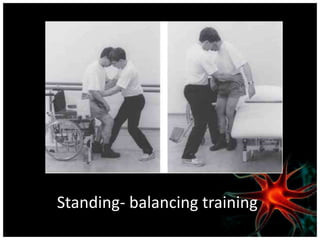
Standing- balancing training
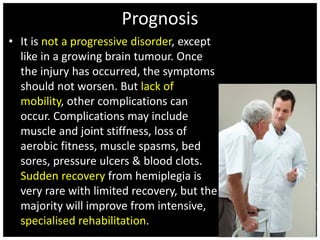
Prognosis 
• It is not a progressive disorder, except 
like in a growing brain tumour. Once 
the injury has occurred, the symptoms 
should not worsen. But lack of 
mobility, other complications can 
occur. Complications may include 
muscle and joint stiffness, loss of 
aerobic fitness, muscle spasms, bed 
sores, pressure ulcers & blood clots. 
Sudden recovery from hemiplegia is 
very rare with limited recovery, but the 
majority will improve from intensive, 
specialised rehabilitation.
Hemiplegia (1)

Hemiplegia (1)

  • 1.
    HEMIPLEGIA Jinu JanetVarghese Group: 4 Year: 3rd Tbilisi State Medical University
  • 2.
    • Hemiplegia istotal paralysis of the arm, leg, and trunk on the same side of the body. • Severe or complete loss of motor function on one side of the body. • Hemiplegia is more severe than hemiparesis, wherein one half of the body has less marked weakness. • Hemiplegia may be congenital or acquired from an illness or stroke.
  • 3.
    Signs & Symptoms • Vary tremendously from person to person.  Difficulty with gait  Difficulty with balance while standing or walking  Having difficulty with motor activities like holding, grasping or pinching  Increasing stiffness of muscles  Muscle spasms  Difficulty with speech
  • 4.
     Difficulty swallowingfood  Significant delay during standing, smiling, crawling or speaking  The majority of children who develop hemiplegia also have abnormal mental development.  Behaviour problems like anxiety, anger, irritability, lack of concentration or comprehension  Emotions — depression  Shoulder pain
  • 5.
    Causes • CerebrovascularAccident (CVA) • Thrombosis, Embolism or hemorrhage • Transient Ischemic Attack (TIA) • Migraine syndrome • Head Trauma • Brain Contusion • Subdural Hematoma • Epidural Hematoma • Todd's Paralysis • Diabetes Mellitus
  • 6.
    • Brain Tumor • Infection • Subdural empyema • Meningitis • Nonketotic hyperosmolar coma • Vasculitis • Acute necrotizing myelitis • Hereditary disease • Leukodystrophies
  • 7.
    Common Causes byetiology • Vascular: cerebral hemorrhage,stroke, diabetic neuropathy • Infective: encephalitis, meningitis, brain abscess • Neoplastic: glioma-meningioma • Demyelination: disseminated sclerosis, lesions to the internal capsule
  • 8.
    • Traumatic: cerebrallacerations, subdural hematoma rare cause of hemiplegia is due to local anaesthetic injections given intra-arterially rapidly, instead of given in a nerve branch. • Congenital: cerebral palsy • Disseminated: multiple sclerosis • Psychological: parasomnia (nocturnal hemiplegia)
  • 9.
    Pathogenesis The exactcause of hemiplegia is not known in all cases.  Brain is deprived of oxygen and this results in the death of neurons. When the corticospinal tract is damaged, the injury is usually manifested on the opposite side of the body. This happens because the motor fibres of corticospinal tract, which take origin from the motor cortex in brain, cross to the opposite side in the lower part of medulla oblangata and then
  • 10.
    descend down inspinal cord to supply their respective muscles.  Depending on the site of lesion in brain, the severity of hemiplegia varies. A lesion in internal capsule where all the motor fibres are condensed in a small area, will cause dense hemiplegia i.e complete loss of power of all muscles of one half of body while a lesion at cortical or subcortical level will cause varied amount of weakness of one half of the body.
  • 11.
    Right hemiplegia &hemianaesthesia(damage to L hemisphere
  • 12.
    CT-scan obtained 2hours after the onset of symptoms in a 65-year-old woman with left hemiplegia
  • 13.
    Clinical Picture Onsetand course :- - Acute onset and regressive course(vascular, infective & traumatic lesions). - Gradual onset & progressive course(neoplastic lesions). - Remittent & relapsing course(D.S.)
  • 14.
    Diagnosis Hemiplegia isidentified by clinical examination by a health professional, such as a physiotherapist or doctor. Radiological studies like a CT scan or magnetic resonance imaging of the brain should be used to confirm injury in the brain and spinal cord, but alone cannot be used to identify movement disorders. Individuals who develop seizures may undergo tests to determine where the focus of excess electrical activity is.
  • 15.
    9 month oldboy with postoperative left – sided hemiplegia and left sided local seizures
  • 16.
    52-year-old woman withright hemiplegia and aphasia. Left internal carotid artery injection with blood pressure at baseline, early arterial phase, shows that the left middle cerebral artery is occluded (white arrow).
  • 17.
    Hemiplegia patients usuallyshow a characteristic gait. The leg on the affected side is extended and internally rotated and is swung in a wide, lateral arc rather than lifted in order to move it forward. The upper limb on the same side is also adducted at the shoulder, flexed at the elbow, and pronated at the wrist with the thumb tucked into the palm and the fingers curled around it.
  • 18.
    Treatment • Treatmentshould be based on assessment by the relevant health professionals. Muscles with severe motor impairment including weakness need these therapists to assist them with specific exercise. • Pharmacological • Surgery • Rehabilitation • Assessment tools(FMA, CSMA, STREAM)
  • 19.
  • 20.
    Prognosis • Itis not a progressive disorder, except like in a growing brain tumour. Once the injury has occurred, the symptoms should not worsen. But lack of mobility, other complications can occur. Complications may include muscle and joint stiffness, loss of aerobic fitness, muscle spasms, bed sores, pressure ulcers & blood clots. Sudden recovery from hemiplegia is very rare with limited recovery, but the majority will improve from intensive, specialised rehabilitation.