High Sensitivity Troponins
March 27th 2014
Rosalind Oakes
Troponin
How troponins have changed
What this means – advantages and disadvantages of
Hs Tn
Hs Tn in the ED
ADAPTED
Cullen (2013)
Introduction
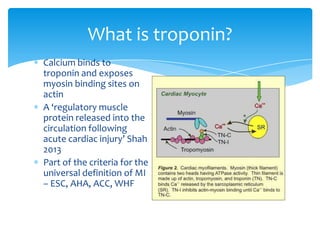
Calcium binds to
troponin and exposes
myosin binding sites on
actin
A ‘regulatory muscle
protein released into the
circulation following
acute cardiac injury’ Shah
2013
Part of the criteria for the
universal definition of MI
– ESC, AHA, ACC, WHF
What is troponin?
Hs Tn have been available since 2010
Newer assays are able to detect troponins at extremely low
concentrations - to a level that we can detect troponin in healthy
people
We can work out (with more reliability) the reference range of
the normal population and determine the 99th centile.
We now think that the 99th centile is higher in men than women
so the test should be sex specific
Normal values are difficult to derive – a population of blood
donors would create a difference normal value than a sicker
population presenting to ED
What has changed
Detecting as low as 3ng/L , ULN 14ng/L, ultra high sensitivity
Sensitivity for diagnosis of MI 73 -91% (Shah 2013)
Compare Sensitivity for ECG 28%
We now can detect troponin at much earlier from the onset of
symptoms (no needs to wait for higher circulating troponin to
become detectable) clinical implications for length of stay
Diagnosis of MI is likely to increase, how will we manage low
troponin rises?
Does not exclude unstable angina
Sensitivity
Ability to rule in MI not as good as previous troponins
Specificity has been reported at 80-85%
May lead to over admission and over investigation
Not as specific
Serial testing of troponin improves specificity – to
around 92%
Looking for a change in the troponin value (rise or
fall) is part of MI definition
Delta values – 20% (older troponins) or 7-9 ng/L
Managing reduction in specificity
Troponin is specific for myocardial injury of some kind..
Type 2 MI Hypotension, tachyarrythmia, respiratory
failure, sepsis
PE, Acute and chronic heart failure, renal failure, strenuous
exercise, acute pericarditis/myocarditis, cardiac contusion,
cardioversion, structural heart disease
Prognostic implications
Patient selection – risk stratification
Managing troponitis
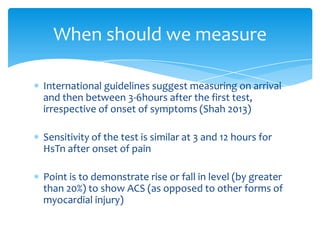
International guidelines suggest measuring on arrival
and then between 3-6hours after the first test,
irrespective of onset of symptoms (Shah 2013)
Sensitivity of the test is similar at 3 and 12 hours for
HsTn after onset of pain
Point is to demonstrate rise or fall in level (by greater
than 20%) to show ACS (as opposed to other forms of
myocardial injury)
When should we measure
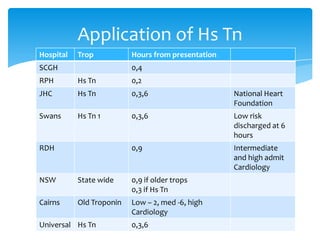
Hospital Trop Hours from presentation
SCGH 0,4
RPH Hs Tn 0,2
JHC Hs Tn 0,3,6 National Heart
Foundation
Swans Hs Tn 1 0,3,6 Low risk
discharged at 6
hours
RDH 0,9 Intermediate
and high admit
Cardiology
NSW State wide 0,9 if older trops
0,3 if Hs Tn
Cairns Old Troponin Low – 2, med -6, high
Cardiology
Universal Hs Tn 0,3,6
Application of Hs Tn
Risk Stratification with Hs-Tn in
ED
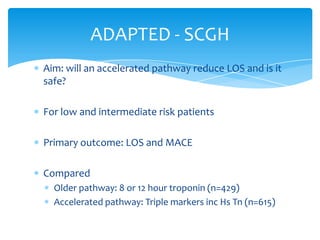
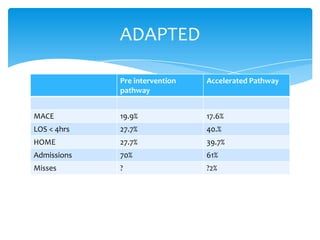
Aim: will an accelerated pathway reduce LOS and is it
safe?
For low and intermediate risk patients
Primary outcome: LOS and MACE
Compared
Older pathway: 8 or 12 hour troponin (n=429)
Accelerated pathway: Triple markers inc Hs Tn (n=615)
ADAPTED - SCGH
Pre intervention
pathway
Accelerated Pathway
MACE 19.9% 17.6%
LOS < 4hrs 27.7% 40.%
HOME 27.7% 39.7%
Admissions 70% 61%
Misses ? ?2%
ADAPTED
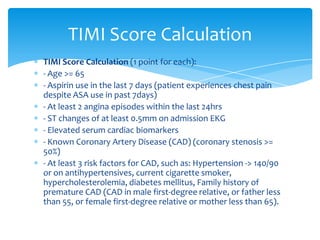
TIMI Score Calculation (1 point for each):
- Age >= 65
- Aspirin use in the last 7 days (patient experiences chest pain
despite ASA use in past 7days)
- At least 2 angina episodes within the last 24hrs
- ST changes of at least 0.5mm on admission EKG
- Elevated serum cardiac biomarkers
- Known Coronary Artery Disease (CAD) (coronary stenosis >=
50%)
- At least 3 risk factors for CAD, such as: Hypertension -> 140/90
or on antihypertensives, current cigarette smoker,
hypercholesterolemia, diabetes mellitus, Family history of
premature CAD (CAD in male first-degree relative, or father less
than 55, or female first-degree relative or mother less than 65).
TIMI Score Calculation
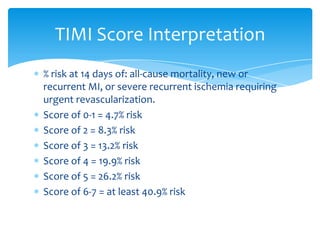
% risk at 14 days of: all-cause mortality, new or
recurrent MI, or severe recurrent ischemia requiring
urgent revascularization.
Score of 0-1 = 4.7% risk
Score of 2 = 8.3% risk
Score of 3 = 13.2% risk
Score of 4 = 19.9% risk
Score of 5 = 26.2% risk
Score of 6-7 = at least 40.9% risk
TIMI Score Interpretation
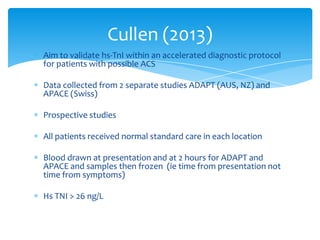
Aim to validate hs-TnI within an accelerated diagnostic protocol
for patients with possible ACS
Data collected from 2 separate studies ADAPT (AUS, NZ) and
APACE (Swiss)
Prospective studies
All patients received normal standard care in each location
Blood drawn at presentation and at 2 hours for ADAPT and
APACE and samples then frozen (ie time from presentation not
time from symptoms)
Hs TNI > 26 ng/L
Cullen (2013)
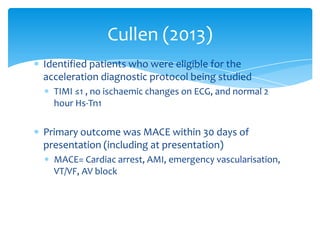
Identified patients who were eligible for the
acceleration diagnostic protocol being studied
TIMI ≤1 , no ischaemic changes on ECG, and normal 2
hour Hs-Tn1
Primary outcome was MACE within 30 days of
presentation (including at presentation)
MACE= Cardiac arrest, AMI, emergency vascularisation,
VT/VF, AV block
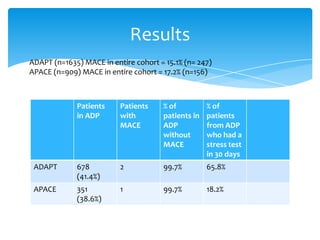
Cullen (2013)
Patients
in ADP
Patients
with
MACE
% of
patients in
ADP
without
MACE
% of
patients
from ADP
who had a
stress test
in 30 days
ADAPT 678
(41.4%)
2 99.7% 65.8%
APACE 351
(38.6%)
1 99.7% 18.2%
Results
ADAPT (n=1635) MACE in entire cohort = 15.1% (n= 247)
APACE (n=909) MACE in entire cohort = 17.2% (n=156)
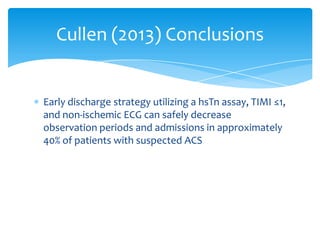
Early discharge strategy utilizing a hsTn assay, TIMI ≤1,
and non-ischemic ECG can safely decrease
observation periods and admissions in approximately
40% of patients with suspected ACS
Cullen (2013) Conclusions
* This algorithm applies to patients with suspected Acute Coronary
Syndrome in the absence of other plausible causes of symptoms or
troponin elevation (eg sepsis, PE, renal failure). W here other
diagnoses are evident, management should be directed at
these conditions.
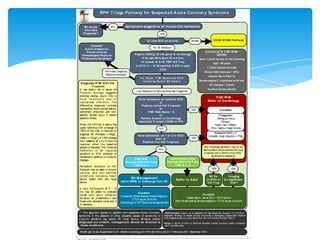
RPH Triage Pathway for Suspected Acute Coronary Syndrome
CODE ST EMI PathwaySTEMI
Mx as per
alternate
Diagnosis *
NO
Consider
Outpatient StressTesting,Stress Imaging or
CTCA as per protocol
Cardiology or GPFollow-up as appropriate
ED Management
admit EMW or Discharge from ED
Symptoms suggestive of myocardial ischaemia
YES
No ST elevation
Low likelihood of SeriousAlternate Diagnosis
References: Cullen L, et al,Validation of High-Sensitivity Troponin I in a 2-Hour
Diagnostic Strategy to Assess 30-Day Outcomes in Emergency Department Patients
With PossibleAcute Coronary Syndrome.JAm Coll Cardiol 2013;62:1242–9.
Mahajan V, Jarolim P, How to Interpret Elevated Cardiac Troponin Levels, Circulation
2011;124:2350-2354.
Draft yet to be A pproved by Dr JRankin (Cardiology),Dr SWright (AAU) and Dr H Patterson (ED). September 2013.
H igh Risk
Refer to Cardiology
NB:Cardiology admission may not be
appropriate in some patients with poor
prognosis due to severe comorbidity -
egdementia,malignancy.
Low Risk
N ormal ECG+H S- Trop
T IMI 0 or 1
YES
Diagnosis of MI with H S-
Troponin
A rise and/or fall in serial HS
Troponin strongly suggests
evolving cardiac injury. This is
mo st co mmo nl y due t o
myocardial infarct ion. The
differential diagnosis includes
myocarditis, acute cardiac failure,
pulmonary embolism and non-
specific cardiac injury in severe
systemic illness.
When the HS-Trop is below the
upper reference limit a change of
>50% of the URL is required to
diagnose MI. (Females ∆>8ng/L,
males ∆>13ng/L).A >20%change
from baseline at 2 to 6 hours is
required when the baseline
sample is elevated.The Universal
Definit ion of MI requir es
symptom or ECG evidence of
ischaemia in addition to troponin
changes.
Persistent elevation of HS-
Troponin may be seen in chronic
car di ac and non-car di ac
conditions including hear t
failure, stable IHD and renal
failure.
A third HS-Troponin at 6 - 12
hrs may be useful to evaluate
those with shor t symptom
duration at presentation and
those with elevated initial and 2
hr samples.
Refer to AAU
Intermediate Risk
N ormal ECG+H S- Trop
T IMI 2, 3, 4
YES
H eparin 5000 u iv
Consider dose reduction <70kg
Ticagrelor
180mg po bolus
*Except*
Heart rate <50bpm
Prior haemorrhagic stroke
Consider
N ew Ischaemia on 1 or 2 hr ECG
and / or
Positive 2 hr H S- Troponin
NO
12 Lead ECG on arrival
NO
Aspirin 300mg (if not given & no allergy)
If O2 sat<94% Start O2 4 l/ min
IV access & U+E, FBP, H S Trop
sl GT N (+/ - IV Morphine) if still in pain
CX R
Consider
Aortic Dissection
Pneumothorax
Oesophageal Rupture
Pulmonary Embolism
Alternate Diagnosis
Requires Exclusion
CALCULAT E T IMI RISK
SCORE
Score 1 point for any of the following
Age ! 65 years
! 3 Risk Factors for CAD
Known CAD (stenosis ! 50%)
Aspirin Use in Past 7d
Severe angina (! 2 episodes in 24 hrs)
ST changes ! 0.5mm
Positive Cardiac Marker
H x, Exam, T IMI Score and CX R
review by Senior ED Doctor
YES
Imaging
Dx significant
IH D?
Consider
Observation, serial ECG / HS-Troponin
Early StressTesting,Stress Imaging or CTCA as per protocol
MI Dx
on ECG or
H S- Trop
YES
N ew Ischaemia on baseline ECG
or
Positive initial H S- Troponin
or
T IMI Risk Score ! 5
or
Patient Known to Cardiology
especially if recent CABG or PCI
Ultra HS Troponins and problems with sensitivity
Attempts to risk stratify using ultra high sensitivity
Care of intermediate group in hospitals – safe
discharge from ED or better managed in hospital
NICE release early rule out with HS Tn in October 2014
Summary & Future
Cullen et al, Validation of High-Sensitivity Troponin I in a 2-
hour Diagnostic Strategy to Assess 30-Fay Outcomes in
Emergency Department Patients With Possible Acute
Coranary Syndrome. JACC 2013 Vol 62 No 14
Gamble, Carlton, Orr, Greaves. High sensitivity troponin, six
lessons and a reading. Br J Cardiol 2013;20:109-12
Thygesen K, Alpert JS, Jaffe AS et al. Third Universal
definition of MI. Eur Heart J 2012; 344
ADAPTED – SCGH, presentation slides by D Mountain
Chest pain guidelines as being used March 2014 from
SCGH, RPH, JHC, Swans, RDH, NSW and Cairns
References
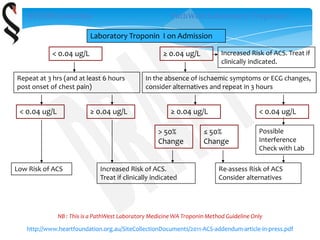
NSTEMI Guideline PathWest Laboratory Troponin I
Laboratory Troponin I on Admission
< 0.04 ug/L ≥ 0.04 ug/L
Repeat at 3 hrs (and at least 6 hours
post onset of chest pain)
In the absence of ischaemic symptoms or ECG changes,
consider alternatives and repeat in 3 hours
< 0.04 ug/L ≥ 0.04 ug/L ≥ 0.04 ug/L < 0.04 ug/L
Low Risk of ACS
Possible
Interference
Check with Lab
≤ 50%
Change
> 50%
Change
Increased Risk of ACS.
Treat if clinically indicated
Re-assess Risk of ACS
Consider alternatives
http://www.heartfoundation.org.au/SiteCollectionDocuments/2011-ACS-addendum-article-in-press.pdf
NB : This is a PathWest Laboratory Medicine WA Troponin Method Guideline Only
Increased Risk of ACS. Treat if
clinically indicated.

High sensitivity troponins

  • 1.
    High Sensitivity Troponins March27th 2014 Rosalind Oakes
  • 2.
    Troponin How troponins havechanged What this means – advantages and disadvantages of Hs Tn Hs Tn in the ED ADAPTED Cullen (2013) Introduction
  • 3.
    Calcium binds to troponinand exposes myosin binding sites on actin A ‘regulatory muscle protein released into the circulation following acute cardiac injury’ Shah 2013 Part of the criteria for the universal definition of MI – ESC, AHA, ACC, WHF What is troponin?
  • 4.
    Hs Tn havebeen available since 2010 Newer assays are able to detect troponins at extremely low concentrations - to a level that we can detect troponin in healthy people We can work out (with more reliability) the reference range of the normal population and determine the 99th centile. We now think that the 99th centile is higher in men than women so the test should be sex specific Normal values are difficult to derive – a population of blood donors would create a difference normal value than a sicker population presenting to ED What has changed
  • 5.
    Detecting as lowas 3ng/L , ULN 14ng/L, ultra high sensitivity Sensitivity for diagnosis of MI 73 -91% (Shah 2013) Compare Sensitivity for ECG 28% We now can detect troponin at much earlier from the onset of symptoms (no needs to wait for higher circulating troponin to become detectable) clinical implications for length of stay Diagnosis of MI is likely to increase, how will we manage low troponin rises? Does not exclude unstable angina Sensitivity
  • 6.
    Ability to rulein MI not as good as previous troponins Specificity has been reported at 80-85% May lead to over admission and over investigation Not as specific
  • 7.
    Serial testing oftroponin improves specificity – to around 92% Looking for a change in the troponin value (rise or fall) is part of MI definition Delta values – 20% (older troponins) or 7-9 ng/L Managing reduction in specificity
  • 8.
    Troponin is specificfor myocardial injury of some kind.. Type 2 MI Hypotension, tachyarrythmia, respiratory failure, sepsis PE, Acute and chronic heart failure, renal failure, strenuous exercise, acute pericarditis/myocarditis, cardiac contusion, cardioversion, structural heart disease Prognostic implications Patient selection – risk stratification Managing troponitis
  • 9.
    International guidelines suggestmeasuring on arrival and then between 3-6hours after the first test, irrespective of onset of symptoms (Shah 2013) Sensitivity of the test is similar at 3 and 12 hours for HsTn after onset of pain Point is to demonstrate rise or fall in level (by greater than 20%) to show ACS (as opposed to other forms of myocardial injury) When should we measure
  • 10.
    Hospital Trop Hoursfrom presentation SCGH 0,4 RPH Hs Tn 0,2 JHC Hs Tn 0,3,6 National Heart Foundation Swans Hs Tn 1 0,3,6 Low risk discharged at 6 hours RDH 0,9 Intermediate and high admit Cardiology NSW State wide 0,9 if older trops 0,3 if Hs Tn Cairns Old Troponin Low – 2, med -6, high Cardiology Universal Hs Tn 0,3,6 Application of Hs Tn
  • 11.
  • 12.
    Aim: will anaccelerated pathway reduce LOS and is it safe? For low and intermediate risk patients Primary outcome: LOS and MACE Compared Older pathway: 8 or 12 hour troponin (n=429) Accelerated pathway: Triple markers inc Hs Tn (n=615) ADAPTED - SCGH
  • 13.
    Pre intervention pathway Accelerated Pathway MACE19.9% 17.6% LOS < 4hrs 27.7% 40.% HOME 27.7% 39.7% Admissions 70% 61% Misses ? ?2% ADAPTED
  • 14.
    TIMI Score Calculation(1 point for each): - Age >= 65 - Aspirin use in the last 7 days (patient experiences chest pain despite ASA use in past 7days) - At least 2 angina episodes within the last 24hrs - ST changes of at least 0.5mm on admission EKG - Elevated serum cardiac biomarkers - Known Coronary Artery Disease (CAD) (coronary stenosis >= 50%) - At least 3 risk factors for CAD, such as: Hypertension -> 140/90 or on antihypertensives, current cigarette smoker, hypercholesterolemia, diabetes mellitus, Family history of premature CAD (CAD in male first-degree relative, or father less than 55, or female first-degree relative or mother less than 65). TIMI Score Calculation
  • 15.
    % risk at14 days of: all-cause mortality, new or recurrent MI, or severe recurrent ischemia requiring urgent revascularization. Score of 0-1 = 4.7% risk Score of 2 = 8.3% risk Score of 3 = 13.2% risk Score of 4 = 19.9% risk Score of 5 = 26.2% risk Score of 6-7 = at least 40.9% risk TIMI Score Interpretation
  • 16.
    Aim to validatehs-TnI within an accelerated diagnostic protocol for patients with possible ACS Data collected from 2 separate studies ADAPT (AUS, NZ) and APACE (Swiss) Prospective studies All patients received normal standard care in each location Blood drawn at presentation and at 2 hours for ADAPT and APACE and samples then frozen (ie time from presentation not time from symptoms) Hs TNI > 26 ng/L Cullen (2013)
  • 17.
    Identified patients whowere eligible for the acceleration diagnostic protocol being studied TIMI ≤1 , no ischaemic changes on ECG, and normal 2 hour Hs-Tn1 Primary outcome was MACE within 30 days of presentation (including at presentation) MACE= Cardiac arrest, AMI, emergency vascularisation, VT/VF, AV block Cullen (2013)
  • 18.
    Patients in ADP Patients with MACE % of patientsin ADP without MACE % of patients from ADP who had a stress test in 30 days ADAPT 678 (41.4%) 2 99.7% 65.8% APACE 351 (38.6%) 1 99.7% 18.2% Results ADAPT (n=1635) MACE in entire cohort = 15.1% (n= 247) APACE (n=909) MACE in entire cohort = 17.2% (n=156)
  • 19.
    Early discharge strategyutilizing a hsTn assay, TIMI ≤1, and non-ischemic ECG can safely decrease observation periods and admissions in approximately 40% of patients with suspected ACS Cullen (2013) Conclusions
  • 20.
    * This algorithmapplies to patients with suspected Acute Coronary Syndrome in the absence of other plausible causes of symptoms or troponin elevation (eg sepsis, PE, renal failure). W here other diagnoses are evident, management should be directed at these conditions. RPH Triage Pathway for Suspected Acute Coronary Syndrome CODE ST EMI PathwaySTEMI Mx as per alternate Diagnosis * NO Consider Outpatient StressTesting,Stress Imaging or CTCA as per protocol Cardiology or GPFollow-up as appropriate ED Management admit EMW or Discharge from ED Symptoms suggestive of myocardial ischaemia YES No ST elevation Low likelihood of SeriousAlternate Diagnosis References: Cullen L, et al,Validation of High-Sensitivity Troponin I in a 2-Hour Diagnostic Strategy to Assess 30-Day Outcomes in Emergency Department Patients With PossibleAcute Coronary Syndrome.JAm Coll Cardiol 2013;62:1242–9. Mahajan V, Jarolim P, How to Interpret Elevated Cardiac Troponin Levels, Circulation 2011;124:2350-2354. Draft yet to be A pproved by Dr JRankin (Cardiology),Dr SWright (AAU) and Dr H Patterson (ED). September 2013. H igh Risk Refer to Cardiology NB:Cardiology admission may not be appropriate in some patients with poor prognosis due to severe comorbidity - egdementia,malignancy. Low Risk N ormal ECG+H S- Trop T IMI 0 or 1 YES Diagnosis of MI with H S- Troponin A rise and/or fall in serial HS Troponin strongly suggests evolving cardiac injury. This is mo st co mmo nl y due t o myocardial infarct ion. The differential diagnosis includes myocarditis, acute cardiac failure, pulmonary embolism and non- specific cardiac injury in severe systemic illness. When the HS-Trop is below the upper reference limit a change of >50% of the URL is required to diagnose MI. (Females ∆>8ng/L, males ∆>13ng/L).A >20%change from baseline at 2 to 6 hours is required when the baseline sample is elevated.The Universal Definit ion of MI requir es symptom or ECG evidence of ischaemia in addition to troponin changes. Persistent elevation of HS- Troponin may be seen in chronic car di ac and non-car di ac conditions including hear t failure, stable IHD and renal failure. A third HS-Troponin at 6 - 12 hrs may be useful to evaluate those with shor t symptom duration at presentation and those with elevated initial and 2 hr samples. Refer to AAU Intermediate Risk N ormal ECG+H S- Trop T IMI 2, 3, 4 YES H eparin 5000 u iv Consider dose reduction <70kg Ticagrelor 180mg po bolus *Except* Heart rate <50bpm Prior haemorrhagic stroke Consider N ew Ischaemia on 1 or 2 hr ECG and / or Positive 2 hr H S- Troponin NO 12 Lead ECG on arrival NO Aspirin 300mg (if not given & no allergy) If O2 sat<94% Start O2 4 l/ min IV access & U+E, FBP, H S Trop sl GT N (+/ - IV Morphine) if still in pain CX R Consider Aortic Dissection Pneumothorax Oesophageal Rupture Pulmonary Embolism Alternate Diagnosis Requires Exclusion CALCULAT E T IMI RISK SCORE Score 1 point for any of the following Age ! 65 years ! 3 Risk Factors for CAD Known CAD (stenosis ! 50%) Aspirin Use in Past 7d Severe angina (! 2 episodes in 24 hrs) ST changes ! 0.5mm Positive Cardiac Marker H x, Exam, T IMI Score and CX R review by Senior ED Doctor YES Imaging Dx significant IH D? Consider Observation, serial ECG / HS-Troponin Early StressTesting,Stress Imaging or CTCA as per protocol MI Dx on ECG or H S- Trop YES N ew Ischaemia on baseline ECG or Positive initial H S- Troponin or T IMI Risk Score ! 5 or Patient Known to Cardiology especially if recent CABG or PCI
  • 21.
    Ultra HS Troponinsand problems with sensitivity Attempts to risk stratify using ultra high sensitivity Care of intermediate group in hospitals – safe discharge from ED or better managed in hospital NICE release early rule out with HS Tn in October 2014 Summary & Future
  • 22.
    Cullen et al,Validation of High-Sensitivity Troponin I in a 2- hour Diagnostic Strategy to Assess 30-Fay Outcomes in Emergency Department Patients With Possible Acute Coranary Syndrome. JACC 2013 Vol 62 No 14 Gamble, Carlton, Orr, Greaves. High sensitivity troponin, six lessons and a reading. Br J Cardiol 2013;20:109-12 Thygesen K, Alpert JS, Jaffe AS et al. Third Universal definition of MI. Eur Heart J 2012; 344 ADAPTED – SCGH, presentation slides by D Mountain Chest pain guidelines as being used March 2014 from SCGH, RPH, JHC, Swans, RDH, NSW and Cairns References
  • 23.
    NSTEMI Guideline PathWestLaboratory Troponin I Laboratory Troponin I on Admission < 0.04 ug/L ≥ 0.04 ug/L Repeat at 3 hrs (and at least 6 hours post onset of chest pain) In the absence of ischaemic symptoms or ECG changes, consider alternatives and repeat in 3 hours < 0.04 ug/L ≥ 0.04 ug/L ≥ 0.04 ug/L < 0.04 ug/L Low Risk of ACS Possible Interference Check with Lab ≤ 50% Change > 50% Change Increased Risk of ACS. Treat if clinically indicated Re-assess Risk of ACS Consider alternatives http://www.heartfoundation.org.au/SiteCollectionDocuments/2011-ACS-addendum-article-in-press.pdf NB : This is a PathWest Laboratory Medicine WA Troponin Method Guideline Only Increased Risk of ACS. Treat if clinically indicated.

Editor's Notes

  • #4 2. TnI has only been found in cardiac tissue but TnT is thought to be expressed to a small extent on skeletal tissue. (UP to date)3. The joint 2012 European Society of Cardiology/American College of Cardiology Foundation/American Heart Association/World Health Federation definition of myocardial infarction endorses the use of troponin as the marker of choice overall
  • #5 No strict definition of what makes is a HsTnI high sensitivity but general agreement that they are able to measure troponin within the normal population. The latest generation of troponins is being referred to as ‘ultra high sensitivity’ troponin. Why do we care about the 99th centile? As per the universal definition. They also want the coefficent variable at the 99th percentile to be less than 10%.5. This is concept is still fuzzy because drug companies have tended to use sick populations to trial their troponins on to work out the normal value. This is likely to overestimate the normal range.
  • #6 4. Decisions for admission or treatment and admission made earlier.3. Previous studies into threshold changes. 200ng/L to 50ng/L. Patients had better clinical outcomes when patients were classified as having an MI – presumable because they had their cardiovascular risk factors better controlled after the diagnosis.
  • #9 Type 2 MI: Myocardial injury where a condition other than CAD contributes to mismatch in oxygen supply and demand eg. Hypotension, tachyarrythymia and respiratory failure.4. Prognostic implications: In ICU patients diagnosed with septic shock, those with elevated troponins (demand ischaemia) had a worse prognosis than those without)In stable outpatients with risk factors for CAD, HsTn levels over 14 ng/L correlated with prognosis, having a four times increased risk of death at 9 years.5. Patients with suspected ACS in the absence of other plausible causes of troponin elevation. Patients with renal failure or sepsis, who are being admitted for other reasons, maybe discuss troponin with AAU and let them add it on if they want prognostic information.
  • #10 3 hours is probably fine for HsTn but 6 hours has been stated due the paucity of data and for older troponins.3. Need two troponins.
  • #13 1ary MACE (observational)AMI (I-V) Cardiac deaths Arrests VT/VFBradyarryhtmias (tx)Emergrevasc Cardiogenic shock(tx)
  • #15 TIMI – thrombolysis in MI is an academic group in Boston, MA.They created the TIMI risk score for patients with UA and NSTEMI to prognosticate to risk of all cause mortality event within the next 14 days.
  • #17 Patients presenting to the Emergency DepartmentADAPT Patients presenting with at least 5 mins possible cardiac symptoms in accordance with AHA definitionAPACE Adults patient with symptoms suggestive of AMI with peak symptoms within the previous 12 hours.
  • #19 In both cohorts almost approx 40% of patients with chest pain thought to be possible ACS were low risk by protocol criteria. Early identification of these patients could reduce the amount of time these patients spend in ED.All 3 cases of MACE were NSTEMI. The study does not say whether these events were identified at baseline or whether they occurred after discharge.Most patients did not have a cardiac event within 30 days of presentation.The cohorts demonstrated a large variability between follow up investigations. We have no idea whether the our patients receive investigations when they are discharged.