Epidemiological Approach &
Methods
BY: Mr. Jagan Kumar Ojha
MSC. Tutor, SNC, SO DTU
Epidemiological Approach
The epidemiological investigation to health
problems involves the two basic approaches:
a.Askingquestions
b.Makingcomparisons
a. Asking Questions
 Epidemiology has been defined as a means of
learning or asking questions.. and getting answers that
lead to further questions.
 The key information can be approached through a
series of questions.
Related to health events
 What are the actual and potential health problems, its
manifestations and characteristics?
 Who are affected with reference to age, sex, social class..?
 Where did it occurs in terms of place?
 Which populations are increased at risk?
Related to health events….
 When does it happen in terms of day, month,
season etc..?
 Why does it happen in terms of contributing or
causative factors?
 Which problems have declined?
 Which problems are increasing or have the risk to
increase?
Related to health action
 What can be done to reduce the problem and its
consequences?
 How can it be prevented in the future?
 What action should be taken by the community/
by the health services/ other sectors to prevent
and manage the problem?
Related to health action…
 Where and for whom these activities carried
out?
 What resources are required in future? How are
the activities to be organized?
 What difficulties may arise, and how it has to be
overcome?
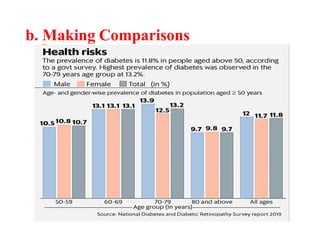
This approach is to make comparisons and draw
inferences.
Comparison may be made :
Between different population at a given time
eg. Rural with urban population
Between sub group of population
eg. Male with female population
Between various periods of observation
eg. Different seasons
b. Making Comparisons
Methods of Epidemiology
 Epidemiological study requires systematic collection
of health data, its analysis, description of health needs
and health problems, identification of factors
associated with the problems and stating the
hypothesis.
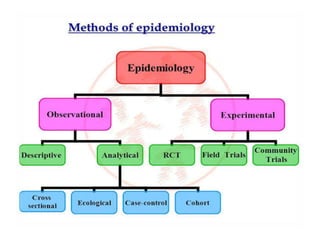
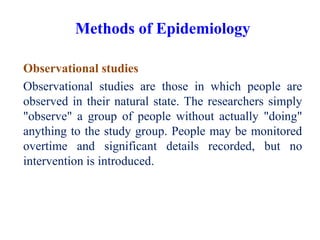
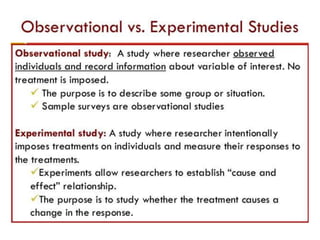
Observational studies
Observational studies are those in which people are
observed in their natural state. The researchers simply
"observe" a group of people without actually "doing"
anything to the study group. People may be monitored
overtime and significant details recorded, but no
intervention is introduced.
Methods of Epidemiology
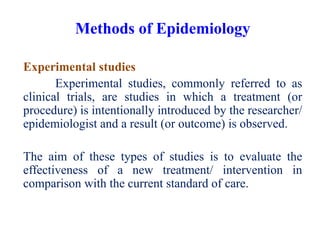
Experimental studies
Experimental studies, commonly referred to as
clinical trials, are studies in which a treatment (or
procedure) is intentionally introduced by the researcher/
epidemiologist and a result (or outcome) is observed.
The aim of these types of studies is to evaluate the
effectiveness of a new treatment/ intervention in
comparison with the current standard of care.
Methods of Epidemiology
Epidemiological approach and methods

Epidemiological approach and methods

  • 1.
    Epidemiological Approach & Methods BY:Mr. Jagan Kumar Ojha MSC. Tutor, SNC, SO DTU
  • 2.
    Epidemiological Approach The epidemiologicalinvestigation to health problems involves the two basic approaches: a.Askingquestions b.Makingcomparisons
  • 3.
    a. Asking Questions Epidemiology has been defined as a means of learning or asking questions.. and getting answers that lead to further questions.  The key information can be approached through a series of questions. Related to health events  What are the actual and potential health problems, its manifestations and characteristics?  Who are affected with reference to age, sex, social class..?  Where did it occurs in terms of place?  Which populations are increased at risk?
  • 4.
    Related to healthevents….  When does it happen in terms of day, month, season etc..?  Why does it happen in terms of contributing or causative factors?  Which problems have declined?  Which problems are increasing or have the risk to increase?
  • 5.
    Related to healthaction  What can be done to reduce the problem and its consequences?  How can it be prevented in the future?  What action should be taken by the community/ by the health services/ other sectors to prevent and manage the problem?
  • 6.
    Related to healthaction…  Where and for whom these activities carried out?  What resources are required in future? How are the activities to be organized?  What difficulties may arise, and how it has to be overcome?
  • 7.
    This approach isto make comparisons and draw inferences. Comparison may be made : Between different population at a given time eg. Rural with urban population Between sub group of population eg. Male with female population Between various periods of observation eg. Different seasons b. Making Comparisons
  • 8.
  • 10.
    Methods of Epidemiology Epidemiological study requires systematic collection of health data, its analysis, description of health needs and health problems, identification of factors associated with the problems and stating the hypothesis.
  • 12.
    Observational studies Observational studiesare those in which people are observed in their natural state. The researchers simply "observe" a group of people without actually "doing" anything to the study group. People may be monitored overtime and significant details recorded, but no intervention is introduced. Methods of Epidemiology
  • 13.
    Experimental studies Experimental studies,commonly referred to as clinical trials, are studies in which a treatment (or procedure) is intentionally introduced by the researcher/ epidemiologist and a result (or outcome) is observed. The aim of these types of studies is to evaluate the effectiveness of a new treatment/ intervention in comparison with the current standard of care. Methods of Epidemiology