Epidemiology
Introduction, Definitions, Components,
Goals, Uses, and Methods
BY: SHIVANGI
COMMUNITY HEALTH CARE LECTURE
Introduction to Epidemiology
• Epidemiology is the study of disease distribution,
determinants, and control in populations.
• It is the scientific foundation of public health, aiding
in disease prevention and health promotion.
• Key role: Planning, evaluating, and implementing
health services.
Definitions of Epidemiology
• John M. Last: 'Study of distribution and
determinants of health-related states or events in
populations.'
• CDC: 'Method to find causes of health outcomes
and diseases in populations.'
Components of Epidemiology
• Distribution: Who, where, and when of diseases.
• Determinants: Causes and risk factors.
• Population: Focuses on groups rather than
individuals.
• Health-Related Events: Includes diseases, injuries,
and other outcomes.
• Application: Development of interventions.
Goals and Aims of Epidemiology
• Goals:
• - Identify etiology of
diseases.
• - Determine disease
extent and impact.
• - Study disease
progression.
• - Evaluate preventive
measures.
• Aims:
• - Descriptive: Time,
place, and person analysis.
• - Analytical: Identifying
causes and associations.
• - Interventional: Disease
control and prevention.
Uses of Epidemiology
• Understanding Disease Causation.
• Public Health Planning.
• Disease Surveillance.
• Program Evaluation.
• Health Promotion.
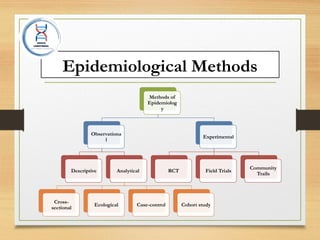
Epidemiological Methods
Methods of
Epidemiolog
y
Observationa
l
Descriptive Analytical
Cross-
sectional
Ecological Case-control Cohort study
Experimental
RCT Field Trials
Community
Trails
1. Observational Method
i) Descriptive Epidemiology
• Objective: Descriptive epidemiology focuses on understanding and analyzing the
distribution of diseases and health-related events in populations. Its primary goal
is to identify patterns and trends by examining the relationship between the
disease and various factors like time, place, and person.
• Purpose: To identify patterns and trends in health conditions, aiding paramedics
in recognizing common issues in their practice.
• Key Aspects: Who is affected (person), where it occurs (place), and when it
happens (time).
• Example:
A paramedic team working in an urban area observes a spike in respiratory
infections during winter. By recording the number of cases, patient demographics,
and environmental factors, they conclude that cold weather and pollution
exacerbate the condition.
ii) Analytical Epidemiology
a] Cross-sectional studies
b] Ecological studies ( Correlational studies )
c] Case-control studies
d] Cohort studies
a] Cross-sectional studies-
Objective:
•To assess the prevalence of a disease or health-related condition at
a single point in time or over a short duration.
•To study the relationship between exposure and outcome
simultaneously.
Purpose:
•To provide a snapshot of the population's health status.
•To identify the prevalence of diseases or risk factors.
•To generate hypotheses for further analytical studies.
Example :
•Measuring the prevalence of anemia among pregnant women
attending a clinic.
•Assessing the relationship between smoking habits and respiratory
symptoms in a population survey.
b) Ecological Studies (Correlational Studies)
Objective:
•To analyze data at the population or group level rather than
individual-level data.
•To study associations between exposure and outcome by
comparing different populations or regions.
Purpose:
•To explore potential associations between environmental, social, or
lifestyle factors and health outcomes.
•To generate hypotheses for further in-depth research.
Example:
•Comparing lung cancer mortality rates between regions with high
and low levels of air pollution.
•Examining the correlation between fluoride levels in water and
dental caries prevalence.
c) Case-Control Studies
Objective :
•To identify associations between exposure and outcome by
comparing individuals with a disease (cases) to those without
(controls).
•To study rare diseases or outcomes.
Purpose :
•To explore risk factors or causes of diseases retrospectively.
•To provide evidence for causal relationships.
Example :
•Investigating the link between a history of occupational exposure
to asbestos and the development of lung cancer.
•Assessing the relationship between poor hand hygiene practices
and an outbreak of a nosocomial infection.
d) Cohort Studies
Objective:
•To observe the association between exposure and outcome over
time in a specific group of individuals (cohort).
•To calculate the incidence of disease in exposed vs. non-exposed
groups.
Purpose:
•To determine the natural history of a disease.
•To assess the risk of developing a disease after a specific exposure.
Example:
• Follow healthcare workers who have been exposed to needle-stick
injuries to assess the development of hepatitis B over time.
•Observing a cohort of smokers and non-smokers for 10 years to
study the incidence of chronic obstructive pulmonary disease
(COPD).
2. Experimental Epidemiology
Experimental Epidemiology is the branch of epidemiology where
researchers actively test how a specific intervention (like a new
medicine, vaccine, or public health program) affects health. They
do this by deliberately changing something in a group of people
and observing the results to find out what works and what
doesn’t.
For example, testing a new vaccine on a group of people to see
if it prevents a disease is experimental epidemiology.
There are 3 types of experimental studies:
a) RCT
b) Field Trials
c) Community Trials
a) Randomized Controlled Trials (RCTs):
A study where participants are randomly assigned to
different groups (e.g., treatment vs. control) to evaluate
the efficacy or safety of an intervention.
Objective: To determine causality by eliminating bias
and confounding factors.
Purpose: To test new treatments, drugs, or preventive
strategies under controlled conditions.
Example: A clinical trial evaluating a new drug for
diabetes where participants are randomly assigned to
receive the drug or a placebo.
b) Field Trials
Studies conducted in non-hospital settings on healthy
individuals to assess interventions aimed at preventing
diseases.
Objective: To evaluate preventive measures (e.g.,
vaccines) in real-world environments.
Purpose: To study the efficacy of interventions before
disease onset in a target population.
Example: A trial to assess the efficacy of a new malaria
vaccine in a high-risk community.
c) Community Trials
Studies in which entire communities, rather than
individuals, are randomized to receive an intervention
or serve as controls.
Objective: To evaluate the impact of public health
interventions at a population level.
Purpose: To study the effects of programs or policies
on health outcomes across large groups.
Example: A study assessing the impact of fluoridation
of water on community dental health.
Conclusion
• Epidemiology is integral to public health.
• It identifies disease patterns, causes, and solutions.
• Methods and findings guide effective interventions
and disease prevention.
THANK YOU

Epidemiology introduction, goals and methods.pptx

  • 1.
    Epidemiology Introduction, Definitions, Components, Goals,Uses, and Methods BY: SHIVANGI COMMUNITY HEALTH CARE LECTURE
  • 2.
    Introduction to Epidemiology •Epidemiology is the study of disease distribution, determinants, and control in populations. • It is the scientific foundation of public health, aiding in disease prevention and health promotion. • Key role: Planning, evaluating, and implementing health services.
  • 3.
    Definitions of Epidemiology •John M. Last: 'Study of distribution and determinants of health-related states or events in populations.' • CDC: 'Method to find causes of health outcomes and diseases in populations.'
  • 4.
    Components of Epidemiology •Distribution: Who, where, and when of diseases. • Determinants: Causes and risk factors. • Population: Focuses on groups rather than individuals. • Health-Related Events: Includes diseases, injuries, and other outcomes. • Application: Development of interventions.
  • 5.
    Goals and Aimsof Epidemiology • Goals: • - Identify etiology of diseases. • - Determine disease extent and impact. • - Study disease progression. • - Evaluate preventive measures. • Aims: • - Descriptive: Time, place, and person analysis. • - Analytical: Identifying causes and associations. • - Interventional: Disease control and prevention.
  • 6.
    Uses of Epidemiology •Understanding Disease Causation. • Public Health Planning. • Disease Surveillance. • Program Evaluation. • Health Promotion.
  • 7.
    Epidemiological Methods Methods of Epidemiolog y Observationa l DescriptiveAnalytical Cross- sectional Ecological Case-control Cohort study Experimental RCT Field Trials Community Trails
  • 8.
    1. Observational Method i)Descriptive Epidemiology • Objective: Descriptive epidemiology focuses on understanding and analyzing the distribution of diseases and health-related events in populations. Its primary goal is to identify patterns and trends by examining the relationship between the disease and various factors like time, place, and person. • Purpose: To identify patterns and trends in health conditions, aiding paramedics in recognizing common issues in their practice. • Key Aspects: Who is affected (person), where it occurs (place), and when it happens (time). • Example: A paramedic team working in an urban area observes a spike in respiratory infections during winter. By recording the number of cases, patient demographics, and environmental factors, they conclude that cold weather and pollution exacerbate the condition.
  • 9.
    ii) Analytical Epidemiology a]Cross-sectional studies b] Ecological studies ( Correlational studies ) c] Case-control studies d] Cohort studies a] Cross-sectional studies- Objective: •To assess the prevalence of a disease or health-related condition at a single point in time or over a short duration. •To study the relationship between exposure and outcome simultaneously. Purpose: •To provide a snapshot of the population's health status. •To identify the prevalence of diseases or risk factors. •To generate hypotheses for further analytical studies. Example : •Measuring the prevalence of anemia among pregnant women attending a clinic. •Assessing the relationship between smoking habits and respiratory symptoms in a population survey.
  • 10.
    b) Ecological Studies(Correlational Studies) Objective: •To analyze data at the population or group level rather than individual-level data. •To study associations between exposure and outcome by comparing different populations or regions. Purpose: •To explore potential associations between environmental, social, or lifestyle factors and health outcomes. •To generate hypotheses for further in-depth research. Example: •Comparing lung cancer mortality rates between regions with high and low levels of air pollution. •Examining the correlation between fluoride levels in water and dental caries prevalence.
  • 11.
    c) Case-Control Studies Objective: •To identify associations between exposure and outcome by comparing individuals with a disease (cases) to those without (controls). •To study rare diseases or outcomes. Purpose : •To explore risk factors or causes of diseases retrospectively. •To provide evidence for causal relationships. Example : •Investigating the link between a history of occupational exposure to asbestos and the development of lung cancer. •Assessing the relationship between poor hand hygiene practices and an outbreak of a nosocomial infection.
  • 12.
    d) Cohort Studies Objective: •Toobserve the association between exposure and outcome over time in a specific group of individuals (cohort). •To calculate the incidence of disease in exposed vs. non-exposed groups. Purpose: •To determine the natural history of a disease. •To assess the risk of developing a disease after a specific exposure. Example: • Follow healthcare workers who have been exposed to needle-stick injuries to assess the development of hepatitis B over time. •Observing a cohort of smokers and non-smokers for 10 years to study the incidence of chronic obstructive pulmonary disease (COPD).
  • 13.
    2. Experimental Epidemiology ExperimentalEpidemiology is the branch of epidemiology where researchers actively test how a specific intervention (like a new medicine, vaccine, or public health program) affects health. They do this by deliberately changing something in a group of people and observing the results to find out what works and what doesn’t. For example, testing a new vaccine on a group of people to see if it prevents a disease is experimental epidemiology. There are 3 types of experimental studies: a) RCT b) Field Trials c) Community Trials
  • 14.
    a) Randomized ControlledTrials (RCTs): A study where participants are randomly assigned to different groups (e.g., treatment vs. control) to evaluate the efficacy or safety of an intervention. Objective: To determine causality by eliminating bias and confounding factors. Purpose: To test new treatments, drugs, or preventive strategies under controlled conditions. Example: A clinical trial evaluating a new drug for diabetes where participants are randomly assigned to receive the drug or a placebo.
  • 15.
    b) Field Trials Studiesconducted in non-hospital settings on healthy individuals to assess interventions aimed at preventing diseases. Objective: To evaluate preventive measures (e.g., vaccines) in real-world environments. Purpose: To study the efficacy of interventions before disease onset in a target population. Example: A trial to assess the efficacy of a new malaria vaccine in a high-risk community.
  • 16.
    c) Community Trials Studiesin which entire communities, rather than individuals, are randomized to receive an intervention or serve as controls. Objective: To evaluate the impact of public health interventions at a population level. Purpose: To study the effects of programs or policies on health outcomes across large groups. Example: A study assessing the impact of fluoridation of water on community dental health.
  • 17.
    Conclusion • Epidemiology isintegral to public health. • It identifies disease patterns, causes, and solutions. • Methods and findings guide effective interventions and disease prevention.
  • 18.