©2016 Micron Technology, Inc. All rights reserved. Information, products, and/or specifications are subject to
change without notice. All information is provided on an “AS IS” basis without warranties of any kind.
Statements regarding products, including regarding their features, availability, functionality, or compatibility,
are provided for informational purposes only and do not modify the warranty, if any, applicable to any
product. Drawings may not be to scale. Micron, the Micron logo, and all other Micron trademarks are the
property of Micron Technology, Inc. All other trademarks are the property of their respective owners.
Memory and Storage-
Side Processing
How persistent memory will bring an entirely
new structure to large data computing
Steve Pawlowski, VP of Advanced Memory Systems
Persistent Memory Today
© 2016 Micron Technology, Inc. |
Closing the Memory / Storage Latency Gap
3
Nanoseconds Microseconds Milliseconds
Storage I/O Memory Persistent Memory
Memory Control
(Load/Store)
I/O Control
(Read/Write)
Hard Disk Drive
(Spinning Media)
SATA/SAS SSD
(NAND)
NVME SSD
(NAND)
QuantX™
Technology
SSD
(3D XPoint™
memory)
DIMM
(3D XPoint™
memory)ASP/Bit
Latency
(not to scale)
NVDIMM-N
(DRAM/NAND)
RDIMM/LRDIMM
(DRAM)
Cost
Optimized PM
Performance
Optimized
PM
January 20, 2017
© 2016 Micron Technology, Inc. |
Impact of NVDIMM-N on Application Performance
| January 20, 20174 | Micron Confidential
• Data committed to persistent media written to
NAND through the I/O stack
• Data committed to persistent media written to
DRAM on NVDIMM-N through the I/O stack
• Latency improvement due to writing to DRAM
(35ns) versus NAND (85,000ns)
• Data committed to persistent media written to
DRAM on NVDIMM-N through Load/Store Bus
• Latency improvement due to circumventing
overhead associated with I/O stack
35ns
35ns
85us
85us
35ns
DRAM + NAND-Based NVMe SSD
DRAM + NVDIMM-N Block Mode
DRAM + NVDIMM-N Direct Mode
35ns
35ns
25us
25us
35ns
35ns
35ns
35ns
35ns
35ns
NV Direct
NV Block
NVMe
LATENCY
© 2016 Micron Technology, Inc. |
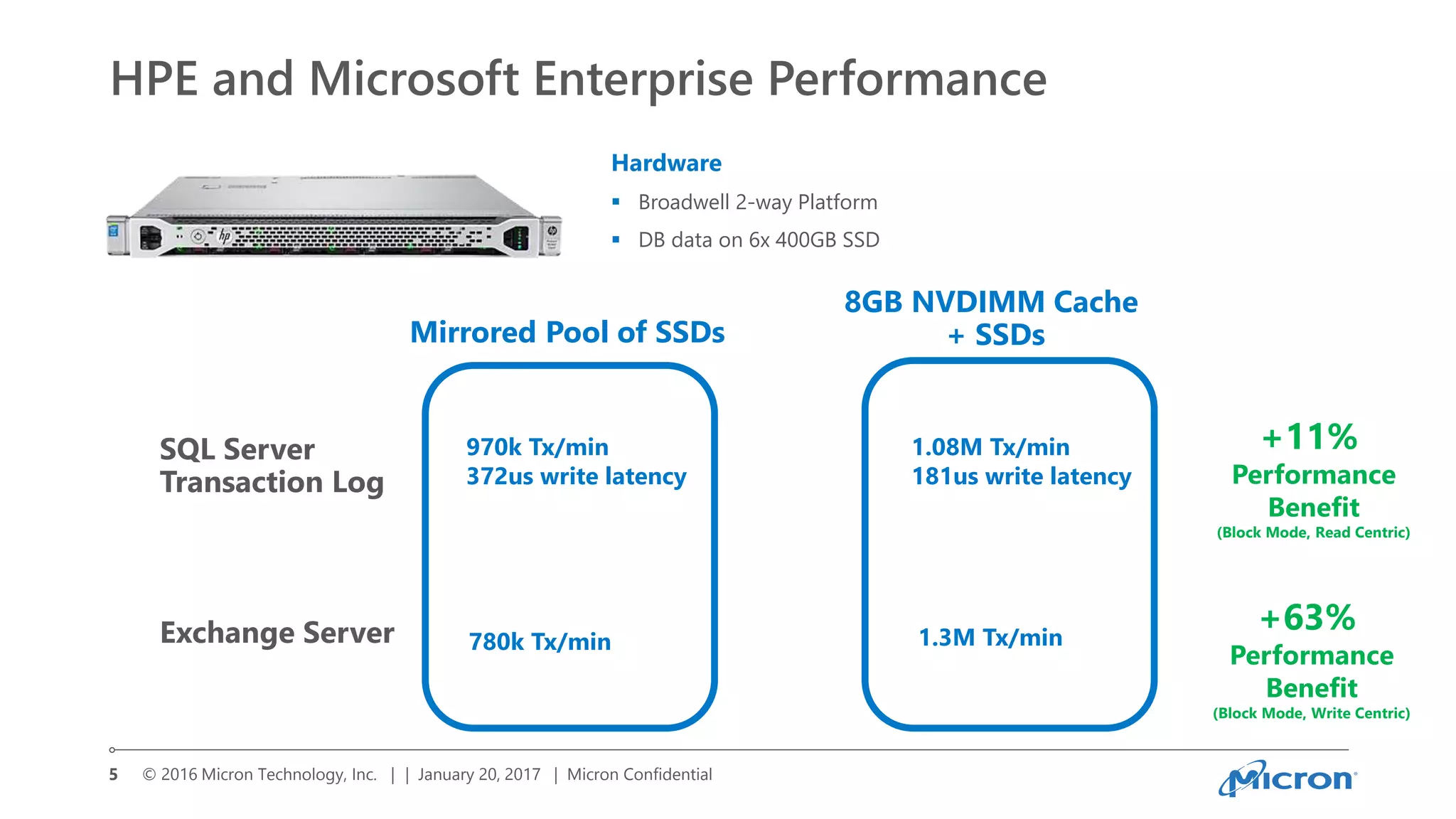
HPE and Microsoft Enterprise Performance
| January 20, 20175 | Micron Confidential
Hardware
 Broadwell 2-way Platform
 DB data on 6x 400GB SSD
8GB NVDIMM Cache
+ SSDsMirrored Pool of SSDs
SQL Server
Transaction Log
970k Tx/min
372us write latency
1.08M Tx/min
181us write latency
+11%
Performance
Benefit
(Block Mode, Read Centric)
Exchange Server +63%
Performance
Benefit
(Block Mode, Write Centric)
780k Tx/min 1.3M Tx/min
Future Vision
© 2016 Micron Technology, Inc. |
Fast Persistent Writes Metadata StorageWrite Back Cache
Scale-out Storage
Big Data Analytics
In-Memory Databases
Relational Databases
Persistent Memory will … Persist
 Higher capacities and storage-class
memories will open even broader
applications
BECOMING THE MAINSTAY OF MEMORY SUBSYSTEMS
© 2016 Micron Technology, Inc. |
The Critical Element of Future Memory Systems
January 20, 20178 | Micron Confidential
NVDIMM-NHybrid Memory Cube
This opens interesting new possibilities for managing data
Integrated on-board controller
© 2016 Micron Technology, Inc. |
Moving Data to the Processor is Costly
 What if we could avoid this 1000x chasm?
January 20, 20179 | Micron Confidential
One floating-point calculation
17 picojoules
Moving data from DRAM to CPU
17,000 picojoules
© 2016 Micron Technology, Inc. |
Why Hasn’t it Been Done Before?
 DRAM transistors are not ideal for logic processing
– In-memory processing must be very simple
– Processing must be intrinsically data-centric
– Complementary to CPU / Custom Processors
January 20, 201710 | Micron Confidential
Memory Technology
Low leakage transistors
Low power
Processor Technology
High speed
High power
© 2016 Micron Technology, Inc. |
What Can Be Done with STM?
 Data-centric problems
• Data sort
• Databases
• Machine learning (90% of the problem is feeding the MACs)
 Computationally lightweight problems
 Solutions that can be smoothly transitioned:
• Replace a library call (qsort ->msort)
• Replace a subsystem (MySQL)
January 20, 201711 | Micron Confidential
© 2016 Micron Technology, Inc. |
An Illustration
January 20, 201712 | Micron Confidential
Challenges to Overcome
© 2016 Micron Technology, Inc. |
Driving Easier Market Adoption
– Simplify the power source
– Minimize SW and programming
ecosystem impact
– Appropriate energy/performance
tradeoffs
– Latency optimization
| January 20, 201714 | Micron Confidential
HPE Smart Storage NVDIMM Integrated Backup Power
© 2016 Micron Technology, Inc. |
Implications of NVDIMM-P
 High capacities enable truly large in-memory computing
 Latencies introduce opportunity for tiered memory systems
 Industry ecosystem should begin preparing
today
January 20, 201715 | Micron Confidential
How Persistent Memory Will Bring an Entirely New Structure to Large Data Computing

How Persistent Memory Will Bring an Entirely New Structure to Large Data Computing

  • 1.
    ©2016 Micron Technology,Inc. All rights reserved. Information, products, and/or specifications are subject to change without notice. All information is provided on an “AS IS” basis without warranties of any kind. Statements regarding products, including regarding their features, availability, functionality, or compatibility, are provided for informational purposes only and do not modify the warranty, if any, applicable to any product. Drawings may not be to scale. Micron, the Micron logo, and all other Micron trademarks are the property of Micron Technology, Inc. All other trademarks are the property of their respective owners. Memory and Storage- Side Processing How persistent memory will bring an entirely new structure to large data computing Steve Pawlowski, VP of Advanced Memory Systems
  • 2.
  • 3.
    © 2016 MicronTechnology, Inc. | Closing the Memory / Storage Latency Gap 3 Nanoseconds Microseconds Milliseconds Storage I/O Memory Persistent Memory Memory Control (Load/Store) I/O Control (Read/Write) Hard Disk Drive (Spinning Media) SATA/SAS SSD (NAND) NVME SSD (NAND) QuantX™ Technology SSD (3D XPoint™ memory) DIMM (3D XPoint™ memory)ASP/Bit Latency (not to scale) NVDIMM-N (DRAM/NAND) RDIMM/LRDIMM (DRAM) Cost Optimized PM Performance Optimized PM January 20, 2017
  • 4.
    © 2016 MicronTechnology, Inc. | Impact of NVDIMM-N on Application Performance | January 20, 20174 | Micron Confidential • Data committed to persistent media written to NAND through the I/O stack • Data committed to persistent media written to DRAM on NVDIMM-N through the I/O stack • Latency improvement due to writing to DRAM (35ns) versus NAND (85,000ns) • Data committed to persistent media written to DRAM on NVDIMM-N through Load/Store Bus • Latency improvement due to circumventing overhead associated with I/O stack 35ns 35ns 85us 85us 35ns DRAM + NAND-Based NVMe SSD DRAM + NVDIMM-N Block Mode DRAM + NVDIMM-N Direct Mode 35ns 35ns 25us 25us 35ns 35ns 35ns 35ns 35ns 35ns NV Direct NV Block NVMe LATENCY
  • 5.
    © 2016 MicronTechnology, Inc. | HPE and Microsoft Enterprise Performance | January 20, 20175 | Micron Confidential Hardware  Broadwell 2-way Platform  DB data on 6x 400GB SSD 8GB NVDIMM Cache + SSDsMirrored Pool of SSDs SQL Server Transaction Log 970k Tx/min 372us write latency 1.08M Tx/min 181us write latency +11% Performance Benefit (Block Mode, Read Centric) Exchange Server +63% Performance Benefit (Block Mode, Write Centric) 780k Tx/min 1.3M Tx/min
  • 6.
  • 7.
    © 2016 MicronTechnology, Inc. | Fast Persistent Writes Metadata StorageWrite Back Cache Scale-out Storage Big Data Analytics In-Memory Databases Relational Databases Persistent Memory will … Persist  Higher capacities and storage-class memories will open even broader applications BECOMING THE MAINSTAY OF MEMORY SUBSYSTEMS
  • 8.
    © 2016 MicronTechnology, Inc. | The Critical Element of Future Memory Systems January 20, 20178 | Micron Confidential NVDIMM-NHybrid Memory Cube This opens interesting new possibilities for managing data Integrated on-board controller
  • 9.
    © 2016 MicronTechnology, Inc. | Moving Data to the Processor is Costly  What if we could avoid this 1000x chasm? January 20, 20179 | Micron Confidential One floating-point calculation 17 picojoules Moving data from DRAM to CPU 17,000 picojoules
  • 10.
    © 2016 MicronTechnology, Inc. | Why Hasn’t it Been Done Before?  DRAM transistors are not ideal for logic processing – In-memory processing must be very simple – Processing must be intrinsically data-centric – Complementary to CPU / Custom Processors January 20, 201710 | Micron Confidential Memory Technology Low leakage transistors Low power Processor Technology High speed High power
  • 11.
    © 2016 MicronTechnology, Inc. | What Can Be Done with STM?  Data-centric problems • Data sort • Databases • Machine learning (90% of the problem is feeding the MACs)  Computationally lightweight problems  Solutions that can be smoothly transitioned: • Replace a library call (qsort ->msort) • Replace a subsystem (MySQL) January 20, 201711 | Micron Confidential
  • 12.
    © 2016 MicronTechnology, Inc. | An Illustration January 20, 201712 | Micron Confidential
  • 13.
  • 14.
    © 2016 MicronTechnology, Inc. | Driving Easier Market Adoption – Simplify the power source – Minimize SW and programming ecosystem impact – Appropriate energy/performance tradeoffs – Latency optimization | January 20, 201714 | Micron Confidential HPE Smart Storage NVDIMM Integrated Backup Power
  • 15.
    © 2016 MicronTechnology, Inc. | Implications of NVDIMM-P  High capacities enable truly large in-memory computing  Latencies introduce opportunity for tiered memory systems  Industry ecosystem should begin preparing today January 20, 201715 | Micron Confidential

Editor's Notes

  • #4 So let’s go back to that memory/storage hierarchy chart we showed earlier. If we bring in a 3D XPoint memory SSD [ADVANCE SLIDE], you can see that we begin to close that performance gap. The really impressive performance differences aren’t illustrated well by this chart, and we’ll dig into those in a minute. In this instance, we’re operating with a legacy storage interface, so we’re handicapping what 3D XPoint memory can do somewhat. The performance charts for these drives show them maxing out the interface pretty quickly. That will get better as we advance storage interfaces, of course, but it’s a limitation for now—we can still provide a dramatic improvement over today’s most impressive flash-based SSDs, though. As we look to the memory side of the chart [ADVANCE SLIDE], you can see that using 3D XPoint memory on the DRAM bus will allow us to begin to bridge the latency gaps that exist between traditional DRAM and the fastest storage technologies—both in a latency/performance and a cost perspective. Micron’s view is that there will eventually be persistent memory solutions at a variety of performance and cost points, providing a true hierarchy of options based on what the system architect is trying to achieve. What’s not shown on this chart is the significant capacities these solutions will provide, since the densities of 3D XPoint memory die are four times greater than DRAM densities. We’re going to be able to place much more data close to the processor on persistent memory. You can tell why we think it’s an excellent time to be a memory and storage company. With so many options, system architects need to pay much more attention to how memory and storage technologies function and interact to get the best results—it requires a depth of knowledge that many of them simply can’t afford to learn themselves; the technology is changing quickly and they don’t have the time. This is expertise we provide to our customers through close collaboration and an increased focus on end-system applications results. We pay a lot of attention to how various storage configurations and memory tweaks can affect those end results. We’re building out a software excellence center in Austin to focus on this and developing applications expertise in ways that simply weren’t needed in the past—being able to show end application, end-user results is becoming a more and more important part of our business. And you’ll also note that the best performance is still clearly coming from DRAM and DRAM-based NVDIMMs. This is why we don’t see 3D XPoint memory creating a massive cannibalization of DRAM in server applications. The most demanding applications are still going to need a significant mix of DRAM technologies to get the performance they want. But they will have some very interesting options to create tiered systems—interesting, but also complex. We see an opportunity for Micron to provide significant value to our customers by helping them determine the best mix for the specific problem they’re trying to solve.