1
Trick Hartman, ThinkSolutions Architect, Lenovo Data Center Group
The All-Flash SAP HANA Solution: Performance,
Economics, and Reliability
May 2016
Adam Roberts, Chief Hardware Architect, SanDisk
2
Forward Looking Statement
During our meeting today we will make forward-looking statements.
Any statement that refers to expectations, projections or other characterizations of future events or circumstances
is a forward-looking statement, including those relating to market growth, industry trends, future products, product
performance and product capabilities. This presentation also contains forward-looking statements attributed to third
parties, which reflect their projections as of the date of issuance.
Actual results may differ materially from those expressed in these forward-looking statements due to a number of risks
and uncertainties, including the factors detailed under the caption “Risk Factors” and elsewhere in the documents we
file from time to time with the SEC, including our annual and quarterly reports.
We undertake no obligation to update these forward-looking statements, which speak only as of the date hereof or
as of the date of issuance by a third party, as the case may be.
3
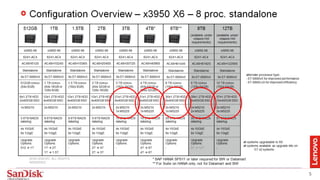
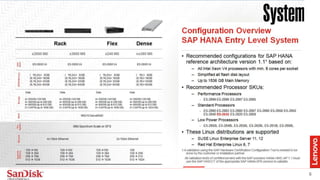
Lenovo All-Flash Solution for SAP HANA
4
5
6
7
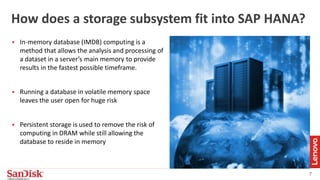
How does a storage subsystem fit into SAP HANA?
 In-memory database (IMDB) computing is a
method that allows the analysis and processing of
a dataset in a server’s main memory to provide
results in the fastest possible timeframe.
 Running a database in volatile memory space
leaves the user open for huge risk
 Persistent storage is used to remove the risk of
computing in DRAM while still allowing the
database to reside in memory
8
Can we see details on how this actually works??
 A core requirement for an enterprise database is durability
 DRAM provide performance but no durability
 Storage provides the durability
 In database technology, atomicity, consistency, isolation, and durability (ACID) must be met to
ensure that database transactions are processed reliably:
 A transaction must be atomic. This means if part of a transaction fails, the entire transaction
must fail and leave the database state unchanged.
 The consistency of a database must be preserved by the transactions that it performs.
 Isolation ensures that no transaction interferes with another transaction.
 Durability means that after a transaction is committed, it remains committed.
 When a dataset primarily lives in main system memory, additional functionality that is not
required with a standard storage based database must be put in place to ensure that durability
is achieved.
9
How do we add this protection?
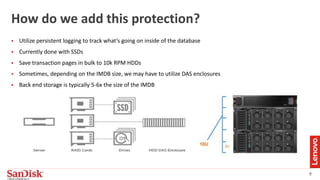
 Utilize persistent logging to track what’s going on inside of the database
 Currently done with SSDs
 Save transaction pages in bulk to 10k RPM HDDs
 Sometimes, depending on the IMDB size, we may have to utilize DAS enclosures
 Back end storage is typically 5-6x the size of the IMDB
10
Our Belief
SanDisk®
Extreme Performance
Massive Capacity
Immediate Information
How can we make this better with an all flash storage subsystem?
After some evaluation……..
Western Digital
11
All-Flash SAP HANA
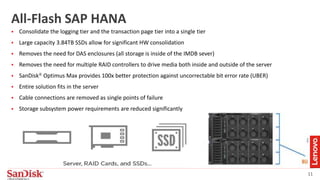
 Consolidate the logging tier and the transaction page tier into a single tier
 Large capacity 3.84TB SSDs allow for significant HW consolidation
 Removes the need for DAS enclosures (all storage is inside of the IMDB sever)
 Removes the need for multiple RAID controllers to drive media both inside and outside of the server
 SanDisk® Optimus Max provides 100x better protection against uncorrectable bit error rate (UBER)
 Entire solution fits in the server
 Cable connections are removed as single points of failure
 Storage subsystem power requirements are reduced significantly
12
HDD w/ EXP 2+p 3+p 4+p 5+p 7+p 2 x (4+p)
0
500
1000
1500
2000
2500
3000
3500
4000
4500
64M create MB/s
16M create MB/s
1M create MB/s
64k create MB/s
16k create MB/s
4k create MB/s
HDD w/ EXP 2+p 3+p 4+p 5+p 7+p 2 x (4+p)
0
1000
2000
3000
4000
5000
6000
64M
16M
1M
64k
16k
4k
13
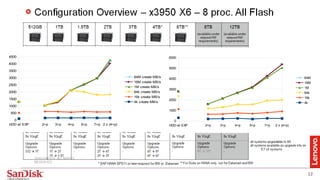
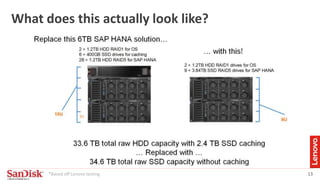
What does this actually look like?
*Based off Lenovo testing
14
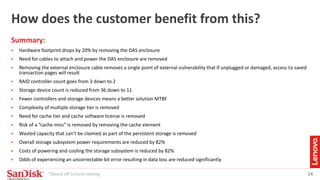
How does the customer benefit from this?
Summary:
 Hardware footprint drops by 20% by removing the DAS enclosure
 Need for cables to attach and power the DAS enclosure are removed
 Removing the external enclosure cable removes a single point of external vulnerability that if unplugged or damaged, access to saved
transaction pages will result
 RAID controller count goes from 3 down to 2
 Storage device count is reduced from 36 down to 11
 Fewer controllers and storage devices means a better solution MTBF
 Complexity of multiple storage tier is removed
 Need for cache tier and cache software license is removed
 Risk of a “cache miss” is removed by removing the cache element
 Wasted capacity that can’t be claimed as part of the persistent storage is removed
 Overall storage subsystem power requirements are reduced by 82%
 Costs of powering and cooling the storage subsystem is reduced by 82%
 Odds of experiencing an uncorrectable bit error resulting in data loss are reduced significantly
*Based off Lenovo testing
15c
© 2016 Western Digital Corporation or its affiliates. All rights reserved. SanDisk and the SanDisk logo are trademarks of Western Digital Corporation or its
affiliates, registered in the U.S. and other countries. Optimus Max is a trademark of Western Digital Corporation or its affiliates. Other brand names
mentioned herein are for identification purposes only and may be the trademark(s) of their respective holder(s).

The All-Flash SAP HANA Solution: Performance, Economics, and Reliability

  • 1.
    1 Trick Hartman, ThinkSolutionsArchitect, Lenovo Data Center Group The All-Flash SAP HANA Solution: Performance, Economics, and Reliability May 2016 Adam Roberts, Chief Hardware Architect, SanDisk
  • 2.
    2 Forward Looking Statement Duringour meeting today we will make forward-looking statements. Any statement that refers to expectations, projections or other characterizations of future events or circumstances is a forward-looking statement, including those relating to market growth, industry trends, future products, product performance and product capabilities. This presentation also contains forward-looking statements attributed to third parties, which reflect their projections as of the date of issuance. Actual results may differ materially from those expressed in these forward-looking statements due to a number of risks and uncertainties, including the factors detailed under the caption “Risk Factors” and elsewhere in the documents we file from time to time with the SEC, including our annual and quarterly reports. We undertake no obligation to update these forward-looking statements, which speak only as of the date hereof or as of the date of issuance by a third party, as the case may be.
  • 3.
  • 4.
  • 5.
  • 6.
  • 7.
    7 How does astorage subsystem fit into SAP HANA?  In-memory database (IMDB) computing is a method that allows the analysis and processing of a dataset in a server’s main memory to provide results in the fastest possible timeframe.  Running a database in volatile memory space leaves the user open for huge risk  Persistent storage is used to remove the risk of computing in DRAM while still allowing the database to reside in memory
  • 8.
    8 Can we seedetails on how this actually works??  A core requirement for an enterprise database is durability  DRAM provide performance but no durability  Storage provides the durability  In database technology, atomicity, consistency, isolation, and durability (ACID) must be met to ensure that database transactions are processed reliably:  A transaction must be atomic. This means if part of a transaction fails, the entire transaction must fail and leave the database state unchanged.  The consistency of a database must be preserved by the transactions that it performs.  Isolation ensures that no transaction interferes with another transaction.  Durability means that after a transaction is committed, it remains committed.  When a dataset primarily lives in main system memory, additional functionality that is not required with a standard storage based database must be put in place to ensure that durability is achieved.
  • 9.
    9 How do weadd this protection?  Utilize persistent logging to track what’s going on inside of the database  Currently done with SSDs  Save transaction pages in bulk to 10k RPM HDDs  Sometimes, depending on the IMDB size, we may have to utilize DAS enclosures  Back end storage is typically 5-6x the size of the IMDB
  • 10.
    10 Our Belief SanDisk® Extreme Performance MassiveCapacity Immediate Information How can we make this better with an all flash storage subsystem? After some evaluation…….. Western Digital
  • 11.
    11 All-Flash SAP HANA Consolidate the logging tier and the transaction page tier into a single tier  Large capacity 3.84TB SSDs allow for significant HW consolidation  Removes the need for DAS enclosures (all storage is inside of the IMDB sever)  Removes the need for multiple RAID controllers to drive media both inside and outside of the server  SanDisk® Optimus Max provides 100x better protection against uncorrectable bit error rate (UBER)  Entire solution fits in the server  Cable connections are removed as single points of failure  Storage subsystem power requirements are reduced significantly
  • 12.
    12 HDD w/ EXP2+p 3+p 4+p 5+p 7+p 2 x (4+p) 0 500 1000 1500 2000 2500 3000 3500 4000 4500 64M create MB/s 16M create MB/s 1M create MB/s 64k create MB/s 16k create MB/s 4k create MB/s HDD w/ EXP 2+p 3+p 4+p 5+p 7+p 2 x (4+p) 0 1000 2000 3000 4000 5000 6000 64M 16M 1M 64k 16k 4k
  • 13.
    13 What does thisactually look like? *Based off Lenovo testing
  • 14.
    14 How does thecustomer benefit from this? Summary:  Hardware footprint drops by 20% by removing the DAS enclosure  Need for cables to attach and power the DAS enclosure are removed  Removing the external enclosure cable removes a single point of external vulnerability that if unplugged or damaged, access to saved transaction pages will result  RAID controller count goes from 3 down to 2  Storage device count is reduced from 36 down to 11  Fewer controllers and storage devices means a better solution MTBF  Complexity of multiple storage tier is removed  Need for cache tier and cache software license is removed  Risk of a “cache miss” is removed by removing the cache element  Wasted capacity that can’t be claimed as part of the persistent storage is removed  Overall storage subsystem power requirements are reduced by 82%  Costs of powering and cooling the storage subsystem is reduced by 82%  Odds of experiencing an uncorrectable bit error resulting in data loss are reduced significantly *Based off Lenovo testing
  • 15.
    15c © 2016 WesternDigital Corporation or its affiliates. All rights reserved. SanDisk and the SanDisk logo are trademarks of Western Digital Corporation or its affiliates, registered in the U.S. and other countries. Optimus Max is a trademark of Western Digital Corporation or its affiliates. Other brand names mentioned herein are for identification purposes only and may be the trademark(s) of their respective holder(s).

Editor's Notes

  • #11 THE WHY - We believe we enable a new generation of services and applications for an experience never before thought possible! THE HOW - Through innovation and 25+ years experience in flash technology we provide Extreme Performance, Massive Capacity and Immediate Access to Information THE WHAT - We deliver enterprise class, web-scale flash solution building blocks in the form of Flash Systems, Flash Software and SSDs  that enable a Flash Transformed Data Center. Flash changes everything and the ripple effect are wide changing. The effect on our lives and solving impactful challenges quicker Health data real-time access, calculation and results make life decisions Rapid access to information ensures business advantage, efficiencies Media streaming – High performant and massive data for video surveillance – think beyond the security needs which are clearly paramount today, think on the possibilities of real time facial recognition with 4K edge cameras with flash, accessing and processing information, calculating an action so when you walk buy that favorite shop in the mall a groupoun coupon is sent directly to your mobile device. Scary for 50% of the world and WAY COOL for the other 50%. Net net a service level never deemed possible before. On Innovation accessing big data and now complex tasks are now more feasible enabling new possibilities AND ON THE DATA CETNER BOTTOM LINE – achieve IT consolation, do more with less, scale without scale cost exponentially, and now focus on delivering to SLAs to grow the business beyond.