

DEVELOPMENTS IN PERSISTENT MEMORY
GORDON PATRICK, DIRECTOR OF ENTERPRISE COMPUTING MEMORY, MICRON TECHNOLOGY
©2016 Micron Technology, Inc. All rights reserved. Information, products, and/or specifications are subject to change without
notice. All information is provided on an “AS IS” basis without warranties of any kind. Statements regarding products, including
regarding their features, availability, functionality, or compatibility, are provided for informational purposes only and do not modify the
warranty, if any, applicable to any product. Drawings may not be to scale. Micron, the Micron logo, and all other Micron trademarks are
the property of Micron Technology, Inc. All other trademarks are the property of their respective owners.
See all the presentations from the In-Memory Computing
Summit at http://imcsummit.org
 Overview
 Why Persistent Memory (PM)
 What problems does PM solve?
 Developing new markets
 Key Segment Focus
 Initial Case Studies
 Designing in persistence
 Portfolio Considerations
 Ecosystem Requirements
DEVELOPMENTS IN PERSISTENT MEMORY
WHY PERSISTENT
MEMORY?
3
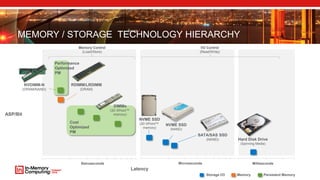
MEMORY / STORAGE TECHNOLOGY HIERARCHY
Nanoseconds Microseconds Milliseconds
Storage I/O Memory Persistent Memory
Memory Control
(Load/Store)
I/O Control
(Read/Write)
Hard Disk Drive
(Spinning Media)
SATA/SAS SSD
(NAND)
NVME SSD
(NAND)
NVME SSD
(3D XPoint™
memory)
DIMMs
(3D XPoint™
memory)ASP/Bit
Latency
NVDIMM-N
(DRAM/NAND)
RDIMM/LRDIMM
(DRAM)
Cost
Optimized
PM
Performance
Optimized
PM
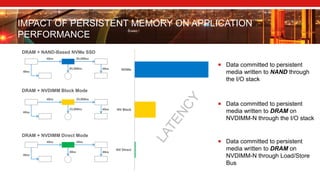
IMPACT OF PERSISTENT MEMORY ON APPLICATION
PERFORMANCE
40ns
40ns
85,000ns
85,000ns
40ns
DRAM + NAND-Based NVMe SSD
DRAM + NVDIMM Block Mode
DRAM + NVDIMM Direct Mode
40ns
40ns
25,000ns
25,000ns
40ns
40ns
40ns
40ns
40ns
40ns
NV Direct
NV Block
NVMe
 Data committed to persistent
media written to NAND through
the I/O stack
 Data committed to persistent
media written to DRAM on
NVDIMM-N through the I/O stack
 Data committed to persistent
media written to DRAM on
NVDIMM-N through Load/Store
Bus
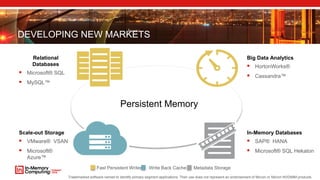
DEVELOPING NEW
MARKETS
DEVELOPING NEW MARKETS
Fast Persistent Writes Metadata StorageWrite Back Cache
Scale-out Storage
 VMware® VSAN
 Microsoft®
Azure™
Big Data Analytics
 HortonWorks®
 Cassandra™
In-Memory Databases
 SAP® HANA
 Microsoft® SQL Hekaton
Persistent Memory
Relational
Databases
 Microsoft® SQL
 MySQL™
Trademarked software named to identify primary segment applications. Their use does not represent an endorsement of Micron or Micron NVDIMM products.
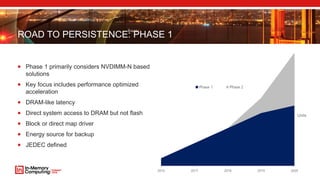
ROAD TO PERSISTENCE: PHASE 1
 Phase 1 primarily considers NVDIMM-N based
solutions
 Key focus includes performance optimized
acceleration
 DRAM-like latency
 Direct system access to DRAM but not flash
 Block or direct map driver
 Energy source for backup
 JEDEC defined
2016 2017 2018 2019 2020
Phase 1 Phase 2
Units
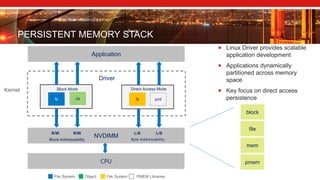
PERSISTENT MEMORY STACK
 Linux Driver provides scalable
application development
 Applications dynamically
partitioned across memory
space
 Key focus on direct access
persistence
NVDIMM
Application
Driver
obfs
Block Mode
fs pml
Direct Access Mode
L/SL/SR/W
CPU
block
file
mem
pmem
R/W
Kernel
Byte AddressabilityBlock Addressability
File System PMEM LibrariesFile SystemObject
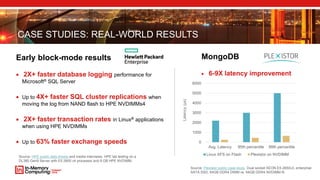
Early block-mode results
 2X+ faster database logging performance for
Microsoft® SQL Server
 Up to 4X+ faster SQL cluster replications when
moving the log from NAND flash to HPE NVDIMMs4
 2X+ faster transaction rates in Linux® applications
when using HPE NVDIMMs
 Up to 63% faster exchange speeds
CASE STUDIES: REAL-WORLD RESULTS
Source: HPE public data sheets and media interviews. HPE lab testing on a
DL380 Gen9 Server with E5 2600 v4 processor and 8 GB HPE NVDIMM.
Source: Plexistor public case study. Dual socket XEON E5-2650v3, enterprise
SATA SSD, 64GB DDR4 DIMM vs. 64GB DDR4 NVDIMM-N
MongoDB
 6-9X latency improvement
0
1000
2000
3000
4000
5000
6000
Avg. Latency 95th percentile 99th percentile
Linux XFS on Flash Plexistor on NVDIMM
Latency(µs)
DESIGNING IN
PERSISTENCE
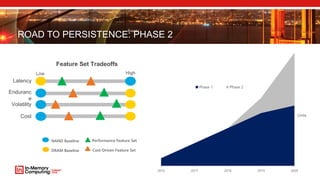
ROAD TO PERSISTENCE: PHASE 2
Latency
Enduranc
e
Volatility
Cost
Low High
Feature Set Tradeoffs
DRAM Baseline
NAND Baseline
Cost-Driven Feature Set
Performance Feature Set
2016 2017 2018 2019 2020
Phase 1 Phase 2
Units
REQUIREMENTS & NEXT STEPS
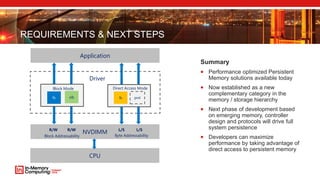
Summary
 Performance optimized Persistent
Memory solutions available today
 Now established as a new
complementary category in the
memory / storage hierarchy
 Next phase of development based
on emerging memory, controller
design and protocols will drive full
system persistence
 Developers can maximize
performance by taking advantage of
direct access to persistent memory
NVDIMM
Application
Driver
obfs
Block Mode
fs pml
Direct Access Mode
L/SL/SR/W
CPU
R/W
Byte AddressabilityBlock Addressability
IMC Summit 2016 Breakout - Gordon Patrick - Developments in Persistent Memory

IMC Summit 2016 Breakout - Gordon Patrick - Developments in Persistent Memory

  • 1.
    DEVELOPMENTS IN PERSISTENTMEMORY GORDON PATRICK, DIRECTOR OF ENTERPRISE COMPUTING MEMORY, MICRON TECHNOLOGY ©2016 Micron Technology, Inc. All rights reserved. Information, products, and/or specifications are subject to change without notice. All information is provided on an “AS IS” basis without warranties of any kind. Statements regarding products, including regarding their features, availability, functionality, or compatibility, are provided for informational purposes only and do not modify the warranty, if any, applicable to any product. Drawings may not be to scale. Micron, the Micron logo, and all other Micron trademarks are the property of Micron Technology, Inc. All other trademarks are the property of their respective owners. See all the presentations from the In-Memory Computing Summit at http://imcsummit.org
  • 2.
     Overview  WhyPersistent Memory (PM)  What problems does PM solve?  Developing new markets  Key Segment Focus  Initial Case Studies  Designing in persistence  Portfolio Considerations  Ecosystem Requirements DEVELOPMENTS IN PERSISTENT MEMORY
  • 3.
  • 4.
    MEMORY / STORAGETECHNOLOGY HIERARCHY Nanoseconds Microseconds Milliseconds Storage I/O Memory Persistent Memory Memory Control (Load/Store) I/O Control (Read/Write) Hard Disk Drive (Spinning Media) SATA/SAS SSD (NAND) NVME SSD (NAND) NVME SSD (3D XPoint™ memory) DIMMs (3D XPoint™ memory)ASP/Bit Latency NVDIMM-N (DRAM/NAND) RDIMM/LRDIMM (DRAM) Cost Optimized PM Performance Optimized PM
  • 5.
    IMPACT OF PERSISTENTMEMORY ON APPLICATION PERFORMANCE 40ns 40ns 85,000ns 85,000ns 40ns DRAM + NAND-Based NVMe SSD DRAM + NVDIMM Block Mode DRAM + NVDIMM Direct Mode 40ns 40ns 25,000ns 25,000ns 40ns 40ns 40ns 40ns 40ns 40ns NV Direct NV Block NVMe  Data committed to persistent media written to NAND through the I/O stack  Data committed to persistent media written to DRAM on NVDIMM-N through the I/O stack  Data committed to persistent media written to DRAM on NVDIMM-N through Load/Store Bus
  • 6.
  • 7.
    DEVELOPING NEW MARKETS FastPersistent Writes Metadata StorageWrite Back Cache Scale-out Storage  VMware® VSAN  Microsoft® Azure™ Big Data Analytics  HortonWorks®  Cassandra™ In-Memory Databases  SAP® HANA  Microsoft® SQL Hekaton Persistent Memory Relational Databases  Microsoft® SQL  MySQL™ Trademarked software named to identify primary segment applications. Their use does not represent an endorsement of Micron or Micron NVDIMM products.
  • 8.
    ROAD TO PERSISTENCE:PHASE 1  Phase 1 primarily considers NVDIMM-N based solutions  Key focus includes performance optimized acceleration  DRAM-like latency  Direct system access to DRAM but not flash  Block or direct map driver  Energy source for backup  JEDEC defined 2016 2017 2018 2019 2020 Phase 1 Phase 2 Units
  • 9.
    PERSISTENT MEMORY STACK Linux Driver provides scalable application development  Applications dynamically partitioned across memory space  Key focus on direct access persistence NVDIMM Application Driver obfs Block Mode fs pml Direct Access Mode L/SL/SR/W CPU block file mem pmem R/W Kernel Byte AddressabilityBlock Addressability File System PMEM LibrariesFile SystemObject
  • 10.
    Early block-mode results 2X+ faster database logging performance for Microsoft® SQL Server  Up to 4X+ faster SQL cluster replications when moving the log from NAND flash to HPE NVDIMMs4  2X+ faster transaction rates in Linux® applications when using HPE NVDIMMs  Up to 63% faster exchange speeds CASE STUDIES: REAL-WORLD RESULTS Source: HPE public data sheets and media interviews. HPE lab testing on a DL380 Gen9 Server with E5 2600 v4 processor and 8 GB HPE NVDIMM. Source: Plexistor public case study. Dual socket XEON E5-2650v3, enterprise SATA SSD, 64GB DDR4 DIMM vs. 64GB DDR4 NVDIMM-N MongoDB  6-9X latency improvement 0 1000 2000 3000 4000 5000 6000 Avg. Latency 95th percentile 99th percentile Linux XFS on Flash Plexistor on NVDIMM Latency(µs)
  • 11.
  • 12.
    ROAD TO PERSISTENCE:PHASE 2 Latency Enduranc e Volatility Cost Low High Feature Set Tradeoffs DRAM Baseline NAND Baseline Cost-Driven Feature Set Performance Feature Set 2016 2017 2018 2019 2020 Phase 1 Phase 2 Units
  • 13.
    REQUIREMENTS & NEXTSTEPS Summary  Performance optimized Persistent Memory solutions available today  Now established as a new complementary category in the memory / storage hierarchy  Next phase of development based on emerging memory, controller design and protocols will drive full system persistence  Developers can maximize performance by taking advantage of direct access to persistent memory NVDIMM Application Driver obfs Block Mode fs pml Direct Access Mode L/SL/SR/W CPU R/W Byte AddressabilityBlock Addressability

Editor's Notes

  • #11 Keep in mind, these numbers are in block mode—you see orders of magnitude improvement when you address they NVDIMM in byte mode “For those of you going to HPE Discover in Las Vegas June 7-9, HPE will have demos showcasing outstanding performance accelerating Microsoft SQL Server 2016 using NVDIMMs in a Microsoft Windows Server 2016 environment.  They also have a session with a panel of Microsoft experts who will be doing a demo on this very topic onstage on June 8. you’ll see some of the data they have on how much performance boost you get when you work with optimized drivers. It’s truly impressive.”