Realizing the Future: 3D XPoint™
August 2015
©2015 Micron Technology, Inc. All rights reserved. Products are warranted only to meet Micron’s production data sheet specifications. Information, products, and/or specifications are subject to change without notice. All information is provided on an “AS IS” basis without
warranties of any kind. Dates are estimates only. Drawings are not to scale. Micron and the Micron logo are trademarks of Micron Technology, Inc. All other trademarks are the property of their respective owners.
1 | ©2015 Micron Technology, Inc.September 11, 2015
2 | ©2014 Micron Technology, Inc.
The Challenge: Nonvolatile Memory Latency
September 11, 2015
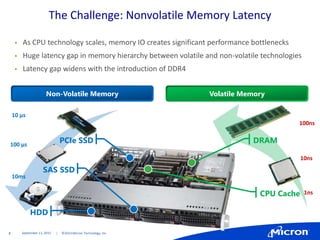
 As CPU technology scales, memory IO creates significant performance bottlenecks
 Huge latency gap in memory hierarchy between volatile and non-volatile technologies
 Latency gap widens with the introduction of DDR4
100ns
10ns
10 µs
100 µs
10ms
1ns
HDD
SAS SSD
PCIe SSD DRAM
CPU Cache
Non-Volatile Memory Volatile Memory
3 | ©2014 Micron Technology, Inc.
Introducing 3D XPoint™
September 11, 2015
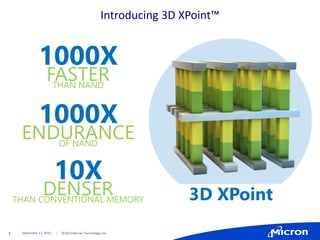
3D XPoint
1000X
FASTERTHAN NAND
1000X
ENDURANCEOF NAND
10X
DENSERTHAN CONVENTIONAL MEMORY
4 | ©2014 Micron Technology, Inc.
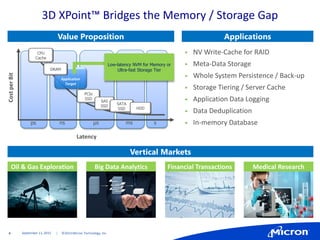
3D XPoint™ Bridges the Memory / Storage Gap
September 11, 2015
Value Proposition Applications
Latency
ps
CostperBit
CPU
Cache
PCIe
SSD
SAS
SSD
SATA
SSD HDD
ns µs ms s
Application
Target
DRAM
Low-latency NVM for Memory or
Ultra-fast Storage Tier
 NV Write-Cache for RAID
 Meta-Data Storage
 Whole System Persistence / Back-up
 Storage Tiering / Server Cache
 Application Data Logging
 Data Deduplication
 In-memory Database
Vertical Markets
Oil & Gas Exploration Medical ResearchBig Data Analytics Financial Transactions
5 | ©2014 Micron Technology, Inc.
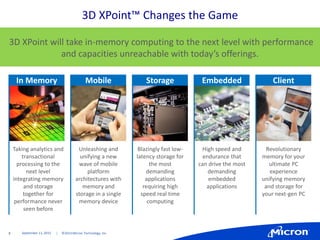
3D XPoint™ Changes the Game
September 11, 2015
3D XPoint will take in-memory computing to the next level with performance
and capacities unreachable with today’s offerings.
In Memory
Taking analytics and
transactional
processing to the
next level
integrating memory
and storage
together for
performance never
seen before
Mobile
Unleashing and
unifying a new
wave of mobile
platform
architectures with
memory and
storage in a single
memory device
Storage
Blazingly fast low-
latency storage for
the most
demanding
applications
requiring high
speed real time
computing
Embedded
High speed and
endurance that
can drive the most
demanding
embedded
applications
Client
Revolutionary
memory for your
ultimate PC
experience
unifying memory
and storage for
your next-gen PC
6 | ©2014 Micron Technology, Inc.September 11, 2015
This new class of non-volatile memory
is a revolutionary technology that allows for
quick access to enormous data sets and
enables entirely new applications.
- Mark Adams, Micron
For decades, the industry has searched for
ways to reduce the time between the
processor and data. This new class of non-
volatile memory achieves this goal and
brings game-changing performance to
memory and storage solutions.
- Rob Crooke, Intel
7 | ©2014 Micron Technology, Inc.
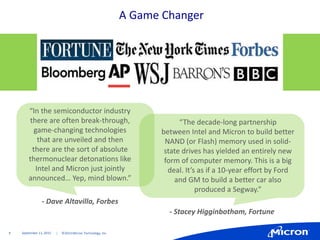
A Game Changer
September 11, 2015
“The decade-long partnership
between Intel and Micron to build better
NAND (or Flash) memory used in solid-
state drives has yielded an entirely new
form of computer memory. This is a big
deal. It’s as if a 10-year effort by Ford
and GM to build a better car also
produced a Segway.”
“In the semiconductor industry
there are often break-through,
game-changing technologies
that are unveiled and then
there are the sort of absolute
thermonuclear detonations like
Intel and Micron just jointly
announced… Yep, mind blown.”
- Dave Altavilla, Forbes
- Stacey Higginbotham, Fortune
8 | ©2014 Micron Technology, Inc.
CPU
The Past: Nonvolatile Memories in Server Architectures
September 11, 2015
PCH
DRAM
DDR
SATA
Lower
R/W
Latency
Higher
Bandwidth
Higher
Endurance
Lower
cost
per bit Disk
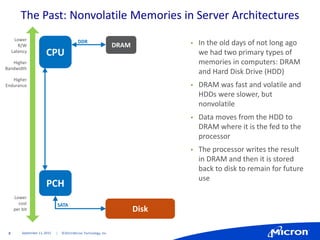
 In the old days of not long ago
we had two primary types of
memories in computers: DRAM
and Hard Disk Drive (HDD)
 DRAM was fast and volatile and
HDDs were slower, but
nonvolatile
 Data moves from the HDD to
DRAM where it is the fed to the
processor
 The processor writes the result
in DRAM and then it is stored
back to disk to remain for future
use
9 | ©2014 Micron Technology, Inc.
The Present: Nonvolatile Memories in Server Architectures
September 11, 2015
CPU
PCH
SATA
SSD
NAND
Flash
NVMe
SSD
NAND
Flash
DRAM
NVDIMM
NAND
Flash
DRAM
DDR
DDR
PCIe
SATA
SATA
Lower
R/W
Latency
Higher
Bandwidth
Higher
Endurance
Lower
cost
per bit Disk
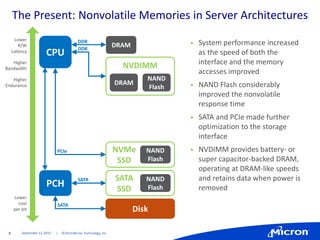
 System performance increased
as the speed of both the
interface and the memory
accesses improved
 NAND Flash considerably
improved the nonvolatile
response time
 SATA and PCIe made further
optimization to the storage
interface
 NVDIMM provides battery- or
super capacitor-backed DRAM,
operating at DRAM-like speeds
and retains data when power is
removed
10 | ©2014 Micron Technology, Inc.
The Future: Nonvolatile Memories in Server Architectures
September 11, 2015
CPU
PCH
SATA
SSD
NAND
Flash
NVMe
SSD
NAND
Flash
DRAM
NVDIMM
NAND
Flash
DRAM
3D XPoint™
DDR
DDR
DDR/PCIe
PCIe
SATA
SATA
Lower
R/W
Latency
Higher
Bandwidth
Higher
Endurance
Lower
cost
per bit Disk
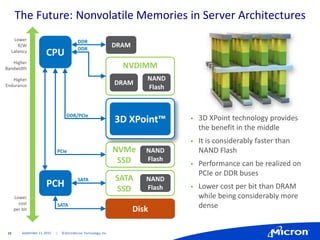
 3D XPoint technology provides
the benefit in the middle
 It is considerably faster than
NAND Flash
 Performance can be realized on
PCIe or DDR buses
 Lower cost per bit than DRAM
while being considerably more
dense
Intel, Micron unveil “breakthrough” 3D XPoint Memory Tech – A revolutionary breakthrough in Memory Technology

Intel, Micron unveil “breakthrough” 3D XPoint Memory Tech – A revolutionary breakthrough in Memory Technology

  • 1.
    Realizing the Future:3D XPoint™ August 2015 ©2015 Micron Technology, Inc. All rights reserved. Products are warranted only to meet Micron’s production data sheet specifications. Information, products, and/or specifications are subject to change without notice. All information is provided on an “AS IS” basis without warranties of any kind. Dates are estimates only. Drawings are not to scale. Micron and the Micron logo are trademarks of Micron Technology, Inc. All other trademarks are the property of their respective owners. 1 | ©2015 Micron Technology, Inc.September 11, 2015
  • 2.
    2 | ©2014Micron Technology, Inc. The Challenge: Nonvolatile Memory Latency September 11, 2015  As CPU technology scales, memory IO creates significant performance bottlenecks  Huge latency gap in memory hierarchy between volatile and non-volatile technologies  Latency gap widens with the introduction of DDR4 100ns 10ns 10 µs 100 µs 10ms 1ns HDD SAS SSD PCIe SSD DRAM CPU Cache Non-Volatile Memory Volatile Memory
  • 3.
    3 | ©2014Micron Technology, Inc. Introducing 3D XPoint™ September 11, 2015 3D XPoint 1000X FASTERTHAN NAND 1000X ENDURANCEOF NAND 10X DENSERTHAN CONVENTIONAL MEMORY
  • 4.
    4 | ©2014Micron Technology, Inc. 3D XPoint™ Bridges the Memory / Storage Gap September 11, 2015 Value Proposition Applications Latency ps CostperBit CPU Cache PCIe SSD SAS SSD SATA SSD HDD ns µs ms s Application Target DRAM Low-latency NVM for Memory or Ultra-fast Storage Tier  NV Write-Cache for RAID  Meta-Data Storage  Whole System Persistence / Back-up  Storage Tiering / Server Cache  Application Data Logging  Data Deduplication  In-memory Database Vertical Markets Oil & Gas Exploration Medical ResearchBig Data Analytics Financial Transactions
  • 5.
    5 | ©2014Micron Technology, Inc. 3D XPoint™ Changes the Game September 11, 2015 3D XPoint will take in-memory computing to the next level with performance and capacities unreachable with today’s offerings. In Memory Taking analytics and transactional processing to the next level integrating memory and storage together for performance never seen before Mobile Unleashing and unifying a new wave of mobile platform architectures with memory and storage in a single memory device Storage Blazingly fast low- latency storage for the most demanding applications requiring high speed real time computing Embedded High speed and endurance that can drive the most demanding embedded applications Client Revolutionary memory for your ultimate PC experience unifying memory and storage for your next-gen PC
  • 6.
    6 | ©2014Micron Technology, Inc.September 11, 2015 This new class of non-volatile memory is a revolutionary technology that allows for quick access to enormous data sets and enables entirely new applications. - Mark Adams, Micron For decades, the industry has searched for ways to reduce the time between the processor and data. This new class of non- volatile memory achieves this goal and brings game-changing performance to memory and storage solutions. - Rob Crooke, Intel
  • 7.
    7 | ©2014Micron Technology, Inc. A Game Changer September 11, 2015 “The decade-long partnership between Intel and Micron to build better NAND (or Flash) memory used in solid- state drives has yielded an entirely new form of computer memory. This is a big deal. It’s as if a 10-year effort by Ford and GM to build a better car also produced a Segway.” “In the semiconductor industry there are often break-through, game-changing technologies that are unveiled and then there are the sort of absolute thermonuclear detonations like Intel and Micron just jointly announced… Yep, mind blown.” - Dave Altavilla, Forbes - Stacey Higginbotham, Fortune
  • 8.
    8 | ©2014Micron Technology, Inc. CPU The Past: Nonvolatile Memories in Server Architectures September 11, 2015 PCH DRAM DDR SATA Lower R/W Latency Higher Bandwidth Higher Endurance Lower cost per bit Disk  In the old days of not long ago we had two primary types of memories in computers: DRAM and Hard Disk Drive (HDD)  DRAM was fast and volatile and HDDs were slower, but nonvolatile  Data moves from the HDD to DRAM where it is the fed to the processor  The processor writes the result in DRAM and then it is stored back to disk to remain for future use
  • 9.
    9 | ©2014Micron Technology, Inc. The Present: Nonvolatile Memories in Server Architectures September 11, 2015 CPU PCH SATA SSD NAND Flash NVMe SSD NAND Flash DRAM NVDIMM NAND Flash DRAM DDR DDR PCIe SATA SATA Lower R/W Latency Higher Bandwidth Higher Endurance Lower cost per bit Disk  System performance increased as the speed of both the interface and the memory accesses improved  NAND Flash considerably improved the nonvolatile response time  SATA and PCIe made further optimization to the storage interface  NVDIMM provides battery- or super capacitor-backed DRAM, operating at DRAM-like speeds and retains data when power is removed
  • 10.
    10 | ©2014Micron Technology, Inc. The Future: Nonvolatile Memories in Server Architectures September 11, 2015 CPU PCH SATA SSD NAND Flash NVMe SSD NAND Flash DRAM NVDIMM NAND Flash DRAM 3D XPoint™ DDR DDR DDR/PCIe PCIe SATA SATA Lower R/W Latency Higher Bandwidth Higher Endurance Lower cost per bit Disk  3D XPoint technology provides the benefit in the middle  It is considerably faster than NAND Flash  Performance can be realized on PCIe or DDR buses  Lower cost per bit than DRAM while being considerably more dense

Editor's Notes

  • #4 Message: Intel/Micron invented a breakthrough in memory technology that is 1000x faster and 1000x greater endurance than NAND and 10x denser than DRAM. This puts Micron in a position to help our customers drive innovative new computing architectures.
  • #5 New storage-class memory technology between DRAM and NAND Can close the gap between the processor and storage—a major challenge in modern computing Not a replacement for DRAM or NAND – but will empower use cases that require more of each Non-volatile, but with high endurance and very high performance Tradeoffs: DRAM – less expensive and non-volatile, but with less endurance and higher latency NAND – faster performance with lower latency and higher endurance, but more expensive
  • #6 o   3D XPoint will take in-memory computing to the next level with performance and capacities unreachable with today’s offerings. o   Envision mobile devices that can use 3D XPoint technology for both memory and storage in a single device o   3D XPoint’s speed and endurance makes it capable of driving the most demanding internet-of-things (IOT) devices like automobiles, wearables and the like. 3D XPoint will power the fastest and most reliable high-end storage that the world has ever seen. Intel will provide the first system level products to the market   Micron will focus on ecosystem enabling     
  • #10 We realized that system performance was increased considerably as we improved the speed of both the interface and the memory accesses. NAND Flash considerably improved the nonvolatile response time and we made further optimizations to the storage interface with SATA and an improved command set, like TRIM. PCIe was next to be optimized – and this transition is currently underway. PCIe is faster than SATA and NVMe considerably reduced the storage protocol overhead. We’ve also looked at optimizations for nonvolatile memory from the DRAM side as well. NVDIMM provides battery- or super capacitor-backed DRAM. This operates at DRAM-like speeds and retains the data when power is removed.
  • #11 3D XPoint™ technology provides the benefit in the middle. It is considerably faster than NAND Flash. Its performance can be realized on PCIe or DDR buses. It also provides a solution that has a lower cost per bit than DRAM while being considerably more dense.