Storage Class Memory
Presented by Charith Suriyakula (168269B)
Content
 Introduction of Storage Class Memory (SCM)
 Key features of SCM
 Candidate device technologies
 Comparison
 Concerns
 Future of SCM
 Conclusion
Introduction
 Storage
 Memory
 Hard disk
 External devices (CD, DVD, USB drive, etc.)
 Memory is typically with high performance and low capacity
 HDD is typically high capacity, affordable but low performance
What is Storage Class Memory (SCM)
 It is a non-volatile storage medium
 It has capacity and economics similar to HDD / SSD and with performance that’s similar
to memory / RAM
How SCM works
 How SCM works
 SCM is created out of flash-based
NAND
 To build a SCM, combine scalable
non-volatile memory with ultra high
density integration
 Using micro to nano addressing
 Using multi-level cells
 Using 3D stacking
Key features
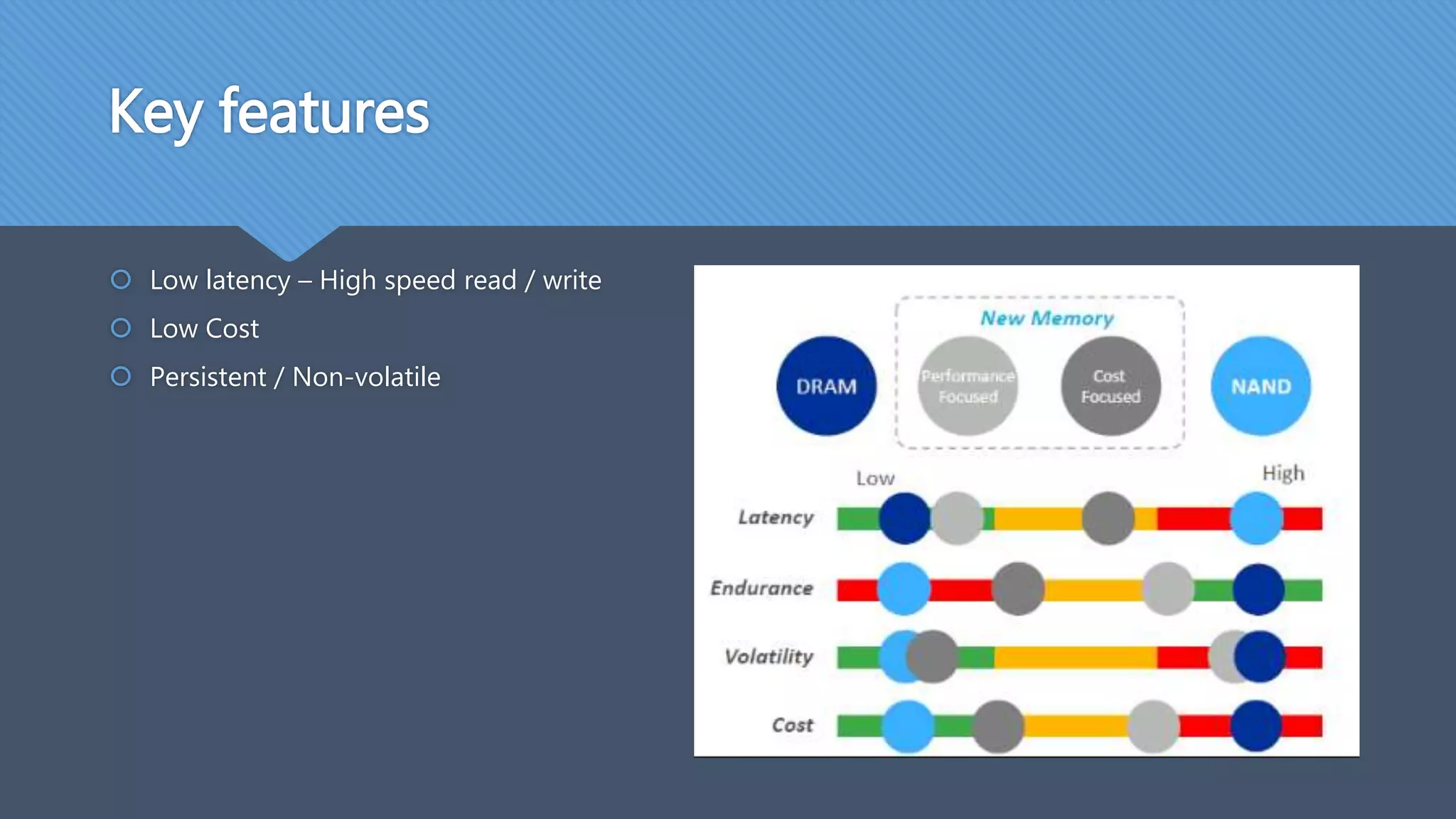
 Low latency – High speed read / write
 Low Cost
 Persistent / Non-volatile
Key features
 SCM is based on several key technologies
 Direct Access Storage (DAS)
 Byte Accessible Storage (BAS)
 Persistent Memory (PM)
 Non-Volatile Memory (NVM)
 New driver model
 SCM Bus driver
 SCM Bus driver enumerates the physical and logical SCM devices in the system
 SCM Disk driver
 This acts as a storage abstraction layer to the rest of the OS
Candidate device technologies
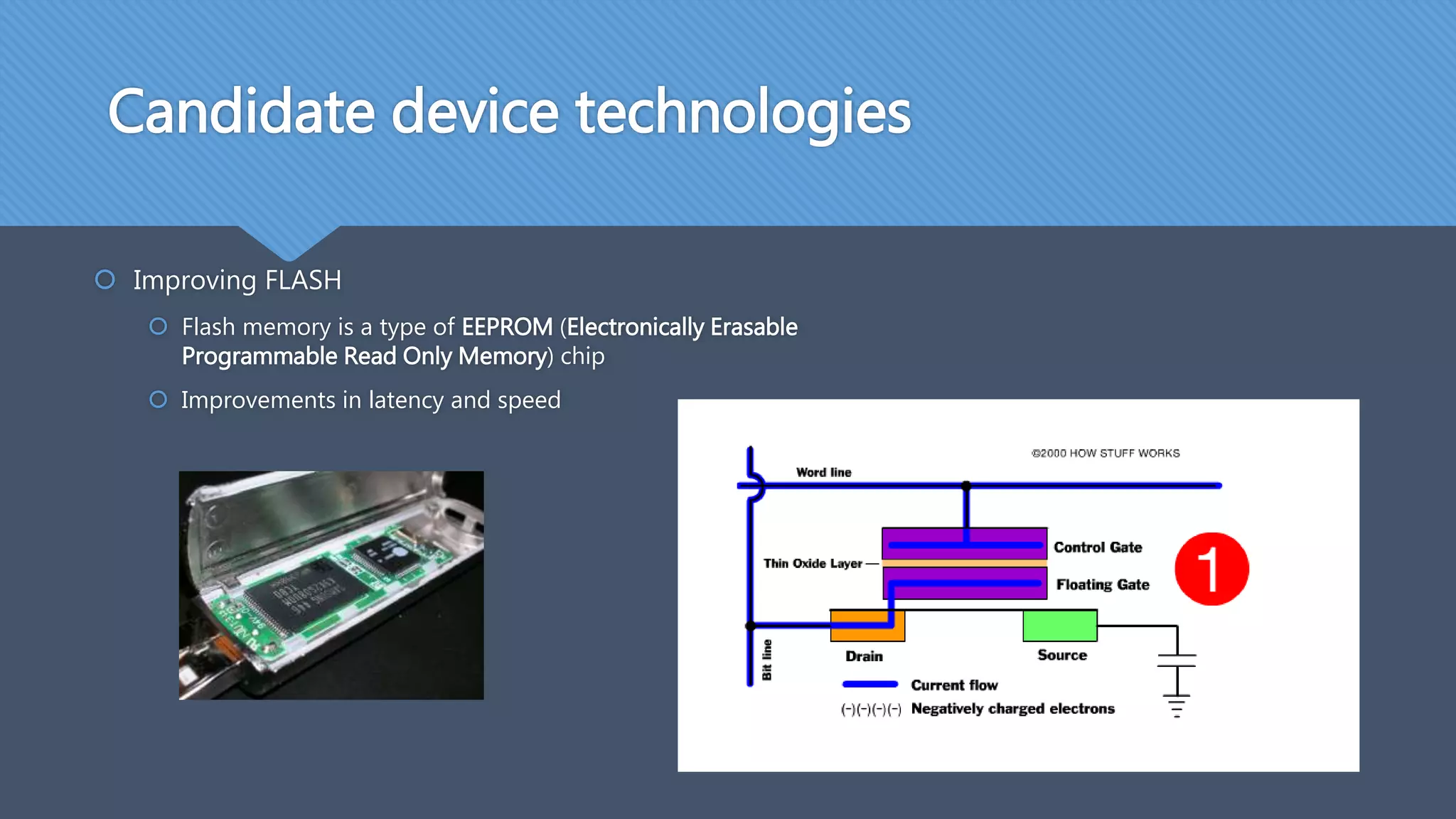
 Improving FLASH
 Flash memory is a type of EEPROM (Electronically Erasable
Programmable Read Only Memory) chip
 Improvements in latency and speed
Candidate device technologies
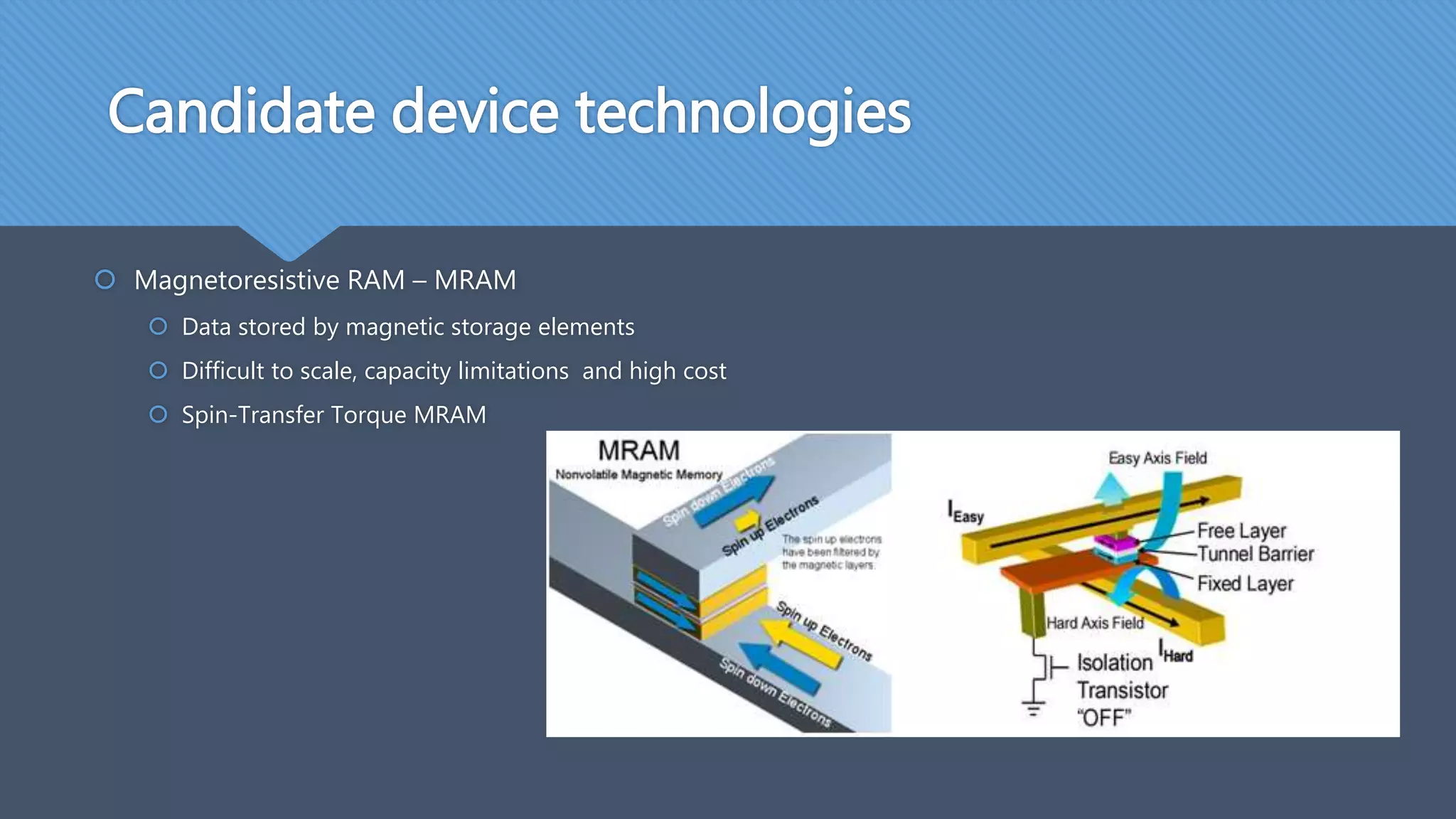
 Magnetoresistive RAM – MRAM
 Data stored by magnetic storage elements
 Difficult to scale, capacity limitations and high cost
 Spin-Transfer Torque MRAM
Candidate device technologies
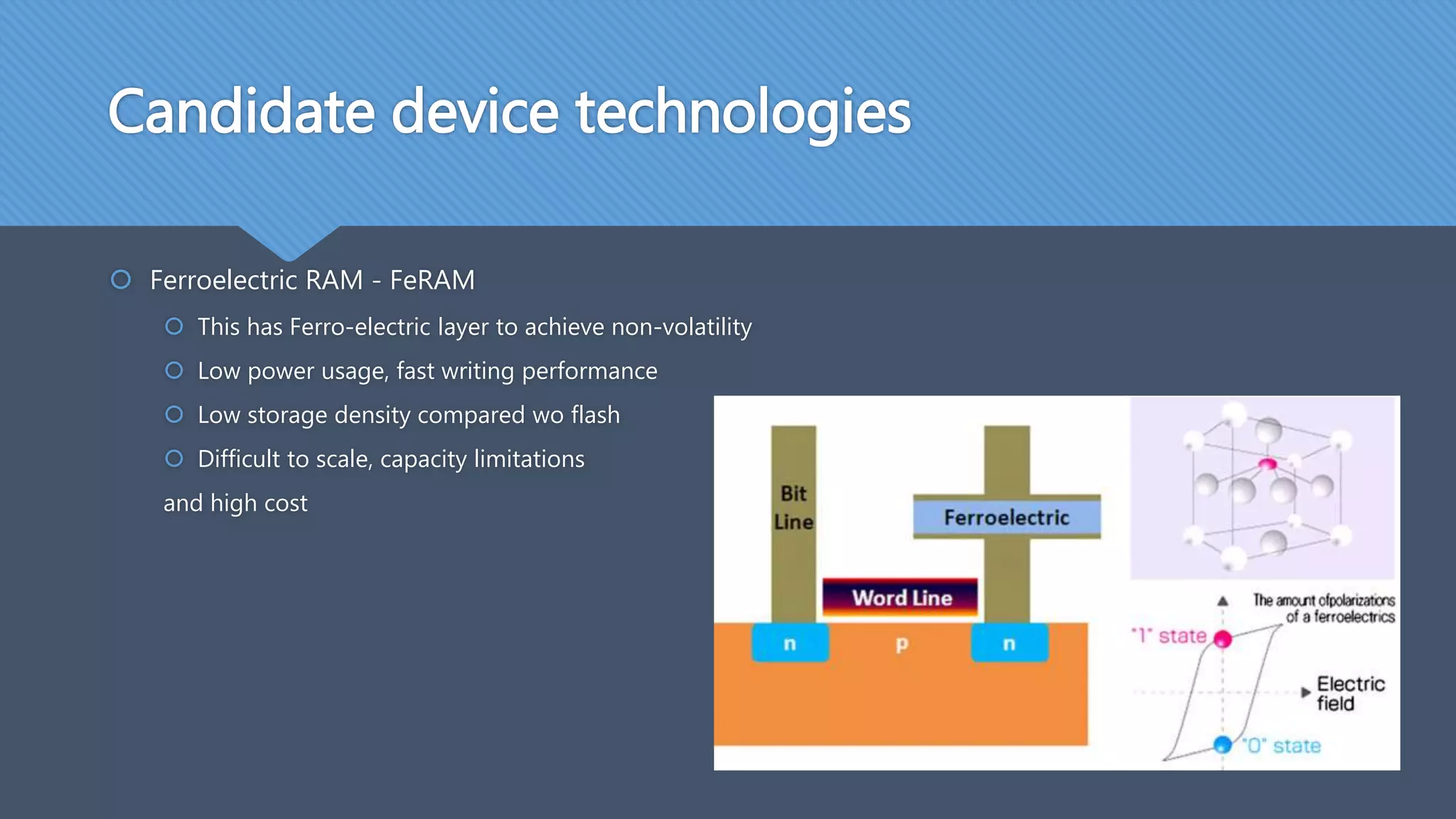
 Ferroelectric RAM - FeRAM
 This has Ferro-electric layer to achieve non-volatility
 Low power usage, fast writing performance
 Low storage density compared wo flash
 Difficult to scale, capacity limitations
and high cost
Candidate device technologies
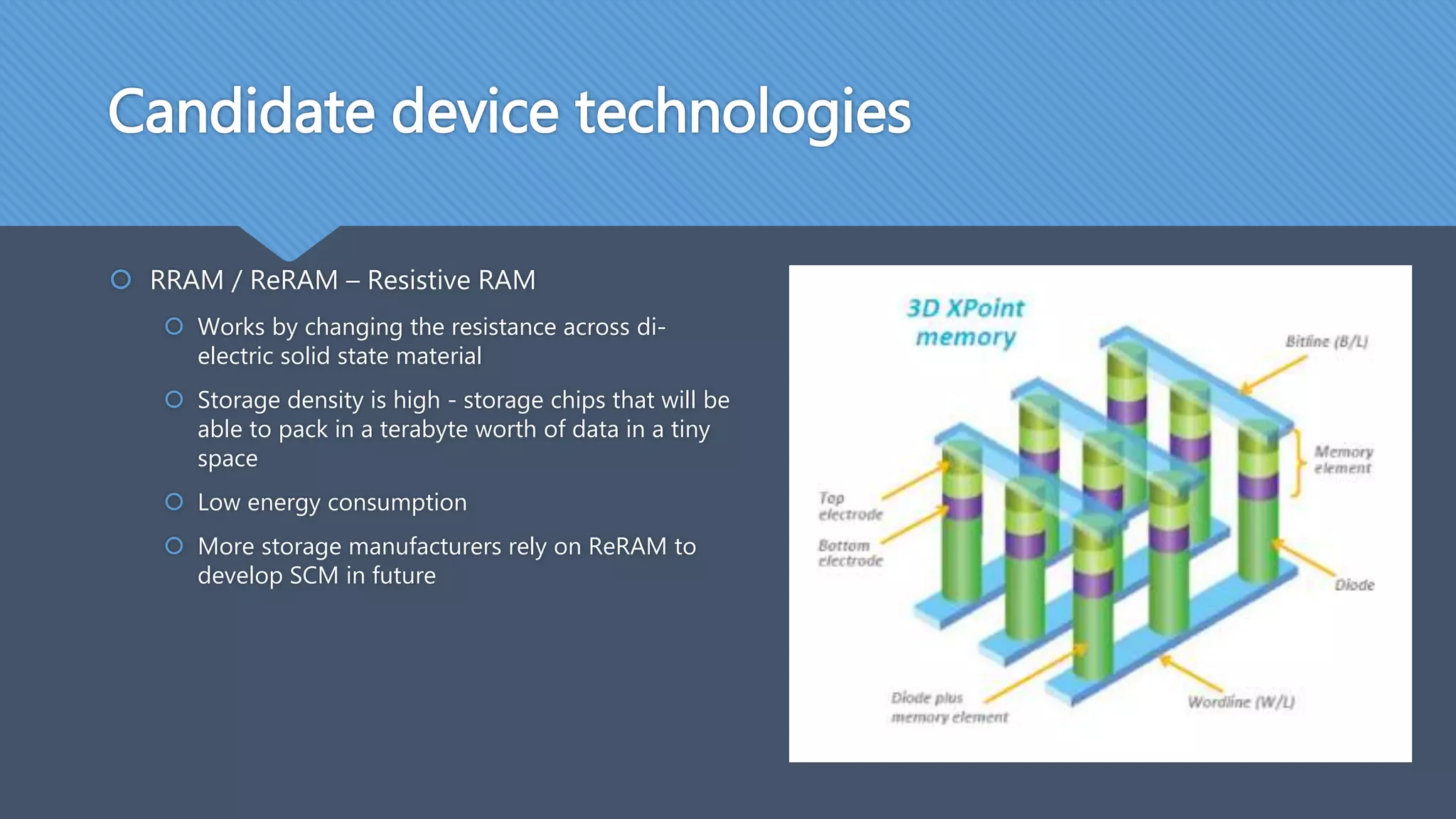
 RRAM / ReRAM – Resistive RAM
 Works by changing the resistance across di-
electric solid state material
 Storage density is high - storage chips that will be
able to pack in a terabyte worth of data in a tiny
space
 Low energy consumption
 More storage manufacturers rely on ReRAM to
develop SCM in future
Candidate device technologies
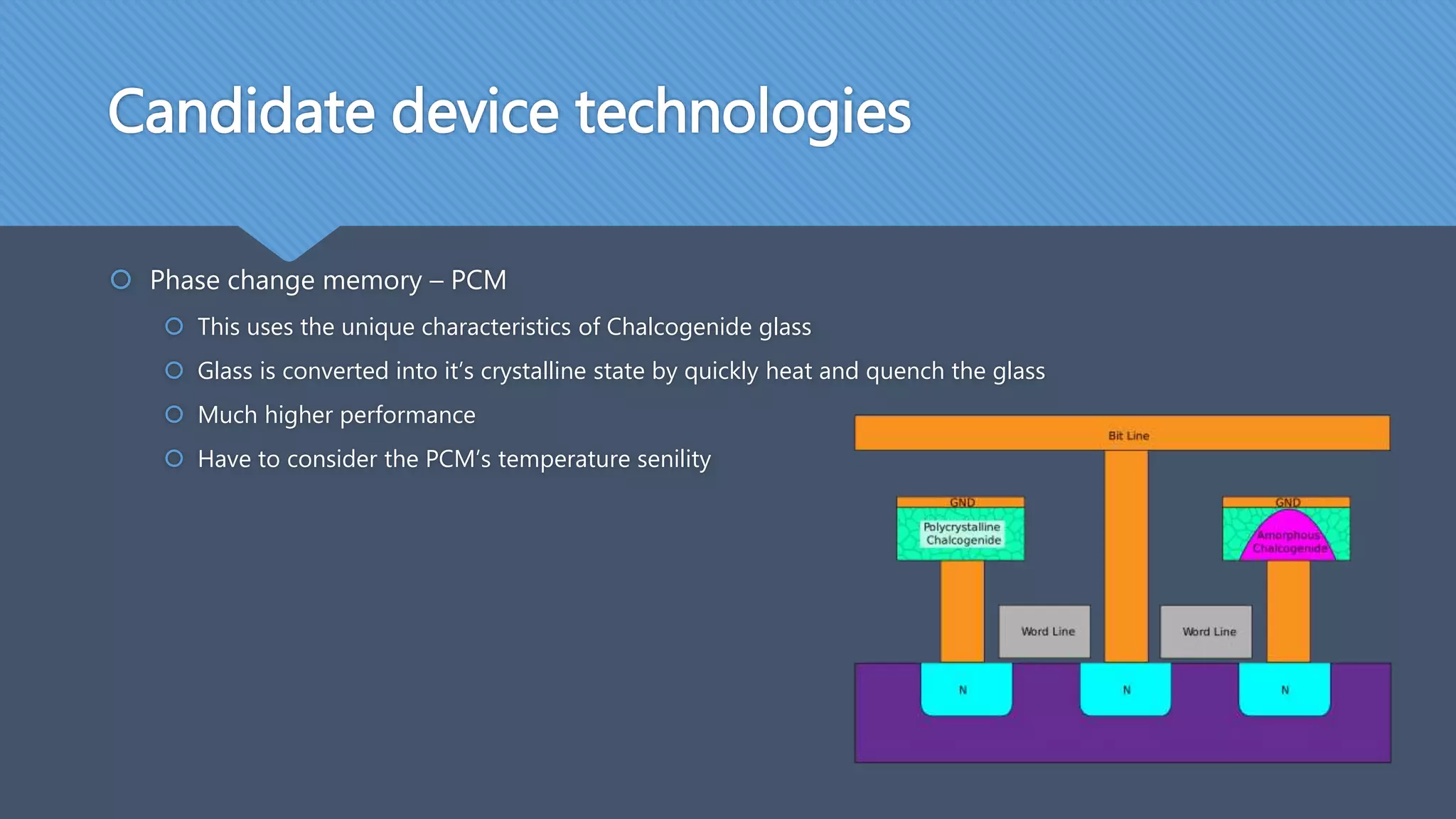
 Phase change memory – PCM
 This uses the unique characteristics of Chalcogenide glass
 Glass is converted into it’s crystalline state by quickly heat and quench the glass
 Much higher performance
 Have to consider the PCM’s temperature senility
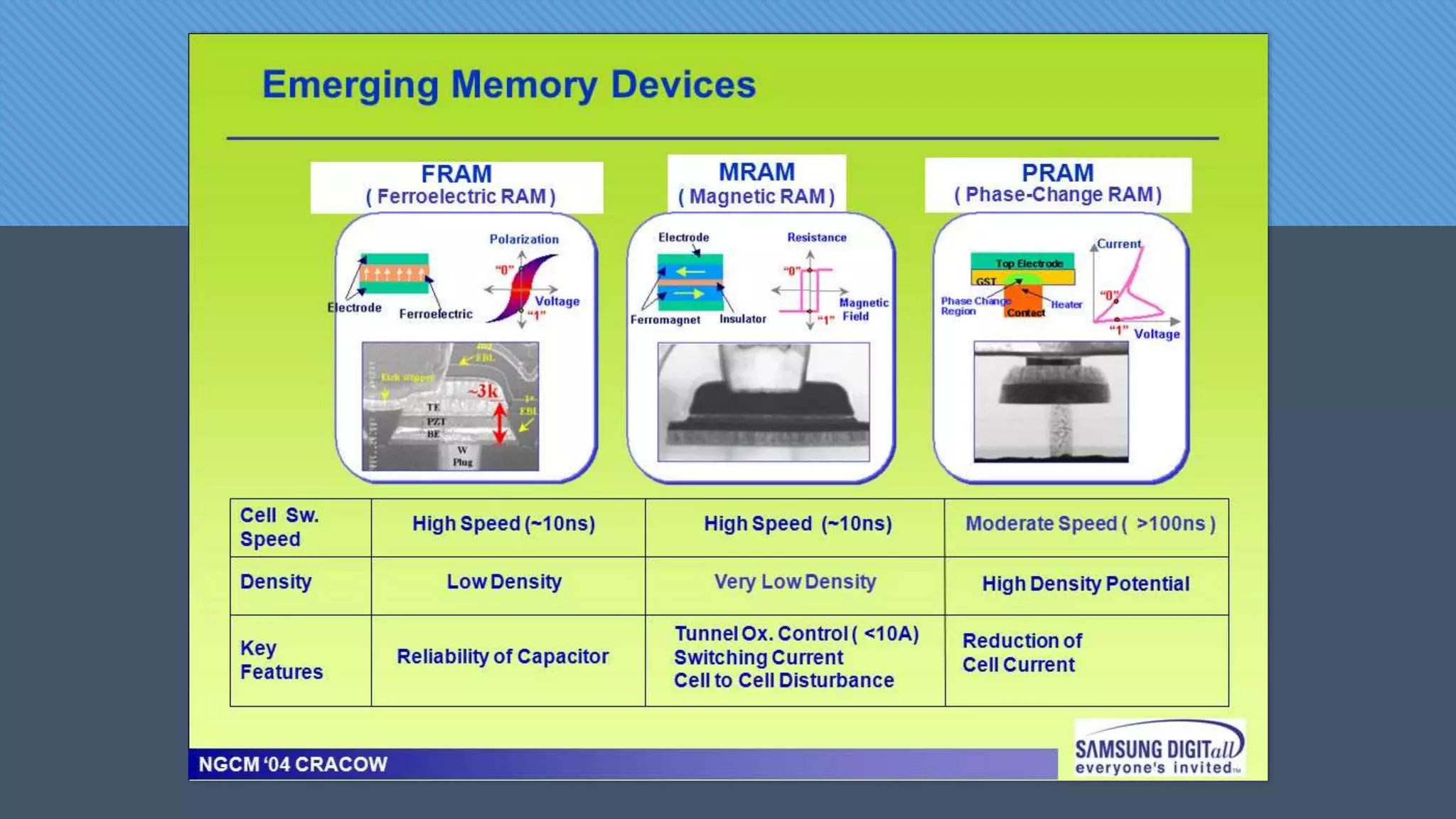
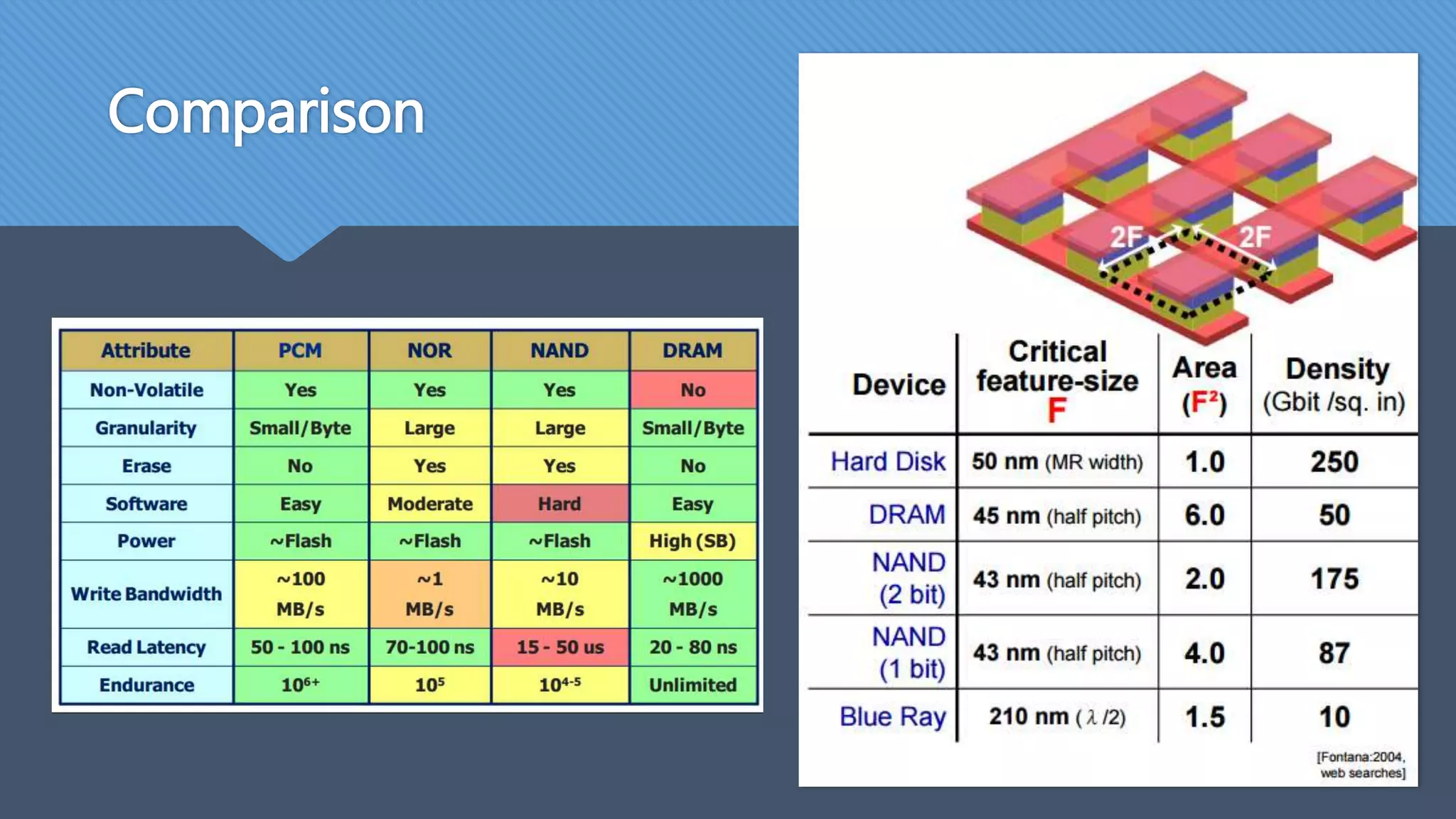
Comparison
Concerns
 Existing interface may not support the new developments in SCM – vendors have to adapt to the
technology
 Traditional storage protocols (SATA / SAS) may be bottleneck to achieve the full performance from
SCM modules
 File system compatibility issues
 Garbage collection will perform only in the flash that it is assigned to, resulting of unused flash cells
inaccessible for other controllers
 Multi-controller environment requires multi-threaded applications
 Flash management intelligence require additional changes in PCIe board as well as flash drivers
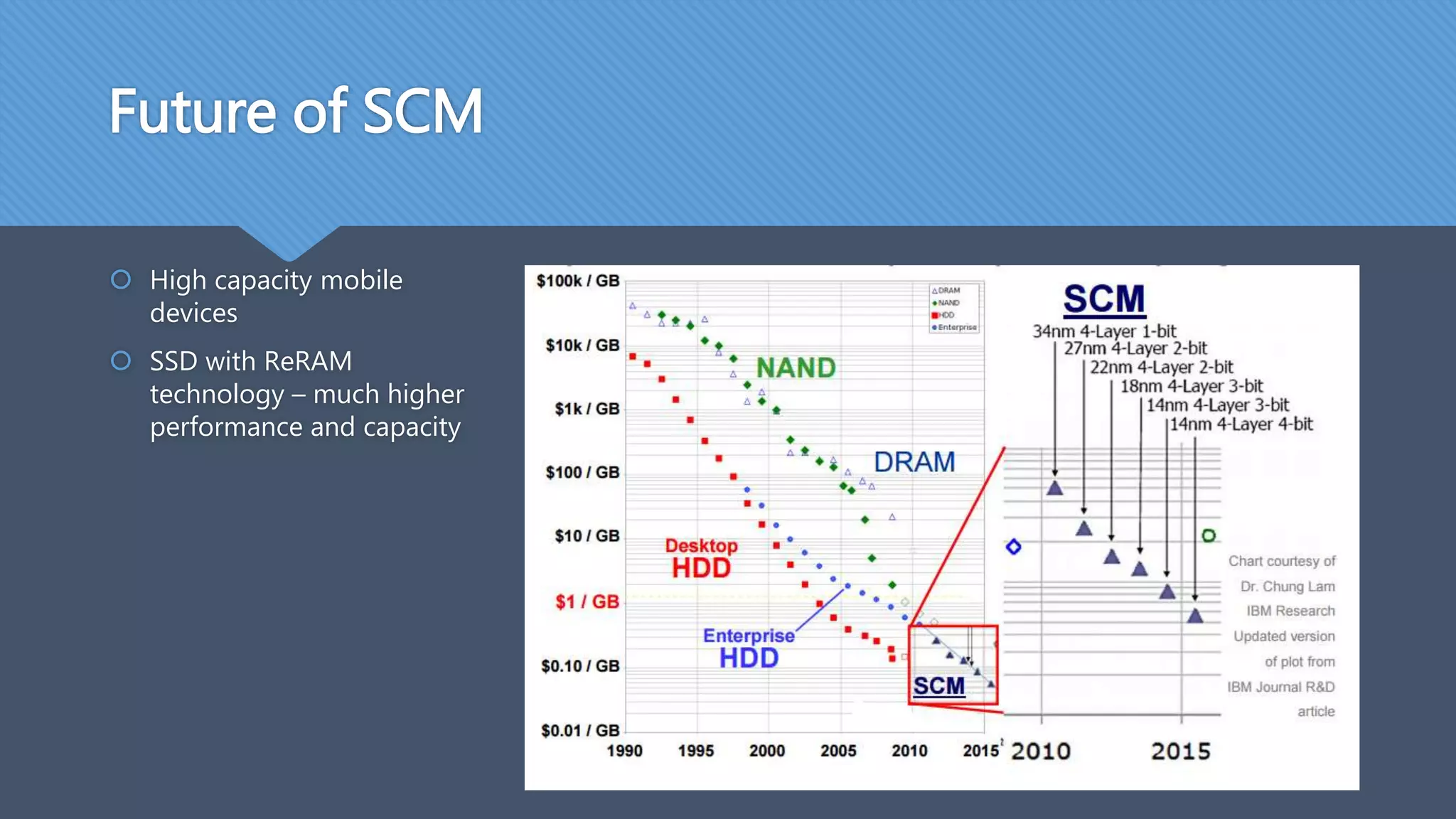
Future of SCM
 High capacity mobile
devices
 SSD with ReRAM
technology – much higher
performance and capacity
Conclusion
 To meet the increasing demand in servers, power and space will be a key consideration
 To support that, HDD and Storage Flash will no suffice
 SCM provides
 High performance and robustness of a Solid State Memory
 Capacity and economical aspects of HDD
References
1. George Crump, What Is Storage Class Memory?, http://www.storage-
switzerland.com/Articles/Entries/2011/12/13_What_Is_Storage_Class_Memory.html
2. Scott Davis, The next generation of storage disruption: storage-class memory,
http://www.networkworld.com/article/3026720/storage/the-next-generation-of-storage-disruption-storage-class-
memory.html
3. Geoffrey W. Burr, Storage Class Memory, IBM Research April 12,2010
4. Robin Harris, The non-volatile memory revolution: Bigger than SSDs, http://www.zdnet.com/article/the-non-volatile-
memory-revolution/
5. Neal Christiansen, Storage Class Memory support in Windows OS, Storage Developer Conference 2015
6. G. W. Burr, et al, Overview of candidate device technologies for storage-class memory (2008), IBM Journal of Research
and Development
7. Janusz J Nowak, et al, Dependence of Voltage and Size on Write Error Rates in Spin-Transfer Torque Magnetic
Random-Access Memory, IEEE Magnetics Letters (Volume:7 )

Storage class memory

  • 1.
    Storage Class Memory Presentedby Charith Suriyakula (168269B)
  • 2.
    Content  Introduction ofStorage Class Memory (SCM)  Key features of SCM  Candidate device technologies  Comparison  Concerns  Future of SCM  Conclusion
  • 3.
    Introduction  Storage  Memory Hard disk  External devices (CD, DVD, USB drive, etc.)  Memory is typically with high performance and low capacity  HDD is typically high capacity, affordable but low performance
  • 4.
    What is StorageClass Memory (SCM)  It is a non-volatile storage medium  It has capacity and economics similar to HDD / SSD and with performance that’s similar to memory / RAM
  • 5.
    How SCM works How SCM works  SCM is created out of flash-based NAND  To build a SCM, combine scalable non-volatile memory with ultra high density integration  Using micro to nano addressing  Using multi-level cells  Using 3D stacking
  • 9.
    Key features  Lowlatency – High speed read / write  Low Cost  Persistent / Non-volatile
  • 10.
    Key features  SCMis based on several key technologies  Direct Access Storage (DAS)  Byte Accessible Storage (BAS)  Persistent Memory (PM)  Non-Volatile Memory (NVM)  New driver model  SCM Bus driver  SCM Bus driver enumerates the physical and logical SCM devices in the system  SCM Disk driver  This acts as a storage abstraction layer to the rest of the OS
  • 11.
    Candidate device technologies Improving FLASH  Flash memory is a type of EEPROM (Electronically Erasable Programmable Read Only Memory) chip  Improvements in latency and speed
  • 12.
    Candidate device technologies Magnetoresistive RAM – MRAM  Data stored by magnetic storage elements  Difficult to scale, capacity limitations and high cost  Spin-Transfer Torque MRAM
  • 13.
    Candidate device technologies Ferroelectric RAM - FeRAM  This has Ferro-electric layer to achieve non-volatility  Low power usage, fast writing performance  Low storage density compared wo flash  Difficult to scale, capacity limitations and high cost
  • 14.
    Candidate device technologies RRAM / ReRAM – Resistive RAM  Works by changing the resistance across di- electric solid state material  Storage density is high - storage chips that will be able to pack in a terabyte worth of data in a tiny space  Low energy consumption  More storage manufacturers rely on ReRAM to develop SCM in future
  • 15.
    Candidate device technologies Phase change memory – PCM  This uses the unique characteristics of Chalcogenide glass  Glass is converted into it’s crystalline state by quickly heat and quench the glass  Much higher performance  Have to consider the PCM’s temperature senility
  • 17.
  • 18.
    Concerns  Existing interfacemay not support the new developments in SCM – vendors have to adapt to the technology  Traditional storage protocols (SATA / SAS) may be bottleneck to achieve the full performance from SCM modules  File system compatibility issues  Garbage collection will perform only in the flash that it is assigned to, resulting of unused flash cells inaccessible for other controllers  Multi-controller environment requires multi-threaded applications  Flash management intelligence require additional changes in PCIe board as well as flash drivers
  • 19.
    Future of SCM High capacity mobile devices  SSD with ReRAM technology – much higher performance and capacity
  • 20.
    Conclusion  To meetthe increasing demand in servers, power and space will be a key consideration  To support that, HDD and Storage Flash will no suffice  SCM provides  High performance and robustness of a Solid State Memory  Capacity and economical aspects of HDD
  • 21.
    References 1. George Crump,What Is Storage Class Memory?, http://www.storage- switzerland.com/Articles/Entries/2011/12/13_What_Is_Storage_Class_Memory.html 2. Scott Davis, The next generation of storage disruption: storage-class memory, http://www.networkworld.com/article/3026720/storage/the-next-generation-of-storage-disruption-storage-class- memory.html 3. Geoffrey W. Burr, Storage Class Memory, IBM Research April 12,2010 4. Robin Harris, The non-volatile memory revolution: Bigger than SSDs, http://www.zdnet.com/article/the-non-volatile- memory-revolution/ 5. Neal Christiansen, Storage Class Memory support in Windows OS, Storage Developer Conference 2015 6. G. W. Burr, et al, Overview of candidate device technologies for storage-class memory (2008), IBM Journal of Research and Development 7. Janusz J Nowak, et al, Dependence of Voltage and Size on Write Error Rates in Spin-Transfer Torque Magnetic Random-Access Memory, IEEE Magnetics Letters (Volume:7 )

Editor's Notes

  • #4 Storage is place where the information is stored. In a typical computer system, basically there are have three types of storage mechanisms. Memory or RAM, Hard disks or SSD and External storage devices. For an example, a server uses memory to store information that it will need immediate access to. It uses storage, on the other hand, to store information that it’s currently acting on, but doesn’t need at that specific moment in time.
  • #11 SCM Bus driver enumerates the physical and logical SCM devices in the system SCM Disk driver is for logical SCM devices – This acts as a storage abstraction layer to the rest of the OS
  • #12 Memory cells are etched onto a silicon wafer in an array of columns (bitlines) and rows (wordlines). The intersection of a bitline and wordline constitutes the address of the memory cell Identifying each row and column (row address select and column address select) Keeping track of the refresh sequence (counter) Reading and restoring the signal from a cell (sense amplifier) Telling a cell whether it should take a charge or not (write enable) FLASH has a grid of columns and rows with a cell that has two transistors at each intersection. The two transistors are separated from each other by a thin oxide layer. One of the transistors is known as afloating gate, and the other one is the control gate. The floating gate's only link to the row, or wordline, is through the control gate. 
  • #13 IBM and Samsung collaborated to develop next-generation magnetoresistive RAM (MRAM) using spin-transfer torque (STT) technology, which would lead to low-capacity memory chips for Internet of Things sensors, wearables and mobile devices that currently use NAND flash to store data. It can easily replace embedded flash, since MRAM is easier to embed, is faster and has unlimited reads and writes. MRAM doesn't wear out because spin torque technology uses a tiny current to switch a bit from a zero to a one and vice versa. Data is stored as a magnetic state versus an electronic charge, providing a non-volatile memory bit that doesn't suffer wear-out or data-retention issues associated with NAND flash technology. Unlike NAND flash, spin-torque MRAM technology transistors don't need to be erased first before being rewritten with new data, which also greatly simplifies chip design and reduces overhead.
  • #14 FeRAM or Ferroelectric Random Access Memory uses a ferroelectric capacitor architecture that employs ferroelectric materials as storage elements. These materials have an intrinsic electric dipole switched into opposite polarities with an external electric field. Switching the ferroelectric polarization states requires the movement of the dipole located within an oxygen octahedron in response to an electric field. This movement can be impeded by a free electric charge or other ionic defects built-up over time and temperature.
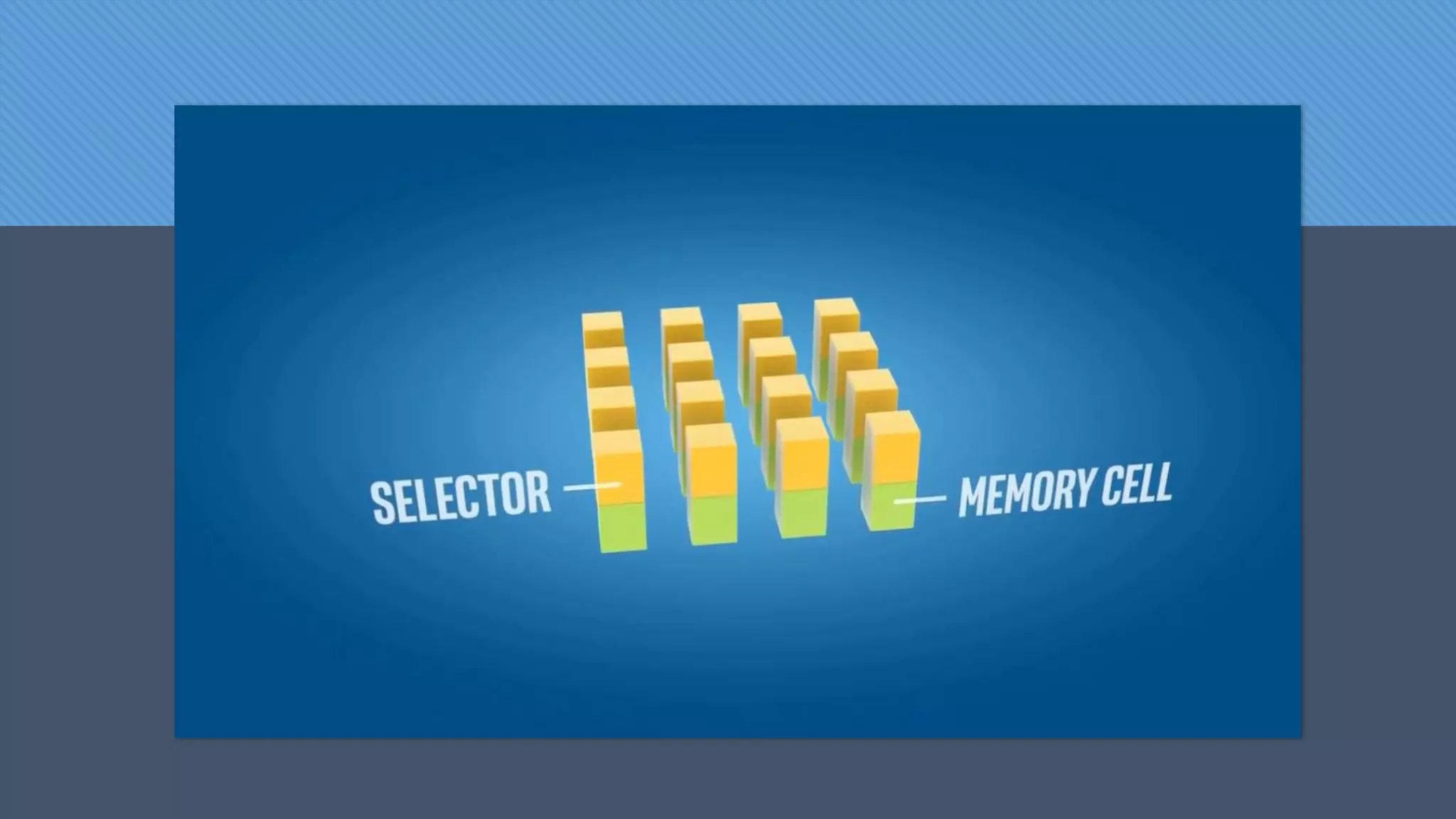
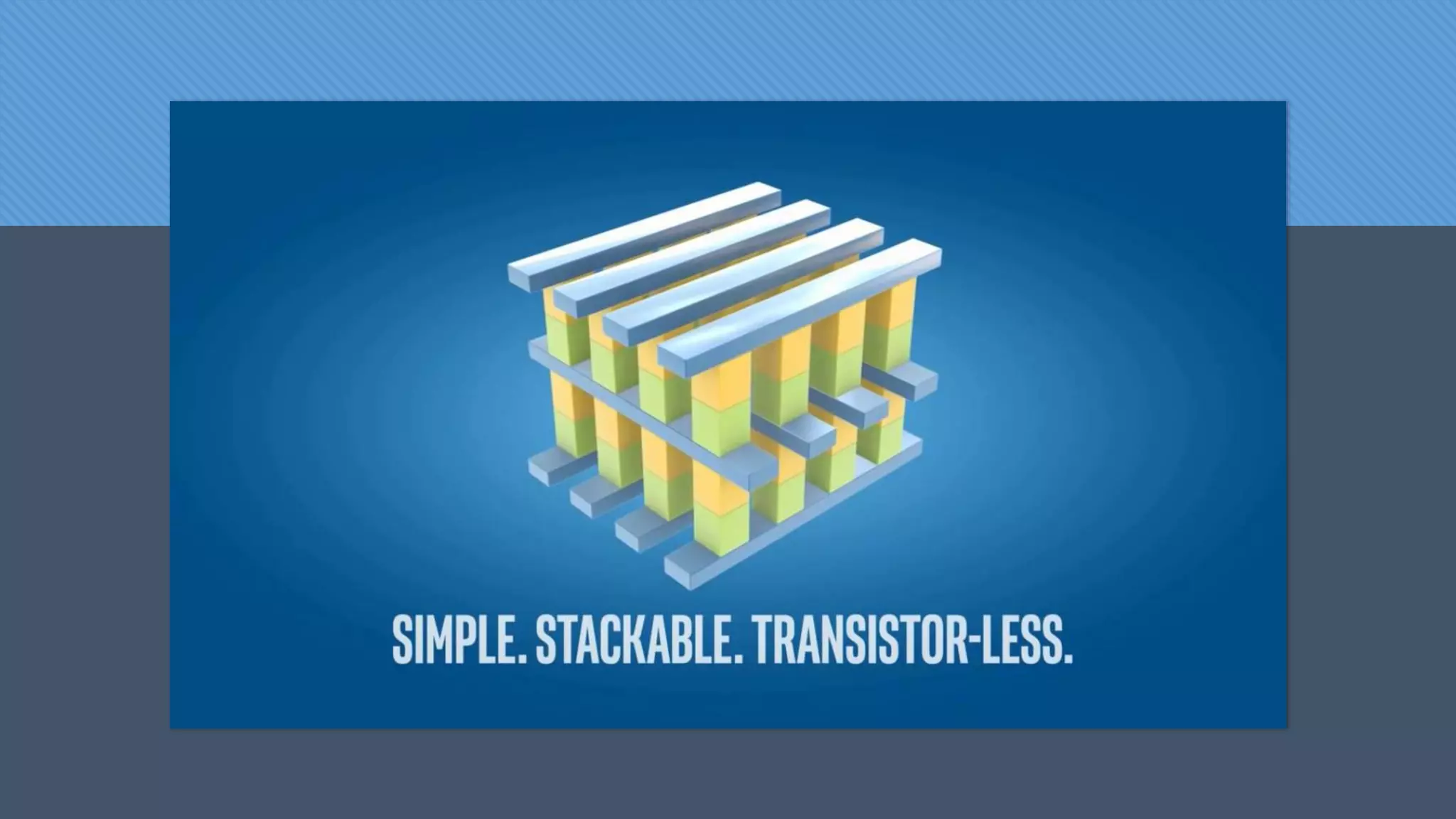
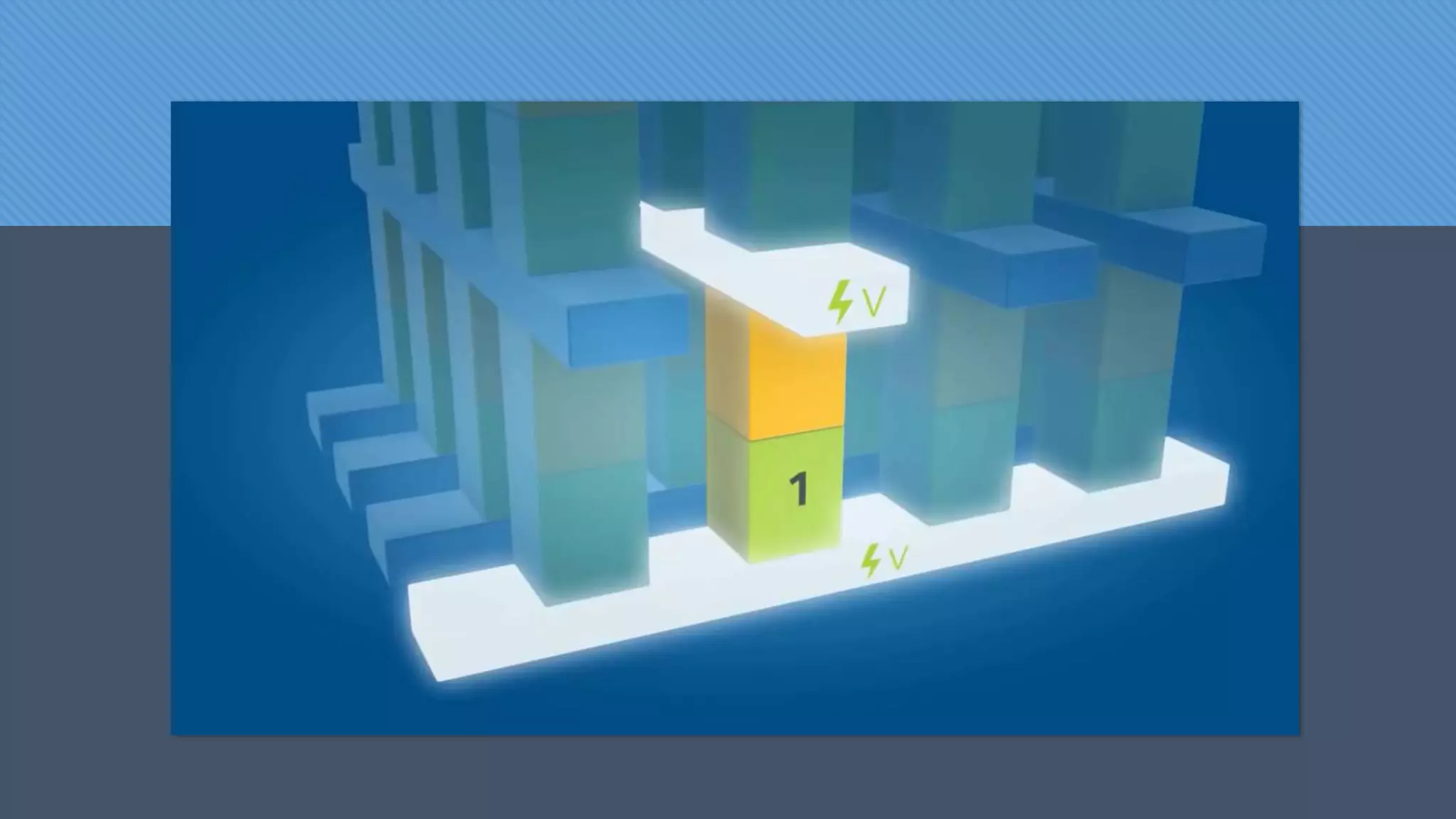
  • #15 ReRAM stores data using ions (charged atoms) as changes in electrical resistance, rather than electrons. A depiction of Intel's and Micron's 3D XPoint (also known as Optane) chip resistive RAM architecture. It removes the need for bit-storing transistors and instead uses a latticework of wires that use electrical resistance to signify a 1 or a 0.
  • #16 3D XPoint and startup named Crossbar uses ReRAM technology – 3D stacking helps to save space
  • #19 SAS - Serial Attached SCSI SATA – Serial AT Attachment Because each controller only has a flash it’s been assigned, other flash on the board isn’t available to replace the bad cells that accumulate over time. Eventually this may leave one controller with an inadequate amount of flash memory while other controllers have plenty of cells.