Atomic Theory


 Atoms are building blocks of elements
 Similar atoms in each element
 Different from atoms of other elements
 Two or more different atoms bond in simple ratios to
  form compounds

                     LecturePLUS Timberlake       1
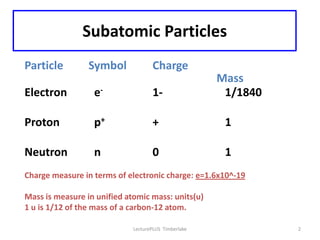
Subatomic Particles
Particle         Symbol             Charge
                                                      Mass
Electron          e-                1-                 1/1840

Proton            p+                +                  1

Neutron           n                 0                  1
Charge measure in terms of electronic charge: e=1.6x10^-19

Mass is measure in unified atomic mass: units(u)
1 u is 1/12 of the mass of a carbon-12 atom.

                             LecturePLUS Timberlake             2
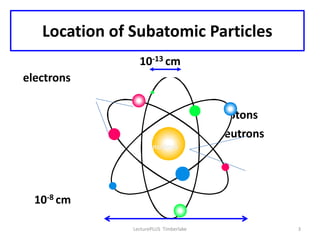
Location of Subatomic Particles
                 10-13 cm
electrons

                                        protons
                                        neutrons
                      nucleus


  10-8 cm

               LecturePLUS Timberlake              3
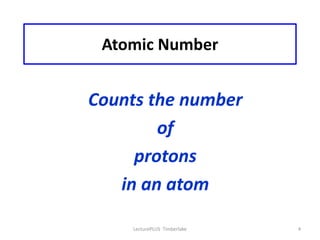
Atomic Number


Counts the number
        of
     protons
   in an atom

    LecturePLUS Timberlake   4
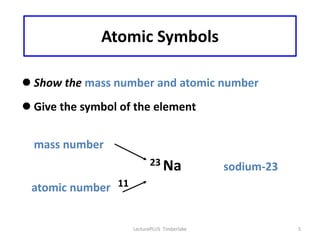
Atomic Symbols

 Show the mass number and atomic number
 Give the symbol of the element


  mass number
                          23 Na              sodium-23
 atomic number 11


                    LecturePLUS Timberlake               5
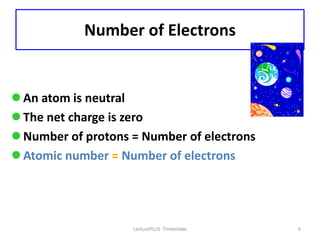
Number of Electrons


 An atom is neutral
 The net charge is zero
 Number of protons = Number of electrons
 Atomic number = Number of electrons


                    LecturePLUS Timberlake   6
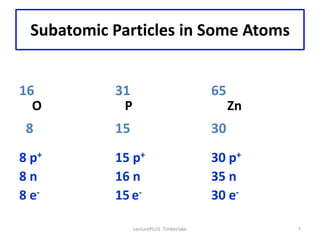
Subatomic Particles in Some Atoms


16         31                            65
  O         P                                 Zn
 8         15                            30
8 p+       15 p+                         30 p+
8n         16 n                          35 n
8 e-       15 e-                         30 e-

                LecturePLUS Timberlake             7
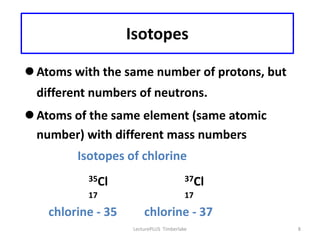
Isotopes

 Atoms with the same number of protons, but
  different numbers of neutrons.
 Atoms of the same element (same atomic
  number) with different mass numbers
         Isotopes of chlorine
           35Cl                          37Cl
           17                            17

    chlorine - 35       chlorine - 37
                    LecturePLUS Timberlake      8
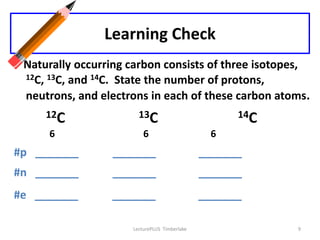
Learning Check
 Naturally occurring carbon consists of three isotopes,
 12C, 13C, and 14C. State the number of protons,

 neutrons, and electrons in each of these carbon atoms.
     12C               13C                          14C
     6                   6                     6
#p _______       _______                      _______
#n _______       _______                      _______
#e _______       _______                      _______

                     LecturePLUS Timberlake               9
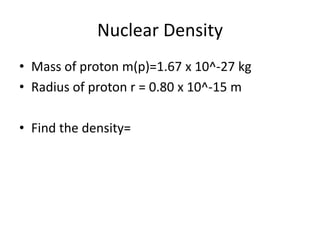
Nuclear Density
• Mass of proton m(p)=1.67 x 10^-27 kg
• Radius of proton r = 0.80 x 10^-15 m

• Find the density=
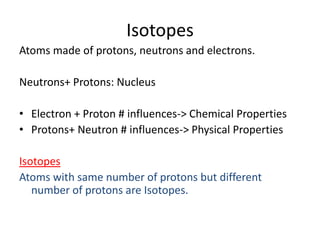
Isotopes
Atoms made of protons, neutrons and electrons.

Neutrons+ Protons: Nucleus

• Electron + Proton # influences-> Chemical Properties
• Protons+ Neutron # influences-> Physical Properties

Isotopes
Atoms with same number of protons but different
   number of protons are Isotopes.
Radioactivity

• A stable nuclei emits radiations. Radiation was
  discovered by Henri Becquerel in 1896. These
  radiations are not influenced by any outside
  conditions such as temperature or pressure.


• It is a spontaneous process, but it occurs at
  fixed intervals. Hence a proportion of sample
  decay will occur in that time interval.
Three particles present in these
              Radiations:
• Alpha, Beta And Gamma


          Alpha
          Beta
         Gamma
• We know that nuclei consists of protons and
  neutrons, if the balance between these two
  types of particles is too far to one side, the
  nucleus may emit alpha or B radiations.

• Gamma emitted after alpha or B radiation to
  release excess energy.
A third conserved quantity
• In radioactive decay, both nucleon number A
  and proton number Z are conserved.

• On comparison b/w mass before and after
  decay, we witness a decrease in mass.

• This is because energy lost caries mass- recall
  E=mc^2, so we witness a net decrease in
  energy.
Properties of Ionizing radiation
• On moving past atoms, alpha or B collide/rub with
  them and this as a result causes to knock or drag away
  electrons from an atom.

• This process is called Ionization.
• Now, Energy is lost during ionization.

             Size:        Motion:      Ionization Ability:
• Alpha: more mass &charge | slow | Most
• Beta:    lighter         | faster | Moderate
• Gamma: no charge                  | Least
Lesson Contents
1.   Physical properties of a, b and g
2.   Penetrating power of a, b and g
3.   N v Z graphs
4.   Decay laws
Alpha Radiation
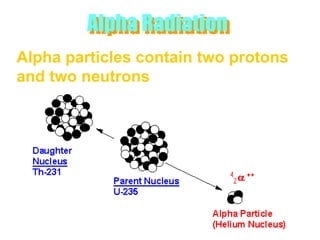
Alpha particles contain two protons
and two neutrons
Alpha Radiation
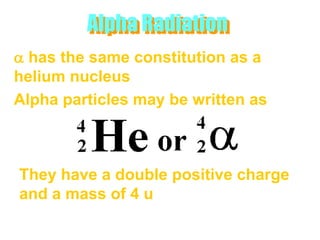
a has the same constitution as a
helium nucleus
Alpha particles may be written as


They have a double positive charge
and a mass of 4 u
Alpha
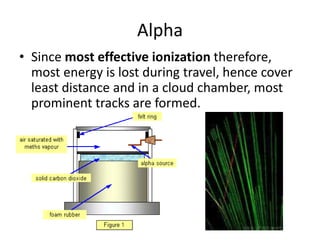
• Since most effective ionization therefore,
  most energy is lost during travel, hence cover
  least distance and in a cloud chamber, most
  prominent tracks are formed.
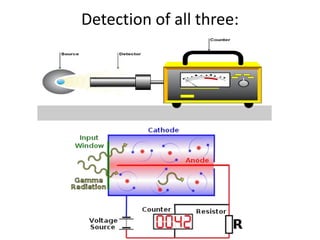
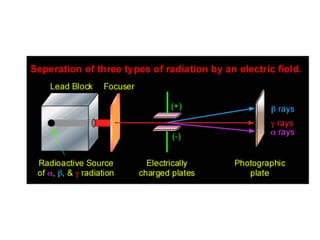
Detection of all three:
Beta-minus Radiation
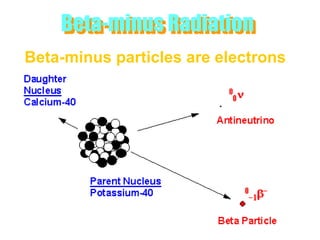
Beta-minus particles are electrons
Beta-minus Radiation
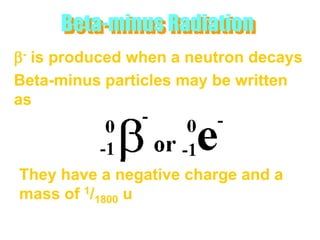
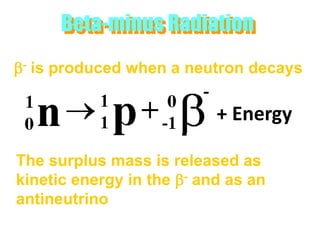
b- is produced when a neutron decays
Beta-minus particles may be written
as


They have a negative charge and a
mass of 1/1800 u
Beta-minus Radiation
b- is produced when a neutron decays

                           + Energy

The surplus mass is released as
kinetic energy in the b- and as an
antineutrino
Gamma Radiation
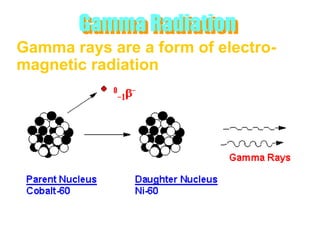
Gamma rays are a form of electro-
magnetic radiation
Gamma Radiation
g release is often associated with a
or b decay
Gamma rays remove energy from
an unstable nucleus
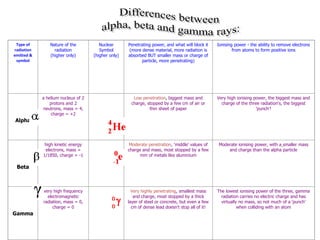
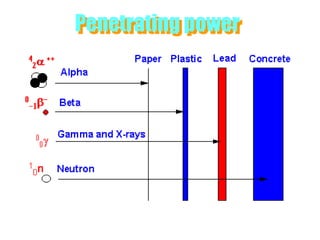
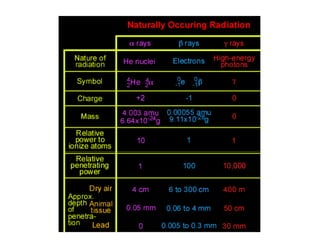
Type of        Nature of the          Nuclear      Penetrating power, and what will block it    Ionising power - the ability to remove electrons
radiation         radiation            Symbol       (more dense material, more radiation is              from atoms to form positive ions
emitted &       (higher only)       (higher only)   absorbed BUT smaller mass or charge of
 symbol                                                   particle, more penetrating)


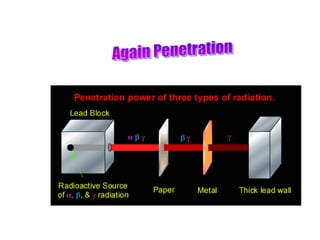
            a helium nucleus of 2                     Low penetration, biggest mass and          Very high ionising power, the biggest mass and
                protons and 2                        charge, stopped by a few cm of air or         charge of the three radiation's, the biggest
            neutrons, mass = 4,                               thin sheet of paper                                    'punch'!
                 charge = +2
Alpha


             high kinetic energy                     Moderate penetration, 'middle' values of    Moderate ionising power, with a smaller mass
             electrons, mass =                      charge and mass, most stopped by a few           and charge than the alpha particle
            1/1850, charge = -1                           mm of metals like aluminium

 Beta


            very high frequency                       Very highly penetrating, smallest mass     The lowest ionising power of the three, gamma
              electromagnetic                          and charge, most stopped by a thick         radiation carries no electric charge and has
            radiation, mass = 0,                    layer of steel or concrete, but even a few     virtually no mass, so not much of a 'punch'
                 charge = 0                           cm of dense lead doesn't stop all of it!              when colliding with an atom
Gamma
Penetrating power
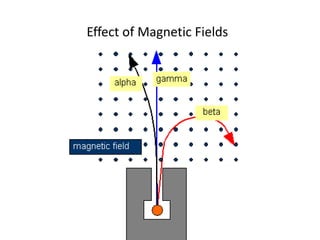
Effect of Magnetic Fields
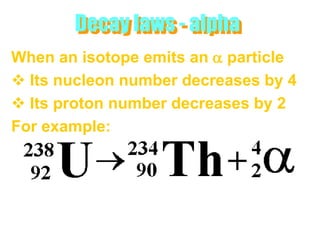
Decay laws - alpha
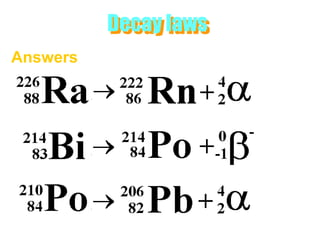
When an isotope emits an a particle
 Its nucleon number decreases by 4
 Its proton number decreases by 2
For example:
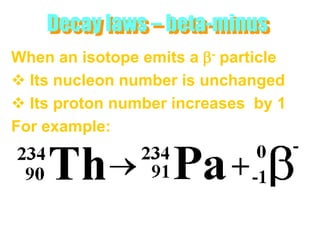
Decay laws – beta-minus
When an isotope emits a b- particle
 Its nucleon number is unchanged
 Its proton number increases by 1
For example:
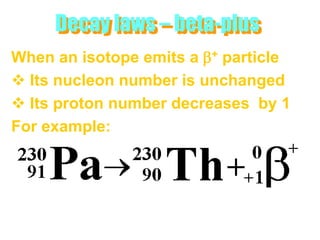
Decay laws – beta-plus
When an isotope emits a b+ particle
 Its nucleon number is unchanged
 Its proton number decreases by 1
For example:
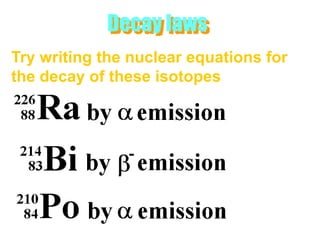
Decay laws
Try writing the nuclear equations for
the decay of these isotopes
Decay laws
Answers
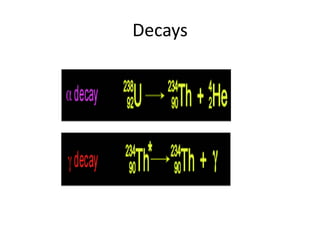
Decays
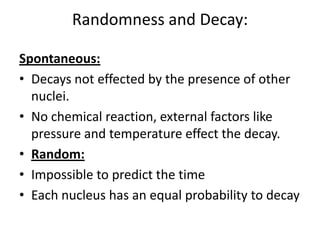
Randomness and Decay:

Spontaneous:
• Decays not effected by the presence of other
  nuclei.
• No chemical reaction, external factors like
  pressure and temperature effect the decay.
• Random:
• Impossible to predict the time
• Each nucleus has an equal probability to decay

Presentation for Radioactivity

  • 1.
    Atomic Theory  Atomsare building blocks of elements  Similar atoms in each element  Different from atoms of other elements  Two or more different atoms bond in simple ratios to form compounds LecturePLUS Timberlake 1
  • 2.
    Subatomic Particles Particle Symbol Charge Mass Electron e- 1- 1/1840 Proton p+ + 1 Neutron n 0 1 Charge measure in terms of electronic charge: e=1.6x10^-19 Mass is measure in unified atomic mass: units(u) 1 u is 1/12 of the mass of a carbon-12 atom. LecturePLUS Timberlake 2
  • 3.
    Location of SubatomicParticles 10-13 cm electrons protons neutrons nucleus 10-8 cm LecturePLUS Timberlake 3
  • 4.
    Atomic Number Counts thenumber of protons in an atom LecturePLUS Timberlake 4
  • 5.
    Atomic Symbols  Showthe mass number and atomic number  Give the symbol of the element mass number 23 Na sodium-23 atomic number 11 LecturePLUS Timberlake 5
  • 6.
    Number of Electrons An atom is neutral  The net charge is zero  Number of protons = Number of electrons  Atomic number = Number of electrons LecturePLUS Timberlake 6
  • 7.
    Subatomic Particles inSome Atoms 16 31 65 O P Zn 8 15 30 8 p+ 15 p+ 30 p+ 8n 16 n 35 n 8 e- 15 e- 30 e- LecturePLUS Timberlake 7
  • 8.
    Isotopes  Atoms withthe same number of protons, but different numbers of neutrons.  Atoms of the same element (same atomic number) with different mass numbers Isotopes of chlorine 35Cl 37Cl 17 17 chlorine - 35 chlorine - 37 LecturePLUS Timberlake 8
  • 9.
    Learning Check Naturallyoccurring carbon consists of three isotopes, 12C, 13C, and 14C. State the number of protons, neutrons, and electrons in each of these carbon atoms. 12C 13C 14C 6 6 6 #p _______ _______ _______ #n _______ _______ _______ #e _______ _______ _______ LecturePLUS Timberlake 9
  • 10.
    Nuclear Density • Massof proton m(p)=1.67 x 10^-27 kg • Radius of proton r = 0.80 x 10^-15 m • Find the density=
  • 11.
    Isotopes Atoms made ofprotons, neutrons and electrons. Neutrons+ Protons: Nucleus • Electron + Proton # influences-> Chemical Properties • Protons+ Neutron # influences-> Physical Properties Isotopes Atoms with same number of protons but different number of protons are Isotopes.
  • 12.
    Radioactivity • A stablenuclei emits radiations. Radiation was discovered by Henri Becquerel in 1896. These radiations are not influenced by any outside conditions such as temperature or pressure. • It is a spontaneous process, but it occurs at fixed intervals. Hence a proportion of sample decay will occur in that time interval.
  • 13.
    Three particles presentin these Radiations: • Alpha, Beta And Gamma Alpha Beta Gamma
  • 14.
    • We knowthat nuclei consists of protons and neutrons, if the balance between these two types of particles is too far to one side, the nucleus may emit alpha or B radiations. • Gamma emitted after alpha or B radiation to release excess energy.
  • 15.
    A third conservedquantity • In radioactive decay, both nucleon number A and proton number Z are conserved. • On comparison b/w mass before and after decay, we witness a decrease in mass. • This is because energy lost caries mass- recall E=mc^2, so we witness a net decrease in energy.
  • 16.
    Properties of Ionizingradiation • On moving past atoms, alpha or B collide/rub with them and this as a result causes to knock or drag away electrons from an atom. • This process is called Ionization. • Now, Energy is lost during ionization. Size: Motion: Ionization Ability: • Alpha: more mass &charge | slow | Most • Beta: lighter | faster | Moderate • Gamma: no charge | Least
  • 17.
    Lesson Contents 1. Physical properties of a, b and g 2. Penetrating power of a, b and g 3. N v Z graphs 4. Decay laws
  • 18.
    Alpha Radiation Alpha particlescontain two protons and two neutrons
  • 19.
    Alpha Radiation a hasthe same constitution as a helium nucleus Alpha particles may be written as They have a double positive charge and a mass of 4 u
  • 20.
    Alpha • Since mosteffective ionization therefore, most energy is lost during travel, hence cover least distance and in a cloud chamber, most prominent tracks are formed.
  • 21.
  • 22.
  • 23.
    Beta-minus Radiation b- isproduced when a neutron decays Beta-minus particles may be written as They have a negative charge and a mass of 1/1800 u
  • 24.
    Beta-minus Radiation b- isproduced when a neutron decays + Energy The surplus mass is released as kinetic energy in the b- and as an antineutrino
  • 25.
    Gamma Radiation Gamma raysare a form of electro- magnetic radiation
  • 26.
    Gamma Radiation g releaseis often associated with a or b decay Gamma rays remove energy from an unstable nucleus
  • 27.
    Type of Nature of the Nuclear Penetrating power, and what will block it Ionising power - the ability to remove electrons radiation radiation Symbol (more dense material, more radiation is from atoms to form positive ions emitted & (higher only) (higher only) absorbed BUT smaller mass or charge of symbol particle, more penetrating) a helium nucleus of 2 Low penetration, biggest mass and Very high ionising power, the biggest mass and protons and 2 charge, stopped by a few cm of air or charge of the three radiation's, the biggest neutrons, mass = 4, thin sheet of paper 'punch'! charge = +2 Alpha high kinetic energy Moderate penetration, 'middle' values of Moderate ionising power, with a smaller mass electrons, mass = charge and mass, most stopped by a few and charge than the alpha particle 1/1850, charge = -1 mm of metals like aluminium Beta very high frequency Very highly penetrating, smallest mass The lowest ionising power of the three, gamma electromagnetic and charge, most stopped by a thick radiation carries no electric charge and has radiation, mass = 0, layer of steel or concrete, but even a few virtually no mass, so not much of a 'punch' charge = 0 cm of dense lead doesn't stop all of it! when colliding with an atom Gamma
  • 28.
  • 31.
  • 33.
    Decay laws -alpha When an isotope emits an a particle  Its nucleon number decreases by 4  Its proton number decreases by 2 For example:
  • 34.
    Decay laws –beta-minus When an isotope emits a b- particle  Its nucleon number is unchanged  Its proton number increases by 1 For example:
  • 35.
    Decay laws –beta-plus When an isotope emits a b+ particle  Its nucleon number is unchanged  Its proton number decreases by 1 For example:
  • 36.
    Decay laws Try writingthe nuclear equations for the decay of these isotopes
  • 37.
  • 38.
  • 39.
    Randomness and Decay: Spontaneous: •Decays not effected by the presence of other nuclei. • No chemical reaction, external factors like pressure and temperature effect the decay. • Random: • Impossible to predict the time • Each nucleus has an equal probability to decay