UNIVERSITY OF CAMBRIDGE INTERNATIONAL EXAMINATIONS
                                          General Certificate of Education
                                          Advanced Subsidiary Level and Advanced Level
* 9 9 6 7 0 8 3 2 7 5 *


                          PHYSICS                                                                                            9702/22
                          Paper 2 AS Structured Questions                                                               May/June 2012
                                                                                                                               1 hour
                          Candidates answer on the Question Paper.
                          No Additional Materials are required.

                          READ THESE INSTRUCTIONS FIRST

                          Write your Centre number, candidate number and name on all the work you hand in.
                          Write in dark blue or black pen.
                          You may use a soft pencil for any diagrams, graphs or rough working.
                          Do not use staples, paper clips, highlighters, glue or correction fluid.
                          DO NOT WRITE IN ANY BARCODES.

                          Answer all questions.
                          You may lose marks if you do not show your working or if you do not use
                          appropriate units.

                          At the end of the examination, fasten all your work securely together.             For Examiner’s Use
                          The number of marks is given in brackets [ ] at the end of each question or
                          part question.                                                                         1

                                                                                                                 2

                                                                                                                 3

                                                                                                                 4

                                                                                                                 5

                                                                                                                 6

                                                                                                                 7

                                                                                                                Total


                                                 This document consists of 15 printed pages and 1 blank page.

                          DC (SJF/SW) 42071/4
                          © UCLES 2012                                                                                      [Turn over
2

Data

speed of light in free space,           c = 3.00 × 10 8 m s –1

permeability of free space,            μ0 = 4π × 10 –7 H m–1

permittivity of free space,            ε0 = 8.85 × 10 –12 F m–1
                                     1
                                (        = 8.99 × 10 9 m F–1 )
                                    4πε0
elementary charge,                      e = 1.60 × 10 –19 C

the Planck constant,                    h = 6.63 × 10 –34 J s

unified atomic mass constant,           u = 1.66 × 10 –27 kg

rest mass of electron,                me = 9.11 × 10 –31 kg

rest mass of proton,                  mp = 1.67 × 10 –27 kg

molar gas constant,                    R = 8.31 J K –1 mol –1

the Avogadro constant,                NA = 6.02 × 10 23 mol –1

the Boltzmann constant,                 k = 1.38 × 10 –23 J K –1

gravitational constant,                G = 6.67 × 10 –11 N m 2 kg –2

acceleration of free fall,              g = 9.81 m s –2


© UCLES 2012                            9702/22/M/J/12
3

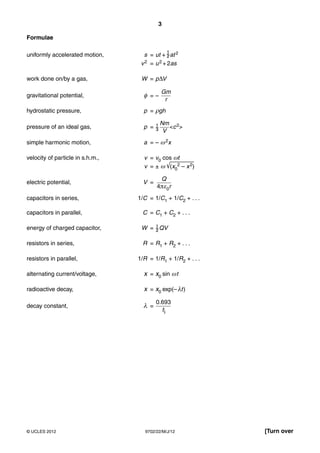
Formulae

uniformly accelerated motion,       s = ut + at 2
                                   v 2 = u 2 + 2as

work done on/by a gas,             W = p ΔV

                                            Gm
gravitational potential,            φ =–
                                             r
hydrostatic pressure,               p = ρgh

                                           Nm 2
pressure of an ideal gas,           p =       <c >
                                            V
simple harmonic motion,             a = – ω 2x

velocity of particle in s.h.m.,     v = v0 cos ωt
                                    v = ± ω √⎯(x0⎯ 2 ⎯ – x 2)
                                                ⎯ ⎯ ⎯⎯ ⎯
                                            Q
electric potential,                 V =
                                          4πε0r
capacitors in series,             1/C = 1/C1 + 1/C2 + . . .

capacitors in parallel,            C = C1 + C2 + . . .

energy of charged capacitor,       W = QV

resistors in series,               R = R1 + R2 + . . .

resistors in parallel,            1/R = 1/R1 + 1/R2 + . . .

alternating current/voltage,        x = x0 sin ω t

radioactive decay,                  x = x0 exp(– λt )

                                          0.693
decay constant,                     λ =
                                            t


© UCLES 2012                        9702/22/M/J/12              [Turn over
4

               BLANK PAGE


© UCLES 2012    9702/22/M/J/12
5

                        Answer all the questions in the spaces provided.                                                                For
                                                                                                                                     Examiner’s
1   The volume V of liquid flowing in time t through a pipe of radius r is given by the equation                                        Use


                                                   V
                                                     =
                                                       π Pr 4
                                                   t    8Cl

    where P is the pressure difference between the ends of the pipe of length l, and C depends
    on the frictional effects of the liquid.

    An experiment is performed to determine C. The measurements made are shown in Fig. 1.1.


               V
                 / 10–6 m3 s–1          P / 103 N m–2                 r / mm                      l /m
               t

                1.20 ± 0.01              2.50 ± 0.05               0.75 ± 0.01            0.250 ± 0.001

                                                     Fig. 1.1

    (a) Calculate the value of C.


                                                                        C = ..................................... N s m–2 [2]

    (b) Calculate the uncertainty in C.


                                                          uncertainty = ..................................... N s m–2 [3]

    (c) State the value of C and its uncertainty to the appropriate number of significant figures.


                         C = ........................................... ± ........................................... N s m–2 [1]


© UCLES 2012                                          9702/22/M/J/12                                                      [Turn over
6

2   (a) A ball is thrown vertically down towards the ground and rebounds as illustrated in                                 For
        Fig. 2.1.                                                                                                       Examiner’s
                                                                                                                           Use

          ball passing point A

                                 A
                             8.4 m s–1

                                                                              ball at maximum
                5.0 m                                                       height after rebound

                                                                                 B
                                                               h


                                                Fig. 2.1

         As the ball passes A, it has a speed of 8.4 m s–1. The height of A is 5.0 m above the
         ground. The ball hits the ground and rebounds to B. Assume that air resistance is
         negligible.

          (i)    Calculate the speed of the ball as it hits the ground.


                                                           speed = ........................................ m s–1 [2]

         (ii) Show that the time taken for the ball to reach the ground is 0.47 s.


                                                                                                                 [1]


© UCLES 2012                                     9702/22/M/J/12
7

    (b) The ball rebounds vertically with a speed of 4.2 m s–1 as it leaves the ground. The time                           For
        the ball is in contact with the ground is 20 ms. The ball rebounds to a maximum height h.                       Examiner’s
                                                                                                                           Use

         The ball passes A at time t = 0. On Fig. 2.2, plot a graph to show the variation with time
         t of the velocity v of the ball. Continue the graph until the ball has rebounded from the
         ground and reaches B.


               v / m s–1


                           0
                            0                                                                t /s


                                                  Fig. 2.2                                                       [3]

    (c) The ball has a mass of 0.050 kg. It moves from A and reaches B after rebounding.

         (i)   For this motion, calculate the change in
               1.   kinetic energy,


                                      change in kinetic energy = .............................................. J [2]
               2.   gravitational potential energy.


                                  change in potential energy = .............................................. J [3]


© UCLES 2012                                       9702/22/M/J/12                                             [Turn over
8

         (ii)   State and explain the total change in energy of the ball for this motion.                                                               For
                                                                                                                                                     Examiner’s
                ..................................................................................................................................      Use


                ..................................................................................................................................

                ..................................................................................................................................

                .............................................................................................................................. [2]


© UCLES 2012                                                     9702/22/M/J/12
9

3   (a) State Newton’s first law.                                                                                                                         For
                                                                                                                                                       Examiner’s
          ..........................................................................................................................................      Use


          ...................................................................................................................................... [1]

    (b) A log of mass 450 kg is pulled up a slope by a wire attached to a motor, as shown in
        Fig. 3.1.

                                                                                                          motor
                                  log                         wire


                                           12°
                                                                 Fig. 3.1

         The angle that the slope makes with the horizontal is 12°. The frictional force acting on
         the log is 650 N. The log travels with constant velocity.

          (i)    With reference to the motion of the log, discuss whether the log is in equilibrium.

                 ..................................................................................................................................

                 ..................................................................................................................................

                 ..................................................................................................................................

                 .............................................................................................................................. [2]

         (ii)    Calculate the tension in the wire.


                                                                               tension = ............................................. N [3]

        (iii)    State and explain whether the gain in the potential energy per unit time of the log is
                 equal to the output power of the motor.

                 ..................................................................................................................................

                 ..................................................................................................................................

                 ..................................................................................................................................

                 .............................................................................................................................. [2]


© UCLES 2012                                                       9702/22/M/J/12                                                          [Turn over
10

4   A battery of electromotive force 12 V and negligible internal resistance is connected to two                              For
    resistors and a light-dependent resistor (LDR), as shown in Fig. 4.1.                                                  Examiner’s
                                                                                                                              Use


                                                8.0 kΩ

                     12 V                                            S
                                                          X

                                                 12 kΩ

                                         A
                                                              Y

                                             Fig. 4.1

    An ammeter is connected in series with the battery. The LDR and switch S are connected
    across the points XY.

    (a) The switch S is open. Calculate the potential difference (p.d.) across XY.


                                                            p. d. = .............................................. V [3]

    (b) The switch S is closed. The resistance of the LDR is 4.0 kΩ. Calculate the current in the
        ammeter.


                                                        current = .............................................. A [3]


© UCLES 2012                                 9702/22/M/J/12
11

    (c) The switch S remains closed. The intensity of the light on the LDR is increased. State                                                          For
        and explain the change to                                                                                                                    Examiner’s
                                                                                                                                                        Use

          (i)   the ammeter reading,

                ..................................................................................................................................

                ..................................................................................................................................

                .............................................................................................................................. [2]

         (ii)   the p.d. across XY.

                ..................................................................................................................................

                ..................................................................................................................................

                .............................................................................................................................. [2]


© UCLES 2012                                                     9702/22/M/J/12                                                          [Turn over
12

5   (a) Define the Young modulus.                                                                                                                         For
                                                                                                                                                       Examiner’s
          ..........................................................................................................................................      Use


          ...................................................................................................................................... [1]

    (b) A load F is suspended from a fixed point by a steel wire. The variation with extension x
        of F for the wire is shown in Fig. 5.1.

                6.0

                5.0

                4.0

       F / N 3.0

                2.0

                1.0

                   0
                       0                                0.10                                 0.20                                 0.30
                                                                                                               x / mm

                                                                 Fig. 5.1

          (i)    State two quantities, other than the gradient of the graph in Fig. 5.1, that are
                 required in order to determine the Young modulus of steel.

                 1. ..............................................................................................................................

                 2. ..............................................................................................................................
                                                                                                                                              [1]

         (ii)    Describe how the quantities you listed in (i) may be measured.

                 ..................................................................................................................................

                 ..................................................................................................................................

                 .............................................................................................................................. [2]


© UCLES 2012                                                       9702/22/M/J/12
13

        (iii)   A load of 3.0 N is applied to the wire. Use Fig. 5.1 to calculate the energy stored in                       For
                the wire.                                                                                                 Examiner’s
                                                                                                                             Use


                                                          energy = .............................................. J [2]

    (c) A copper wire has the same original dimensions as the steel wire. The Young modulus
        for steel is 2.2 × 10¹¹ N m–2 and for copper is 1.1 × 10¹¹ N m–2.

         On Fig. 5.1, sketch the variation with x of F for the copper wire for extensions up to
         0.25 mm. The copper wire is not extended beyond its limit of proportionality.      [2]


© UCLES 2012                                    9702/22/M/J/12                                                 [Turn over
14

6   (a) Use the principle of superposition to explain the formation of a stationary wave.                                                                 For
                                                                                                                                                       Examiner’s
          ..........................................................................................................................................      Use


          ..........................................................................................................................................

          ..........................................................................................................................................

          ..........................................................................................................................................

          ...................................................................................................................................... [3]

    (b) Describe an experiment to determine the wavelength of sound in air using stationary
        waves. Include a diagram of the apparatus in your answer.


          ..........................................................................................................................................

          ..........................................................................................................................................

          ..........................................................................................................................................

          ..........................................................................................................................................

          ..........................................................................................................................................

          ..........................................................................................................................................

          ..........................................................................................................................................

          ..........................................................................................................................................

          ..........................................................................................................................................

          ...................................................................................................................................... [3]


© UCLES 2012                                                       9702/22/M/J/12
15

    (c) The variation with distance x of the intensity I of a stationary sound wave is shown in                               For
        Fig. 6.1.                                                                                                          Examiner’s
                                                                                                                              Use

           1.0

I / arbitrary
    units
           0.5


                0
                    0                      20                         40                            60
                                                                                               x / cm

                                                    Fig. 6.1

          (i)       On the x-axis of Fig. 6.1, indicate the positions of all the nodes and antinodes of the
                    stationary wave. Label the nodes N and the antinodes A.                              [1]

         (ii)       The speed of sound in air is 340 m s–1.
                    Use Fig. 6.1 to determine the frequency of the sound wave.


                                                         frequency = ............................................ Hz [3]


                                      Please turn over for Question 7.


© UCLES 2012                                         9702/22/M/J/12                                             [Turn over
16

7      (a) A nuclear reaction occurs when a uranium-235 nucleus absorbs a neutron. The reaction                                                               For
           may be represented by the equation:                                                                                                             Examiner’s
                                                                                                                                                              Use
                                        235           W                   93            141
                                         92 U     +   Xn                  37 Rb     +     Z Cs     + YW n
                                                                                                      X

              State the number represented by the letter

              W .............................................................

              X ..............................................................

              Y ..............................................................

              Z ...............................................................
                                                                                                                                                    [3]

       (b) The sum of the masses on the left-hand side of the equation in (a) is not the same as
           the sum of the masses on the right-hand side.

              Explain why mass seems not to be conserved.

              ..........................................................................................................................................

              ..........................................................................................................................................

              ...................................................................................................................................... [2]


Permission to reproduce items where third-party owned material protected by copyright is included has been sought and cleared where possible. Every
reasonable effort has been made by the publisher (UCLES) to trace copyright holders, but if any items requiring clearance have unwittingly been included, the
publisher will be pleased to make amends at the earliest possible opportunity.

University of Cambridge International Examinations is part of the Cambridge Assessment Group. Cambridge Assessment is the brand name of University of
Cambridge Local Examinations Syndicate (UCLES), which is itself a department of the University of Cambridge.

© UCLES 2012                                                           9702/22/M/J/12

AS PHYSICS-May/June 9702/22

  • 1.
    UNIVERSITY OF CAMBRIDGEINTERNATIONAL EXAMINATIONS General Certificate of Education Advanced Subsidiary Level and Advanced Level * 9 9 6 7 0 8 3 2 7 5 * PHYSICS 9702/22 Paper 2 AS Structured Questions May/June 2012 1 hour Candidates answer on the Question Paper. No Additional Materials are required. READ THESE INSTRUCTIONS FIRST Write your Centre number, candidate number and name on all the work you hand in. Write in dark blue or black pen. You may use a soft pencil for any diagrams, graphs or rough working. Do not use staples, paper clips, highlighters, glue or correction fluid. DO NOT WRITE IN ANY BARCODES. Answer all questions. You may lose marks if you do not show your working or if you do not use appropriate units. At the end of the examination, fasten all your work securely together. For Examiner’s Use The number of marks is given in brackets [ ] at the end of each question or part question. 1 2 3 4 5 6 7 Total This document consists of 15 printed pages and 1 blank page. DC (SJF/SW) 42071/4 © UCLES 2012 [Turn over
  • 2.
    2 Data speed of lightin free space, c = 3.00 × 10 8 m s –1 permeability of free space, μ0 = 4π × 10 –7 H m–1 permittivity of free space, ε0 = 8.85 × 10 –12 F m–1 1 ( = 8.99 × 10 9 m F–1 ) 4πε0 elementary charge, e = 1.60 × 10 –19 C the Planck constant, h = 6.63 × 10 –34 J s unified atomic mass constant, u = 1.66 × 10 –27 kg rest mass of electron, me = 9.11 × 10 –31 kg rest mass of proton, mp = 1.67 × 10 –27 kg molar gas constant, R = 8.31 J K –1 mol –1 the Avogadro constant, NA = 6.02 × 10 23 mol –1 the Boltzmann constant, k = 1.38 × 10 –23 J K –1 gravitational constant, G = 6.67 × 10 –11 N m 2 kg –2 acceleration of free fall, g = 9.81 m s –2 © UCLES 2012 9702/22/M/J/12
  • 3.
    3 Formulae uniformly accelerated motion, s = ut + at 2 v 2 = u 2 + 2as work done on/by a gas, W = p ΔV Gm gravitational potential, φ =– r hydrostatic pressure, p = ρgh Nm 2 pressure of an ideal gas, p = <c > V simple harmonic motion, a = – ω 2x velocity of particle in s.h.m., v = v0 cos ωt v = ± ω √⎯(x0⎯ 2 ⎯ – x 2) ⎯ ⎯ ⎯⎯ ⎯ Q electric potential, V = 4πε0r capacitors in series, 1/C = 1/C1 + 1/C2 + . . . capacitors in parallel, C = C1 + C2 + . . . energy of charged capacitor, W = QV resistors in series, R = R1 + R2 + . . . resistors in parallel, 1/R = 1/R1 + 1/R2 + . . . alternating current/voltage, x = x0 sin ω t radioactive decay, x = x0 exp(– λt ) 0.693 decay constant, λ = t © UCLES 2012 9702/22/M/J/12 [Turn over
  • 4.
    4 BLANK PAGE © UCLES 2012 9702/22/M/J/12
  • 5.
    5 Answer all the questions in the spaces provided. For Examiner’s 1 The volume V of liquid flowing in time t through a pipe of radius r is given by the equation Use V = π Pr 4 t 8Cl where P is the pressure difference between the ends of the pipe of length l, and C depends on the frictional effects of the liquid. An experiment is performed to determine C. The measurements made are shown in Fig. 1.1. V / 10–6 m3 s–1 P / 103 N m–2 r / mm l /m t 1.20 ± 0.01 2.50 ± 0.05 0.75 ± 0.01 0.250 ± 0.001 Fig. 1.1 (a) Calculate the value of C. C = ..................................... N s m–2 [2] (b) Calculate the uncertainty in C. uncertainty = ..................................... N s m–2 [3] (c) State the value of C and its uncertainty to the appropriate number of significant figures. C = ........................................... ± ........................................... N s m–2 [1] © UCLES 2012 9702/22/M/J/12 [Turn over
  • 6.
    6 2 (a) A ball is thrown vertically down towards the ground and rebounds as illustrated in For Fig. 2.1. Examiner’s Use ball passing point A A 8.4 m s–1 ball at maximum 5.0 m height after rebound B h Fig. 2.1 As the ball passes A, it has a speed of 8.4 m s–1. The height of A is 5.0 m above the ground. The ball hits the ground and rebounds to B. Assume that air resistance is negligible. (i) Calculate the speed of the ball as it hits the ground. speed = ........................................ m s–1 [2] (ii) Show that the time taken for the ball to reach the ground is 0.47 s. [1] © UCLES 2012 9702/22/M/J/12
  • 7.
    7 (b) The ball rebounds vertically with a speed of 4.2 m s–1 as it leaves the ground. The time For the ball is in contact with the ground is 20 ms. The ball rebounds to a maximum height h. Examiner’s Use The ball passes A at time t = 0. On Fig. 2.2, plot a graph to show the variation with time t of the velocity v of the ball. Continue the graph until the ball has rebounded from the ground and reaches B. v / m s–1 0 0 t /s Fig. 2.2 [3] (c) The ball has a mass of 0.050 kg. It moves from A and reaches B after rebounding. (i) For this motion, calculate the change in 1. kinetic energy, change in kinetic energy = .............................................. J [2] 2. gravitational potential energy. change in potential energy = .............................................. J [3] © UCLES 2012 9702/22/M/J/12 [Turn over
  • 8.
    8 (ii) State and explain the total change in energy of the ball for this motion. For Examiner’s .................................................................................................................................. Use .................................................................................................................................. .................................................................................................................................. .............................................................................................................................. [2] © UCLES 2012 9702/22/M/J/12
  • 9.
    9 3 (a) State Newton’s first law. For Examiner’s .......................................................................................................................................... Use ...................................................................................................................................... [1] (b) A log of mass 450 kg is pulled up a slope by a wire attached to a motor, as shown in Fig. 3.1. motor log wire 12° Fig. 3.1 The angle that the slope makes with the horizontal is 12°. The frictional force acting on the log is 650 N. The log travels with constant velocity. (i) With reference to the motion of the log, discuss whether the log is in equilibrium. .................................................................................................................................. .................................................................................................................................. .................................................................................................................................. .............................................................................................................................. [2] (ii) Calculate the tension in the wire. tension = ............................................. N [3] (iii) State and explain whether the gain in the potential energy per unit time of the log is equal to the output power of the motor. .................................................................................................................................. .................................................................................................................................. .................................................................................................................................. .............................................................................................................................. [2] © UCLES 2012 9702/22/M/J/12 [Turn over
  • 10.
    10 4 A battery of electromotive force 12 V and negligible internal resistance is connected to two For resistors and a light-dependent resistor (LDR), as shown in Fig. 4.1. Examiner’s Use 8.0 kΩ 12 V S X 12 kΩ A Y Fig. 4.1 An ammeter is connected in series with the battery. The LDR and switch S are connected across the points XY. (a) The switch S is open. Calculate the potential difference (p.d.) across XY. p. d. = .............................................. V [3] (b) The switch S is closed. The resistance of the LDR is 4.0 kΩ. Calculate the current in the ammeter. current = .............................................. A [3] © UCLES 2012 9702/22/M/J/12
  • 11.
    11 (c) The switch S remains closed. The intensity of the light on the LDR is increased. State For and explain the change to Examiner’s Use (i) the ammeter reading, .................................................................................................................................. .................................................................................................................................. .............................................................................................................................. [2] (ii) the p.d. across XY. .................................................................................................................................. .................................................................................................................................. .............................................................................................................................. [2] © UCLES 2012 9702/22/M/J/12 [Turn over
  • 12.
    12 5 (a) Define the Young modulus. For Examiner’s .......................................................................................................................................... Use ...................................................................................................................................... [1] (b) A load F is suspended from a fixed point by a steel wire. The variation with extension x of F for the wire is shown in Fig. 5.1. 6.0 5.0 4.0 F / N 3.0 2.0 1.0 0 0 0.10 0.20 0.30 x / mm Fig. 5.1 (i) State two quantities, other than the gradient of the graph in Fig. 5.1, that are required in order to determine the Young modulus of steel. 1. .............................................................................................................................. 2. .............................................................................................................................. [1] (ii) Describe how the quantities you listed in (i) may be measured. .................................................................................................................................. .................................................................................................................................. .............................................................................................................................. [2] © UCLES 2012 9702/22/M/J/12
  • 13.
    13 (iii) A load of 3.0 N is applied to the wire. Use Fig. 5.1 to calculate the energy stored in For the wire. Examiner’s Use energy = .............................................. J [2] (c) A copper wire has the same original dimensions as the steel wire. The Young modulus for steel is 2.2 × 10¹¹ N m–2 and for copper is 1.1 × 10¹¹ N m–2. On Fig. 5.1, sketch the variation with x of F for the copper wire for extensions up to 0.25 mm. The copper wire is not extended beyond its limit of proportionality. [2] © UCLES 2012 9702/22/M/J/12 [Turn over
  • 14.
    14 6 (a) Use the principle of superposition to explain the formation of a stationary wave. For Examiner’s .......................................................................................................................................... Use .......................................................................................................................................... .......................................................................................................................................... .......................................................................................................................................... ...................................................................................................................................... [3] (b) Describe an experiment to determine the wavelength of sound in air using stationary waves. Include a diagram of the apparatus in your answer. .......................................................................................................................................... .......................................................................................................................................... .......................................................................................................................................... .......................................................................................................................................... .......................................................................................................................................... .......................................................................................................................................... .......................................................................................................................................... .......................................................................................................................................... .......................................................................................................................................... ...................................................................................................................................... [3] © UCLES 2012 9702/22/M/J/12
  • 15.
    15 (c) The variation with distance x of the intensity I of a stationary sound wave is shown in For Fig. 6.1. Examiner’s Use 1.0 I / arbitrary units 0.5 0 0 20 40 60 x / cm Fig. 6.1 (i) On the x-axis of Fig. 6.1, indicate the positions of all the nodes and antinodes of the stationary wave. Label the nodes N and the antinodes A. [1] (ii) The speed of sound in air is 340 m s–1. Use Fig. 6.1 to determine the frequency of the sound wave. frequency = ............................................ Hz [3] Please turn over for Question 7. © UCLES 2012 9702/22/M/J/12 [Turn over
  • 16.
    16 7 (a) A nuclear reaction occurs when a uranium-235 nucleus absorbs a neutron. The reaction For may be represented by the equation: Examiner’s Use 235 W 93 141 92 U + Xn 37 Rb + Z Cs + YW n X State the number represented by the letter W ............................................................. X .............................................................. Y .............................................................. Z ............................................................... [3] (b) The sum of the masses on the left-hand side of the equation in (a) is not the same as the sum of the masses on the right-hand side. Explain why mass seems not to be conserved. .......................................................................................................................................... .......................................................................................................................................... ...................................................................................................................................... [2] Permission to reproduce items where third-party owned material protected by copyright is included has been sought and cleared where possible. Every reasonable effort has been made by the publisher (UCLES) to trace copyright holders, but if any items requiring clearance have unwittingly been included, the publisher will be pleased to make amends at the earliest possible opportunity. University of Cambridge International Examinations is part of the Cambridge Assessment Group. Cambridge Assessment is the brand name of University of Cambridge Local Examinations Syndicate (UCLES), which is itself a department of the University of Cambridge. © UCLES 2012 9702/22/M/J/12