RADIOACTIVITY
By - Mr. Yogesh Puri & Ms. Priya Tyagi
STRUCTURE OF ATOM
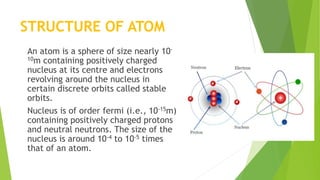
An atom is a sphere of size nearly 10-
10m containing positively charged
nucleus at its centre and electrons
revolving around the nucleus in
certain discrete orbits called stable
orbits.
Nucleus is of order fermi (i.e., 10-15m)
containing positively charged protons
and neutral neutrons. The size of the
nucleus is around 10-4 to 10-5 times
that of an atom.
Electrons are distributed in various shells like K, L, M,… and
maximum number of electrons in a shell = 2n2, where n is
the number of shell E.g. K- shell = 2 electrons; L- shell = 8
electrons; M- shell = 18 electrons and so on…
Charge on an electron (qe) = - 1.6 x 10⁻¹⁹C
Charge on a proton (qp) = + 1.6 x 10⁻¹⁹C
Mass of an electron (me) = 9.1 x 10⁻³¹kg
Mass of a proton (mp) = 1.67 x 10⁻²⁷kg
ATOMIC NUMBER
Atomic number of an element is defined as the number
of protons present in the nucleus of every atom of that
element.
Atomic number of an element is also equal to the
number of electrons revolving around the nucleus of
every atom of that element.
Atomic number is generally denoted by Z.
Atomic number (Z) = Number of protons (p) = Number
of electrons (e-).
MASS NUMBER
Mass number of an element is defined as the total number of
protons and neutrons (also called nucleons) present in the
nucleus of an atom of that element.
Mass number is also called Atomic Mass Number or Nucleon
Number.
Mass number is generally denoted by A.
Mass number = Number of protons + Number of neutrons
i.e., A = p + n
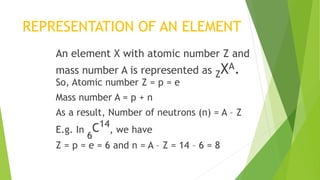
REPRESENTATION OF AN ELEMENT
An element X with atomic number Z and
mass number A is represented as ZXA.
So, Atomic number Z = p = e
Mass number A = p + n
As a result, Number of neutrons (n) = A – Z
E.g. In
6
C14
, we have
Z = p = e = 6 and n = A – Z = 14 – 6 = 8
ATOMIC MODEL
An atom is electrically neutral and
stable as the numbers of protons
present inside the nucleus is
numerically equal to the number of
electrons revolving around the nucleus.
As a result, the net positive charge of
the nucleus is balanced by the net
negative charge of the electrons.
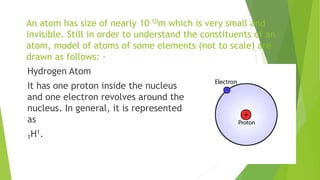
An atom has size of nearly 10-10m which is very small and
invisible. Still in order to understand the constituents of an
atom, model of atoms of some elements (not to scale) are
drawn as follows: -
Hydrogen Atom
It has one proton inside the nucleus
and one electron revolves around the
nucleus. In general, it is represented
as
1H1.
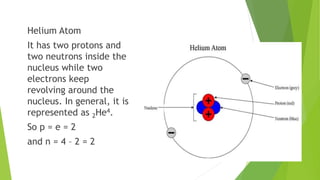
Helium Atom
It has two protons and
two neutrons inside the
nucleus while two
electrons keep
revolving around the
nucleus. In general, it is
represented as 2He4.
So p = e = 2
and n = 4 – 2 = 2
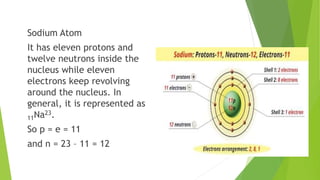
Sodium Atom
It has eleven protons and
twelve neutrons inside the
nucleus while eleven
electrons keep revolving
around the nucleus. In
general, it is represented as
11Na23.
So p = e = 11
and n = 23 – 11 = 12
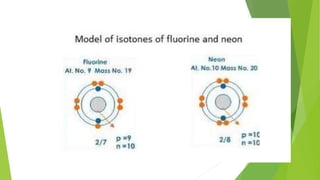
ISOTOPES
Isotopes are the atoms of the same element having same
atomic number and different mass number.
The number of protons and electrons (Z = p =e) in case of
Isotopes are same but the number of neutrons (A – Z) are
different.
Since the number of electrons outside the nucleus is same
so Isotopes have same chemical properties.
EXAMPLES OF ISOTOPES
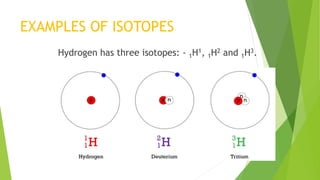
Hydrogen has three isotopes: - 1H1, 1H2 and 1H3.
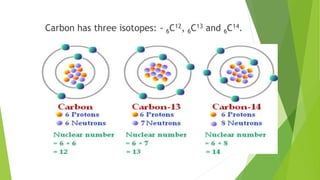
Carbon has three isotopes: - 6C12, 6C13 and 6C14.
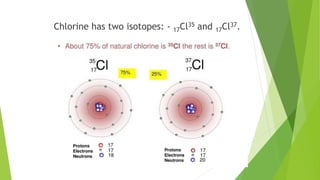
Chlorine has two isotopes: - 17Cl35 and 17Cl37.
Tin has largest number of isotopes i.e., 10 isotopes.
Isotopes can be classified as: -
(A). Stable Isotopes- These are the one in which the number of
neutrons are nearly equal to the number of protons inside
their nucleus.
(B). Unstable or Radioactive Isotopes- These are the one in
which the number of neutrons are greater than the number of
protons inside their nucleus.
Since Unstable or Radioactive Isotopes undergo radioactive
decay so they find application in industries and medical
science.
ISOBARS
Isobars are the atoms of different elements having same
mass number but different atomic number.
In case of Isobars, the number of protons (Z) and the
number of neutrons (A – Z) are different but number of
nucleons (A) is same.
The number of electrons outside the nucleus is also
different.
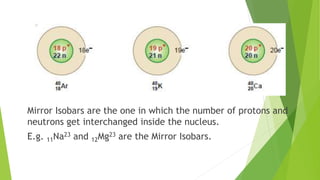
E.g. 11Na23 and 12Mg23; 6C14 and 7N14; 18Ar40, 19K40 and 20Ca40.
Mirror Isobars are the one in which the number of protons and
neutrons get interchanged inside the nucleus.
E.g. 11Na23 and 12Mg23 are the Mirror Isobars.
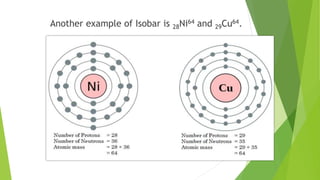
Another example of Isobar is 28Ni64 and 29Cu64.
ISOTONES
Isotones are the atoms of different elements having
same number of neutrons but different atomic number
and mass number .
In case of Isotones, the number of protons (Z) and the
number of nucleons (A) are different but the number of
neutrons (A – Z) is same.
The number of electrons outside the nucleus is also
different.
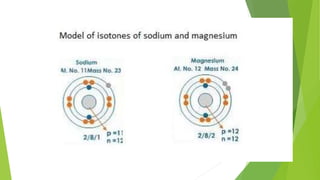
E.g. 11Na23 and 12Mg24; 19K39 and 20Ca40.
RADIOACTIVITY
In 1896, Henry Becquerel accidentally discovered the
phenomenon of Radioactivity.
Initially the radiations given out by uranium salt were called
Becquerel rays but further studies led to following types of
particles/ radiations: -
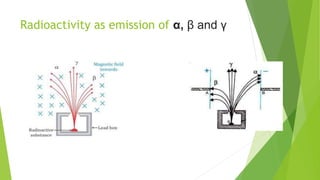
1. Positively charged particle or Alpha particle (α).
2. Negatively charged particle or Beta particle (β).
3. Uncharged radiation or Gamma radiation (γ).
RADIOACTIVE SUBSTANCES
Radioactive substances are the one which
disintegrate or decay by the spontaneous emission
of radiations. E.g. uranium, actinium, polonium,
radium, thorium etc.
In case of isotopes of almost all elements with
atomic number higher than 82, the number of
neutrons inside the nucleus is much more than the
number of protons. So they are radioactive and are
called Natural Radioactive Substances.
Radioactivity is a nuclear phenomenon. It is spontaneous
emission of alpha particle or beta particle and gamma
radiation from the nucleus of atoms during their decay.
Since Radioactivity is a nuclear phenomenon, so any physical
change like changes in pressure and temperature or chemical
change like oxidation, reduction, excessive heating, freezing,
chemical treatment, action of strong electric and magnetic
fields etc., do not affect the nature of radiations emitted by a
radioactive substance and its rate of decay.
Radioactivity is independent of orbital electrons which are
affected by physical and chemical change.
Radioactivity is a random phenomenon, Since it is not
possible to find out which atom will decay out of large no. of
atoms of a radioactive substance.
There is no law available to determine the disintegration of an individual nucleus.
Radioactivity as emission of α, β and γ
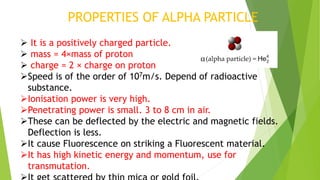
PROPERTIES OF ALPHA PARTICLE
 It is a positively charged particle.
 mass = 4×mass of proton
 charge = 2 × charge on proton
Speed is of the order of 107m/s. Depend of radioactive
substance.
Ionisation power is very high.
Penetrating power is small. 3 to 8 cm in air.
These can be deflected by the electric and magnetic fields.
Deflection is less.
It cause Fluorescence on striking a Fluorescent material.
It has high kinetic energy and momentum, use for
transmutation.
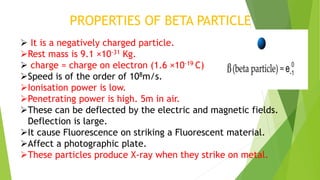
PROPERTIES OF BETA PARTICLE
 It is a negatively charged particle.
Rest mass is 9.1 ×10⁻³¹ Kg.
 charge = charge on electron (1.6 ×10⁻¹⁹ C)
Speed is of the order of 108m/s.
Ionisation power is low.
Penetrating power is high. 5m in air.
These can be deflected by the electric and magnetic fields.
Deflection is large.
It cause Fluorescence on striking a Fluorescent material.
Affect a photographic plate.
These particles produce X-ray when they strike on metal.
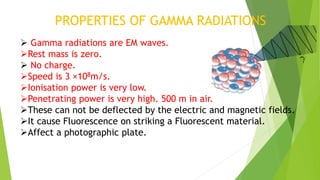
PROPERTIES OF GAMMA RADIATIONS
 Gamma radiations are EM waves.
Rest mass is zero.
 No charge.
Speed is 3 ×10⁸m/s.
Ionisation power is very low.
Penetrating power is very high. 500 m in air.
These can not be deflected by the electric and magnetic fields.
It cause Fluorescence on striking a Fluorescent material.
Affect a photographic plate.
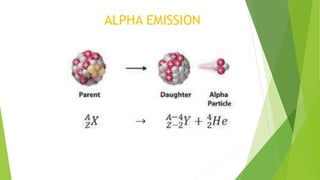
ALPHA EMISSION
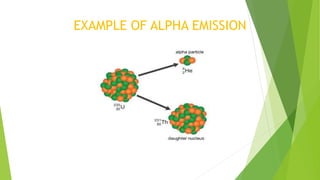
EXAMPLE OF ALPHA EMISSION
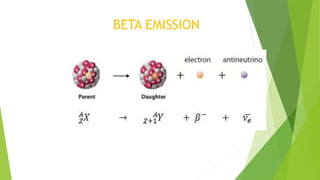
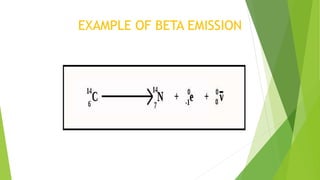
BETA EMISSION
EXAMPLE OF BETA EMISSION
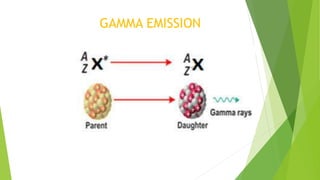
GAMMA EMISSION
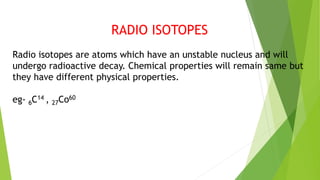
RADIO ISOTOPES
Radio isotopes are atoms which have an unstable nucleus and will
undergo radioactive decay. Chemical properties will remain same but
they have different physical properties.
eg- 6C14 , 27Co60
USES OF RADIOACTIVITY
MEDICAL USE
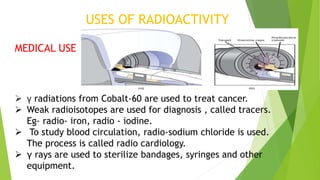
 γ radiations from Cobalt-60 are used to treat cancer.
 Weak radioisotopes are used for diagnosis , called tracers.
Eg- radio- iron, radio - iodine.
 To study blood circulation, radio-sodium chloride is used.
The process is called radio cardiology.
 γ rays are used to sterilize bandages, syringes and other
equipment.
SCIENTIFIC USE
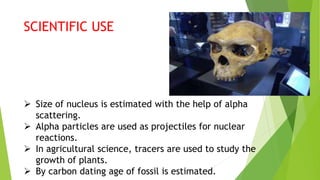
 Size of nucleus is estimated with the help of alpha
scattering.
 Alpha particles are used as projectiles for nuclear
reactions.
 In agricultural science, tracers are used to study the
growth of plants.
 By carbon dating age of fossil is estimated.
INDUSTRIAL USE
 Used as a fuel for atomic energy reactors.
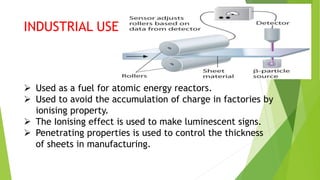
 Used to avoid the accumulation of charge in factories by
ionising property.
 The Ionising effect is used to make luminescent signs.
 Penetrating properties is used to control the thickness
of sheets in manufacturing.
SOURCES OF HARMFUL RADIATIONS
Radioactive fall out from the nuclear power plants- If an accident
happen in a nuclear reactor , a large no of radiations escape to
atmosphere. They will cover a large area through air currents.
Accidents that occurred-
 U.S.A.
 JAPAN
 UKRAINE
Nuclear Waste- Fuel rods- When reactivity decreases these rods
become nuclear waste.
Other sources- Uncharged radiations such as X ray and gamma rays
reach the earth’s atmosphere and affects human beings.
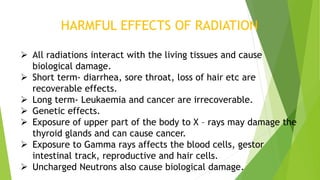
HARMFUL EFFECTS OF RADIATION
 All radiations interact with the living tissues and cause
biological damage.
 Short term- diarrhea, sore throat, loss of hair etc are
recoverable effects.
 Long term- Leukaemia and cancer are irrecoverable.
 Genetic effects.
 Exposure of upper part of the body to X – rays may damage the
thyroid glands and can cause cancer.
 Exposure to Gamma rays affects the blood cells, gestor
intestinal track, reproductive and hair cells.
 Uncharged Neutrons also cause biological damage.
SAFETY PRECAUTIONS
 While establishing a nuclear power plant, ensure there should
be no exposure to harmful rays.
 Nuclear reactor must be shielded properly.
 Nuclear reactor must be at that place which can withstand the
earthquakes, fire and explosion.
 While handling radioactive materials, People should use lead
aprons, gloves and tongs.
 Testing is necessary from time to time to check the amount of
radiations to which a person has been exposed.
 At disposal of nuclear waste- Nuclear waste must be buried in
deep underground stores.
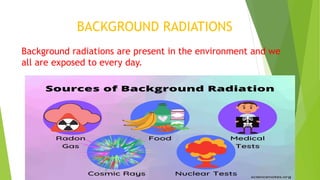
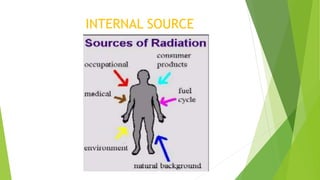
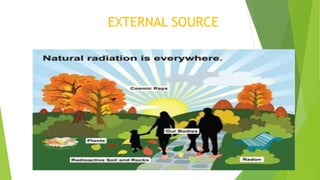
BACKGROUND RADIATIONS
Background radiations are present in the environment and we
all are exposed to every day.
INTERNAL SOURCE
EXTERNAL SOURCE
Radioactivity

Radioactivity

  • 1.
    RADIOACTIVITY By - Mr.Yogesh Puri & Ms. Priya Tyagi
  • 2.
    STRUCTURE OF ATOM Anatom is a sphere of size nearly 10- 10m containing positively charged nucleus at its centre and electrons revolving around the nucleus in certain discrete orbits called stable orbits. Nucleus is of order fermi (i.e., 10-15m) containing positively charged protons and neutral neutrons. The size of the nucleus is around 10-4 to 10-5 times that of an atom.
  • 3.
    Electrons are distributedin various shells like K, L, M,… and maximum number of electrons in a shell = 2n2, where n is the number of shell E.g. K- shell = 2 electrons; L- shell = 8 electrons; M- shell = 18 electrons and so on… Charge on an electron (qe) = - 1.6 x 10⁻¹⁹C Charge on a proton (qp) = + 1.6 x 10⁻¹⁹C Mass of an electron (me) = 9.1 x 10⁻³¹kg Mass of a proton (mp) = 1.67 x 10⁻²⁷kg
  • 4.
    ATOMIC NUMBER Atomic numberof an element is defined as the number of protons present in the nucleus of every atom of that element. Atomic number of an element is also equal to the number of electrons revolving around the nucleus of every atom of that element. Atomic number is generally denoted by Z. Atomic number (Z) = Number of protons (p) = Number of electrons (e-).
  • 5.
    MASS NUMBER Mass numberof an element is defined as the total number of protons and neutrons (also called nucleons) present in the nucleus of an atom of that element. Mass number is also called Atomic Mass Number or Nucleon Number. Mass number is generally denoted by A. Mass number = Number of protons + Number of neutrons i.e., A = p + n
  • 6.
    REPRESENTATION OF ANELEMENT An element X with atomic number Z and mass number A is represented as ZXA. So, Atomic number Z = p = e Mass number A = p + n As a result, Number of neutrons (n) = A – Z E.g. In 6 C14 , we have Z = p = e = 6 and n = A – Z = 14 – 6 = 8
  • 7.
    ATOMIC MODEL An atomis electrically neutral and stable as the numbers of protons present inside the nucleus is numerically equal to the number of electrons revolving around the nucleus. As a result, the net positive charge of the nucleus is balanced by the net negative charge of the electrons.
  • 8.
    An atom hassize of nearly 10-10m which is very small and invisible. Still in order to understand the constituents of an atom, model of atoms of some elements (not to scale) are drawn as follows: - Hydrogen Atom It has one proton inside the nucleus and one electron revolves around the nucleus. In general, it is represented as 1H1.
  • 9.
    Helium Atom It hastwo protons and two neutrons inside the nucleus while two electrons keep revolving around the nucleus. In general, it is represented as 2He4. So p = e = 2 and n = 4 – 2 = 2
  • 10.
    Sodium Atom It haseleven protons and twelve neutrons inside the nucleus while eleven electrons keep revolving around the nucleus. In general, it is represented as 11Na23. So p = e = 11 and n = 23 – 11 = 12
  • 11.
    ISOTOPES Isotopes are theatoms of the same element having same atomic number and different mass number. The number of protons and electrons (Z = p =e) in case of Isotopes are same but the number of neutrons (A – Z) are different. Since the number of electrons outside the nucleus is same so Isotopes have same chemical properties.
  • 12.
    EXAMPLES OF ISOTOPES Hydrogenhas three isotopes: - 1H1, 1H2 and 1H3.
  • 13.
    Carbon has threeisotopes: - 6C12, 6C13 and 6C14.
  • 14.
    Chlorine has twoisotopes: - 17Cl35 and 17Cl37.
  • 15.
    Tin has largestnumber of isotopes i.e., 10 isotopes. Isotopes can be classified as: - (A). Stable Isotopes- These are the one in which the number of neutrons are nearly equal to the number of protons inside their nucleus. (B). Unstable or Radioactive Isotopes- These are the one in which the number of neutrons are greater than the number of protons inside their nucleus. Since Unstable or Radioactive Isotopes undergo radioactive decay so they find application in industries and medical science.
  • 16.
    ISOBARS Isobars are theatoms of different elements having same mass number but different atomic number. In case of Isobars, the number of protons (Z) and the number of neutrons (A – Z) are different but number of nucleons (A) is same. The number of electrons outside the nucleus is also different. E.g. 11Na23 and 12Mg23; 6C14 and 7N14; 18Ar40, 19K40 and 20Ca40.
  • 17.
    Mirror Isobars arethe one in which the number of protons and neutrons get interchanged inside the nucleus. E.g. 11Na23 and 12Mg23 are the Mirror Isobars.
  • 18.
    Another example ofIsobar is 28Ni64 and 29Cu64.
  • 19.
    ISOTONES Isotones are theatoms of different elements having same number of neutrons but different atomic number and mass number . In case of Isotones, the number of protons (Z) and the number of nucleons (A) are different but the number of neutrons (A – Z) is same. The number of electrons outside the nucleus is also different. E.g. 11Na23 and 12Mg24; 19K39 and 20Ca40.
  • 22.
    RADIOACTIVITY In 1896, HenryBecquerel accidentally discovered the phenomenon of Radioactivity. Initially the radiations given out by uranium salt were called Becquerel rays but further studies led to following types of particles/ radiations: - 1. Positively charged particle or Alpha particle (α). 2. Negatively charged particle or Beta particle (β). 3. Uncharged radiation or Gamma radiation (γ).
  • 23.
    RADIOACTIVE SUBSTANCES Radioactive substancesare the one which disintegrate or decay by the spontaneous emission of radiations. E.g. uranium, actinium, polonium, radium, thorium etc. In case of isotopes of almost all elements with atomic number higher than 82, the number of neutrons inside the nucleus is much more than the number of protons. So they are radioactive and are called Natural Radioactive Substances.
  • 24.
    Radioactivity is anuclear phenomenon. It is spontaneous emission of alpha particle or beta particle and gamma radiation from the nucleus of atoms during their decay. Since Radioactivity is a nuclear phenomenon, so any physical change like changes in pressure and temperature or chemical change like oxidation, reduction, excessive heating, freezing, chemical treatment, action of strong electric and magnetic fields etc., do not affect the nature of radiations emitted by a radioactive substance and its rate of decay. Radioactivity is independent of orbital electrons which are affected by physical and chemical change.
  • 25.
    Radioactivity is arandom phenomenon, Since it is not possible to find out which atom will decay out of large no. of atoms of a radioactive substance. There is no law available to determine the disintegration of an individual nucleus.
  • 26.
    Radioactivity as emissionof α, β and γ
  • 27.
    PROPERTIES OF ALPHAPARTICLE  It is a positively charged particle.  mass = 4×mass of proton  charge = 2 × charge on proton Speed is of the order of 107m/s. Depend of radioactive substance. Ionisation power is very high. Penetrating power is small. 3 to 8 cm in air. These can be deflected by the electric and magnetic fields. Deflection is less. It cause Fluorescence on striking a Fluorescent material. It has high kinetic energy and momentum, use for transmutation.
  • 28.
    PROPERTIES OF BETAPARTICLE  It is a negatively charged particle. Rest mass is 9.1 ×10⁻³¹ Kg.  charge = charge on electron (1.6 ×10⁻¹⁹ C) Speed is of the order of 108m/s. Ionisation power is low. Penetrating power is high. 5m in air. These can be deflected by the electric and magnetic fields. Deflection is large. It cause Fluorescence on striking a Fluorescent material. Affect a photographic plate. These particles produce X-ray when they strike on metal.
  • 29.
    PROPERTIES OF GAMMARADIATIONS  Gamma radiations are EM waves. Rest mass is zero.  No charge. Speed is 3 ×10⁸m/s. Ionisation power is very low. Penetrating power is very high. 500 m in air. These can not be deflected by the electric and magnetic fields. It cause Fluorescence on striking a Fluorescent material. Affect a photographic plate.
  • 30.
  • 31.
  • 32.
  • 33.
  • 34.
  • 35.
    RADIO ISOTOPES Radio isotopesare atoms which have an unstable nucleus and will undergo radioactive decay. Chemical properties will remain same but they have different physical properties. eg- 6C14 , 27Co60
  • 36.
    USES OF RADIOACTIVITY MEDICALUSE  γ radiations from Cobalt-60 are used to treat cancer.  Weak radioisotopes are used for diagnosis , called tracers. Eg- radio- iron, radio - iodine.  To study blood circulation, radio-sodium chloride is used. The process is called radio cardiology.  γ rays are used to sterilize bandages, syringes and other equipment.
  • 37.
    SCIENTIFIC USE  Sizeof nucleus is estimated with the help of alpha scattering.  Alpha particles are used as projectiles for nuclear reactions.  In agricultural science, tracers are used to study the growth of plants.  By carbon dating age of fossil is estimated.
  • 38.
    INDUSTRIAL USE  Usedas a fuel for atomic energy reactors.  Used to avoid the accumulation of charge in factories by ionising property.  The Ionising effect is used to make luminescent signs.  Penetrating properties is used to control the thickness of sheets in manufacturing.
  • 39.
    SOURCES OF HARMFULRADIATIONS Radioactive fall out from the nuclear power plants- If an accident happen in a nuclear reactor , a large no of radiations escape to atmosphere. They will cover a large area through air currents. Accidents that occurred-  U.S.A.  JAPAN  UKRAINE Nuclear Waste- Fuel rods- When reactivity decreases these rods become nuclear waste. Other sources- Uncharged radiations such as X ray and gamma rays reach the earth’s atmosphere and affects human beings.
  • 40.
    HARMFUL EFFECTS OFRADIATION  All radiations interact with the living tissues and cause biological damage.  Short term- diarrhea, sore throat, loss of hair etc are recoverable effects.  Long term- Leukaemia and cancer are irrecoverable.  Genetic effects.  Exposure of upper part of the body to X – rays may damage the thyroid glands and can cause cancer.  Exposure to Gamma rays affects the blood cells, gestor intestinal track, reproductive and hair cells.  Uncharged Neutrons also cause biological damage.
  • 41.
    SAFETY PRECAUTIONS  Whileestablishing a nuclear power plant, ensure there should be no exposure to harmful rays.  Nuclear reactor must be shielded properly.  Nuclear reactor must be at that place which can withstand the earthquakes, fire and explosion.  While handling radioactive materials, People should use lead aprons, gloves and tongs.  Testing is necessary from time to time to check the amount of radiations to which a person has been exposed.  At disposal of nuclear waste- Nuclear waste must be buried in deep underground stores.
  • 42.
    BACKGROUND RADIATIONS Background radiationsare present in the environment and we all are exposed to every day.
  • 43.
  • 44.