• Mass:
  As an object is moved around the Earth it is the
  same object, made of the same molecules in the
  same order and that something about it remains
  constant. This is the amount of matter or “stuff”
  it contains.

  This unchanging quantity is called the mass and
  is measured in kilograms. It is the quantity one
  is usually interested in when buying, say, fruit or
  vegetables.
4b. State that mass of a body resists change
from its state of rest or motion.

• mass determines how difficult it is to change the
  motion of a body (e.g. to speed it up) and that is
  because it determines the inertia of the body.

• Its here we will talk about inertia:
• Inertia: is the resistance of any physical object to a
  change in its state of motion or rest, or the tendency
  of an object to resist any change in its motion. It is
  proportional to an object's mass.
• Lets have a look at a video to understand this
  concept:
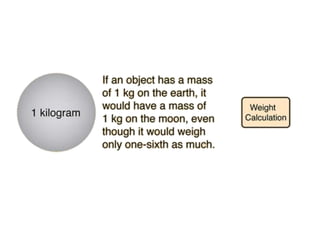
• Weight:
  The weight of an object is the force of gravity
  on the object and may be defined as the mass
  times the acceleration of gravity, w = mg.
  Since the weight is a force, its SI unit is the
  newton.
4c. State that a gravitational field is a region in which a
mass experiences a force due to gravitational
attraction.
Gravity Fields
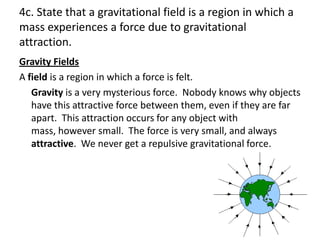
A field is a region in which a force is felt.
   Gravity is a very mysterious force. Nobody knows why objects
   have this attractive force between them, even if they are far
   apart. This attraction occurs for any object with
   mass, however small. The force is very small, and always
   attractive. We never get a repulsive gravitational force.
• As an object journeys around the Solar System, the force of
  attraction to the nearest planet changes with the planet’s
  proximity and mass.

• On Earth this force is approximately 10 N for every kilogram of the
  object’s mass. Emphasise that it varies according to height above
  sea-level (the actual value is between 9.79 N/kg and 9.83 N/kg).

• At this stage an appropriate “definition” of the Newton is “the
  weight of an average apple” – use a fruit or vegetable that the
  pupils will be most familiar with.

• If the mass of 1 APPLE IS 20 GRAMS, WHAT DO YOU THINK WOULD
  BE ITS WEIGHT IN NEWTONS; (taking g=9.81m/s2)
4(d) Calculate the weight from the equation:
weight = mass x gravitational field strength.

•   Mass of 15 kg,
                          2
•   Weight=15 Kg x 10m/s =150 N
•   Mass 100g
•   100g100/1000=0.1 Kg
•   Weight=0.1 Kg x 10=1 N

• Weight mass comparison
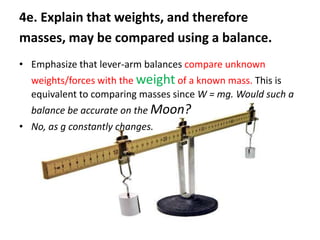
4e. Explain that weights, and therefore
masses, may be compared using a balance.
• Emphasize that lever-arm balances compare unknown
  weights/forces with the weight of a known mass. This is
  equivalent to comparing masses since W = mg. Would such a
  balance be accurate on the Moon?
• No, as g constantly changes.
4f. Describe how to measure mass and weight by
using appropriate balances.

   Spring balance:
• A spring balance is used to weigh things. An object placed
  on it will compress or bend a spring to a degree that depends
  upon the amount of weight, which can thereby be measured.
  The typical bathroom scale is an example of a spring balance.

• Spring balances measure the weight and deduce the mass assuming that
  g = 10 N/kg. Is this a valid assumption on the Moon?
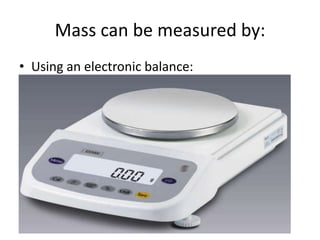
Mass can be measured by:
• Using an electronic balance:
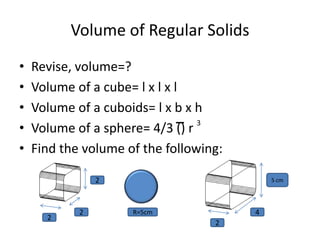
Volume of Regular Solids
•   Revise, volume=?
•   Volume of a cube= l x l x l
•   Volume of a cuboids= l x b x h
                                 3
•   Volume of a sphere= 4/3 () r
•   Find the volume of the following:

                2                           5 cm


            2        R=5cm              4
      2
                                   2
volume of a liquid?


Volume of Liquids:
• Recall SI unit of volume is m , another popular unit
      3                     3
  is, cm , liters, milli liters.

• You usually hear that your nestle bottle that you put on
  the dispenser is 20 liters, hence usually the volume of
  liquids is represented in liters, while that of solids is
  represented in meters cube or cm cube.
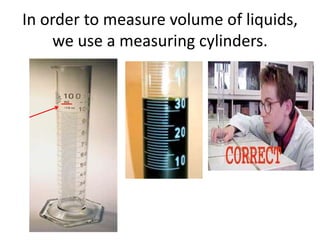
In order to measure volume of liquids,
    we use a measuring cylinders.
• How do we measure the volume of bolts and pebbles and coins?
• In short, volume of irregular solids:

Ans.=
1. Fill half of the measuring cylinder with water.
2. Note down the reading (volume), V1
3. Immerse a pebble in the cylinder.
4. Note down the reading (volume), V2
5. Volume of pebble= V2-V1


You will notice that your volume is in ml, we will use our knowledge
                    3
    that 1 ml=1cm

• Does immersion in oil give a different value?
• No! Since the change would remain the same in both liquids.
4h. Describe how to determine the density of a liquid, of a
regularly shaped solid and of an irregularly shaped solid which
sinks in water (volume by displacement).

Density of Regular Solids:

Calculate Mass:

Use one of the apparatus to compute the mass of regular objects:
1. Spring balance (weight  mass)
2. Lever arm balance (weight  mass)
3. Electronic balance (mass)

Calculate Volume: using formula if you know it!

Calculate Density:
                         3
Density=Mass/volume= kg/m
(in proper SI units)
Density of irregular solids:

Calculate Mass:

Use one of the apparatus to compute the mass of irregular objects:
1. Spring balance (weight  mass)
2. Lever arm balance (weight  mass)
3. Electronic balance (mass)

Calculate Volume:

By immersing them in measuring cylinders as discussed.

Calculate Density:

Density=Mass/volume= kg/m3
Density of Liquids:
Calculate Mass:

1.   Take a measuring cylinder and measure its mass using: Spring balance, Lever arm
     balance, Electronic balance
2.   Fill it with the liquid in question
3.   Measure the mass of the filled cylinder just the way you did in step 1.
4.   Subtract the value obtained in step 3 with the value obtained in step 1.
5.   This is your mass.

Calculate Volume:

Measure the volume using a measuring cylinder.

Calculate Density:

Density=Mass/volume= kg/m3
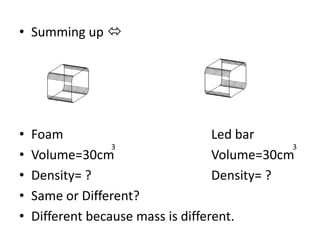
• Summing up 


•   Foam                            Led bar
                  3                            3
•   Volume=30cm                     Volume=30cm
•   Density= ?                      Density= ?
•   Same or Different?
•   Different because mass is different.
END

Weight massdensity

  • 2.
    • Mass: As an object is moved around the Earth it is the same object, made of the same molecules in the same order and that something about it remains constant. This is the amount of matter or “stuff” it contains. This unchanging quantity is called the mass and is measured in kilograms. It is the quantity one is usually interested in when buying, say, fruit or vegetables.
  • 4.
    4b. State thatmass of a body resists change from its state of rest or motion. • mass determines how difficult it is to change the motion of a body (e.g. to speed it up) and that is because it determines the inertia of the body. • Its here we will talk about inertia: • Inertia: is the resistance of any physical object to a change in its state of motion or rest, or the tendency of an object to resist any change in its motion. It is proportional to an object's mass.
  • 5.
    • Lets havea look at a video to understand this concept:
  • 6.
    • Weight: The weight of an object is the force of gravity on the object and may be defined as the mass times the acceleration of gravity, w = mg. Since the weight is a force, its SI unit is the newton.
  • 7.
    4c. State thata gravitational field is a region in which a mass experiences a force due to gravitational attraction. Gravity Fields A field is a region in which a force is felt. Gravity is a very mysterious force. Nobody knows why objects have this attractive force between them, even if they are far apart. This attraction occurs for any object with mass, however small. The force is very small, and always attractive. We never get a repulsive gravitational force.
  • 8.
    • As anobject journeys around the Solar System, the force of attraction to the nearest planet changes with the planet’s proximity and mass. • On Earth this force is approximately 10 N for every kilogram of the object’s mass. Emphasise that it varies according to height above sea-level (the actual value is between 9.79 N/kg and 9.83 N/kg). • At this stage an appropriate “definition” of the Newton is “the weight of an average apple” – use a fruit or vegetable that the pupils will be most familiar with. • If the mass of 1 APPLE IS 20 GRAMS, WHAT DO YOU THINK WOULD BE ITS WEIGHT IN NEWTONS; (taking g=9.81m/s2)
  • 9.
    4(d) Calculate theweight from the equation: weight = mass x gravitational field strength. • Mass of 15 kg, 2 • Weight=15 Kg x 10m/s =150 N • Mass 100g • 100g100/1000=0.1 Kg • Weight=0.1 Kg x 10=1 N • Weight mass comparison
  • 10.
    4e. Explain thatweights, and therefore masses, may be compared using a balance. • Emphasize that lever-arm balances compare unknown weights/forces with the weight of a known mass. This is equivalent to comparing masses since W = mg. Would such a balance be accurate on the Moon? • No, as g constantly changes.
  • 11.
    4f. Describe howto measure mass and weight by using appropriate balances. Spring balance: • A spring balance is used to weigh things. An object placed on it will compress or bend a spring to a degree that depends upon the amount of weight, which can thereby be measured. The typical bathroom scale is an example of a spring balance. • Spring balances measure the weight and deduce the mass assuming that g = 10 N/kg. Is this a valid assumption on the Moon?
  • 12.
    Mass can bemeasured by: • Using an electronic balance:
  • 13.
    Volume of RegularSolids • Revise, volume=? • Volume of a cube= l x l x l • Volume of a cuboids= l x b x h 3 • Volume of a sphere= 4/3 () r • Find the volume of the following: 2 5 cm 2 R=5cm 4 2 2
  • 14.
    volume of aliquid? Volume of Liquids: • Recall SI unit of volume is m , another popular unit 3 3 is, cm , liters, milli liters. • You usually hear that your nestle bottle that you put on the dispenser is 20 liters, hence usually the volume of liquids is represented in liters, while that of solids is represented in meters cube or cm cube.
  • 15.
    In order tomeasure volume of liquids, we use a measuring cylinders.
  • 16.
    • How dowe measure the volume of bolts and pebbles and coins? • In short, volume of irregular solids: Ans.= 1. Fill half of the measuring cylinder with water. 2. Note down the reading (volume), V1 3. Immerse a pebble in the cylinder. 4. Note down the reading (volume), V2 5. Volume of pebble= V2-V1 You will notice that your volume is in ml, we will use our knowledge 3 that 1 ml=1cm • Does immersion in oil give a different value? • No! Since the change would remain the same in both liquids.
  • 17.
    4h. Describe howto determine the density of a liquid, of a regularly shaped solid and of an irregularly shaped solid which sinks in water (volume by displacement). Density of Regular Solids: Calculate Mass: Use one of the apparatus to compute the mass of regular objects: 1. Spring balance (weight  mass) 2. Lever arm balance (weight  mass) 3. Electronic balance (mass) Calculate Volume: using formula if you know it! Calculate Density: 3 Density=Mass/volume= kg/m (in proper SI units)
  • 18.
    Density of irregularsolids: Calculate Mass: Use one of the apparatus to compute the mass of irregular objects: 1. Spring balance (weight  mass) 2. Lever arm balance (weight  mass) 3. Electronic balance (mass) Calculate Volume: By immersing them in measuring cylinders as discussed. Calculate Density: Density=Mass/volume= kg/m3
  • 19.
    Density of Liquids: CalculateMass: 1. Take a measuring cylinder and measure its mass using: Spring balance, Lever arm balance, Electronic balance 2. Fill it with the liquid in question 3. Measure the mass of the filled cylinder just the way you did in step 1. 4. Subtract the value obtained in step 3 with the value obtained in step 1. 5. This is your mass. Calculate Volume: Measure the volume using a measuring cylinder. Calculate Density: Density=Mass/volume= kg/m3
  • 20.
    • Summing up • Foam Led bar 3 3 • Volume=30cm Volume=30cm • Density= ? Density= ? • Same or Different? • Different because mass is different.
  • 21.

Editor's Notes

  • #10 Tell them to bring their tests back.
  • #11 Lever-arm balances: http://edinfo.securesites.net/math_science/mass_weight.htm
  • #15 Measuring cylinders: http://www.saburchill.com/chemistry/chapters/chap0021.html 4g. Describe how to use a measuring cylinder to measure the volume of a liquid or solid.
  • #18 Density: http://www.nyu.edu/pages/mathmol/modules/water/density_intro.html