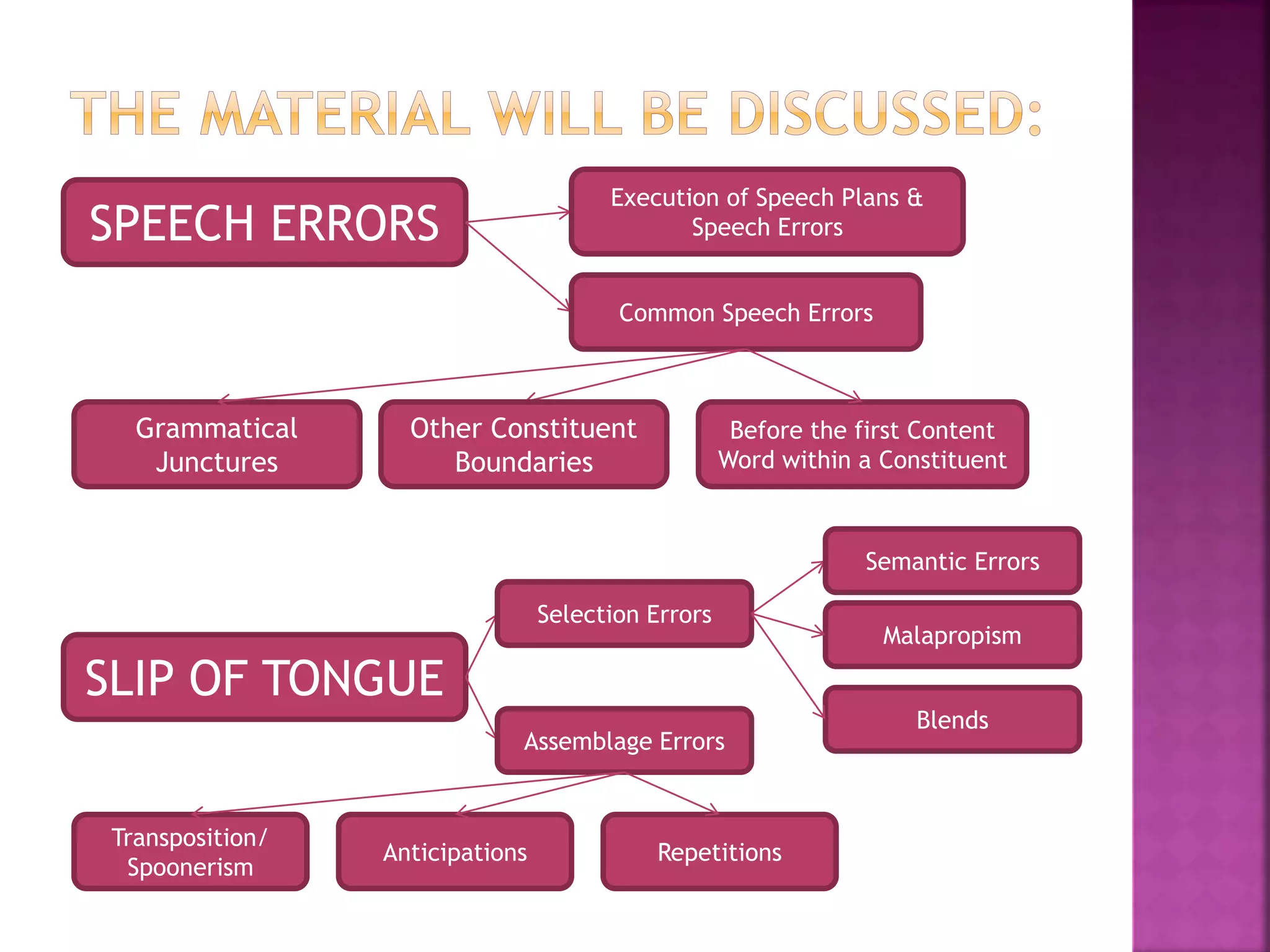
SPEECH ERRORS
SLIP OF TONGUE
Execution of Speech Plans &
Speech Errors
Common Speech Errors
Selection Errors
Assemblage Errors
Other Constituent
Boundaries
Before the first Content
Word within a Constituent
Grammatical
Junctures
Transposition/
Spoonerism
Anticipations Repetitions
Semantic Errors
Malapropism
Blends
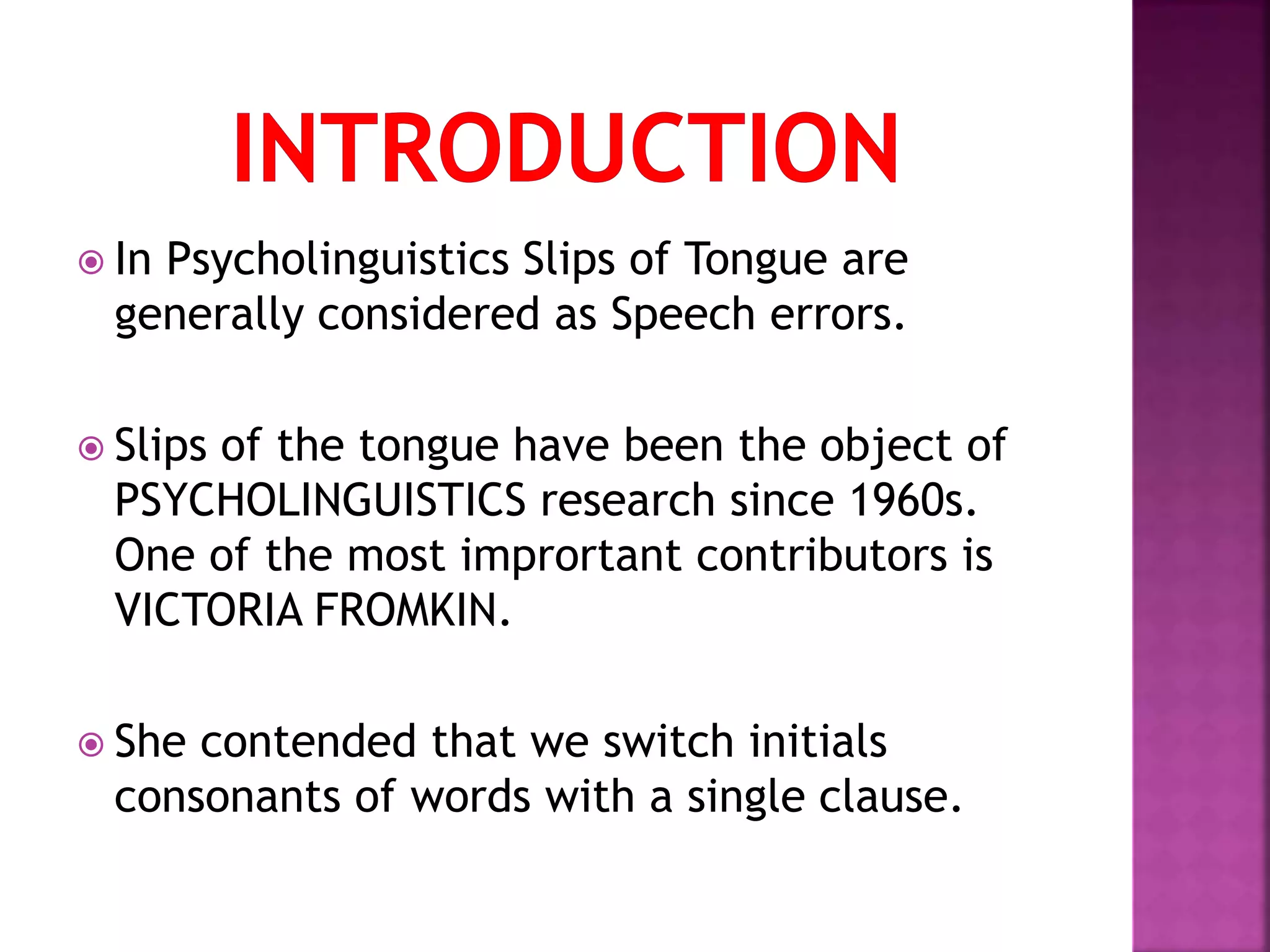
 In Psycholinguistics Slips of Tongue are
generally considered as Speech errors.
 Slips of the tongue have been the object of
PSYCHOLINGUISTICS research since 1960s.
One of the most imprortant contributors is
VICTORIA FROMKIN.
 She contended that we switch initials
consonants of words with a single clause.
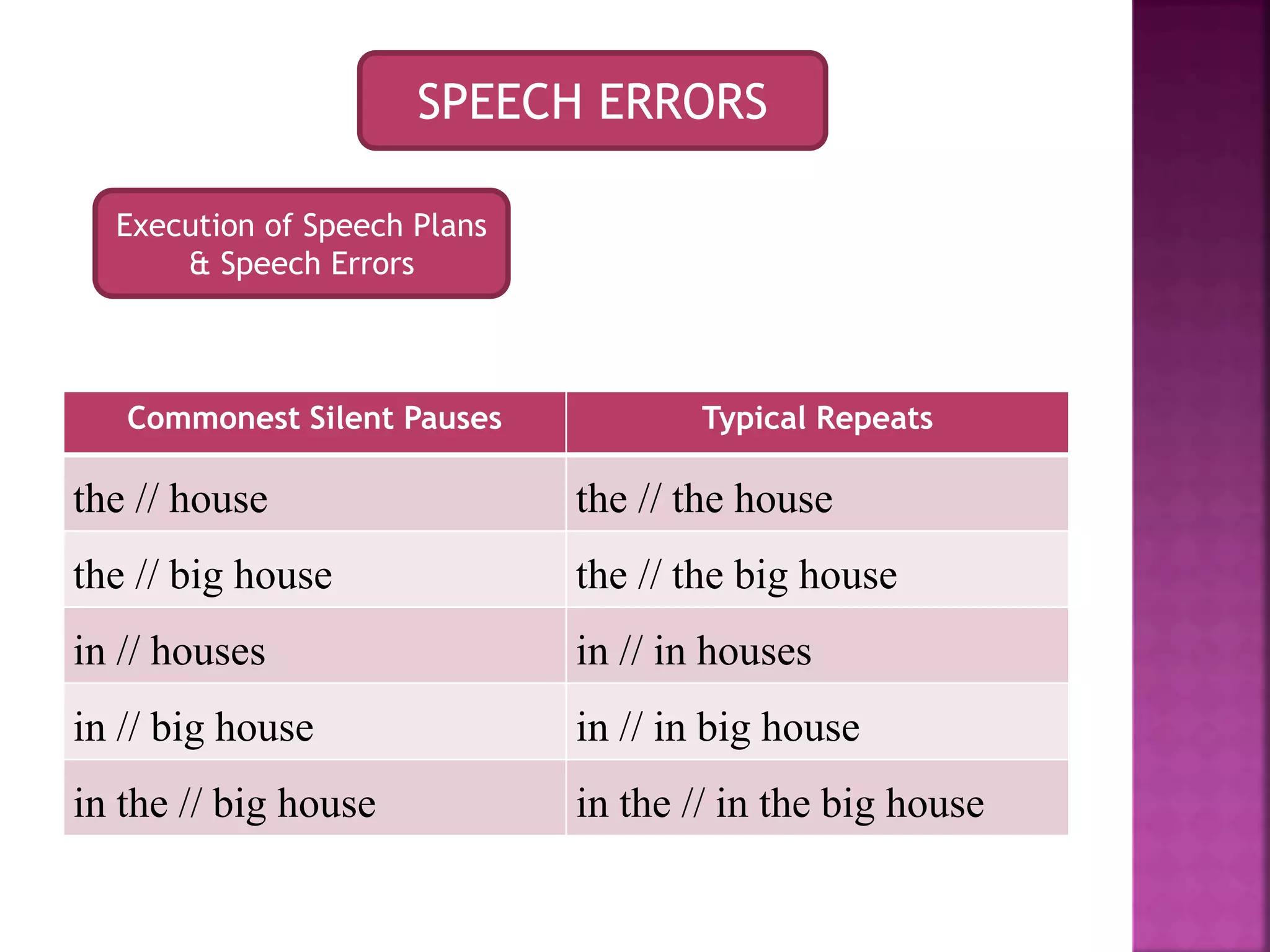
Commonest Silent Pauses Typical Repeats
the // house the // the house
the // big house the // the big house
in // houses in // in houses
in // big house in // in big house
in the // big house in the // in the big house
SPEECH ERRORS
Execution of Speech Plans
& Speech Errors
Common Speech Errors
SPEECH ERRORS
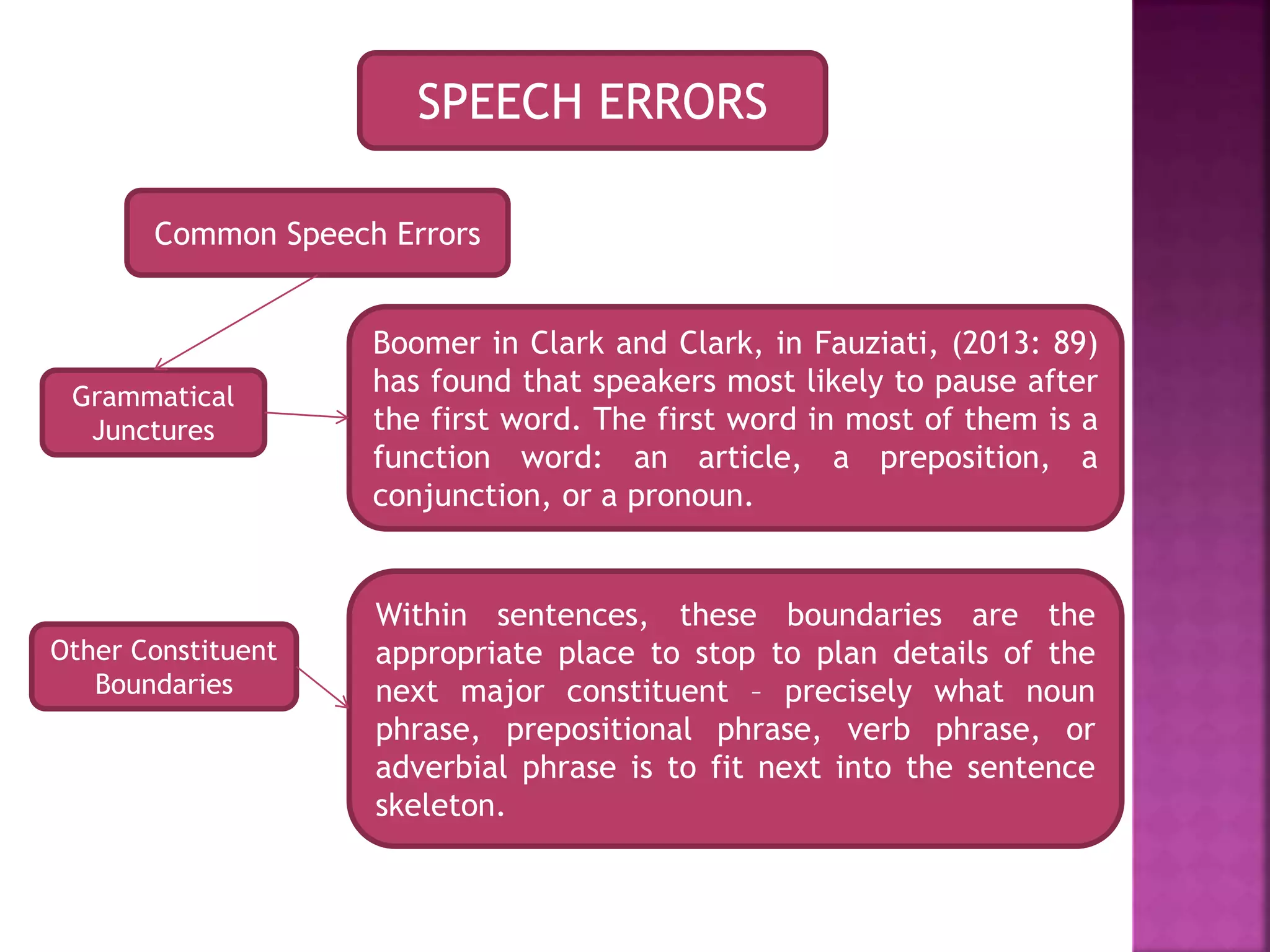
Grammatical
Junctures
Boomer in Clark and Clark, in Fauziati, (2013: 89)
has found that speakers most likely to pause after
the first word. The first word in most of them is a
function word: an article, a preposition, a
conjunction, or a pronoun.
Other Constituent
Boundaries
Within sentences, these boundaries are the
appropriate place to stop to plan details of the
next major constituent – precisely what noun
phrase, prepositional phrase, verb phrase, or
adverbial phrase is to fit next into the sentence
skeleton.
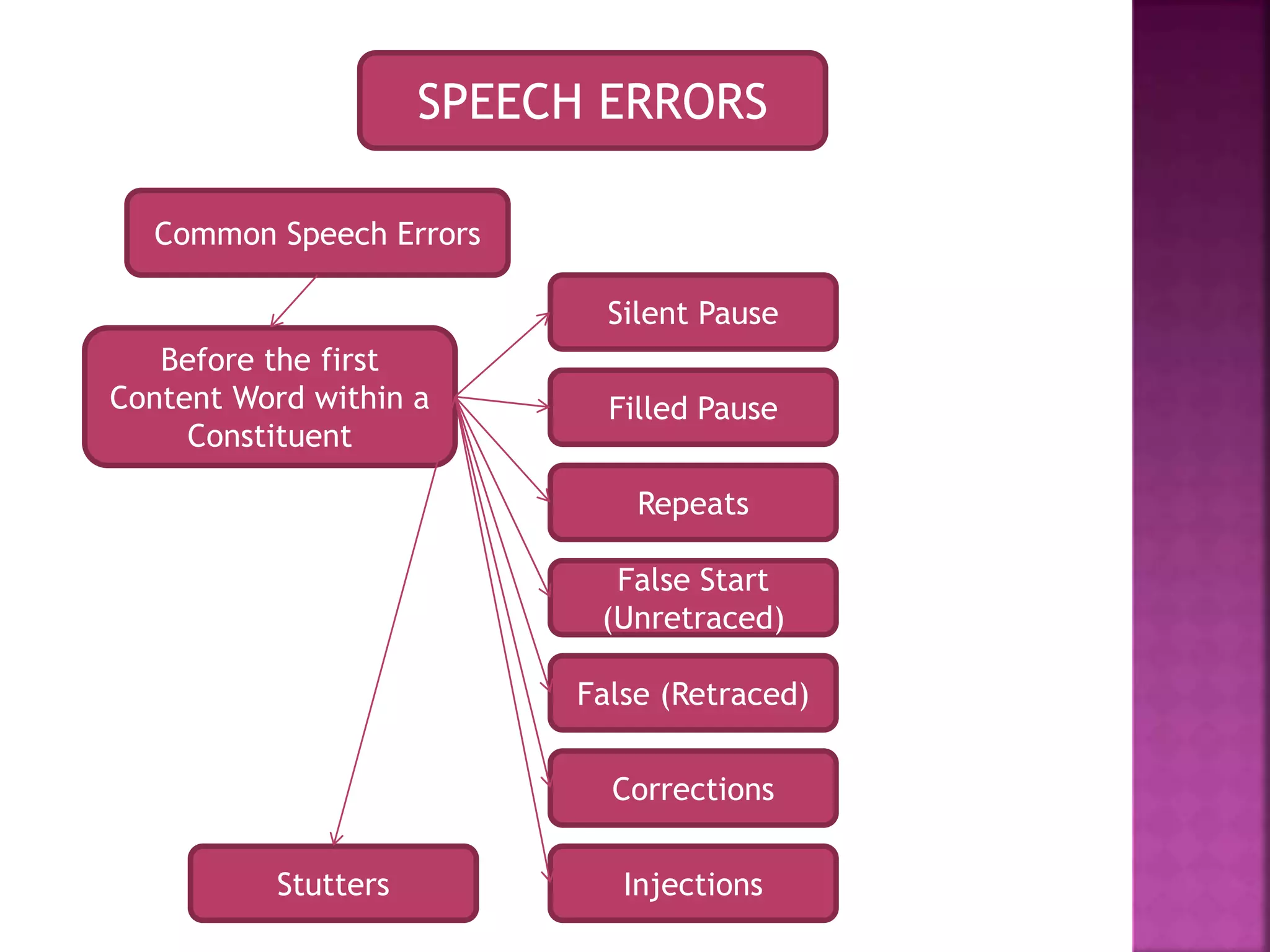
Before the first
Content Word within a
Constituent
SPEECH ERRORS
Common Speech Errors
Silent Pause
Filled Pause
Repeats
False Start
(Unretraced)
False (Retraced)
Corrections
InjectionsStutters
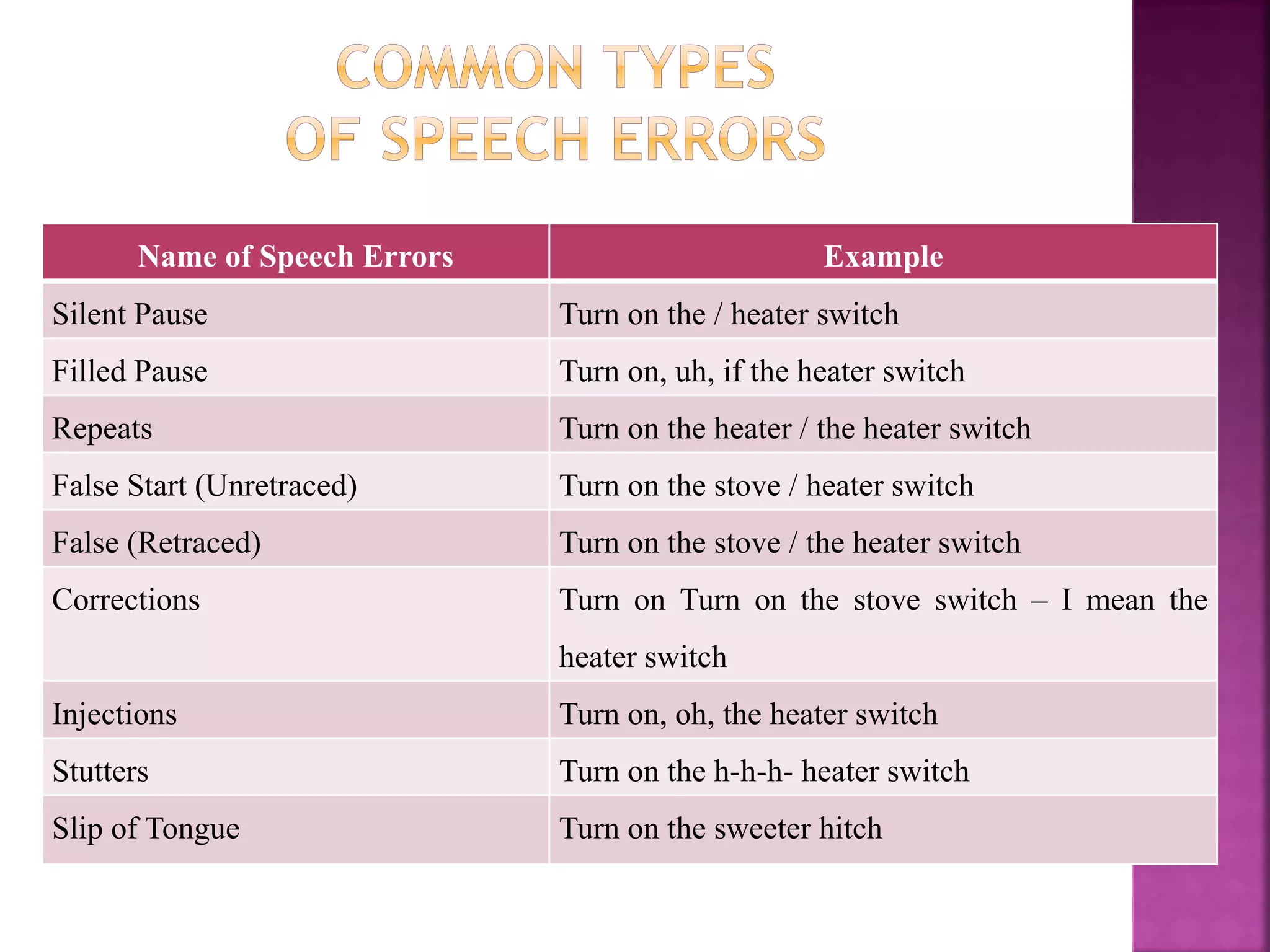
Name of Speech Errors Example
Silent Pause Turn on the / heater switch
Filled Pause Turn on, uh, if the heater switch
Repeats Turn on the heater / the heater switch
False Start (Unretraced) Turn on the stove / heater switch
False (Retraced) Turn on the stove / the heater switch
Corrections Turn on Turn on the stove switch – I mean the
heater switch
Injections Turn on, oh, the heater switch
Stutters Turn on the h-h-h- heater switch
Slip of Tongue Turn on the sweeter hitch
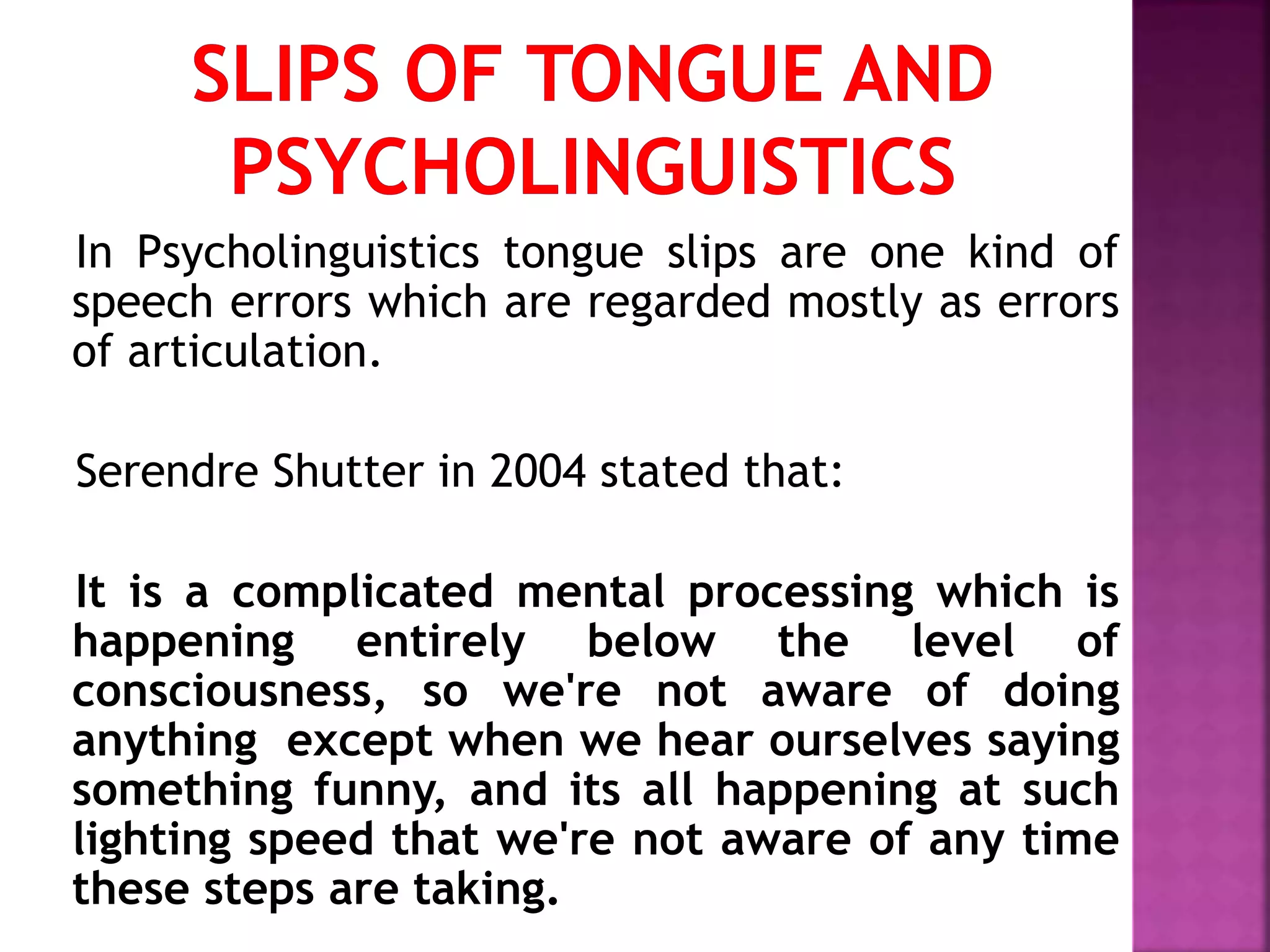
In Psycholinguistics tongue slips are one kind of
speech errors which are regarded mostly as errors
of articulation.
Serendre Shutter in 2004 stated that:
It is a complicated mental processing which is
happening entirely below the level of
consciousness, so we're not aware of doing
anything except when we hear ourselves saying
something funny, and its all happening at such
lighting speed that we're not aware of any time
these steps are taking.
William A. Spooner (1844-1930), a famous lecturer at
Oxford University to whom many slips of the
tongue have been attributed. For this reason, slips
of the tongue are sometimes called Spoonerisms.
SPOONERISMS: is the transposition of initial
consonants in a pair of words.
Examples:
(1) Intended: You have wasted the whole term
Said: You have tasted the whole worm
(2) Intended: The dear old Queen
Said: The queer old dean
 This suggests that there is pre-planning of
an utterance: speakers have a „mental
image” of an utterance before they even
start producing it.
 Victoria Fromkin Said that:
“Slips of the tongue are often the result of a
sound being carried over from one word to the
next”
 Although the slips are mostly treated as errors of
articulation, it has been suggested that they may
result from ‘slips of the brain’ as it tries to organize
linguistic messages.
 Tongue slips can be classified into two
categories : the major category and the
secondary category.
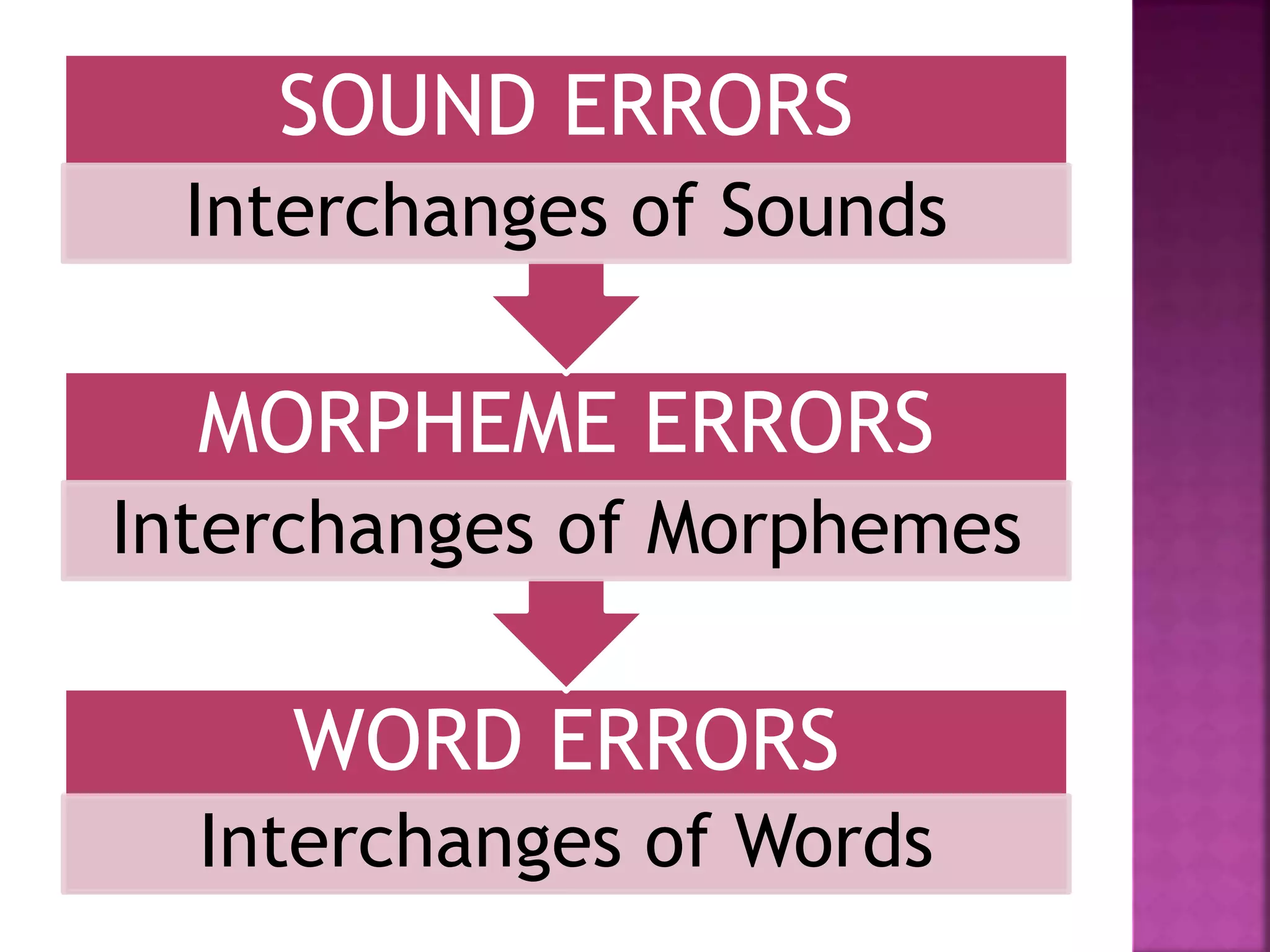
 Smith (2003:1) identifies three levels of
tongue slips, they are as follows:
WORD ERRORS
Interchanges of Words
MORPHEME ERRORS
Interchanges of Morphemes
SOUND ERRORS
Interchanges of Sounds
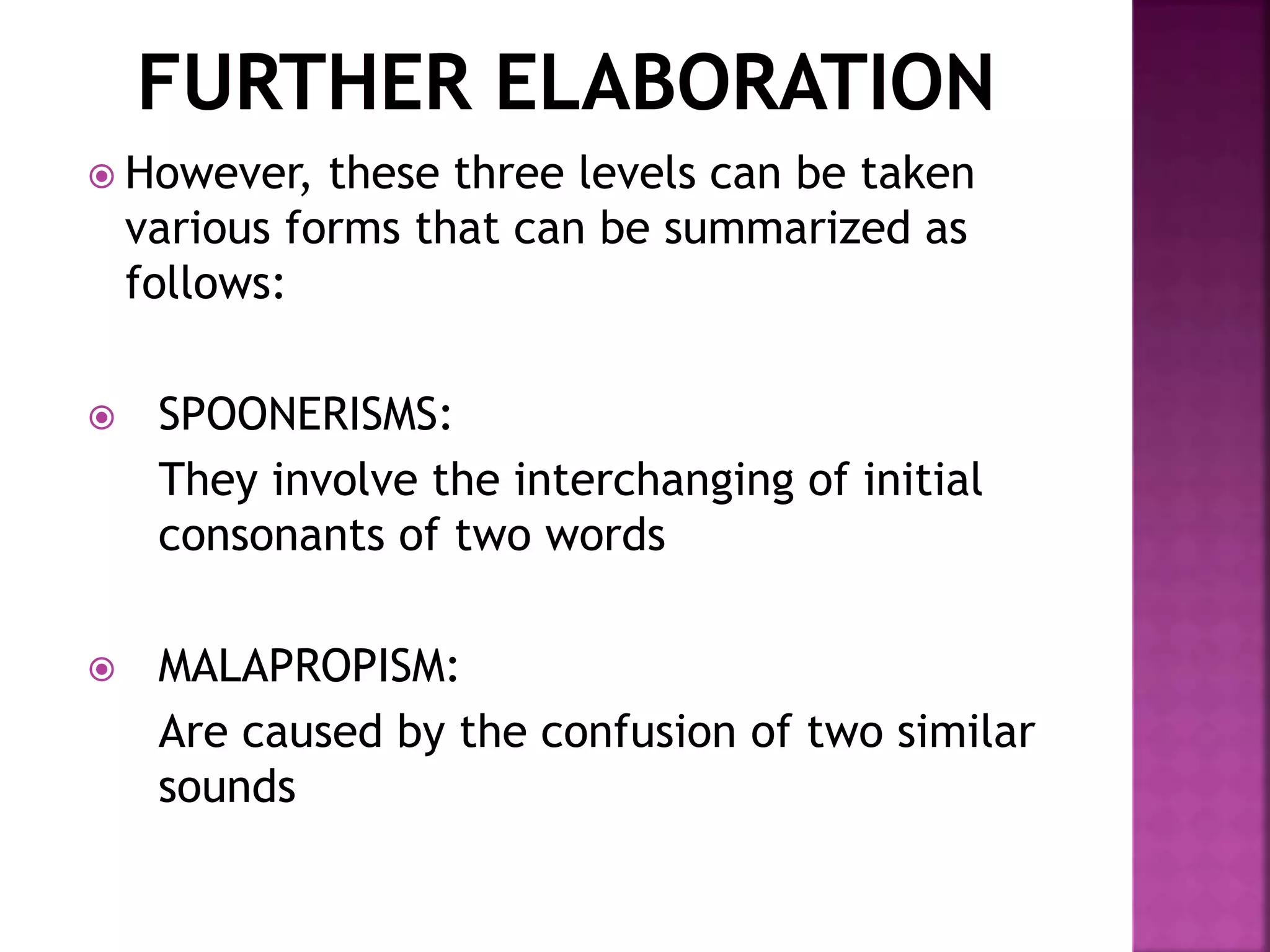
 However, these three levels can be taken
various forms that can be summarized as
follows:
 SPOONERISMS:
They involve the interchanging of initial
consonants of two words
 MALAPROPISM:
Are caused by the confusion of two similar
sounds
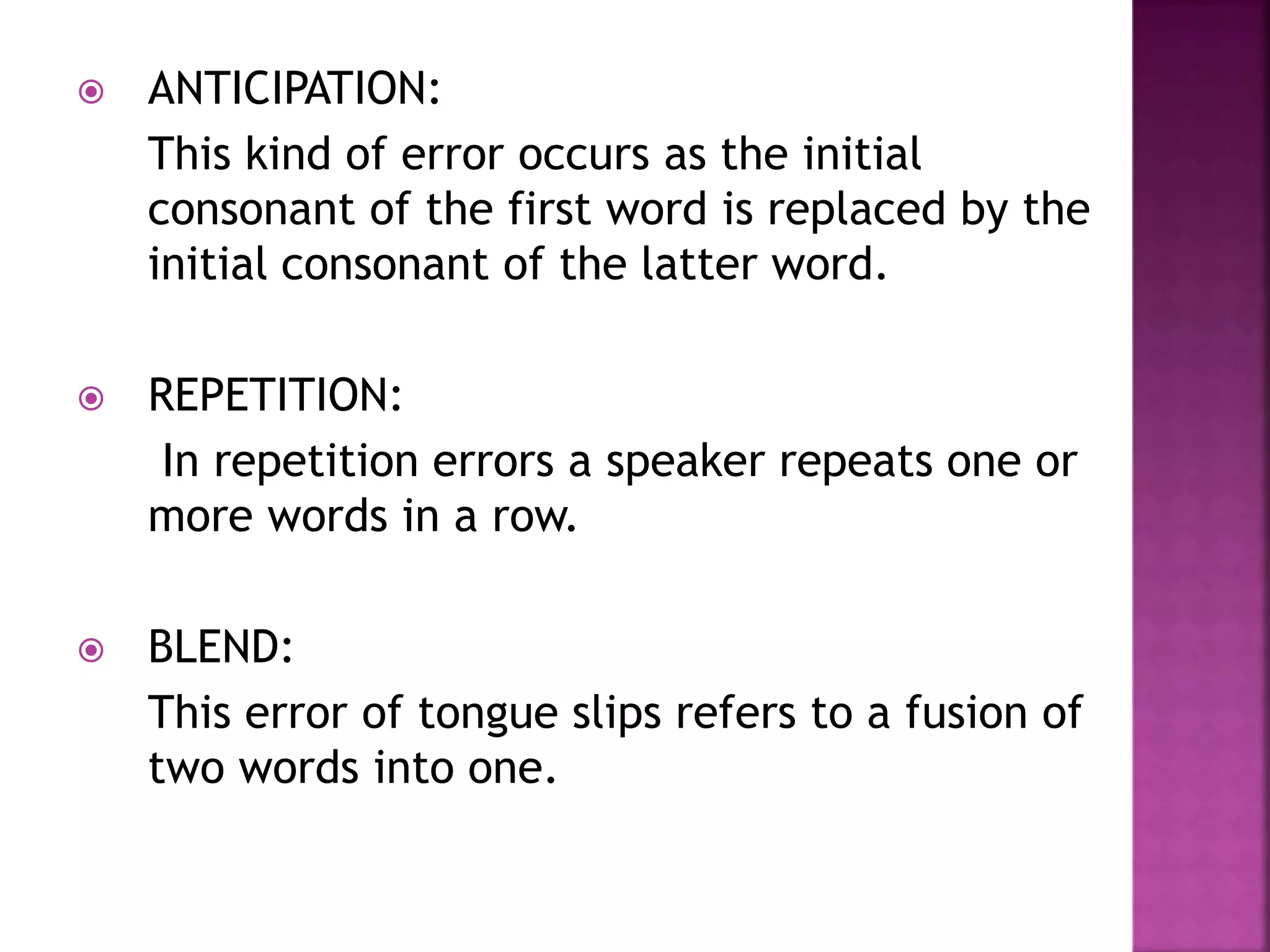
 ANTICIPATION:
This kind of error occurs as the initial
consonant of the first word is replaced by the
initial consonant of the latter word.
 REPETITION:
In repetition errors a speaker repeats one or
more words in a row.
 BLEND:
This error of tongue slips refers to a fusion of
two words into one.
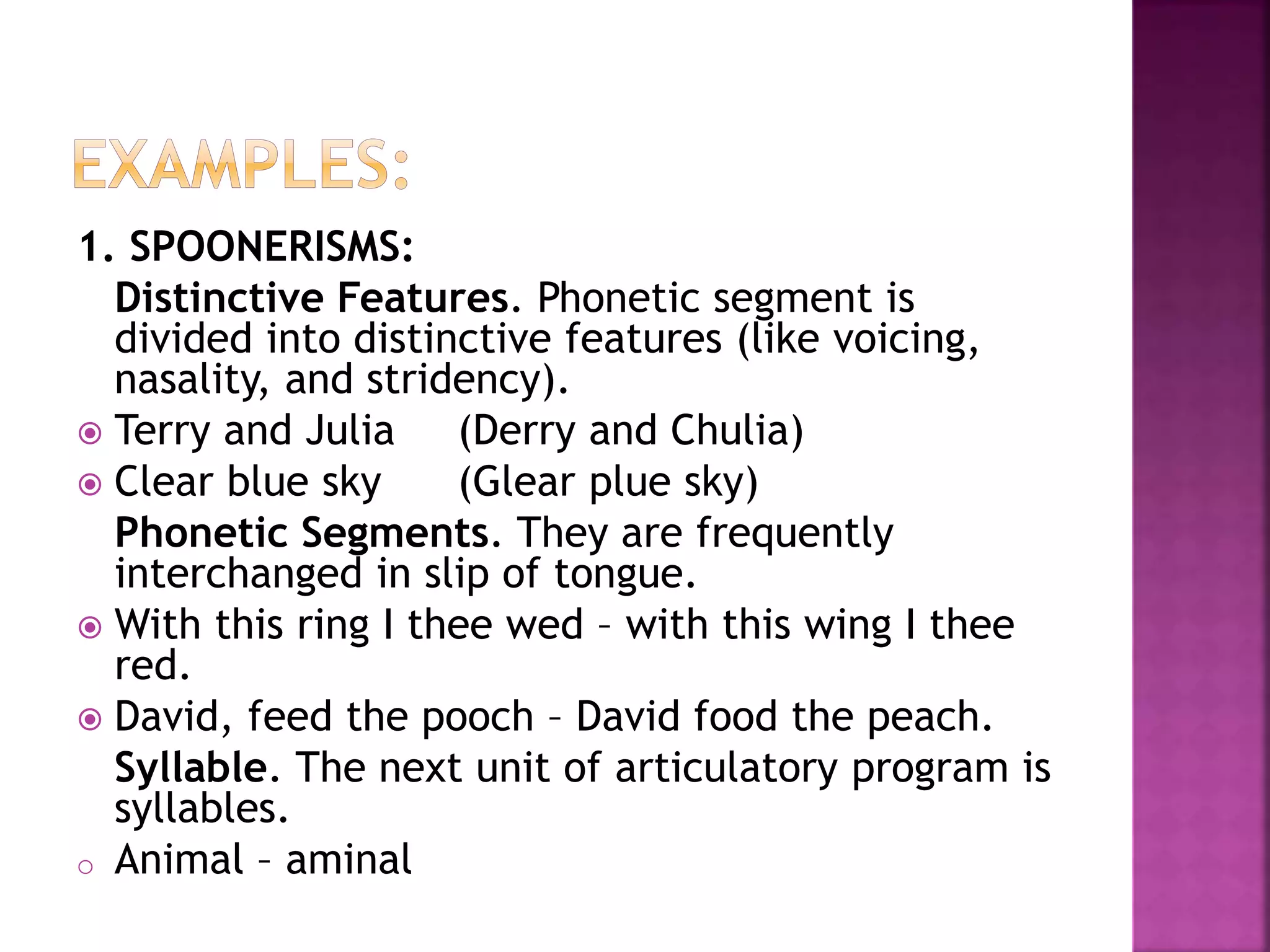
1. SPOONERISMS:
Distinctive Features. Phonetic segment is
divided into distinctive features (like voicing,
nasality, and stridency).
 Terry and Julia (Derry and Chulia)
 Clear blue sky (Glear plue sky)
Phonetic Segments. They are frequently
interchanged in slip of tongue.
 With this ring I thee wed – with this wing I thee
red.
 David, feed the pooch – David food the peach.
Syllable. The next unit of articulatory program is
syllables.
o Animal – aminal
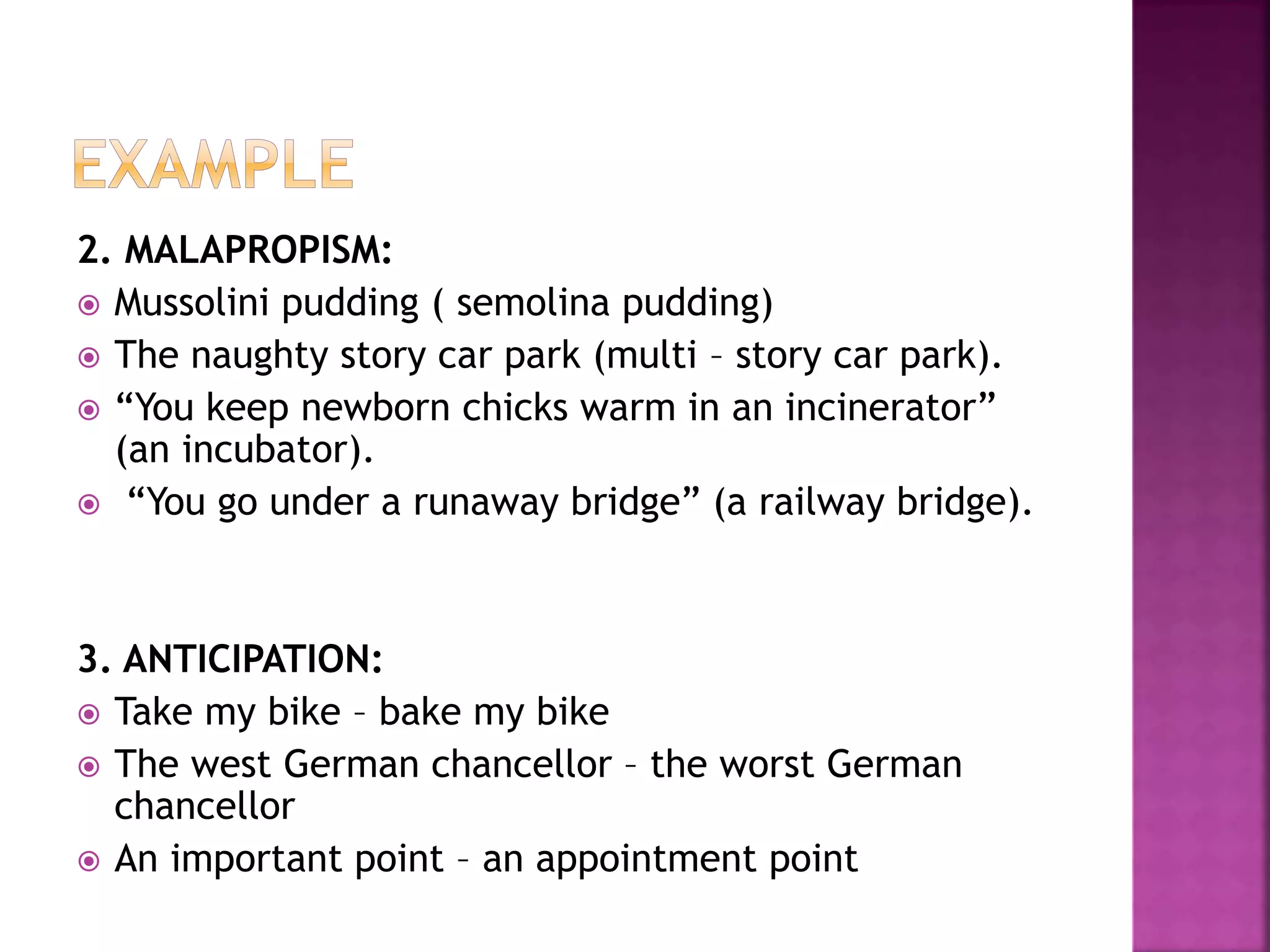
2. MALAPROPISM:
 Mussolini pudding ( semolina pudding)
 The naughty story car park (multi – story car park).
 “You keep newborn chicks warm in an incinerator”
(an incubator).
 “You go under a runaway bridge” (a railway bridge).
3. ANTICIPATION:
 Take my bike – bake my bike
 The west German chancellor – the worst German
chancellor
 An important point – an appointment point
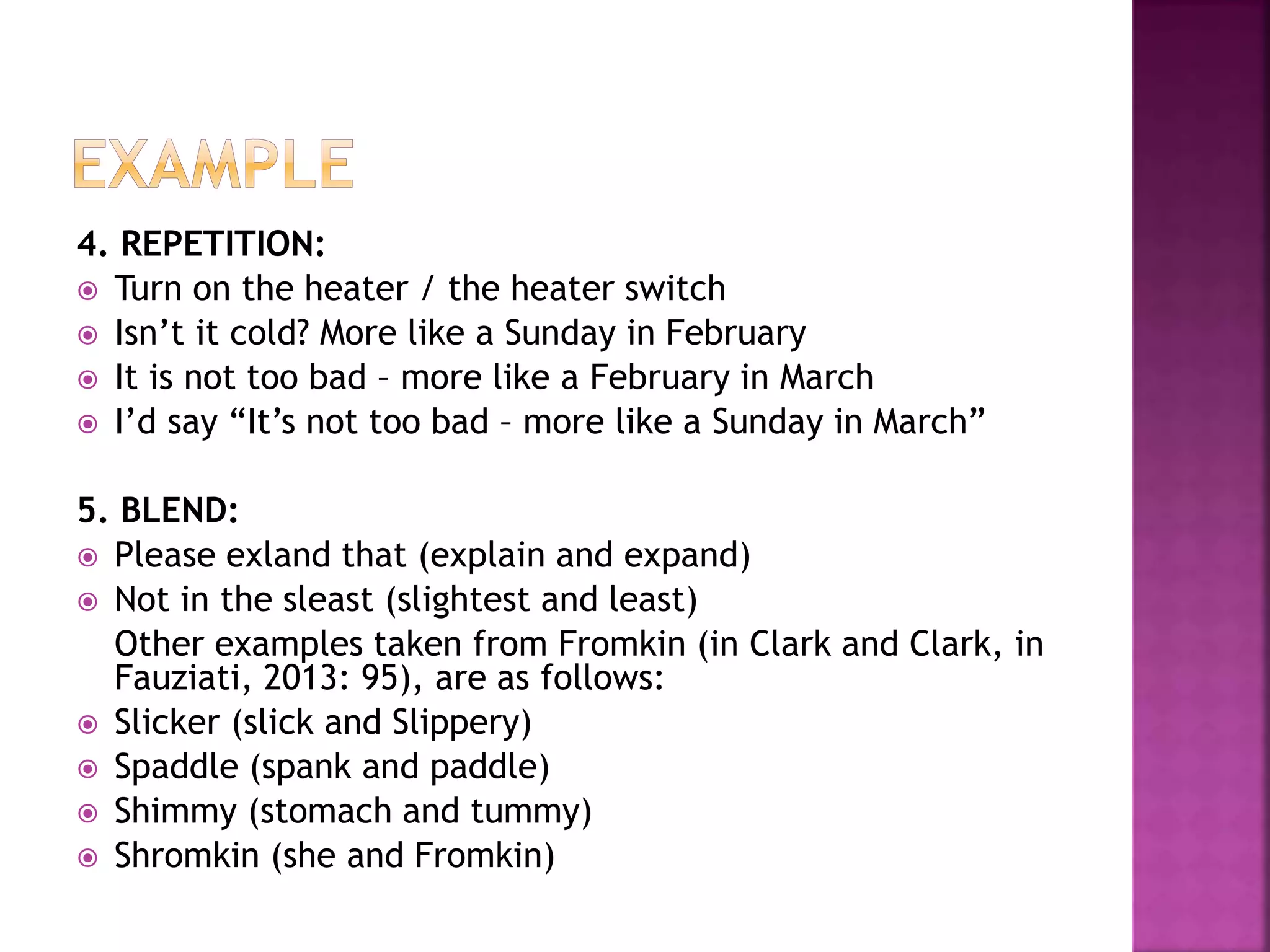
4. REPETITION:
 Turn on the heater / the heater switch
 Isn’t it cold? More like a Sunday in February
 It is not too bad – more like a February in March
 I’d say “It’s not too bad – more like a Sunday in March”
5. BLEND:
 Please exland that (explain and expand)
 Not in the sleast (slightest and least)
Other examples taken from Fromkin (in Clark and Clark, in
Fauziati, 2013: 95), are as follows:
 Slicker (slick and Slippery)
 Spaddle (spank and paddle)
 Shimmy (stomach and tummy)
 Shromkin (she and Fromkin)
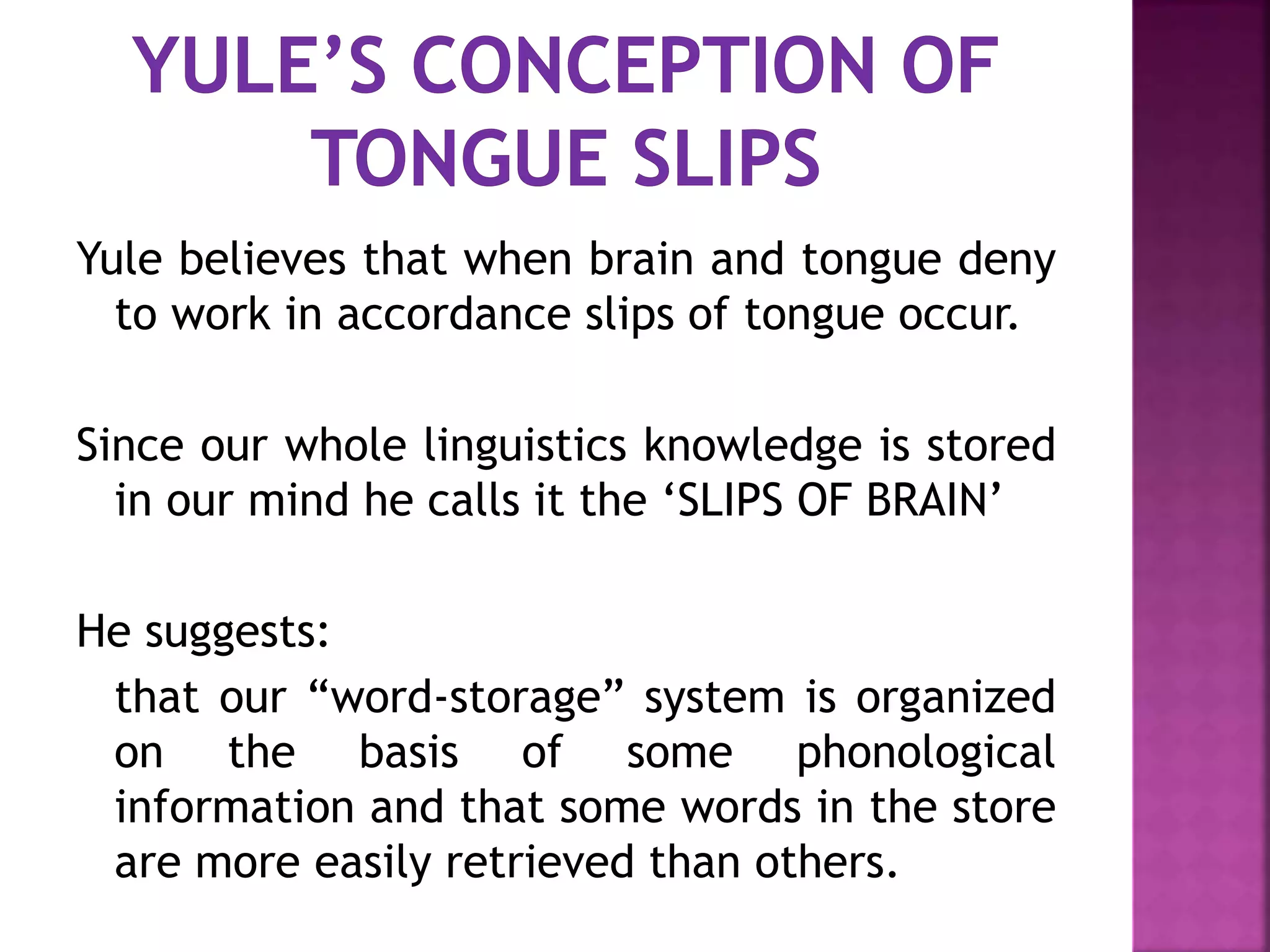
Yule believes that when brain and tongue deny
to work in accordance slips of tongue occur.
Since our whole linguistics knowledge is stored
in our mind he calls it the ‘SLIPS OF BRAIN’
He suggests:
that our “word-storage” system is organized
on the basis of some phonological
information and that some words in the store
are more easily retrieved than others.
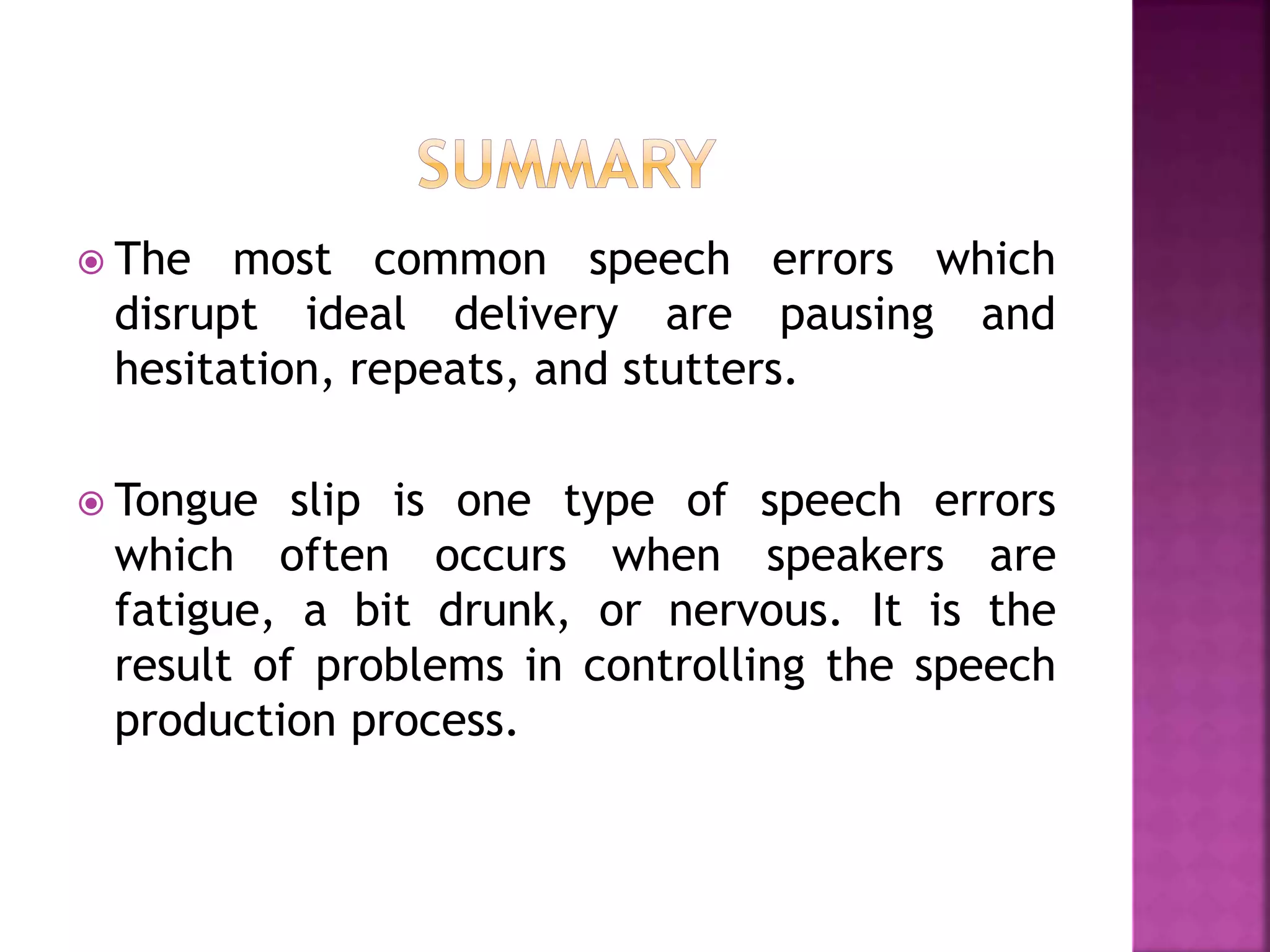
 The most common speech errors which
disrupt ideal delivery are pausing and
hesitation, repeats, and stutters.
 Tongue slip is one type of speech errors
which often occurs when speakers are
fatigue, a bit drunk, or nervous. It is the
result of problems in controlling the speech
production process.

Speech error and slip of tongue

  • 2.
    SPEECH ERRORS SLIP OFTONGUE Execution of Speech Plans & Speech Errors Common Speech Errors Selection Errors Assemblage Errors Other Constituent Boundaries Before the first Content Word within a Constituent Grammatical Junctures Transposition/ Spoonerism Anticipations Repetitions Semantic Errors Malapropism Blends
  • 3.
     In PsycholinguisticsSlips of Tongue are generally considered as Speech errors.  Slips of the tongue have been the object of PSYCHOLINGUISTICS research since 1960s. One of the most imprortant contributors is VICTORIA FROMKIN.  She contended that we switch initials consonants of words with a single clause.
  • 4.
    Commonest Silent PausesTypical Repeats the // house the // the house the // big house the // the big house in // houses in // in houses in // big house in // in big house in the // big house in the // in the big house SPEECH ERRORS Execution of Speech Plans & Speech Errors
  • 5.
    Common Speech Errors SPEECHERRORS Grammatical Junctures Boomer in Clark and Clark, in Fauziati, (2013: 89) has found that speakers most likely to pause after the first word. The first word in most of them is a function word: an article, a preposition, a conjunction, or a pronoun. Other Constituent Boundaries Within sentences, these boundaries are the appropriate place to stop to plan details of the next major constituent – precisely what noun phrase, prepositional phrase, verb phrase, or adverbial phrase is to fit next into the sentence skeleton.
  • 6.
    Before the first ContentWord within a Constituent SPEECH ERRORS Common Speech Errors Silent Pause Filled Pause Repeats False Start (Unretraced) False (Retraced) Corrections InjectionsStutters
  • 7.
    Name of SpeechErrors Example Silent Pause Turn on the / heater switch Filled Pause Turn on, uh, if the heater switch Repeats Turn on the heater / the heater switch False Start (Unretraced) Turn on the stove / heater switch False (Retraced) Turn on the stove / the heater switch Corrections Turn on Turn on the stove switch – I mean the heater switch Injections Turn on, oh, the heater switch Stutters Turn on the h-h-h- heater switch Slip of Tongue Turn on the sweeter hitch
  • 8.
    In Psycholinguistics tongueslips are one kind of speech errors which are regarded mostly as errors of articulation. Serendre Shutter in 2004 stated that: It is a complicated mental processing which is happening entirely below the level of consciousness, so we're not aware of doing anything except when we hear ourselves saying something funny, and its all happening at such lighting speed that we're not aware of any time these steps are taking.
  • 9.
    William A. Spooner(1844-1930), a famous lecturer at Oxford University to whom many slips of the tongue have been attributed. For this reason, slips of the tongue are sometimes called Spoonerisms. SPOONERISMS: is the transposition of initial consonants in a pair of words. Examples: (1) Intended: You have wasted the whole term Said: You have tasted the whole worm (2) Intended: The dear old Queen Said: The queer old dean
  • 10.
     This suggeststhat there is pre-planning of an utterance: speakers have a „mental image” of an utterance before they even start producing it.  Victoria Fromkin Said that: “Slips of the tongue are often the result of a sound being carried over from one word to the next”  Although the slips are mostly treated as errors of articulation, it has been suggested that they may result from ‘slips of the brain’ as it tries to organize linguistic messages.
  • 11.
     Tongue slipscan be classified into two categories : the major category and the secondary category.  Smith (2003:1) identifies three levels of tongue slips, they are as follows:
  • 12.
    WORD ERRORS Interchanges ofWords MORPHEME ERRORS Interchanges of Morphemes SOUND ERRORS Interchanges of Sounds
  • 13.
     However, thesethree levels can be taken various forms that can be summarized as follows:  SPOONERISMS: They involve the interchanging of initial consonants of two words  MALAPROPISM: Are caused by the confusion of two similar sounds
  • 14.
     ANTICIPATION: This kindof error occurs as the initial consonant of the first word is replaced by the initial consonant of the latter word.  REPETITION: In repetition errors a speaker repeats one or more words in a row.  BLEND: This error of tongue slips refers to a fusion of two words into one.
  • 15.
    1. SPOONERISMS: Distinctive Features.Phonetic segment is divided into distinctive features (like voicing, nasality, and stridency).  Terry and Julia (Derry and Chulia)  Clear blue sky (Glear plue sky) Phonetic Segments. They are frequently interchanged in slip of tongue.  With this ring I thee wed – with this wing I thee red.  David, feed the pooch – David food the peach. Syllable. The next unit of articulatory program is syllables. o Animal – aminal
  • 16.
    2. MALAPROPISM:  Mussolinipudding ( semolina pudding)  The naughty story car park (multi – story car park).  “You keep newborn chicks warm in an incinerator” (an incubator).  “You go under a runaway bridge” (a railway bridge). 3. ANTICIPATION:  Take my bike – bake my bike  The west German chancellor – the worst German chancellor  An important point – an appointment point
  • 17.
    4. REPETITION:  Turnon the heater / the heater switch  Isn’t it cold? More like a Sunday in February  It is not too bad – more like a February in March  I’d say “It’s not too bad – more like a Sunday in March” 5. BLEND:  Please exland that (explain and expand)  Not in the sleast (slightest and least) Other examples taken from Fromkin (in Clark and Clark, in Fauziati, 2013: 95), are as follows:  Slicker (slick and Slippery)  Spaddle (spank and paddle)  Shimmy (stomach and tummy)  Shromkin (she and Fromkin)
  • 18.
    Yule believes thatwhen brain and tongue deny to work in accordance slips of tongue occur. Since our whole linguistics knowledge is stored in our mind he calls it the ‘SLIPS OF BRAIN’ He suggests: that our “word-storage” system is organized on the basis of some phonological information and that some words in the store are more easily retrieved than others.
  • 19.
     The mostcommon speech errors which disrupt ideal delivery are pausing and hesitation, repeats, and stutters.  Tongue slip is one type of speech errors which often occurs when speakers are fatigue, a bit drunk, or nervous. It is the result of problems in controlling the speech production process.