GRAMMAR
Universidad Nacional Experimental
“Francisco de Miranda”
Área: Ciencias de la Educación
Programa: Educación Mención Inglés
U.C. Lingüística General
Dra. Cristina Chirino
What Is Grammar?
• Grammar = the knowledge speakers have about the
units and rules of their language
– Rules for combining sounds into words, word
formation, making sentences, assigning meaning
– When a sentence is ungrammatical in a linguistic
sense, it means that it breaks the rules of the shared
mental grammar of the language
The french word for LANGUAGELangue:
The term was used by the linguist Saussure to mean the
system of a language, that is the arrangement of sounds
and words which speakers of a language have a shared
knowledge of, or as Saussure said « agree to use» Langue
is the ideal form of a language
Parole:
The actual use f language by people in speech or writing
Competence: (Noam Chomsky)
A person’ internalized grammar of a language. This means
a person’ ability to create and understand sentences ,
including sentences they have never heard before. It also
includes a person`s knowledge of what are and are not
sentences of a particular language.
Eg. I want to go home & I want going home
Performance:
The actual use of the language by individuals in speech
and writing
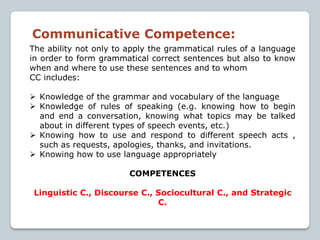
Communicative Competence:
The ability not only to apply the grammatical rules of a language
in order to form grammatical correct sentences but also to know
when and where to use these sentences and to whom
CC includes:
 Knowledge of the grammar and vocabulary of the language
 Knowledge of rules of speaking (e.g. knowing how to begin
and end a conversation, knowing what topics may be talked
about in different types of speech events, etc.)
 Knowing how to use and respond to different speech acts ,
such as requests, apologies, thanks, and invitations.
 Knowing how to use language appropriately
COMPETENCES
Linguistic C., Discourse C., Sociocultural C., and Strategic
C.
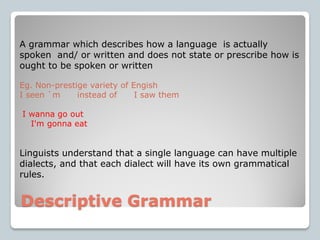
Descriptive Grammar
A grammar which describes how a language is actually
spoken and/ or written and does not state or prescribe how is
ought to be spoken or written
Eg. Non-prestige variety of Engish
I seen `m instead of I saw them
I wanna go out
I'm gonna eat
Linguists understand that a single language can have multiple
dialects, and that each dialect will have its own grammatical
rules.
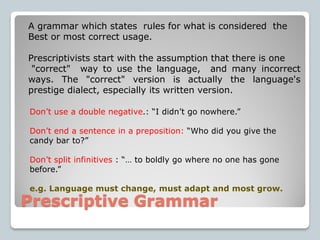
Prescriptive Grammar
A grammar which states rules for what is considered the
Best or most correct usage.
Prescriptivists start with the assumption that there is one
"correct" way to use the language, and many incorrect
ways. The "correct" version is actually the language's
prestige dialect, especially its written version.
Don’t use a double negative.: “I didn’t go nowhere.”
Don’t end a sentence in a preposition: “Who did you give the
candy bar to?”
Don’t split infinitives : “… to boldly go where no one has gone
before.”
e.g. Language must change, must adapt and most grow.
Dialect - Lexical Differences
• Regional dialects may also differ lexically
– British: lift American: elevator
– British: pants American: underpants
– Boston: tonic Los Angeles: soda
– Los Angeles: freeway
– New York: thruway
– New Jersey: parkway
– England: motorway
Dialect- Phonological
Differences
• There are systematic pronunciation differences
between American and British English
– For example, Americans put stress on the first
syllable of a polysyllabic word, and British speakers put
the stress on the second syllable in words like
cigarette,applicable, formidable, laboratory
– Americans may pronounce the first vowel in data as
[e] or [ei] but vast majority of British speakers would
only use [e]
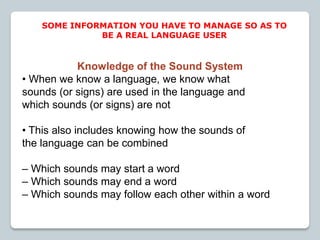
Knowledge of the Sound System
• When we know a language, we know what
sounds (or signs) are used in the language and
which sounds (or signs) are not
• This also includes knowing how the sounds of
the language can be combined
– Which sounds may start a word
– Which sounds may end a word
– Which sounds may follow each other within a word
SOME INFORMATION YOU HAVE TO MANAGE SO AS TO
BE A REAL LANGUAGE USER
Knowledge of Words
• Knowing a language also means
identifying certain strings of sounds as
meaningful words
• Most words in all languages are arbitrary
connections of sound to meaning
hand main ruka
(English) (French) (Russian)
Knowledge of Sentences and
Nonsentences
• Language is more than a set of words because
words must be ordered in certain ways to create
Sentences
• Our knowledge of language allows us to
separate possible sentences from nonsentences
– What he did was climb a tree
– *What he thought was want a sports car

Grammar

  • 1.
    GRAMMAR Universidad Nacional Experimental “Franciscode Miranda” Área: Ciencias de la Educación Programa: Educación Mención Inglés U.C. Lingüística General Dra. Cristina Chirino
  • 2.
    What Is Grammar? •Grammar = the knowledge speakers have about the units and rules of their language – Rules for combining sounds into words, word formation, making sentences, assigning meaning – When a sentence is ungrammatical in a linguistic sense, it means that it breaks the rules of the shared mental grammar of the language
  • 3.
    The french wordfor LANGUAGELangue: The term was used by the linguist Saussure to mean the system of a language, that is the arrangement of sounds and words which speakers of a language have a shared knowledge of, or as Saussure said « agree to use» Langue is the ideal form of a language Parole: The actual use f language by people in speech or writing
  • 4.
    Competence: (Noam Chomsky) Aperson’ internalized grammar of a language. This means a person’ ability to create and understand sentences , including sentences they have never heard before. It also includes a person`s knowledge of what are and are not sentences of a particular language. Eg. I want to go home & I want going home Performance: The actual use of the language by individuals in speech and writing
  • 5.
    Communicative Competence: The abilitynot only to apply the grammatical rules of a language in order to form grammatical correct sentences but also to know when and where to use these sentences and to whom CC includes:  Knowledge of the grammar and vocabulary of the language  Knowledge of rules of speaking (e.g. knowing how to begin and end a conversation, knowing what topics may be talked about in different types of speech events, etc.)  Knowing how to use and respond to different speech acts , such as requests, apologies, thanks, and invitations.  Knowing how to use language appropriately COMPETENCES Linguistic C., Discourse C., Sociocultural C., and Strategic C.
  • 6.
    Descriptive Grammar A grammarwhich describes how a language is actually spoken and/ or written and does not state or prescribe how is ought to be spoken or written Eg. Non-prestige variety of Engish I seen `m instead of I saw them I wanna go out I'm gonna eat Linguists understand that a single language can have multiple dialects, and that each dialect will have its own grammatical rules.
  • 7.
    Prescriptive Grammar A grammarwhich states rules for what is considered the Best or most correct usage. Prescriptivists start with the assumption that there is one "correct" way to use the language, and many incorrect ways. The "correct" version is actually the language's prestige dialect, especially its written version. Don’t use a double negative.: “I didn’t go nowhere.” Don’t end a sentence in a preposition: “Who did you give the candy bar to?” Don’t split infinitives : “… to boldly go where no one has gone before.” e.g. Language must change, must adapt and most grow.
  • 8.
    Dialect - LexicalDifferences • Regional dialects may also differ lexically – British: lift American: elevator – British: pants American: underpants – Boston: tonic Los Angeles: soda – Los Angeles: freeway – New York: thruway – New Jersey: parkway – England: motorway
  • 9.
    Dialect- Phonological Differences • Thereare systematic pronunciation differences between American and British English – For example, Americans put stress on the first syllable of a polysyllabic word, and British speakers put the stress on the second syllable in words like cigarette,applicable, formidable, laboratory – Americans may pronounce the first vowel in data as [e] or [ei] but vast majority of British speakers would only use [e]
  • 10.
    Knowledge of theSound System • When we know a language, we know what sounds (or signs) are used in the language and which sounds (or signs) are not • This also includes knowing how the sounds of the language can be combined – Which sounds may start a word – Which sounds may end a word – Which sounds may follow each other within a word SOME INFORMATION YOU HAVE TO MANAGE SO AS TO BE A REAL LANGUAGE USER
  • 11.
    Knowledge of Words •Knowing a language also means identifying certain strings of sounds as meaningful words • Most words in all languages are arbitrary connections of sound to meaning hand main ruka (English) (French) (Russian)
  • 12.
    Knowledge of Sentencesand Nonsentences • Language is more than a set of words because words must be ordered in certain ways to create Sentences • Our knowledge of language allows us to separate possible sentences from nonsentences – What he did was climb a tree – *What he thought was want a sports car