HYBRID OPERATING ROOMPRESENTED BY:
SUFYAN AHMAD
NAZIA KHANAM
CONTEMPORARY TECHNOLOGY
FACILITY WITHIN HOSPITAL WHERE SURGICAL OPERATIONS ARE CARRIED OUT IN A STERILE ENVIRONMENT.
FEATURES OF AN OPERATION THEATRE:
• Generally windowless
• Controlled temperature and humidity.
• Special air handlers filter
• The air and maintain a slightly elevated pressure.
• Rooms are supplied with wall suction, oxygen, and possibly other,
anesthetic gases.
OPERATION THEATRE: INTRODUCTION
1/20Presented by : Nazia Khanam
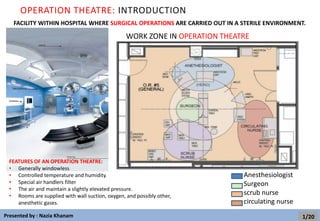
Anesthesiologist
Surgeon
scrub nurse
circulating nurse
WORK ZONE IN OPERATION THEATRE
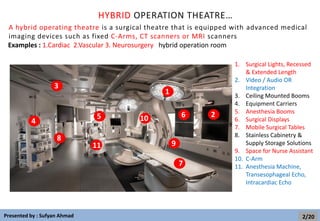
HYBRID OPERATION THEATRE…
A hybrid operating theatre is a surgical theatre that is equipped with advanced medical
imaging devices such as fixed C-Arms, CT scanners or MRI scanners
Examples : 1.Cardiac 2.Vascular 3. Neurosurgery hybrid operation room
1. Surgical Lights, Recessed
& Extended Length
2. Video / Audio OR
Integration
3. Ceiling Mounted Booms
4. Equipment Carriers
5. Anesthesia Booms
6. Surgical Displays
7. Mobile Surgical Tables
8. Stainless Cabinetry &
Supply Storage Solutions
9. Space for Nurse Assistant
10. C-Arm
11. Anesthesia Machine,
Transesophageal Echo,
Intracardiac Echo
4 1
2
3
4
5 6
7
8
911
10
2/20Presented by : Sufyan Ahmad
SALIENT FEATURES: HYBRID OPERATION THEATRE
 Patient safety
 Cost saving for the patient
 State-of-the-art imaging during surgery
 It allows us to do more complex procedures
 Physicians with different skills can work simultaneously
ADVANTAGES OF HYBRID OT
The main advantages of hybrid OT are :
 Minimized procedural and patient risk
 Optimized success rates
 Enhanced complication management
 Advanced workflow efficiency
3/20Presented by : Nazia Khanam
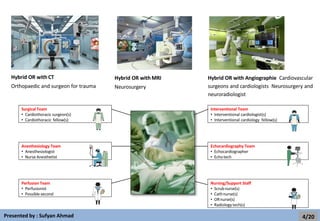
Hybrid OR with CT
Orthopaedic and surgeon for trauma
Hybrid OR with MRI
Neurosurgery
Hybrid OR with Angiographie Cardiovascular
surgeons and cardiologists Neurosurgery and
neuroradiologist
Interventional Team
• Interventional cardiologist(s)
• Interventional cardiology fellow(s)
Echocardiography Team
• Echocardiographer
• Echotech
Nursing/Support Staff
• Scrubnurse(s)
• Cathnurse(s)
• ORnurse(s)
• Radiology tech(s)
Surgical Team
• Cardiothoracic surgeon(s)
• Cardiothoracic fellow(s)
Anesthesiology Team
• Anesthesiologist
• Nurse Anesthetist
Perfusion Team
• Perfusionist
• Possible second
4/20Presented by : Sufyan Ahmad
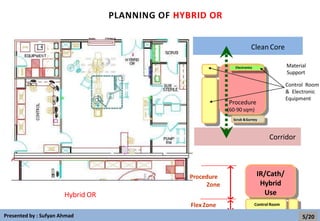
PLANNING OF HYBRID OR
Hybrid OR
Corridor
Clean Core
Electronics
Procedure
(60-90 sqm)
Material
Support
Control Room
& Electronic
Equipment
Scrub &Gurney
IR/Cath/
Hybrid
Use
SubsequentUse
Control RoomFlexZone
Procedure
Zone
5/20Presented by : Sufyan Ahmad
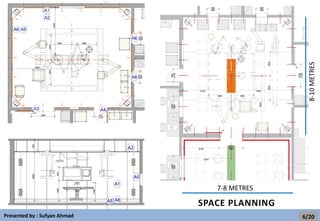
SPACE PLANNING
7-8 METRES
8-10METRES
6/20Presented by : Sufyan Ahmad
DESIGN CONSIDERATIONS – CARDIOVASCULAR
1
2 3
4
3
4
3
2
1
Assisting Surgeon
Surgeon
Anesthesiologist
Assisting Nurse
6
7
8
9
10
Anesthesia Machine
5
Anesthesia Cart
6 Control Pedestal7
Ultrasound (IVUS)
8
Contrast Injector9
Patient Warmer
10
5
11
11 Heart Lung Machine
7/20Presented by : Sufyan Ahmad
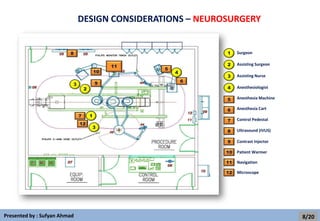
DESIGN CONSIDERATIONS – NEUROSURGERY
1
2
3
4
3
4
3
2
1
Assisting Surgeon
Surgeon
Anesthesiologist
Assisting Nurse
5
6
7
8
9
10
Anesthesia Machine
5
Anesthesia Cart
6
Control Pedestal
7
Ultrasound (IVUS)
8
Contrast Injector
9
Patient Warmer
10
11 Navigation
11
12 Microscope
12
8/20Presented by : Sufyan Ahmad
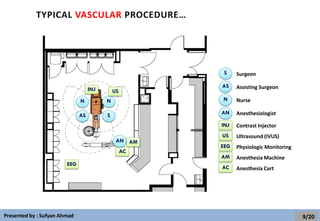
AM
AC
EEG
AN
N
AS S
N
USINJ
AM
AC
EEG
AN
N
AS
S
US
INJ
Surgeon
Assisting Surgeon
Nurse
Anesthesiologist
Contrast Injector
Ultrasound (IVUS)
Physiologic Monitoring
Anesthesia Machine
Anesthesia Cart
TYPICAL VASCULAR PROCEDURE…
9/20Presented by : Sufyan Ahmad
AM
AC
EEG
AN
N
S
INJ
AM
AC
PCW
AN
PA
AS
S
NAV
INJ
Surgeon
Assisting Surgeon
Nurse
Anesthesiologist
Contrast Injector
Navigation
Patient Cooler/Warmer
Anesthesia Machine
Anesthesia Cart
PCW
NAV
MIC
MAS Mobile Aspirator
MIC Microscope
N
TYPICAL VASCULAR PROCEDURE…
10/20Presented by : Sufyan Ahmad
AM
AC
EEG
AN
N
S
INJ
AM
AC
PCW
AN
PA
AS
S
NAV
INJ
Surgeon
Assisting Surgeon
Nurse
Anesthesiologist
Contrast Injector
Navigation
Patient Cooler/Warmer
Anesthesia Machine
Anesthesia Cart
PCW NAV
MIC
MAS Mobile Aspirator
MIC Microscope
N
TYPICAL VASCULAR PROCEDURE…
11/20Presented by : Sufyan Ahmad
CONSIDERATIONS WHILE CONSTRUCTING HYBRID OR
Hybrid OR Room Specifications
Specifications CatheterizationLab CardiacOR HybridOR
Square Meter 37-56 56-70 60-90
Ceiling Height (In meter) 3 3 3-3.6
Ceiling Type Lay-in type ceiling permitted Monolithic, scrubbable,
capable of withstanding
chemicals
Monolithic, scrubbable,
capable of withstanding
chemicals
Ceiling Structural
Reinforcement/Design
Support for ceiling-mounted
C- arm
Support for boom-mounted
equipment, sufficient space
for HVAC duct-work
Support for boom-
mounted equipment, and
uni-strut reinforcement
for ceiling mounted C-arm,
sufficient space for HVAC
duct-work
RoomShielding LeadLined N/A LeadLined
Optimal Temperature (F) 70-75 68-73 68-75
Air Exchange Rate 20-25 15-20 20-25
Illuminance (Lux) 300 500-1,000 500-1,000
Special Lighting Needs Dimmable, ambient
lighting, minor surgery
task light
External surgical field, fiber
optic, microscope
illumination systems
External surgical field, fiber
optic, microscope
illumination systems
Number of Electrical Outlets 8 24 >24
12/20Presented by : Nazia Khanam
14
UNDERSTANDING ALL THE EQUIPMENTS IN HYBRID O.R.
C-ARM Carbon Fibre
Table
Surgical LightsEcho Technology Audio-Video
Integration
• An X-ray image
intensifier (XRII)
an image intensifier
that converts x-rays
into visible light
at higher intensity
• Transesophageal
echo
• Transthoracic echo
• Intracardiac echo
• Intravascular
ultrasound
• To optimize the
usefulness of the
radiographic
equipment
• provide complete
clearance beneath a
panning x-ray system.
• Top priority features:
lighting intensity,
color temperature,
heat control, shadow
control, and flexibility
• Touchscreens
• Voiceactivated
controls
• Video conferencing
13/20Presented by : Nazia Khanam
21
UNDERSTANDING ALL THE EQUIPMENTS IN HYBRID O.R.
Other Essentials for the Hybrid Operating Room
Anesthesia
Equipment
• Anesthesia becoming
standard of care in
hybrid ORs for cath,
hybrid, and EP
procedures alike
• If not mounted, is space-
intensive, and must be in
close proximity to the
patient/table
Lead
Shielding
Power
Injectors
Hemodynamic
Monitoring
• Used to reduce the risk of
exposure toradiation
beams, ionizing radiation
• May be incorporated into
the lab’s infrastructure—
both within the walls and
within the lab via side
table drapes, door- or
ceiling-mounted acrylic
shields, and lead aprons
• Angiographic injectors
should be able to attach to
catheters from the cath table
and at any catheter
introduction site
• Ceiling-mounted injectors
are preferable (lower risk of
contaminating the sterile
field, occupy less space than
floor- mounted systems)
• Systems should interface
with a lab’s
documentation systems to
record and store
information for later
review
14/20Presented by : Nazia Khanam
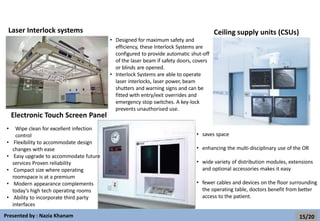
• Designed for maximum safety and
efficiency, these Interlock Systems are
configured to provide automatic shut-off
of the laser beam if safety doors, covers
or blinds are opened.
• Interlock Systems are able to operate
laser interlocks, laser power, beam
shutters and warning signs and can be
fitted with entry/exit overrides and
emergency stop switches. A key-lock
prevents unauthorised use.
• Wipe clean for excellent infection
control
• Flexibility to accommodate design
changes with ease
• Easy upgrade to accommodate future
services Proven reliability
• Compact size where operating
roomspace is at a premium
• Modern appearance complements
today’s high tech operating rooms
• Ability to incorporate third party
interfaces
Electronic Touch Screen Panel
Laser Interlock systems
• saves space
• enhancing the multi-disciplinary use of the OR
• wide variety of distribution modules, extensions
and optional accessories makes it easy
• fewer cables and devices on the floor surrounding
the operating table, doctors benefit from better
access to the patient.
Ceiling supply units (CSUs)
15/20Presented by : Nazia Khanam
29
BEHIND-THE-SCENES CONTROLS
Ancillary Controls in theHybrid OR
Temperature
• Full-scale temperature and
humidity control
• Pediatrics patients must be
kept at a relatively high
temperature such that they
do not acquire hypothermia
(leading to cardiac arrest)
• Room temperature should
remain between 68 and 80
degrees fahrenheit
• Anesthetic gases—oxygen, air,
suction, nitrous, gas scavenge—
housed on a single boom (column)
with network/electrical connections
• Gases to support a heart-lung
machine in the room may be
housed on a single boom
• Be aware of source of thegases,
lengths of the hoses required—
select procedures require nitrogen as
does a sternal saw if needed
• Careful planning should ensure
that high- and low- voltage
connections are converted in
the ceiling—and not mounted
behind monitors—and pulled
through a boom
• High-voltage connections must
be housed in shielded conduits
• Booms should be designated as
either high- or low-voltage
Gases Electricity
16/20Presented by : Sufyan Ahmad
SERVICES OF HYBRID OR
VENTILATION:
• There should be +ve pressure ventilation with
lowering pressure gradient from sterile to
protective zone laminar flow.
• All anaesthetic gases to be vented out to exhaust.
• Flow of air 2 to 3 cu meter minute.
AIR CONDITIONING:
• Control asepsis, controlled air flow, positive
pressure.
• Maintenance of temperature 22 degree Celsius
for comfort.
• Humidity 55% + or – 5 % only.
• 100% fresh air with 20 changes per hour.
• Filter of 1 to 3 micron size to be used.
• Control air-conditioning system.
• False ceiling 1 meter below the roof.
17/20Presented by : Sufyan Ahmad
STRUCTURAL COMPONENTS OF HYBRID OPERATION THEATRE:
Walls:
• Melanin facing walls for easy cleaning.
• The inner surface walls will be constructed with
1.60mm thick EGP steel panels backed by 12-mm
gypsum board
• Pale colour to be used.
• Resistant to minor damage or impact.
• All the sharp edges and corners will be in radius
to avoid bacteria contamination.
• Door opening should be min. 1.5 M wide,
swinging and 2.1 M height.
Roof:
• Should take the load of OT lights, X-rays unit, TV
camera, Gas and electric panels.
Floors:
• Easily washable, non staining, impervious.
• The floor finish in the operating room should be
Conductive PVC tiles, laid on a semi conductive
adhesive base.
• The floor finish should continue up the wall for
100mm.
http://pdt.com.au/u/lib/mob/20150317161414_3c7c241034454de62/sawmh-
ot10-03a-low-res.jpg
18/20Presented by : Sufyan Ahmad
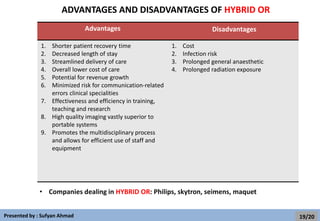
Advantages Disadvantages
1. Shorter patient recovery time
2. Decreased length of stay
3. Streamlined delivery of care
4. Overall lower cost of care
5. Potential for revenue growth
6. Minimized risk for communication-related
errors clinical specialities
7. Effectiveness and efficiency in training,
teaching and research
8. High quality imaging vastly superior to
portable systems
9. Promotes the multidisciplinary process
and allows for efficient use of staff and
equipment
1. Cost
2. Infection risk
3. Prolonged general anaesthetic
4. Prolonged radiation exposure
ADVANTAGES AND DISADVANTAGES OF HYBRID OR
• Companies dealing in HYBRID OR: Philips, skytron, seimens, maquet
19/20Presented by : Sufyan Ahmad
REFERENCES
• http://cathlabdigest.com/articles/Cardiovascular-Hybrid-Surgical-Room-Evolving-Future-
Cardiovascular-Surgery#sthash.pyufaslw.dpuf
• http://hybridoperatingroom.com/hybrid-or-operating-room-skytron-surgical-lights-booms-monitors-
tables-equipment-anesthesia/
• http://static.squarespace.com/static/50305915e4b00d577d14e583/50a52d36e4b0e80bad99a190/50
a52d37e4b0f7142090aed5/1353002295944/Hybrid-OR-Operating-Room-Layout-Drawing-Siemens-
Zeego-vs-Philips-FlexMove-Imaging-Systems-SKYTRON.jpg
• http://hybridoperatingroom.com/hybrid-operating-room-layouts-3d-design-mockups/
• http://www.maquet-hybridoperatingroom.com/slide-show/
• http://www.ctsnet.org/portals/endovascular/nutsbolts/Nollert_HypridOR_fig5
• http://www.youtube.com/watch?v=Oeg8wIhrn5w
• http://www.christusspohn.org/hybridsurgicalsuite
20/20Presented by : Sufyan Ahmad & Nazia Khanam
THANKYOU

HYBRID OPERATING ROOM

  • 1.
    HYBRID OPERATING ROOMPRESENTEDBY: SUFYAN AHMAD NAZIA KHANAM CONTEMPORARY TECHNOLOGY
  • 2.
    FACILITY WITHIN HOSPITALWHERE SURGICAL OPERATIONS ARE CARRIED OUT IN A STERILE ENVIRONMENT. FEATURES OF AN OPERATION THEATRE: • Generally windowless • Controlled temperature and humidity. • Special air handlers filter • The air and maintain a slightly elevated pressure. • Rooms are supplied with wall suction, oxygen, and possibly other, anesthetic gases. OPERATION THEATRE: INTRODUCTION 1/20Presented by : Nazia Khanam Anesthesiologist Surgeon scrub nurse circulating nurse WORK ZONE IN OPERATION THEATRE
  • 3.
    HYBRID OPERATION THEATRE… Ahybrid operating theatre is a surgical theatre that is equipped with advanced medical imaging devices such as fixed C-Arms, CT scanners or MRI scanners Examples : 1.Cardiac 2.Vascular 3. Neurosurgery hybrid operation room 1. Surgical Lights, Recessed & Extended Length 2. Video / Audio OR Integration 3. Ceiling Mounted Booms 4. Equipment Carriers 5. Anesthesia Booms 6. Surgical Displays 7. Mobile Surgical Tables 8. Stainless Cabinetry & Supply Storage Solutions 9. Space for Nurse Assistant 10. C-Arm 11. Anesthesia Machine, Transesophageal Echo, Intracardiac Echo 4 1 2 3 4 5 6 7 8 911 10 2/20Presented by : Sufyan Ahmad
  • 4.
    SALIENT FEATURES: HYBRIDOPERATION THEATRE  Patient safety  Cost saving for the patient  State-of-the-art imaging during surgery  It allows us to do more complex procedures  Physicians with different skills can work simultaneously ADVANTAGES OF HYBRID OT The main advantages of hybrid OT are :  Minimized procedural and patient risk  Optimized success rates  Enhanced complication management  Advanced workflow efficiency 3/20Presented by : Nazia Khanam
  • 5.
    Hybrid OR withCT Orthopaedic and surgeon for trauma Hybrid OR with MRI Neurosurgery Hybrid OR with Angiographie Cardiovascular surgeons and cardiologists Neurosurgery and neuroradiologist Interventional Team • Interventional cardiologist(s) • Interventional cardiology fellow(s) Echocardiography Team • Echocardiographer • Echotech Nursing/Support Staff • Scrubnurse(s) • Cathnurse(s) • ORnurse(s) • Radiology tech(s) Surgical Team • Cardiothoracic surgeon(s) • Cardiothoracic fellow(s) Anesthesiology Team • Anesthesiologist • Nurse Anesthetist Perfusion Team • Perfusionist • Possible second 4/20Presented by : Sufyan Ahmad
  • 6.
    PLANNING OF HYBRIDOR Hybrid OR Corridor Clean Core Electronics Procedure (60-90 sqm) Material Support Control Room & Electronic Equipment Scrub &Gurney IR/Cath/ Hybrid Use SubsequentUse Control RoomFlexZone Procedure Zone 5/20Presented by : Sufyan Ahmad
  • 7.
  • 8.
    DESIGN CONSIDERATIONS –CARDIOVASCULAR 1 2 3 4 3 4 3 2 1 Assisting Surgeon Surgeon Anesthesiologist Assisting Nurse 6 7 8 9 10 Anesthesia Machine 5 Anesthesia Cart 6 Control Pedestal7 Ultrasound (IVUS) 8 Contrast Injector9 Patient Warmer 10 5 11 11 Heart Lung Machine 7/20Presented by : Sufyan Ahmad
  • 9.
    DESIGN CONSIDERATIONS –NEUROSURGERY 1 2 3 4 3 4 3 2 1 Assisting Surgeon Surgeon Anesthesiologist Assisting Nurse 5 6 7 8 9 10 Anesthesia Machine 5 Anesthesia Cart 6 Control Pedestal 7 Ultrasound (IVUS) 8 Contrast Injector 9 Patient Warmer 10 11 Navigation 11 12 Microscope 12 8/20Presented by : Sufyan Ahmad
  • 10.
    AM AC EEG AN N AS S N USINJ AM AC EEG AN N AS S US INJ Surgeon Assisting Surgeon Nurse Anesthesiologist ContrastInjector Ultrasound (IVUS) Physiologic Monitoring Anesthesia Machine Anesthesia Cart TYPICAL VASCULAR PROCEDURE… 9/20Presented by : Sufyan Ahmad
  • 11.
    AM AC EEG AN N S INJ AM AC PCW AN PA AS S NAV INJ Surgeon Assisting Surgeon Nurse Anesthesiologist Contrast Injector Navigation PatientCooler/Warmer Anesthesia Machine Anesthesia Cart PCW NAV MIC MAS Mobile Aspirator MIC Microscope N TYPICAL VASCULAR PROCEDURE… 10/20Presented by : Sufyan Ahmad
  • 12.
    AM AC EEG AN N S INJ AM AC PCW AN PA AS S NAV INJ Surgeon Assisting Surgeon Nurse Anesthesiologist Contrast Injector Navigation PatientCooler/Warmer Anesthesia Machine Anesthesia Cart PCW NAV MIC MAS Mobile Aspirator MIC Microscope N TYPICAL VASCULAR PROCEDURE… 11/20Presented by : Sufyan Ahmad
  • 13.
    CONSIDERATIONS WHILE CONSTRUCTINGHYBRID OR Hybrid OR Room Specifications Specifications CatheterizationLab CardiacOR HybridOR Square Meter 37-56 56-70 60-90 Ceiling Height (In meter) 3 3 3-3.6 Ceiling Type Lay-in type ceiling permitted Monolithic, scrubbable, capable of withstanding chemicals Monolithic, scrubbable, capable of withstanding chemicals Ceiling Structural Reinforcement/Design Support for ceiling-mounted C- arm Support for boom-mounted equipment, sufficient space for HVAC duct-work Support for boom- mounted equipment, and uni-strut reinforcement for ceiling mounted C-arm, sufficient space for HVAC duct-work RoomShielding LeadLined N/A LeadLined Optimal Temperature (F) 70-75 68-73 68-75 Air Exchange Rate 20-25 15-20 20-25 Illuminance (Lux) 300 500-1,000 500-1,000 Special Lighting Needs Dimmable, ambient lighting, minor surgery task light External surgical field, fiber optic, microscope illumination systems External surgical field, fiber optic, microscope illumination systems Number of Electrical Outlets 8 24 >24 12/20Presented by : Nazia Khanam
  • 14.
    14 UNDERSTANDING ALL THEEQUIPMENTS IN HYBRID O.R. C-ARM Carbon Fibre Table Surgical LightsEcho Technology Audio-Video Integration • An X-ray image intensifier (XRII) an image intensifier that converts x-rays into visible light at higher intensity • Transesophageal echo • Transthoracic echo • Intracardiac echo • Intravascular ultrasound • To optimize the usefulness of the radiographic equipment • provide complete clearance beneath a panning x-ray system. • Top priority features: lighting intensity, color temperature, heat control, shadow control, and flexibility • Touchscreens • Voiceactivated controls • Video conferencing 13/20Presented by : Nazia Khanam
  • 15.
    21 UNDERSTANDING ALL THEEQUIPMENTS IN HYBRID O.R. Other Essentials for the Hybrid Operating Room Anesthesia Equipment • Anesthesia becoming standard of care in hybrid ORs for cath, hybrid, and EP procedures alike • If not mounted, is space- intensive, and must be in close proximity to the patient/table Lead Shielding Power Injectors Hemodynamic Monitoring • Used to reduce the risk of exposure toradiation beams, ionizing radiation • May be incorporated into the lab’s infrastructure— both within the walls and within the lab via side table drapes, door- or ceiling-mounted acrylic shields, and lead aprons • Angiographic injectors should be able to attach to catheters from the cath table and at any catheter introduction site • Ceiling-mounted injectors are preferable (lower risk of contaminating the sterile field, occupy less space than floor- mounted systems) • Systems should interface with a lab’s documentation systems to record and store information for later review 14/20Presented by : Nazia Khanam
  • 16.
    • Designed formaximum safety and efficiency, these Interlock Systems are configured to provide automatic shut-off of the laser beam if safety doors, covers or blinds are opened. • Interlock Systems are able to operate laser interlocks, laser power, beam shutters and warning signs and can be fitted with entry/exit overrides and emergency stop switches. A key-lock prevents unauthorised use. • Wipe clean for excellent infection control • Flexibility to accommodate design changes with ease • Easy upgrade to accommodate future services Proven reliability • Compact size where operating roomspace is at a premium • Modern appearance complements today’s high tech operating rooms • Ability to incorporate third party interfaces Electronic Touch Screen Panel Laser Interlock systems • saves space • enhancing the multi-disciplinary use of the OR • wide variety of distribution modules, extensions and optional accessories makes it easy • fewer cables and devices on the floor surrounding the operating table, doctors benefit from better access to the patient. Ceiling supply units (CSUs) 15/20Presented by : Nazia Khanam
  • 17.
    29 BEHIND-THE-SCENES CONTROLS Ancillary Controlsin theHybrid OR Temperature • Full-scale temperature and humidity control • Pediatrics patients must be kept at a relatively high temperature such that they do not acquire hypothermia (leading to cardiac arrest) • Room temperature should remain between 68 and 80 degrees fahrenheit • Anesthetic gases—oxygen, air, suction, nitrous, gas scavenge— housed on a single boom (column) with network/electrical connections • Gases to support a heart-lung machine in the room may be housed on a single boom • Be aware of source of thegases, lengths of the hoses required— select procedures require nitrogen as does a sternal saw if needed • Careful planning should ensure that high- and low- voltage connections are converted in the ceiling—and not mounted behind monitors—and pulled through a boom • High-voltage connections must be housed in shielded conduits • Booms should be designated as either high- or low-voltage Gases Electricity 16/20Presented by : Sufyan Ahmad
  • 18.
    SERVICES OF HYBRIDOR VENTILATION: • There should be +ve pressure ventilation with lowering pressure gradient from sterile to protective zone laminar flow. • All anaesthetic gases to be vented out to exhaust. • Flow of air 2 to 3 cu meter minute. AIR CONDITIONING: • Control asepsis, controlled air flow, positive pressure. • Maintenance of temperature 22 degree Celsius for comfort. • Humidity 55% + or – 5 % only. • 100% fresh air with 20 changes per hour. • Filter of 1 to 3 micron size to be used. • Control air-conditioning system. • False ceiling 1 meter below the roof. 17/20Presented by : Sufyan Ahmad
  • 19.
    STRUCTURAL COMPONENTS OFHYBRID OPERATION THEATRE: Walls: • Melanin facing walls for easy cleaning. • The inner surface walls will be constructed with 1.60mm thick EGP steel panels backed by 12-mm gypsum board • Pale colour to be used. • Resistant to minor damage or impact. • All the sharp edges and corners will be in radius to avoid bacteria contamination. • Door opening should be min. 1.5 M wide, swinging and 2.1 M height. Roof: • Should take the load of OT lights, X-rays unit, TV camera, Gas and electric panels. Floors: • Easily washable, non staining, impervious. • The floor finish in the operating room should be Conductive PVC tiles, laid on a semi conductive adhesive base. • The floor finish should continue up the wall for 100mm. http://pdt.com.au/u/lib/mob/20150317161414_3c7c241034454de62/sawmh- ot10-03a-low-res.jpg 18/20Presented by : Sufyan Ahmad
  • 20.
    Advantages Disadvantages 1. Shorterpatient recovery time 2. Decreased length of stay 3. Streamlined delivery of care 4. Overall lower cost of care 5. Potential for revenue growth 6. Minimized risk for communication-related errors clinical specialities 7. Effectiveness and efficiency in training, teaching and research 8. High quality imaging vastly superior to portable systems 9. Promotes the multidisciplinary process and allows for efficient use of staff and equipment 1. Cost 2. Infection risk 3. Prolonged general anaesthetic 4. Prolonged radiation exposure ADVANTAGES AND DISADVANTAGES OF HYBRID OR • Companies dealing in HYBRID OR: Philips, skytron, seimens, maquet 19/20Presented by : Sufyan Ahmad
  • 21.
    REFERENCES • http://cathlabdigest.com/articles/Cardiovascular-Hybrid-Surgical-Room-Evolving-Future- Cardiovascular-Surgery#sthash.pyufaslw.dpuf • http://hybridoperatingroom.com/hybrid-or-operating-room-skytron-surgical-lights-booms-monitors- tables-equipment-anesthesia/ •http://static.squarespace.com/static/50305915e4b00d577d14e583/50a52d36e4b0e80bad99a190/50 a52d37e4b0f7142090aed5/1353002295944/Hybrid-OR-Operating-Room-Layout-Drawing-Siemens- Zeego-vs-Philips-FlexMove-Imaging-Systems-SKYTRON.jpg • http://hybridoperatingroom.com/hybrid-operating-room-layouts-3d-design-mockups/ • http://www.maquet-hybridoperatingroom.com/slide-show/ • http://www.ctsnet.org/portals/endovascular/nutsbolts/Nollert_HypridOR_fig5 • http://www.youtube.com/watch?v=Oeg8wIhrn5w • http://www.christusspohn.org/hybridsurgicalsuite 20/20Presented by : Sufyan Ahmad & Nazia Khanam
  • 22.