SAFE ENVIRONMENT & OT
INFECTION PREVENTION
Dr.Sabah Javed
Consultant Microbiologist
RKCH Raipur
1
2
3
OT
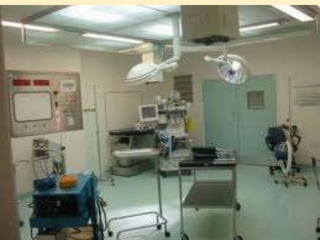
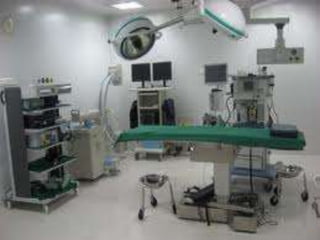
 Theaters have been divided into two distinct
groups:
 Superspeciality OT: Superspeciality OT
means
operations of Neurosciences, Orthopedics
(Joint
Replacement), Cardiothoracic and Transplant
Surgery (Renal, Liver etc).
 General OT: This includes Ophthalmology
4
THEATRE DESIGN
Theatre Design Consideration:
 The prevention of wound infection.
 The safety of patients and staff.
5
Design Features
 Designing a safe environment incorporates
features that prevent or control the risk of
infection, fire, explosion, and chemical and
electrical hazards.
 Well-devised traffic patterns, material-
handling systems, disposal systems, positive-
pressure and well-dispersed clean
ventilation, and high-flow, unidirectional
ventilation systems for special applications all
contribute to a safe surgical environment.
6
DESIGN FEATURES
 OT Size: Standard OT size of 20’ x 20’ x 10’
(Ht.
below the false ceiling level is considered).
 Occupancy: Standard occupancy of 5-8
persons at any given point of time inside the
OT is considered.
 Equipment Load: Standard equipment load
of 5-7 kW considered per OT.
7
SUPERSPECIALITY & GENERAL OT
Appropriate ventilation systems aid in the
control of infection by minimizing microbial
contamination.
 Air Changes Per Hour:
Minimum total air changes should be 30(supersp
OT) &25(GOT)based on international guidelines
 The same will vary with biological load and the
location.
 The fresh air component of the air change is
required to be minimum 5 air changes out of total
minimum 30 air changes 30(supersp OT)&
minimum 4 air changes out of total minimum 25 air
changes(GOT). 8
SUPER-SPECIALTY OT& GOT
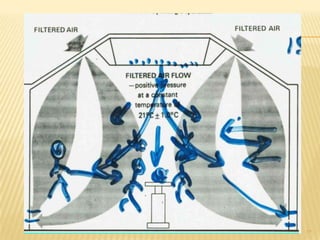
 Air Velocity: The vertical down flow of air coming out of the
diffusers should be able to carry bacteria carrying particle
load away from the operating table.
 The airflow needs to be unidirectional and downwards on
the OT table.
 The air velocity recommended as per the international and
national guidelines is 90-120 FPM at the Grille/Diffuser
level.
 Positive Pressure: There is a requirement to maintain
positive pressure differential between OT and adjoining
areas to prevent outside air entry into OT.
 The minimum positive pressure recommended is 15 Pascal
(0.05 inches of water) as per ISO 14644 Clean Room
Standard.
9
SUPER-SPECIALTY OT& GOT
 Air handling in the OT including air Quality:
 Air is supplied through Terminal HEPA filters in the
ceiling. The minimum size of the filtration area
should be 8’ x 6’ to cover the entire OT table and
surgical team.
 The minimum supply air volume to the OT (in CFM)
should be compliant with the desired minimum air
change.
 The return air should be picked up/ taken out from
the exhaust grille located near the floor level (appx
6 inches above the floor level).
 The air quality at the supply i.e. at grille level
should be Class 100/ ISO Class 5 (at rest
condition). Class 100 means a cubic foot of must
have no more than 100 particles measuring 0.5
microns or larger. 10
SUPER-SPECIALTY OT& GOT
 Temperature and Humidity: The temperature
should be maintained at 21 +/- 3 Deg C (68° and 73°
F) inside the OT
 Relative humidity between 40 to 60% though the ideal
Rh is considered to be 55% to reduce bacterial
growth and suppress static electricity.
 Appropriate devices to monitor and display these
conditions inside the OT may be installed.
 Temperatures in that range allow for comfort of the
surgical team and are tolerated by most patients.
 Each operating room should have individual
temperature controls to accommodate patient
safety, as when increased warmth is required for
patients at high risk for inadvertent hypothermia
during operative procedures.
11
CONTD…
 Air Filtration: The AHU must be an air
purification unit and air filtration unit.
 There must be two sets of washable flange type
pre filters of capacity 10 microns and 5 microns
with aluminum/ SS 304 frame within the AHU.
 HEPA filters of efficiency 99.97% down to o.3
microns or higher efficiency are to be provided in
the OT and not in the AHU.
 The AHU of each OT should be dedicated one
and should not be linked to air conditioning
of any other area
12
CONTD….
 Window & split A/c should not be used in any type of
OT because they are pure re circulating units and
have convenient pockets for microbial growth which
cannot be sealed.
 The flooring, walls and ceiling should be
nonporous, smooth, seamless without corners and
should be easily cleanable repeatedly. The material
should be chosen accordingly.
 periodic preventive maintenance be carried out in
terms of cleaning of pre filters at the interval of 15
days.
 Preventive maintenance of all the parts is carried out
as per manufacturer recommendations.
13
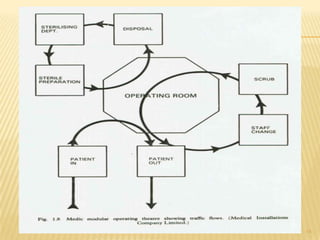
TRAFFIC FLOW
Traffic Patterns in the Surgical Suite, a
three-zone designation of areas within
the surgical suite facilitates appropriate
movement of patients and personnel.
14
TRAFFIC FLOW
1. Unrestricted areas are those in which
personnel may wear street clothes, and traffic
is not limited.
2. In semi-restricted areas, such as processing
and storage areas for instruments and
supplies, as well as corridors leading to the
restricted areas of the surgical
suite, personnel must wear surgical attire and
patients must wear gowns and hair coverings.
3. Restricted areas include operating rooms
and clean core and scrub sink areas. Surgical
attire and masks are required in these areas
when there are open sterile supplies or
scrubbed persons in the area.
15
16
TRAFFIC FLOW
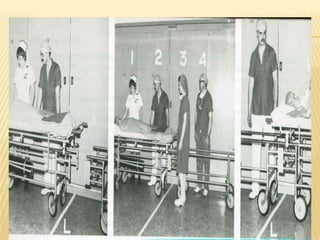
 The flow of supplies should be from the clean
core area through the operating rooms to the
peripheral corridor.
 Soiled materials should not re-enter the clean
core area. Soiled linen and trash collection
areas should be separated from personnel and
patient traffic areas for infection control
purposes.
17
18
19
EMERGENCY SIGNALS
 Every surgical suite should have an emergency
signal system that can be activated inside each
operating room.
 A light should appear outside the door of the room
involved, and a buzzer or bell should sound in a
central nursing or anaesthesia area.
 The signals should remain on until the alarm is
turned off at the source.
 All personnel should be familiar with the system and
should know both how to send a signal and how to
respond to it.
 Such a system, restricted to use in life-threatening
emergencies, saves invaluable time in bringing
additional personnel and resources for assistance.
20
OPERATING DEPARTMENT COMPRISES:
 Rest rooms
 Changing rooms
 Teaching rooms
 Storage
 Reception areas
 An operating suite
21
AN OPERATING SUITE
Is one functioning unit of a department:
 An anesthetic room
 Clean preparation room
 Scrub-up area
 Operating theatre
 Sluice room
 Exit bay
22
CLEAN AND DIRTY”
All journeys within the department
are made from clean to dirty
areas, never the other way round
23
PATIENTS
 Will enter the department from the hospital corridor via
a transfer bay. Here they are usually lifted on to a
theatre trolley, leaving the ward bed outside.
 Next they enter either a holding bay area or else move
directly to the anesthetic room.
 Finally they enter the theatre itself where surgery is to
be performed
 The journey has been one through progressively
cleaner areas, arriving finally at the cleanest of all.
 Once the wound has been closed and covered with
dressing, it is safe for the patient to return to the ward
via progressively more dirty areas: through the exit
bay, recovery and the hospital corridor.
24
INSTRUMENT AND EQUIPMENT
 Are brought from outside the department into clean
store rooms.
 Instruments are often supplied in pre-packed sterilized
trays by the Theatre Sterile Supplies Unit (TSSU).
 Finally, they enter the theatre ready for use on the
scrub nurse’s trolley.
 At the end of an operation, dirty instruments, linen and
rubbish are removed to the sluice room, and when
correctly packaged for disposal, to agreed collection
points.
 Porters then take them via a dirty corridor to their
several destinations: the TSSU, laundry or hospital
incinerator.
25
THEATRE PERSONNEL
 Enter the department via a changing room
where outdoor clothing is left.
 Once attired in correct theatre dress they
can proceed to a suite along a clean
corridor.
 Here they enter via the clean preparation
room or the scrub-area, and like the
patient, leave through the exit bay.
26
THE ANESTHETIC ROOM
 The anesthetic machine
 Suction apparatus
 The drug cupboar
The Operating Theatre
 The operating table – centre piece of the
room, a very versatile piece of equipment.
 It has to be in order to accommodate the great
variety of different operating positions.
27
THE OPERATING LIGHTS
 There are usually two operating lights in a
theatre attached to the ceiling.
 The lights are easily
maneuvered, necessary to accommodate
the needs of surgery.
 Good lighting is needed to carry out an
operation, and lighting a wound from two
converging angles is designed to eliminate
shadows. 28
ANESTHETIC SCAVENGING
 A long length of corrugated plastic tubing
connected to the anesthetic circuit at one
end, while the other connects to a vent in the
ceiling or wall.
 The system draws out of the theatre any anesthetic
gases or agents leaking from the circuit and which
pollute the atmosphere.
29
THE SWAB RACK
 This is a metal piece of furniture used for hanging
up swabs during an operation for ease counting.
 It comprises of several tiers have either hooks to
hang the swabs, or else holes to poke them
through.
 The hooks and holes are grouped in numbers off
fives, and each tiers can usually accommodate ten
swabs.
30
THE SWAB BOARD
 This is for recording the amount of blood loss
during the operation especially major operation.
 The nurses record this information for anesthetist's
benefit, who will instigate replacement therapy.
 The board is usually marked in two columns; one
for blood loss from the swabs and one for loss from
the suction.
31
WEIGHING SCALE: ESTIMATING BLOOD LOSS
 You should find a list of known dry weights of each
different type of swab.
 To estimate blood loss, you weigh the blood-soaked
swab, and from that weight subtract the known dry
weight.
 This leaves you with the weight of blood lost, which
is the amount you record, adding it to the running
total.
e.g.; Dry Large swab = 20g, Soaked in blood = 90g
: 90g – 20g =70g is the weight of the blood loss
(1g = 1ml) 32
X-ray Screens
This is vital as some operations are conducted with close
reference to a patient’s x-rays throughout.
e.g. orthopaedic surgery, tumour surgery and operations
such as cholecystectomy
RUBBISH BINS, SWAB BINS AND LINEN BINS
 Every theatre has separate disposal containers
for rubbish, swabs and linen.
 During the operation the swabs must remain
separate, to facilitate the swab counting
procedure.
 Leave the disposal bags in the theatre until the
end of the operation, until the scrub nurse is
entirely happy with the final count.
 Fresh disposal bags are always brought in for
every operation.
34
RECOVERY AREA
 Carried out in the corridor outside the
operating theatre.
 Normally made up of several bed
spaces, each with necessary equipment to
facilitate recovery e.g. oxygen, suction
apparatus, pulse oximetry, emergency trolley
necessary to deal with cardiac arrests or
anesthetic emergencies etc.
35
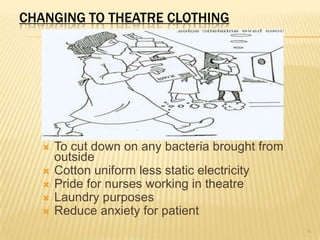
CHANGING TO THEATRE CLOTHING
 To cut down on any bacteria brought from
outside
 Cotton uniform less static electricity
 Pride for nurses working in theatre
 Laundry purposes
 Reduce anxiety for patient
36
WHAT IS WRONG WITH OUR INFECTION
CONTROL PRACTICES
 Disinfectants used indiscrimately,
 Used unnecessarily
 Not used when needed.
 Concentration not adequate
 Economic consideration,
 Business promotions.
.
37
BASIC PRINCIPLES
 Cleaning more Important
 Disinfection and Sterilization ?
 Cleaning
Removes contaminants,
Dust, organic matter,
Disinfection
Reduces number of microbes
38
BASIC CARE OF OPERATION THEATRES.
 Reduction of Microbial counts is important.
 Very rarely the Microbes reach the operation
site,
 Paying attention to Floors
 Using unnecessary, too many chemical not
necessary
 Keep Clean Dry - Bacteria are reduced,
 Most Important component of Bacteria is
water, dry areas causes natural death.
39
WALLS AND ROOF OF
OPERATION THEATRE
 Frequent cleaning has little effect.
 Do not disturb these areas unnecessarily,
 Floors get contaminated quickly, depend on
Number of persons present in the
Theatre / Movements they make,
On many people make unnecessary
movements than needed
40
CARE OF FLOORS
 Do remember only 1 % are pathogenic.
 On many occasion S.aureus.
 The counts depend on the number of persons,
 Only people needed for procedures should enter the
theatres.
 Unnecessary movements disturbs the bacterial flora
 Floor should be decontaminated with
Don't broom
Use Vacuum cleaner.
Wet cleaning techniques
Wet Mop / Keep the mops dry
41
CARE OF ROOF
 Do not disturb unnecessarily,
 Do not use ceiling fans they cause aerosol
spread
 Clean only when remodeling or accumulated
,good amount of dust.
42
CLEANING THE FLOOR
 A simple detergent reduces flora by 80
%
 Addition of disinfectant reduces to 95 %
 In busy Hospitals counts raise in 2
hours
43
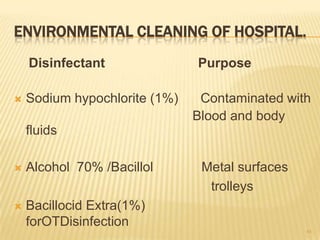
ENVIRONMENTAL CLEANING OF HOSPITAL.
Disinfectant Purpose
 Sodium hypochlorite (1%) Contaminated with
Blood and body
fluids
 Alcohol 70% /Bacillol Metal surfaces
trolleys
 Bacillocid Extra(1%)
forOTDisinfection
44
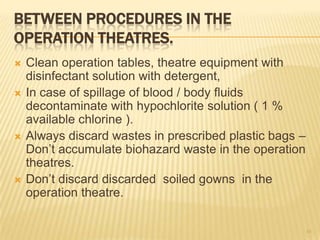
BETWEEN PROCEDURES IN THE
OPERATION THEATRES.
 Clean operation tables, theatre equipment with
disinfectant solution with detergent,
 In case of spillage of blood / body fluids
decontaminate with hypochlorite solution ( 1 %
available chlorine ).
 Always discard wastes in prescribed plastic bags –
Don’t accumulate biohazard waste in the operation
theatres.
 Don’t discard discarded soiled gowns in the
operation theatre.
45
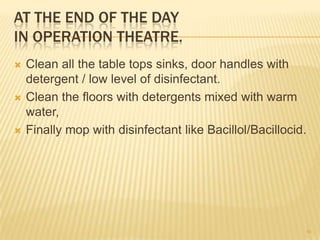
AT THE END OF THE DAY
IN OPERATION THEATRE.
 Clean all the table tops sinks, door handles with
detergent / low level of disinfectant.
 Clean the floors with detergents mixed with warm
water,
 Finally mop with disinfectant like Bacillol/Bacillocid.
46
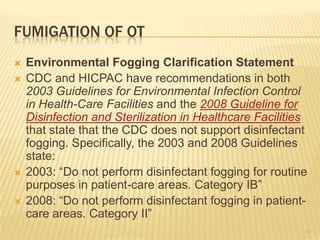
FUMIGATION OF OT
 Environmental Fogging Clarification Statement
 CDC and HICPAC have recommendations in both
2003 Guidelines for Environmental Infection Control
in Health-Care Facilities and the 2008 Guideline for
Disinfection and Sterilization in Healthcare Facilities
that state that the CDC does not support disinfectant
fogging. Specifically, the 2003 and 2008 Guidelines
state:
 2003: “Do not perform disinfectant fogging for routine
purposes in patient-care areas. Category IB”
 2008: “Do not perform disinfectant fogging in patient-
care areas. Category II”
47
CONTD….
 These recommendations refer to the spraying or fogging
of chemicals (e.g., formaldehyde, phenol-based
agents, or quaternary ammonium compounds) as a way
to decontaminate environmental surfaces or disinfect the
air in patient rooms.
 The recommendation against fogging was based on
studies in the 1970’s that reported a lack of microbicidal
efficacy (e.g., use of quaternary ammonium compounds
in mist applications) but
 also adverse effects on healthcare workers and others in
facilities where these methods were utilized.
 Furthermore, some of these chemicals are not EPA-
registered for use in fogging-type applications.
48
SURVEILLANCE OF OPERATION THEATRE
EXAMINATION OF AIR
 Estimations are done for detection of
bacteria carrying particles in Air.
 Factors influence
Number of persons present.
Body movements,
Disturbances of clothing.
49
METHODS OF AIR SURVEILLANCE
1 Settle plate method.
2 Slit sampler method (from given volume)
Counts vary from one to many
Settle plates method
Record position – Time - Duration
Plates with media as Blood agar/N.Agar exposed for
specified period and incubated in the
incubator for 24 hours at 37º c
50
HOW MANY BACTERIA ARE PATHOGENIC
 Counts vary On number of personal present in the
given area.
 Behavior of the persons.
 Depend on nature of procedures, type of
operations.
 Varying ranges
 But remember only 1 % are pathogenic
 Presence of S. aureus makes difference
51
DO WE NEED SURVEILLANCE REGULARLY
52
 Bacteriological surveillance testing at
regular internals is not warranted,
 But warranted when modification of
operation theaters are done,
 In any unforeseen increase of
incidence of infection form any
particular operation theatre.
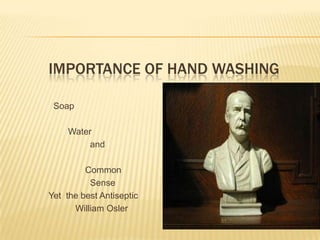
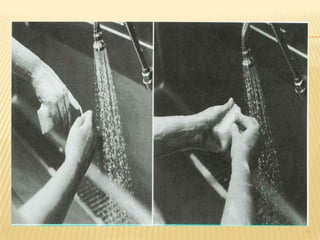
IMPORTANCE OF HAND WASHING
Soap
Water
and
Common
Sense
Yet the best Antiseptic
William Osler
53
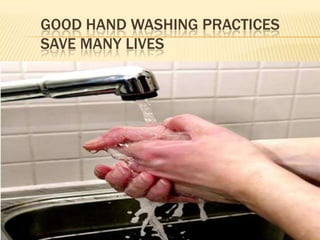
GOOD HAND WASHING PRACTICES
SAVE MANY LIVES
54
OPERATION THEATRE SAFTEY
IS RESPONSIBILITY OF?
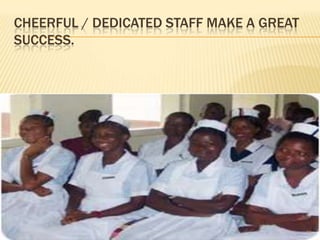
CHEERFUL / DEDICATED STAFF MAKE A GREAT
SUCCESS.
56
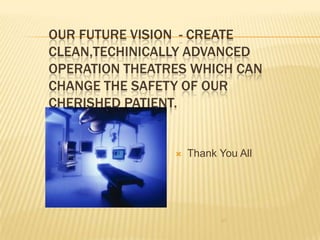
OUR FUTURE VISION - CREATE
CLEAN,TECHINICALLY ADVANCED
OPERATION THEATRES WHICH CAN
CHANGE THE SAFETY OF OUR
CHERISHED PATIENT.
 Thank You All
57
PRAYING THE BEST FROM OF DIVINITY
58
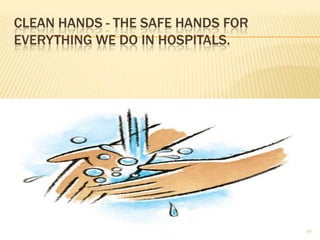
CLEAN HANDS - THE SAFE HANDS FOR
EVERYTHING WE DO IN HOSPITALS.
59
60
61
62
63
64
65
66
67
68
69
The End

Ot infection control rkch

  • 1.
    SAFE ENVIRONMENT &OT INFECTION PREVENTION Dr.Sabah Javed Consultant Microbiologist RKCH Raipur 1
  • 2.
  • 3.
  • 4.
    OT  Theaters havebeen divided into two distinct groups:  Superspeciality OT: Superspeciality OT means operations of Neurosciences, Orthopedics (Joint Replacement), Cardiothoracic and Transplant Surgery (Renal, Liver etc).  General OT: This includes Ophthalmology 4
  • 5.
    THEATRE DESIGN Theatre DesignConsideration:  The prevention of wound infection.  The safety of patients and staff. 5
  • 6.
    Design Features  Designinga safe environment incorporates features that prevent or control the risk of infection, fire, explosion, and chemical and electrical hazards.  Well-devised traffic patterns, material- handling systems, disposal systems, positive- pressure and well-dispersed clean ventilation, and high-flow, unidirectional ventilation systems for special applications all contribute to a safe surgical environment. 6
  • 7.
    DESIGN FEATURES  OTSize: Standard OT size of 20’ x 20’ x 10’ (Ht. below the false ceiling level is considered).  Occupancy: Standard occupancy of 5-8 persons at any given point of time inside the OT is considered.  Equipment Load: Standard equipment load of 5-7 kW considered per OT. 7
  • 8.
    SUPERSPECIALITY & GENERALOT Appropriate ventilation systems aid in the control of infection by minimizing microbial contamination.  Air Changes Per Hour: Minimum total air changes should be 30(supersp OT) &25(GOT)based on international guidelines  The same will vary with biological load and the location.  The fresh air component of the air change is required to be minimum 5 air changes out of total minimum 30 air changes 30(supersp OT)& minimum 4 air changes out of total minimum 25 air changes(GOT). 8
  • 9.
    SUPER-SPECIALTY OT& GOT Air Velocity: The vertical down flow of air coming out of the diffusers should be able to carry bacteria carrying particle load away from the operating table.  The airflow needs to be unidirectional and downwards on the OT table.  The air velocity recommended as per the international and national guidelines is 90-120 FPM at the Grille/Diffuser level.  Positive Pressure: There is a requirement to maintain positive pressure differential between OT and adjoining areas to prevent outside air entry into OT.  The minimum positive pressure recommended is 15 Pascal (0.05 inches of water) as per ISO 14644 Clean Room Standard. 9
  • 10.
    SUPER-SPECIALTY OT& GOT Air handling in the OT including air Quality:  Air is supplied through Terminal HEPA filters in the ceiling. The minimum size of the filtration area should be 8’ x 6’ to cover the entire OT table and surgical team.  The minimum supply air volume to the OT (in CFM) should be compliant with the desired minimum air change.  The return air should be picked up/ taken out from the exhaust grille located near the floor level (appx 6 inches above the floor level).  The air quality at the supply i.e. at grille level should be Class 100/ ISO Class 5 (at rest condition). Class 100 means a cubic foot of must have no more than 100 particles measuring 0.5 microns or larger. 10
  • 11.
    SUPER-SPECIALTY OT& GOT Temperature and Humidity: The temperature should be maintained at 21 +/- 3 Deg C (68° and 73° F) inside the OT  Relative humidity between 40 to 60% though the ideal Rh is considered to be 55% to reduce bacterial growth and suppress static electricity.  Appropriate devices to monitor and display these conditions inside the OT may be installed.  Temperatures in that range allow for comfort of the surgical team and are tolerated by most patients.  Each operating room should have individual temperature controls to accommodate patient safety, as when increased warmth is required for patients at high risk for inadvertent hypothermia during operative procedures. 11
  • 12.
    CONTD…  Air Filtration:The AHU must be an air purification unit and air filtration unit.  There must be two sets of washable flange type pre filters of capacity 10 microns and 5 microns with aluminum/ SS 304 frame within the AHU.  HEPA filters of efficiency 99.97% down to o.3 microns or higher efficiency are to be provided in the OT and not in the AHU.  The AHU of each OT should be dedicated one and should not be linked to air conditioning of any other area 12
  • 13.
    CONTD….  Window &split A/c should not be used in any type of OT because they are pure re circulating units and have convenient pockets for microbial growth which cannot be sealed.  The flooring, walls and ceiling should be nonporous, smooth, seamless without corners and should be easily cleanable repeatedly. The material should be chosen accordingly.  periodic preventive maintenance be carried out in terms of cleaning of pre filters at the interval of 15 days.  Preventive maintenance of all the parts is carried out as per manufacturer recommendations. 13
  • 14.
    TRAFFIC FLOW Traffic Patternsin the Surgical Suite, a three-zone designation of areas within the surgical suite facilitates appropriate movement of patients and personnel. 14
  • 15.
    TRAFFIC FLOW 1. Unrestrictedareas are those in which personnel may wear street clothes, and traffic is not limited. 2. In semi-restricted areas, such as processing and storage areas for instruments and supplies, as well as corridors leading to the restricted areas of the surgical suite, personnel must wear surgical attire and patients must wear gowns and hair coverings. 3. Restricted areas include operating rooms and clean core and scrub sink areas. Surgical attire and masks are required in these areas when there are open sterile supplies or scrubbed persons in the area. 15
  • 16.
  • 17.
    TRAFFIC FLOW  Theflow of supplies should be from the clean core area through the operating rooms to the peripheral corridor.  Soiled materials should not re-enter the clean core area. Soiled linen and trash collection areas should be separated from personnel and patient traffic areas for infection control purposes. 17
  • 18.
  • 19.
  • 20.
    EMERGENCY SIGNALS  Everysurgical suite should have an emergency signal system that can be activated inside each operating room.  A light should appear outside the door of the room involved, and a buzzer or bell should sound in a central nursing or anaesthesia area.  The signals should remain on until the alarm is turned off at the source.  All personnel should be familiar with the system and should know both how to send a signal and how to respond to it.  Such a system, restricted to use in life-threatening emergencies, saves invaluable time in bringing additional personnel and resources for assistance. 20
  • 21.
    OPERATING DEPARTMENT COMPRISES: Rest rooms  Changing rooms  Teaching rooms  Storage  Reception areas  An operating suite 21
  • 22.
    AN OPERATING SUITE Isone functioning unit of a department:  An anesthetic room  Clean preparation room  Scrub-up area  Operating theatre  Sluice room  Exit bay 22
  • 23.
    CLEAN AND DIRTY” Alljourneys within the department are made from clean to dirty areas, never the other way round 23
  • 24.
    PATIENTS  Will enterthe department from the hospital corridor via a transfer bay. Here they are usually lifted on to a theatre trolley, leaving the ward bed outside.  Next they enter either a holding bay area or else move directly to the anesthetic room.  Finally they enter the theatre itself where surgery is to be performed  The journey has been one through progressively cleaner areas, arriving finally at the cleanest of all.  Once the wound has been closed and covered with dressing, it is safe for the patient to return to the ward via progressively more dirty areas: through the exit bay, recovery and the hospital corridor. 24
  • 25.
    INSTRUMENT AND EQUIPMENT Are brought from outside the department into clean store rooms.  Instruments are often supplied in pre-packed sterilized trays by the Theatre Sterile Supplies Unit (TSSU).  Finally, they enter the theatre ready for use on the scrub nurse’s trolley.  At the end of an operation, dirty instruments, linen and rubbish are removed to the sluice room, and when correctly packaged for disposal, to agreed collection points.  Porters then take them via a dirty corridor to their several destinations: the TSSU, laundry or hospital incinerator. 25
  • 26.
    THEATRE PERSONNEL  Enterthe department via a changing room where outdoor clothing is left.  Once attired in correct theatre dress they can proceed to a suite along a clean corridor.  Here they enter via the clean preparation room or the scrub-area, and like the patient, leave through the exit bay. 26
  • 27.
    THE ANESTHETIC ROOM The anesthetic machine  Suction apparatus  The drug cupboar The Operating Theatre  The operating table – centre piece of the room, a very versatile piece of equipment.  It has to be in order to accommodate the great variety of different operating positions. 27
  • 28.
    THE OPERATING LIGHTS There are usually two operating lights in a theatre attached to the ceiling.  The lights are easily maneuvered, necessary to accommodate the needs of surgery.  Good lighting is needed to carry out an operation, and lighting a wound from two converging angles is designed to eliminate shadows. 28
  • 29.
    ANESTHETIC SCAVENGING  Along length of corrugated plastic tubing connected to the anesthetic circuit at one end, while the other connects to a vent in the ceiling or wall.  The system draws out of the theatre any anesthetic gases or agents leaking from the circuit and which pollute the atmosphere. 29
  • 30.
    THE SWAB RACK This is a metal piece of furniture used for hanging up swabs during an operation for ease counting.  It comprises of several tiers have either hooks to hang the swabs, or else holes to poke them through.  The hooks and holes are grouped in numbers off fives, and each tiers can usually accommodate ten swabs. 30
  • 31.
    THE SWAB BOARD This is for recording the amount of blood loss during the operation especially major operation.  The nurses record this information for anesthetist's benefit, who will instigate replacement therapy.  The board is usually marked in two columns; one for blood loss from the swabs and one for loss from the suction. 31
  • 32.
    WEIGHING SCALE: ESTIMATINGBLOOD LOSS  You should find a list of known dry weights of each different type of swab.  To estimate blood loss, you weigh the blood-soaked swab, and from that weight subtract the known dry weight.  This leaves you with the weight of blood lost, which is the amount you record, adding it to the running total. e.g.; Dry Large swab = 20g, Soaked in blood = 90g : 90g – 20g =70g is the weight of the blood loss (1g = 1ml) 32
  • 33.
    X-ray Screens This isvital as some operations are conducted with close reference to a patient’s x-rays throughout. e.g. orthopaedic surgery, tumour surgery and operations such as cholecystectomy
  • 34.
    RUBBISH BINS, SWABBINS AND LINEN BINS  Every theatre has separate disposal containers for rubbish, swabs and linen.  During the operation the swabs must remain separate, to facilitate the swab counting procedure.  Leave the disposal bags in the theatre until the end of the operation, until the scrub nurse is entirely happy with the final count.  Fresh disposal bags are always brought in for every operation. 34
  • 35.
    RECOVERY AREA  Carriedout in the corridor outside the operating theatre.  Normally made up of several bed spaces, each with necessary equipment to facilitate recovery e.g. oxygen, suction apparatus, pulse oximetry, emergency trolley necessary to deal with cardiac arrests or anesthetic emergencies etc. 35
  • 36.
    CHANGING TO THEATRECLOTHING  To cut down on any bacteria brought from outside  Cotton uniform less static electricity  Pride for nurses working in theatre  Laundry purposes  Reduce anxiety for patient 36
  • 37.
    WHAT IS WRONGWITH OUR INFECTION CONTROL PRACTICES  Disinfectants used indiscrimately,  Used unnecessarily  Not used when needed.  Concentration not adequate  Economic consideration,  Business promotions. . 37
  • 38.
    BASIC PRINCIPLES  Cleaningmore Important  Disinfection and Sterilization ?  Cleaning Removes contaminants, Dust, organic matter, Disinfection Reduces number of microbes 38
  • 39.
    BASIC CARE OFOPERATION THEATRES.  Reduction of Microbial counts is important.  Very rarely the Microbes reach the operation site,  Paying attention to Floors  Using unnecessary, too many chemical not necessary  Keep Clean Dry - Bacteria are reduced,  Most Important component of Bacteria is water, dry areas causes natural death. 39
  • 40.
    WALLS AND ROOFOF OPERATION THEATRE  Frequent cleaning has little effect.  Do not disturb these areas unnecessarily,  Floors get contaminated quickly, depend on Number of persons present in the Theatre / Movements they make, On many people make unnecessary movements than needed 40
  • 41.
    CARE OF FLOORS Do remember only 1 % are pathogenic.  On many occasion S.aureus.  The counts depend on the number of persons,  Only people needed for procedures should enter the theatres.  Unnecessary movements disturbs the bacterial flora  Floor should be decontaminated with Don't broom Use Vacuum cleaner. Wet cleaning techniques Wet Mop / Keep the mops dry 41
  • 42.
    CARE OF ROOF Do not disturb unnecessarily,  Do not use ceiling fans they cause aerosol spread  Clean only when remodeling or accumulated ,good amount of dust. 42
  • 43.
    CLEANING THE FLOOR A simple detergent reduces flora by 80 %  Addition of disinfectant reduces to 95 %  In busy Hospitals counts raise in 2 hours 43
  • 44.
    ENVIRONMENTAL CLEANING OFHOSPITAL. Disinfectant Purpose  Sodium hypochlorite (1%) Contaminated with Blood and body fluids  Alcohol 70% /Bacillol Metal surfaces trolleys  Bacillocid Extra(1%) forOTDisinfection 44
  • 45.
    BETWEEN PROCEDURES INTHE OPERATION THEATRES.  Clean operation tables, theatre equipment with disinfectant solution with detergent,  In case of spillage of blood / body fluids decontaminate with hypochlorite solution ( 1 % available chlorine ).  Always discard wastes in prescribed plastic bags – Don’t accumulate biohazard waste in the operation theatres.  Don’t discard discarded soiled gowns in the operation theatre. 45
  • 46.
    AT THE ENDOF THE DAY IN OPERATION THEATRE.  Clean all the table tops sinks, door handles with detergent / low level of disinfectant.  Clean the floors with detergents mixed with warm water,  Finally mop with disinfectant like Bacillol/Bacillocid. 46
  • 47.
    FUMIGATION OF OT Environmental Fogging Clarification Statement  CDC and HICPAC have recommendations in both 2003 Guidelines for Environmental Infection Control in Health-Care Facilities and the 2008 Guideline for Disinfection and Sterilization in Healthcare Facilities that state that the CDC does not support disinfectant fogging. Specifically, the 2003 and 2008 Guidelines state:  2003: “Do not perform disinfectant fogging for routine purposes in patient-care areas. Category IB”  2008: “Do not perform disinfectant fogging in patient- care areas. Category II” 47
  • 48.
    CONTD….  These recommendationsrefer to the spraying or fogging of chemicals (e.g., formaldehyde, phenol-based agents, or quaternary ammonium compounds) as a way to decontaminate environmental surfaces or disinfect the air in patient rooms.  The recommendation against fogging was based on studies in the 1970’s that reported a lack of microbicidal efficacy (e.g., use of quaternary ammonium compounds in mist applications) but  also adverse effects on healthcare workers and others in facilities where these methods were utilized.  Furthermore, some of these chemicals are not EPA- registered for use in fogging-type applications. 48
  • 49.
    SURVEILLANCE OF OPERATIONTHEATRE EXAMINATION OF AIR  Estimations are done for detection of bacteria carrying particles in Air.  Factors influence Number of persons present. Body movements, Disturbances of clothing. 49
  • 50.
    METHODS OF AIRSURVEILLANCE 1 Settle plate method. 2 Slit sampler method (from given volume) Counts vary from one to many Settle plates method Record position – Time - Duration Plates with media as Blood agar/N.Agar exposed for specified period and incubated in the incubator for 24 hours at 37º c 50
  • 51.
    HOW MANY BACTERIAARE PATHOGENIC  Counts vary On number of personal present in the given area.  Behavior of the persons.  Depend on nature of procedures, type of operations.  Varying ranges  But remember only 1 % are pathogenic  Presence of S. aureus makes difference 51
  • 52.
    DO WE NEEDSURVEILLANCE REGULARLY 52  Bacteriological surveillance testing at regular internals is not warranted,  But warranted when modification of operation theaters are done,  In any unforeseen increase of incidence of infection form any particular operation theatre.
  • 53.
    IMPORTANCE OF HANDWASHING Soap Water and Common Sense Yet the best Antiseptic William Osler 53
  • 54.
    GOOD HAND WASHINGPRACTICES SAVE MANY LIVES 54
  • 55.
    OPERATION THEATRE SAFTEY ISRESPONSIBILITY OF?
  • 56.
    CHEERFUL / DEDICATEDSTAFF MAKE A GREAT SUCCESS. 56
  • 57.
    OUR FUTURE VISION- CREATE CLEAN,TECHINICALLY ADVANCED OPERATION THEATRES WHICH CAN CHANGE THE SAFETY OF OUR CHERISHED PATIENT.  Thank You All 57
  • 58.
    PRAYING THE BESTFROM OF DIVINITY 58
  • 59.
    CLEAN HANDS -THE SAFE HANDS FOR EVERYTHING WE DO IN HOSPITALS. 59
  • 60.
  • 61.
  • 62.
  • 63.
  • 64.
  • 65.
  • 66.
  • 67.
  • 68.
  • 69.