Design of CSSD and New Trends Anuradha Desai Manager, Getinge Academy
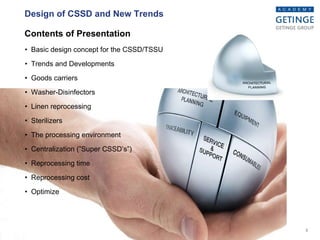
Basic design concept for the CSSD/TSSU Trends and Developments Goods carriers Washer-Disinfectors Linen reprocessing Sterilizers The processing environment Centralization (”Super CSSD’s”) Reprocessing time Reprocessing cost Optimize Design of CSSD and New Trends Contents of Presentation 08/19/11  I  Anuradha Desai  I  Getinge Academy  I  Public
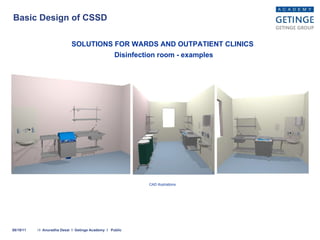
SOLUTIONS FOR WARDS AND OUTPATIENT CLINICS Disinfection room - examples 08/19/11  I  Anuradha Desai  I  Getinge Academy  I  Public Basic Design of CSSD CAD illustrations
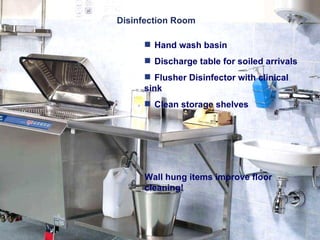
Disinfection Room Hand wash basin Discharge table for soiled arrivals Flusher Disinfector with clinical sink Clean storage shelves Wall hung items improve floor cleaning!
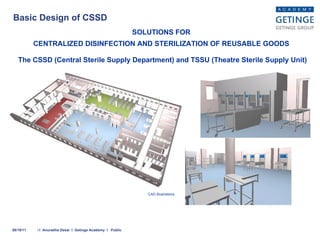
SOLUTIONS FOR CENTRALIZED DISINFECTION AND STERILIZATION OF REUSABLE GOODS The CSSD (Central Sterile Supply Department) and TSSU (Theatre Sterile Supply Unit) CAD illustrations 08/19/11  I  Anuradha Desai  I  Getinge Academy  I  Public Basic Design of CSSD
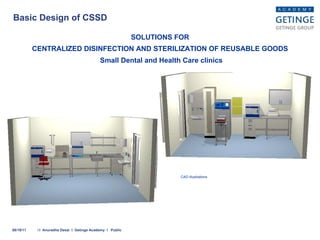
SOLUTIONS FOR CENTRALIZED DISINFECTION AND STERILIZATION OF REUSABLE GOODS Small Dental and Health Care clinics CAD illustrations 08/19/11  I  Anuradha Desai  I  Getinge Academy  I  Public Basic Design of CSSD
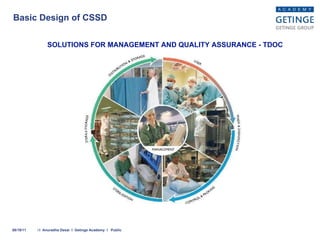
SOLUTIONS FOR MANAGEMENT AND QUALITY ASSURANCE - TDOC 08/19/11  I  Anuradha Desai  I  Getinge Academy  I  Public Basic Design of CSSD
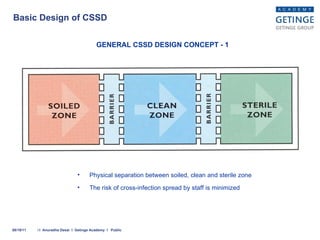
Physical separation between soiled, clean and sterile zone  The risk of cross-infection spread by staff is minimized  GENERAL CSSD DESIGN CONCEPT - 1 08/19/11  I  Anuradha Desai  I  Getinge Academy  I  Public Basic Design of CSSD
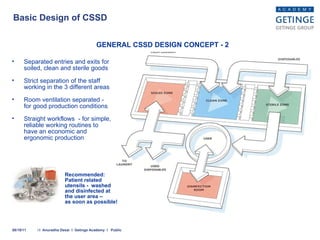
Separated entries and exits for soiled, clean and sterile goods Strict separation of the staff working in the 3 different areas Room ventilation separated - for good production conditions Straight workflows  - for simple, reliable working routines to have an economic and ergonomic production GENERAL CSSD DESIGN CONCEPT - 2 08/19/11  I  Anuradha Desai  I  Getinge Academy  I  Public Basic Design of CSSD Recommended:  Patient related utensils -  washed and disinfected at the user area – as soon as possible!
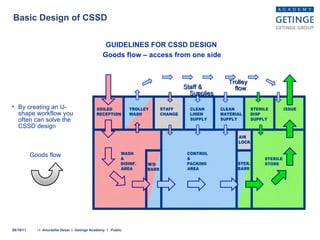
Goods flow – access from one side By creating an U-shape workflow you often can solve the CSSD design GUIDELINES FOR CSSD DESIGN 08/19/11  I  Anuradha Desai  I  Getinge Academy  I  Public Basic Design of CSSD Goods flow   Trolley flow Staff & Supplies
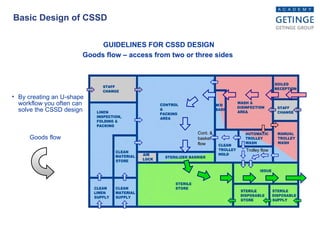
Goods flow – access from two or three sides By creating an U-shape workflow you often can solve the CSSD design GUIDELINES FOR CSSD DESIGN Basic Design of CSSD Trolley flow Cont. & basket flow Goods flow
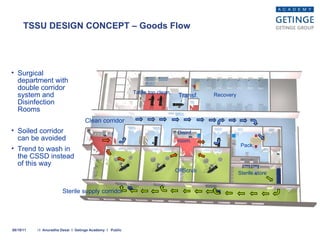
TSSU DESIGN CONCEPT – Goods Flow 08/19/11  I  Anuradha Desai  I  Getinge Academy  I  Public Surgical department with double corridor system and Disinfection Rooms Soiled corridor can be avoided Trend to wash in the CSSD instead of this way Pack. Transf. Table top clean. Sterile store Sterile supply corridor Clean corridor Recovery OR Scrub Disinf. room.
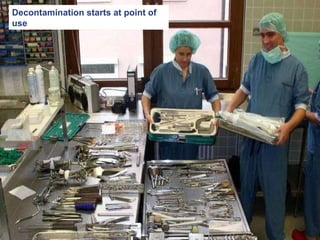
Decontamination starts at point of use
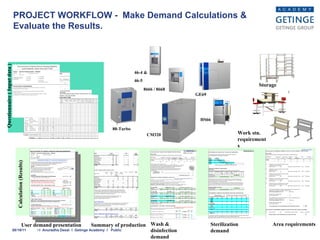
PROJECT WORKFLOW -  Make Demand Calculations & Evaluate the Results. Work stn. requirements Wash & disinfection demand Questionnaire ( Input data ) Summary of production User demand presentation Calculation (Results) Sterilization demand Area requirements HS66 GE69 8666 / 8668 CM320 88-Turbo 08/19/11  I  Anuradha Desai  I  Getinge Academy  I  Public Storage requirements 46-4 & 46-5
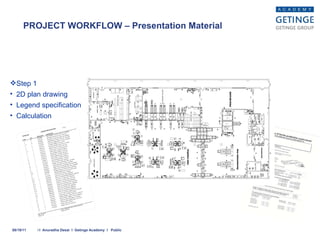
PROJECT WORKFLOW – Presentation Material  Step 1 2D plan drawing Legend specification Calculation 08/19/11  I  Anuradha Desai  I  Getinge Academy  I  Public
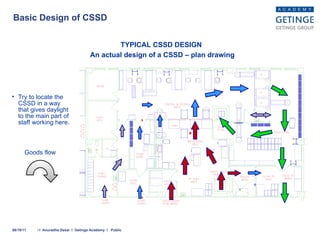
Try to locate the CSSD in a way that gives daylight to the main part of staff working here. TYPICAL CSSD DESIGN An actual design of a CSSD – plan drawing 08/19/11  I  Anuradha Desai  I  Getinge Academy  I  Public Basic Design of CSSD Goods flow
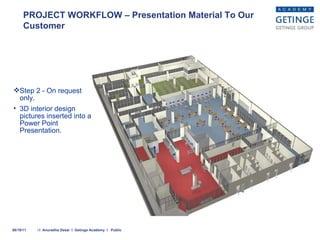
Step 2 - On request only. 3D interior design pictures inserted into a Power Point Presentation. PROJECT WORKFLOW – Presentation Material To Our Customer 08/19/11  I  Anuradha Desai  I  Getinge Academy  I  Public
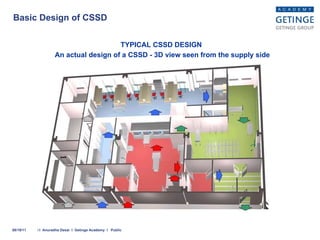
TYPICAL CSSD DESIGN An actual design of a CSSD - 3D view seen from the supply side 08/19/11  I  Anuradha Desai  I  Getinge Academy  I  Public Basic Design of CSSD
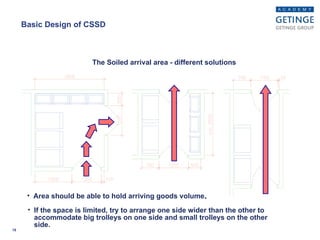
The Soiled arrival area - different solutions If the space is limited, try to arrange one side wider than the other to accommodate big trolleys on one side and small trolleys on the other side. Area   should   be   able   to   hold   arriving   goods   volume . Basic Design of CSSD
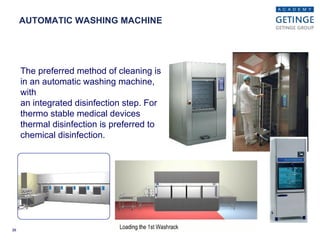
The preferred method of cleaning is in an automatic washing machine, with an integrated disinfection step. For thermo stable medical devices thermal disinfection is preferred to chemical disinfection. AUTOMATIC WASHING MACHINE
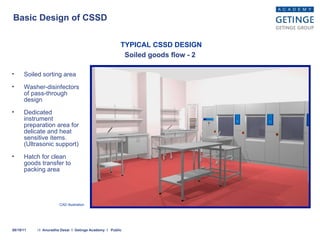
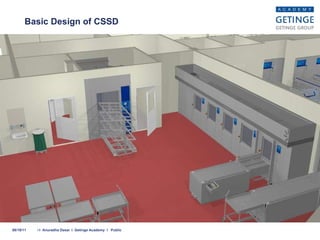
Soiled sorting area Washer-disinfectors of pass-through design Dedicated instrument preparation area for delicate and heat sensitive items. (Ultrasonic support) Hatch for clean goods transfer to packing area CAD illustration TYPICAL CSSD DESIGN Soiled goods flow - 2 08/19/11  I  Anuradha Desai  I  Getinge Academy  I  Public Basic Design of CSSD
Basic Design of CSSD 08/19/11  I  Anuradha Desai  I  Getinge Academy  I  Public
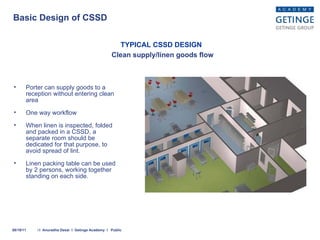
Porter can supply goods to a reception without entering clean area One way workflow When linen is inspected, folded and packed in a CSSD, a separate room should be dedicated for that purpose, to avoid spread of lint. Linen packing table can be used by 2 persons, working together standing on each side. TYPICAL CSSD DESIGN Clean supply/linen goods flow 08/19/11  I  Anuradha Desai  I  Getinge Academy  I  Public Basic Design of CSSD
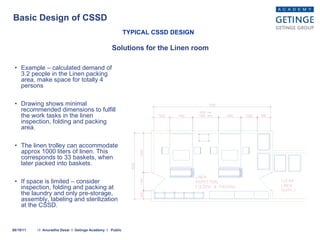
Solutions for the Linen room Example – calculated demand of 3.2 people in the Linen packing area, make space for totally 4 persons Drawing shows minimal recommended dimensions to fulfill the work tasks in the linen inspection, folding and packing area. The linen trolley can accommodate approx 1000 liters of linen. This corresponds to 33 baskets, when later packed into baskets. If space is limited – consider inspection, folding and packing at the laundry and only pre-storage, assembly, labeling and sterilization at the CSSD. TYPICAL CSSD DESIGN 08/19/11  I  Anuradha Desai  I  Getinge Academy  I  Public Basic Design of CSSD
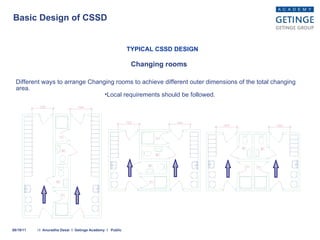
Changing rooms Local requirements should be followed. Different ways to arrange Changing rooms to achieve different outer dimensions of the total changing area. TYPICAL   CSSD DESIGN 08/19/11  I  Anuradha Desai  I  Getinge Academy  I  Public Basic Design of CSSD
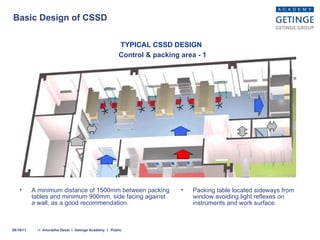
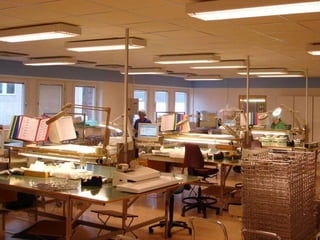
A minimum distance of 1500mm between packing tables and minimum 900mm, side facing against a wall, as a good recommendation. TYPICAL CSSD DESIGN Control & packing area - 1 Packing table located sideways from window avoiding light reflexes on instruments and work surface. 08/19/11  I  Anuradha Desai  I  Getinge Academy  I  Public Basic Design of CSSD
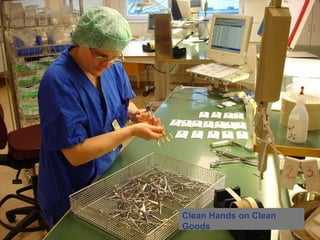
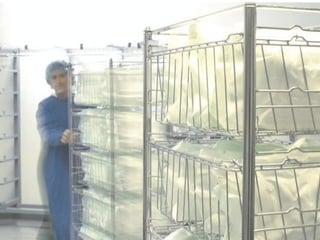
Clean Hands on Clean Goods
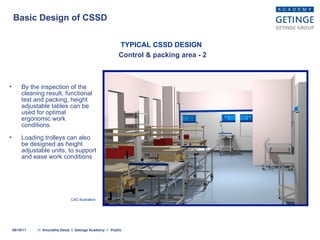
By the inspection of the cleaning result, functional test and packing, height adjustable tables can be used for optimal ergonomic work conditions. Loading trolleys can also be designed as height adjustable units, to support and ease work conditions CAD illustration TYPICAL CSSD DESIGN Control & packing area - 2 08/19/11  I  Anuradha Desai  I  Getinge Academy  I  Public Basic Design of CSSD
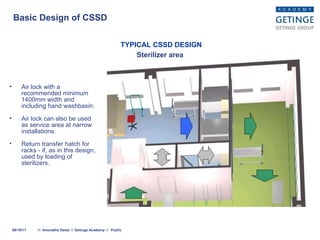
Air lock with a recommended minimum 1400mm width and including hand washbasin. Air lock can also be used as service area at narrow installations.  Return transfer hatch for racks - if, as in this design, used by loading of sterilizers. TYPICAL CSSD DESIGN Sterilizer area 08/19/11  I  Anuradha Desai  I  Getinge Academy  I  Public Basic Design of CSSD
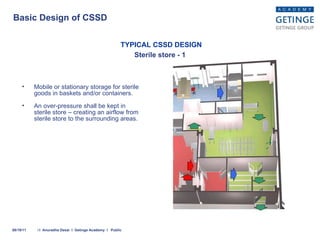
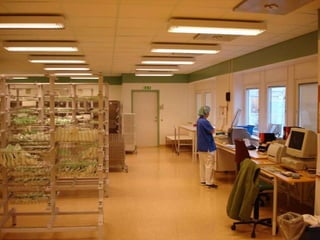
Mobile or stationary storage for sterile goods in baskets and/or containers. An over-pressure shall be kept in  sterile store – creating an airflow from sterile store to the surrounding areas. TYPICAL CSSD DESIGN Sterile store - 1 08/19/11  I  Anuradha Desai  I  Getinge Academy  I  Public Basic Design of CSSD
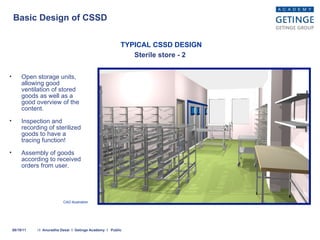
Open storage units, allowing good ventilation of stored goods as well as a good overview of the content. Inspection and recording of sterilized goods to have a tracing function! Assembly of goods according to received orders from user. CAD illustration TYPICAL CSSD DESIGN Sterile store - 2 08/19/11  I  Anuradha Desai  I  Getinge Academy  I  Public Basic Design of CSSD
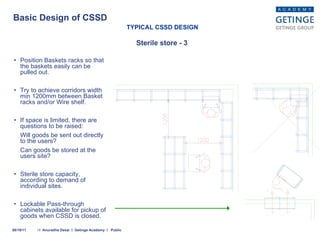
Sterile store - 3 Position Baskets racks so that the baskets easily can be pulled out. Try to achieve corridors width min 1200mm between Basket racks and/or Wire shelf. If space is limited, there are questions to be raised: Will goods be sent out directly to the users? Can goods be stored at the users site? Sterile store capacity, according to demand of individual sites. Lockable Pass-through cabinets available for pickup of goods when CSSD is closed. TYPICAL   CSSD DESIGN 08/19/11  I  Anuradha Desai  I  Getinge Academy  I  Public Basic Design of CSSD
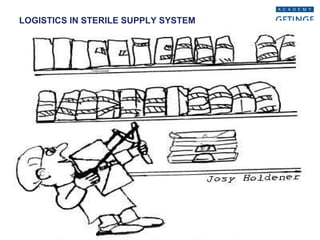
LOGISTICS IN STERILE SUPPLY SYSTEM
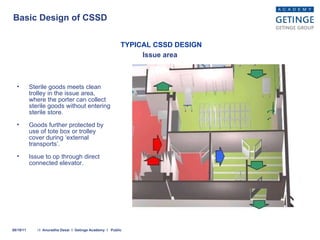
Sterile goods meets clean trolley in the issue area, where the porter can collect sterile goods without entering sterile store. Goods further protected by use of tote box or trolley cover during ‘external transports’. Issue to op through direct connected elevator. TYPICAL CSSD DESIGN Issue area 08/19/11  I  Anuradha Desai  I  Getinge Academy  I  Public Basic Design of CSSD
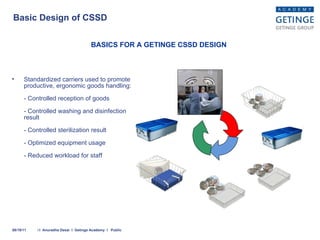
Standardized carriers used to promote productive, ergonomic goods handling: - Controlled reception of goods - Controlled washing and disinfection result - Controlled sterilization result - Optimized equipment usage - Reduced workload for staff BASICS FOR A GETINGE CSSD DESIGN 08/19/11  I  Anuradha Desai  I  Getinge Academy  I  Public Basic Design of CSSD
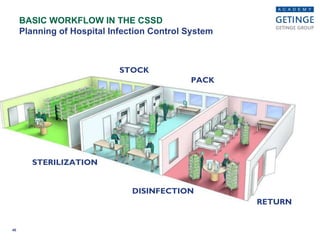
BASIC WORKFLOW  I N THE CSSD   Planning of Hospital Infection Control System PACK STERILIZATION STOCK RETURN DISINFECTION
INFECTION CONTROL TRENDS & DEVELOPMENTS 08/19/11  I  Anuradha Desai  I  Getinge Academy  I  Public NEW TRENDS AND DEVELOPMENTS!
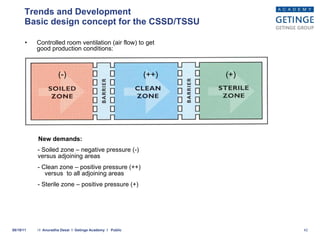
Trends and Development Basic design concept for the CSSD/TSSU Controlled room ventilation (air flow) to get good production conditions: - Soiled zone – negative pressure (-) versus adjoining areas  - Clean zone – positive pressure (++)  versus  to all adjoining areas  - Sterile zone – positive pressure (+) New demands: 08/19/11  I  Anuradha Desai  I  Getinge Academy  I  Public - Soiled zone – negative pressure (-) versus adjoining areas  - Clean zone – positive pressure (++)  versus  to all adjoining areas  - Sterile zone – positive pressure (+) (-) (++) (+)
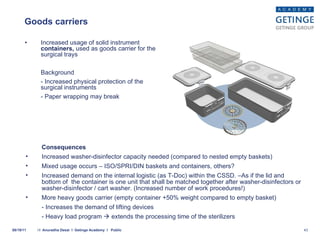
Goods carriers Increased usage of solid instrument  containers,  used as goods carrier for the surgical trays Background - Increased physical protection of the surgical instruments - Paper wrapping may break  08/19/11  I  Anuradha Desai  I  Getinge Academy  I  Public Consequences Increased washer-disinfector capacity needed (compared to nested empty baskets) Mixed usage occurs – ISO/SPRI/DIN baskets and containers, others? Increased demand on the internal logistic (as T-Doc) within the CSSD. –As if the lid and bottom of  the container is one unit that shall be matched together after washer-disinfectors or washer-disinfector / cart washer. (Increased number of work procedures!) More heavy goods carrier (empty container +50% weight compared to empty basket) - Increases the demand of lifting devices - Heavy load program    extends the processing time of the sterilizers
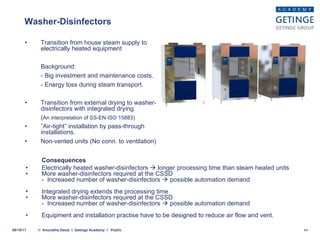
Washer-Disinfectors Transition from house steam supply to electrically heated equipment Background: - Big investment and maintenance costs. - Energy loss during steam transport. Transition from external drying to washer-disinfectors with integrated drying.  ( An interpretation of SS-EN ISO 15883) ” Air-tight” installation by pass-through installations . Non-vented units (No conn. to ventilation) 08/19/11  I  Anuradha Desai  I  Getinge Academy  I  Public Consequences Electrically heated washer-disinfectors    longer processing time than steam heated units More washer-disinfectors required at the CSSD -  Increased number of washer-disinfectors    possible automation demand Integrated drying extends the processing time More washer-disinfectors required at the CSSD -  Increased number of washer-disinfectors    possible automation demand Equipment and installation practise have to be designed to reduce air flow and vent.
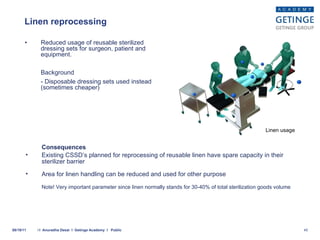
Linen reprocessing Reduced usage of reusable sterilized dressing sets for surgeon, patient and equipment. Background - Disposable dressing sets used instead (sometimes cheaper) 08/19/11  I  Anuradha Desai  I  Getinge Academy  I  Public Consequences Existing CSSD’s planned for reprocessing of reusable linen have spare capacity in their sterilizer barrier Area for linen handling can be reduced and used for other purpose Note! Very important parameter since linen normally stands for 30-40% of total sterilization goods volume Linen usage
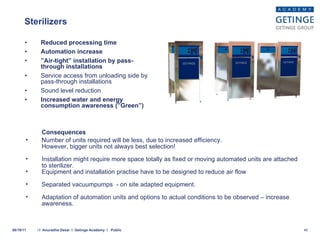
Sterilizers Reduced processing time Automation increase ” Air-tight” installation by pass-through installations Service access from unloading side by pass-through installations Sound level reduction Increased water and energy consumption awareness (”Green”) 08/19/11  I  Anuradha Desai  I  Getinge Academy  I  Public Consequences Number of units required will be less, due to increased efficiency. However, bigger units not always best selection! Installation might require more space totally as fixed or moving automated units are attached to sterilizer. Equipment and installation practise have to be designed to reduce air flow Separated vacuumpumps  - on site adapted equipment. Adaptation of automation units and options to actual conditions to be observed – increase awareness.
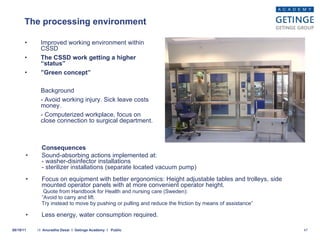
The processing environment Improved working environment within CSSD  The CSSD work getting a higher “status” ” Green concept” Background - Avoid working injury. Sick leave costs money. - Computerized workplace, focus on close connection to surgical department. 08/19/11  I  Anuradha Desai  I  Getinge Academy  I  Public Consequences Sound-absorbing actions implemented at: - washer-disinfector installations  - sterilizer installations (separate located vacuum pump) Focus on equipment with better ergonomics: Height adjustable tables and trolleys, side mounted operator panels with at more convenient operator height.   Quote from Handbook for Health and nursing care (Sweden): ” Avoid to carry and lift.  Try instead to move by pushing or pulling and reduce the friction by means of assistance” Less energy, water consumption required.
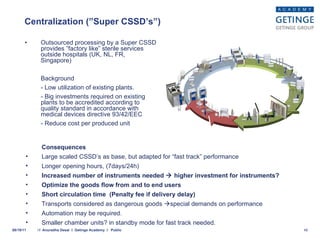
Centralization (”Super CSSD’s”) Outsourced processing by a Super CSSD provides ”factory like” sterile services outside hospitals (UK, NL, FR, Singapore) Background - Low utilization of existing plants. - Big investments required on existing plants to be accredited according to quality standard in accordance with medical devices directive 93/42/EEC - Reduce cost per produced unit 08/19/11  I  Anuradha Desai  I  Getinge Academy  I  Public Consequences Large scaled CSSD’s as base, but adapted for “fast track” performance Longer opening hours, (7days/24h) Increased number of instruments needed    higher investment for instruments? Optimize the goods flow from and to end users Short circulation time  (Penalty fee if delivery delay) Transports considered as dangerous goods   special demands on performance Automation may be required.  Smaller chamber units? in standby mode for fast track needed.
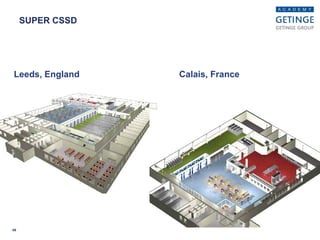
Leeds, England SUPER  CSSD  Calais, France
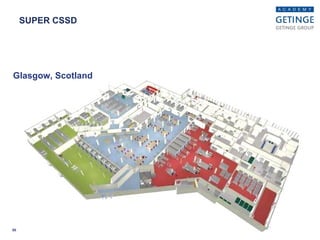
SUPER CSSD   Glasgow, Scotland
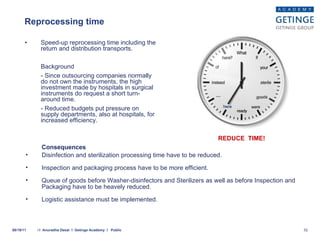
Reprocessing time Speed-up reprocessing time including the return and distribution transports. Background - Since outsourcing companies normally do not own the instruments, the high investment made by hospitals in surgical instruments do request a short turn-around time.  - Reduced budgets put pressure on supply departments, also at hospitals, for increased efficiency. 08/19/11  I  Anuradha Desai  I  Getinge Academy  I  Public Consequences Disinfection and sterilization processing time have to be reduced. Inspection and packaging process have to be more efficient. Queue of goods before Washer-disinfectors and Sterilizers as well as before Inspection and Packaging have to be heavely reduced. Logistic assistance must be implemented. REDUCE  TIME!
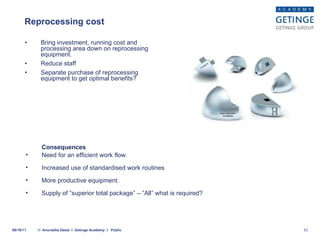
Reprocessing cost Bring investment, running cost and processing area down on reprocessing equipment. Reduce staff  Separate purchase of reprocessing equipment to get optimal benefits? 08/19/11  I  Anuradha Desai  I  Getinge Academy  I  Public Consequences Need for an efficient work flow. Increased use of standardised work routines More productive equipment. Supply of ”superior total package” – ”All” what is required?
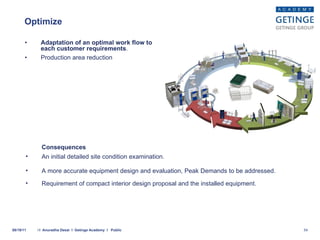
Optimize  Adaptation of an optimal work flow to each customer requirements . Production area reduction 08/19/11  I  Anuradha Desai  I  Getinge Academy  I  Public Consequences An initial detailed site condition examination. A more accurate equipment design and evaluation, Peak Demands to be addressed. Requirement of compact interior design proposal and the installed equipment.
08/19/11  I  Anuradha Desai  I  Getinge Academy  I  Public

Design of cssd

  • 1.
    Design of CSSDand New Trends Anuradha Desai Manager, Getinge Academy
  • 2.
    Basic design conceptfor the CSSD/TSSU Trends and Developments Goods carriers Washer-Disinfectors Linen reprocessing Sterilizers The processing environment Centralization (”Super CSSD’s”) Reprocessing time Reprocessing cost Optimize Design of CSSD and New Trends Contents of Presentation 08/19/11  I Anuradha Desai I Getinge Academy I Public
  • 3.
    SOLUTIONS FOR WARDSAND OUTPATIENT CLINICS Disinfection room - examples 08/19/11  I Anuradha Desai I Getinge Academy I Public Basic Design of CSSD CAD illustrations
  • 4.
    Disinfection Room Handwash basin Discharge table for soiled arrivals Flusher Disinfector with clinical sink Clean storage shelves Wall hung items improve floor cleaning!
  • 5.
    SOLUTIONS FOR CENTRALIZEDDISINFECTION AND STERILIZATION OF REUSABLE GOODS The CSSD (Central Sterile Supply Department) and TSSU (Theatre Sterile Supply Unit) CAD illustrations 08/19/11  I Anuradha Desai I Getinge Academy I Public Basic Design of CSSD
  • 6.
    SOLUTIONS FOR CENTRALIZEDDISINFECTION AND STERILIZATION OF REUSABLE GOODS Small Dental and Health Care clinics CAD illustrations 08/19/11  I Anuradha Desai I Getinge Academy I Public Basic Design of CSSD
  • 7.
    SOLUTIONS FOR MANAGEMENTAND QUALITY ASSURANCE - TDOC 08/19/11  I Anuradha Desai I Getinge Academy I Public Basic Design of CSSD
  • 8.
    Physical separation betweensoiled, clean and sterile zone The risk of cross-infection spread by staff is minimized GENERAL CSSD DESIGN CONCEPT - 1 08/19/11  I Anuradha Desai I Getinge Academy I Public Basic Design of CSSD
  • 9.
    Separated entries andexits for soiled, clean and sterile goods Strict separation of the staff working in the 3 different areas Room ventilation separated - for good production conditions Straight workflows - for simple, reliable working routines to have an economic and ergonomic production GENERAL CSSD DESIGN CONCEPT - 2 08/19/11  I Anuradha Desai I Getinge Academy I Public Basic Design of CSSD Recommended: Patient related utensils - washed and disinfected at the user area – as soon as possible!
  • 10.
    Goods flow –access from one side By creating an U-shape workflow you often can solve the CSSD design GUIDELINES FOR CSSD DESIGN 08/19/11  I Anuradha Desai I Getinge Academy I Public Basic Design of CSSD Goods flow Trolley flow Staff & Supplies
  • 11.
    Goods flow –access from two or three sides By creating an U-shape workflow you often can solve the CSSD design GUIDELINES FOR CSSD DESIGN Basic Design of CSSD Trolley flow Cont. & basket flow Goods flow
  • 12.
    TSSU DESIGN CONCEPT– Goods Flow 08/19/11  I Anuradha Desai I Getinge Academy I Public Surgical department with double corridor system and Disinfection Rooms Soiled corridor can be avoided Trend to wash in the CSSD instead of this way Pack. Transf. Table top clean. Sterile store Sterile supply corridor Clean corridor Recovery OR Scrub Disinf. room.
  • 13.
  • 14.
    PROJECT WORKFLOW - Make Demand Calculations & Evaluate the Results. Work stn. requirements Wash & disinfection demand Questionnaire ( Input data ) Summary of production User demand presentation Calculation (Results) Sterilization demand Area requirements HS66 GE69 8666 / 8668 CM320 88-Turbo 08/19/11  I Anuradha Desai I Getinge Academy I Public Storage requirements 46-4 & 46-5
  • 15.
    PROJECT WORKFLOW –Presentation Material Step 1 2D plan drawing Legend specification Calculation 08/19/11  I Anuradha Desai I Getinge Academy I Public
  • 16.
    Try to locatethe CSSD in a way that gives daylight to the main part of staff working here. TYPICAL CSSD DESIGN An actual design of a CSSD – plan drawing 08/19/11  I Anuradha Desai I Getinge Academy I Public Basic Design of CSSD Goods flow
  • 17.
    Step 2 -On request only. 3D interior design pictures inserted into a Power Point Presentation. PROJECT WORKFLOW – Presentation Material To Our Customer 08/19/11  I Anuradha Desai I Getinge Academy I Public
  • 18.
    TYPICAL CSSD DESIGNAn actual design of a CSSD - 3D view seen from the supply side 08/19/11  I Anuradha Desai I Getinge Academy I Public Basic Design of CSSD
  • 19.
    The Soiled arrivalarea - different solutions If the space is limited, try to arrange one side wider than the other to accommodate big trolleys on one side and small trolleys on the other side. Area should be able to hold arriving goods volume . Basic Design of CSSD
  • 20.
    The preferred methodof cleaning is in an automatic washing machine, with an integrated disinfection step. For thermo stable medical devices thermal disinfection is preferred to chemical disinfection. AUTOMATIC WASHING MACHINE
  • 22.
    Soiled sorting areaWasher-disinfectors of pass-through design Dedicated instrument preparation area for delicate and heat sensitive items. (Ultrasonic support) Hatch for clean goods transfer to packing area CAD illustration TYPICAL CSSD DESIGN Soiled goods flow - 2 08/19/11  I Anuradha Desai I Getinge Academy I Public Basic Design of CSSD
  • 23.
    Basic Design ofCSSD 08/19/11  I Anuradha Desai I Getinge Academy I Public
  • 24.
    Porter can supplygoods to a reception without entering clean area One way workflow When linen is inspected, folded and packed in a CSSD, a separate room should be dedicated for that purpose, to avoid spread of lint. Linen packing table can be used by 2 persons, working together standing on each side. TYPICAL CSSD DESIGN Clean supply/linen goods flow 08/19/11  I Anuradha Desai I Getinge Academy I Public Basic Design of CSSD
  • 25.
    Solutions for theLinen room Example – calculated demand of 3.2 people in the Linen packing area, make space for totally 4 persons Drawing shows minimal recommended dimensions to fulfill the work tasks in the linen inspection, folding and packing area. The linen trolley can accommodate approx 1000 liters of linen. This corresponds to 33 baskets, when later packed into baskets. If space is limited – consider inspection, folding and packing at the laundry and only pre-storage, assembly, labeling and sterilization at the CSSD. TYPICAL CSSD DESIGN 08/19/11  I Anuradha Desai I Getinge Academy I Public Basic Design of CSSD
  • 26.
    Changing rooms Localrequirements should be followed. Different ways to arrange Changing rooms to achieve different outer dimensions of the total changing area. TYPICAL CSSD DESIGN 08/19/11  I Anuradha Desai I Getinge Academy I Public Basic Design of CSSD
  • 27.
    A minimum distanceof 1500mm between packing tables and minimum 900mm, side facing against a wall, as a good recommendation. TYPICAL CSSD DESIGN Control & packing area - 1 Packing table located sideways from window avoiding light reflexes on instruments and work surface. 08/19/11  I Anuradha Desai I Getinge Academy I Public Basic Design of CSSD
  • 29.
    Clean Hands onClean Goods
  • 30.
    By the inspectionof the cleaning result, functional test and packing, height adjustable tables can be used for optimal ergonomic work conditions. Loading trolleys can also be designed as height adjustable units, to support and ease work conditions CAD illustration TYPICAL CSSD DESIGN Control & packing area - 2 08/19/11  I Anuradha Desai I Getinge Academy I Public Basic Design of CSSD
  • 31.
    Air lock witha recommended minimum 1400mm width and including hand washbasin. Air lock can also be used as service area at narrow installations. Return transfer hatch for racks - if, as in this design, used by loading of sterilizers. TYPICAL CSSD DESIGN Sterilizer area 08/19/11  I Anuradha Desai I Getinge Academy I Public Basic Design of CSSD
  • 33.
    Mobile or stationarystorage for sterile goods in baskets and/or containers. An over-pressure shall be kept in sterile store – creating an airflow from sterile store to the surrounding areas. TYPICAL CSSD DESIGN Sterile store - 1 08/19/11  I Anuradha Desai I Getinge Academy I Public Basic Design of CSSD
  • 34.
    Open storage units,allowing good ventilation of stored goods as well as a good overview of the content. Inspection and recording of sterilized goods to have a tracing function! Assembly of goods according to received orders from user. CAD illustration TYPICAL CSSD DESIGN Sterile store - 2 08/19/11  I Anuradha Desai I Getinge Academy I Public Basic Design of CSSD
  • 36.
    Sterile store -3 Position Baskets racks so that the baskets easily can be pulled out. Try to achieve corridors width min 1200mm between Basket racks and/or Wire shelf. If space is limited, there are questions to be raised: Will goods be sent out directly to the users? Can goods be stored at the users site? Sterile store capacity, according to demand of individual sites. Lockable Pass-through cabinets available for pickup of goods when CSSD is closed. TYPICAL CSSD DESIGN 08/19/11  I Anuradha Desai I Getinge Academy I Public Basic Design of CSSD
  • 37.
    LOGISTICS IN STERILESUPPLY SYSTEM
  • 38.
    Sterile goods meetsclean trolley in the issue area, where the porter can collect sterile goods without entering sterile store. Goods further protected by use of tote box or trolley cover during ‘external transports’. Issue to op through direct connected elevator. TYPICAL CSSD DESIGN Issue area 08/19/11  I Anuradha Desai I Getinge Academy I Public Basic Design of CSSD
  • 39.
    Standardized carriers usedto promote productive, ergonomic goods handling: - Controlled reception of goods - Controlled washing and disinfection result - Controlled sterilization result - Optimized equipment usage - Reduced workload for staff BASICS FOR A GETINGE CSSD DESIGN 08/19/11  I Anuradha Desai I Getinge Academy I Public Basic Design of CSSD
  • 40.
    BASIC WORKFLOW I N THE CSSD Planning of Hospital Infection Control System PACK STERILIZATION STOCK RETURN DISINFECTION
  • 41.
    INFECTION CONTROL TRENDS& DEVELOPMENTS 08/19/11  I Anuradha Desai I Getinge Academy I Public NEW TRENDS AND DEVELOPMENTS!
  • 42.
    Trends and DevelopmentBasic design concept for the CSSD/TSSU Controlled room ventilation (air flow) to get good production conditions: - Soiled zone – negative pressure (-) versus adjoining areas - Clean zone – positive pressure (++) versus to all adjoining areas - Sterile zone – positive pressure (+) New demands: 08/19/11  I Anuradha Desai I Getinge Academy I Public - Soiled zone – negative pressure (-) versus adjoining areas - Clean zone – positive pressure (++) versus to all adjoining areas - Sterile zone – positive pressure (+) (-) (++) (+)
  • 43.
    Goods carriers Increasedusage of solid instrument containers, used as goods carrier for the surgical trays Background - Increased physical protection of the surgical instruments - Paper wrapping may break 08/19/11  I Anuradha Desai I Getinge Academy I Public Consequences Increased washer-disinfector capacity needed (compared to nested empty baskets) Mixed usage occurs – ISO/SPRI/DIN baskets and containers, others? Increased demand on the internal logistic (as T-Doc) within the CSSD. –As if the lid and bottom of the container is one unit that shall be matched together after washer-disinfectors or washer-disinfector / cart washer. (Increased number of work procedures!) More heavy goods carrier (empty container +50% weight compared to empty basket) - Increases the demand of lifting devices - Heavy load program  extends the processing time of the sterilizers
  • 44.
    Washer-Disinfectors Transition fromhouse steam supply to electrically heated equipment Background: - Big investment and maintenance costs. - Energy loss during steam transport. Transition from external drying to washer-disinfectors with integrated drying. ( An interpretation of SS-EN ISO 15883) ” Air-tight” installation by pass-through installations . Non-vented units (No conn. to ventilation) 08/19/11  I Anuradha Desai I Getinge Academy I Public Consequences Electrically heated washer-disinfectors  longer processing time than steam heated units More washer-disinfectors required at the CSSD - Increased number of washer-disinfectors  possible automation demand Integrated drying extends the processing time More washer-disinfectors required at the CSSD - Increased number of washer-disinfectors  possible automation demand Equipment and installation practise have to be designed to reduce air flow and vent.
  • 45.
    Linen reprocessing Reducedusage of reusable sterilized dressing sets for surgeon, patient and equipment. Background - Disposable dressing sets used instead (sometimes cheaper) 08/19/11  I Anuradha Desai I Getinge Academy I Public Consequences Existing CSSD’s planned for reprocessing of reusable linen have spare capacity in their sterilizer barrier Area for linen handling can be reduced and used for other purpose Note! Very important parameter since linen normally stands for 30-40% of total sterilization goods volume Linen usage
  • 46.
    Sterilizers Reduced processingtime Automation increase ” Air-tight” installation by pass-through installations Service access from unloading side by pass-through installations Sound level reduction Increased water and energy consumption awareness (”Green”) 08/19/11  I Anuradha Desai I Getinge Academy I Public Consequences Number of units required will be less, due to increased efficiency. However, bigger units not always best selection! Installation might require more space totally as fixed or moving automated units are attached to sterilizer. Equipment and installation practise have to be designed to reduce air flow Separated vacuumpumps - on site adapted equipment. Adaptation of automation units and options to actual conditions to be observed – increase awareness.
  • 47.
    The processing environmentImproved working environment within CSSD The CSSD work getting a higher “status” ” Green concept” Background - Avoid working injury. Sick leave costs money. - Computerized workplace, focus on close connection to surgical department. 08/19/11  I Anuradha Desai I Getinge Academy I Public Consequences Sound-absorbing actions implemented at: - washer-disinfector installations - sterilizer installations (separate located vacuum pump) Focus on equipment with better ergonomics: Height adjustable tables and trolleys, side mounted operator panels with at more convenient operator height. Quote from Handbook for Health and nursing care (Sweden): ” Avoid to carry and lift. Try instead to move by pushing or pulling and reduce the friction by means of assistance” Less energy, water consumption required.
  • 48.
    Centralization (”Super CSSD’s”)Outsourced processing by a Super CSSD provides ”factory like” sterile services outside hospitals (UK, NL, FR, Singapore) Background - Low utilization of existing plants. - Big investments required on existing plants to be accredited according to quality standard in accordance with medical devices directive 93/42/EEC - Reduce cost per produced unit 08/19/11  I Anuradha Desai I Getinge Academy I Public Consequences Large scaled CSSD’s as base, but adapted for “fast track” performance Longer opening hours, (7days/24h) Increased number of instruments needed  higher investment for instruments? Optimize the goods flow from and to end users Short circulation time (Penalty fee if delivery delay) Transports considered as dangerous goods  special demands on performance Automation may be required. Smaller chamber units? in standby mode for fast track needed.
  • 49.
    Leeds, England SUPER CSSD Calais, France
  • 50.
    SUPER CSSD Glasgow, Scotland
  • 52.
    Reprocessing time Speed-upreprocessing time including the return and distribution transports. Background - Since outsourcing companies normally do not own the instruments, the high investment made by hospitals in surgical instruments do request a short turn-around time. - Reduced budgets put pressure on supply departments, also at hospitals, for increased efficiency. 08/19/11  I Anuradha Desai I Getinge Academy I Public Consequences Disinfection and sterilization processing time have to be reduced. Inspection and packaging process have to be more efficient. Queue of goods before Washer-disinfectors and Sterilizers as well as before Inspection and Packaging have to be heavely reduced. Logistic assistance must be implemented. REDUCE TIME!
  • 53.
    Reprocessing cost Bringinvestment, running cost and processing area down on reprocessing equipment. Reduce staff Separate purchase of reprocessing equipment to get optimal benefits? 08/19/11  I Anuradha Desai I Getinge Academy I Public Consequences Need for an efficient work flow. Increased use of standardised work routines More productive equipment. Supply of ”superior total package” – ”All” what is required?
  • 54.
    Optimize Adaptationof an optimal work flow to each customer requirements . Production area reduction 08/19/11  I Anuradha Desai I Getinge Academy I Public Consequences An initial detailed site condition examination. A more accurate equipment design and evaluation, Peak Demands to be addressed. Requirement of compact interior design proposal and the installed equipment.
  • 55.
    08/19/11  I Anuradha Desai I Getinge Academy I Public