Bioanalytical method validation
EMEA
• This guideline defines key elements necessary
for the validation of bioanalytical methods.
• Guidance and criteria are given on the
application of these validated methods in the
routine analysis of study samples from animal
and human studies.
• Measurement of drug concentrations in
biological matrices (such as serum, plasma,
blood, urine, and saliva) is an important
aspect of medicinal product development.
• The results of animal toxicokinetic studies and
of clinical trials, including bioequivalence
studies are used to make critical decisions
supporting the safety and efficacy of a
medicinal drug substance or product.
• It is therefore paramount that the applied
bioanalytical methods used are well
characterised, fully validated and documented
to a satisfactory standard in order to yield
reliable results.
• This guideline provides recommendations for
the validation of bioanalytical methods
applied to measure drug concentrations in
biological matrices obtained in animal
toxicokinetic studies and all phases of clinical
trials.
• As ligand binding assays differ substantially
from chromatographic analytical methods,
separate validation recommendations for
ligand binding assays are provided.
• This guideline will describe when partial
validation or cross validation should be carried
out in addition to the full validation of an
analytical method.
Method validation
• Full validation of an analytical method
• A full method validation should be performed
for any analytical method whether new or
based upon literature.
• to demonstrate the reliability of a particular
method for the determination of an analyte
concentration in a specific biological matrix,
such as blood, serum, plasma, urine, or saliva.
• if an anticoagulant is used, validation should be
performed using the same anticoagulant as for
the study samples.
• Generally a full validation should be performed
for each species and matrix concerned.
• In some cases, it may be problematic for
validation purposes to obtain an identical matrix
compared to the matrix of the study samples. A
suitable alternative matrix may be used, e.g.
synthetically prepared cerebrospinal fluid, if
justified.
• This may involve two different drugs, but can
also involve a parent drug with its
metabolites, or the enantiomers or isomers of
a drug. In these cases the principles of
validation and analysis apply to all analytes of
interest.
Reference standard
• sample analysis should be obtained from an
authentic and traceable source.
Suitable reference standards include
• Prepared in-house
• Compendial standards,
• Commercially available standards,
• Sufficiently Characterised standards
• By an external non-commercial organisation.
• A certificate of analysis is required to ensure purity and
provide information on storage conditions, expiration
date and batch number of the reference standard.
• When mass-spectrometry (MS) detection is used in the
bioanalytical method, a stable isotope-labelled IS is
recommended to be used whenever possible.
• it is essential that the labelled standard is of the
highest isotope purity and that no isotope exchange
reaction occurs.
• The presence of any unlabelled analyte should be
checked and if relative amounts of unlabelled analyte
are detected the potential influence has to be
evaluated during method validation.
Selectivity
• The analytical method should be able to differentiate
the analyte(s) of interest and IS from endogenous
components in the matrix or other components in the
sample.
• Selectivity should be proved using at least 6 individual
sources of the appropriate blank matrix, which are
individually analysed and evaluated for interference.
• Use of fewer sources is acceptable in case of rare
matrices.
• Normally, absence of interfering components is
accepted where the response is less than 20% of the
lower limit of quantification for the analyte and 5% for
the internal standard.
Carry Over
• Carry-over should be addressed and minimised
during method development .
• During validation carry-over should be assessed
by injecting blank samples after a high
concentration sample or calibration standard at
the upper limit of quantification.
• Carry over in the blank sample following the high
concentration standard should not be greater
than 20% of the lower limit of quantification
(LLOQ; see below) and 5% for the internal
standard.
• The lower limit of quantification (LLOQ) is the
lowest concentration of analyte in a sample
which can be quantified reliably, with an
acceptable accuracy and precision.
• In addition, the analyte signal of the LLOQ
sample should be at least 5 times the signal of
a blank sample .
• Bioequivalence studies the LLOQ should be
not higher than 5% of the Cmax, while such a
low LLOQ may be not necessary for
exploratory pharmacokinetic studies.
• The response of the instrument with regard to
the concentration of analyte should be known,
and should be evaluated over a specified
concentration range.
• The calibration standards should be prepared in
the same matrix as the matrix of the intended
study samples by spiking the blank matrix with
known concentrations of the analyte.
• There should be one calibration curve for each
analyte studied in the method validation and for
each analytical run.
• A minimum of six calibration concentration levels
should be used, in addition to the blank sample
and a zero sample
• Each calibration standard can be analysed in
replicate.
• All the available (or acceptable) curves obtained
during validation, with a minimum of 3 should be
reported.
• The back calculated concentrations of the
calibration standards should be within ±15% of
the nominal value, except for the LLOQ for which
it should be within ±20%. At least 75% of the
calibration
• In case a calibration standard does not comply
with these criteria, this calibration standard
sample should be rejected.
• The calibration curve without this calibration
standard should be re-evaluated, including
regression analysis.
• In case all replicates of the LLOQ or the ULOQ
calibration standard are rejected then the batch
should be rejected from the validation.
• The possible source of the failure be determined
and the method revised (if necessary).
• If the next validation batch also fails, then the
method should be revised before restarting
validation.
• Although the calibration curve should
preferably be prepared using freshly spiked
samples, it is allowed to use previously
prepared and stored calibration samples, if
supported by appropriate stability data.
• The accuracy of an analytical method
describes the closeness of the determined
value obtained by the method to the nominal
concentration of the analyte (expressed in
percentage).
Within-run accuracy
• Within-run accuracy should be determined by
analysing in a single run a minimum of 5
samples per level at a minimum of 4
concentration levels which are covering the
calibration curve range: the LLOQ, within
three times the LLOQ (low QC), around 30 -
50% of the calibration curve range (medium
QC), and at least at 75% of the upper
calibration curve range (high QC).
Between –run accuracy
• For the validation of the between-run
accuracy, LLOQ, low, medium and high QC
samples from at least three runs analysed on
at least two different days should be
evaluated.
Precision
• The precision of the analytical method describes
the closeness of repeated individual measures of
analyte.
• For the validation of the within-run precision,
there should be a minimum of five samples per
concentration level at LLOQ, low, medium and
high QC samples in a single run.
• For the validation of the between-run precision,
LLOQ, low, medium and high QC samples from at
least three runs analysed on at least two different
days should be evaluated.
Matrix effect
• Matrix effects should be investigated when using mass
spectrometric methods, using at least 6 lots of blank
matrix from individual donors. Pooled matrix should
not be used.
• on-line sample preparation, the variability of the
response from lot to lot should be assessed by
analysing at least 6 lots of matrix, spiked at a low and
at a high level of concentration (maximum of 3 times
the LLOQ and close to the ULOQ).
• If the matrix is difficult to obtain, less than 6 different
lots of matrix may be used, but this should be justified.
However, matrix effects should still be investigated.
• In addition to the normal matrix it is
recommended to investigate matrix effects on
other samples e.g. haemolysed and
hyperlipidaemic plasma samples.
• If samples from special populations (such as
renally or hepatically impaired populations)
are to be analysed
• it is also recommended to study matrix effects
using matrix from such populations.
Stability
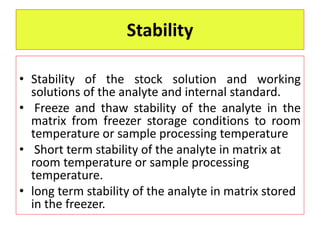
• Stability of the stock solution and working
solutions of the analyte and internal standard.
• Freeze and thaw stability of the analyte in the
matrix from freezer storage conditions to room
temperature or sample processing temperature
• Short term stability of the analyte in matrix at
room temperature or sample processing
temperature.
• long term stability of the analyte in matrix stored
in the freezer.
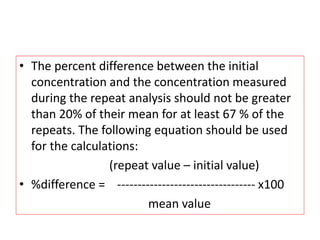
• The percent difference between the initial
concentration and the concentration measured
during the repeat analysis should not be greater
than 20% of their mean for at least 67 % of the
repeats. The following equation should be used
for the calculations:
(repeat value – initial value)
• %difference = ---------------------------------- x100
mean value
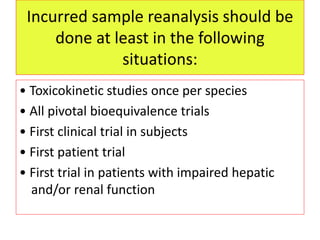
Incurred sample reanalysis should be
done at least in the following
situations:
• Toxicokinetic studies once per species
• All pivotal bioequivalence trials
• First clinical trial in subjects
• First patient trial
• First trial in patients with impaired hepatic
and/or renal function
Bioanalytical method validation emea

Bioanalytical method validation emea

  • 1.
  • 2.
    • This guidelinedefines key elements necessary for the validation of bioanalytical methods. • Guidance and criteria are given on the application of these validated methods in the routine analysis of study samples from animal and human studies. • Measurement of drug concentrations in biological matrices (such as serum, plasma, blood, urine, and saliva) is an important aspect of medicinal product development.

  • 3.
    • The resultsof animal toxicokinetic studies and of clinical trials, including bioequivalence studies are used to make critical decisions supporting the safety and efficacy of a medicinal drug substance or product. • It is therefore paramount that the applied bioanalytical methods used are well characterised, fully validated and documented to a satisfactory standard in order to yield reliable results.
  • 4.
    • This guidelineprovides recommendations for the validation of bioanalytical methods applied to measure drug concentrations in biological matrices obtained in animal toxicokinetic studies and all phases of clinical trials. • As ligand binding assays differ substantially from chromatographic analytical methods, separate validation recommendations for ligand binding assays are provided.
  • 5.
    • This guidelinewill describe when partial validation or cross validation should be carried out in addition to the full validation of an analytical method.
  • 6.
    Method validation • Fullvalidation of an analytical method • A full method validation should be performed for any analytical method whether new or based upon literature. • to demonstrate the reliability of a particular method for the determination of an analyte concentration in a specific biological matrix, such as blood, serum, plasma, urine, or saliva.
  • 7.
    • if ananticoagulant is used, validation should be performed using the same anticoagulant as for the study samples. • Generally a full validation should be performed for each species and matrix concerned. • In some cases, it may be problematic for validation purposes to obtain an identical matrix compared to the matrix of the study samples. A suitable alternative matrix may be used, e.g. synthetically prepared cerebrospinal fluid, if justified.
  • 8.
    • This mayinvolve two different drugs, but can also involve a parent drug with its metabolites, or the enantiomers or isomers of a drug. In these cases the principles of validation and analysis apply to all analytes of interest.
  • 9.
    Reference standard • sampleanalysis should be obtained from an authentic and traceable source. Suitable reference standards include • Prepared in-house • Compendial standards, • Commercially available standards, • Sufficiently Characterised standards • By an external non-commercial organisation.
  • 10.
    • A certificateof analysis is required to ensure purity and provide information on storage conditions, expiration date and batch number of the reference standard. • When mass-spectrometry (MS) detection is used in the bioanalytical method, a stable isotope-labelled IS is recommended to be used whenever possible. • it is essential that the labelled standard is of the highest isotope purity and that no isotope exchange reaction occurs. • The presence of any unlabelled analyte should be checked and if relative amounts of unlabelled analyte are detected the potential influence has to be evaluated during method validation.
  • 11.
    Selectivity • The analyticalmethod should be able to differentiate the analyte(s) of interest and IS from endogenous components in the matrix or other components in the sample. • Selectivity should be proved using at least 6 individual sources of the appropriate blank matrix, which are individually analysed and evaluated for interference. • Use of fewer sources is acceptable in case of rare matrices. • Normally, absence of interfering components is accepted where the response is less than 20% of the lower limit of quantification for the analyte and 5% for the internal standard.
  • 12.
    Carry Over • Carry-overshould be addressed and minimised during method development . • During validation carry-over should be assessed by injecting blank samples after a high concentration sample or calibration standard at the upper limit of quantification. • Carry over in the blank sample following the high concentration standard should not be greater than 20% of the lower limit of quantification (LLOQ; see below) and 5% for the internal standard.
  • 13.
    • The lowerlimit of quantification (LLOQ) is the lowest concentration of analyte in a sample which can be quantified reliably, with an acceptable accuracy and precision. • In addition, the analyte signal of the LLOQ sample should be at least 5 times the signal of a blank sample . • Bioequivalence studies the LLOQ should be not higher than 5% of the Cmax, while such a low LLOQ may be not necessary for exploratory pharmacokinetic studies.
  • 14.
    • The responseof the instrument with regard to the concentration of analyte should be known, and should be evaluated over a specified concentration range. • The calibration standards should be prepared in the same matrix as the matrix of the intended study samples by spiking the blank matrix with known concentrations of the analyte. • There should be one calibration curve for each analyte studied in the method validation and for each analytical run.
  • 15.
    • A minimumof six calibration concentration levels should be used, in addition to the blank sample and a zero sample • Each calibration standard can be analysed in replicate. • All the available (or acceptable) curves obtained during validation, with a minimum of 3 should be reported. • The back calculated concentrations of the calibration standards should be within ±15% of the nominal value, except for the LLOQ for which it should be within ±20%. At least 75% of the calibration
  • 16.
    • In casea calibration standard does not comply with these criteria, this calibration standard sample should be rejected. • The calibration curve without this calibration standard should be re-evaluated, including regression analysis. • In case all replicates of the LLOQ or the ULOQ calibration standard are rejected then the batch should be rejected from the validation. • The possible source of the failure be determined and the method revised (if necessary). • If the next validation batch also fails, then the method should be revised before restarting validation.
  • 17.
    • Although thecalibration curve should preferably be prepared using freshly spiked samples, it is allowed to use previously prepared and stored calibration samples, if supported by appropriate stability data.
  • 18.
    • The accuracyof an analytical method describes the closeness of the determined value obtained by the method to the nominal concentration of the analyte (expressed in percentage).
  • 19.
    Within-run accuracy • Within-runaccuracy should be determined by analysing in a single run a minimum of 5 samples per level at a minimum of 4 concentration levels which are covering the calibration curve range: the LLOQ, within three times the LLOQ (low QC), around 30 - 50% of the calibration curve range (medium QC), and at least at 75% of the upper calibration curve range (high QC).
  • 20.
    Between –run accuracy •For the validation of the between-run accuracy, LLOQ, low, medium and high QC samples from at least three runs analysed on at least two different days should be evaluated.
  • 21.
    Precision • The precisionof the analytical method describes the closeness of repeated individual measures of analyte. • For the validation of the within-run precision, there should be a minimum of five samples per concentration level at LLOQ, low, medium and high QC samples in a single run. • For the validation of the between-run precision, LLOQ, low, medium and high QC samples from at least three runs analysed on at least two different days should be evaluated.
  • 22.
    Matrix effect • Matrixeffects should be investigated when using mass spectrometric methods, using at least 6 lots of blank matrix from individual donors. Pooled matrix should not be used. • on-line sample preparation, the variability of the response from lot to lot should be assessed by analysing at least 6 lots of matrix, spiked at a low and at a high level of concentration (maximum of 3 times the LLOQ and close to the ULOQ). • If the matrix is difficult to obtain, less than 6 different lots of matrix may be used, but this should be justified. However, matrix effects should still be investigated.
  • 23.
    • In additionto the normal matrix it is recommended to investigate matrix effects on other samples e.g. haemolysed and hyperlipidaemic plasma samples. • If samples from special populations (such as renally or hepatically impaired populations) are to be analysed • it is also recommended to study matrix effects using matrix from such populations.
  • 24.
    Stability • Stability ofthe stock solution and working solutions of the analyte and internal standard. • Freeze and thaw stability of the analyte in the matrix from freezer storage conditions to room temperature or sample processing temperature • Short term stability of the analyte in matrix at room temperature or sample processing temperature. • long term stability of the analyte in matrix stored in the freezer.
  • 25.
    • The percentdifference between the initial concentration and the concentration measured during the repeat analysis should not be greater than 20% of their mean for at least 67 % of the repeats. The following equation should be used for the calculations: (repeat value – initial value) • %difference = ---------------------------------- x100 mean value
  • 26.
    Incurred sample reanalysisshould be done at least in the following situations: • Toxicokinetic studies once per species • All pivotal bioequivalence trials • First clinical trial in subjects • First patient trial • First trial in patients with impaired hepatic and/or renal function