Heating and Cooling Curves Ms L Chu Sunday 17 October 2010
Objectives To be able to draw heating and cooling curves from experimental data. To be able to interpret these graphs and use the graph to determine the melting and boiling points of substances. Keywords:  heating curve, cooling curve, phase, stearic acid, solidified
Heating Curve When substances are being heated they gained energy from the heat and use this energy to try and break away from the forces holding them together. At this point the heat is no longer being used to raise the temperature which now remains constant.
A graph of the temperature against the time can be constructed to show this time temperature Solid & liquid Liquid & gas Substance is evaporating/boiling Substance is melting Liquid only Solid only Gas only Boiling point
Explanations for the heating curve Solid only phase  – here the particles are absorbing or gaining the energy as they are being heated so the temperature is increasing. Solid & Liquid phase  – the temperature remains the same or constant for some minutes. Here the particles are using the energy absorbed to move away from their fixed position and the forces holding them
together. The solid is changing into liquid. This is its melting point. Liquid only phase  – the particles are now in liquid phase. They are gaining more energy - the temperature is rising again. Liquid & Gas phase  – the temperature stops rising due to particles using energy absorbed. The liquid changes into gas.
Constructing a heating curve of water The ice was heated until it boiled. The temperature was taken every 30 seconds and a graph was constructed to find its boiling point.  Results Temperature  0 C Time (sec)
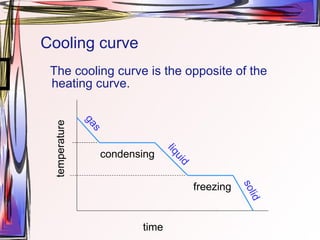
Cooling curve The cooling curve is the opposite of the heating curve. condensing freezing liquid gas solid time temperature
Construct a cooling curve A boiling tube containing liquid stearic acid was placed in a water bath at 30  0 C. The temperature was taken every 10 seconds until it solidified.  A graph was drawn and the melting point of stearic acid was determined. Results

Heatingcoolingcurves

  • 1.
    Heating and CoolingCurves Ms L Chu Sunday 17 October 2010
  • 2.
    Objectives To beable to draw heating and cooling curves from experimental data. To be able to interpret these graphs and use the graph to determine the melting and boiling points of substances. Keywords: heating curve, cooling curve, phase, stearic acid, solidified
  • 3.
    Heating Curve Whensubstances are being heated they gained energy from the heat and use this energy to try and break away from the forces holding them together. At this point the heat is no longer being used to raise the temperature which now remains constant.
  • 4.
    A graph ofthe temperature against the time can be constructed to show this time temperature Solid & liquid Liquid & gas Substance is evaporating/boiling Substance is melting Liquid only Solid only Gas only Boiling point
  • 5.
    Explanations for theheating curve Solid only phase – here the particles are absorbing or gaining the energy as they are being heated so the temperature is increasing. Solid & Liquid phase – the temperature remains the same or constant for some minutes. Here the particles are using the energy absorbed to move away from their fixed position and the forces holding them
  • 6.
    together. The solidis changing into liquid. This is its melting point. Liquid only phase – the particles are now in liquid phase. They are gaining more energy - the temperature is rising again. Liquid & Gas phase – the temperature stops rising due to particles using energy absorbed. The liquid changes into gas.
  • 7.
    Constructing a heatingcurve of water The ice was heated until it boiled. The temperature was taken every 30 seconds and a graph was constructed to find its boiling point. Results Temperature 0 C Time (sec)
  • 8.
    Cooling curve Thecooling curve is the opposite of the heating curve. condensing freezing liquid gas solid time temperature
  • 9.
    Construct a coolingcurve A boiling tube containing liquid stearic acid was placed in a water bath at 30 0 C. The temperature was taken every 10 seconds until it solidified. A graph was drawn and the melting point of stearic acid was determined. Results