OPTOM FASLU MUHAMMED
CORNEA
HERPES ZOSTER OPTHALMICUS
 Varicella zoster virus causes chicken pox(varicella )
&shingles (herpes zoster )
 HZO discribes shingles involving the dermatome
supplied by the opthalmic division of the 5 th cranial
nerve
 Mechanism of involvement :
1. Direct invasion : causing conjuctivits& keratitis
2. Secondry inflammation : Scleritis , uveitis
3. Reeactivation : causes necrosis & inflammof the
sensory ganglia leading to cornal anasthesia &
neurotropic ulcers
RISK OF OCULAR INVOLVEMENT
1. Hutchinson sign : invovlment of the skin suppliued
by external nasal nerve , a branch of nasocillary
nerve, supply the lip and side & root of the nose –
strong corelation with ocular involvemnt
2. Age : 6 -7 th decade
3. AIDS :
if affected in children r/o immunocomp/malignancy
 ACUTE SHINGLES
Skin lesions in the dermatomes , varies accrding to
age of the lesions –vesicles-> crusting-> scar
 Eye disease
1)Acute 2)Chronic
1)Acute :
a)Acute epithelial keratitis :
In 50% of cases within 2 days of onset of rashes
Resolve sponatneously
Characterised by dendritic lesions
Rx: Topical antiviral
b) Conjuctivitis
Follicular /pappilary
On Rx
c)Episcleritis :
Reslove spontaneously
Mild NSAIDS
d) Scleritis :
e)Nummular keratitis :
10 days after onset of rash
Characterised by fine grandular sub epithelial
depositis surrounded by halo of stromal haze
f) Disciform keratitis
g)Anterior uveitis
h)Monitor IOP
i)Neurological complications
CN palsies 3 ,4 6
Encephalitis
 CHRONIC EYE DISEASES
1) Neurotropic keratitis
2) Scleritis -scleral atrophy
3) Mucous plaque keratitis : sudden appearance
4) Lipid degenration
5) Lipid granulomata
6) Eyelid scarring-entropion /extropion
INTERSTICIAL KERATITIS
 Inflammtion of the corneawithout primary
involvement of the epithelim or endothelium
 Immune mediated process
 Etiology : syphillis / herpetic keartitis , cogans
syndrome
SYPHYLLITIC IK
 CONGENITAL / AQUIRED
CONGENITAL :
 Transplacentally
 Causes anterioir uveitis , IK, dislocation of the lens ,
optic atropy, retinopathy
AQUIRED
uveitis , IK, optic neuritis , madarosis
SYPHILITIC IK
1)Presentation:
 If congenital : 5 – 25 yrs
Anterior uveitis , b/l
 If aquired : unilateral
2)Signs :
 limbitis , deep stromal vascularization – salmon patch
apperence
 Granulaomamtous anterior uveitis
 After months the vessels become non –perfused : Ghost
vessals
 If the cornea later becomes inflammed , vessels are refilled
and bleeds
 Scarring
 Rx: systemic antibiotics (pencillin)
 Steroids and clyclopegics
PROTOZOAN KERATITIS
ACANTHAMOEBA
 Commonly found in URT
 Cystic form –highly resilent & infective in
favourable environmental condition , also produce
enzymes for tissue penetration
 Symptoms :
 Blurred vision & Severe pain out proportion to the
lesions
 SIGNS :
 Early : irregular epithelial surface
 Epithelial psuedodentrites
 Limbitis with stromal infiltration
 Gradual enlargement of infitrate and coalescence
to form a ring abscess
 Scleritis
 Stromal opacification and vascul
 Corneal melting
 INVESTIGATIONS :
1. Staining of the corneal scraping (PAS / calcofluor
white )
Gram and Gimesa
2. Cultures :
3. Others :
RX:
 Suspected if the patient do not respond well with
antibiotics
1. Debridment :
2. Topical Amoebicides : polyhexamethylene biguanide
0.02%
And/ chlorhexidien digluconate 0.02%
3. Pain control
 ONCHOCERCIASIS
 River blindness
1. Caused by oncecerca volvulus
2. Second most common infectious cause of
blindness
3. Sign:
 L ive microfilariae can be seen in the cornea
/aqeous /vitreous in 50 %
 Anterior Uveitis
 Punctate keratitis and sclerosing keratitis initally in
3 and 9 o clock postion , later on extending on to
the whole cornea and scarring
1. Rx: systemic Ivermectin and steroids ( for acute
inflammation )
XEROPHTHALMIA
 Defficency of vit . A
 Vit . A: Functions
1. Epithelial surfaces
2. Immune function
3. Retinal photorecetops
CAUSES :
1. MAL ABSR/ NUTRI
2. ALCOHOL
3. SELECTIVE DIET
DIAGNOSIS
 SYMPTOMS:
1. Night blindness/ nyctalopia
2. Loss of vision
CONJUCTIVA
1. XEROSIS:
Dryness in interpalpbral zone
Loss of globlet cells
Squamous metaplasia, keratinization
2.BITOTS SPOTS :
Keratinised epithelium in the interp…---
cornybacterium xerosis
CORNEA
1. Lusterless- due to second xerosis
2. B/L punctate epithelial erosions epitheliad
defects
3. Keratinization
4. Corneal melting (liqufactive necrosis) –perforation
RETINA
Retinopathy –yellowish peripheral dots
Rx:
Kearatolamalacia –indicated severe vitm defficency –
medical emergency – risk of death
SYSYTEMIC
ORAL: 2 lkh IU
IM : 1 lakh IU
Dietary supplements
 Local
Lubricants
Retinoic acid – promote Healing
Corneal perforation – Sx
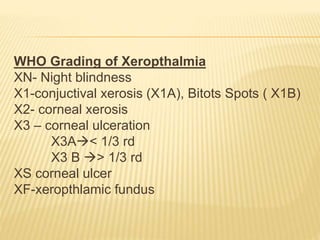
WHO Grading of Xeropthalmia
XN- Night blindness
X1-conjuctival xerosis (X1A), Bitots Spots ( X1B)
X2- corneal xerosis
X3 – corneal ulceration
X3A< 1/3 rd
X3 B > 1/3 rd
XS corneal ulcer
XF-xeropthlamic fundus

Cornea

  • 1.
  • 2.
    HERPES ZOSTER OPTHALMICUS Varicella zoster virus causes chicken pox(varicella ) &shingles (herpes zoster )  HZO discribes shingles involving the dermatome supplied by the opthalmic division of the 5 th cranial nerve  Mechanism of involvement : 1. Direct invasion : causing conjuctivits& keratitis 2. Secondry inflammation : Scleritis , uveitis 3. Reeactivation : causes necrosis & inflammof the sensory ganglia leading to cornal anasthesia & neurotropic ulcers
  • 3.
    RISK OF OCULARINVOLVEMENT 1. Hutchinson sign : invovlment of the skin suppliued by external nasal nerve , a branch of nasocillary nerve, supply the lip and side & root of the nose – strong corelation with ocular involvemnt 2. Age : 6 -7 th decade 3. AIDS : if affected in children r/o immunocomp/malignancy
  • 4.
     ACUTE SHINGLES Skinlesions in the dermatomes , varies accrding to age of the lesions –vesicles-> crusting-> scar  Eye disease 1)Acute 2)Chronic 1)Acute : a)Acute epithelial keratitis : In 50% of cases within 2 days of onset of rashes Resolve sponatneously Characterised by dendritic lesions Rx: Topical antiviral
  • 5.
    b) Conjuctivitis Follicular /pappilary OnRx c)Episcleritis : Reslove spontaneously Mild NSAIDS d) Scleritis : e)Nummular keratitis : 10 days after onset of rash Characterised by fine grandular sub epithelial depositis surrounded by halo of stromal haze
  • 6.
    f) Disciform keratitis g)Anterioruveitis h)Monitor IOP i)Neurological complications CN palsies 3 ,4 6 Encephalitis
  • 7.
     CHRONIC EYEDISEASES 1) Neurotropic keratitis 2) Scleritis -scleral atrophy 3) Mucous plaque keratitis : sudden appearance 4) Lipid degenration 5) Lipid granulomata 6) Eyelid scarring-entropion /extropion
  • 8.
    INTERSTICIAL KERATITIS  Inflammtionof the corneawithout primary involvement of the epithelim or endothelium  Immune mediated process  Etiology : syphillis / herpetic keartitis , cogans syndrome SYPHYLLITIC IK  CONGENITAL / AQUIRED CONGENITAL :  Transplacentally  Causes anterioir uveitis , IK, dislocation of the lens , optic atropy, retinopathy
  • 9.
    AQUIRED uveitis , IK,optic neuritis , madarosis SYPHILITIC IK 1)Presentation:  If congenital : 5 – 25 yrs Anterior uveitis , b/l  If aquired : unilateral 2)Signs :  limbitis , deep stromal vascularization – salmon patch apperence  Granulaomamtous anterior uveitis  After months the vessels become non –perfused : Ghost vessals  If the cornea later becomes inflammed , vessels are refilled and bleeds  Scarring
  • 10.
     Rx: systemicantibiotics (pencillin)  Steroids and clyclopegics
  • 11.
    PROTOZOAN KERATITIS ACANTHAMOEBA  Commonlyfound in URT  Cystic form –highly resilent & infective in favourable environmental condition , also produce enzymes for tissue penetration  Symptoms :  Blurred vision & Severe pain out proportion to the lesions
  • 12.
     SIGNS : Early : irregular epithelial surface  Epithelial psuedodentrites  Limbitis with stromal infiltration  Gradual enlargement of infitrate and coalescence to form a ring abscess  Scleritis  Stromal opacification and vascul  Corneal melting
  • 13.
     INVESTIGATIONS : 1.Staining of the corneal scraping (PAS / calcofluor white ) Gram and Gimesa 2. Cultures : 3. Others : RX:  Suspected if the patient do not respond well with antibiotics 1. Debridment : 2. Topical Amoebicides : polyhexamethylene biguanide 0.02% And/ chlorhexidien digluconate 0.02% 3. Pain control
  • 14.
     ONCHOCERCIASIS  Riverblindness 1. Caused by oncecerca volvulus 2. Second most common infectious cause of blindness 3. Sign:  L ive microfilariae can be seen in the cornea /aqeous /vitreous in 50 %  Anterior Uveitis  Punctate keratitis and sclerosing keratitis initally in 3 and 9 o clock postion , later on extending on to the whole cornea and scarring 1. Rx: systemic Ivermectin and steroids ( for acute inflammation )
  • 15.
    XEROPHTHALMIA  Defficency ofvit . A  Vit . A: Functions 1. Epithelial surfaces 2. Immune function 3. Retinal photorecetops CAUSES : 1. MAL ABSR/ NUTRI 2. ALCOHOL 3. SELECTIVE DIET
  • 16.
    DIAGNOSIS  SYMPTOMS: 1. Nightblindness/ nyctalopia 2. Loss of vision CONJUCTIVA 1. XEROSIS: Dryness in interpalpbral zone Loss of globlet cells Squamous metaplasia, keratinization
  • 17.
    2.BITOTS SPOTS : Keratinisedepithelium in the interp…--- cornybacterium xerosis CORNEA 1. Lusterless- due to second xerosis 2. B/L punctate epithelial erosions epitheliad defects 3. Keratinization 4. Corneal melting (liqufactive necrosis) –perforation
  • 18.
    RETINA Retinopathy –yellowish peripheraldots Rx: Kearatolamalacia –indicated severe vitm defficency – medical emergency – risk of death SYSYTEMIC ORAL: 2 lkh IU IM : 1 lakh IU Dietary supplements
  • 19.
     Local Lubricants Retinoic acid– promote Healing Corneal perforation – Sx
  • 20.
    WHO Grading ofXeropthalmia XN- Night blindness X1-conjuctival xerosis (X1A), Bitots Spots ( X1B) X2- corneal xerosis X3 – corneal ulceration X3A< 1/3 rd X3 B > 1/3 rd XS corneal ulcer XF-xeropthlamic fundus