Anatomy of Maxilla and Mandible
By:-
Dr. Syed Irfan Qadeer
Prof. And Head, Department of Anatomy
Sardar Patel Dental College, Lucknow.
Maxilla
• It is the second largest bone of the face
• It forms the upper jaw with the fellow of the
opposite side
• It also contributes to the formation of
1. Floor of the nose and the orbit
2. Roof of the mouth
3. Lateral wall of the nose
4. Pterigopalatine and infratemporal fossae
5. Pterigomaxillary and infraorbital fissures
Anatomy of the maxilla
• The anatomy of the maxilla has two main
parts:
1. Body(pyramidal shape)
– Anterior surface
– Posterior surface
– Orbital surface
– Nasal surface
2. Processes
– Zygomatic
– Frontal
– Alveolar
– Palatine
Anterior Surface:
• Incisive Fossa:
– Depressor septi nasi
– Orbicularis oris
• Canine fossa:
– Levator anguli oris
• Infraorbital foramen (above canine fossa)
– Infraorbital nerves and vessels
• Above sharp border between anterior and orbital
surface:
– Levator labi superioris
• Nasal notch: Dilator Naris
• Ant Nasal Spine
Posterior Surface
• It is directed backwards and laterally
• It forms anterior wall of the infratemporal fossa
• Anterior and posterior surfaces are seperated by ridge
which leads to the socket of 1st molar tooth
• Near the centre of posterior surface 2 to 3 openings of
dental canal for posterior superior alveolar vessels and
nerves
• At the lower end there is a raised maxillary tubrosity which
is rough in the upper part of its medial end for tubercle of
the palatine bone which has the attachment of superficial
fibres of themedial pterigoid muscles
• Above this smooth surface which forms the boundry of the
ptrigopalatine fossa is grooved for the maxillary nerve, this
groove is contineous with the infra orbital groove
Orbital surface
Smooth and triangular
• Medial border
– Notch: lacrimal notch
– Behind this it articulates with the
• Lacrimal
• Orbital plate of ethmoid
• Orbital process of palatine
• Posterior border: Smooth, rounded and it forms greater part of
infraorbital fissure in middle infraorbital groove
• Anterior border: forms orbital margin ,infraorbital groove and
canal; a little lateral to this is canalis sinuosus which passes in the
anterior wall of the maxillary sinus and reaches in the nasal cavity
and opens in the side of the nasal septum in front of incisive canal
• A little lateral to the lacrimal groove there is attachment of inferior
oblique muscle of eveball
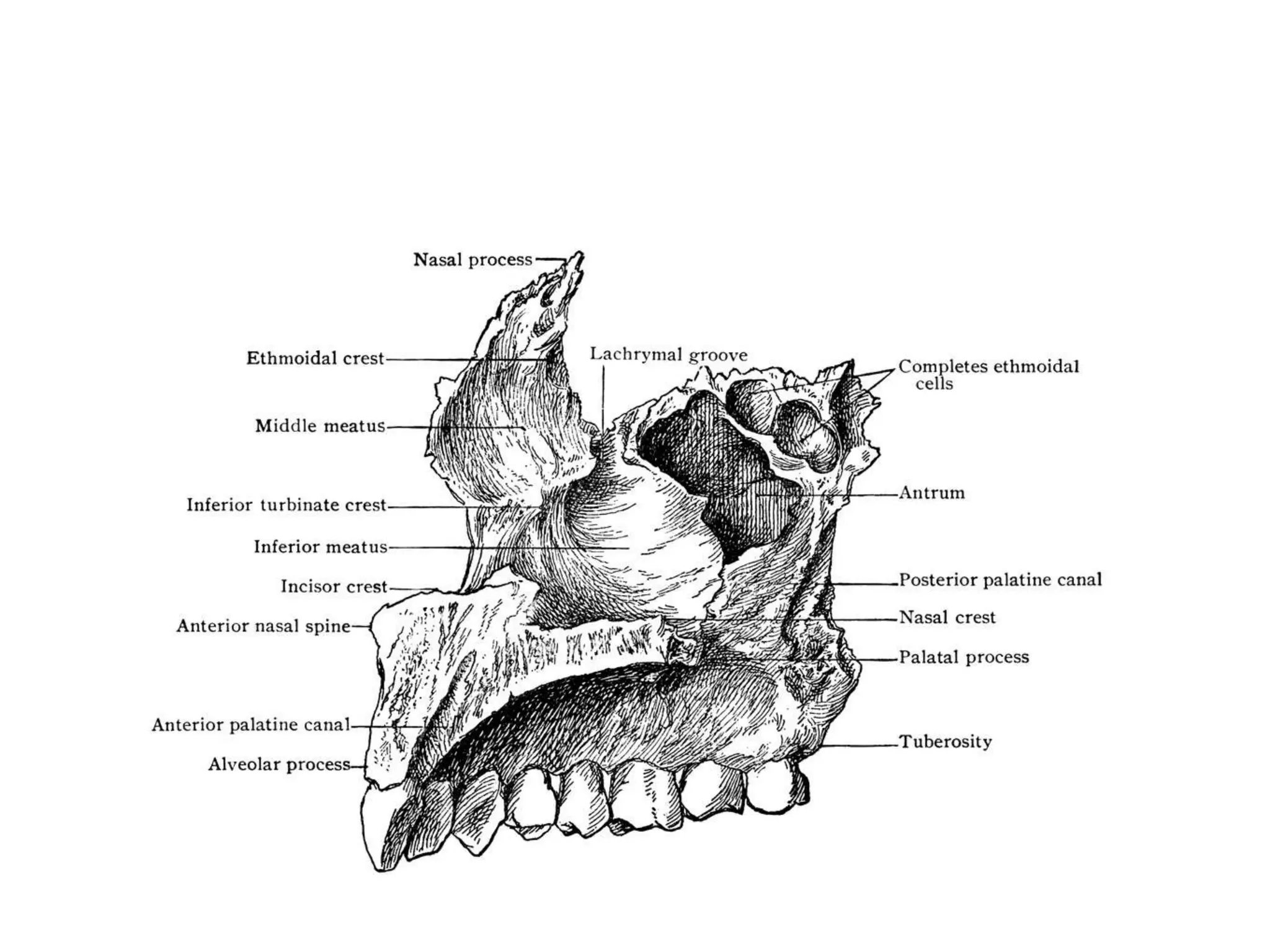
Nasal Surface
• In its upper posterior part there is a large
maxillary hiatus which leads into the maxillary
sinus
In articulated skull this hiatus is completed by
ethmoid and lacrimal bones
• Behind this there is a rough impression for the
perpendicular plate of palatine bone
• Infront of maxillary hiatus there is a lacrimal
groove
• More anteriorly concal crest for articulation with
inferior nasal concha
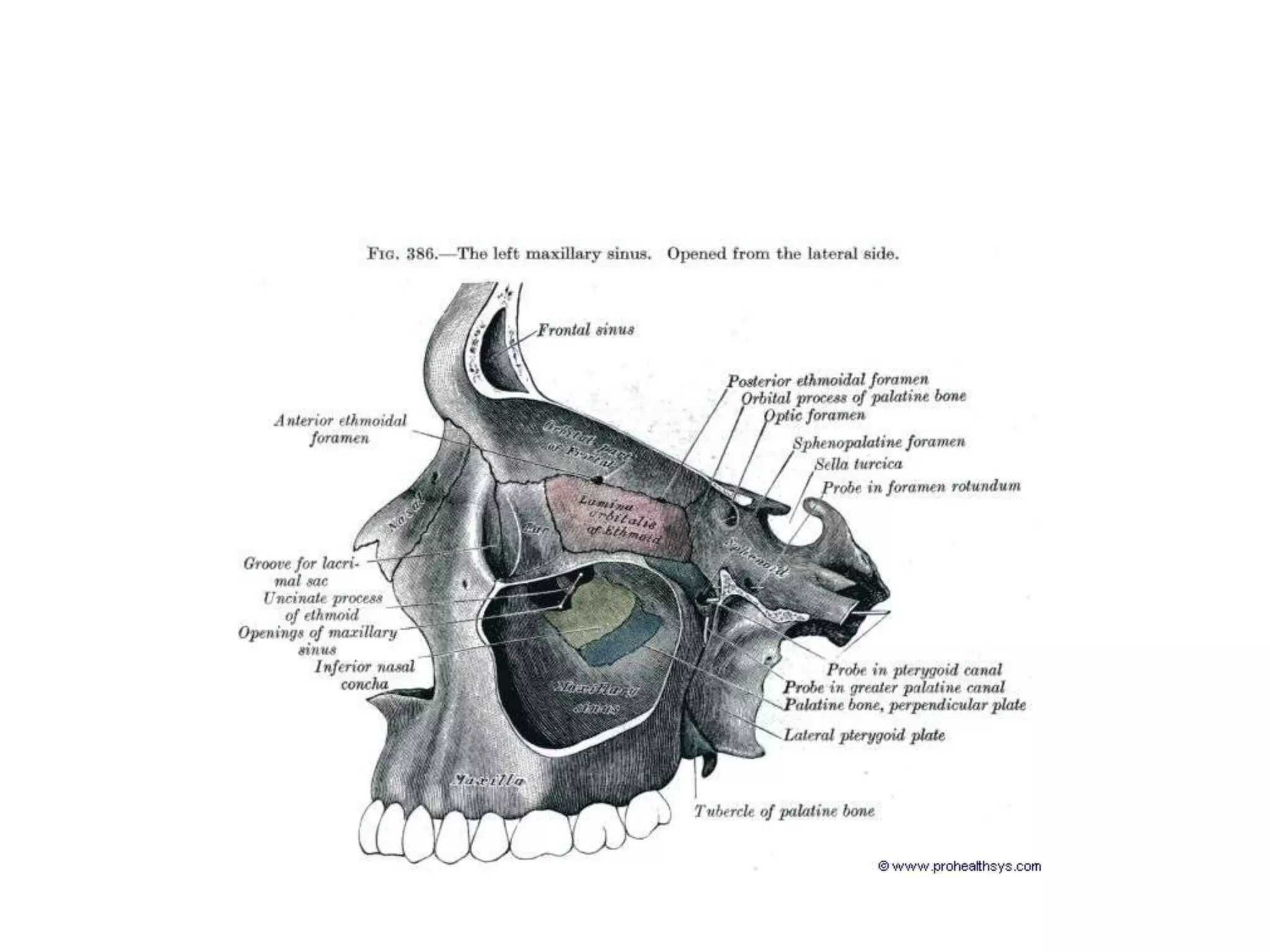
Maxillary Sinus
• Large pyramidal cavity with its apex directed laterally
towards the zygomatic process
• Base is towards the lateral wall of the nose
• In articulated skull it is reduced by
Above
• Uncinate process of ethmoid
• Desending part of lacrimal bone
Below: inferior nasal concha
Behind: perpendicular plate of palatine
• It opens into the middle meatus of the nose usually by two
openings one of which is closed by mucous membrane in
living state
• Occasionally there are projections in the maxillary sinus
from roof to anterior wall
Processes
• Zygomatic: it is rough and pyramidal
– Front:it is contineous with the anterior surface of
body
– Behind(concave):in continuity of the posterior
surface
– Above: articulates with zygomatic bone
– Below(arched border) which anterior and
posterior surface of the body
• Frontal Process:
– Lateral Surface:
• Vertical ridge (Lacrimal crest)
• Groove for the lacrimal sac
– Medial surface: It is rough and uneven and
articulates with the ethmoid and also closes the
anterior ethmoidal sinus below ethmoidal crest
• Upper end: Articulates with the frontal bone
• Anterior border with the nasal bone
• Posterior border with the lacrimal bone
• Alveolar processes: It has thick arched border
behind and contains sockets to receive roots
of teeth which vary in size and depth
– Canine deepest
– Molar widest and subdivided into 3 minor sockets
by septae
– Incisors and premolars single
– Occasionally incisors are divided into 2 sockes
• Palatine Process: Thick strong horizontal
– Inferior surface is concave and presents numerous
foramina for passage of nutrient vessels and contains
depressions for lodgement of glands
– Groove for grater palatine Vessels and nerves
– Incisive fossa leads into the incisive canal
– Sometimes anterior and posterior incisive foramen for
long sphenopalatine nerve which communicates with
the greater palatine nerve
– Upper surface: forms the floor of the nasal cavity
– Lateral Border fuses with rest of the bone
– Posterior border fuses with the horizontal plate of the
palatine
Muscles attached to maxilla
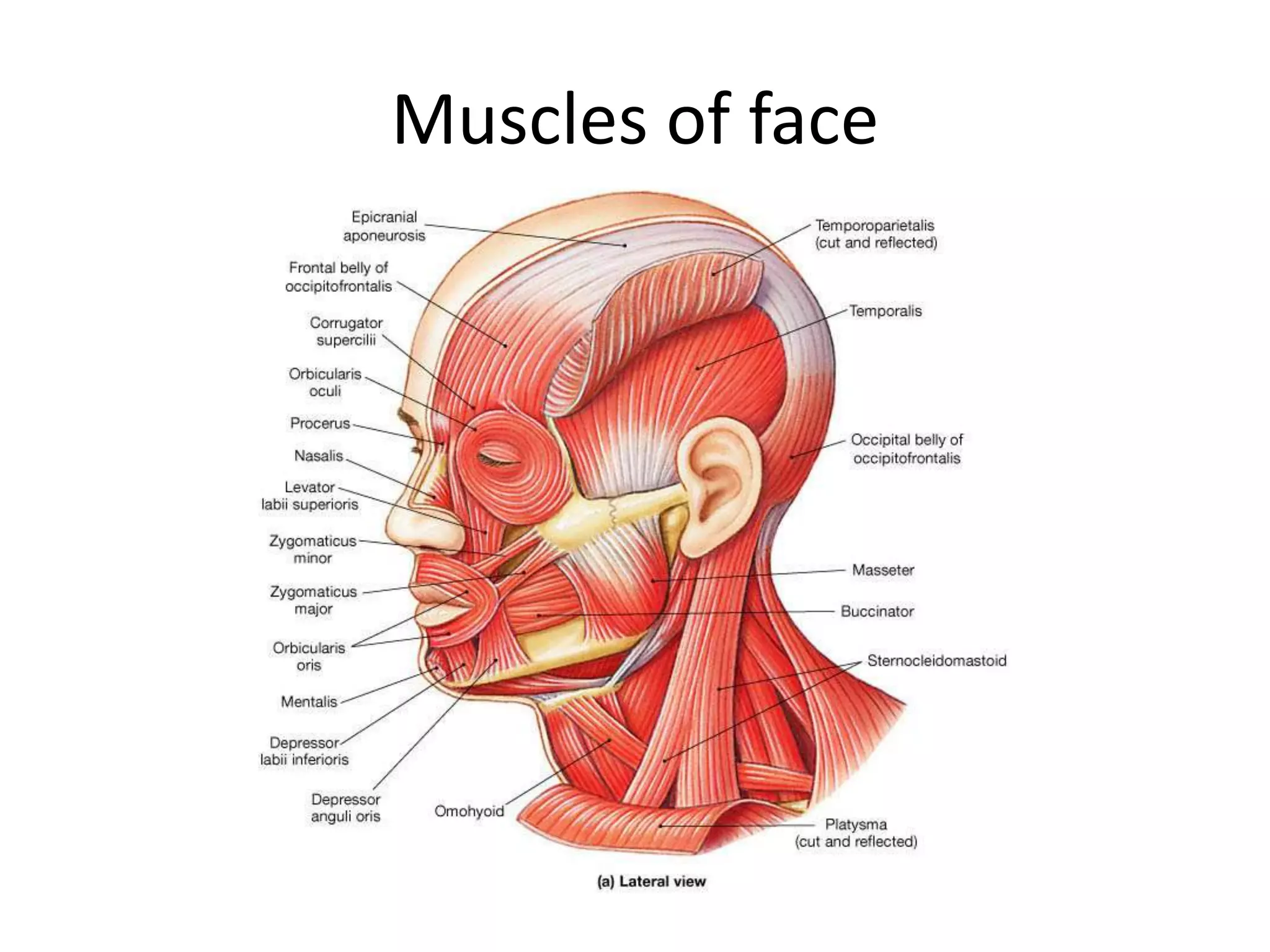
Muscles of face
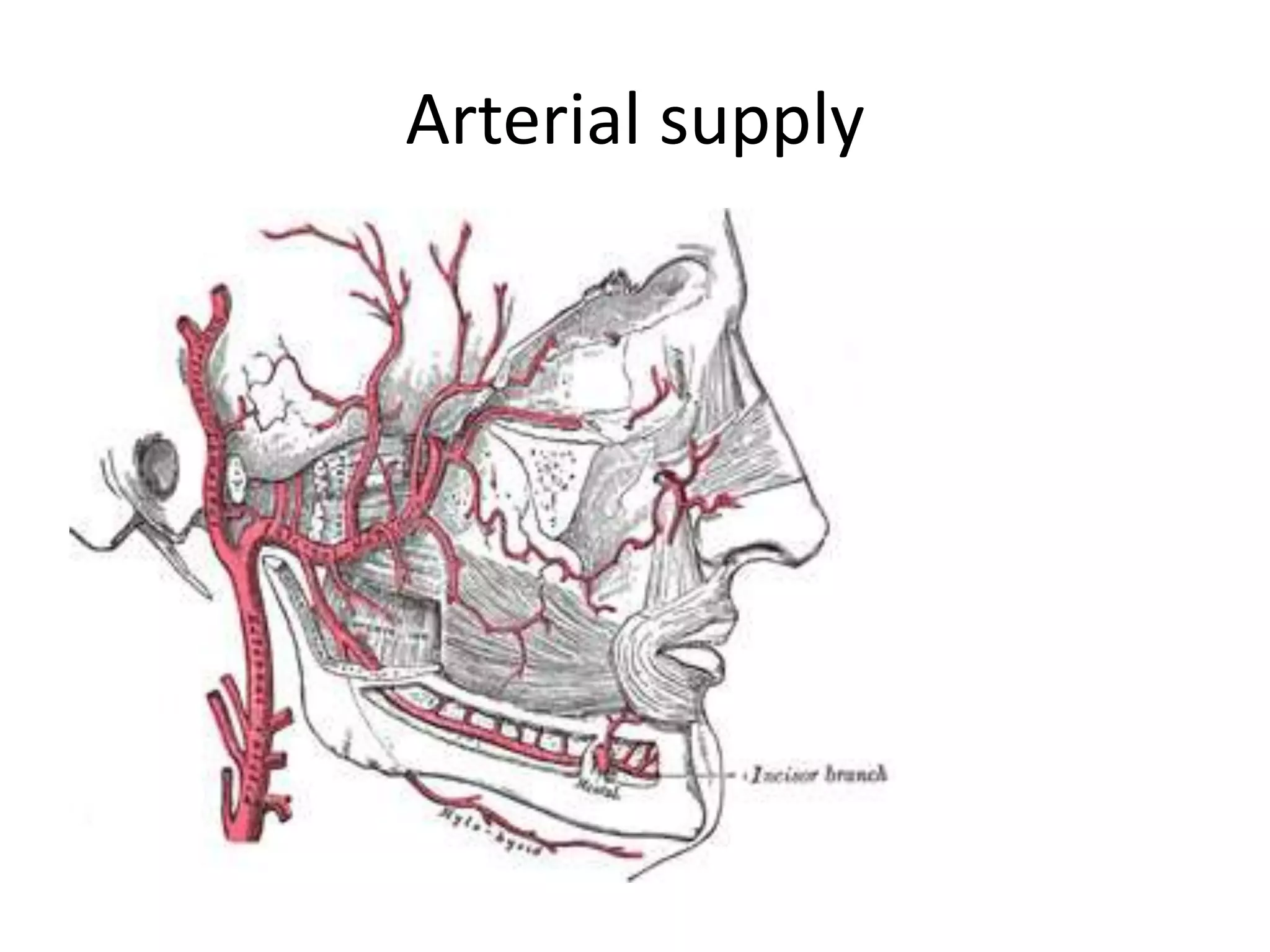
Arterial supply
Maxillary Artery
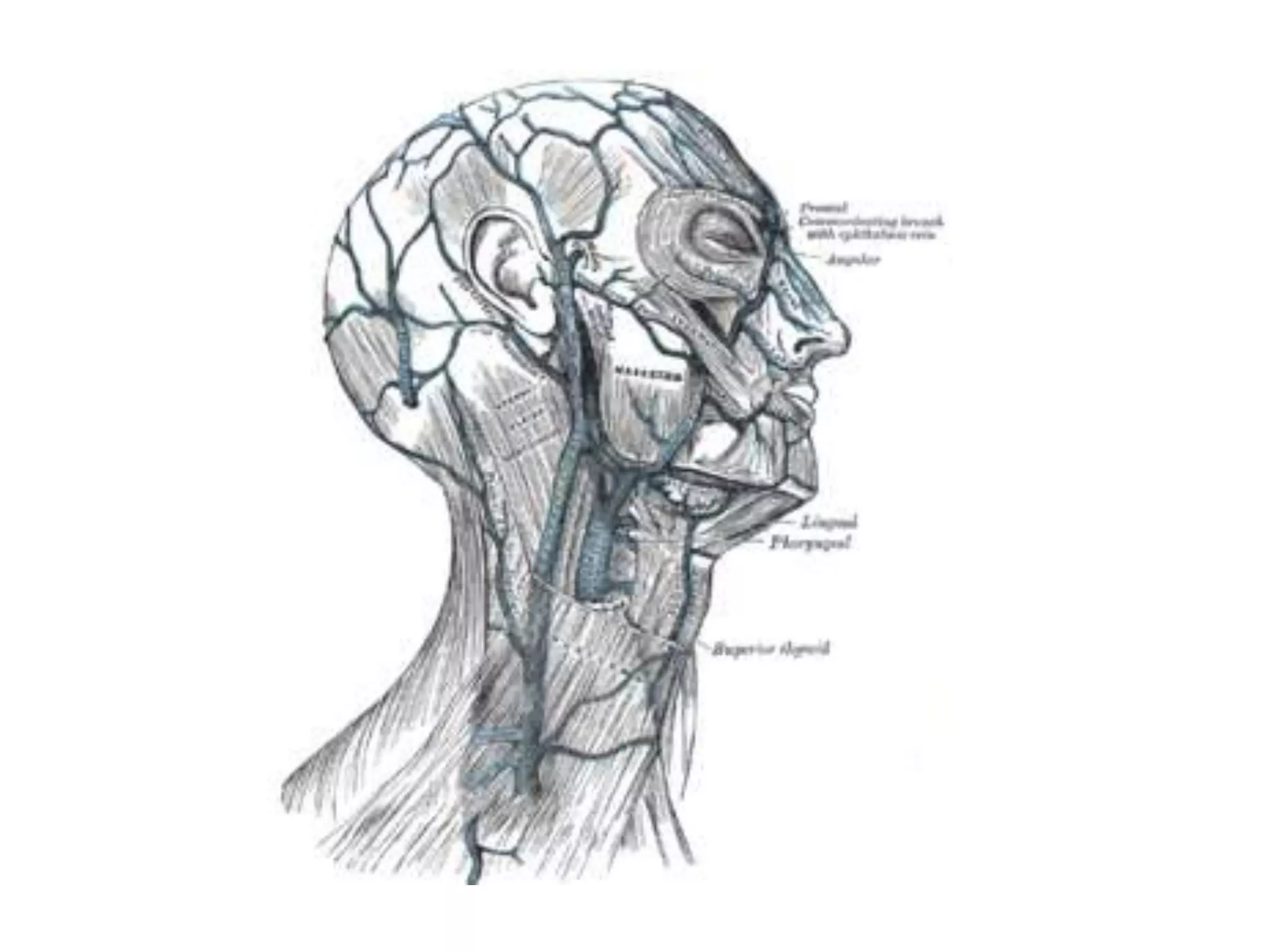
Veinous drainage
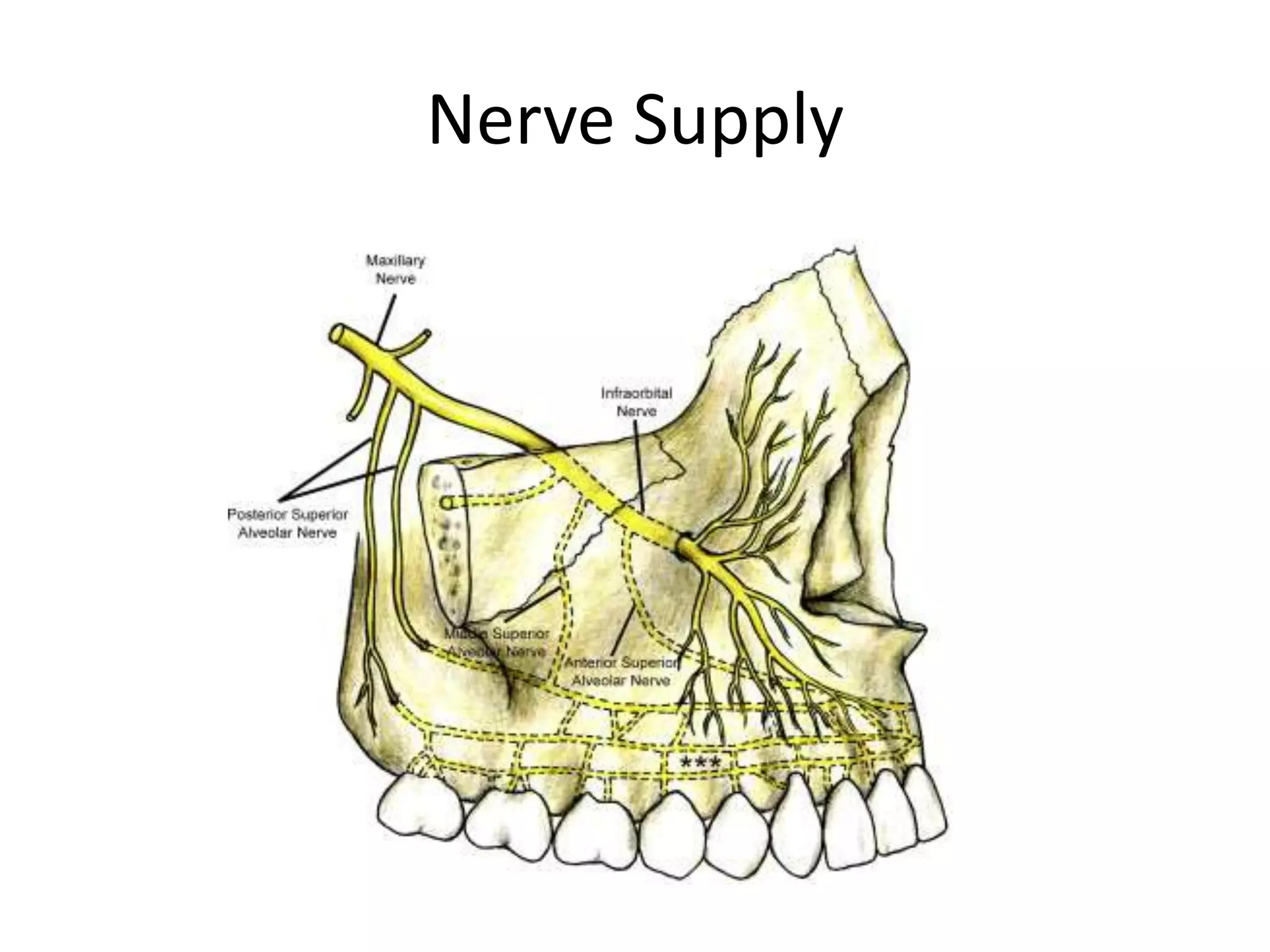
Nerve Supply
Lymphatics
Age changes in Maxilla
Mandible
• Largest and strongest bone of the face
• Curved horizontal body; convex forwards
• It has two rami which project upward from
posterior end of the body
• The body is horse shoe shaped
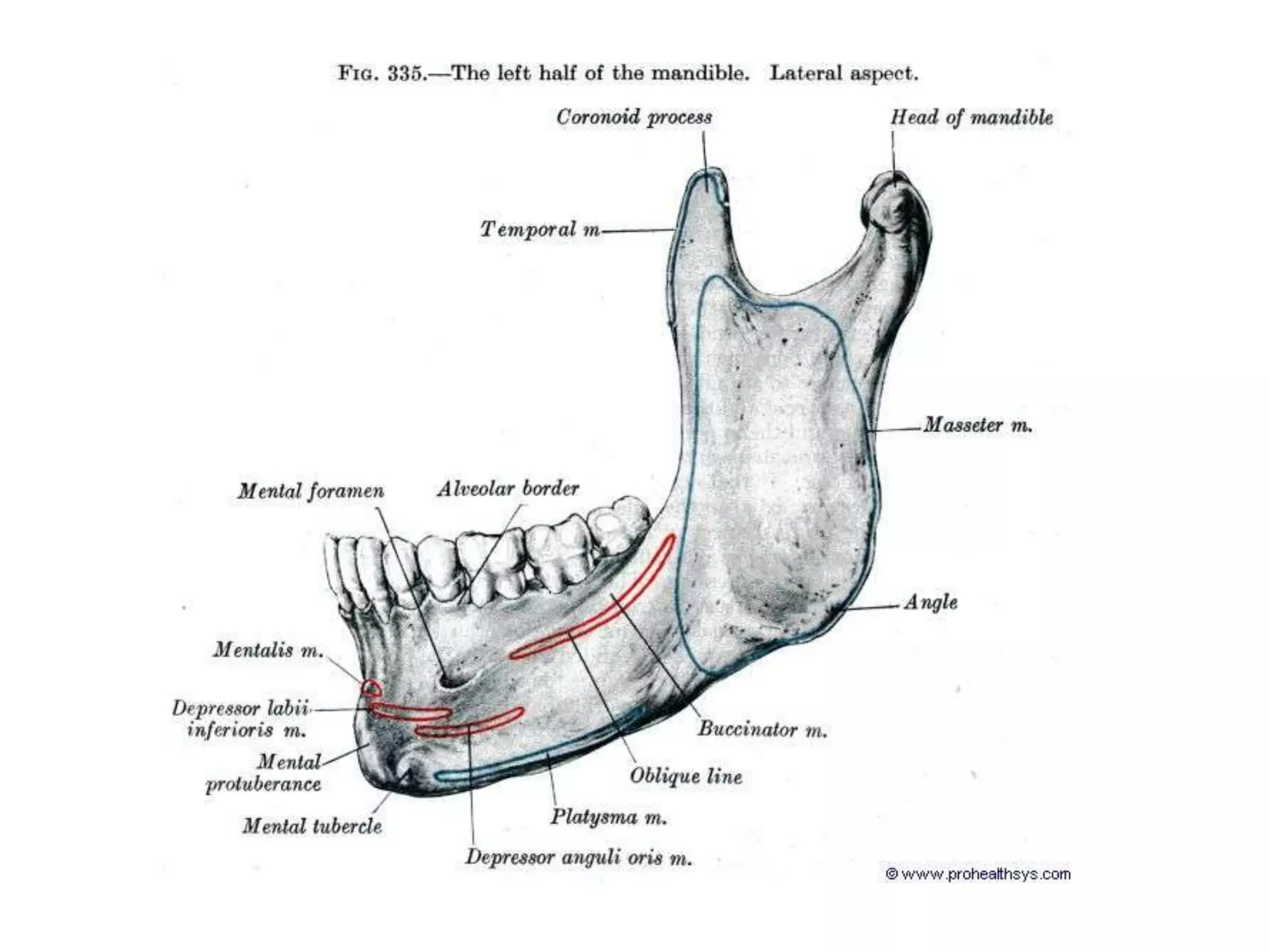
External Surface
• Faint ridge: symphisis menti
• Mental protuberance in the triangular area
below sympisis menti
• Mental tubercle on each side of mental
protruberance
• Mental foramen between premolar teeth
• Oblique line
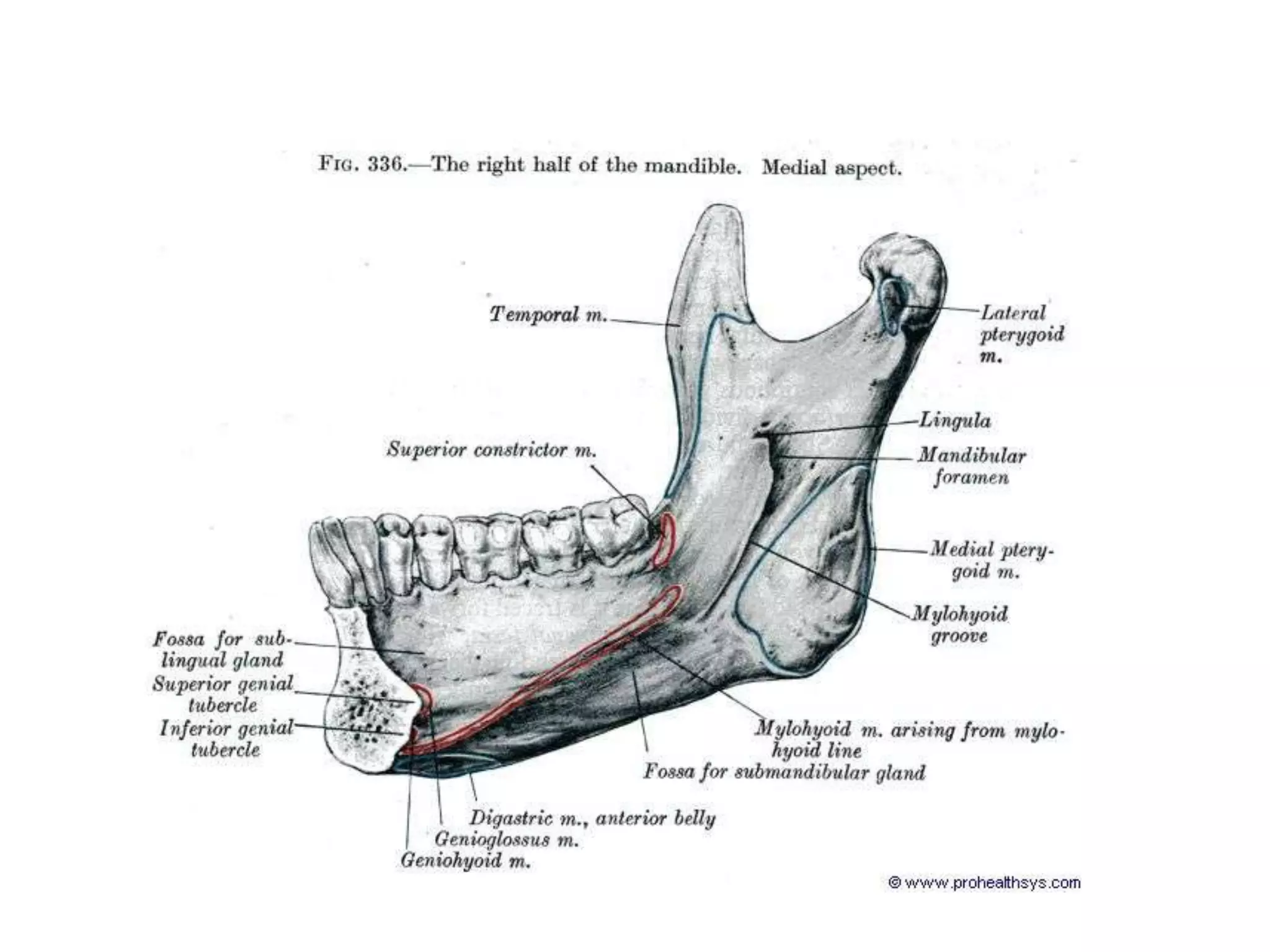
Internal Surface
• Myelohyoid line
• Sub mandibular fossa
• Sub lingual fossa
• Genial tubercle
• Myelohyoid groove
Borders
• Upper boder:
– Sockets for the mandibular teeth are present
• Lower border(Base) presents a digastric fossa
• Ramus
– Lateral Surface
– Medial Surface
• Mandibular foramen canal
• Lingula- mylohyoid groove
• Inferior border is continuous with the angle of
mandible
• Upper Border: Mandibular Notch
Arterial Supply of Maxilla and
Mandible
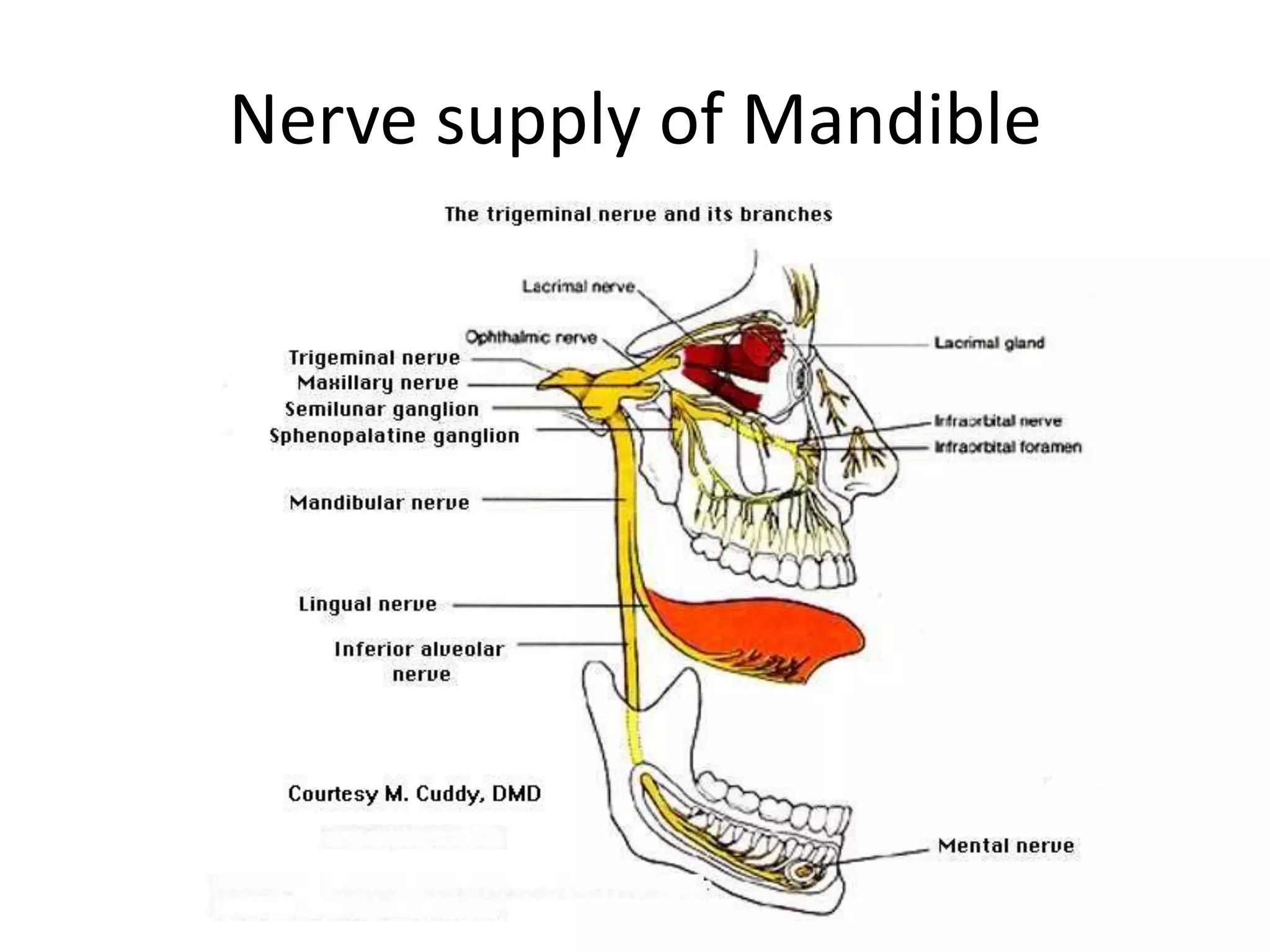
Nerve supply of Mandible
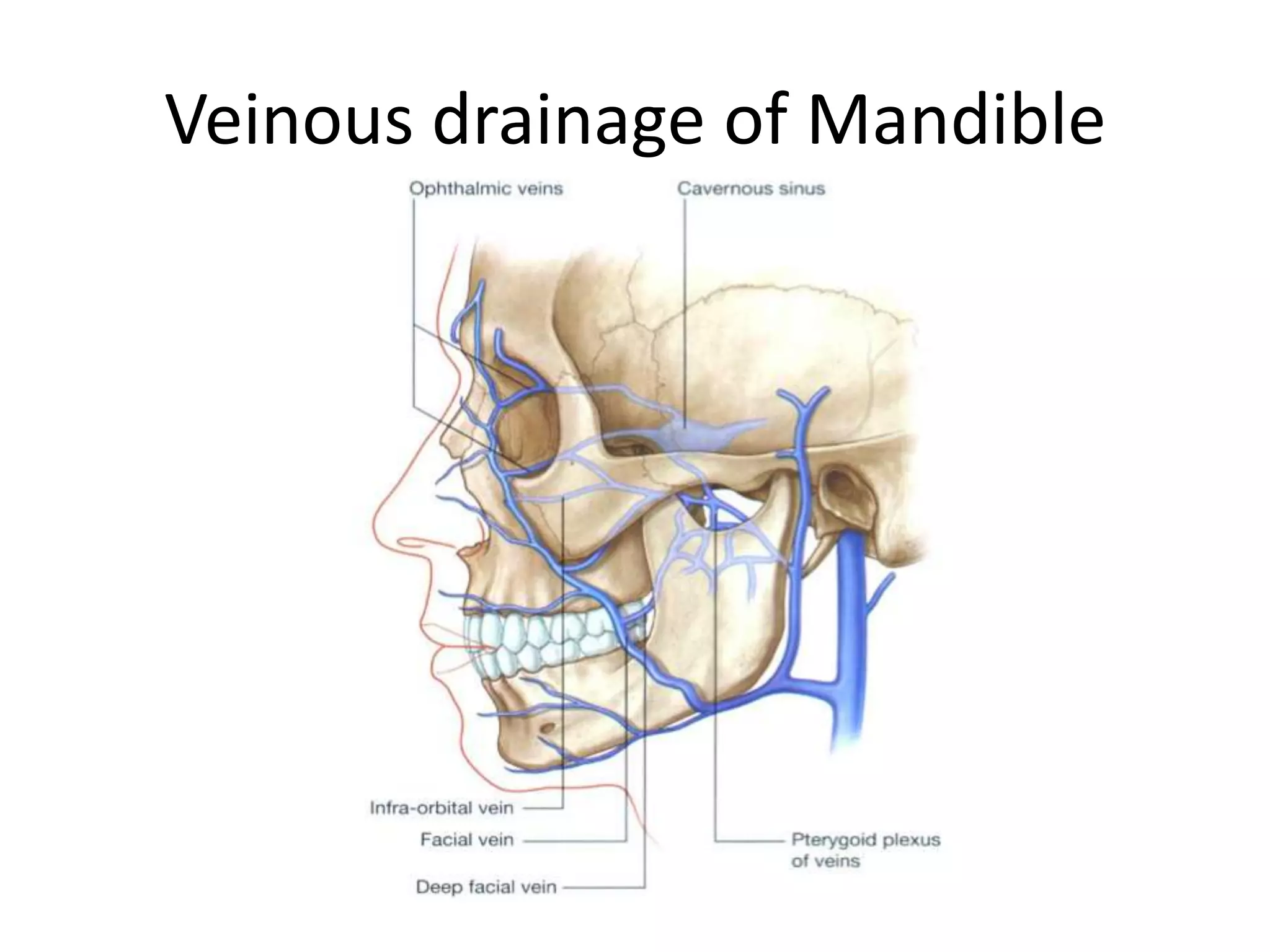
Veinous drainage of Mandible
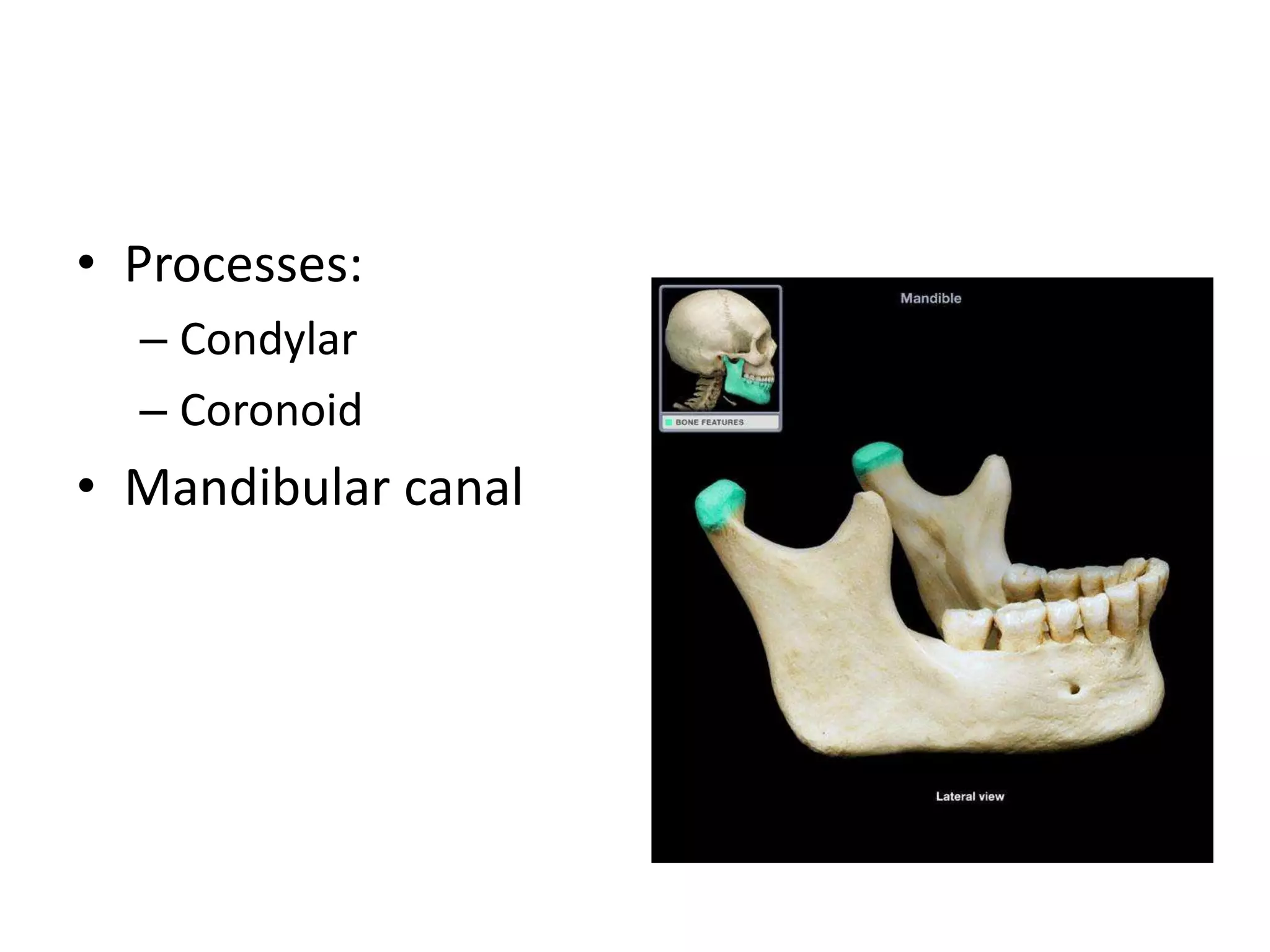
• Processes:
– Condylar
– Coronoid
• Mandibular canal
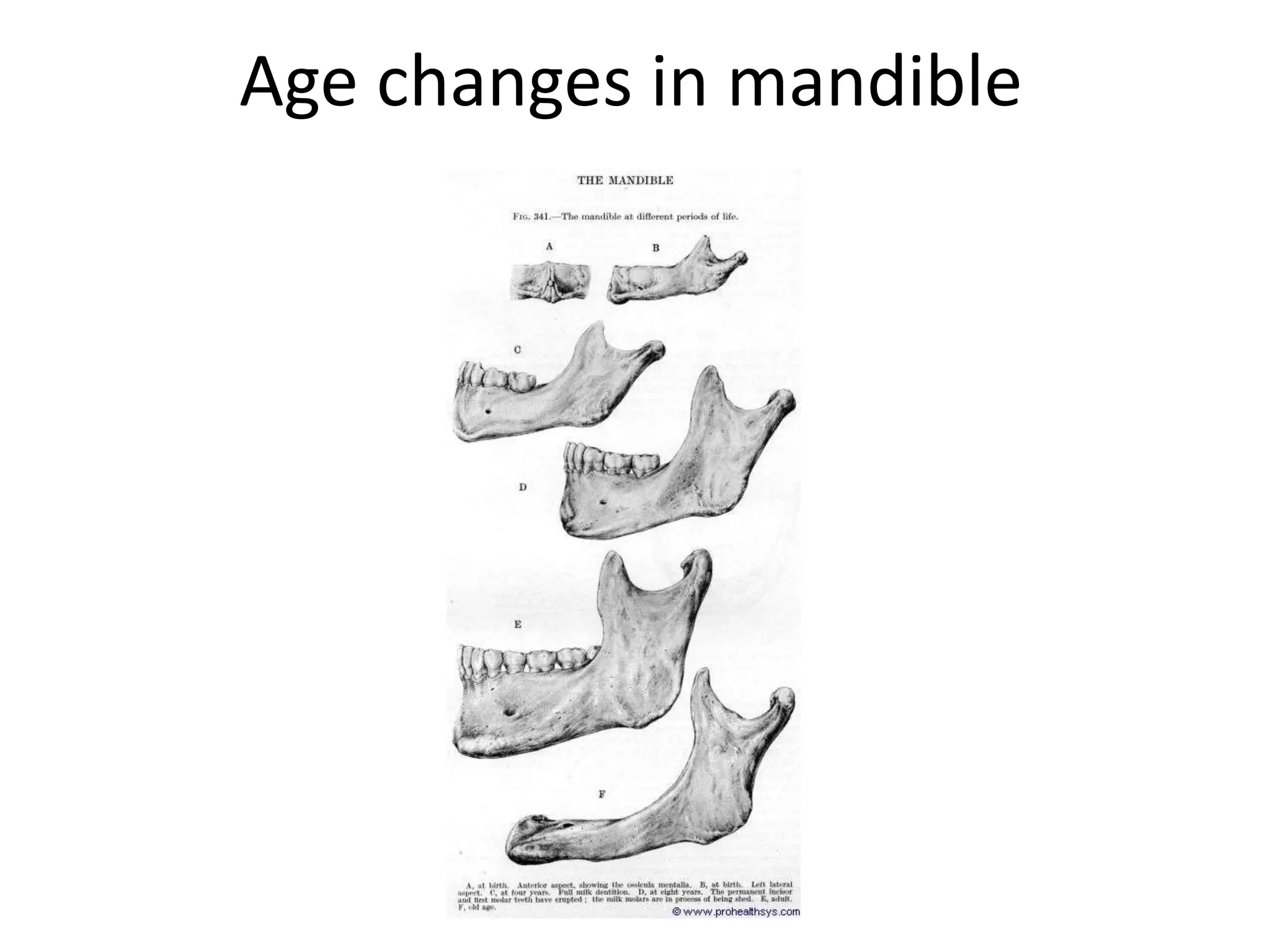
Age changes in mandible
Applied Anatomy
Muscle injuries: Its cause and effects
• Incisivus labii Superioris:
– During the exposure of
the bone of premaxilla
between the canines ,a
mucoperiosteal flap
reflection may detach
the muscle and if the
muscle gets damaged
the the drooping of the
septum and ala of the
nose may occur
• Mylohyoid muscle
– Surgical manupulation of the floor of the mouth may result
in edematous swelling of the sublingual space (above the
mylohyoid muscle )and submandibular space(below the
mylohyoid muscle)
– Cellulitis of this sublingual space in quiet common
however excessive bilateral cellulitis of the sublingual
spaces may push the tongue backwards and compress the
pharynx and may result in airway obstruction
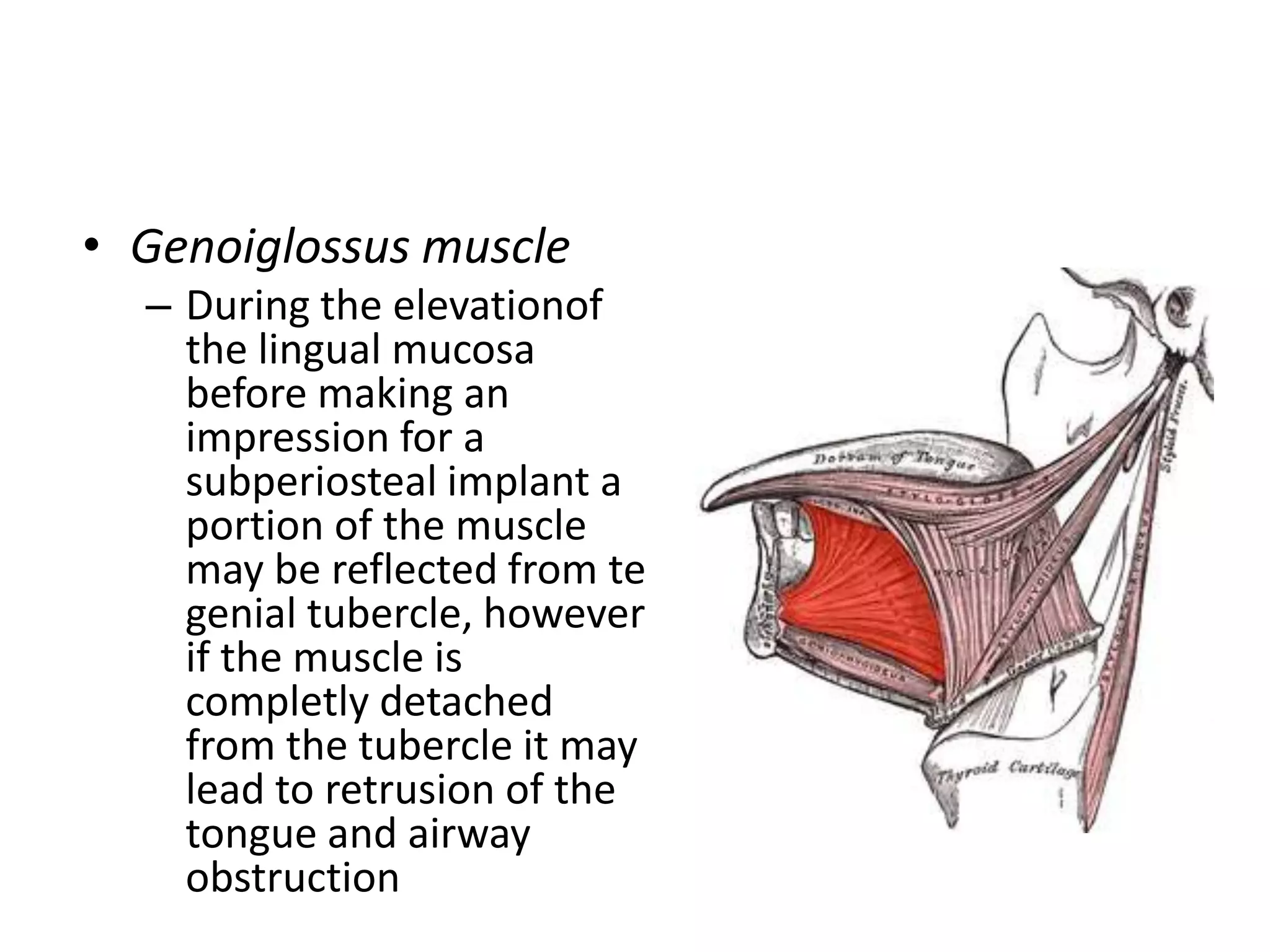
• Genoiglossus muscle
– During the elevationof
the lingual mucosa
before making an
impression for a
subperiosteal implant a
portion of the muscle
may be reflected from te
genial tubercle, however
if the muscle is
completly detached
from the tubercle it may
lead to retrusion of the
tongue and airway
obstruction
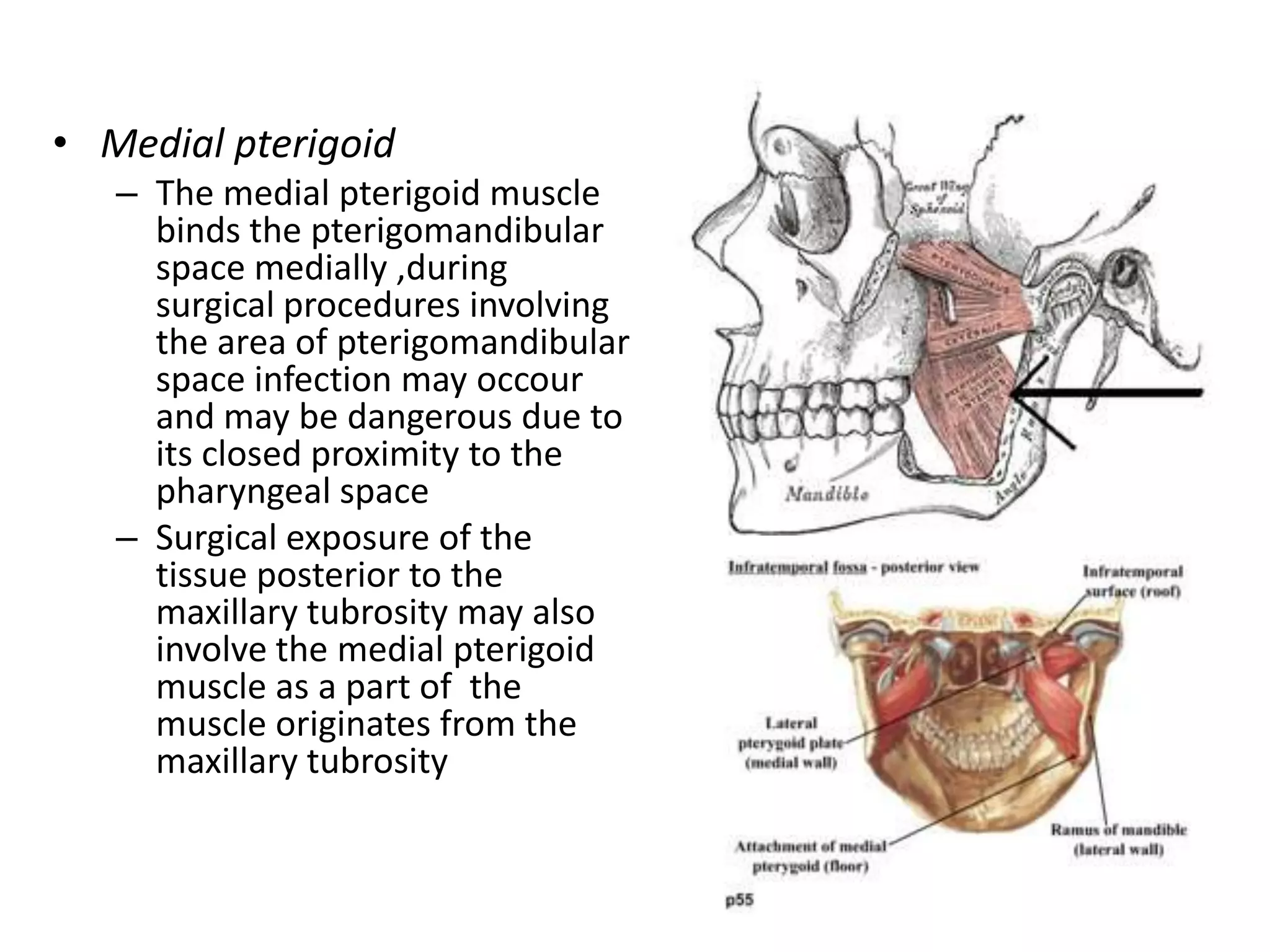
• Medial pterigoid
– The medial pterigoid muscle
binds the pterigomandibular
space medially ,during
surgical procedures involving
the area of pterigomandibular
space infection may occour
and may be dangerous due to
its closed proximity to the
pharyngeal space
– Surgical exposure of the
tissue posterior to the
maxillary tubrosity may also
involve the medial pterigoid
muscle as a part of the
muscle originates from the
maxillary tubrosity
• Lateral pterigoid muscle
– The lateral pterigoid muscle fibres are placed in an
angulated manner and because of this there may
be pain in patients with a full arched subperiosteal
implant or prosthetic splint
• Mentalis muscle:
– Complete reflection of the
mentalis muscle for the
purpose of extension of a
subperiosteal implant may
result in a condition known
as witch’s chin
There is failure of the mentalis
muscle reattachment
following the implantation.
An external bandage is
applied for four days to help
in the reattachment of the
muscle
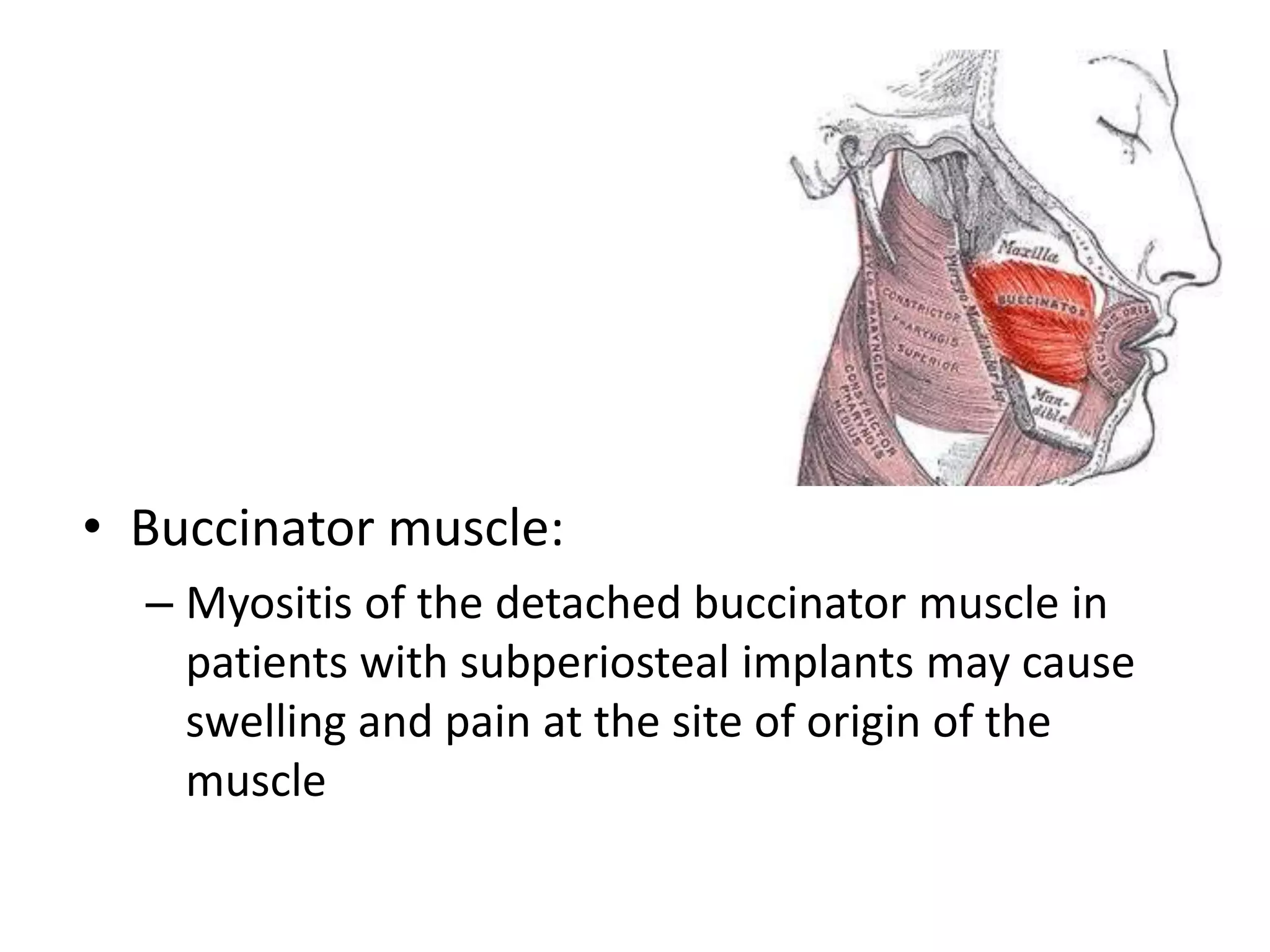
• Buccinator muscle:
– Myositis of the detached buccinator muscle in
patients with subperiosteal implants may cause
swelling and pain at the site of origin of the
muscle
Nerve injuries
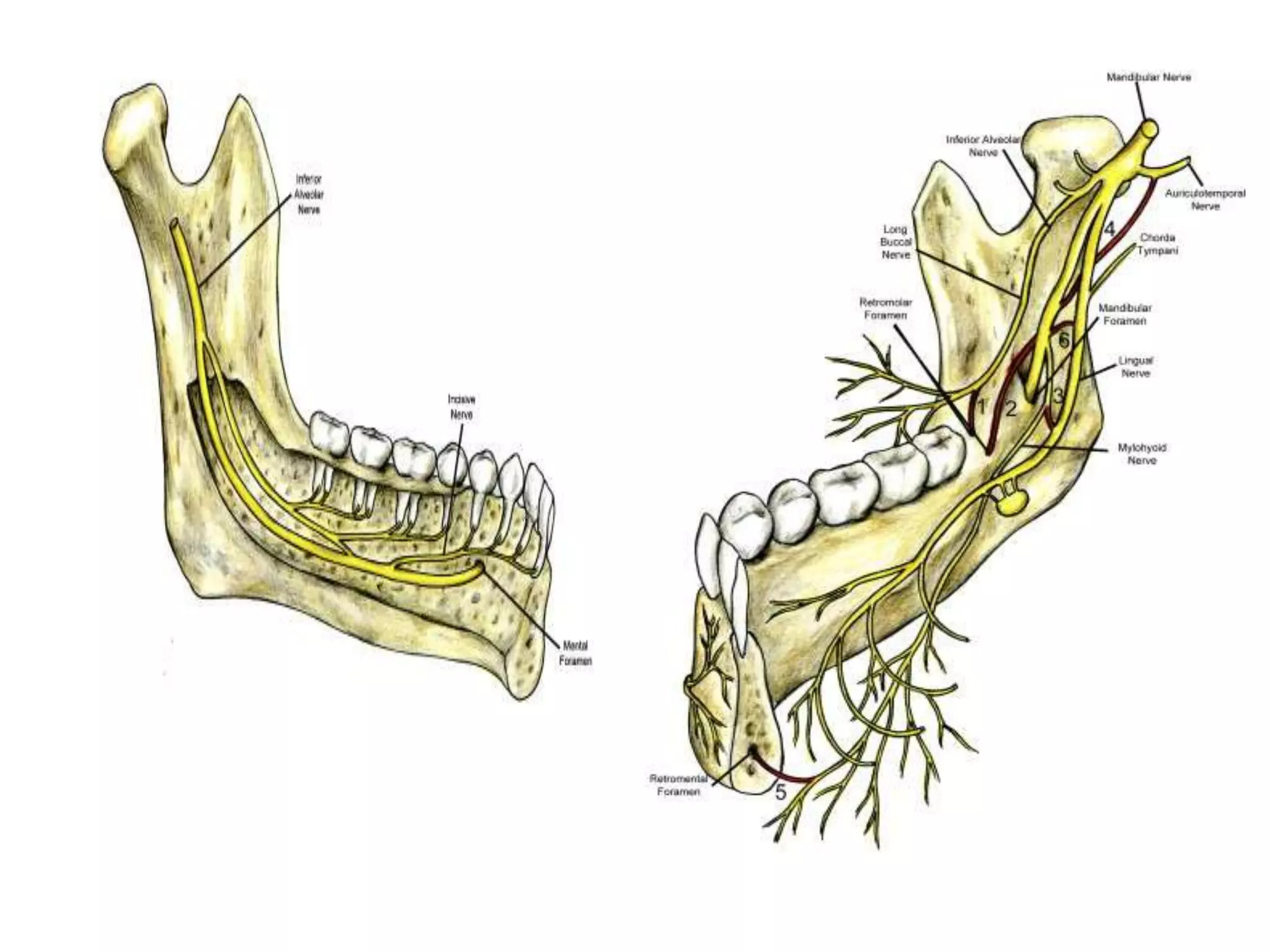
• Inferior alveolar nerve:
– The nerve may be
damaged easily when
making an incision or
reflection of the
mucosa in its area
therefore position of
the inferior dental
canal in vertical and
buccolingual
dimension is of great
importance during
site preprations for
implants
• Lingual nerve
– The position of the
nerve is lateral to the
retromolar pad the
incision should remain
lateral to the pad and
the mucosal reflection
should be done with a
periosteal elevator in
constant contact with
the bone to prevent
injury to the nerve
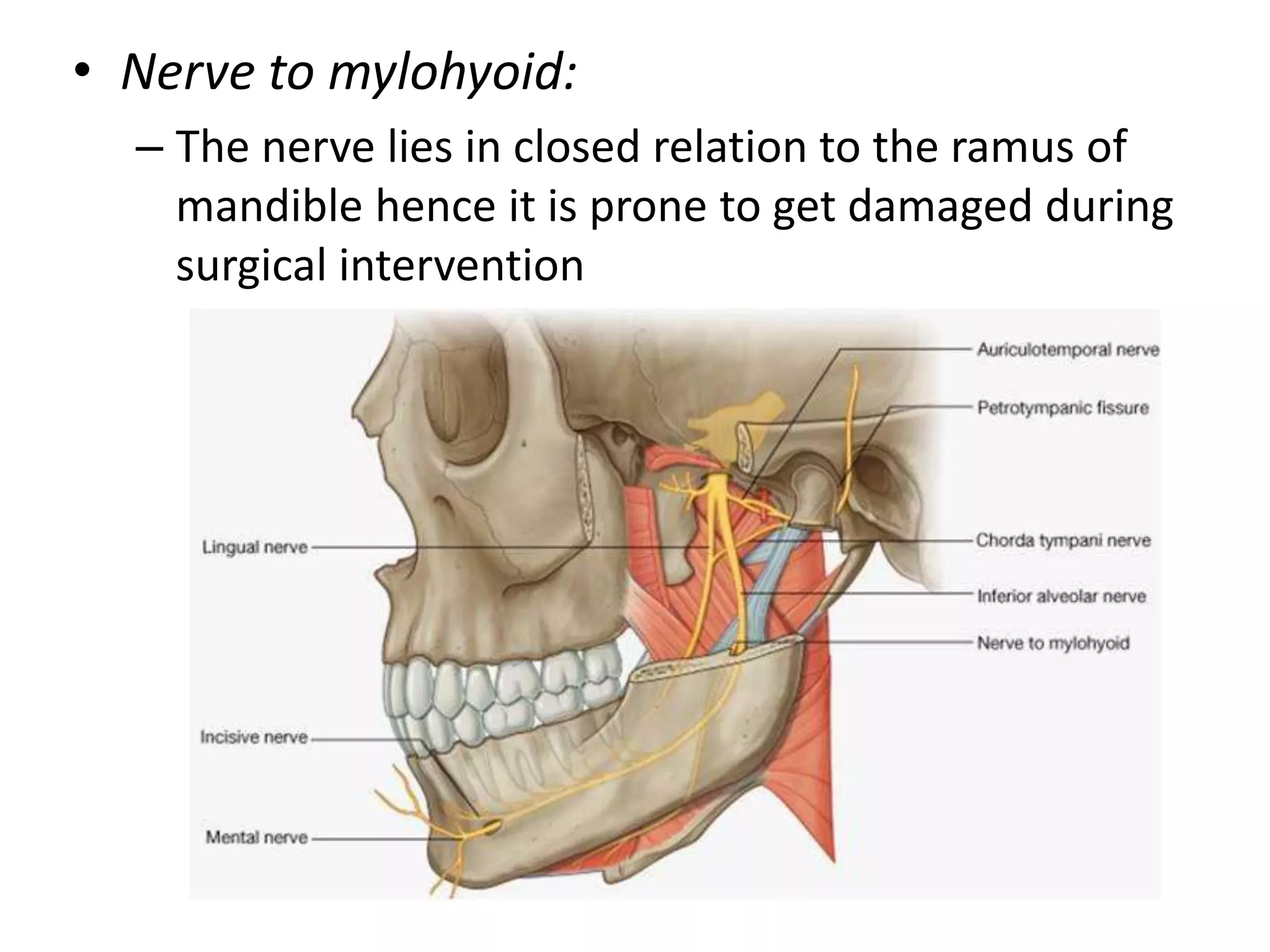
• Nerve to mylohyoid:
– The nerve lies in closed relation to the ramus of
mandible hence it is prone to get damaged during
surgical intervention
• Long buccal nerve:
– When the ramus is
accessed for the
purpose of a block
graft excision great
care must be take
to protect this
nerve from injury
Injury to vessels
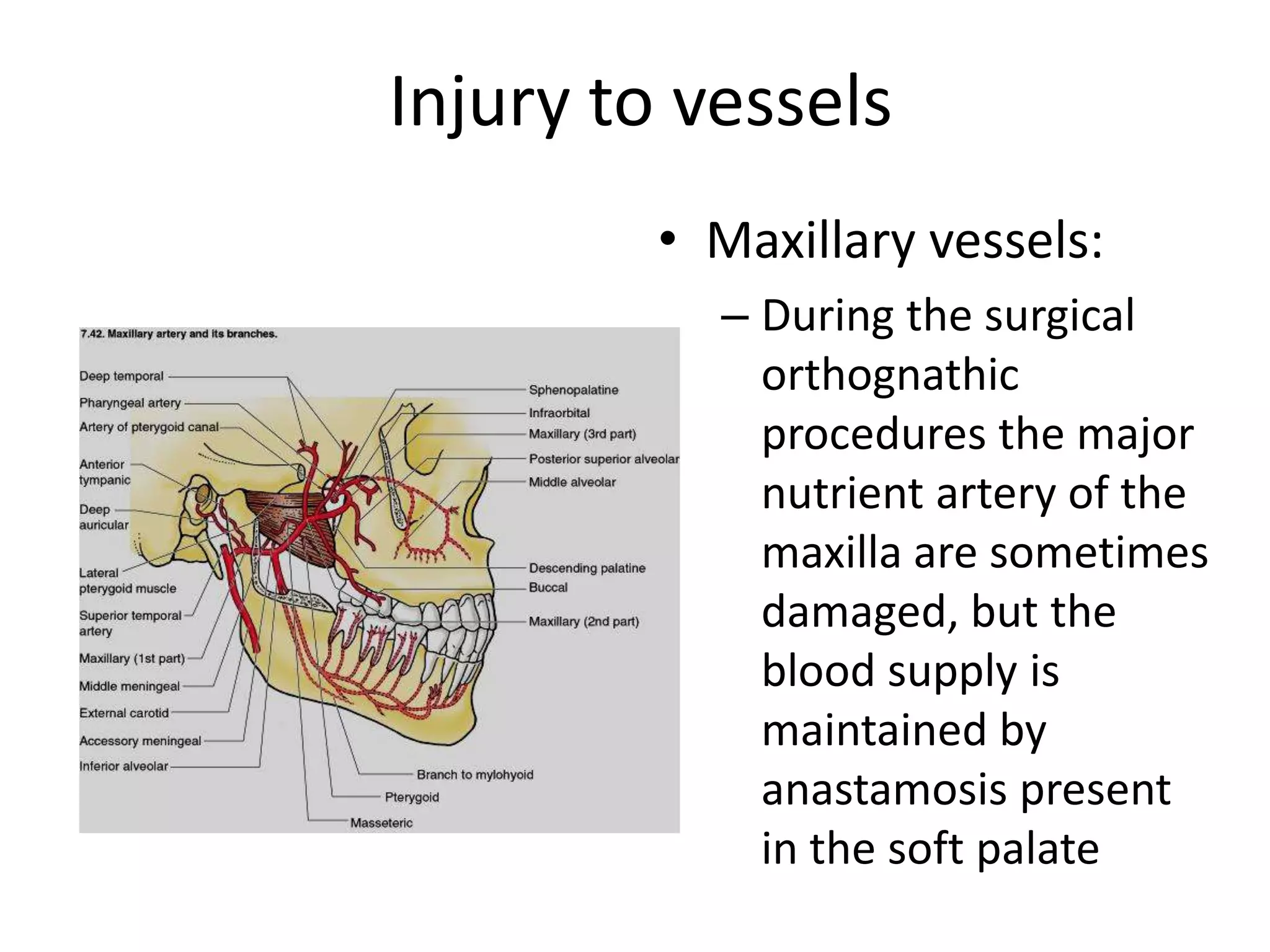
• Maxillary vessels:
– During the surgical
orthognathic
procedures the major
nutrient artery of the
maxilla are sometimes
damaged, but the
blood supply is
maintained by
anastamosis present
in the soft palate
Thank You
syedirfanqadeer@ymail.com

Anatomy of maxilla and mandible

  • 1.
    Anatomy of Maxillaand Mandible By:- Dr. Syed Irfan Qadeer Prof. And Head, Department of Anatomy Sardar Patel Dental College, Lucknow.
  • 2.
    Maxilla • It isthe second largest bone of the face • It forms the upper jaw with the fellow of the opposite side • It also contributes to the formation of 1. Floor of the nose and the orbit 2. Roof of the mouth 3. Lateral wall of the nose 4. Pterigopalatine and infratemporal fossae 5. Pterigomaxillary and infraorbital fissures
  • 3.
    Anatomy of themaxilla • The anatomy of the maxilla has two main parts: 1. Body(pyramidal shape) – Anterior surface – Posterior surface – Orbital surface – Nasal surface 2. Processes – Zygomatic – Frontal – Alveolar – Palatine
  • 5.
    Anterior Surface: • IncisiveFossa: – Depressor septi nasi – Orbicularis oris • Canine fossa: – Levator anguli oris • Infraorbital foramen (above canine fossa) – Infraorbital nerves and vessels • Above sharp border between anterior and orbital surface: – Levator labi superioris • Nasal notch: Dilator Naris • Ant Nasal Spine
  • 7.
    Posterior Surface • Itis directed backwards and laterally • It forms anterior wall of the infratemporal fossa • Anterior and posterior surfaces are seperated by ridge which leads to the socket of 1st molar tooth • Near the centre of posterior surface 2 to 3 openings of dental canal for posterior superior alveolar vessels and nerves • At the lower end there is a raised maxillary tubrosity which is rough in the upper part of its medial end for tubercle of the palatine bone which has the attachment of superficial fibres of themedial pterigoid muscles • Above this smooth surface which forms the boundry of the ptrigopalatine fossa is grooved for the maxillary nerve, this groove is contineous with the infra orbital groove
  • 8.
    Orbital surface Smooth andtriangular • Medial border – Notch: lacrimal notch – Behind this it articulates with the • Lacrimal • Orbital plate of ethmoid • Orbital process of palatine • Posterior border: Smooth, rounded and it forms greater part of infraorbital fissure in middle infraorbital groove • Anterior border: forms orbital margin ,infraorbital groove and canal; a little lateral to this is canalis sinuosus which passes in the anterior wall of the maxillary sinus and reaches in the nasal cavity and opens in the side of the nasal septum in front of incisive canal • A little lateral to the lacrimal groove there is attachment of inferior oblique muscle of eveball
  • 9.
    Nasal Surface • Inits upper posterior part there is a large maxillary hiatus which leads into the maxillary sinus In articulated skull this hiatus is completed by ethmoid and lacrimal bones • Behind this there is a rough impression for the perpendicular plate of palatine bone • Infront of maxillary hiatus there is a lacrimal groove • More anteriorly concal crest for articulation with inferior nasal concha
  • 11.
    Maxillary Sinus • Largepyramidal cavity with its apex directed laterally towards the zygomatic process • Base is towards the lateral wall of the nose • In articulated skull it is reduced by Above • Uncinate process of ethmoid • Desending part of lacrimal bone Below: inferior nasal concha Behind: perpendicular plate of palatine • It opens into the middle meatus of the nose usually by two openings one of which is closed by mucous membrane in living state • Occasionally there are projections in the maxillary sinus from roof to anterior wall
  • 13.
    Processes • Zygomatic: itis rough and pyramidal – Front:it is contineous with the anterior surface of body – Behind(concave):in continuity of the posterior surface – Above: articulates with zygomatic bone – Below(arched border) which anterior and posterior surface of the body
  • 14.
    • Frontal Process: –Lateral Surface: • Vertical ridge (Lacrimal crest) • Groove for the lacrimal sac – Medial surface: It is rough and uneven and articulates with the ethmoid and also closes the anterior ethmoidal sinus below ethmoidal crest • Upper end: Articulates with the frontal bone • Anterior border with the nasal bone • Posterior border with the lacrimal bone
  • 15.
    • Alveolar processes:It has thick arched border behind and contains sockets to receive roots of teeth which vary in size and depth – Canine deepest – Molar widest and subdivided into 3 minor sockets by septae – Incisors and premolars single – Occasionally incisors are divided into 2 sockes
  • 16.
    • Palatine Process:Thick strong horizontal – Inferior surface is concave and presents numerous foramina for passage of nutrient vessels and contains depressions for lodgement of glands – Groove for grater palatine Vessels and nerves – Incisive fossa leads into the incisive canal – Sometimes anterior and posterior incisive foramen for long sphenopalatine nerve which communicates with the greater palatine nerve – Upper surface: forms the floor of the nasal cavity – Lateral Border fuses with rest of the bone – Posterior border fuses with the horizontal plate of the palatine
  • 17.
  • 18.
  • 19.
  • 20.
  • 21.
  • 23.
  • 24.
  • 25.
  • 26.
    Mandible • Largest andstrongest bone of the face • Curved horizontal body; convex forwards • It has two rami which project upward from posterior end of the body • The body is horse shoe shaped
  • 29.
    External Surface • Faintridge: symphisis menti • Mental protuberance in the triangular area below sympisis menti • Mental tubercle on each side of mental protruberance • Mental foramen between premolar teeth • Oblique line
  • 31.
    Internal Surface • Myelohyoidline • Sub mandibular fossa • Sub lingual fossa • Genial tubercle • Myelohyoid groove
  • 32.
    Borders • Upper boder: –Sockets for the mandibular teeth are present • Lower border(Base) presents a digastric fossa • Ramus – Lateral Surface – Medial Surface • Mandibular foramen canal • Lingula- mylohyoid groove • Inferior border is continuous with the angle of mandible • Upper Border: Mandibular Notch
  • 33.
    Arterial Supply ofMaxilla and Mandible
  • 35.
  • 37.
  • 38.
    • Processes: – Condylar –Coronoid • Mandibular canal
  • 39.
  • 40.
    Applied Anatomy Muscle injuries:Its cause and effects • Incisivus labii Superioris: – During the exposure of the bone of premaxilla between the canines ,a mucoperiosteal flap reflection may detach the muscle and if the muscle gets damaged the the drooping of the septum and ala of the nose may occur
  • 41.
    • Mylohyoid muscle –Surgical manupulation of the floor of the mouth may result in edematous swelling of the sublingual space (above the mylohyoid muscle )and submandibular space(below the mylohyoid muscle) – Cellulitis of this sublingual space in quiet common however excessive bilateral cellulitis of the sublingual spaces may push the tongue backwards and compress the pharynx and may result in airway obstruction
  • 42.
    • Genoiglossus muscle –During the elevationof the lingual mucosa before making an impression for a subperiosteal implant a portion of the muscle may be reflected from te genial tubercle, however if the muscle is completly detached from the tubercle it may lead to retrusion of the tongue and airway obstruction
  • 43.
    • Medial pterigoid –The medial pterigoid muscle binds the pterigomandibular space medially ,during surgical procedures involving the area of pterigomandibular space infection may occour and may be dangerous due to its closed proximity to the pharyngeal space – Surgical exposure of the tissue posterior to the maxillary tubrosity may also involve the medial pterigoid muscle as a part of the muscle originates from the maxillary tubrosity
  • 44.
    • Lateral pterigoidmuscle – The lateral pterigoid muscle fibres are placed in an angulated manner and because of this there may be pain in patients with a full arched subperiosteal implant or prosthetic splint
  • 45.
    • Mentalis muscle: –Complete reflection of the mentalis muscle for the purpose of extension of a subperiosteal implant may result in a condition known as witch’s chin There is failure of the mentalis muscle reattachment following the implantation. An external bandage is applied for four days to help in the reattachment of the muscle
  • 46.
    • Buccinator muscle: –Myositis of the detached buccinator muscle in patients with subperiosteal implants may cause swelling and pain at the site of origin of the muscle
  • 47.
    Nerve injuries • Inferioralveolar nerve: – The nerve may be damaged easily when making an incision or reflection of the mucosa in its area therefore position of the inferior dental canal in vertical and buccolingual dimension is of great importance during site preprations for implants
  • 48.
    • Lingual nerve –The position of the nerve is lateral to the retromolar pad the incision should remain lateral to the pad and the mucosal reflection should be done with a periosteal elevator in constant contact with the bone to prevent injury to the nerve
  • 49.
    • Nerve tomylohyoid: – The nerve lies in closed relation to the ramus of mandible hence it is prone to get damaged during surgical intervention
  • 50.
    • Long buccalnerve: – When the ramus is accessed for the purpose of a block graft excision great care must be take to protect this nerve from injury
  • 51.
    Injury to vessels •Maxillary vessels: – During the surgical orthognathic procedures the major nutrient artery of the maxilla are sometimes damaged, but the blood supply is maintained by anastamosis present in the soft palate
  • 52.