CONTRAST AGENTS
Dr Fahad Shafi
PG RADIODIAGNOSIS &IMAGING
Aims of this session
• Why contrast agents are used
• What are the desirable features of a
contrast agent
• Types of contrast agents used in clinical
settings
• Methods of administrating contrast agents
• Examples of examinations utilising contrast
agents
• Problems/issues associated with
administrating contrast agents
Why contrast agents are used
• Different tissues within the body attenuate
the beam of X-rays to different degrees.
• The degree of attenuation of an X-ray beam by
an element is complex, but one of the major
variables isthe number of electrons in the
path of the beam with which it can interact.
• The number of electrons in the path of the
beam is dependent upon three factors:
• The thickness of the substance being studied
• Its density
• The number of electrons per atom of the
element (which is equal to its atomic number)
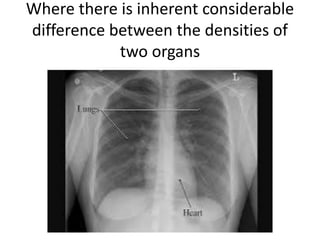
Where there is inherent considerable
difference between the densities of
two organs
• However, if the two organs have similar
densities and similar average atomic numbers,
then it is not possible to distinguish them on a
radiograph, because no natural contrast exists.
• For example, it is not possible to identify
blood vessels within an organ, or to
demonstrate the internal structure of the
kidney, without artificially altering one of the
factors mentioned earlier
Two of the factors important in organ
contrast can be artificially altered,
• the density of an organ, and,
• more usefully, the average atomic number of a
structure.
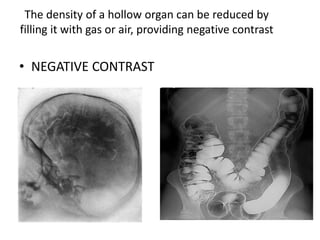
The density of a hollow organ can be reduced by
filling it with gas or air, providing negative contrast
• NEGATIVE CONTRAST
The average atomic number is
INCREASED positive contrast
What are the desirable features of a
contrast agent
• Easy to administer
• No toxicity/carcinogenecity
• Stable compound
• Concentrates in area of interest
• Proper demonstration of the organ system
• Should have rapid elimination
• Minimal distress to patients (viscosity)
• Cost effective
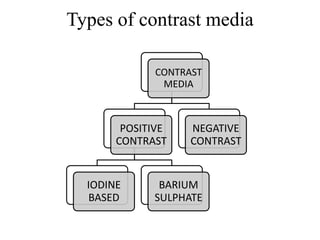
Types of contrast media
CONTRAST
MEDIA
POSITIVE
CONTRAST
IODINE
BASED
BARIUM
SULPHATE
NEGATIVE
CONTRAST
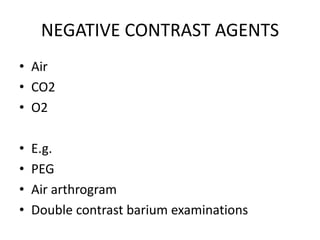
NEGATIVE CONTRAST AGENTS
• Air
• CO2
• O2
• E.g.
• PEG
• Air arthrogram
• Double contrast barium examinations
POSITIVE CONTRAST AGENTS
• BARIUM SULPHATE
• Radiological contrast media are usually water
soluble solutions, but there is one commonly
used variety that is based on a suspension of
large insoluble particles
• Examinations of the upper and lower
gastrointestinal tracts
• Barium sulphate suspensions have better
coating properties than the iodinated contrast
media, and tend to form thin layers spread
over the lining of the gut
WHY BARIUM IN GI SERIES
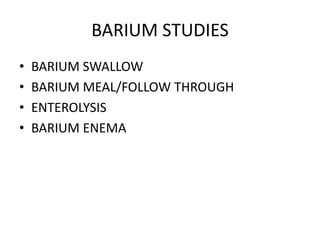
BARIUM STUDIES
• BARIUM SWALLOW
• BARIUM MEAL/FOLLOW THROUGH
• ENTEROLYSIS
• BARIUM ENEMA
Barium swallow examination
Barium meal and Barium follow
through
Enteroclysis
• Enteroclysis has shown to be very accurate in
diagnosing small bowel diseases, with a
sensitivity of 93.1% and specificity of 96.9%.
• It permits detection of lesion which may not
be seen with other imaging techniques.
• no significant difference Enteroclysis and
Computer tomographic enterography.
Enteroclysis in double contrast technique showing
stenosis of the small intestine
Barium enema
ADVERSE EFFECTS
• Constipation and abdominal pain
• Toxicity
• Encephalopathy
• Peritonitis, adhesion,granuloma,ENDOTOXIC
SHOCK
• Aspiration pneumonia
• Allergy
IODINE BASED
• Early 1920s to treat syphilis with high doses of
sodium iodide. The urine in the bladder was
observed to become radio-opaque during this
treatment. Sodium iodide was too toxic.
• The first suitable structure was a derivative called
pyridine, to which a single iodine atom could be
bound in order to render it radio-opaque.
• The first radiological contrast medium that could
produce safe and reliable intravenous urograms
in patients was Uroselectan
• In the 1950s, contrast media were developed
that were based on the six-carbon benzoic
acid ring rather than the five-carbon pyridine
ring. This structure was able to carry three
atoms of iodine, and therefore was even more
radio-opaque.
• Had a very high osmolality
WATER VS OIL BASED
• OIL BASED
• NEVER INJECTED
• ONLY DUCTS
• NOT INGESTED
• WATER BASED
• INJECTED VESSELLS/DUCTS
• INGESTED
• Organ function/flow
All contrast media are not the same
• Viscosity
• Osmolality
• Chemotoxicity
• LD50
Viscosity
• The practical importance of viscosity of a
contrast medium relates chiefly to the force
that is required to inject
• The viscosity can be reduced by lowering the
concentration of the contrast medium, but
result in unsatisfactory opacification. Since
viscosity is inversely related to temperature,
warming the contrast medium may partly
resolve this problem
Osmolality
• In general, the higher the osmotic pressure the
poorer the tolerance. Ionic contrast media
undergo this dissociation, whilst newer, non-ionic
contrast media do not.
• Osmolality is directly responsible for a number of
clinically important effects
• The sensations of heat and discomfort or even
pain
• damage to the blood-brain barrier, renal damage
and disturbance or electrolyte balance in small
children.
• Both the viscosity of a contrast medium and
its osmolality are INVERSELY related to
tolerance but directly to degree of
opacification.
• With increasing strength of contrast medium,
the opacifying power of the solution
increases, but so, of course, do the osmolality
and viscosity, while tolerance tends to decline.
Ways of reducing osmolality, whilst
maintaining satisfactory radio-opacity
• two contrast medium molecules together,
producing a much larger molecule, which still
ionises, but possesses six atoms of iodine per
molecule
• replace the dissociating cationic portion of the
contrast medium molecule completely with a
non-dissociating organic chain
CHEMOTOXICITY/LD50
• mechanism responsible for causing the toxic
effects of contrast media that cannot be
explained by other means (e.g. osmolality,
electrical charge).
• There are a number of properties of contrast
media that relate to this tem (e.g.
hydrophilicity/lipophilicity, protein-binding,
histamine release).
Methods of Administration
• Orally
• Rectally
• Intravenous
• Intra cavitatory
Examples of examinations utilising
contrast agents
• Angiography
• Intravenous urography (IVU), intravenous
pyelography (IVP)
• Computed tomography (CT)
• Interventional techniques
• GI series
• Other examinations
Choice of contrast
• Infants (introduction of hyperosmolar fluid into the bodies
of very young children can cause
• problems of fluid balance)
• The elderly (for the same reason)
• Diabetics
• Patients with cardiac impairment
• Patients with renal impairment
• Asthmatics
• Patients who have previously reacted adversely to a
contrast medium
• Patients with a history of allergy
• Patients who are unduly anxious
Safety of contrast media
• Contrast media are among the safest of all of
the pharmaceutical products available to the
doctor today. They are not intended to have
therapeutic activity: indeed, the ideal contrast
medium would have no pharmacological
activity at all.
• rate of adverse reactions to iodinated contrast
media on the market is extremely low, but
such reactions do occur - just as they do with
every pharmaceutical product.
two groups
• Those reactions that are clearly dependent on
the dose and concentration of the contrast
medium administered......... heat,
pain,vasodilation, cardiac depression and
hypotension,CIN
• and those that are almost independent of
dose and concentration........ allergy-like or
hypersensitive reactions
• Most contrast media reactions are minor and need
no treatment. Moderate reactions are encountered
rarely (about 1%) and severe reactions very rarely
(about 0.1%), but all moderate and severe reactions
require adequate treatment. Deaths following
contrast media administration are extremely rare.
• Reported mortality rates vary between 1 in 10,000
and 1 in 169,000 averaging around 1 in 75,000.
• Katayama et al. (Radiology 1990; 175: 621-628)
found that there is a reduction in adverse reaction
rate of about four times using(LOCM) for intravenous
injection compared to HOCM
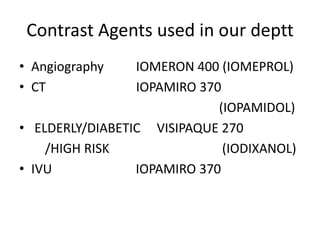
Contrast Agents used in our deptt
• Angiography IOMERON 400 (IOMEPROL)
• CT IOPAMIRO 370
(IOPAMIDOL)
• ELDERLY/DIABETIC VISIPAQUE 270
/HIGH RISK (IODIXANOL)
• IVU IOPAMIRO 370
MRI contrast agent
• Gadolinium (Gd):
Extracellular fluid agents
Blood pool agents
Organ specific agents
• Iron oxide
• Iron Platinum
• Manganese
CEUS

Contrast agents ppt

  • 1.
    CONTRAST AGENTS Dr FahadShafi PG RADIODIAGNOSIS &IMAGING
  • 2.
    Aims of thissession • Why contrast agents are used • What are the desirable features of a contrast agent • Types of contrast agents used in clinical settings • Methods of administrating contrast agents • Examples of examinations utilising contrast agents • Problems/issues associated with administrating contrast agents
  • 3.
    Why contrast agentsare used • Different tissues within the body attenuate the beam of X-rays to different degrees. • The degree of attenuation of an X-ray beam by an element is complex, but one of the major variables isthe number of electrons in the path of the beam with which it can interact.
  • 4.
    • The numberof electrons in the path of the beam is dependent upon three factors: • The thickness of the substance being studied • Its density • The number of electrons per atom of the element (which is equal to its atomic number)
  • 5.
    Where there isinherent considerable difference between the densities of two organs
  • 6.
    • However, ifthe two organs have similar densities and similar average atomic numbers, then it is not possible to distinguish them on a radiograph, because no natural contrast exists. • For example, it is not possible to identify blood vessels within an organ, or to demonstrate the internal structure of the kidney, without artificially altering one of the factors mentioned earlier
  • 8.
    Two of thefactors important in organ contrast can be artificially altered, • the density of an organ, and, • more usefully, the average atomic number of a structure.
  • 9.
    The density ofa hollow organ can be reduced by filling it with gas or air, providing negative contrast • NEGATIVE CONTRAST
  • 10.
    The average atomicnumber is INCREASED positive contrast
  • 11.
    What are thedesirable features of a contrast agent • Easy to administer • No toxicity/carcinogenecity • Stable compound • Concentrates in area of interest • Proper demonstration of the organ system • Should have rapid elimination • Minimal distress to patients (viscosity) • Cost effective
  • 12.
    Types of contrastmedia CONTRAST MEDIA POSITIVE CONTRAST IODINE BASED BARIUM SULPHATE NEGATIVE CONTRAST
  • 13.
    NEGATIVE CONTRAST AGENTS •Air • CO2 • O2 • E.g. • PEG • Air arthrogram • Double contrast barium examinations
  • 15.
    POSITIVE CONTRAST AGENTS •BARIUM SULPHATE • Radiological contrast media are usually water soluble solutions, but there is one commonly used variety that is based on a suspension of large insoluble particles • Examinations of the upper and lower gastrointestinal tracts
  • 16.
    • Barium sulphatesuspensions have better coating properties than the iodinated contrast media, and tend to form thin layers spread over the lining of the gut WHY BARIUM IN GI SERIES
  • 17.
    BARIUM STUDIES • BARIUMSWALLOW • BARIUM MEAL/FOLLOW THROUGH • ENTEROLYSIS • BARIUM ENEMA
  • 18.
  • 19.
    Barium meal andBarium follow through
  • 20.
    Enteroclysis • Enteroclysis hasshown to be very accurate in diagnosing small bowel diseases, with a sensitivity of 93.1% and specificity of 96.9%. • It permits detection of lesion which may not be seen with other imaging techniques. • no significant difference Enteroclysis and Computer tomographic enterography.
  • 21.
    Enteroclysis in doublecontrast technique showing stenosis of the small intestine
  • 22.
  • 23.
    ADVERSE EFFECTS • Constipationand abdominal pain • Toxicity • Encephalopathy • Peritonitis, adhesion,granuloma,ENDOTOXIC SHOCK • Aspiration pneumonia • Allergy
  • 24.
    IODINE BASED • Early1920s to treat syphilis with high doses of sodium iodide. The urine in the bladder was observed to become radio-opaque during this treatment. Sodium iodide was too toxic. • The first suitable structure was a derivative called pyridine, to which a single iodine atom could be bound in order to render it radio-opaque. • The first radiological contrast medium that could produce safe and reliable intravenous urograms in patients was Uroselectan
  • 25.
    • In the1950s, contrast media were developed that were based on the six-carbon benzoic acid ring rather than the five-carbon pyridine ring. This structure was able to carry three atoms of iodine, and therefore was even more radio-opaque. • Had a very high osmolality
  • 26.
    WATER VS OILBASED • OIL BASED • NEVER INJECTED • ONLY DUCTS • NOT INGESTED • WATER BASED • INJECTED VESSELLS/DUCTS • INGESTED • Organ function/flow
  • 27.
    All contrast mediaare not the same • Viscosity • Osmolality • Chemotoxicity • LD50
  • 28.
    Viscosity • The practicalimportance of viscosity of a contrast medium relates chiefly to the force that is required to inject • The viscosity can be reduced by lowering the concentration of the contrast medium, but result in unsatisfactory opacification. Since viscosity is inversely related to temperature, warming the contrast medium may partly resolve this problem
  • 29.
    Osmolality • In general,the higher the osmotic pressure the poorer the tolerance. Ionic contrast media undergo this dissociation, whilst newer, non-ionic contrast media do not. • Osmolality is directly responsible for a number of clinically important effects • The sensations of heat and discomfort or even pain • damage to the blood-brain barrier, renal damage and disturbance or electrolyte balance in small children.
  • 30.
    • Both theviscosity of a contrast medium and its osmolality are INVERSELY related to tolerance but directly to degree of opacification. • With increasing strength of contrast medium, the opacifying power of the solution increases, but so, of course, do the osmolality and viscosity, while tolerance tends to decline.
  • 31.
    Ways of reducingosmolality, whilst maintaining satisfactory radio-opacity • two contrast medium molecules together, producing a much larger molecule, which still ionises, but possesses six atoms of iodine per molecule • replace the dissociating cationic portion of the contrast medium molecule completely with a non-dissociating organic chain
  • 32.
    CHEMOTOXICITY/LD50 • mechanism responsiblefor causing the toxic effects of contrast media that cannot be explained by other means (e.g. osmolality, electrical charge). • There are a number of properties of contrast media that relate to this tem (e.g. hydrophilicity/lipophilicity, protein-binding, histamine release).
  • 34.
    Methods of Administration •Orally • Rectally • Intravenous • Intra cavitatory
  • 35.
    Examples of examinationsutilising contrast agents • Angiography • Intravenous urography (IVU), intravenous pyelography (IVP) • Computed tomography (CT) • Interventional techniques • GI series • Other examinations
  • 37.
    Choice of contrast •Infants (introduction of hyperosmolar fluid into the bodies of very young children can cause • problems of fluid balance) • The elderly (for the same reason) • Diabetics • Patients with cardiac impairment • Patients with renal impairment • Asthmatics • Patients who have previously reacted adversely to a contrast medium • Patients with a history of allergy • Patients who are unduly anxious
  • 38.
    Safety of contrastmedia • Contrast media are among the safest of all of the pharmaceutical products available to the doctor today. They are not intended to have therapeutic activity: indeed, the ideal contrast medium would have no pharmacological activity at all. • rate of adverse reactions to iodinated contrast media on the market is extremely low, but such reactions do occur - just as they do with every pharmaceutical product.
  • 39.
    two groups • Thosereactions that are clearly dependent on the dose and concentration of the contrast medium administered......... heat, pain,vasodilation, cardiac depression and hypotension,CIN • and those that are almost independent of dose and concentration........ allergy-like or hypersensitive reactions
  • 40.
    • Most contrastmedia reactions are minor and need no treatment. Moderate reactions are encountered rarely (about 1%) and severe reactions very rarely (about 0.1%), but all moderate and severe reactions require adequate treatment. Deaths following contrast media administration are extremely rare. • Reported mortality rates vary between 1 in 10,000 and 1 in 169,000 averaging around 1 in 75,000. • Katayama et al. (Radiology 1990; 175: 621-628) found that there is a reduction in adverse reaction rate of about four times using(LOCM) for intravenous injection compared to HOCM
  • 41.
    Contrast Agents usedin our deptt • Angiography IOMERON 400 (IOMEPROL) • CT IOPAMIRO 370 (IOPAMIDOL) • ELDERLY/DIABETIC VISIPAQUE 270 /HIGH RISK (IODIXANOL) • IVU IOPAMIRO 370
  • 42.
    MRI contrast agent •Gadolinium (Gd): Extracellular fluid agents Blood pool agents Organ specific agents • Iron oxide • Iron Platinum • Manganese
  • 43.