CONTRAST MEDIACONTRAST MEDIA
By Jayanti GyawaliBy Jayanti Gyawali
B.Sc.MIT 3B.Sc.MIT 3rdrd
batchbatch
22ndnd
yearyear
 It is an agent that changes differential attenuation of
x-ray by increasing or decreasing the density of the
structure.
 It is commonly used to enhance the visibility of blood
vessels, gastrointestinal tract etc.
CONTRAST
MEDIA
Types of Contrast Media
 Positive contrast media.
Negative contrast media.(air /carbon
dioxide)
Paramagnetic contrast media (MRI)
Ultrasonic contrast media(USG)
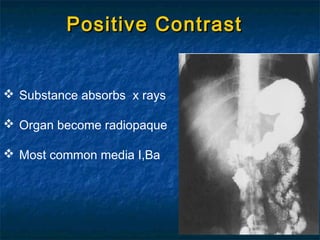
Positive ContrastPositive Contrast
 Substance absorbs x rays
 Organ become radiopaque
 Most common media I,Ba
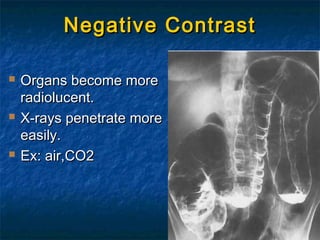
Negative ContrastNegative Contrast
 Organs become moreOrgans become more
radiolucent.radiolucent.
 X-rays penetrate moreX-rays penetrate more
easily.easily.
 Ex: air,CO2Ex: air,CO2
 Oil based C.M.Oil based C.M.
a)a) It was 1It was 1stst
introduced in myelography by sicard asintroduced in myelography by sicard as
11stst
generation C.M in 1921.generation C.M in 1921.
b)b) it was used for bronchography, HSG,it was used for bronchography, HSG,
pyelography and lymphography.pyelography and lymphography.
c)c) It is rarely used now a days in some specialIt is rarely used now a days in some special
cases like COPD & pulmonary hypertension.cases like COPD & pulmonary hypertension.
Disadvantages of Oil BasedDisadvantages of Oil Based
C.MC.M..
 Poorly absorbed so forms foreign bodyPoorly absorbed so forms foreign body
granulomata.granulomata.
 Pulmonary and peripheral fat micro emboli.Pulmonary and peripheral fat micro emboli.
 They are water soluble C.MThey are water soluble C.M
 It is of two types-It is of two types-
a.a. Renal C.MRenal C.M
b.b. Biliary C.MBiliary C.M
2nd
generation C.M
 Iodine is main + ve C.M and used as 25% NaI
in 1923.
 In 1925,pyridine series developed as-
• uroselectant A(1 iodine atom)
• uroselectant B(2 iodine atom)
 This diodinated C.M were used in diagnostic
radiology with satisfactory tolerability.
Renal C.M
In 1950, 3 changes were made in pyridine
derivatives.
 Changed to Benzene with 3 iodines.
 Hydrophillic side chains were added.
 Meglumine cation was introduced.
Renal C.M Contd…..
WHY IODINE?WHY IODINE?
 IODINE(atomic wt 127) provides excellentIODINE(atomic wt 127) provides excellent
radio-opacity due toradio-opacity due to
 Higher atomic no: and K-shell electronHigher atomic no: and K-shell electron
binding energy of 34kev which is lowerbinding energy of 34kev which is lower
than but closed to mean energy used inthan but closed to mean energy used in
diagnostic x-rays and thus maximizing thediagnostic x-rays and thus maximizing the
photo-electric effect.photo-electric effect.
Iodinated Contrast AgentsIodinated Contrast Agents
Principal classes of iodinated radiologicalPrincipal classes of iodinated radiological
contrast mediumcontrast medium
1). CONVENTIONAL HOCM1). CONVENTIONAL HOCM
 Ionic monomerIonic monomer
2). LOCM2). LOCM
 Ionic dimerIonic dimer
 Non ionic monomerNon ionic monomer
 Non ionic dimerNon ionic dimer
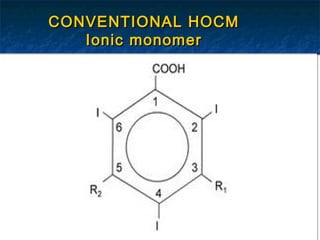
CONVENTIONAL HOCMCONVENTIONAL HOCM
Ionic monomerIonic monomer
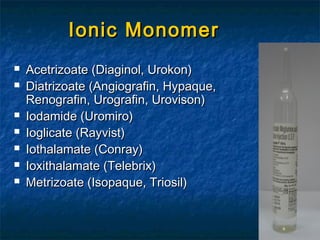
Ionic MonomerIonic Monomer
 Acetrizoate (Diaginol, Urokon)Acetrizoate (Diaginol, Urokon)
 Diatrizoate (Angiografin, Hypaque,Diatrizoate (Angiografin, Hypaque,
Renografin, Urografin, Urovison)Renografin, Urografin, Urovison)
 Iodamide (Uromiro)Iodamide (Uromiro)
 Ioglicate (Rayvist)Ioglicate (Rayvist)
 Iothalamate (Conray)Iothalamate (Conray)
 Ioxithalamate (Telebrix)Ioxithalamate (Telebrix)
 Metrizoate (Isopaque, Triosil)Metrizoate (Isopaque, Triosil)
Iodinated Contrast AgentsIodinated Contrast Agents
 IONIC MONOMERSIONIC MONOMERS
 Tri-iodinated benzoic acid derivative withTri-iodinated benzoic acid derivative with
Na+ / meglumine cationNa+ / meglumine cation
 High osmolality > 1400 mosm/kgHigh osmolality > 1400 mosm/kg
 Iodine:particle ratio of 3:2Iodine:particle ratio of 3:2
 Further classified on basis of % ofFurther classified on basis of % of
compound in the solution.eg. 30%, 70%compound in the solution.eg. 30%, 70%
[ UROGRAFFIN 76%][ UROGRAFFIN 76%]
 Sodium is toxic to endothelium & BBB SoSodium is toxic to endothelium & BBB So
avoided in venography and cerebralavoided in venography and cerebral
angiography.angiography.
Ionic MonomerIonic Monomer
 Meglumine salts are used for this.Meglumine salts are used for this.
 Both pure sodium and pure meglumineBoth pure sodium and pure meglumine
salts are associated with high risk ofsalts are associated with high risk of
ventricular fibrillation so a mixture ofventricular fibrillation so a mixture of
sodium and meglumine is used.sodium and meglumine is used.
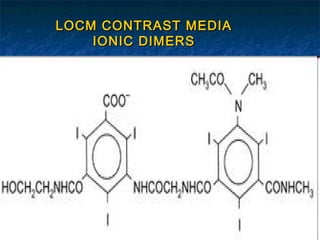
LOCM CONTRAST MEDIALOCM CONTRAST MEDIA
IONIC DIMERSIONIC DIMERS
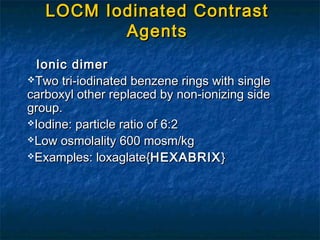
Ionic dimerIonic dimer
Two tri-iodinated benzene rings with singleTwo tri-iodinated benzene rings with single
carboxyl other replaced by non-ionizing sidecarboxyl other replaced by non-ionizing side
group.group.
Iodine: particle ratio of 6:2Iodine: particle ratio of 6:2
Low osmolality 600 mosm/kgLow osmolality 600 mosm/kg
Examples: loxaglate{Examples: loxaglate{HEXABRIXHEXABRIX}}
LOCM Iodinated ContrastLOCM Iodinated Contrast
AgentsAgents
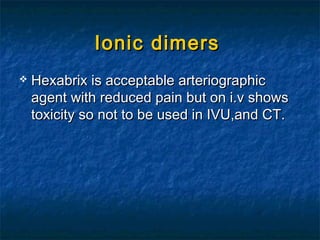
Ionic dimersIonic dimers
 Hexabrix is acceptable arteriographicHexabrix is acceptable arteriographic
agent with reduced pain but on i.v showsagent with reduced pain but on i.v shows
toxicity so not to be used in IVU,and CT.toxicity so not to be used in IVU,and CT.
Iodinated Contrast AgentsIodinated Contrast Agents
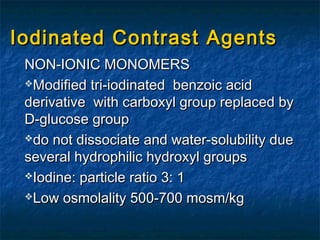
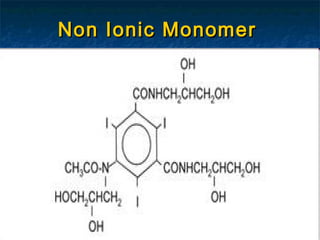
NON-IONIC MONOMERSNON-IONIC MONOMERS
Modified tri-iodinated benzoic acidModified tri-iodinated benzoic acid
derivative with carboxyl group replaced byderivative with carboxyl group replaced by
D-glucose groupD-glucose group
do not dissociate and water-solubility duedo not dissociate and water-solubility due
several hydrophilic hydroxyl groupsseveral hydrophilic hydroxyl groups
Iodine: particle ratio 3: 1Iodine: particle ratio 3: 1
Low osmolality 500-700 mosm/kgLow osmolality 500-700 mosm/kg
Non Ionic MonomerNon Ionic Monomer
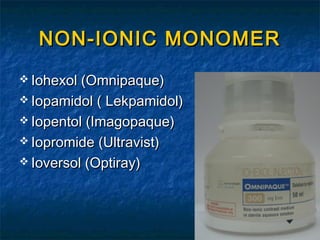
NON-IONIC MONOMERNON-IONIC MONOMER
 Iohexol (Omnipaque)Iohexol (Omnipaque)
 Iopamidol ( Lekpamidol)Iopamidol ( Lekpamidol)
 Iopentol (Imagopaque)Iopentol (Imagopaque)
 Iopromide (Ultravist)Iopromide (Ultravist)
 Ioversol (Optiray)Ioversol (Optiray)
Iodinated Contrast AgentsIodinated Contrast Agents
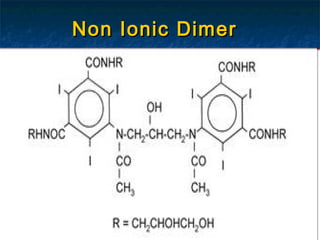
 Non ionic dimerNon ionic dimer
 Two non-ionic tri-iodinated benzene ringsTwo non-ionic tri-iodinated benzene rings
replacing both carboxyl groups withreplacing both carboxyl groups with
hydrophilic groups.hydrophilic groups.
 Iodine:particle ratio 6:1Iodine:particle ratio 6:1
 Low osmolality 300 mosm/kgLow osmolality 300 mosm/kg
 Examples: lotrolan, lodixanolExamples: lotrolan, lodixanol
Non Ionic DimerNon Ionic Dimer
Iodinated Contrast AgentsIodinated Contrast Agents
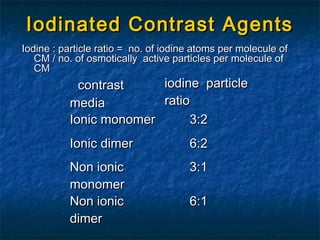
Iodine : particle ratio = no. of iodine atoms per molecule ofIodine : particle ratio = no. of iodine atoms per molecule of
CM / no. of osmotically active particles per molecule ofCM / no. of osmotically active particles per molecule of
CMCM
contrastcontrast
mediamedia
iodine particleiodine particle
ratioratio
Ionic monomerIonic monomer 3:23:2
Ionic dimerIonic dimer 6:26:2
Non ionicNon ionic
monomermonomer
3:13:1
Non ionicNon ionic
dimerdimer
6:16:1
Iodinated Contrast AgentsIodinated Contrast Agents
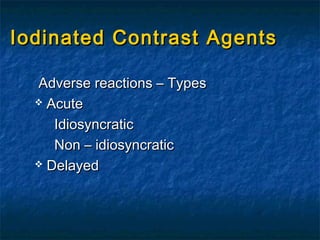
Adverse reactions – TypesAdverse reactions – Types
 AcuteAcute
IdiosyncraticIdiosyncratic
Non – idiosyncraticNon – idiosyncratic
 DelayedDelayed
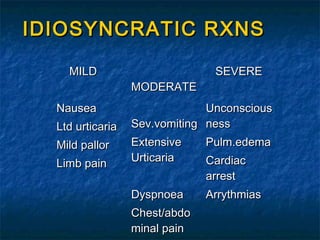
IDIOSYNCRATIC RXNSIDIOSYNCRATIC RXNS
MILDMILD
NauseaNausea
Ltd urticariaLtd urticaria
Mild pallorMild pallor
Limb painLimb pain
MODERATEMODERATE
Sev.vomitingSev.vomiting
ExtensiveExtensive
UrticariaUrticaria
DyspnoeaDyspnoea
Chest/abdoChest/abdo
minal painminal pain
SEVERESEVERE
UnconsciousUnconscious
nessness
Pulm.edemaPulm.edema
CardiacCardiac
arrestarrest
ArrythmiasArrythmias
Iodinated Contrast AgentsIodinated Contrast Agents
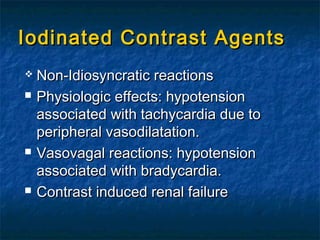
 Non-Idiosyncratic reactionsNon-Idiosyncratic reactions
 Physiologic effects: hypotensionPhysiologic effects: hypotension
associated with tachycardia due toassociated with tachycardia due to
peripheral vasodilatation.peripheral vasodilatation.
 Vasovagal reactions: hypotensionVasovagal reactions: hypotension
associated with bradycardia.associated with bradycardia.
 Contrast induced renal failureContrast induced renal failure
 ConvulsionsConvulsions
 Cutaneous- Phlebitis/extravasationCutaneous- Phlebitis/extravasation
Iodinated Contrast AgentsIodinated Contrast Agents
 Delayed reactionsDelayed reactions
 Occur after 1 hour to 1 weekOccur after 1 hour to 1 week
- flu like symptoms- flu like symptoms
- delayed arm pain- delayed arm pain
- rash/ pruritus- rash/ pruritus
- salivary gland swelling- salivary gland swelling
- Steven Johnson syndrome- Steven Johnson syndrome
 more common with LOCMmore common with LOCM
Contra indicationContra indication
 Risk factorsRisk factors
 Raised creatinine levelRaised creatinine level
 DehydrationDehydration
 Congestive heart failureCongestive heart failure
 Age over 70 years oldAge over 70 years old
THANK YOUTHANK YOU

Contrast Media

  • 1.
    CONTRAST MEDIACONTRAST MEDIA ByJayanti GyawaliBy Jayanti Gyawali B.Sc.MIT 3B.Sc.MIT 3rdrd batchbatch 22ndnd yearyear
  • 2.
     It isan agent that changes differential attenuation of x-ray by increasing or decreasing the density of the structure.  It is commonly used to enhance the visibility of blood vessels, gastrointestinal tract etc. CONTRAST MEDIA
  • 3.
    Types of ContrastMedia  Positive contrast media. Negative contrast media.(air /carbon dioxide) Paramagnetic contrast media (MRI) Ultrasonic contrast media(USG)
  • 4.
    Positive ContrastPositive Contrast Substance absorbs x rays  Organ become radiopaque  Most common media I,Ba
  • 5.
    Negative ContrastNegative Contrast Organs become moreOrgans become more radiolucent.radiolucent.  X-rays penetrate moreX-rays penetrate more easily.easily.  Ex: air,CO2Ex: air,CO2
  • 6.
     Oil basedC.M.Oil based C.M. a)a) It was 1It was 1stst introduced in myelography by sicard asintroduced in myelography by sicard as 11stst generation C.M in 1921.generation C.M in 1921. b)b) it was used for bronchography, HSG,it was used for bronchography, HSG, pyelography and lymphography.pyelography and lymphography. c)c) It is rarely used now a days in some specialIt is rarely used now a days in some special cases like COPD & pulmonary hypertension.cases like COPD & pulmonary hypertension.
  • 7.
    Disadvantages of OilBasedDisadvantages of Oil Based C.MC.M..  Poorly absorbed so forms foreign bodyPoorly absorbed so forms foreign body granulomata.granulomata.  Pulmonary and peripheral fat micro emboli.Pulmonary and peripheral fat micro emboli.
  • 8.
     They arewater soluble C.MThey are water soluble C.M  It is of two types-It is of two types- a.a. Renal C.MRenal C.M b.b. Biliary C.MBiliary C.M 2nd generation C.M
  • 9.
     Iodine ismain + ve C.M and used as 25% NaI in 1923.  In 1925,pyridine series developed as- • uroselectant A(1 iodine atom) • uroselectant B(2 iodine atom)  This diodinated C.M were used in diagnostic radiology with satisfactory tolerability. Renal C.M
  • 10.
    In 1950, 3changes were made in pyridine derivatives.  Changed to Benzene with 3 iodines.  Hydrophillic side chains were added.  Meglumine cation was introduced. Renal C.M Contd…..
  • 11.
    WHY IODINE?WHY IODINE? IODINE(atomic wt 127) provides excellentIODINE(atomic wt 127) provides excellent radio-opacity due toradio-opacity due to  Higher atomic no: and K-shell electronHigher atomic no: and K-shell electron binding energy of 34kev which is lowerbinding energy of 34kev which is lower than but closed to mean energy used inthan but closed to mean energy used in diagnostic x-rays and thus maximizing thediagnostic x-rays and thus maximizing the photo-electric effect.photo-electric effect.
  • 12.
    Iodinated Contrast AgentsIodinatedContrast Agents Principal classes of iodinated radiologicalPrincipal classes of iodinated radiological contrast mediumcontrast medium 1). CONVENTIONAL HOCM1). CONVENTIONAL HOCM  Ionic monomerIonic monomer 2). LOCM2). LOCM  Ionic dimerIonic dimer  Non ionic monomerNon ionic monomer  Non ionic dimerNon ionic dimer
  • 13.
  • 14.
    Ionic MonomerIonic Monomer Acetrizoate (Diaginol, Urokon)Acetrizoate (Diaginol, Urokon)  Diatrizoate (Angiografin, Hypaque,Diatrizoate (Angiografin, Hypaque, Renografin, Urografin, Urovison)Renografin, Urografin, Urovison)  Iodamide (Uromiro)Iodamide (Uromiro)  Ioglicate (Rayvist)Ioglicate (Rayvist)  Iothalamate (Conray)Iothalamate (Conray)  Ioxithalamate (Telebrix)Ioxithalamate (Telebrix)  Metrizoate (Isopaque, Triosil)Metrizoate (Isopaque, Triosil)
  • 15.
    Iodinated Contrast AgentsIodinatedContrast Agents  IONIC MONOMERSIONIC MONOMERS  Tri-iodinated benzoic acid derivative withTri-iodinated benzoic acid derivative with Na+ / meglumine cationNa+ / meglumine cation  High osmolality > 1400 mosm/kgHigh osmolality > 1400 mosm/kg  Iodine:particle ratio of 3:2Iodine:particle ratio of 3:2
  • 16.
     Further classifiedon basis of % ofFurther classified on basis of % of compound in the solution.eg. 30%, 70%compound in the solution.eg. 30%, 70% [ UROGRAFFIN 76%][ UROGRAFFIN 76%]  Sodium is toxic to endothelium & BBB SoSodium is toxic to endothelium & BBB So avoided in venography and cerebralavoided in venography and cerebral angiography.angiography. Ionic MonomerIonic Monomer
  • 17.
    Ionic MonomerIonic Monomer Meglumine salts are used for this.Meglumine salts are used for this.  Both pure sodium and pure meglumineBoth pure sodium and pure meglumine salts are associated with high risk ofsalts are associated with high risk of ventricular fibrillation so a mixture ofventricular fibrillation so a mixture of sodium and meglumine is used.sodium and meglumine is used.
  • 18.
    LOCM CONTRAST MEDIALOCMCONTRAST MEDIA IONIC DIMERSIONIC DIMERS
  • 19.
    Ionic dimerIonic dimer Twotri-iodinated benzene rings with singleTwo tri-iodinated benzene rings with single carboxyl other replaced by non-ionizing sidecarboxyl other replaced by non-ionizing side group.group. Iodine: particle ratio of 6:2Iodine: particle ratio of 6:2 Low osmolality 600 mosm/kgLow osmolality 600 mosm/kg Examples: loxaglate{Examples: loxaglate{HEXABRIXHEXABRIX}} LOCM Iodinated ContrastLOCM Iodinated Contrast AgentsAgents
  • 20.
    Ionic dimersIonic dimers Hexabrix is acceptable arteriographicHexabrix is acceptable arteriographic agent with reduced pain but on i.v showsagent with reduced pain but on i.v shows toxicity so not to be used in IVU,and CT.toxicity so not to be used in IVU,and CT.
  • 21.
    Iodinated Contrast AgentsIodinatedContrast Agents NON-IONIC MONOMERSNON-IONIC MONOMERS Modified tri-iodinated benzoic acidModified tri-iodinated benzoic acid derivative with carboxyl group replaced byderivative with carboxyl group replaced by D-glucose groupD-glucose group do not dissociate and water-solubility duedo not dissociate and water-solubility due several hydrophilic hydroxyl groupsseveral hydrophilic hydroxyl groups Iodine: particle ratio 3: 1Iodine: particle ratio 3: 1 Low osmolality 500-700 mosm/kgLow osmolality 500-700 mosm/kg
  • 22.
    Non Ionic MonomerNonIonic Monomer
  • 23.
    NON-IONIC MONOMERNON-IONIC MONOMER Iohexol (Omnipaque)Iohexol (Omnipaque)  Iopamidol ( Lekpamidol)Iopamidol ( Lekpamidol)  Iopentol (Imagopaque)Iopentol (Imagopaque)  Iopromide (Ultravist)Iopromide (Ultravist)  Ioversol (Optiray)Ioversol (Optiray)
  • 24.
    Iodinated Contrast AgentsIodinatedContrast Agents  Non ionic dimerNon ionic dimer  Two non-ionic tri-iodinated benzene ringsTwo non-ionic tri-iodinated benzene rings replacing both carboxyl groups withreplacing both carboxyl groups with hydrophilic groups.hydrophilic groups.  Iodine:particle ratio 6:1Iodine:particle ratio 6:1  Low osmolality 300 mosm/kgLow osmolality 300 mosm/kg  Examples: lotrolan, lodixanolExamples: lotrolan, lodixanol
  • 25.
    Non Ionic DimerNonIonic Dimer
  • 26.
    Iodinated Contrast AgentsIodinatedContrast Agents Iodine : particle ratio = no. of iodine atoms per molecule ofIodine : particle ratio = no. of iodine atoms per molecule of CM / no. of osmotically active particles per molecule ofCM / no. of osmotically active particles per molecule of CMCM contrastcontrast mediamedia iodine particleiodine particle ratioratio Ionic monomerIonic monomer 3:23:2 Ionic dimerIonic dimer 6:26:2 Non ionicNon ionic monomermonomer 3:13:1 Non ionicNon ionic dimerdimer 6:16:1
  • 27.
    Iodinated Contrast AgentsIodinatedContrast Agents Adverse reactions – TypesAdverse reactions – Types  AcuteAcute IdiosyncraticIdiosyncratic Non – idiosyncraticNon – idiosyncratic  DelayedDelayed
  • 28.
    IDIOSYNCRATIC RXNSIDIOSYNCRATIC RXNS MILDMILD NauseaNausea LtdurticariaLtd urticaria Mild pallorMild pallor Limb painLimb pain MODERATEMODERATE Sev.vomitingSev.vomiting ExtensiveExtensive UrticariaUrticaria DyspnoeaDyspnoea Chest/abdoChest/abdo minal painminal pain SEVERESEVERE UnconsciousUnconscious nessness Pulm.edemaPulm.edema CardiacCardiac arrestarrest ArrythmiasArrythmias
  • 29.
    Iodinated Contrast AgentsIodinatedContrast Agents  Non-Idiosyncratic reactionsNon-Idiosyncratic reactions  Physiologic effects: hypotensionPhysiologic effects: hypotension associated with tachycardia due toassociated with tachycardia due to peripheral vasodilatation.peripheral vasodilatation.  Vasovagal reactions: hypotensionVasovagal reactions: hypotension associated with bradycardia.associated with bradycardia.  Contrast induced renal failureContrast induced renal failure
  • 30.
     ConvulsionsConvulsions  Cutaneous-Phlebitis/extravasationCutaneous- Phlebitis/extravasation
  • 31.
    Iodinated Contrast AgentsIodinatedContrast Agents  Delayed reactionsDelayed reactions  Occur after 1 hour to 1 weekOccur after 1 hour to 1 week - flu like symptoms- flu like symptoms - delayed arm pain- delayed arm pain - rash/ pruritus- rash/ pruritus - salivary gland swelling- salivary gland swelling - Steven Johnson syndrome- Steven Johnson syndrome  more common with LOCMmore common with LOCM
  • 32.
    Contra indicationContra indication Risk factorsRisk factors  Raised creatinine levelRaised creatinine level  DehydrationDehydration  Congestive heart failureCongestive heart failure  Age over 70 years oldAge over 70 years old
  • 33.