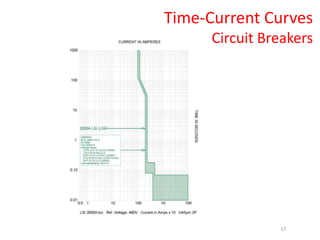
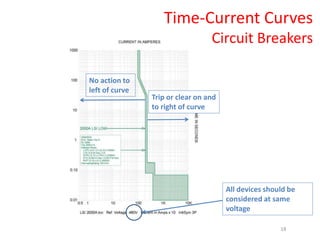
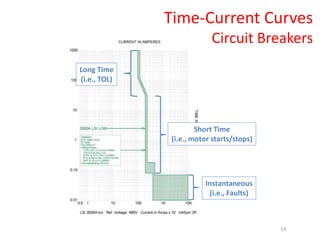
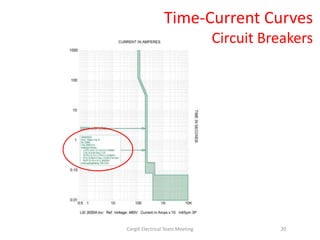
Time-Current Curves
1
Protective Device Coordination
Protective Device Coordination Study-
Description:
• An organized time-current study of protective
devices from the utility to a device.
• A comparison of the time it takes protective
devices to operate when certain levels of
normal or abnormal current pass through
them.
2
Protective Device Coordination
Protective Device Coordination Study-
Objective:
• Determine the characteristics, ratings, and
settings of overcurrent protective devices
• Ensure that the minimium, un-faulted load is
interrupted when the protective devices
isolate a fault or overload anywhere in the
system.
3
Protective Device Coordination
Protective Device Coordination Study-
Results:
• Selection of instrument transformers ratios
• Protective relay characteristics and settings
• Fuse ratings
• LV circuit breaker ratings, characteristics, and
settings.
4
Protective Device Coordination
Protective Device Coordination Study-
Frequency:
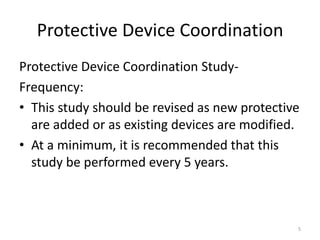
• This study should be revised as new protective
are added or as existing devices are modified.
• At a minimum, it is recommended that this
study be performed every 5 years.
5
Protective Device Coordination
Protective Device Coordination Study-
Frequency:
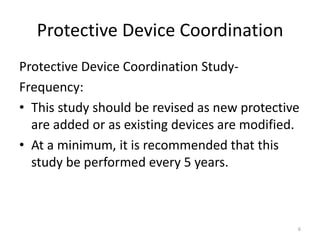
• This study should be revised as new protective
are added or as existing devices are modified.
• At a minimum, it is recommended that this
study be performed every 5 years.
6
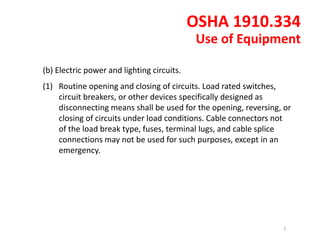
(b) Electric power and lighting circuits.
(1) Routine opening and closing of circuits. Load rated switches,
circuit breakers, or other devices specifically designed as
disconnecting means shall be used for the opening, reversing, or
closing of circuits under load conditions. Cable connectors not
of the load break type, fuses, terminal lugs, and cable splice
connections may not be used for such purposes, except in an
emergency.
OSHA 1910.334
Use of Equipment
7
OSHA 1910.334
Use of Equipment
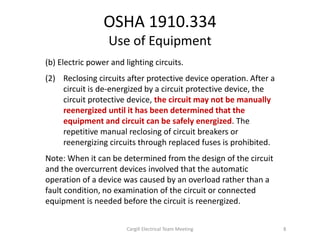
(b) Electric power and lighting circuits.
(2) Reclosing circuits after protective device operation. After a
circuit is de-energized by a circuit protective device, the
circuit protective device, the circuit may not be manually
reenergized until it has been determined that the
equipment and circuit can be safely energized. The
repetitive manual reclosing of circuit breakers or
reenergizing circuits through replaced fuses is prohibited.
Note: When it can be determined from the design of the circuit
and the overcurrent devices involved that the automatic
operation of a device was caused by an overload rather than a
fault condition, no examination of the circuit or connected
equipment is needed before the circuit is reenergized.
8Cargill Electrical Team Meeting
(b) Electric power and lighting circuits.
(3) Overcurrent protection modification. Overcurrent
protection of circuits and conductors may not be
modified, even on a temporary basis, beyond that
allowed by 1910.304(e), the installation safety
requirements for overcurrent protection.
OSHA 1910.334
Use of Equipment
9Cargill Electrical Team Meeting
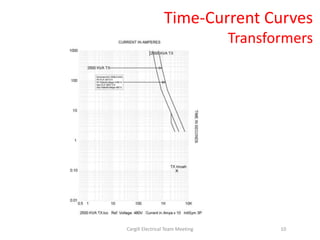
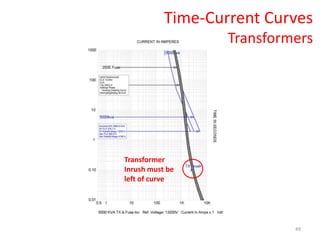
Time-Current Curves
Transformers
10Cargill Electrical Team Meeting
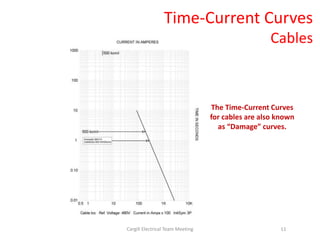
Time-Current Curves
Cables
The Time-Current Curves
for cables are also known
as “Damage” curves.
11Cargill Electrical Team Meeting
Cargill Electrical Team Meeting 12
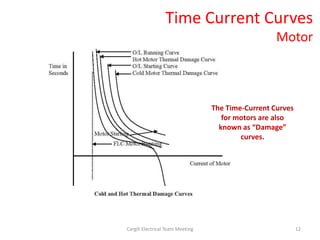
Time Current Curves
Motor
The Time-Current Curves
for motors are also
known as “Damage”
curves.
13
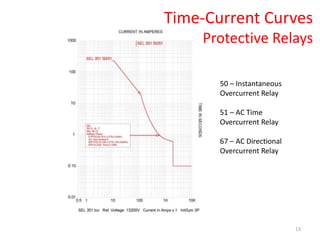
Time-Current Curves
Protective Relays
50 – Instantaneous
Overcurrent Relay
51 – AC Time
Overcurrent Relay
67 – AC Directional
Overcurrent Relay
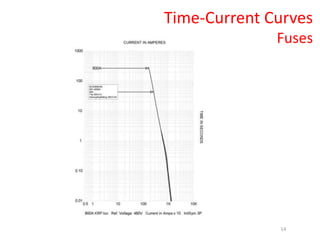
Time-Current Curves
Fuses
14
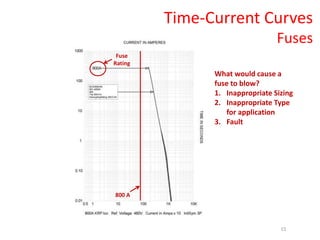
Time-Current Curves
Fuses
800 A
Fuse
Rating
What would cause a
fuse to blow?
1. Inappropriate Sizing
2. Inappropriate Type
for application
3. Fault
15
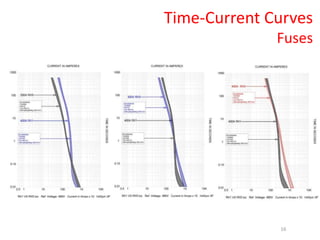
Time-Current Curves
Fuses
16
Time-Current Curves
Circuit Breakers
17
Time-Current Curves
Circuit Breakers
No action to
left of curve
Trip or clear on and
to right of curve
All devices should be
considered at same
voltage
18
Short Time
(i.e., motor starts/stops)
Long Time
(i.e., TOL)
Instantaneous
(i.e., Faults)
Time-Current Curves
Circuit Breakers
19
Time-Current Curves
Circuit Breakers
20Cargill Electrical Team Meeting
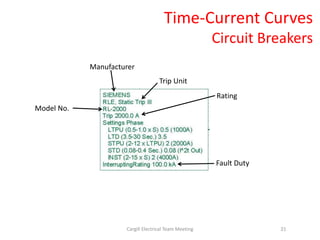
Manufacturer
Model No.
Trip Unit
Rating
Fault Duty
Time-Current Curves
Circuit Breakers
21Cargill Electrical Team Meeting
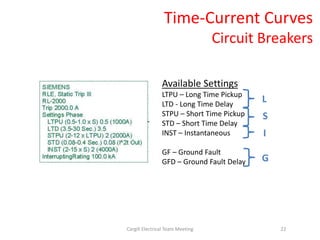
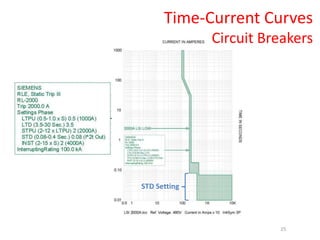
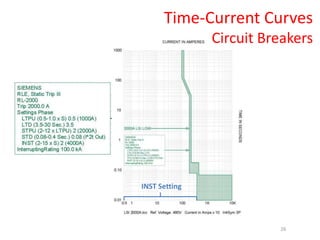
Available Settings
LTPU – Long Time Pickup
LTD - Long Time Delay
STPU – Short Time Pickup
STD – Short Time Delay
INST – Instantaneous
GF – Ground Fault
GFD – Ground Fault Delay
L
S
I
G
Time-Current Curves
Circuit Breakers
22Cargill Electrical Team Meeting
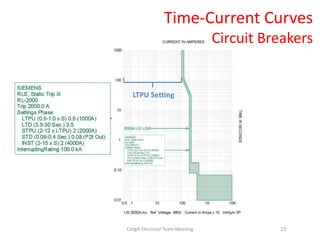
LTPU Setting
Time-Current Curves
Circuit Breakers
23Cargill Electrical Team Meeting
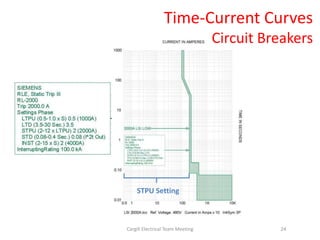
STPU Setting
Time-Current Curves
Circuit Breakers
24Cargill Electrical Team Meeting
STD Setting
Time-Current Curves
Circuit Breakers
25
INST Setting
Time-Current Curves
Circuit Breakers
26
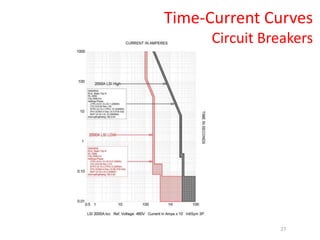
Time-Current Curves
Circuit Breakers
27
Time-Current Curves
Thermal-Mag Breakers
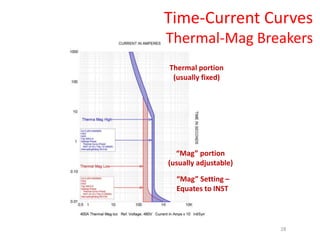
Thermal portion
(usually fixed)
“Mag” portion
(usually adjustable)
“Mag” Setting –
Equates to INST
28
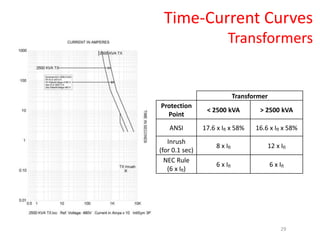
Transformer
Protection
Point
< 2500 kVA > 2500 kVA
ANSI 17.6 x Ifl x 58% 16.6 x Ifl x 58%
Inrush
(for 0.1 sec)
8 x Ifl 12 x Ifl
NEC Rule
(6 x Ifl)
6 x Ifl 6 x Ifl
Time-Current Curves
Transformers
29
30
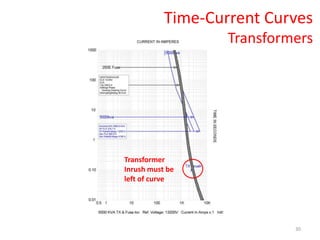
Time-Current Curves
Transformers
Transformer
Inrush must be
left of curve
31
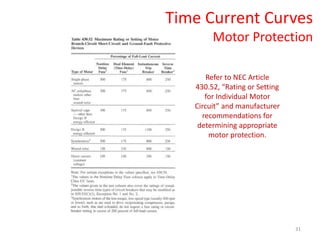
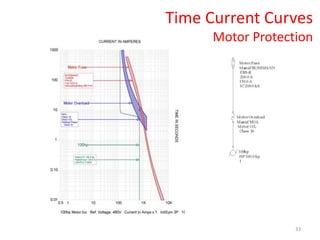
Time Current Curves
Motor Protection
Refer to NEC Article
430.52, “Rating or Setting
for Individual Motor
Circuit” and manufacturer
recommendations for
determining appropriate
motor protection.
32
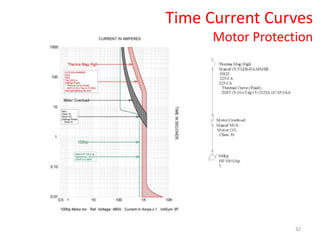
Time Current Curves
Motor Protection
33
Time Current Curves
Motor Protection
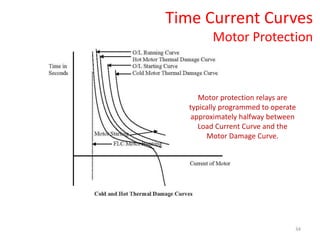
34
Time Current Curves
Motor Protection
Motor protection relays are
typically programmed to operate
approximately halfway between
Load Current Curve and the
Motor Damage Curve.
35
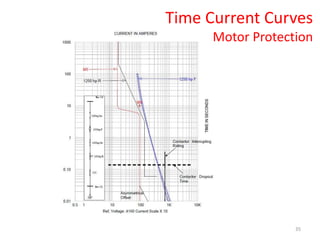
Time Current Curves
Motor Protection
36
Time-Current Curves
Questions or Comments?
Troubleshooting
37
38
Troubleshooting
Troubleshooting Tools:
• Design Information:
— One-Line Diagrams
— Time-Current Curves
— Manufacturer Literature
— Operating History
• Maintenance Information:
— Visual Inspection
— IR Surveys
— Oil Sample Reports
— UE/PD Surveys
— Testing Data Sheets
— Protective Relays
— Power Monitors
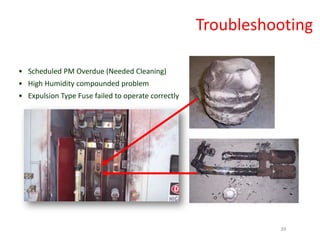
• Scheduled PM Overdue (Needed Cleaning)
• High Humidity compounded problem
• Expulsion Type Fuse failed to operate correctly
Troubleshooting
39
49
Time-Current Curves
Transformers
Transformer
Inrush must be
left of curve
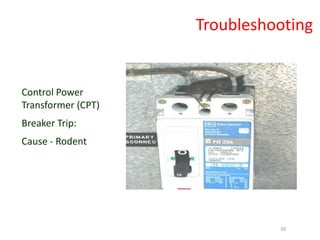
Control Power
Transformer (CPT)
Breaker Trip:
Cause - Rodent
Troubleshooting
50
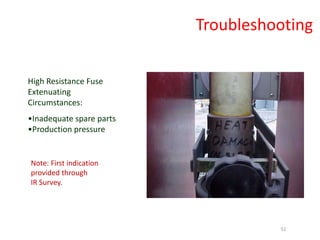
Note: First indication
provided through
IR Survey.
High Resistance Fuse
Extenuating
Circumstances:
•Inadequate spare parts
•Production pressure
Troubleshooting
51
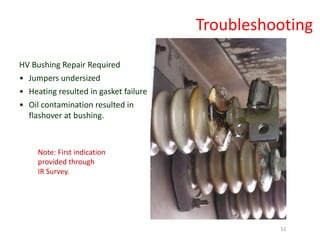
Note: First indication
provided through
IR Survey.
HV Bushing Repair Required
• Jumpers undersized
• Heating resulted in gasket failure
• Oil contamination resulted in
flashover at bushing.
Troubleshooting
52
Troubleshooting
53
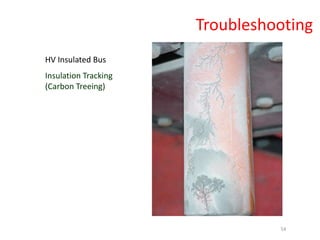
HV Insulated Bus
Insulation Tracking
(Carbon Treeing)
Troubleshooting
54
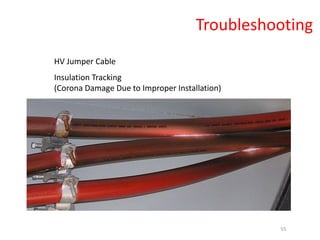
HV Jumper Cable
Insulation Tracking
(Corona Damage Due to Improper Installation)
Troubleshooting
55
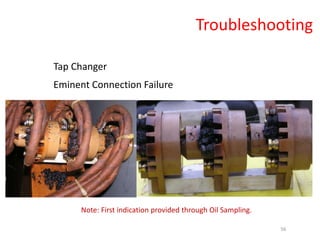
Tap Changer
Eminent Connection Failure
Note: First indication provided through Oil Sampling.
Troubleshooting
56
Cargill Electrical Team Meeting 59
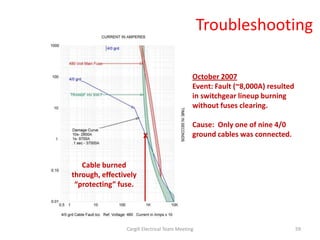
October 2007
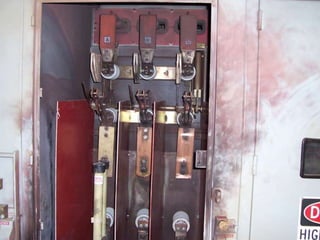
Event: Fault (~8,000A) resulted
in switchgear lineup burning
without fuses clearing.
Cause: Only one of nine 4/0
ground cables was connected.
Cable burned
through, effectively
“protecting” fuse.
X
Troubleshooting
60
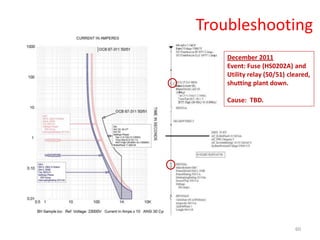
December 2011
Event: Fuse (HS0202A) and
Utility relay (50/51) cleared,
shutting plant down.
Cause: TBD.
Troubleshooting
61
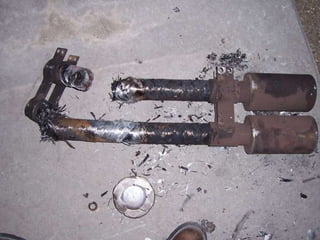
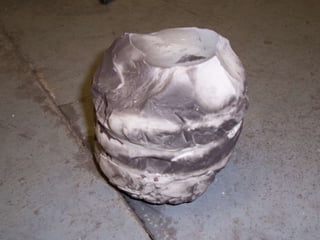
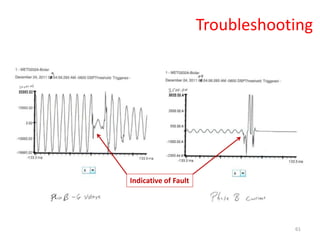
Indicative of Fault
Troubleshooting
62
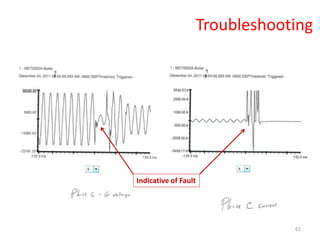
Indicative of Fault
Troubleshooting
63
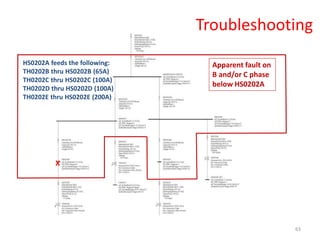
HS0202A feeds the following:
TH0202B thru HS0202B (65A)
TH0202C thru HS0202C (100A)
TH0202D thru HS0202D (100A)
TH0202E thru HS0202E (200A)
Apparent fault on
B and/or C phase
below HS0202A
Troubleshooting
X
OSHA 1910.334
Use of Equipment
(b) Electric power and lighting circuits.
(2) Reclosing circuits after protective device operation. After a
circuit is de-energized by a circuit protective device, the
circuit protective device, the circuit may not be manually
reenergized until it has been determined that the
equipment and circuit can be safely energized. The
repetitive manual reclosing of circuit breakers or
reenergizing circuits through replaced fuses is prohibited.
Note: When it can be determined from the design of the circuit
and the overcurrent devices involved that the automatic
operation of a device was caused by an overload rather than a
fault condition, no examination of the circuit or connected
equipment is needed before the circuit is reenergized.
64
65
Questions or Comments?
Troubleshooting

Time current curves