richardsm
ith@
asia.com
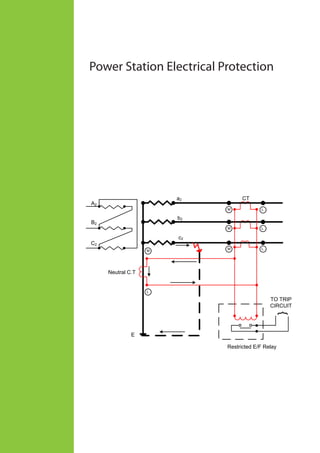
Power Station Electrical Protection
}
M
M
M
L
L
L
M
L
E
A2
B2
C2
Neutral C.T
a2
b2
c2
TO TRIP
CIRCUIT
Restricted E/F Relay
CT
richardsm
ith@
asia.com
Contents
1 The Need for Protection 2
1.1 Types of Faults . . . . . . . . . . . . . . . . . . . . . . . . . . . . 2
1.1.1 Overcurrent . . . . . . . . . . . . . . . . . . . . . . . . . . 2
1.1.2 Earth Fault . . . . . . . . . . . . . . . . . . . . . . . . . . 2
1.2 Fault Detection . . . . . . . . . . . . . . . . . . . . . . . . . . . . 2
1.3 Isolation of Faulty Equipment . . . . . . . . . . . . . . . . . . . . 2
1.4 Protective Relays . . . . . . . . . . . . . . . . . . . . . . . . . . . 3
1.5 Classes of Protection . . . . . . . . . . . . . . . . . . . . . . . . . 4
1.6 Characteristics of a Good Protection Scheme . . . . . . . . . . . 4
2 Common Terms Related to Protection 5
3 Unit protection schemes 7
3.1 Transformer protection . . . . . . . . . . . . . . . . . . . . . . . . 7
3.1.1 The Buchholz relay . . . . . . . . . . . . . . . . . . . . . . 7
3.1.2 Explosion Vent . . . . . . . . . . . . . . . . . . . . . . . . 8
3.1.3 Qualitrol Pressure Relief . . . . . . . . . . . . . . . . . . . 8
3.1.4 Continuous Gas Analyser . . . . . . . . . . . . . . . . . . 8
3.1.5 Earth Fault Protection of High Voltage Delta Windings . 10
3.1.6 Differential protection . . . . . . . . . . . . . . . . . . . . 12
3.1.7 Differential Protection of a Three Phase Transformer . . . 15
3.1.8 Differential Earth Fault Protection of Star Windings . . . 17
3.2 Busbar protection . . . . . . . . . . . . . . . . . . . . . . . . . . 19
3.2.1 Check Zones . . . . . . . . . . . . . . . . . . . . . . . . . 19
3.2.2 Blind Spots and Blind Spot Protection . . . . . . . . . . . 22
3.2.3 AC Wiring Supervision . . . . . . . . . . . . . . . . . . . 23
3.2.4 DC Supply Failure . . . . . . . . . . . . . . . . . . . . . . 24
3.2.5 Protection Inoperative Alarm . . . . . . . . . . . . . . . . 24
3.2.6 Circuit Breaker failure (CB fail) Protection . . . . . . . . 24
3.3 Circuit Protection . . . . . . . . . . . . . . . . . . . . . . . . . . 25
3.3.1 Distance-time and definite distance protection . . . . . . 25
3.3.2 Auto Reclose . . . . . . . . . . . . . . . . . . . . . . . . . 33
3.3.3 Pilot Wire Protection . . . . . . . . . . . . . . . . . . . . 33
3.3.4 220kV Oil-filled Cable Protection . . . . . . . . . . . . . . 35
3.4 Generator Protection . . . . . . . . . . . . . . . . . . . . . . . . . 36
3.4.1 Generator Earth Faults . . . . . . . . . . . . . . . . . . . 36
3.4.2 Stator Differential Protection . . . . . . . . . . . . . . . . 38
3.4.3 Generator Stator Over-Currents . . . . . . . . . . . . . . 39
3.4.4 Negative Phase Sequence Protection . . . . . . . . . . . . 40
3.4.5 Reverse Power Protection . . . . . . . . . . . . . . . . . . 44
4 Non-Unit protection 45
4.1 Overcurrent Relays . . . . . . . . . . . . . . . . . . . . . . . . . . 45
4.2 Earth Fault Relays . . . . . . . . . . . . . . . . . . . . . . . . . . 46
4.3 Earth Fault Protection of Transformers . . . . . . . . . . . . . . 46
4.4 Earth Fault Protection on Circuits . . . . . . . . . . . . . . . . . 47
4.5 Earth Fault on Interconnecting and Generator Transformers . . . 48
4.6 Time Graded (Non-Unit) Protection . . . . . . . . . . . . . . . . 49
richardsm
ith@
asia.com
4.7 Directional Relays . . . . . . . . . . . . . . . . . . . . . . . . . . 51
5 Backup Protection 53
6 Measuring Voltage and Current 55
6.1 Voltage Transformers . . . . . . . . . . . . . . . . . . . . . . . . . 55
6.2 Current Transformers . . . . . . . . . . . . . . . . . . . . . . . . 55
A Pre 1985 relay codes 57
B Post 1985 relay codes 58
richardsm
ith@
asia.com
List of Figures
1 Photo of Transformer explosive vent . . . . . . . . . . . . . . . . 9
2 Photo of Transformer Qualitrol . . . . . . . . . . . . . . . . . . . 9
3 Photo of Transformer Gas Analyser . . . . . . . . . . . . . . . . . 10
4 Delta-Star transformer Protection . . . . . . . . . . . . . . . . . 11
5 Fault is outside area covered by CT’s therefore relay does not
operate (i.e. current from CT – A is cancelled by current from
CT – B) . . . . . . . . . . . . . . . . . . . . . . . . . . . . . . . . 12
6 Relay operates as fault is between CT’s (i.e. current from CT –
A is NOT cancelled by current from CT – B) . . . . . . . . . . . 13
7 Instantaneous relay . . . . . . . . . . . . . . . . . . . . . . . . . . 13
8 Biased relay . . . . . . . . . . . . . . . . . . . . . . . . . . . . . . 13
9 Biased type relay . . . . . . . . . . . . . . . . . . . . . . . . . . . 14
10 Protection of single phase of a Transformer . . . . . . . . . . . . 15
11 Transformer Differential Protection . . . . . . . . . . . . . . . . . 16
12 Differential (Restricted) Earth Fault Protection of Transformer -
Operation on Fault inside Zone . . . . . . . . . . . . . . . . . . . 18
13 Differential (Restricted) Earth Fault Protection of Transformer –
Operation on Fault outside Zone . . . . . . . . . . . . . . . . . . 18
14 Busbar protection scheme for a single busbar . . . . . . . . . . . 20
15 Bus zone protection scheme for a single bus with bus section
circuit breaker . . . . . . . . . . . . . . . . . . . . . . . . . . . . 20
16 Bus zone protection for circuit breakers and a half without check
zone . . . . . . . . . . . . . . . . . . . . . . . . . . . . . . . . . . 21
17 Busbar protection scheme for a single bus with a bus section
circuit breaker . . . . . . . . . . . . . . . . . . . . . . . . . . . . 22
18 measurement of distance to fault . . . . . . . . . . . . . . . . . . 25
19 distance protection zones . . . . . . . . . . . . . . . . . . . . . . 27
20 Acceleration of Distance measurement . . . . . . . . . . . . . . . 31
21 Differential comparison Earth fault protection . . . . . . . . . . . 32
22 Summation Transformer . . . . . . . . . . . . . . . . . . . . . . . 34
23 Generator stator earth fault protection . . . . . . . . . . . . . . . 37
24 Location of differential protection CT’s . . . . . . . . . . . . . . . 38
25 Basic generator differential scheme . . . . . . . . . . . . . . . . . 39
26 Positive phase sequence . . . . . . . . . . . . . . . . . . . . . . . 41
27 Negative sequence rotation . . . . . . . . . . . . . . . . . . . . . 42
28 Zero phase sequence . . . . . . . . . . . . . . . . . . . . . . . . . 42
29 Effects of PPS and NPS on turbo-alternator (top - Positive phase
sequence; bottom - Negative phase sequence) . . . . . . . . . . . 43
30 . . . . . . . . . . . . . . . . . . . . . . . . . . . . . . . . . . . . . 46
31 Earth fault protection on the Delta side of a transformer . . . . . 47
32 Overcurrent and Earth Leakage Relays Connections . . . . . . . 48
33 . . . . . . . . . . . . . . . . . . . . . . . . . . . . . . . . . . . . . 48
34 . . . . . . . . . . . . . . . . . . . . . . . . . . . . . . . . . . . . . 49
35 Instantaneous relays with Definite Time . . . . . . . . . . . . . . 49
36 Inverse Time relays . . . . . . . . . . . . . . . . . . . . . . . . . . 50
37 Directional relay . . . . . . . . . . . . . . . . . . . . . . . . . . . 51
38 Non-Directional relays applied to parallel feeders . . . . . . . . . 52
39 Directional relays applied to parallel feeders . . . . . . . . . . . . 52
richardsm
ith@
asia.com
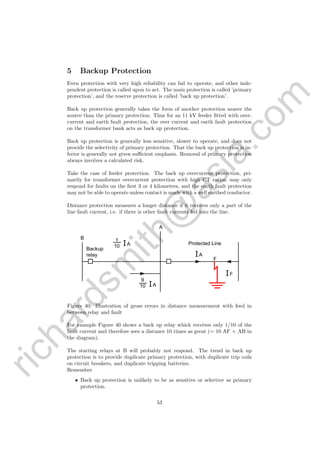
40 Illustration of gross errors in distance measurement with feed in
between relay and fault . . . . . . . . . . . . . . . . . . . . . . . 53
richardsm
ith@
asia.com
19481 – Demonstrate knowledge of electricity supply protection equipment
Protection 19481
Author - Richard J Smith Creation date - 7 November 2006 Last Updated - 3
May 2007
Description This course provides the student with an understanding of elec-
tricity supply protection equipment with emphasis on the equipment provided
at Huntly Power Station. Successful completion of this course will enable the
student to achieve NZQA unit standard 19481 – Demonstrate knowledge of
electrical supply protection equipment.
Pre-Requisites The student have achieved EnChem level 2 and completed his/her
electrical component of their plant training at Huntly or equivalent work expe-
rience.
Completing and Passing the Course The following modules need to be success-
fully completed to pass the course: 1. the 19481 Protection workbook to a
satisfactory level 2. the course evaluation survey
Who should do this Course Genesis staff wishing to complete NZQA National
Cert Electricity Supply (Level 4) will be required to undertake this course.
Student Objectives On completing this course, the student will be able to; 1.
Define common terms and abbreviations used in discussing electrical protection.
2. Describe the purpose and classes of protection (range: purpose of protection,
typical causes of faults) 3. Identify the methods of discrimination used to find
faults (range: time, current, direction of power flow, distance measurement,
differential relays) 4. State the purpose of voltage and current transformers
5. Identify and describe the types of transformer protection (range: buchholz,
overcurrent, earth fault, differential) 6. Describe the principles of circuit and
busbar protection (range: distance measurement, earth faults, bus zone, CB
fail, and backup protection) 7. Describe relay numbering systems, both pre
1985 and ANSI C37.2
1
richardsm
ith@
asia.com
1 The Need for Protection
If a fault or other abnormal condition occurs in a power system, the faulty
apparatus must be isolated from the rest of the system as quickly as possible to
reduce damage both to the faulty equipment and to those parts of the system
carrying the fault current. Protective devices are therefore installed in the
system to detect the presence of a fault and initiate the required action. Isolation
of the affected equipment will then allow continued operation of the remainder
of the system as normal.
1.1 Types of Faults
1.1.1 Overcurrent
When a circuit or piece of equipment is carrying a greater current than it was
designed for, it is said to be overloaded. Most equipment can tolerate some
degree of overloading for a limited time, but protection needs to be provided to
limit the overloading to a value that doesn’t damage the equipment. Overcurrent
can be caused by lighting strikes on overhead lines or just attempting to supply
more load than the circuit design load.
1.1.2 Earth Fault
A common cause of faults on buried cables and overhead lines is an earth fault.
This can be caused by breakdown of insulation or digging up of buried cables,
or by operating cranes, etc near overhead lines. When a live circuit is connected
to earth a large current will flow (which can cause overloading on the circuit),
the earth voltage near the point of the earth fault can increase to a dangerous
level, and supply to the intended recipient can be interrupted.
1.2 Fault Detection
Faults and other abnormal conditions may cause changes in the magnitude, di-
rection, phase angle and frequency of circuit currents and voltages. The nature
of these changes depends upon the fault and the position of the fault relative
to the point in the system from which the fault is being observed.
A protective system uses current transformers and voltage transformers (to mea-
sure magnitudes of current and voltage and transform them to values which can
be handled by the relays), relays (to monitor these values and detect an abnor-
mal condition) and a tripping circuit to the circuit breaker.
A fault detection system must provide protection of the system.
1.3 Isolation of Faulty Equipment
Protection of the system is the ability of a fault on equipment to be isolated
from the system quickly and with as little interruption to other supplies as pos-
sible. By the operation of many types of relays which measure the electricity
in the system, an appropriate operation of a particular relay will trip circuit
breakers to isolate the fault.
2
richardsm
ith@
asia.com
The protective equipment should be simple as possible, but it should also pro-
cess ’discrimination’ in order that it should isolate only the faulty circuit or
apparatus and not operate for other faults outside its zone.
1.4 Protective Relays
A relay used for automatic protection may be defined as a mechanical or elec-
trical apparatus triggered by current, voltage, or power which opens or closes
a local circuit when the current has a specified magnitude, or bears a specified
relation to the voltage of the main circuit with which the relay is associated.
The function the relay provides may be classified as follows:
• UNDER VOLTAGE, and UNDER CURRENT in which operation takes
place when the voltage or current falls below a specified value.
• OVER VOLTAGE, and OVER CURRENT, in which operation takes place
when the voltage or current rises above a specified value.
• DIRECTIONAL, in which operation takes place when the component of
the current in phase with the voltage, assumes a specified magnitude and
a specified direction in relation to the voltage.
• DISTANCE, in which the operation is governed by the ratio of the voltage
to the current, i.e. impedance, or to the component of the current having
some specified phase relation to the voltage.
Relays can be classified, with regard to their timing characteristics, under the
following headings;
• INSTANTANEOUS, in which complete operation takes place with no in-
tentional time delay from the incidence of the operating current reaching
the minimum pick up value.
• DEFINITE TIME, in which the time delay between incidence of the oper-
ating current and the completion of the relay operation is independent of
the magnitude of the current. That is a definite time must elapse after the
minimum pick up value of current is reached, before tripping is initiated.
• INVERSE TIME, in which the time lag decreases as the value of the
operating current or power increases.
The function of a protective relay is to remove the faulty line or equipment
from service with as little disturbance and as little damage to the equipment as
possible. Both these considerations require that the time of operation must be
as fast as possible but the first also requires that only the faulty section must
be removed.
Protective relays must therefore be speedy and selective and this is achieved
by the use of both time and current graded relays and special relays for special
types of fault.
Remember
3
richardsm
ith@
asia.com
• Relays may require current and/or voltage supplies from CTs and/or VT’s.
• Relays operate on current, voltage, power, or impedance.
• Some relays have a built in, time delay, either definite time or inverse time.
1.5 Classes of Protection
Protection systems can be divided into two basic classes:
Unit Protection Unit protection protects a precisely defined area of the pri-
mary system and will respond only to faults within that area.
• Typical examples are differential protection, differential earth fault
protection, busbar protection, Buchholz relay, pilot wire, direction
comparison earth fault.
Non-Unit Protection will respond to a fault within an area that is not pre-
cisely defined.
• Typical examples are overcurrent protection, unrestricted earth fault
protection.
1.6 Characteristics of a Good Protection Scheme
• Reliability
• Discrimination
• Stability
• Speed of operation
4
richardsm
ith@
asia.com
2 Common Terms Related to Protection
Back up Protection This is a second, often slower and cheaper protective
system, that supplements the primary protection should the latter fail to
operate for any reason.
CT Current Transformer
Definite Time Relay A relay which operates in a pre-determined time, which
is not affected by fault values. Usually it is operated by the closure of
a contact on another relay, such as an instantaneous over-current relay,
instantaneous earth fault relay, etc.
Discrimination The ability of protection to select and disconnect only the
faulty equipment, leaving as much other equipment as possible live. Also
called “selectivity”
Instantaneous Relay These are relays whose operation is not intentionally
delayed. Typical operating times are from about 0.05 to 0.1 second.
Inverse Time (e.g. Overcurrent Relay) These have a time of operation
that decreases as the magnitude of the operating current (or other op-
erating quantity) increases.
Non-Unit Protection Protection that will respond to a fault over a wide area
of the system. In general the area will not be precisely defined.
High Speed Tripping This is a relative term but generally implies operation
in less than 2 or 3 cycles (0.04 or 0.06 seconds).
HV High Voltage
LV Low Voltage
Primary Protection This is the main protective system that is intended to
operate on an internal fault.
Relay Drop off Value When the current is lowered, the value at which the
relay returns to the de-energised position.
Relay Pick up Current The value of current at which the relay just operates
and closes its contacts (or voltage for voltage operated relays).
Reliability In the event of a fault in a zone, the protection of that zone must
operate and trip the correct circuit breakers to isolate that zone, and
only that zone, from all live supplies. If it fails to operate, or operates
unnecessarily, the protection system is said to mal-operate. Achieving
reliability requires correct design and installation and regular maintenance
of the protective equipment.
Residual Current The current that results from combining the three currents
in the phases. Paralleling the three secondaries of CT’s on R, Y and B
phases gives an output of the vector sum of the currents in the three phases
- the residual current. This is commonly connected to an earth fault relay.
5
richardsm
ith@
asia.com
Residual Voltage The vector sum of the voltages to earth of the three phase
conductors. The secondary equivalent is obtained by connecting the three
VT secondaries in series.
Restraint A relay may be hindered from operating by some quantity, such as
voltage. it is then said to be given (voltage) restraint. An impedance
relay is restrained by voltage, operated by current. The current tending
to close the contacts, the voltage to open them.
Sensitivity A protective scheme is sensitive when it will respond to very small
internal faults, but note that extreme sensitivity is usually accompanied
by poor stability.
item[Selectivity or discrimination] The protection in any zone is said to
discriminate or be selective, when it can distinguish between an internal
fault within the zone and an external (through) fault in another zone. The
protection should trip on an internal fault but ignore all external faults
and normal load current. A scheme that lacks discrimination will cause
unnecessary disconnection of healthy plant and circuits.
Signal Link A communication link between two substations used for protec-
tion purposes, usually to close (or open) a contact at the remote station.
The link may be by metallic wires (pilots), carrier over pilot wires, power
line carrier, radio, etc.
Speed of Operation The longer a fault is allowed to persist, the greater the
damage that may be caused. In the case of a high current fault close to
a generator, synchronisation to the system may be lost. Fast operation
should not, however, be sought at the expense of selectivity or reliability.
Stability Protection is stable if it does not respond to faults outside the pro-
tected zone, i.e. it operates only for those faults it is designed to operate
for.
Unit Protection Protection which protects a precisely defined area of the
power system. It responds only to faults within that defined area. Typical
examples are differential protection, busbar protection, Buchholz relay.
VT Voltage Transformer
6
richardsm
ith@
asia.com
3 Unit protection schemes
Unit protection responds only to faults within clearly defined boundaries and
therefore no time delay is necessary for discrimination. This allows fast clearance
times which are important for protection of main equipment such as generators
and transformers. Usually the protective scheme consists of two CT’s per phase,
one set at each end of the protective zone. The relay measures the difference
between the secondary currents. If the zone is healthy, there is no difference
between the currents and the relay remains inoperative. If a fault occurs within
the zone (i.e. between the ends), currents from the CTs no longer balance and
the relay operates.
Examples of unit protection:
• Differential protection of generators
• Differential protection of transformers
• Overall differential protection of generator transformers
• Differential earth fault protection of the star winding of transformers,
including cables
• Earth fault protection of transformer delta windings
• Busbar protection
• Pilot wire protection
• Some directional comparison schemes (or distance carrier)
• Buchholz protection
3.1 Transformer protection
3.1.1 The Buchholz relay
The Buchholz relay is mounted on transformers in the oil pipe between the
main transformer tank and the conservator tank. Its purpose is to collect any
gas from the transformer. Gas given off can be an early warning of damage
to the transformer and early detection can greatly reduce the cost of repair.
The Buchholz relay has two switches, ”alarm” and ”trip”. The alarm switch is
connected to a float in the top of the relay.
This will operate when a certain amount of gas has accumulated in the re-
lay. The trip switch is connected to a flap in line with the oil pipe, and may
have a float in addition. In the event of major trouble the switch will be ac-
tivated by a sudden rush of gas or oil. Some transformer tap changers have a
Buchholz relay with trip contacts only.
Early Buchholz relays used mercury switches; these caused spurious alarms
or trippings in times of earth tremors due to slopping of the mercury. These
alarms or trippings can be prevented by the use of a seismic blocking relay which
7
richardsm
ith@
asia.com
switches the Buchholz relay out of service when earth tremors are detected. A
seismic blocking relay uses the pendulum principle. When the pendulum moves,
contacts close and the Buchholz trip circuit is temporarily made inoperable.
This relay must he firmly mounted so that movement caused by vehicles etc is
not detected. The disadvantage is that at the time of earth tremors this pro-
tection is out of service.
An improved method is the use of a Buchholz relay using reed switches. These
are not affected by movement, as reed switches are closed magnetically. To
prevent the possibility of reed switches closing due to the magnetic field caused
by inrush currents special ”biased reed switches” are used. These have a small
magnet holding the contacts open. This prevents the switch from being closed
by stray magnetic fields. When the switch is moved to its operating magnet,
the switch closes as usual.
The Buchholz alarm which is float operated can be activated by low oil level
allowing air into the relay or by air from the oil in the transformer after filtering
has been carried out.
The Buchholz relays primary purpose is to provide early warning of conditions
inside the transformer that indicate the probability of a developing fault. If a
large internal fault in the transformer does develop, the fault would be cleared
by a differential relay.
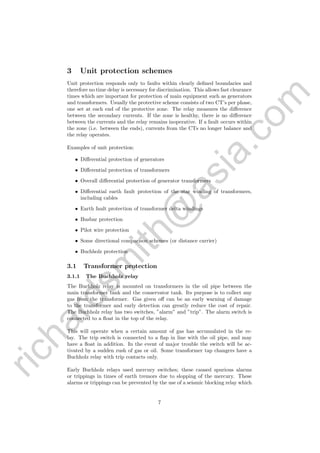
3.1.2 Explosion Vent
Explosion vents are fitted to all large transformers. This vent is a large diameter
pipe welded to the top of the transformer tank with a down turned bursting
disk or diaphragm. The pipe is usually higher than the conservator tank to
prevent excessive loss of oil, should the disk burst. The explosion vent protects
the transformer case from building up pressure in the case of an internal fault.
When a serious internal fault occurs gas is produced. This quickly builds up
pressure which will operate the Buchbolz trip. Should the pressure not be
sufficiently relieved the bursting disk will shatter and relieve the pressure from
inside the tank case. This is usually obvious by the spillage of oil down the
transformer and over the ground below the vent.
3.1.3 Qualitrol Pressure Relief
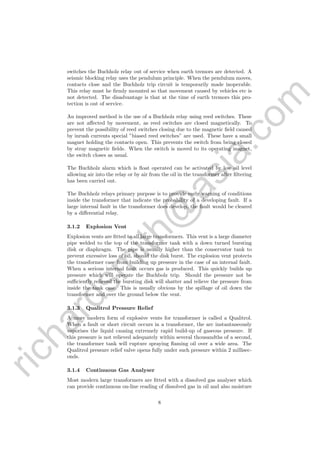
A more modern form of explosive vents for transformer is called a Qualitrol.
When a fault or short circuit occurs in a transformer, the arc instantaneously
vaporises the liquid causing extremely rapid build-up of gaseous pressure. If
this pressure is not relieved adequately within several thousandths of a second,
the transformer tank will rupture spraying flaming oil over a wide area. The
Qualitrol pressure relief valve opens fully under such pressure within 2 millisec-
onds.
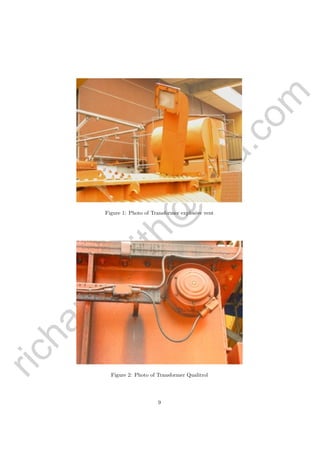
3.1.4 Continuous Gas Analyser
Most modern large transformers are fitted with a dissolved gas analyser which
can provide continuous on-line reading of dissolved gas in oil and also moisture
8
richardsm
ith@
asia.com
Figure 1: Photo of Transformer explosive vent
Figure 2: Photo of Transformer Qualitrol
9
richardsm
ith@
asia.com
level in oil.
The gas detection component is based on combustible gases dissolved in oil
passing through a selectively gas-permeable membrane into an electrochemical
gas detector. Within the gas detector, the gases combine with oxygen from the
ambient air to produce an electrical signal that is measured by an electronic
circuit and converted to ppm. The gas detector is sensitive to the gases that
are the primary indicators of incipient faults in oil-filled transformers (i.e. Hy-
drogen, Carbon monoxide, Ethylene, and Acetylene).
Moisture detection is performed by a thin-film capacitive moisture sensor. The
capacitive value of this sensor varies according to the moisture level and this
value is converted to an electrical signal.
Both the gas detection and moisture level reading are configured to generate
alarms but are not usually connected to transformer trip circuits.
Figure 3: Photo of Transformer Gas Analyser
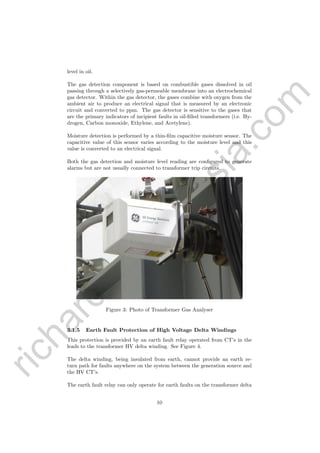
3.1.5 Earth Fault Protection of High Voltage Delta Windings
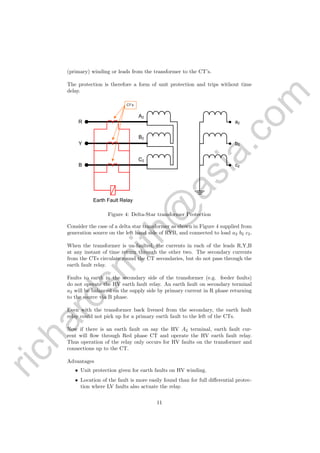
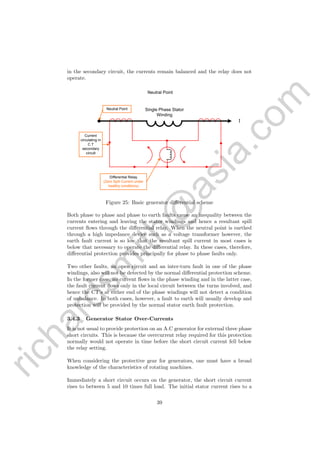
This protection is provided by an earth fault relay operated from CT’s in the
leads to the transformer HV delta winding. See Figure 4.
The delta winding, being insulated from earth, cannot provide an earth re-
turn path for faults anywhere on the system between the generation source and
the HV CT’s.
The earth fault relay can only operate for earth faults on the transformer delta
10
richardsm
ith@
asia.com
(primary) winding or leads from the transformer to the CT’s.
The protection is therefore a form of unit protection and trips without time
delay.
Earth Fault Relay
R
Y
B
a2
b2
c2
A2
B2
C2
CT’s
Figure 4: Delta-Star transformer Protection
Consider the case of a delta star transformer as shown in Figure 4 supplied from
generation source on the left hand side of RYB, and connected to load a2 b2 c2.
When the transformer is un-faulted, the currents in each of the leads R,Y,B
at any instant of time return through the other two. The secondary currents
from the CTs circulate round the CT secondaries, but do not pass through the
earth fault relay.
Faults to earth in the secondary side of the transformer (e.g. feeder faults)
do not operate the HV earth fault relay. An earth fault on secondary terminal
a2 will be balanced on the supply side by primary current in R phase returning
to the source via B phase.
Even with the transformer back livened from the secondary, the earth fault
relay could not pick up for a primary earth fault to the left of the CTs.
Now if there is an earth fault on say the HV A2 terminal, earth fault cur-
rent will flow through Red phase CT and operate the HV earth fault relay.
Thus operation of the relay only occurs for HV faults on the transformer and
connections up to the CT.
Advantages
• Unit protection given for earth faults on HV winding.
• Location of the fault is more easily found than for full differential protec-
tion where LV faults also actuate the relay.
11
richardsm
ith@
asia.com
• Fast operating, and cheap.
Disadvantages
• Only operates for HV earth faults.
• Does not cover HV phase to phase faults, short circuited turns, or LV
faults. (However if the fault is inside the transformer, it is cleared by the
buchholz relay.)
Remember
• Differential earth fault protection of transformer LV star windings also
protects the LV cables if the CT position includes them in the protected
zone.
• Earth fault protection of the delta winding may operate for flashover of
the transformer rod gaps or surge diverters.
3.1.6 Differential protection
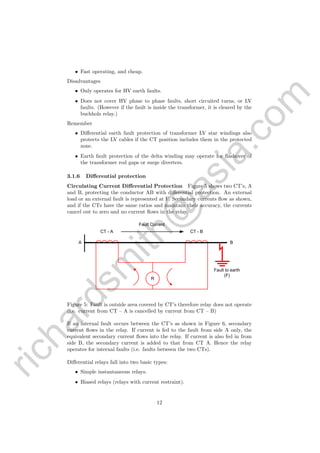
Circulating Current Differential Protection Figure 5 shows two CT’s, A
and B, protecting the conductor AB with differential protection. An external
load or an external fault is represented at F. Secondary currents flow as shown,
and if the CTs have the same ratios and maintain their accuracy, the currents
cancel out to zero and no current flows in the relay.
R
CT - A CT - B
Fault to earth
(F)
A B
Fault Current
Figure 5: Fault is outside area covered by CT’s therefore relay does not operate
(i.e. current from CT – A is cancelled by current from CT – B)
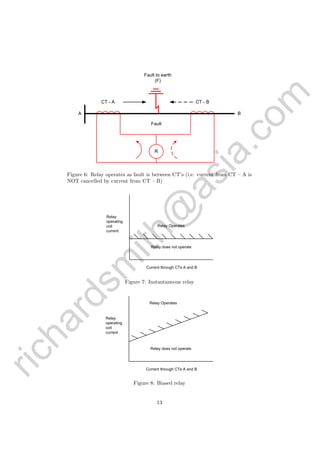
If an internal fault occurs between the CT’s as shown in Figure 6, secondary
current flows in the relay. If current is fed to the fault from side A only, the
equivalent secondary current flows into the relay. If current is also fed in from
side B, the secondary current is added to that from CT A. Hence the relay
operates for internal faults (i.e. faults between the two CTs).
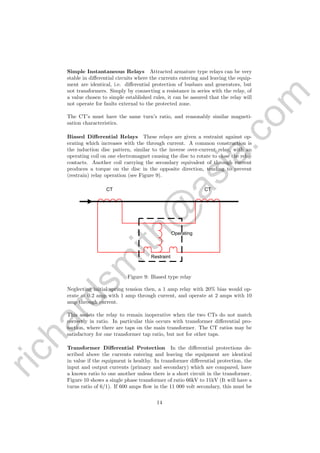
Differential relays fall into two basic types:
• Simple instantaneous relays.
• Biased relays (relays with current restraint).
12
richardsm
ith@
asia.com
R
CT - A CT - B
A B
Fault
Fault to earth
(F)
Figure 6: Relay operates as fault is between CT’s (i.e. current from CT – A is
NOT cancelled by current from CT – B)
Relay Operates
Relay does not operate
Relay
operating
coil
current
Current through CTs A and B
Figure 7: Instantaneous relay
Relay Operates
Relay does not operate
Relay
operating
coil
current
Current through CTs A and B
Figure 8: Biased relay
13
richardsm
ith@
asia.com
Simple Instantaneous Relays Attracted armature type relays can be very
stable in differential circuits where the currents entering and leaving the equip-
ment are identical, i.e. differential protection of busbars and generators, but
not transformers. Simply by connecting a resistance in series with the relay, of
a value chosen to simple established rules, it can be assured that the relay will
not operate for faults external to the protected zone.
The CT’s must have the same turn’s ratio, and reasonably similar magneti-
sation characteristics.
Biased Differential Relays These relays are given a restraint against op-
erating which increases with the through current. A common construction is
the induction disc pattern, similar to the inverse over-current relay, with an
operating coil on one electromagnet causing the disc to rotate to close the relay
contacts. Another coil carrying the secondary equivalent of through current
produces a torque on the disc in the opposite direction, tending to prevent
(restrain) relay operation (see Figure 9).
CT CT
Restraint
Operating
Figure 9: Biased type relay
Neglecting initial spring tension then, a 1 amp relay with 20% bias would op-
erate at 0.2 amp with 1 amp through current, and operate at 2 amps with 10
amp through current.
This assists the relay to remain inoperative when the two CTs do not match
correctly in ratio. In particular this occurs with transformer differential pro-
tection, where there are taps on the main transformer. The CT ratios may be
satisfactory for one transformer tap ratio, but not for other taps.
Transformer Differential Protection In the differential protections de-
scribed above the currents entering and leaving the equipment are identical
in value if the equipment is healthy. In transformer differential protection, the
input and output currents (primary and secondary) which are compared, have
a known ratio to one another unless there is a short circuit in the transformer.
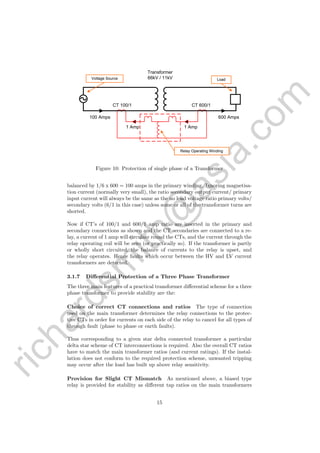
Figure 10 shows a single phase transformer of ratio 66kV to 11kV (It will have a
turns ratio of 6/1). If 600 amps flow in the 11 000 volt secondary, this must be
14
richardsm
ith@
asia.com
600 Amps100 Amps
CT 100/1 CT 600/1
Transformer
66kV / 11kVVoltage Source Load
1 Amp 1 Amp
Relay Operating Winding
Figure 10: Protection of single phase of a Transformer
balanced by 1/6 x 600 = 100 amps in the primary winding. Ignoring magnetisa-
tion current (normally very small), the ratio secondary output current/ primary
input current will always be the same as the no load voltage ratio primary volts/
secondary volts (6/1 in this case) unless some or all of the transformer turns are
shorted.
Now if CT’s of 100/1 and 600/1 amp ratio are inserted in the primary and
secondary connections as shown and the CT secondaries are connected to a re-
lay, a current of 1 amp will circulate round the CTs, and the current through the
relay operating coil will be zero (or practically so). If the transformer is partly
or wholly short circuited, the balance of currents to the relay is upset, and
the relay operates. Hence faults which occur between the HV and LV current
transformers are detected.
3.1.7 Differential Protection of a Three Phase Transformer
The three main features of a practical transformer differential scheme for a three
phase transformer to provide stability are the:
Choice of correct CT connections and ratios The type of connection
used on the main transformer determines the relay connections to the protec-
tive CTs in order for currents on each side of the relay to cancel for all types of
through fault (phase to phase or earth faults).
Thus corresponding to a given star delta connected transformer a particular
delta star scheme of CT interconnections is required. Also the overall CT ratios
have to match the main transformer ratios (and current ratings). If the instal-
lation does not conform to the required protection scheme, unwanted tripping
may occur after the load has built up above relay sensitivity.
Provision for Slight CT Mismatch As mentioned above, a biased type
relay is provided for stability as different tap ratios on the main transformers
15
richardsm
ith@
asia.com
result in different current ratios for the transformer.
Provision of Stability against Magnetisation Inrush Currents When
the voltage supply to a transformer is suddenly switched on to liven it, magneti-
sation currents are drawn from the supply of a value many times full load of the
bank. These currents on one side of the bank are not matched by corresponding
currents on the output winding and hence, fed only to one side of the relay
appear as a transformer fault. The currents take many seconds to decay to the
normal low value.
These magnetisation inrush currents contain a high proportion of 100 cycle
per second (100 Hz) component which is the second harmonic of the normal 50
Hz supply frequency. Internal transformer fault currents for which the relay is
expected to operate do not contain this second harmonic.
This characteristic is used to make the relay immune to operation from mag-
netisation inrush currents. A proportion of relay operating current is passed
through a filter circuit, and the 100 Hz component from it is fed into a sensitive
winding on the relay which hinders it from operating. A timer of approximately
20 seconds is usually employed to ensure inrush currents have stabilised.
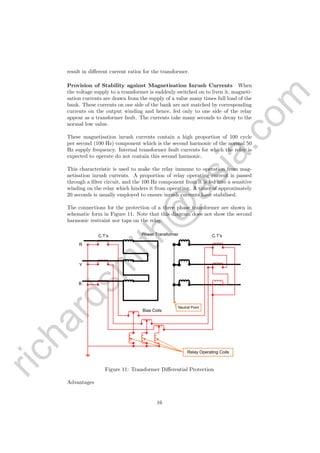
The connections for the protection of a three phase transformer are shown in
schematic form in Figure 11. Note that this diagram does not show the second
harmonic restraint nor taps on the relay.
R
Y
B
Power Transformer
Bias Coils
C.T’s C.T’s
Neutral Point
Relay Operating Coils
Figure 11: Transformer Differential Protection
Advantages
16
richardsm
ith@
asia.com
• High speed of operation.
• Protects external leads, cables, and bushings not covered by buchholz.
• Being unit protection - provides discrimination with time delayed non-unit
protection elsewhere on the system.
Disadvantages
• Does not detect some incipient faults. (These are detected by the buch-
holz)
• Does not protect the transformer against overheating due to overloads or
external short circuits.
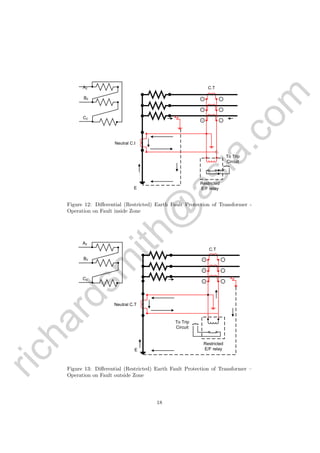
3.1.8 Differential Earth Fault Protection of Star Windings
This protection consists of three phase CTs with secondaries connected in par-
allel to give the earth fault current. This residual current is balanced against
the secondary current from the transformer neutral CT and the difference is
applied to the differential relay (see Figure 13).
Thus the scheme detects earth faults between the neutral CT and the phase
CT’s, i.e. in the star winding of the transformer, LV bushings, and cable up to
the switchgear containing the CT’s.
This relay is generally used with lead sheathed cables on 11 kV installations,
and phase to phase faults are practically impossible on the 11 kV side. (Faults
on single core 11 kV cables will be earth faults.)
Advantages
• Low Cost.
• Fast fault clearance for heavy faults on cables as well as on the transformer.
• In conjunction with buchholz and fast protection of the delta winding, it
virtually provides unit protection of the bank, provided that short circuits
between phases are unlikely on either the HV or LV side, i.e. when cables
are used on the star connected side, and spacings are larger on the other.
Disadvantages
• Does not protect against phase to phase faults or short circuited turns,
nor faults in the delta winding.
• When connections from the star winding are by overhead conductor in-
stead of cable, phase to phase faults are not cleared, and where two banks
are installed, both banks are tripped on overcurrent.
• May not detect earth faults at the neutral end of the transformer winding.
Remember
• Unit protection operates for faults within clearly defined boundaries, usu-
ally between two sets of CTs.
17
richardsm
ith@
asia.com
}
M
M
M
L
L
L
A2
B2
C2
E
Neutral C.I
C.T
To Trip
Circuit
Restricted
E/F relay
Figure 12: Differential (Restricted) Earth Fault Protection of Transformer -
Operation on Fault inside Zone
}
M
M
M
L
L
L
A2
B2
C2
E
Neutral C.T
C.T
Restricted
E/F relay
To Trip
Circuit
Figure 13: Differential (Restricted) Earth Fault Protection of Transformer –
Operation on Fault outside Zone
18
richardsm
ith@
asia.com
• There will be practically no current in a unit protection relay for an ex-
ternal fault.
• When unit protection operates, it trips without time delay.
• In differential protection of transformers:
• CT ratios and interconnections are chosen so that the currents com-
pared in the relay are nearly equal.
• Slight mismatch of currents is permitted by the relay design (bias).
• Transformer magnetisation inrush currents could operate the relay,
but restraint is provided on modern relays by using the 100 Hz con-
tent.
3.2 Busbar protection
Busbar protection is another example of unit protection. The most common
relaying principle adopted in the New Zealand transmission system is the high
impedance differential scheme, which is a circulating current scheme.
The basic principle of busbar protection is that for an un-faulted busbar the
total input current is equal to the total output. The sum of the currents is zero
for each phase. The relays measuring the summation of the currents receive no
current for un-faulted conditions of the busbar. However when a busbar fault
occurs, the balance is upset, and the relay receives current causing it to operate.
The extent of the busbar and associated equipment protected by busbar pro-
tection (i.e. the ”bus zone”) is dependent upon the position of the busbar
protection C.T’s. The C.T’s may be in the circuit breaker (bulk oil circuit
breakers) or adjacent to the circuit breaker.
3.2.1 Check Zones
Because the consequences of an incorrect bus zone trip can be very serious
a completely independent check zone supplied by separate bus zone current
transformers is usually included within a bus zone protection scheme. The
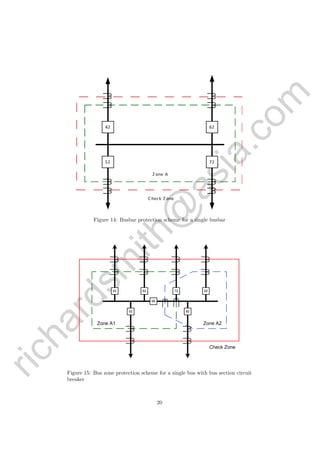
check zone encompasses the whole bus and therefore contains both zone A1 and
zone A2 in a typical three zone scheme. For a bus zone tripping to occur both
differential relays have to respond to a fault e.g. for a fault in zone A1, the zone
A1 differential relay and the check zone differential relay. Detecting the fault
by two separate relays greatly reduces the risk of accidental trips.
For this scheme for a fault within zone A, both the zone A and the check zone
differential relays have to operate before a bus trip will occur.
In many cases it is not acceptable to remove the whole bus from service. A
bus coupling CB can be used to sectionise the bus into two sections.
A fault on the bus in zone A1 will be detected in zone A1 and the cheek zone.
CBs 42, 52, 62 and 68 will be tripped via their bus zone relays. This leaves the
other section of the bus in service.
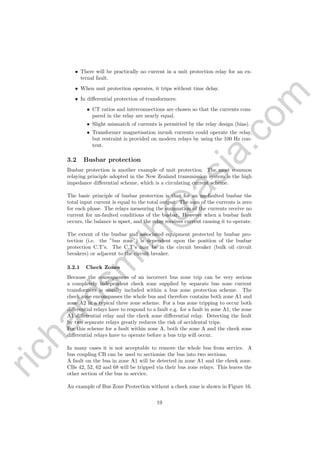
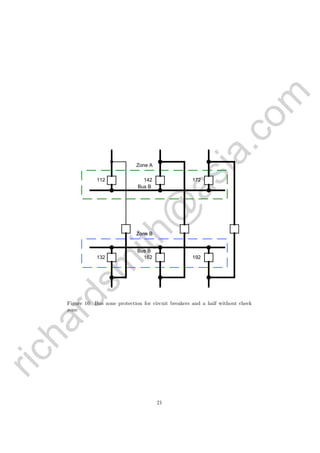
An example of Bus Zone Protection without a check zone is shown in Figure 16.
19
richardsm
ith@
asia.com
	
  
Figure 14: Busbar protection scheme for a single busbar
42 62
68
72 92
52 82
Zone A2
Check Zone
Zone A1
Figure 15: Bus zone protection scheme for a single bus with bus section circuit
breaker
20
richardsm
ith@
asia.com
Bus B
Zone B
Zone A
Bus B
112 142 172
132 162 192
Figure 16: Bus zone protection for circuit breakers and a half without check
zone
21
richardsm
ith@
asia.com
In this case a Bus A fault will trip CBs 112, 142 and 172 this will disconnect
Bus A without the loss of any supplies due to the Circuit Breaker and a half
configuration. The check zone is not essential, as in the case of accidental trip-
ping, no supplies are lost.
However, a check zone may be included with a circuit breaker and a half scheme,
so always check. The half breakers are not included in either zone and so are
not covered by the bus zone protection.
3.2.2 Blind Spots and Blind Spot Protection
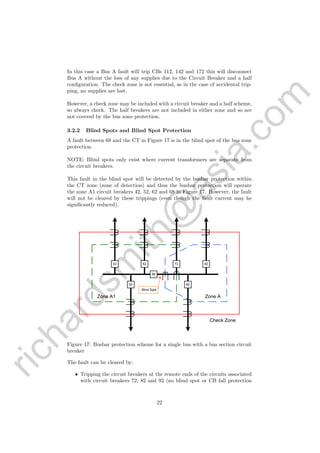
A fault between 68 and the CT in Figure 17 is in the blind spot of the bus zone
protection.
NOTE: Blind spots only exist where current transformers are separate from
the circuit breakers.
This fault in the blind spot will be detected by the busbar protection within
the CT zone (zone of detection) and thus the busbar protection will operate
the zone A1 circuit breakers 42, 52, 62 and 68 in Figure 17. However, the fault
will not be cleared by these trippings (even though the fault current may he
significantly reduced).
42 62
68
72 92
52 82
Zone A
Check Zone
Zone A1
Blind Spot
Figure 17: Busbar protection scheme for a single bus with a bus section circuit
breaker
The fault can be cleared by:
• Tripping the circuit breakers at the remote ends of the circuits associated
with circuit breakers 72, 82 and 92 (no blind spot or CB fall protection
22
richardsm
ith@
asia.com
fitted). This would be a zone 2 tripping and would not clear the fault for
approximately 0.65 seconds.
or
• By tripping circuit breakers 72, 82 and 92 via the zone A2 trip circuitry
(blind spot protection fitted).
Blind spot protection in its simplest form is only a timing relay. A fault
takes place in the blind spot in Figure 17. Zone A1 and the check zone
relays detect this fault. Zone A1 circuit breakers are opened but the fault
is still supplied from zone A2 bus. A timing relay is also activated. After
a short time, approximately 0.15 seconds, zone A1 and check zone relays
are still detecting a fault. As the zone A1 circuit breakers are open the
fault must be in the blind spot and zone A2 is tripped by the timing relay.
This requires a definite time to elapse, but is much faster than a zone 2
tripping from remote stations. The fault in the blind spot did however
clear both sections of the bus.
or
• Using CB fail protection
The CB fail protection would detect current flowing through the CT ad-
jacent to CB 68, after the CB had opened. This would be taken as a CB
failure and a trip signal sent to CBs 42, 52, 62, 72, 82 and 92, to isolate
CB 68 which had ”failed”.
Blind spot protection is now being removed and replaced with CB failure, as
it completes the same function as blind spot protection, as well as protecting
against failure of a CB to operate.
Blind spots also exist between all other circuit breakers and their CTs. Consider
a fault between 42 and its CT. As this is seen as a bus fault zone A1 will trip.
The fault will still be supplied from the remote end of the circuit which will trip
in zone 2. Other supplies on that bus have been interrupted unnecessarily. Ide-
ally we are only required to trip the circuit on 42, but as the fault was ”behind”
the CT it is seen on the bus and not on the circuit.
3.2.3 AC Wiring Supervision
Wiring supervision relays are required to detect abnormal voltages on the CT
wiring. One - three phase relay is required, per zone. Abnormal voltages can be
caused by open circuited CTs, CT isolator switch open while primary circuit is
on load, AC wiring fault, etc.
If abnormal voltages are detected on the CT wiring then the protection is dis-
abled for the duration of the fault.
AC wiring supervision flags are self resetting and generally only evident for
a few seconds.
23
richardsm
ith@
asia.com
3.2.4 DC Supply Failure
In older installations a DC supply failure relay (or trip supply supervision relay)
is used to detect a D.C supply failure to the bus zone protection. One relay per
scheme or one per panel is generally installed.
In more modern installations it is incorporated with the bus zone protection
inoperative alarms. A loss of D.C supply to the protection will render the
protection inoperative.
3.2.5 Protection Inoperative Alarm
An alarm is fitted to each separate bus zone to indicate loss of protection. In
Figure 17 these alarms are installed for zones A1 and A2. It is not necessary to
install a separate alarm for the check zone as a fault in the check zone protection
will alarm all zones connected to it. A loss of check zone protection in Figure
17 will alarm both A1 and A2 zones.
This alarm can occur due to:
• Wiring supervision relay operation.
• The test switch being left in the test position.
• Failure of the D.C power supplies to the relay.
3.2.6 Circuit Breaker failure (CB fail) Protection
When a circuit breaker receives a trip signal, but fails to fully disconnect its
associated faulted primary plant within its normal operating time, CB fail pro-
tection will be activated.
This protection will then attempt to disconnect an adjacent circuit breaker
so as to complete the disconnection of the faulted primary plant.
CB fail protection shall be enabled only when the protected circuit breaker
has been called upon to trip by operation of its associated protection systems.
It shall not operate if the circuit breaker fails to open during a routine switching
operation or automatic switching sequence unless such failure coincides with or
precipitates the development of a system fault, resulting in the operation of its
associated protection systems.
Remember
• Busbar protection is a special case of circulating current differential pro-
tection (as for generators).
• It looks more complicated because there are more than two sets of CTs
for current summations.
• When the current entering the busbar is equal to the current leaving, the
sum of the currents is zero. Hence the sum of secondary currents is also
zero, and the relay is inoperative.
24
richardsm
ith@
asia.com
• If a fault occurs on the busbar, the balance is upset and the relay operates.
• A second differential relay must also operate for tripping to occur - the
busbar check differential relay.
• Circuit supervision relays cut out the protection after a time delay if there
is a slight out of balance of current.
• A check zone is usually included and the check zone and the faulted zone
must detect the fault before a tripping takes place.
• Bus zone protection is most effective when the bus is in several sections
to limit the effect of the tripping.
• Blind spots exist between CBs and CTs. Faults in blind spots usually
remove more equipment than essential from service to clear them.
3.3 Circuit Protection
3.3.1 Distance-time and definite distance protection
Distance relays are used to protect transmission lines. As their name implies
they measure the distance from the relaying point to the fault, and trip if the
measured distance is less than the relay setting.
V
L
Substation
Generating Source (s)
Fault
I
F
Z
Figure 18: measurement of distance to fault
L = Distance of fault from substation
V = Voltage of line at substation
I = Line current flowing in the transmission line loop
Z = Impedance of the loop
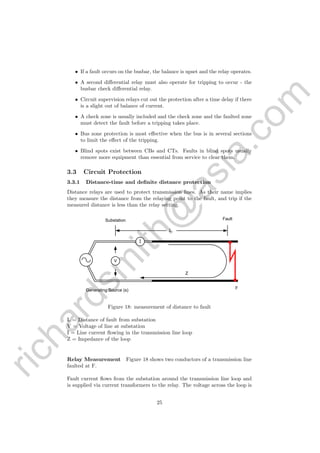
Relay Measurement Figure 18 shows two conductors of a transmission line
faulted at F.
Fault current flows from the substation around the transmission line loop and
is supplied via current transformers to the relay. The voltage across the loop is
25
richardsm
ith@
asia.com
measured by the line (or busbar VT) to the relay.
Providing the resistance of the fault is negligible, the measured ratio Line Volts/
Line Current (V/I) is the impedance of the transmission line loop. Also the loop
impedance z is proportional to distance L. Hence a measurement can be made
of the distance to the fault.
If the measured impedance is less than the set value, it means that the fault is
closer to the substation than the distance for which the relay is set and therefore
the trip relay will operate.
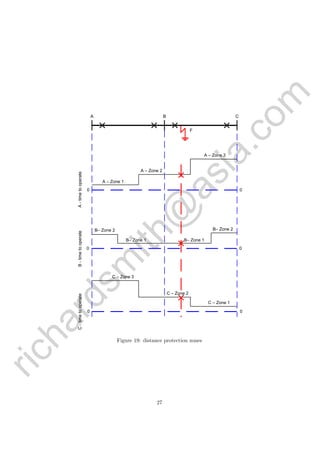
Discrimination Discrimination is provided by using the stepped time dis-
tance characteristic, as shown in Figure 19. AB and BC are transmission lines
fed from both ends A and C. The relay at A measures the distance to the fault
when the fault current flows out from the busbar A into the line, and has the
time distance characteristic shown above the reference line 00. Thus for all
faults within the first 85% (approximately) of line AB, the circuit breaker at A
is tripped instantaneously. For faults further away the relay waits for about 0.5
seconds (zone 2 time), then measures a longer distance zone 2 (say 120% of the
line length) and if the fault is measured within this distance, breaker A trips.
If the fault continues, a greater distance zone 3 is measured and tripped in still
longer time (usually 1.2 seconds for zone 3 trippings). In addition a zone 4 may
be fitted that will operate in 4 seconds.
Relay B on the line BC has a similar characteristic with tripping time char-
acteristics shown above the reference line 00. Relays at C on the line CB and
B on the line BA, measure for faults flowing from right to left on the diagram,
and have the characteristics shown below the reference line 00.
Consider now a fault at F. Relay A measures the fault as beyond zone 1 but
before zone 2 time elapses the fault is cleared at B. (Relay B, facing C, measures
and trips in zone 1 instantaneous time.)
Note that zone 1 of each relay is arranged to cover about 85% of a line. This
is because the distance relays have unavoidable errors in measuring distance. A
margin has to be allowed so that faults outside’ the line are not seen as zone 1
faults.
Zone 2 distance covers about 120% (or more) of the line to ensure definite
detection of all faults at the end of the line. Zone 3 provides general back up
protection (some schemes include a fourth zone for back up.)
Importance of Voltage Supply Distance relays measure distance from the
current/voltage ratio measurements at the relaying point. Current tends to op-
erate the relay, and voltage to restrain tripping. It is therefore important that
VT supplies should always be maintained to distance relays. The absence of
VT voltage results in relays seeing an apparent fault, and provided the current
is sufficient, the relay trips. Loss of voltage means that the impedance seen by
the relay is zero.
26
richardsm
ith@
asia.com
	
  
B
F
A C
B– Zone 2
B– Zone 1B– Zone 1
B– Zone 2
A – Zone 1
A – Zone 2
A – Zone 3
C – Zone 1
C – Zone 2
C – Zone 3
A-timetooperateB-timetooperateC-timetooperate
0 0
0 0
0 0
Figure 19: distance protection zones
27
richardsm
ith@
asia.com
i.e. voltage V = 0 therefore Z =
V
I
=
0
I
= 0
Measurement of Direction by Distance Relays For phase to earth, and
phase to phase faults, a voltage in a selected un-faulted phase is used as a ref-
erence of the direction of the fault (towards the line, or reverse direction).
The relay trips in the first two zones for faults out towards the line, but does
not trip for reverse faults (behind the busbars).
The measurement principle used extensively combines directional measurement
and distance measurement in one relay element. (One tripping contact, only
closed when direction is correct, and volts/amps measurements conform to set-
tings).
Starting Relays Starting relays are used to sense a fault on the system, and
start the various relay measurements. If the fault is cleared elsewhere on the
system the starting relays reset. (Starting flags do not necessarily mean that a
fault has occurred on that particular transmission line.)
Impedance relays are generally used on each phase, and are given directional
phase angle characteristics for better load carrying insensitivity. The starting
relays also select which phases are to be measured, and whether to measure for
faults to earth or to measure phase to phase faults.
Earth fault relays are used to initiate earth fault measurement.
Negative sequence current relays are used in some relays to initiate phase to
phase fault measurement, these detect current imbalance in the three phases.
Measurement of Three Phase Faults For three phase faults close to the
protection relay, all voltages fall very low, and in particular, the phase to phase
reference voltage is very low. The reference voltage is the phase to phase volt-
age which is used to enable the relay to determine in which direction the fault
current flows, whether to the line or from the line. Without sufficient reference
voltage the relay is unable to trip.
One commonly used scheme to overcome the difficulty is to use a “memory”
action. This is simply a resonant circuit tuned to 50-cycles, so that the current
in the reference winding persists for a few cycles after the reference voltage has
collapsed. Thus with the relay in service, if a three phase fault occurs the relay
can determine the direction of the fault.
However when the VT’s are directly connected to the line, and the line cir-
cuit breaker is open, there is no voltage for the relays to ‘remember’ and the
feature cannot operate. This is overcome by arranging a contact to be closed
for a short time while the main breaker is being closed. If any starting relay op-
erates, the trip circuit is completed through this contact, and the main breaker
is tripped.
28
richardsm
ith@
asia.com
Other relays at the station, with already livened VT’s will sense the direction
by memory action, and will not trip.
Voltage Transformer Supply A three phase switch for disconnecting the
secondary voltages is usually fitted on the relay panel, this also disconnects the
D.C supply to the relay, and effectively prevents the distance relay from operat-
ing. When busbar VT’s are utilised, a changeover switch is fitted to select the
voltages from one of the VT’s.
Care has to be exercised that the VT supply to relays is not lost, particularly
when sectionalising a busbar with VT’s on it, or an accidental tripping may
result. Care must also be exercised with busbar VT’s to ensure that the relay
receives the line terminal voltage from a VT directly connected to the line via
the line circuit breaker not through a circuitous route involving line impedances.
In the latter case distance measurement would be incorrect.
Advantages of Distance Protection
• Rapid tripping for faults, which is essential near generating stations to
preserve coordinated generation.
• Applicable in a complex transmission network with interconnecting gen-
erating stations.
• Applicable to long and medium length lines, i.e. all but very short lines.
• Good discrimination between fault and load current.
• Good discrimination with faults external to the protected line.
• High reliability.
• Even without carrier, most faults trip in zone 1 time of 0.04 seconds;
remaining faults are finally cleared within 0.5 seconds.
• With short clearing time, minimum damage to conductor strands results.
This is particularly beneficial for aluminium conductors.
Disadvantages of Distance Protection
• Not suitable for short lines.
• Relatively high cost if compared with overcurrent relays.
• Requires supply of line terminal voltage.
• Complicated due to the various possible faults to be measured (different
phase combinations, zone 1 and zone 2, and starting relays).
• Measurement may be affected by fault resistance.
Remember
• All distance relays measure the distance to the fault using the voltages
and currents, and decide whether the measurement is less than the relay
setting.
29
richardsm
ith@
asia.com
• Stepped time distance characteristics are used for discrimination.
• The measurement by relays used in New Zealand is inherently directional.
• Three phase measurement of close up faults present a design problem,
generally overcome by use of ”memory” relays.
• Distance relays measure line impedance and so must be supplied with the
line terminal voltage. The line terminal voltage is the same as the busbar
voltage when the line circuit breaker is closed.
In some installations the line terminal voltage for the relay is taken from
a busbar VT (usually on 110kV circuits). In such instances, if the busbar
is to be split, care must be taken that the busbar VT used is directly
connected to the line (through the line CB, and not through a circuitous
route involving line impedances) otherwise distance measurement will be
wrong.
• Disconnection of the VT supply to the relay, other than by special means
provided, can result in relay tripping due to load.
Protection Signalling with Distance Protection Communications links
between two stations (power line carrier, radio, etc.) are used for protection
purposes. One application is, in conjunction with distance protection, to pro-
vide fast tripping for faults over the entire length of a transmission line, in zone
1 time, without any zone 2 time ”delayed trippings”.
Closure of a relay contact at station A produces a closed contact at station
B.
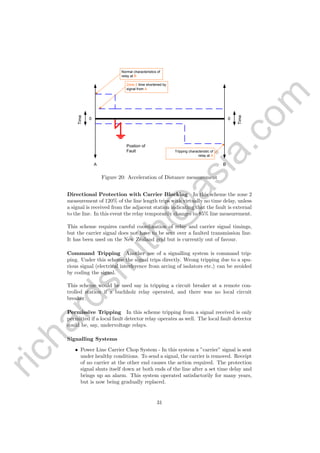
Acceleration with Distance Protection In the ’acceleration’ technique
tripping at one end of the line in zone 1 accelerates the operation of the zone 2
measurement at the other end of the line (see Figure 20).
Consider a line AB, faulted within 15% of its length from station A. The relay
at station A trips immediately, and sends a signal to station B to change its
distance measurement from 85% of the line length to 120%. The relay at B now
detects the fault and trips without having to wait for zone 2 time to elapse.
One advantage of this carrier signal system is that there is no danger of trip-
ping a remote circuit breaker during communications or protection maintenance.
The same signal as used for accelerated distance protection can be used with
earth fault directional comparison protection. The two protections can be com-
bined and are on most Transpower 220 kV transmission line protection schemes.
The loss of carrier (or other signalling channel) results in the loss of the di-
rectional comparison and the distance protection reverts to plain distance pro-
tection.
30
richardsm
ith@
asia.com
	
  
Time
Time
Postion of
Fault
0 0
Normal characteristics of
relay at B
Zone 2 time shortened by
signal from A
Tripping characteristic of
relay at A
A B
Figure 20: Acceleration of Distance measurement
Directional Protection with Carrier Blocking In this scheme the zone 2
measurement of 120% of the line length trips with virtually no time delay, unless
a signal is received from the adjacent station indicating that the fault is external
to the line. In this event the relay temporarily changes to 85% line measurement.
This scheme requires careful coordination of relay and carrier signal timings,
but the carrier signal does not have to be sent over a faulted transmission line.
It has been used on the New Zealand grid but is currently out of favour.
Command Tripping Another use of a signalling system is command trip-
ping. Under this scheme the signal trips directly. Wrong tripping due to a spu-
rious signal (electrical interference from arcing of isolators etc.) can be avoided
by coding the signal.
This scheme would be used say in tripping a circuit breaker at a remote con-
trolled station if a buchholz relay operated, and there was no local circuit
breaker.
Permissive Tripping In this scheme tripping from a signal received is only
permitted if a local fault detector relay operates as well. The local fault detector
could be, say, undervoltage relays.
Signalling Systems
• Power Line Carrier Chop System - In this system a ”carrier” signal is sent
under healthy conditions. To send a signal, the carrier is removed. Receipt
of no carrier at the other end causes the action required. The protection
signal shuts itself down at both ends of the line after a set time delay and
brings up an alarm. This system operated satisfactorily for many years,
but is now being gradually replaced.
31
richardsm
ith@
asia.com
• Frequency Shift Signalling - Under normal conditions a steady signal
(guard signal) is sent. To transmit a protection signal, the guard sig-
nal is stopped, and replaced by an operate signal of a different frequency.
Hence the name frequency shift. The transmission medium may be carrier
or radio.
Directional Comparison Earth Fault (DCEF) Signalling systems are
also used to link directional earth fault relays at both ends of a transmission
line, thus enabling them to function as DCEF protections. In this scheme if a
relay senses an earth fault in the line direction (towards its companion station)
it sends a trip signal.
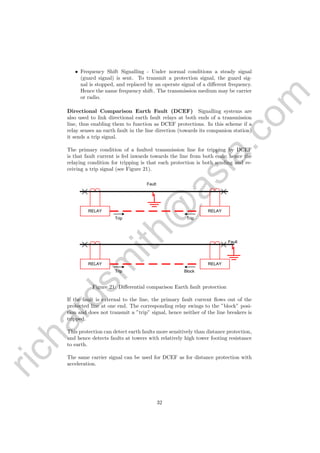
The primary condition of a faulted transmission line for tripping by DCEF
is that fault current is fed inwards towards the line from both ends; hence the
relaying condition for tripping is that each protection is both sending and re-
ceiving a trip signal (see Figure 21).
Fault
RELAY RELAY
Trip Trip
RELAY RELAY
Trip Block
Fault
Figure 21: Differential comparison Earth fault protection
If the fault is external to the line, the primary fault current flows out of the
protected line at one end. The corresponding relay swings to the ”block” posi-
tion and does not transmit a ”trip” signal, hence neither of the line breakers is
tripped.
This protection can detect earth faults more sensitively than distance protection,
and hence detects faults at towers with relatively high tower footing resistance
to earth.
The same carrier signal can be used for DCEF as for distance protection with
acceleration.
32
richardsm
ith@
asia.com
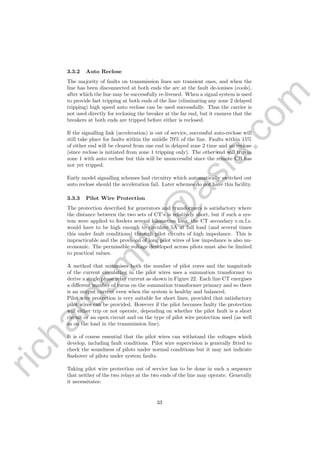
3.3.2 Auto Reclose
The majority of faults on transmission lines are transient ones, and when the
line has been disconnected at both ends the arc at the fault de-ionises (cools),
after which the line may be successfully re-livened. When a signal system is used
to provide fast tripping at both ends of the line (eliminating any zone 2 delayed
tripping) high speed auto reclose can be used successfully. Thus the carrier is
not used directly for reclosing the breaker at the far end, but it ensures that the
breakers at both ends are tripped before either is reclosed.
If the signalling link (acceleration) is out of service, successful auto-reclose will
still take place for faults within the middle 70% of the line. Faults within 15%
of either end will be cleared from one end in delayed zone 2 time and no reclose
(since reclose is initiated from zone 1 tripping only). The other end will trip in
zone 1 with auto reclose but this will be unsuccessful since the remote CB has
not yet tripped.
Early model signalling schemes had circuitry which automatically switched out
auto reclose should the acceleration fail. Later schemes do not have this facility.
3.3.3 Pilot Wire Protection
The protection described for generators and transformers is satisfactory where
the distance between the two sets of CT’s is relatively short, but if such a sys-
tem were applied to feeders several kilometres long, the CT secondary e.m.f.s.
would have to be high enough to circulate 5A at full load (and several times
this under fault conditions) through pilot circuits of high impedance. This is
impracticable and the provision of long pilot wires of low impedance is also un-
economic. The permissible voltage developed across pilots must also be limited
to practical values.
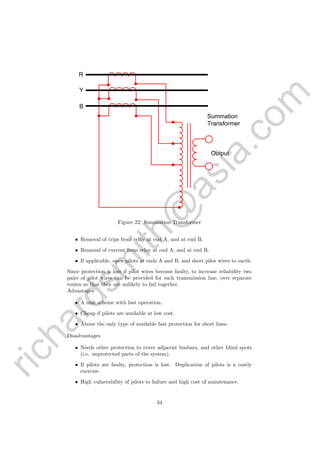
A method that minimises both the number of pilot cores and the magnitude
of the current circulating in the pilot wires uses a summation transformer to
derive a single phase relay current as shown in Figure 22. Each line CT energises
a different number of turns on the summation transformer primary and so there
is an output current even when the system is healthy and balanced.
Pilot wire protection is very suitable for short lines, provided that satisfactory
pilot wires can be provided. However if the pilot becomes faulty the protection
will either trip or not operate, depending on whether the pilot fault is a short
circuit or an open circuit and on the type of pilot wire protection used (as well
as on the load in the transmission line).
It is of course essential that the pilot wires can withstand the voltages which
develop, including fault conditions. Pilot wire supervision is generally fitted to
check the soundness of pilots under normal conditions but it may not indicate
flashover of pilots under system faults.
Taking pilot wire protection out of service has to be done in such a sequence
that neither of the two relays at the two ends of the line may operate. Generally
it necessitates:
33
richardsm
ith@
asia.com
Y
B
R
Summation
Transformer
Output
Figure 22: Summation Transformer
• Removal of trips from relay at end A, and at end B.
• Removal of current from relay at end A, and at end B.
• If applicable, open pilots at ends A and B, and short pilot wires to earth.
Since protection is lost if pilot wires become faulty, to increase reliability two
pairs of pilot wires can be provided for each transmission line, over separate
routes so that they are unlikely to fail together.
Advantages
• A unit scheme with fast operation.
• Cheap if pilots are available at low cost.
• About the only type of available fast protection for short lines.
Disadvantages
• Needs other protection to cover adjacent busbars, and other blind spots
(i.e. unprotected parts of the system).
• If pilots are faulty, protection is lost. Duplication of pilots is a costly
exercise.
• High vulnerability of pilots to failure and high cost of maintenance.
34
richardsm
ith@
asia.com
In the experience of electricity distribution in New Zealand, overhead pilots are
subject to short circuits from wind, pole interference by vehicles, animals, de-
bris, kites, rifle fire and lightning.
Buried pilots are subject to interference from bulldozers and other digging op-
erations, particularly in city areas. Also rise in earth voltages during faults can
cause insulation breakdown. Altogether the cost of maintenance of pilot wires
has been a great deterrent to using this form of protection.
Remember
• Pilot wire protection is a modified form of differential protection.
• If the pilot wires are defective, so is the protection.
• Protection will trip for short or open circuited pilots, depending on type
of protection.
• Pilot wire protection is excellent for short lines, if the reliability of the
pilots is good.
• If the protection has to be taken out of service with the transmission line
in service, the correct sequence for operating test switches requires an
operator at each substation.
3.3.4 220kV Oil-filled Cable Protection
Where the cables are to be buried an alternative to pilot wire protection could
be using oil filled cables. The oil in the cables is for insulation purposes and is
under pressure.
Should the pressure increase, an alarm will be triggered and is an indication
of excessive heat being generated in the cable. A source of this heat could be
overloading of the cables.
A low pressure alarm and low pressure trip are also provided to indicate any
damage to the cable (possibly from an external source) and hence remove the
circuit from service.
Additionally a buchholz relay can be fitted at the end of the cable to indicate a
fault within the circuit.
Remember
• By protection signalling, relay contacts can be actuated at a remote station
by communications link.
• Distance protection line end clearing times (zone 2 times) can be shortened
considerably by inter signalling.
• The main scheme used in New Zealand is the ”acceleration” method.
• Either radio or power line carrier is used to link stations at each end of a
line.
35
richardsm
ith@
asia.com
• Directional comparison earth fault protection detects internal line faults
to earth by comparing the direction of current flow.
• The condition of tripping from direction comparison earth fault protection
DCEF) is that each relay at the line ends receives and transmits a ”line
faulted” (trip) signal.
• Directional comparison earth fault protection is more sensitive, generally,
than distance protection.
• Directional comparison earth fault protection is combined with distance
protection.
3.4 Generator Protection
Generators are an important component of the power system. They are expen-
sive both in terms of initial investment and down time. If they suffer damage
they cannot he quickly repaired. It is therefore economic to provide them with
a protection system which reduces the possibility of damage from any internal
fault or other cause.
Insulation breakdown may be caused by electrical stress, mechanical damage,
thermal or chemical degradation or a combination of these. Insulation failure
in a generator is most likely to cause damage, as the windings are in close prox-
imity to the magnetic core. If a fault occurs, heavy currents may circulate. The
core plates may be burned and the insulating varnish between laminations may
be damaged by fault currents. This would require the core to be dismantled,
which is a costly process. High speed tripping is essential to minimise damage.
Breakdown of stator insulation may cause earth faults, phase to phase faults or
three phase faults. Phase to phase faults and three phase faults may or may
not involve earth. However, experience has shown that phase to phase faults
which do not initially involve earth, very rapidly do so. Three phase faults are
amongst the rarest type of fault on a generator. Protection for phase to phase
faults also provides protection for three phase faults.
All generators are provided with two stator protection schemes. These are
stator differential protection and stator earth fault protection. The more recent
installations also include stator inter-turn protection.
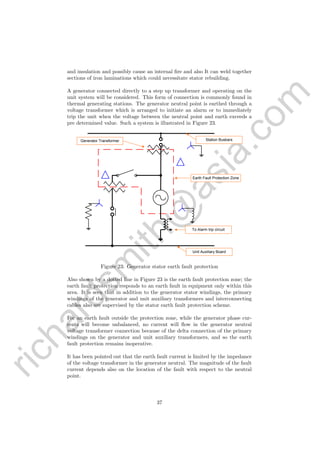
3.4.1 Generator Earth Faults
Probably the most likely fault in a generator is a phase to earth breakdown.
The stator windings are solidly connected to earth free delta connected wind-
ings on the output (and if present, the unit transformer) transformer. They are
star connected at the generator neutral point and the star point is connected to
earth sometimes directly but most often through a current limiting component.
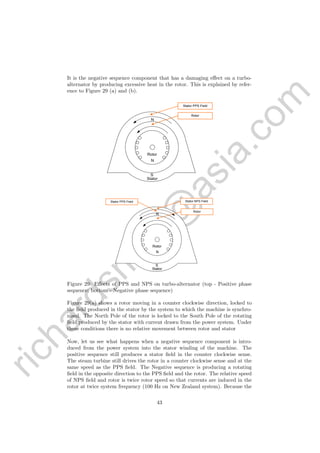
The current limiting component provides a moderate restraint against the flow
of massive earth fault currents. This has the effect of minimising damage to
the generator winding resulting from an earth fault. This is important since a
severe earth fault inside a generator can cause extensive damage to windings
36
richardsm
ith@
asia.com
and insulation and possibly cause an internal fire and also It can weld together
sections of iron laminations which could necessitate stator rebuilding.
A generator connected directly to a step up transformer and operating on the
unit system will be considered. This form of connection is commonly found in
thermal generating stations. The generator neutral point is earthed through a
voltage transformer which is arranged to initiate an alarm or to immediately
trip the unit when the voltage between the neutral point and earth exceeds a
pre determined value. Such a system is illustrated in Figure 23.
	
  
Generator Transformer Station Busbars
Earth Fault Protection Zone
To Alarm trip circuit
Unit Auxiliary Board
Figure 23: Generator stator earth fault protection
Also shown by a dotted line in Figure 23 is the earth fault protection zone; the
earth fault protection responds to an earth fault in equipment only within this
area. It is seen that in addition to the generator stator windings, the primary
windings of the generator and unit auxiliary transformers and interconnecting
cables also are supervised by the stator earth fault protection scheme.
For an earth fault outside the protection zone, while the generator phase cur-
rents will become unbalanced, no current will flow in the generator neutral
voltage transformer connection because of the delta connection of the primary
windings on the generator and unit auxiliary transformers, and so the earth
fault protection remains inoperative.
It has been pointed out that the earth fault current is limited by the impedance
of the voltage transformer in the generator neutral. The magnitude of the fault
current depends also on the location of the fault with respect to the neutral
point.
37
richardsm
ith@
asia.com
3.4.2 Stator Differential Protection
This protection, sometimes called circulating current protection, is designed
principally to protect the generator against internal phase to phase faults. De-
pending on the method of neutral earthing, a measure of protection against
phase to earth faults may be provided, but in most cases, a separate stator
earth fault protection scheme is necessary. Because of the high current and
possible damage following a phase to phase fault, the differential protection is
designed to clear the fault practically instantaneously.
Generator differential protection is a scheme whereby the current at the neutral
end and the current at the terminal end in each of the three phase windings is
compared. The circuit is arranged so that any inequality between these currents
due to a fault will cause a spill current to flow through the differential relay,
causing it to operate.
In order to measure the current entering and leaving each of the three phase
windings, each winding has a CT connected at the neutral end and another at
the terminal end. The secondary windings of these CT’s are interconnected in
such a way that a current normally circulates in the secondary circuit. Hence
the term circulating current protection. Figure 24 shows the usual position of
the differential protection CT’s.
Protection Zone
Stator
Windings
Neutral Point
Stator
Output
Figure 24: Location of differential protection CT’s
A feature of the differential protection is that it will respond only to faults
within the protection zone and will remain unresponsive to through faults; that
is, faults external to the protection zone. The protection zone is that area be-
tween the two sets of CT’s as shown in Figure 24
Figure 25 shows the basic connections for a differential protection scheme on a
single phase basis. It can be seen that any fault which results in an inequality
between the current entering and leaving the winding will cause the differential
relay to operate. Under through fault conditions, the increase in current affects
both CT’s equally and although there is an increase in the current circulating
38
richardsm
ith@
asia.com
in the secondary circuit, the currents remain balanced and the relay does not
operate.
I
Single Phase Stator
Winding
Neutral Point
Current
circulating in
C.T
secondary
circult
Differential Relay
(Zero Spill Current under
healthy conditions)
Neutral Point
Figure 25: Basic generator differential scheme
Both phase to phase and phase to earth faults cause an inequality between the
currents entering and leaving the stator windings and hence a resultant spill
current flows through the differential relay. When the neutral point is earthed
through a high impedance device such as a voltage transformer however, the
earth fault current is so low that the resultant spill current in most cases is
below that necessary to operate the differential relay. In these cases, therefore,
differential protection provides principally for phase to phase faults only.
Two other faults, an open circuit and an inter-turn fault in one of the phase
windings, also will not be detected by the normal differential protection scheme.
In the former case, no current flows in the phase winding and in the latter case,
the fault current flows only in the local circuit between the turns involved, and
hence the CT’s at either end of the phase windings will not detect a condition
of unbalance. In both cases, however, a fault to earth will usually develop and
protection will be provided by the normal stator earth fault protection.
3.4.3 Generator Stator Over-Currents
It is not usual to provide protection on an A.C generator for external three phase
short circuits. This is because the overcurrent relay required for this protection
normally would not operate in time before the short circuit current fell below
the relay setting.
When considering the protective gear for generators, one must have a broad
knowledge of the characteristics of rotating machines.
Immediately a short circuit occurs on the generator, the short circuit current
rises to between 5 and 10 times full load. The initial stator current rises to a
39
richardsm
ith@
asia.com
value which is limited only by the sub transient leakage reactance of the ma-
chine which, for all intents and purposes, is equal to the leakage reactance. The
leakage reactance is due to the flux set up by the stator magnetomotive force
which fails to cross the air gap. The increase in stator current which is predom-
inantly of a lagging characteristic causes a demagnetising effect by opposing the
air gap flux, but it is an appreciable time before a major change in the air gap
flux can he completed. The net effect is a gradual decrease in the short circuit
current over a period of seconds to a value which can be well below full load of
the machine.
Modern A.C generators are able to withstand the effects of an external short
circuit for a short period, provided the three phase currents are balanced.
Sustained three phase faults external to the machine are not dangerous. The
most likely sequel is loss of synchronism and instability, after the fault has
cleared. No special protective system is installed to guard against this con-
dition. It is the duty of the automatic regulator to deal with the generator
stability.
One of the most dangerous conditions for a generator is sustained unbalanced
current. This causes a very rapid rise of temperature in the rotor due to in-
creased currents which may result in mechanical weakening or even failure.
Generators are protected for overcurrent faults. Current transformers energise
induction pattern relays which give an inverse time feature. This overcurrent
protection is essentially a back up protection to the previously mentioned differ-
ential and earth fault protection as the settings are high in order not to operate
under emergency load conditions and to grade and provide discrimination with
the other protection systems.
3.4.4 Negative Phase Sequence Protection
This is provided where generators are not able to supply currents which are
unbalanced in the three phases without producing rotor overheating.
Negative phase sequence currents in the generator stator are caused by un-
balanced loading. This unbalanced loading is usually caused by an open circuit
of one phase at some point in the system external to the generator (internal
faults are cleared by the differential protection), and could persist for sufficient
time to cause dangerous overheating of the generator rotor.
The negative phase sequence component of unbalanced stator currents produces
a backward rotating magnetic field which will induce currents at the rotor sur-
face of twice normal frequency. If this condition persists, damage may be caused
by overheating of the rotor body, slot wedges and rotor end winding retaining
rings. The Huntly machines may continue to operate with a maximum negative
phase sequence component of current of only 15% of full load current, a reflec-
tion of the high electrical loading of the machines.
With the increase in size of units the time factor for allowing the negative
40
richardsm
ith@
asia.com
phase sequence current to flow in the generator has diminished.
Before we discuss protecting plant against negative phase sequence currents
we shall specify what we mean by this term, and how the phenomena affects
certain items of plant.
Let us assume phasors, 120◦
(electrical) apart rotated in a counter clockwise
direction, (according to convention) so the sequence in which the phasors would
pass a fixed spot ‘F’ would be R, Y and B as in Figure 26 using colour conven-
tion.
	
  
R
B Y
F
Figure 26: Positive phase sequence
Now if the rotation was reversed so that the phasors rotated in a clockwise
direction, passing F in the sequence, R, B and Y as in Figure 27, we would
have a negative phase sequence system. If we had the three phase cables con-
nected to terminals, you can see that a complete phase reversal from positive
phase sequence (PPS) to negative phase sequence (NPS) is produced, merely by
changing the Y and B connections in the example shown. (Changing any two
phase connections would produce the same result.)
In addition to positive and negative phase sequences, a three phase power system
can produce another phenomenon known as zero phase sequence (ZPS). This can
be displayed vectoriaIly as three phasors rotating together as shown in Figure
28.
Now, different system faults can cause various combinations of positive, nega-
tive and/or zero phase sequences to occur in varying amounts. For example, a
phase to phase fault will create a mixture of PPS and NPS. A phase to earth
fault may cause a combination of PPS, NPS and ZPS. An open circuit phase
connection (such as one phase of a breaker failing to close) may also cause PPS
+ NPS + ZPS.
When ”seen” from an individual generator, the amounts of PPS, NPS and ZPS
will depend upon the load being supplied, the severity of the fault, and amount
of generation on the system and the distance the fault is from the machine (in
other words the impedance to the machine.
41
richardsm
ith@
asia.com
	
  
R
B Y
F
Figure 27: Negative sequence rotation
	
  
Ro
Yo
Bo
Figure 28: Zero phase sequence
42
richardsm
ith@
asia.com
It is the negative sequence component that has a damaging effect on a turbo-
alternator by producing excessive heat in the rotor. This is explained by refer-
ence to Figure 29 (a) and (b).
Rotor
S
N
N
Stator PPS Field
Rotor
Stator
Rotor
S
N
N
Stator NPS Field
Rotor
Stator
Stator PPS Field
Figure 29: Effects of PPS and NPS on turbo-alternator (top - Positive phase
sequence; bottom - Negative phase sequence)
Figure 29(a) shows a rotor moving in a counter clockwise direction, locked to
the field produced in the stator by the system to which the machine is synchro-
nised. The North Pole of the rotor is locked to the South Pole of the rotating
field produced by the stator with current drawn from the power system. Under
these conditions there is no relative movement between rotor and stator
Now, let us see what happens when a negative sequence component is intro-
duced from the power system into the stator winding of the machine. The
positive sequence still produces a stator field in the counter clockwise sense.
The steam turbine still drives the rotor in a counter clockwise sense and at the
same speed as the PPS field. The Negative sequence is producing a rotating
field in the opposite direction to the PPS field and the rotor. The relative speed
of NPS field and rotor is twice rotor speed so that currents are induced in the
rotor at twice system frequency (100 Hz on New Zealand system). Because the
43
richardsm
ith@
asia.com
rotor is designed to operate under static flux conditions, and to give a high me-
chanical strength, it is made from a solid steel forging. This solid forging gives
many paths for the induced currents (at 100Hz) induced by the NPS component.
The end result is rapid heating of the rotor, destruction of the rotor insulation
and perhaps bending of the rotor itself. The latter could result in catastrophic
disintegration of the machine since the rotor may weigh many tonnes and is
rotating at 3000 rpm.
Therefore, the modern turbo alternator must be protected from the effects of
negative phase sequence.
3.4.5 Reverse Power Protection
When the prime mover power falls below the level needed to keep a generator
spinning at synchronous speed, power flows in the reverse direction and the
machine becomes a motor. Although this action is wasteful it does not damage
the generator but if the prime mover is a steam turbine, running it with air
in its low pressure stages will cause severe overheating and damage might be
caused to the turbine blades. However with the protection systems installed on
Thermal Units the circumstances in which motoring can take place will be most
infrequent in the life of the Unit. This is because for any speculated type of
fault the HVCB will be tripped before motoring can take place. The protective
devices which operate should trip the HVCB when the forward power is about
0.5% of the MW power rating.
Steam driven units have a reverse power relay which either gives an alarm,
or after a relay operation shuts down the unit.
Damage arises if the protection system fails due to some mal-operation in which
case operator action will be necessary. However, it must be remembered that it
is normal for more than one sensitive relay to be fitted to reduce this risk.
Hydro machines with tail water depression have a reverse power relay to prevent
motoring with a turbine scroll case full of water.
44
richardsm
ith@
asia.com
4 Non-Unit protection
Non unit Protection will respond to a fault over a wide area of the system. In
general the area will not be precisely defined and will be influenced by factors
such as system fault level, system configuration etc. Operation of non unit pro-
tection will provide only a rough indication of the fault location.
Typical examples are overcurrent protection, unrestricted earth fault protection.
Where both unit and non Unit protection have operated the unit protection
flags will provide a more positive indication of fault location than those of the
non unit protection.
If a transformer tripped and the flaggings were on the differential relay, then
the fault must be between the CTs (unit protection). This unit will include
the transformer and usually connecting cables or buswork. A Buchholz trip-
ping would indicate a fault within the transformer. If however, the transformer
tripped on overcurrent (non unit protection) the fault would he outside the
transformer. The overcurrent would indicate the transformer was overloaded,
perhaps due to a fault on the system or to excess system loading. The flagging
given do not identify the location of, or reason for the overload.
4.1 Overcurrent Relays
Current magnitude is widely used as a means of detecting faults on low voltage
distribution systems, but not so widely on extra high voltage (E.H.V) transmis-
sion circuits. In general faster fault clearance is necessary on E.H.V. systems,
faster and more expensive protection schemes are justified.
The need for ”selectivity” with overcurrent protection is clear in the simplest
systems. Consider the situation where one incoming feeder set to trip at 400A
gives supply to two outgoing feeders each set to trip at 200A, i.e.
If a fault occurs on feeder C the resultant current will flow through the two
circuit breakers A and C in series. Unless the time delay on A exceeds that on
C by a safe margin both circuit breakers will open. This is not necessary to
clear the fault. A should remain closed to maintain supply to feeder B.
A variety of time characteristics are used with overcurrent relays. Inverse time
current relays offer better selectivity and permit lower time settings where the
level of generation is reasonably constant and the fault current is controlled
by the fault location. Very inverse time characteristics are used where sharper
selectivity is required, for matching the time characteristics of fuses, or for the
protection of power rectifiers.
Instantaneous overcurrent relays are sometimes added to inverse time current
relays to reduce the tripping time under maximum short circuit conditions.
Overcurrent relays protect against faults between 2 or all 3 phases. These relays
do not necessarily give satisfactory protection for phase to earth faults as the
current magnitude may be restricted by the earth impedance.
45
richardsm
ith@
asia.com
12
B
C
200 A
200 A
400 A
Figure 30:
4.2 Earth Fault Relays
Most faults within equipment are due to an insulation failure on one phase al-
lowing current to flow to earth, a condition which may lead rapidly to a fault
between phases and possibly to danger to personnel. Earth fault protection is
therefore required to detect a fault to earth and disconnect it from the system
in the shortest possible time.
One principle of operation of earth fault protection is based on the fact that
in a balanced circuit currents in the three phases sum up (vectorially) to zero.
When a fault between one phase and earth occurs this balance is upset and the
out of balance (or residual) current is fed to the relay.
Earth fault relays are essentially overcurrent relays which, by virtue of the relay
CT connections, are sensitive only to earth faults. Current settings are much
lower than for overcurrent relays since normally no current flows in the relay.
Earth fault relays are used in unit protection schemes where they will oper-
ate only for faults within a clearly identified part of the system.
Earth fault relays are also used for non unit protection. For example: feeder
protection, LV bus bar and feeder back up protection, HV bus bar and line
back up protection, and Inverse time relays on interconnecting and generator
transformers.
4.3 Earth Fault Protection of Transformers
A typical combination of overcurrent and earth fault relays on the HV primary
(delta) side of a transformer shown in Figure 31.
46
richardsm
ith@
asia.com
The earth fault relay is instantaneous in operating and very low earth fault
settings can usually be obtained. For unearthed windings delta or star the pro-
tection would consist of a single pole instantaneous earth fault relay with or
without a series resistor depending on the type of relay. This is the “plain earth
fault” system of protection and is shown in Figure 31.
Stabilizing
resistor
Earth fault Relay
Over
Current
relay
Trip Coil
Figure 31: Earth fault protection on the Delta side of a transformer
4.4 Earth Fault Protection on Circuits
Most 11kV and 33kV feeders have an earth fault relay operating on the principle
of residual current in the three phases.
The connection of the earth fault relay is similar to that of the star transformer
in Figure 31. In the case of the circuit a CT is not used in the neutral or earth of
the transformer. Without this CT the earth relay will only detect an earth fault
from the CT’s outwards (i.e. away from the transformer). At a substation each
feeder would have protection similar to that in Figure 32. As each responds to
earth faults past the CTs each feeder is easily separately protected.
47
richardsm
ith@
asia.com
C.T.s
Over current Relay coils
R.Y & B Phases
Earth Fault
Relay Coil
Figure 32: Overcurrent and Earth Leakage Relays Connections
4.5 Earth Fault on Interconnecting and Generator Trans-
formers
The relay used on these is simply an inverse time over current relay connected
to a CT in the neutral of the transformer. As earth return is not used on our
primary transmission then usually very little current flows through the neutral.
FCT
Figure 33:
Remember
• Protection may be unit or non unit.
• Protection must he selective to disconnect only the faulted equipment.
• Earth fault relays may have time delay built in.
• Some non unit protection gives no indication as to location of fault.
48
richardsm
ith@
asia.com
4.6 Time Graded (Non-Unit) Protection
Time grading is commonly used in protection to selectively trip circuit breakers
when a fault occurs on the system. A simple case is that of instantaneous
overcurrent definite time protection applied to line breakers fed in series (see
Figure 34).
1.5 sec 1.0 sec 1.5 sec F
A B C D
Figure 34:
A
B
C
1.5
1.0
0.5
0
Relay A Operated
Fault Current at
“F”
Primary Current
Operating
Time
(Sec’s)
Instantaneous Relays with Definite Time
Figure 35: Instantaneous relays with Definite Time
Time Graded Protection Figure 34 shows transmission line AD, fed from
end A, supplying power to substations B, C and D in series. Circuit breakers at
A, B and C are fitted with instantaneous overcurrent relays, tripping in definite
times of 1.5, 1.0 and 0.5 seconds. The overcurrent settings are high enough to
carry load currents, but operate for fault currents. The tripping characteristics
are shown in Figure 35.
When a line fault occurs at F on section CD, relays at A, B and C all carry
the same fault current and pick up. But the time setting of C of 0.5 seconds
is less than B by an adequate margin, and the smallest section of line, CD is
49
richardsm
ith@
asia.com
A
B
C
Relay A Operated
Fault Current at
“F”
Primary Current
Operating
Time
(Sec’s)
Inverse Time Relays
Figure 36: Inverse Time relays
disconnected. It can be seen that discrimination is thus obtained, and that it
applies for all values of primary currents which could occur.
Similarly a fault on line section BC results in breaker B opening but breaker A
remains closed.
Figure 36 represents inverse time (IDMT) relays, at A, B and C, with B op-
erating 0.5 seconds later than C for any fault current up to maximum value.
Similarly relay A discriminates with B.
Thus time grading is applied to inverse time relays as well as instantaneous
definite time relays.
Discrimination for Earth Faults Discrimination for earth faults is provided
by time settings on the earth fault relays. Suppose in our example of Figure 34,
the earth fault relay at C is given a clearing time for earth faults of 2 seconds.
Earth fault relay B is then set to clear earth faults in 2.5 seconds, and A is set
to clear earth faults in 3 seconds.
The clearing times for earth faults can be, and generally are, quite different
from phase faults clearing times - if C discriminates with B for earth faults, and
C also discriminates with B for phase faults, C discriminates for all types of
faults.
Remember
• Time graded protection is a form of non unit protection.
• If it operates the fault may be anywhere on the system from the protection
CT towards the load, limited only by relay sensitivity.
50
richardsm
ith@
asia.com
• Time discrimination is commonly used to trip faults from the system se-
lectively.
• Earth fault protection time settings may be completely distinct from phase
fault protection (overcurrent) time settings (as well as having different
sensitivities).
4.7 Directional Relays
A directional characteristic (obtained by providing VT’s) is required in many
locations to provide selectivity and to prevent healthy plant backfeeding the
fault.
	
  
Voltage circuit
Current Circuit
Disk (Rotating)
Figure 37: Directional relay
Figure 37 shows the directional component of a directional overcurrent relay.
When the current flow is in the required direction the rotation of the disk de-
tected and contacts are closed and the inverse time relay is in service. When the
current flow is in the reverse direction the disk rotates in the reverse direction
and the contacts are open and the inverse time relay will not operate.
Direction overcurrent relays improve protection on feeders in parallel.
It can be seen from the diagrams below that if non directional relays are applied
to parallel feeders any faults occurring on the line will inevitably, irrespective
of the relay settings chosen, isolate both lines and completely disrupt supply.
To ensure selective operation (i.e. remove only the faulted feeder) it is usual
to connect relays R3 and R4 such that they only operate for faults occurring
in the line in the direction indicated. They should also operate before the non
directional relays R1 and R2.
Remember
• Overcurrent relay can be fitted with a directional element, so they only
operate when the current flow is in one direction.
• Direction protection improves selecting on parallel feeders.
51
richardsm
ith@
asia.com
Figure 38: Non-Directional relays applied to parallel feeders
	
  
R1 (1SEC) R3 (0.5SEC)
R2 (1SEC) R4 (0.5Sec)
Figure 39: Directional relays applied to parallel feeders
52
richardsm
ith@
asia.com
5 Backup Protection
Even protection with very high reliability can fail to operate, and other inde-
pendent protection is called upon to act. The main protection is called ’primary
protection’, and the reserve protection is called ’back up protection’.
Back up protection generally takes the form of another protection nearer the
source than the primary protection. Thus for an 11 kV feeder fitted with over-
current and earth fault protection, the over current and earth fault protection
on the transformer bank acts as back up protection.
Back up protection is generally less sensitive, slower to operate, and does not
provide the selectivity of primary protection. That the back up protection is in-
ferior is generally not given sufficient emphasis. Removal of primary protection
always involves a calculated risk.
Take the case of feeder protection. The back up overcurrent protection, pri-
marily for transformer overcurrent protection with high CT ratios, may only
respond for faults on the first 3 or 4 kilometres, and the earth fault protection
may not be able to operate unless contact is made with a well earthed conductor.
Distance protection measures a longer distance if it receives only a part of the
line fault current, i.e. if there is other fault currents fed into the line.
B
A
1
10 IA
IA
F
IF
IA
9
10
Backup
relay
Protected Line
Figure 40: Illustration of gross errors in distance measurement with feed in
between relay and fault
For example Figure 40 shows a back up relay which receives only 1/10 of the
fault current and therefore sees a distance 10 times as great (= 10 AF + AB in
the diagram).
The starting relays at B will probably not respond. The trend in back up
protection is to provide duplicate primary protection, with duplicate trip coils
on circuit breakers, and duplicate tripping batteries.
Remember
• Back up protection is unlikely to be as sensitive or selective as primary
protection.
53
richardsm
ith@
asia.com
• Permission is required from the equipment owner before protection is taken
out of service.
• Removal of VT supplies on which protection depends for operation will
also require permission.
• Consider taking the main equipment out of service instead of removing
the protection.
54
richardsm
ith@
asia.com
6 Measuring Voltage and Current
6.1 Voltage Transformers
The voltage transformer (VT) is used to step down a given primary voltage, ac-
curately to a definite secondary voltage. The usual secondary voltage is 110V.
On 3 phase VT’s the secondaries are usually 63.5V each, star connected to give
a line voltage of 110V. The secondary winding is isolated from the primary
winding. The VT works on a similar principle to power transformers but VT’s
are never used to supply any power load as the current in the transformer would
cause ‘copper losses’ and the secondary voltage would he inaccurate. The VT
is only used to supply relays, meters, potential lamps, master clocks etc.
Oil filled double wound VT’s are used for line voltages up to 110kV. On 220kV
lines and other 110kV equipment CVT’s are used.
Two types of capacitor voltage transformer or CVT are in use. Older CVT’s
use a stack of 10 capacitors of equal value connected in series between phase
and earth to act as a voltage divider. A VT is connected across the capacitor at
the earth end of the stack. The primary voltage of the VT is therefore equal to
10% of the phase voltage. That is on a 220kV circuit 12700. The voltage ratio
of the VT is then 12700 to 63.5V.
Modern CVT’s are built with the capacitors enclosed in a bushing with the
VT mounted at the base.
On all CVT’s a connecting network is used on the primary of the VT. This
has calibration adjustments to allow for errors in ratio (due to the tolerance of
capacitor values) and phase displacement (due to the phase displacement in the
capacitors).
6.2 Current Transformers
The current transformer (CT) is designed so that the secondary circuit produces
an accurate percentage of the current in the primary circuit. The secondary cir-
cuit is also isolated from the primary circuit. The secondary circuit is earthed
at one point. For line CTs this is usually in the outdoor junction box at the
star point of the CT connection.
There are two main types of CTs used for two different uses: measuring CT’s
used with instruments and meters, and protective CTs used with protective
relays. Measuring CTS are designed to maintain their specified ratio of trans-
formation up to 150
Protective CTs are designed to maintain their specified ratio to at least 600%,
sometimes 2000% or even 3000% of rated current. These CTs must be accurate
under heavy current fault conditions to operate the relays.
One CT is therefore not suitable for both metering and protection circuits.
Line CTs used on extra high voltage circuits contain several individual CTs
55
richardsm
ith@
asia.com
within the one enclosure, 5 being typical 2 for metering and 3 for protection.
CTs not in use are short circuited and earthed. Some circuit breakers have CTs
in their bushings. Typical CT secondary currents are 1 or 5 amps. If a line
carries a full load of 1000A, the CT ratio will be 1000:1 or 1000:5, depending
on the current required by the metering and protection in use.
NOTE. A CT must not be energised with its secondary open circuited. With
no secondary demagnetising magneto motive force produced, the core usually
saturates and produces a very high voltage, often several thousand volts in the
secondary winding. This can damage insulation and endanger life.
Remember
• Faults and abnormal conditions must be removed as quickly as possible.
This requires the automatic operation of protective devices.
• CTs are designed for one of two uses.
• CTs secondaries must be earthed at one point for safety.
• A ”Current Transformer” or a CB bushing may contain several separate
CT’s.
• VT’s may be a double wound oil filled transformer if the high voltage is
110kV or less. At 110kV and above capacitor voltage transformers are
used.
56
richardsm
ith@
asia.com
A Pre 1985 relay codes
Electrical protection relays are designated by a Standard Code which indicates
the type and duty of the relay. Each relay is prefixed by the number of the circuit
breaker which it trips. In the case of the generator protection at Huntly, there
are 3 220kV C.B.’s which are tripped and the number of the Bus ’B’ Selector
breaker is used as the prefix. A letter follows this number to indicate the relay
function in the protection scheme. The letters applicable to the protection
schemes at Huntly are as follows:
A Instantaneous Overcurrent
B Instantaneous Earth Fault
C Definite Time
D Tripping
E Inverse-Time Overcurrent
F Inverse-Time Earth Fault
H Distance
I Negative Phase Sequence
J Differential
M Temperature (including motor thermal overload)
N Change-Over (auto reclose)
P Directional Earth Fault
Q Differential Earth Fault
R Buchholz or Oil Pressure
S Under voltage
U Uni-directional protection signalling system
X Special Functions (low forward power, boiler trip, turbine trip, etc)
In addition, where more than one relay of the same class is associated with the
same circuit breaker, a number suffix is applied. Also the individual phases
from which the relay is supplied may be indicated by R, Y or B following the
number suffix.
Example:-
262 E1 (R) - indicates an inverse-time overcurrent relay, fed from Red phase
and associated with C.B. 262, ie Generator 1 circuit. This relay is in fact the
220kV Generator Transformer 1 inverse time overcurrent relay.
262 E2 (R) - indicates a similar class relay and is the unit transformer high
voltage inverse time overcurrent relay.
57
richardsm
ith@
asia.com
B Post 1985 relay codes
Since the mid 80’s most plant commissioned in New Zealand has followed the
American National Standards Institute ANSI/IEEE C37.2 code for numbering
of electrical protection relays. Each relay is designated by its device function
number, with appropriate suffix letter or letter where necessary which denote
the main device to which the relay is applied or related.
Some of the standard device numbers applicable to the Huntly Unit 5 site are
as follows:
14 underspeed device is a device that functions when the speed of a machine
falls below a predetermined value
21 distance relay is a relay that functions when the circuit admittance, impedance,
or reactance increases or decreases beyond a predetermined value
25 synchronizing or synchronism-check device is a device that operates when
two A.C circuits are within the desired limits of frequency, phase angle,
and voltage, to permit or to cause the paralleling of these two circuits
27 undervoltage relay is a relay which operates when its input voltage is less
than a predetermined value
28 flame detector is a device that monitors the presence of the pilot or main
flame in such apparatus as a gas turbine or a steam boiler
32 directional power relay is a relay which operates on a predetermined value
of power flow in a given direction, or upon reverse power such as that
resulting from the motoring of a generator upon loss of its prime mover
41 field circuit breaker is a device that functions to apply or remove the field
excitation of a machine
46 reverse-phase or phase-balance current relay is a relay that functions when
the polyphase currents are of reverse-phase sequence, or when the polyphase
currents are unbalanced or contain negative phase-sequence components
above a given amount
47 phase-sequence voltage relay is a relay that functions upon a predetermined
value of polyphase voltage in the desired phase sequence
50 instantaneous overcurrent or rate-of-rise relay is a relay that functions in-
stantaneously on an excessive value of current or on an excessive rate of
current rise
52 A.C circuit breaker is a device that is used to close and interrupt an A.C
power circuit under normal conditions or to interrupt this circuit under
fault or emergency conditions
59 overvoltage relay is a relay which operates when its input voltage is more
than a predetermined value
58
richardsm
ith@
asia.com
81 frequency relay is a relay that responds to the frequency of an electrical
quantity, operating when the frequency or rate of change of frequency
exceeds or is less than a predetermined value
86 lockout relay is a hand or electrically reset auxiliary relay that is operated
upon the occurrence of abnormal conditions to maintain associated equip-
ment or devices inoperative until it is reset
87 differential protective relay is a protective relay that functions on a percent-
age or phase angle or other quantitative difference of two currents, or of
some other electrical quantities
Some of the standard suffix letters that can be applied to device numbers are
as follows:
A Alarm or Auxiliary power
B Battery
D Discharge or DC direct current
E Exciter
F Feeder
G Generator
M Motor or Metering
N Neutral
R Reactor or rectifier
S Synchronising
T Transformer
Examples:-
41E Field circuit breaker
87G Generator differential relay
87T Transformer differential relay
46 Negative phase sequence
59

Power Station Electrical Protection

  • 1.
    richardsm ith@ asia.com Power Station ElectricalProtection } M M M L L L M L E A2 B2 C2 Neutral C.T a2 b2 c2 TO TRIP CIRCUIT Restricted E/F Relay CT
  • 2.
    richardsm ith@ asia.com Contents 1 The Needfor Protection 2 1.1 Types of Faults . . . . . . . . . . . . . . . . . . . . . . . . . . . . 2 1.1.1 Overcurrent . . . . . . . . . . . . . . . . . . . . . . . . . . 2 1.1.2 Earth Fault . . . . . . . . . . . . . . . . . . . . . . . . . . 2 1.2 Fault Detection . . . . . . . . . . . . . . . . . . . . . . . . . . . . 2 1.3 Isolation of Faulty Equipment . . . . . . . . . . . . . . . . . . . . 2 1.4 Protective Relays . . . . . . . . . . . . . . . . . . . . . . . . . . . 3 1.5 Classes of Protection . . . . . . . . . . . . . . . . . . . . . . . . . 4 1.6 Characteristics of a Good Protection Scheme . . . . . . . . . . . 4 2 Common Terms Related to Protection 5 3 Unit protection schemes 7 3.1 Transformer protection . . . . . . . . . . . . . . . . . . . . . . . . 7 3.1.1 The Buchholz relay . . . . . . . . . . . . . . . . . . . . . . 7 3.1.2 Explosion Vent . . . . . . . . . . . . . . . . . . . . . . . . 8 3.1.3 Qualitrol Pressure Relief . . . . . . . . . . . . . . . . . . . 8 3.1.4 Continuous Gas Analyser . . . . . . . . . . . . . . . . . . 8 3.1.5 Earth Fault Protection of High Voltage Delta Windings . 10 3.1.6 Differential protection . . . . . . . . . . . . . . . . . . . . 12 3.1.7 Differential Protection of a Three Phase Transformer . . . 15 3.1.8 Differential Earth Fault Protection of Star Windings . . . 17 3.2 Busbar protection . . . . . . . . . . . . . . . . . . . . . . . . . . 19 3.2.1 Check Zones . . . . . . . . . . . . . . . . . . . . . . . . . 19 3.2.2 Blind Spots and Blind Spot Protection . . . . . . . . . . . 22 3.2.3 AC Wiring Supervision . . . . . . . . . . . . . . . . . . . 23 3.2.4 DC Supply Failure . . . . . . . . . . . . . . . . . . . . . . 24 3.2.5 Protection Inoperative Alarm . . . . . . . . . . . . . . . . 24 3.2.6 Circuit Breaker failure (CB fail) Protection . . . . . . . . 24 3.3 Circuit Protection . . . . . . . . . . . . . . . . . . . . . . . . . . 25 3.3.1 Distance-time and definite distance protection . . . . . . 25 3.3.2 Auto Reclose . . . . . . . . . . . . . . . . . . . . . . . . . 33 3.3.3 Pilot Wire Protection . . . . . . . . . . . . . . . . . . . . 33 3.3.4 220kV Oil-filled Cable Protection . . . . . . . . . . . . . . 35 3.4 Generator Protection . . . . . . . . . . . . . . . . . . . . . . . . . 36 3.4.1 Generator Earth Faults . . . . . . . . . . . . . . . . . . . 36 3.4.2 Stator Differential Protection . . . . . . . . . . . . . . . . 38 3.4.3 Generator Stator Over-Currents . . . . . . . . . . . . . . 39 3.4.4 Negative Phase Sequence Protection . . . . . . . . . . . . 40 3.4.5 Reverse Power Protection . . . . . . . . . . . . . . . . . . 44 4 Non-Unit protection 45 4.1 Overcurrent Relays . . . . . . . . . . . . . . . . . . . . . . . . . . 45 4.2 Earth Fault Relays . . . . . . . . . . . . . . . . . . . . . . . . . . 46 4.3 Earth Fault Protection of Transformers . . . . . . . . . . . . . . 46 4.4 Earth Fault Protection on Circuits . . . . . . . . . . . . . . . . . 47 4.5 Earth Fault on Interconnecting and Generator Transformers . . . 48 4.6 Time Graded (Non-Unit) Protection . . . . . . . . . . . . . . . . 49
  • 3.
    richardsm ith@ asia.com 4.7 Directional Relays. . . . . . . . . . . . . . . . . . . . . . . . . . 51 5 Backup Protection 53 6 Measuring Voltage and Current 55 6.1 Voltage Transformers . . . . . . . . . . . . . . . . . . . . . . . . . 55 6.2 Current Transformers . . . . . . . . . . . . . . . . . . . . . . . . 55 A Pre 1985 relay codes 57 B Post 1985 relay codes 58
  • 4.
    richardsm ith@ asia.com List of Figures 1Photo of Transformer explosive vent . . . . . . . . . . . . . . . . 9 2 Photo of Transformer Qualitrol . . . . . . . . . . . . . . . . . . . 9 3 Photo of Transformer Gas Analyser . . . . . . . . . . . . . . . . . 10 4 Delta-Star transformer Protection . . . . . . . . . . . . . . . . . 11 5 Fault is outside area covered by CT’s therefore relay does not operate (i.e. current from CT – A is cancelled by current from CT – B) . . . . . . . . . . . . . . . . . . . . . . . . . . . . . . . . 12 6 Relay operates as fault is between CT’s (i.e. current from CT – A is NOT cancelled by current from CT – B) . . . . . . . . . . . 13 7 Instantaneous relay . . . . . . . . . . . . . . . . . . . . . . . . . . 13 8 Biased relay . . . . . . . . . . . . . . . . . . . . . . . . . . . . . . 13 9 Biased type relay . . . . . . . . . . . . . . . . . . . . . . . . . . . 14 10 Protection of single phase of a Transformer . . . . . . . . . . . . 15 11 Transformer Differential Protection . . . . . . . . . . . . . . . . . 16 12 Differential (Restricted) Earth Fault Protection of Transformer - Operation on Fault inside Zone . . . . . . . . . . . . . . . . . . . 18 13 Differential (Restricted) Earth Fault Protection of Transformer – Operation on Fault outside Zone . . . . . . . . . . . . . . . . . . 18 14 Busbar protection scheme for a single busbar . . . . . . . . . . . 20 15 Bus zone protection scheme for a single bus with bus section circuit breaker . . . . . . . . . . . . . . . . . . . . . . . . . . . . 20 16 Bus zone protection for circuit breakers and a half without check zone . . . . . . . . . . . . . . . . . . . . . . . . . . . . . . . . . . 21 17 Busbar protection scheme for a single bus with a bus section circuit breaker . . . . . . . . . . . . . . . . . . . . . . . . . . . . 22 18 measurement of distance to fault . . . . . . . . . . . . . . . . . . 25 19 distance protection zones . . . . . . . . . . . . . . . . . . . . . . 27 20 Acceleration of Distance measurement . . . . . . . . . . . . . . . 31 21 Differential comparison Earth fault protection . . . . . . . . . . . 32 22 Summation Transformer . . . . . . . . . . . . . . . . . . . . . . . 34 23 Generator stator earth fault protection . . . . . . . . . . . . . . . 37 24 Location of differential protection CT’s . . . . . . . . . . . . . . . 38 25 Basic generator differential scheme . . . . . . . . . . . . . . . . . 39 26 Positive phase sequence . . . . . . . . . . . . . . . . . . . . . . . 41 27 Negative sequence rotation . . . . . . . . . . . . . . . . . . . . . 42 28 Zero phase sequence . . . . . . . . . . . . . . . . . . . . . . . . . 42 29 Effects of PPS and NPS on turbo-alternator (top - Positive phase sequence; bottom - Negative phase sequence) . . . . . . . . . . . 43 30 . . . . . . . . . . . . . . . . . . . . . . . . . . . . . . . . . . . . . 46 31 Earth fault protection on the Delta side of a transformer . . . . . 47 32 Overcurrent and Earth Leakage Relays Connections . . . . . . . 48 33 . . . . . . . . . . . . . . . . . . . . . . . . . . . . . . . . . . . . . 48 34 . . . . . . . . . . . . . . . . . . . . . . . . . . . . . . . . . . . . . 49 35 Instantaneous relays with Definite Time . . . . . . . . . . . . . . 49 36 Inverse Time relays . . . . . . . . . . . . . . . . . . . . . . . . . . 50 37 Directional relay . . . . . . . . . . . . . . . . . . . . . . . . . . . 51 38 Non-Directional relays applied to parallel feeders . . . . . . . . . 52 39 Directional relays applied to parallel feeders . . . . . . . . . . . . 52
  • 5.
    richardsm ith@ asia.com 40 Illustration ofgross errors in distance measurement with feed in between relay and fault . . . . . . . . . . . . . . . . . . . . . . . 53
  • 6.
    richardsm ith@ asia.com 19481 – Demonstrateknowledge of electricity supply protection equipment Protection 19481 Author - Richard J Smith Creation date - 7 November 2006 Last Updated - 3 May 2007 Description This course provides the student with an understanding of elec- tricity supply protection equipment with emphasis on the equipment provided at Huntly Power Station. Successful completion of this course will enable the student to achieve NZQA unit standard 19481 – Demonstrate knowledge of electrical supply protection equipment. Pre-Requisites The student have achieved EnChem level 2 and completed his/her electrical component of their plant training at Huntly or equivalent work expe- rience. Completing and Passing the Course The following modules need to be success- fully completed to pass the course: 1. the 19481 Protection workbook to a satisfactory level 2. the course evaluation survey Who should do this Course Genesis staff wishing to complete NZQA National Cert Electricity Supply (Level 4) will be required to undertake this course. Student Objectives On completing this course, the student will be able to; 1. Define common terms and abbreviations used in discussing electrical protection. 2. Describe the purpose and classes of protection (range: purpose of protection, typical causes of faults) 3. Identify the methods of discrimination used to find faults (range: time, current, direction of power flow, distance measurement, differential relays) 4. State the purpose of voltage and current transformers 5. Identify and describe the types of transformer protection (range: buchholz, overcurrent, earth fault, differential) 6. Describe the principles of circuit and busbar protection (range: distance measurement, earth faults, bus zone, CB fail, and backup protection) 7. Describe relay numbering systems, both pre 1985 and ANSI C37.2 1
  • 7.
    richardsm ith@ asia.com 1 The Needfor Protection If a fault or other abnormal condition occurs in a power system, the faulty apparatus must be isolated from the rest of the system as quickly as possible to reduce damage both to the faulty equipment and to those parts of the system carrying the fault current. Protective devices are therefore installed in the system to detect the presence of a fault and initiate the required action. Isolation of the affected equipment will then allow continued operation of the remainder of the system as normal. 1.1 Types of Faults 1.1.1 Overcurrent When a circuit or piece of equipment is carrying a greater current than it was designed for, it is said to be overloaded. Most equipment can tolerate some degree of overloading for a limited time, but protection needs to be provided to limit the overloading to a value that doesn’t damage the equipment. Overcurrent can be caused by lighting strikes on overhead lines or just attempting to supply more load than the circuit design load. 1.1.2 Earth Fault A common cause of faults on buried cables and overhead lines is an earth fault. This can be caused by breakdown of insulation or digging up of buried cables, or by operating cranes, etc near overhead lines. When a live circuit is connected to earth a large current will flow (which can cause overloading on the circuit), the earth voltage near the point of the earth fault can increase to a dangerous level, and supply to the intended recipient can be interrupted. 1.2 Fault Detection Faults and other abnormal conditions may cause changes in the magnitude, di- rection, phase angle and frequency of circuit currents and voltages. The nature of these changes depends upon the fault and the position of the fault relative to the point in the system from which the fault is being observed. A protective system uses current transformers and voltage transformers (to mea- sure magnitudes of current and voltage and transform them to values which can be handled by the relays), relays (to monitor these values and detect an abnor- mal condition) and a tripping circuit to the circuit breaker. A fault detection system must provide protection of the system. 1.3 Isolation of Faulty Equipment Protection of the system is the ability of a fault on equipment to be isolated from the system quickly and with as little interruption to other supplies as pos- sible. By the operation of many types of relays which measure the electricity in the system, an appropriate operation of a particular relay will trip circuit breakers to isolate the fault. 2
  • 8.
    richardsm ith@ asia.com The protective equipmentshould be simple as possible, but it should also pro- cess ’discrimination’ in order that it should isolate only the faulty circuit or apparatus and not operate for other faults outside its zone. 1.4 Protective Relays A relay used for automatic protection may be defined as a mechanical or elec- trical apparatus triggered by current, voltage, or power which opens or closes a local circuit when the current has a specified magnitude, or bears a specified relation to the voltage of the main circuit with which the relay is associated. The function the relay provides may be classified as follows: • UNDER VOLTAGE, and UNDER CURRENT in which operation takes place when the voltage or current falls below a specified value. • OVER VOLTAGE, and OVER CURRENT, in which operation takes place when the voltage or current rises above a specified value. • DIRECTIONAL, in which operation takes place when the component of the current in phase with the voltage, assumes a specified magnitude and a specified direction in relation to the voltage. • DISTANCE, in which the operation is governed by the ratio of the voltage to the current, i.e. impedance, or to the component of the current having some specified phase relation to the voltage. Relays can be classified, with regard to their timing characteristics, under the following headings; • INSTANTANEOUS, in which complete operation takes place with no in- tentional time delay from the incidence of the operating current reaching the minimum pick up value. • DEFINITE TIME, in which the time delay between incidence of the oper- ating current and the completion of the relay operation is independent of the magnitude of the current. That is a definite time must elapse after the minimum pick up value of current is reached, before tripping is initiated. • INVERSE TIME, in which the time lag decreases as the value of the operating current or power increases. The function of a protective relay is to remove the faulty line or equipment from service with as little disturbance and as little damage to the equipment as possible. Both these considerations require that the time of operation must be as fast as possible but the first also requires that only the faulty section must be removed. Protective relays must therefore be speedy and selective and this is achieved by the use of both time and current graded relays and special relays for special types of fault. Remember 3
  • 9.
    richardsm ith@ asia.com • Relays mayrequire current and/or voltage supplies from CTs and/or VT’s. • Relays operate on current, voltage, power, or impedance. • Some relays have a built in, time delay, either definite time or inverse time. 1.5 Classes of Protection Protection systems can be divided into two basic classes: Unit Protection Unit protection protects a precisely defined area of the pri- mary system and will respond only to faults within that area. • Typical examples are differential protection, differential earth fault protection, busbar protection, Buchholz relay, pilot wire, direction comparison earth fault. Non-Unit Protection will respond to a fault within an area that is not pre- cisely defined. • Typical examples are overcurrent protection, unrestricted earth fault protection. 1.6 Characteristics of a Good Protection Scheme • Reliability • Discrimination • Stability • Speed of operation 4
  • 10.
    richardsm ith@ asia.com 2 Common TermsRelated to Protection Back up Protection This is a second, often slower and cheaper protective system, that supplements the primary protection should the latter fail to operate for any reason. CT Current Transformer Definite Time Relay A relay which operates in a pre-determined time, which is not affected by fault values. Usually it is operated by the closure of a contact on another relay, such as an instantaneous over-current relay, instantaneous earth fault relay, etc. Discrimination The ability of protection to select and disconnect only the faulty equipment, leaving as much other equipment as possible live. Also called “selectivity” Instantaneous Relay These are relays whose operation is not intentionally delayed. Typical operating times are from about 0.05 to 0.1 second. Inverse Time (e.g. Overcurrent Relay) These have a time of operation that decreases as the magnitude of the operating current (or other op- erating quantity) increases. Non-Unit Protection Protection that will respond to a fault over a wide area of the system. In general the area will not be precisely defined. High Speed Tripping This is a relative term but generally implies operation in less than 2 or 3 cycles (0.04 or 0.06 seconds). HV High Voltage LV Low Voltage Primary Protection This is the main protective system that is intended to operate on an internal fault. Relay Drop off Value When the current is lowered, the value at which the relay returns to the de-energised position. Relay Pick up Current The value of current at which the relay just operates and closes its contacts (or voltage for voltage operated relays). Reliability In the event of a fault in a zone, the protection of that zone must operate and trip the correct circuit breakers to isolate that zone, and only that zone, from all live supplies. If it fails to operate, or operates unnecessarily, the protection system is said to mal-operate. Achieving reliability requires correct design and installation and regular maintenance of the protective equipment. Residual Current The current that results from combining the three currents in the phases. Paralleling the three secondaries of CT’s on R, Y and B phases gives an output of the vector sum of the currents in the three phases - the residual current. This is commonly connected to an earth fault relay. 5
  • 11.
    richardsm ith@ asia.com Residual Voltage Thevector sum of the voltages to earth of the three phase conductors. The secondary equivalent is obtained by connecting the three VT secondaries in series. Restraint A relay may be hindered from operating by some quantity, such as voltage. it is then said to be given (voltage) restraint. An impedance relay is restrained by voltage, operated by current. The current tending to close the contacts, the voltage to open them. Sensitivity A protective scheme is sensitive when it will respond to very small internal faults, but note that extreme sensitivity is usually accompanied by poor stability. item[Selectivity or discrimination] The protection in any zone is said to discriminate or be selective, when it can distinguish between an internal fault within the zone and an external (through) fault in another zone. The protection should trip on an internal fault but ignore all external faults and normal load current. A scheme that lacks discrimination will cause unnecessary disconnection of healthy plant and circuits. Signal Link A communication link between two substations used for protec- tion purposes, usually to close (or open) a contact at the remote station. The link may be by metallic wires (pilots), carrier over pilot wires, power line carrier, radio, etc. Speed of Operation The longer a fault is allowed to persist, the greater the damage that may be caused. In the case of a high current fault close to a generator, synchronisation to the system may be lost. Fast operation should not, however, be sought at the expense of selectivity or reliability. Stability Protection is stable if it does not respond to faults outside the pro- tected zone, i.e. it operates only for those faults it is designed to operate for. Unit Protection Protection which protects a precisely defined area of the power system. It responds only to faults within that defined area. Typical examples are differential protection, busbar protection, Buchholz relay. VT Voltage Transformer 6
  • 12.
    richardsm ith@ asia.com 3 Unit protectionschemes Unit protection responds only to faults within clearly defined boundaries and therefore no time delay is necessary for discrimination. This allows fast clearance times which are important for protection of main equipment such as generators and transformers. Usually the protective scheme consists of two CT’s per phase, one set at each end of the protective zone. The relay measures the difference between the secondary currents. If the zone is healthy, there is no difference between the currents and the relay remains inoperative. If a fault occurs within the zone (i.e. between the ends), currents from the CTs no longer balance and the relay operates. Examples of unit protection: • Differential protection of generators • Differential protection of transformers • Overall differential protection of generator transformers • Differential earth fault protection of the star winding of transformers, including cables • Earth fault protection of transformer delta windings • Busbar protection • Pilot wire protection • Some directional comparison schemes (or distance carrier) • Buchholz protection 3.1 Transformer protection 3.1.1 The Buchholz relay The Buchholz relay is mounted on transformers in the oil pipe between the main transformer tank and the conservator tank. Its purpose is to collect any gas from the transformer. Gas given off can be an early warning of damage to the transformer and early detection can greatly reduce the cost of repair. The Buchholz relay has two switches, ”alarm” and ”trip”. The alarm switch is connected to a float in the top of the relay. This will operate when a certain amount of gas has accumulated in the re- lay. The trip switch is connected to a flap in line with the oil pipe, and may have a float in addition. In the event of major trouble the switch will be ac- tivated by a sudden rush of gas or oil. Some transformer tap changers have a Buchholz relay with trip contacts only. Early Buchholz relays used mercury switches; these caused spurious alarms or trippings in times of earth tremors due to slopping of the mercury. These alarms or trippings can be prevented by the use of a seismic blocking relay which 7
  • 13.
    richardsm ith@ asia.com switches the Buchholzrelay out of service when earth tremors are detected. A seismic blocking relay uses the pendulum principle. When the pendulum moves, contacts close and the Buchholz trip circuit is temporarily made inoperable. This relay must he firmly mounted so that movement caused by vehicles etc is not detected. The disadvantage is that at the time of earth tremors this pro- tection is out of service. An improved method is the use of a Buchholz relay using reed switches. These are not affected by movement, as reed switches are closed magnetically. To prevent the possibility of reed switches closing due to the magnetic field caused by inrush currents special ”biased reed switches” are used. These have a small magnet holding the contacts open. This prevents the switch from being closed by stray magnetic fields. When the switch is moved to its operating magnet, the switch closes as usual. The Buchholz alarm which is float operated can be activated by low oil level allowing air into the relay or by air from the oil in the transformer after filtering has been carried out. The Buchholz relays primary purpose is to provide early warning of conditions inside the transformer that indicate the probability of a developing fault. If a large internal fault in the transformer does develop, the fault would be cleared by a differential relay. 3.1.2 Explosion Vent Explosion vents are fitted to all large transformers. This vent is a large diameter pipe welded to the top of the transformer tank with a down turned bursting disk or diaphragm. The pipe is usually higher than the conservator tank to prevent excessive loss of oil, should the disk burst. The explosion vent protects the transformer case from building up pressure in the case of an internal fault. When a serious internal fault occurs gas is produced. This quickly builds up pressure which will operate the Buchbolz trip. Should the pressure not be sufficiently relieved the bursting disk will shatter and relieve the pressure from inside the tank case. This is usually obvious by the spillage of oil down the transformer and over the ground below the vent. 3.1.3 Qualitrol Pressure Relief A more modern form of explosive vents for transformer is called a Qualitrol. When a fault or short circuit occurs in a transformer, the arc instantaneously vaporises the liquid causing extremely rapid build-up of gaseous pressure. If this pressure is not relieved adequately within several thousandths of a second, the transformer tank will rupture spraying flaming oil over a wide area. The Qualitrol pressure relief valve opens fully under such pressure within 2 millisec- onds. 3.1.4 Continuous Gas Analyser Most modern large transformers are fitted with a dissolved gas analyser which can provide continuous on-line reading of dissolved gas in oil and also moisture 8
  • 14.
    richardsm ith@ asia.com Figure 1: Photoof Transformer explosive vent Figure 2: Photo of Transformer Qualitrol 9
  • 15.
    richardsm ith@ asia.com level in oil. Thegas detection component is based on combustible gases dissolved in oil passing through a selectively gas-permeable membrane into an electrochemical gas detector. Within the gas detector, the gases combine with oxygen from the ambient air to produce an electrical signal that is measured by an electronic circuit and converted to ppm. The gas detector is sensitive to the gases that are the primary indicators of incipient faults in oil-filled transformers (i.e. Hy- drogen, Carbon monoxide, Ethylene, and Acetylene). Moisture detection is performed by a thin-film capacitive moisture sensor. The capacitive value of this sensor varies according to the moisture level and this value is converted to an electrical signal. Both the gas detection and moisture level reading are configured to generate alarms but are not usually connected to transformer trip circuits. Figure 3: Photo of Transformer Gas Analyser 3.1.5 Earth Fault Protection of High Voltage Delta Windings This protection is provided by an earth fault relay operated from CT’s in the leads to the transformer HV delta winding. See Figure 4. The delta winding, being insulated from earth, cannot provide an earth re- turn path for faults anywhere on the system between the generation source and the HV CT’s. The earth fault relay can only operate for earth faults on the transformer delta 10
  • 16.
    richardsm ith@ asia.com (primary) winding orleads from the transformer to the CT’s. The protection is therefore a form of unit protection and trips without time delay. Earth Fault Relay R Y B a2 b2 c2 A2 B2 C2 CT’s Figure 4: Delta-Star transformer Protection Consider the case of a delta star transformer as shown in Figure 4 supplied from generation source on the left hand side of RYB, and connected to load a2 b2 c2. When the transformer is un-faulted, the currents in each of the leads R,Y,B at any instant of time return through the other two. The secondary currents from the CTs circulate round the CT secondaries, but do not pass through the earth fault relay. Faults to earth in the secondary side of the transformer (e.g. feeder faults) do not operate the HV earth fault relay. An earth fault on secondary terminal a2 will be balanced on the supply side by primary current in R phase returning to the source via B phase. Even with the transformer back livened from the secondary, the earth fault relay could not pick up for a primary earth fault to the left of the CTs. Now if there is an earth fault on say the HV A2 terminal, earth fault cur- rent will flow through Red phase CT and operate the HV earth fault relay. Thus operation of the relay only occurs for HV faults on the transformer and connections up to the CT. Advantages • Unit protection given for earth faults on HV winding. • Location of the fault is more easily found than for full differential protec- tion where LV faults also actuate the relay. 11
  • 17.
    richardsm ith@ asia.com • Fast operating,and cheap. Disadvantages • Only operates for HV earth faults. • Does not cover HV phase to phase faults, short circuited turns, or LV faults. (However if the fault is inside the transformer, it is cleared by the buchholz relay.) Remember • Differential earth fault protection of transformer LV star windings also protects the LV cables if the CT position includes them in the protected zone. • Earth fault protection of the delta winding may operate for flashover of the transformer rod gaps or surge diverters. 3.1.6 Differential protection Circulating Current Differential Protection Figure 5 shows two CT’s, A and B, protecting the conductor AB with differential protection. An external load or an external fault is represented at F. Secondary currents flow as shown, and if the CTs have the same ratios and maintain their accuracy, the currents cancel out to zero and no current flows in the relay. R CT - A CT - B Fault to earth (F) A B Fault Current Figure 5: Fault is outside area covered by CT’s therefore relay does not operate (i.e. current from CT – A is cancelled by current from CT – B) If an internal fault occurs between the CT’s as shown in Figure 6, secondary current flows in the relay. If current is fed to the fault from side A only, the equivalent secondary current flows into the relay. If current is also fed in from side B, the secondary current is added to that from CT A. Hence the relay operates for internal faults (i.e. faults between the two CTs). Differential relays fall into two basic types: • Simple instantaneous relays. • Biased relays (relays with current restraint). 12
  • 18.
    richardsm ith@ asia.com R CT - ACT - B A B Fault Fault to earth (F) Figure 6: Relay operates as fault is between CT’s (i.e. current from CT – A is NOT cancelled by current from CT – B) Relay Operates Relay does not operate Relay operating coil current Current through CTs A and B Figure 7: Instantaneous relay Relay Operates Relay does not operate Relay operating coil current Current through CTs A and B Figure 8: Biased relay 13
  • 19.
    richardsm ith@ asia.com Simple Instantaneous RelaysAttracted armature type relays can be very stable in differential circuits where the currents entering and leaving the equip- ment are identical, i.e. differential protection of busbars and generators, but not transformers. Simply by connecting a resistance in series with the relay, of a value chosen to simple established rules, it can be assured that the relay will not operate for faults external to the protected zone. The CT’s must have the same turn’s ratio, and reasonably similar magneti- sation characteristics. Biased Differential Relays These relays are given a restraint against op- erating which increases with the through current. A common construction is the induction disc pattern, similar to the inverse over-current relay, with an operating coil on one electromagnet causing the disc to rotate to close the relay contacts. Another coil carrying the secondary equivalent of through current produces a torque on the disc in the opposite direction, tending to prevent (restrain) relay operation (see Figure 9). CT CT Restraint Operating Figure 9: Biased type relay Neglecting initial spring tension then, a 1 amp relay with 20% bias would op- erate at 0.2 amp with 1 amp through current, and operate at 2 amps with 10 amp through current. This assists the relay to remain inoperative when the two CTs do not match correctly in ratio. In particular this occurs with transformer differential pro- tection, where there are taps on the main transformer. The CT ratios may be satisfactory for one transformer tap ratio, but not for other taps. Transformer Differential Protection In the differential protections de- scribed above the currents entering and leaving the equipment are identical in value if the equipment is healthy. In transformer differential protection, the input and output currents (primary and secondary) which are compared, have a known ratio to one another unless there is a short circuit in the transformer. Figure 10 shows a single phase transformer of ratio 66kV to 11kV (It will have a turns ratio of 6/1). If 600 amps flow in the 11 000 volt secondary, this must be 14
  • 20.
    richardsm ith@ asia.com 600 Amps100 Amps CT100/1 CT 600/1 Transformer 66kV / 11kVVoltage Source Load 1 Amp 1 Amp Relay Operating Winding Figure 10: Protection of single phase of a Transformer balanced by 1/6 x 600 = 100 amps in the primary winding. Ignoring magnetisa- tion current (normally very small), the ratio secondary output current/ primary input current will always be the same as the no load voltage ratio primary volts/ secondary volts (6/1 in this case) unless some or all of the transformer turns are shorted. Now if CT’s of 100/1 and 600/1 amp ratio are inserted in the primary and secondary connections as shown and the CT secondaries are connected to a re- lay, a current of 1 amp will circulate round the CTs, and the current through the relay operating coil will be zero (or practically so). If the transformer is partly or wholly short circuited, the balance of currents to the relay is upset, and the relay operates. Hence faults which occur between the HV and LV current transformers are detected. 3.1.7 Differential Protection of a Three Phase Transformer The three main features of a practical transformer differential scheme for a three phase transformer to provide stability are the: Choice of correct CT connections and ratios The type of connection used on the main transformer determines the relay connections to the protec- tive CTs in order for currents on each side of the relay to cancel for all types of through fault (phase to phase or earth faults). Thus corresponding to a given star delta connected transformer a particular delta star scheme of CT interconnections is required. Also the overall CT ratios have to match the main transformer ratios (and current ratings). If the instal- lation does not conform to the required protection scheme, unwanted tripping may occur after the load has built up above relay sensitivity. Provision for Slight CT Mismatch As mentioned above, a biased type relay is provided for stability as different tap ratios on the main transformers 15
  • 21.
    richardsm ith@ asia.com result in differentcurrent ratios for the transformer. Provision of Stability against Magnetisation Inrush Currents When the voltage supply to a transformer is suddenly switched on to liven it, magneti- sation currents are drawn from the supply of a value many times full load of the bank. These currents on one side of the bank are not matched by corresponding currents on the output winding and hence, fed only to one side of the relay appear as a transformer fault. The currents take many seconds to decay to the normal low value. These magnetisation inrush currents contain a high proportion of 100 cycle per second (100 Hz) component which is the second harmonic of the normal 50 Hz supply frequency. Internal transformer fault currents for which the relay is expected to operate do not contain this second harmonic. This characteristic is used to make the relay immune to operation from mag- netisation inrush currents. A proportion of relay operating current is passed through a filter circuit, and the 100 Hz component from it is fed into a sensitive winding on the relay which hinders it from operating. A timer of approximately 20 seconds is usually employed to ensure inrush currents have stabilised. The connections for the protection of a three phase transformer are shown in schematic form in Figure 11. Note that this diagram does not show the second harmonic restraint nor taps on the relay. R Y B Power Transformer Bias Coils C.T’s C.T’s Neutral Point Relay Operating Coils Figure 11: Transformer Differential Protection Advantages 16
  • 22.
    richardsm ith@ asia.com • High speedof operation. • Protects external leads, cables, and bushings not covered by buchholz. • Being unit protection - provides discrimination with time delayed non-unit protection elsewhere on the system. Disadvantages • Does not detect some incipient faults. (These are detected by the buch- holz) • Does not protect the transformer against overheating due to overloads or external short circuits. 3.1.8 Differential Earth Fault Protection of Star Windings This protection consists of three phase CTs with secondaries connected in par- allel to give the earth fault current. This residual current is balanced against the secondary current from the transformer neutral CT and the difference is applied to the differential relay (see Figure 13). Thus the scheme detects earth faults between the neutral CT and the phase CT’s, i.e. in the star winding of the transformer, LV bushings, and cable up to the switchgear containing the CT’s. This relay is generally used with lead sheathed cables on 11 kV installations, and phase to phase faults are practically impossible on the 11 kV side. (Faults on single core 11 kV cables will be earth faults.) Advantages • Low Cost. • Fast fault clearance for heavy faults on cables as well as on the transformer. • In conjunction with buchholz and fast protection of the delta winding, it virtually provides unit protection of the bank, provided that short circuits between phases are unlikely on either the HV or LV side, i.e. when cables are used on the star connected side, and spacings are larger on the other. Disadvantages • Does not protect against phase to phase faults or short circuited turns, nor faults in the delta winding. • When connections from the star winding are by overhead conductor in- stead of cable, phase to phase faults are not cleared, and where two banks are installed, both banks are tripped on overcurrent. • May not detect earth faults at the neutral end of the transformer winding. Remember • Unit protection operates for faults within clearly defined boundaries, usu- ally between two sets of CTs. 17
  • 23.
    richardsm ith@ asia.com } M M M L L L A2 B2 C2 E Neutral C.I C.T To Trip Circuit Restricted E/Frelay Figure 12: Differential (Restricted) Earth Fault Protection of Transformer - Operation on Fault inside Zone } M M M L L L A2 B2 C2 E Neutral C.T C.T Restricted E/F relay To Trip Circuit Figure 13: Differential (Restricted) Earth Fault Protection of Transformer – Operation on Fault outside Zone 18
  • 24.
    richardsm ith@ asia.com • There willbe practically no current in a unit protection relay for an ex- ternal fault. • When unit protection operates, it trips without time delay. • In differential protection of transformers: • CT ratios and interconnections are chosen so that the currents com- pared in the relay are nearly equal. • Slight mismatch of currents is permitted by the relay design (bias). • Transformer magnetisation inrush currents could operate the relay, but restraint is provided on modern relays by using the 100 Hz con- tent. 3.2 Busbar protection Busbar protection is another example of unit protection. The most common relaying principle adopted in the New Zealand transmission system is the high impedance differential scheme, which is a circulating current scheme. The basic principle of busbar protection is that for an un-faulted busbar the total input current is equal to the total output. The sum of the currents is zero for each phase. The relays measuring the summation of the currents receive no current for un-faulted conditions of the busbar. However when a busbar fault occurs, the balance is upset, and the relay receives current causing it to operate. The extent of the busbar and associated equipment protected by busbar pro- tection (i.e. the ”bus zone”) is dependent upon the position of the busbar protection C.T’s. The C.T’s may be in the circuit breaker (bulk oil circuit breakers) or adjacent to the circuit breaker. 3.2.1 Check Zones Because the consequences of an incorrect bus zone trip can be very serious a completely independent check zone supplied by separate bus zone current transformers is usually included within a bus zone protection scheme. The check zone encompasses the whole bus and therefore contains both zone A1 and zone A2 in a typical three zone scheme. For a bus zone tripping to occur both differential relays have to respond to a fault e.g. for a fault in zone A1, the zone A1 differential relay and the check zone differential relay. Detecting the fault by two separate relays greatly reduces the risk of accidental trips. For this scheme for a fault within zone A, both the zone A and the check zone differential relays have to operate before a bus trip will occur. In many cases it is not acceptable to remove the whole bus from service. A bus coupling CB can be used to sectionise the bus into two sections. A fault on the bus in zone A1 will be detected in zone A1 and the cheek zone. CBs 42, 52, 62 and 68 will be tripped via their bus zone relays. This leaves the other section of the bus in service. An example of Bus Zone Protection without a check zone is shown in Figure 16. 19
  • 25.
    richardsm ith@ asia.com   Figure 14:Busbar protection scheme for a single busbar 42 62 68 72 92 52 82 Zone A2 Check Zone Zone A1 Figure 15: Bus zone protection scheme for a single bus with bus section circuit breaker 20
  • 26.
    richardsm ith@ asia.com Bus B Zone B ZoneA Bus B 112 142 172 132 162 192 Figure 16: Bus zone protection for circuit breakers and a half without check zone 21
  • 27.
    richardsm ith@ asia.com In this casea Bus A fault will trip CBs 112, 142 and 172 this will disconnect Bus A without the loss of any supplies due to the Circuit Breaker and a half configuration. The check zone is not essential, as in the case of accidental trip- ping, no supplies are lost. However, a check zone may be included with a circuit breaker and a half scheme, so always check. The half breakers are not included in either zone and so are not covered by the bus zone protection. 3.2.2 Blind Spots and Blind Spot Protection A fault between 68 and the CT in Figure 17 is in the blind spot of the bus zone protection. NOTE: Blind spots only exist where current transformers are separate from the circuit breakers. This fault in the blind spot will be detected by the busbar protection within the CT zone (zone of detection) and thus the busbar protection will operate the zone A1 circuit breakers 42, 52, 62 and 68 in Figure 17. However, the fault will not be cleared by these trippings (even though the fault current may he significantly reduced). 42 62 68 72 92 52 82 Zone A Check Zone Zone A1 Blind Spot Figure 17: Busbar protection scheme for a single bus with a bus section circuit breaker The fault can be cleared by: • Tripping the circuit breakers at the remote ends of the circuits associated with circuit breakers 72, 82 and 92 (no blind spot or CB fall protection 22
  • 28.
    richardsm ith@ asia.com fitted). This wouldbe a zone 2 tripping and would not clear the fault for approximately 0.65 seconds. or • By tripping circuit breakers 72, 82 and 92 via the zone A2 trip circuitry (blind spot protection fitted). Blind spot protection in its simplest form is only a timing relay. A fault takes place in the blind spot in Figure 17. Zone A1 and the check zone relays detect this fault. Zone A1 circuit breakers are opened but the fault is still supplied from zone A2 bus. A timing relay is also activated. After a short time, approximately 0.15 seconds, zone A1 and check zone relays are still detecting a fault. As the zone A1 circuit breakers are open the fault must be in the blind spot and zone A2 is tripped by the timing relay. This requires a definite time to elapse, but is much faster than a zone 2 tripping from remote stations. The fault in the blind spot did however clear both sections of the bus. or • Using CB fail protection The CB fail protection would detect current flowing through the CT ad- jacent to CB 68, after the CB had opened. This would be taken as a CB failure and a trip signal sent to CBs 42, 52, 62, 72, 82 and 92, to isolate CB 68 which had ”failed”. Blind spot protection is now being removed and replaced with CB failure, as it completes the same function as blind spot protection, as well as protecting against failure of a CB to operate. Blind spots also exist between all other circuit breakers and their CTs. Consider a fault between 42 and its CT. As this is seen as a bus fault zone A1 will trip. The fault will still be supplied from the remote end of the circuit which will trip in zone 2. Other supplies on that bus have been interrupted unnecessarily. Ide- ally we are only required to trip the circuit on 42, but as the fault was ”behind” the CT it is seen on the bus and not on the circuit. 3.2.3 AC Wiring Supervision Wiring supervision relays are required to detect abnormal voltages on the CT wiring. One - three phase relay is required, per zone. Abnormal voltages can be caused by open circuited CTs, CT isolator switch open while primary circuit is on load, AC wiring fault, etc. If abnormal voltages are detected on the CT wiring then the protection is dis- abled for the duration of the fault. AC wiring supervision flags are self resetting and generally only evident for a few seconds. 23
  • 29.
    richardsm ith@ asia.com 3.2.4 DC SupplyFailure In older installations a DC supply failure relay (or trip supply supervision relay) is used to detect a D.C supply failure to the bus zone protection. One relay per scheme or one per panel is generally installed. In more modern installations it is incorporated with the bus zone protection inoperative alarms. A loss of D.C supply to the protection will render the protection inoperative. 3.2.5 Protection Inoperative Alarm An alarm is fitted to each separate bus zone to indicate loss of protection. In Figure 17 these alarms are installed for zones A1 and A2. It is not necessary to install a separate alarm for the check zone as a fault in the check zone protection will alarm all zones connected to it. A loss of check zone protection in Figure 17 will alarm both A1 and A2 zones. This alarm can occur due to: • Wiring supervision relay operation. • The test switch being left in the test position. • Failure of the D.C power supplies to the relay. 3.2.6 Circuit Breaker failure (CB fail) Protection When a circuit breaker receives a trip signal, but fails to fully disconnect its associated faulted primary plant within its normal operating time, CB fail pro- tection will be activated. This protection will then attempt to disconnect an adjacent circuit breaker so as to complete the disconnection of the faulted primary plant. CB fail protection shall be enabled only when the protected circuit breaker has been called upon to trip by operation of its associated protection systems. It shall not operate if the circuit breaker fails to open during a routine switching operation or automatic switching sequence unless such failure coincides with or precipitates the development of a system fault, resulting in the operation of its associated protection systems. Remember • Busbar protection is a special case of circulating current differential pro- tection (as for generators). • It looks more complicated because there are more than two sets of CTs for current summations. • When the current entering the busbar is equal to the current leaving, the sum of the currents is zero. Hence the sum of secondary currents is also zero, and the relay is inoperative. 24
  • 30.
    richardsm ith@ asia.com • If afault occurs on the busbar, the balance is upset and the relay operates. • A second differential relay must also operate for tripping to occur - the busbar check differential relay. • Circuit supervision relays cut out the protection after a time delay if there is a slight out of balance of current. • A check zone is usually included and the check zone and the faulted zone must detect the fault before a tripping takes place. • Bus zone protection is most effective when the bus is in several sections to limit the effect of the tripping. • Blind spots exist between CBs and CTs. Faults in blind spots usually remove more equipment than essential from service to clear them. 3.3 Circuit Protection 3.3.1 Distance-time and definite distance protection Distance relays are used to protect transmission lines. As their name implies they measure the distance from the relaying point to the fault, and trip if the measured distance is less than the relay setting. V L Substation Generating Source (s) Fault I F Z Figure 18: measurement of distance to fault L = Distance of fault from substation V = Voltage of line at substation I = Line current flowing in the transmission line loop Z = Impedance of the loop Relay Measurement Figure 18 shows two conductors of a transmission line faulted at F. Fault current flows from the substation around the transmission line loop and is supplied via current transformers to the relay. The voltage across the loop is 25
  • 31.
    richardsm ith@ asia.com measured by theline (or busbar VT) to the relay. Providing the resistance of the fault is negligible, the measured ratio Line Volts/ Line Current (V/I) is the impedance of the transmission line loop. Also the loop impedance z is proportional to distance L. Hence a measurement can be made of the distance to the fault. If the measured impedance is less than the set value, it means that the fault is closer to the substation than the distance for which the relay is set and therefore the trip relay will operate. Discrimination Discrimination is provided by using the stepped time dis- tance characteristic, as shown in Figure 19. AB and BC are transmission lines fed from both ends A and C. The relay at A measures the distance to the fault when the fault current flows out from the busbar A into the line, and has the time distance characteristic shown above the reference line 00. Thus for all faults within the first 85% (approximately) of line AB, the circuit breaker at A is tripped instantaneously. For faults further away the relay waits for about 0.5 seconds (zone 2 time), then measures a longer distance zone 2 (say 120% of the line length) and if the fault is measured within this distance, breaker A trips. If the fault continues, a greater distance zone 3 is measured and tripped in still longer time (usually 1.2 seconds for zone 3 trippings). In addition a zone 4 may be fitted that will operate in 4 seconds. Relay B on the line BC has a similar characteristic with tripping time char- acteristics shown above the reference line 00. Relays at C on the line CB and B on the line BA, measure for faults flowing from right to left on the diagram, and have the characteristics shown below the reference line 00. Consider now a fault at F. Relay A measures the fault as beyond zone 1 but before zone 2 time elapses the fault is cleared at B. (Relay B, facing C, measures and trips in zone 1 instantaneous time.) Note that zone 1 of each relay is arranged to cover about 85% of a line. This is because the distance relays have unavoidable errors in measuring distance. A margin has to be allowed so that faults outside’ the line are not seen as zone 1 faults. Zone 2 distance covers about 120% (or more) of the line to ensure definite detection of all faults at the end of the line. Zone 3 provides general back up protection (some schemes include a fourth zone for back up.) Importance of Voltage Supply Distance relays measure distance from the current/voltage ratio measurements at the relaying point. Current tends to op- erate the relay, and voltage to restrain tripping. It is therefore important that VT supplies should always be maintained to distance relays. The absence of VT voltage results in relays seeing an apparent fault, and provided the current is sufficient, the relay trips. Loss of voltage means that the impedance seen by the relay is zero. 26
  • 32.
    richardsm ith@ asia.com   B F A C B–Zone 2 B– Zone 1B– Zone 1 B– Zone 2 A – Zone 1 A – Zone 2 A – Zone 3 C – Zone 1 C – Zone 2 C – Zone 3 A-timetooperateB-timetooperateC-timetooperate 0 0 0 0 0 0 Figure 19: distance protection zones 27
  • 33.
    richardsm ith@ asia.com i.e. voltage V= 0 therefore Z = V I = 0 I = 0 Measurement of Direction by Distance Relays For phase to earth, and phase to phase faults, a voltage in a selected un-faulted phase is used as a ref- erence of the direction of the fault (towards the line, or reverse direction). The relay trips in the first two zones for faults out towards the line, but does not trip for reverse faults (behind the busbars). The measurement principle used extensively combines directional measurement and distance measurement in one relay element. (One tripping contact, only closed when direction is correct, and volts/amps measurements conform to set- tings). Starting Relays Starting relays are used to sense a fault on the system, and start the various relay measurements. If the fault is cleared elsewhere on the system the starting relays reset. (Starting flags do not necessarily mean that a fault has occurred on that particular transmission line.) Impedance relays are generally used on each phase, and are given directional phase angle characteristics for better load carrying insensitivity. The starting relays also select which phases are to be measured, and whether to measure for faults to earth or to measure phase to phase faults. Earth fault relays are used to initiate earth fault measurement. Negative sequence current relays are used in some relays to initiate phase to phase fault measurement, these detect current imbalance in the three phases. Measurement of Three Phase Faults For three phase faults close to the protection relay, all voltages fall very low, and in particular, the phase to phase reference voltage is very low. The reference voltage is the phase to phase volt- age which is used to enable the relay to determine in which direction the fault current flows, whether to the line or from the line. Without sufficient reference voltage the relay is unable to trip. One commonly used scheme to overcome the difficulty is to use a “memory” action. This is simply a resonant circuit tuned to 50-cycles, so that the current in the reference winding persists for a few cycles after the reference voltage has collapsed. Thus with the relay in service, if a three phase fault occurs the relay can determine the direction of the fault. However when the VT’s are directly connected to the line, and the line cir- cuit breaker is open, there is no voltage for the relays to ‘remember’ and the feature cannot operate. This is overcome by arranging a contact to be closed for a short time while the main breaker is being closed. If any starting relay op- erates, the trip circuit is completed through this contact, and the main breaker is tripped. 28
  • 34.
    richardsm ith@ asia.com Other relays atthe station, with already livened VT’s will sense the direction by memory action, and will not trip. Voltage Transformer Supply A three phase switch for disconnecting the secondary voltages is usually fitted on the relay panel, this also disconnects the D.C supply to the relay, and effectively prevents the distance relay from operat- ing. When busbar VT’s are utilised, a changeover switch is fitted to select the voltages from one of the VT’s. Care has to be exercised that the VT supply to relays is not lost, particularly when sectionalising a busbar with VT’s on it, or an accidental tripping may result. Care must also be exercised with busbar VT’s to ensure that the relay receives the line terminal voltage from a VT directly connected to the line via the line circuit breaker not through a circuitous route involving line impedances. In the latter case distance measurement would be incorrect. Advantages of Distance Protection • Rapid tripping for faults, which is essential near generating stations to preserve coordinated generation. • Applicable in a complex transmission network with interconnecting gen- erating stations. • Applicable to long and medium length lines, i.e. all but very short lines. • Good discrimination between fault and load current. • Good discrimination with faults external to the protected line. • High reliability. • Even without carrier, most faults trip in zone 1 time of 0.04 seconds; remaining faults are finally cleared within 0.5 seconds. • With short clearing time, minimum damage to conductor strands results. This is particularly beneficial for aluminium conductors. Disadvantages of Distance Protection • Not suitable for short lines. • Relatively high cost if compared with overcurrent relays. • Requires supply of line terminal voltage. • Complicated due to the various possible faults to be measured (different phase combinations, zone 1 and zone 2, and starting relays). • Measurement may be affected by fault resistance. Remember • All distance relays measure the distance to the fault using the voltages and currents, and decide whether the measurement is less than the relay setting. 29
  • 35.
    richardsm ith@ asia.com • Stepped timedistance characteristics are used for discrimination. • The measurement by relays used in New Zealand is inherently directional. • Three phase measurement of close up faults present a design problem, generally overcome by use of ”memory” relays. • Distance relays measure line impedance and so must be supplied with the line terminal voltage. The line terminal voltage is the same as the busbar voltage when the line circuit breaker is closed. In some installations the line terminal voltage for the relay is taken from a busbar VT (usually on 110kV circuits). In such instances, if the busbar is to be split, care must be taken that the busbar VT used is directly connected to the line (through the line CB, and not through a circuitous route involving line impedances) otherwise distance measurement will be wrong. • Disconnection of the VT supply to the relay, other than by special means provided, can result in relay tripping due to load. Protection Signalling with Distance Protection Communications links between two stations (power line carrier, radio, etc.) are used for protection purposes. One application is, in conjunction with distance protection, to pro- vide fast tripping for faults over the entire length of a transmission line, in zone 1 time, without any zone 2 time ”delayed trippings”. Closure of a relay contact at station A produces a closed contact at station B. Acceleration with Distance Protection In the ’acceleration’ technique tripping at one end of the line in zone 1 accelerates the operation of the zone 2 measurement at the other end of the line (see Figure 20). Consider a line AB, faulted within 15% of its length from station A. The relay at station A trips immediately, and sends a signal to station B to change its distance measurement from 85% of the line length to 120%. The relay at B now detects the fault and trips without having to wait for zone 2 time to elapse. One advantage of this carrier signal system is that there is no danger of trip- ping a remote circuit breaker during communications or protection maintenance. The same signal as used for accelerated distance protection can be used with earth fault directional comparison protection. The two protections can be com- bined and are on most Transpower 220 kV transmission line protection schemes. The loss of carrier (or other signalling channel) results in the loss of the di- rectional comparison and the distance protection reverts to plain distance pro- tection. 30
  • 36.
    richardsm ith@ asia.com   Time Time Postion of Fault 00 Normal characteristics of relay at B Zone 2 time shortened by signal from A Tripping characteristic of relay at A A B Figure 20: Acceleration of Distance measurement Directional Protection with Carrier Blocking In this scheme the zone 2 measurement of 120% of the line length trips with virtually no time delay, unless a signal is received from the adjacent station indicating that the fault is external to the line. In this event the relay temporarily changes to 85% line measurement. This scheme requires careful coordination of relay and carrier signal timings, but the carrier signal does not have to be sent over a faulted transmission line. It has been used on the New Zealand grid but is currently out of favour. Command Tripping Another use of a signalling system is command trip- ping. Under this scheme the signal trips directly. Wrong tripping due to a spu- rious signal (electrical interference from arcing of isolators etc.) can be avoided by coding the signal. This scheme would be used say in tripping a circuit breaker at a remote con- trolled station if a buchholz relay operated, and there was no local circuit breaker. Permissive Tripping In this scheme tripping from a signal received is only permitted if a local fault detector relay operates as well. The local fault detector could be, say, undervoltage relays. Signalling Systems • Power Line Carrier Chop System - In this system a ”carrier” signal is sent under healthy conditions. To send a signal, the carrier is removed. Receipt of no carrier at the other end causes the action required. The protection signal shuts itself down at both ends of the line after a set time delay and brings up an alarm. This system operated satisfactorily for many years, but is now being gradually replaced. 31
  • 37.
    richardsm ith@ asia.com • Frequency ShiftSignalling - Under normal conditions a steady signal (guard signal) is sent. To transmit a protection signal, the guard sig- nal is stopped, and replaced by an operate signal of a different frequency. Hence the name frequency shift. The transmission medium may be carrier or radio. Directional Comparison Earth Fault (DCEF) Signalling systems are also used to link directional earth fault relays at both ends of a transmission line, thus enabling them to function as DCEF protections. In this scheme if a relay senses an earth fault in the line direction (towards its companion station) it sends a trip signal. The primary condition of a faulted transmission line for tripping by DCEF is that fault current is fed inwards towards the line from both ends; hence the relaying condition for tripping is that each protection is both sending and re- ceiving a trip signal (see Figure 21). Fault RELAY RELAY Trip Trip RELAY RELAY Trip Block Fault Figure 21: Differential comparison Earth fault protection If the fault is external to the line, the primary fault current flows out of the protected line at one end. The corresponding relay swings to the ”block” posi- tion and does not transmit a ”trip” signal, hence neither of the line breakers is tripped. This protection can detect earth faults more sensitively than distance protection, and hence detects faults at towers with relatively high tower footing resistance to earth. The same carrier signal can be used for DCEF as for distance protection with acceleration. 32
  • 38.
    richardsm ith@ asia.com 3.3.2 Auto Reclose Themajority of faults on transmission lines are transient ones, and when the line has been disconnected at both ends the arc at the fault de-ionises (cools), after which the line may be successfully re-livened. When a signal system is used to provide fast tripping at both ends of the line (eliminating any zone 2 delayed tripping) high speed auto reclose can be used successfully. Thus the carrier is not used directly for reclosing the breaker at the far end, but it ensures that the breakers at both ends are tripped before either is reclosed. If the signalling link (acceleration) is out of service, successful auto-reclose will still take place for faults within the middle 70% of the line. Faults within 15% of either end will be cleared from one end in delayed zone 2 time and no reclose (since reclose is initiated from zone 1 tripping only). The other end will trip in zone 1 with auto reclose but this will be unsuccessful since the remote CB has not yet tripped. Early model signalling schemes had circuitry which automatically switched out auto reclose should the acceleration fail. Later schemes do not have this facility. 3.3.3 Pilot Wire Protection The protection described for generators and transformers is satisfactory where the distance between the two sets of CT’s is relatively short, but if such a sys- tem were applied to feeders several kilometres long, the CT secondary e.m.f.s. would have to be high enough to circulate 5A at full load (and several times this under fault conditions) through pilot circuits of high impedance. This is impracticable and the provision of long pilot wires of low impedance is also un- economic. The permissible voltage developed across pilots must also be limited to practical values. A method that minimises both the number of pilot cores and the magnitude of the current circulating in the pilot wires uses a summation transformer to derive a single phase relay current as shown in Figure 22. Each line CT energises a different number of turns on the summation transformer primary and so there is an output current even when the system is healthy and balanced. Pilot wire protection is very suitable for short lines, provided that satisfactory pilot wires can be provided. However if the pilot becomes faulty the protection will either trip or not operate, depending on whether the pilot fault is a short circuit or an open circuit and on the type of pilot wire protection used (as well as on the load in the transmission line). It is of course essential that the pilot wires can withstand the voltages which develop, including fault conditions. Pilot wire supervision is generally fitted to check the soundness of pilots under normal conditions but it may not indicate flashover of pilots under system faults. Taking pilot wire protection out of service has to be done in such a sequence that neither of the two relays at the two ends of the line may operate. Generally it necessitates: 33
  • 39.
    richardsm ith@ asia.com Y B R Summation Transformer Output Figure 22: SummationTransformer • Removal of trips from relay at end A, and at end B. • Removal of current from relay at end A, and at end B. • If applicable, open pilots at ends A and B, and short pilot wires to earth. Since protection is lost if pilot wires become faulty, to increase reliability two pairs of pilot wires can be provided for each transmission line, over separate routes so that they are unlikely to fail together. Advantages • A unit scheme with fast operation. • Cheap if pilots are available at low cost. • About the only type of available fast protection for short lines. Disadvantages • Needs other protection to cover adjacent busbars, and other blind spots (i.e. unprotected parts of the system). • If pilots are faulty, protection is lost. Duplication of pilots is a costly exercise. • High vulnerability of pilots to failure and high cost of maintenance. 34
  • 40.
    richardsm ith@ asia.com In the experienceof electricity distribution in New Zealand, overhead pilots are subject to short circuits from wind, pole interference by vehicles, animals, de- bris, kites, rifle fire and lightning. Buried pilots are subject to interference from bulldozers and other digging op- erations, particularly in city areas. Also rise in earth voltages during faults can cause insulation breakdown. Altogether the cost of maintenance of pilot wires has been a great deterrent to using this form of protection. Remember • Pilot wire protection is a modified form of differential protection. • If the pilot wires are defective, so is the protection. • Protection will trip for short or open circuited pilots, depending on type of protection. • Pilot wire protection is excellent for short lines, if the reliability of the pilots is good. • If the protection has to be taken out of service with the transmission line in service, the correct sequence for operating test switches requires an operator at each substation. 3.3.4 220kV Oil-filled Cable Protection Where the cables are to be buried an alternative to pilot wire protection could be using oil filled cables. The oil in the cables is for insulation purposes and is under pressure. Should the pressure increase, an alarm will be triggered and is an indication of excessive heat being generated in the cable. A source of this heat could be overloading of the cables. A low pressure alarm and low pressure trip are also provided to indicate any damage to the cable (possibly from an external source) and hence remove the circuit from service. Additionally a buchholz relay can be fitted at the end of the cable to indicate a fault within the circuit. Remember • By protection signalling, relay contacts can be actuated at a remote station by communications link. • Distance protection line end clearing times (zone 2 times) can be shortened considerably by inter signalling. • The main scheme used in New Zealand is the ”acceleration” method. • Either radio or power line carrier is used to link stations at each end of a line. 35
  • 41.
    richardsm ith@ asia.com • Directional comparisonearth fault protection detects internal line faults to earth by comparing the direction of current flow. • The condition of tripping from direction comparison earth fault protection DCEF) is that each relay at the line ends receives and transmits a ”line faulted” (trip) signal. • Directional comparison earth fault protection is more sensitive, generally, than distance protection. • Directional comparison earth fault protection is combined with distance protection. 3.4 Generator Protection Generators are an important component of the power system. They are expen- sive both in terms of initial investment and down time. If they suffer damage they cannot he quickly repaired. It is therefore economic to provide them with a protection system which reduces the possibility of damage from any internal fault or other cause. Insulation breakdown may be caused by electrical stress, mechanical damage, thermal or chemical degradation or a combination of these. Insulation failure in a generator is most likely to cause damage, as the windings are in close prox- imity to the magnetic core. If a fault occurs, heavy currents may circulate. The core plates may be burned and the insulating varnish between laminations may be damaged by fault currents. This would require the core to be dismantled, which is a costly process. High speed tripping is essential to minimise damage. Breakdown of stator insulation may cause earth faults, phase to phase faults or three phase faults. Phase to phase faults and three phase faults may or may not involve earth. However, experience has shown that phase to phase faults which do not initially involve earth, very rapidly do so. Three phase faults are amongst the rarest type of fault on a generator. Protection for phase to phase faults also provides protection for three phase faults. All generators are provided with two stator protection schemes. These are stator differential protection and stator earth fault protection. The more recent installations also include stator inter-turn protection. 3.4.1 Generator Earth Faults Probably the most likely fault in a generator is a phase to earth breakdown. The stator windings are solidly connected to earth free delta connected wind- ings on the output (and if present, the unit transformer) transformer. They are star connected at the generator neutral point and the star point is connected to earth sometimes directly but most often through a current limiting component. The current limiting component provides a moderate restraint against the flow of massive earth fault currents. This has the effect of minimising damage to the generator winding resulting from an earth fault. This is important since a severe earth fault inside a generator can cause extensive damage to windings 36
  • 42.
    richardsm ith@ asia.com and insulation andpossibly cause an internal fire and also It can weld together sections of iron laminations which could necessitate stator rebuilding. A generator connected directly to a step up transformer and operating on the unit system will be considered. This form of connection is commonly found in thermal generating stations. The generator neutral point is earthed through a voltage transformer which is arranged to initiate an alarm or to immediately trip the unit when the voltage between the neutral point and earth exceeds a pre determined value. Such a system is illustrated in Figure 23.   Generator Transformer Station Busbars Earth Fault Protection Zone To Alarm trip circuit Unit Auxiliary Board Figure 23: Generator stator earth fault protection Also shown by a dotted line in Figure 23 is the earth fault protection zone; the earth fault protection responds to an earth fault in equipment only within this area. It is seen that in addition to the generator stator windings, the primary windings of the generator and unit auxiliary transformers and interconnecting cables also are supervised by the stator earth fault protection scheme. For an earth fault outside the protection zone, while the generator phase cur- rents will become unbalanced, no current will flow in the generator neutral voltage transformer connection because of the delta connection of the primary windings on the generator and unit auxiliary transformers, and so the earth fault protection remains inoperative. It has been pointed out that the earth fault current is limited by the impedance of the voltage transformer in the generator neutral. The magnitude of the fault current depends also on the location of the fault with respect to the neutral point. 37
  • 43.
    richardsm ith@ asia.com 3.4.2 Stator DifferentialProtection This protection, sometimes called circulating current protection, is designed principally to protect the generator against internal phase to phase faults. De- pending on the method of neutral earthing, a measure of protection against phase to earth faults may be provided, but in most cases, a separate stator earth fault protection scheme is necessary. Because of the high current and possible damage following a phase to phase fault, the differential protection is designed to clear the fault practically instantaneously. Generator differential protection is a scheme whereby the current at the neutral end and the current at the terminal end in each of the three phase windings is compared. The circuit is arranged so that any inequality between these currents due to a fault will cause a spill current to flow through the differential relay, causing it to operate. In order to measure the current entering and leaving each of the three phase windings, each winding has a CT connected at the neutral end and another at the terminal end. The secondary windings of these CT’s are interconnected in such a way that a current normally circulates in the secondary circuit. Hence the term circulating current protection. Figure 24 shows the usual position of the differential protection CT’s. Protection Zone Stator Windings Neutral Point Stator Output Figure 24: Location of differential protection CT’s A feature of the differential protection is that it will respond only to faults within the protection zone and will remain unresponsive to through faults; that is, faults external to the protection zone. The protection zone is that area be- tween the two sets of CT’s as shown in Figure 24 Figure 25 shows the basic connections for a differential protection scheme on a single phase basis. It can be seen that any fault which results in an inequality between the current entering and leaving the winding will cause the differential relay to operate. Under through fault conditions, the increase in current affects both CT’s equally and although there is an increase in the current circulating 38
  • 44.
    richardsm ith@ asia.com in the secondarycircuit, the currents remain balanced and the relay does not operate. I Single Phase Stator Winding Neutral Point Current circulating in C.T secondary circult Differential Relay (Zero Spill Current under healthy conditions) Neutral Point Figure 25: Basic generator differential scheme Both phase to phase and phase to earth faults cause an inequality between the currents entering and leaving the stator windings and hence a resultant spill current flows through the differential relay. When the neutral point is earthed through a high impedance device such as a voltage transformer however, the earth fault current is so low that the resultant spill current in most cases is below that necessary to operate the differential relay. In these cases, therefore, differential protection provides principally for phase to phase faults only. Two other faults, an open circuit and an inter-turn fault in one of the phase windings, also will not be detected by the normal differential protection scheme. In the former case, no current flows in the phase winding and in the latter case, the fault current flows only in the local circuit between the turns involved, and hence the CT’s at either end of the phase windings will not detect a condition of unbalance. In both cases, however, a fault to earth will usually develop and protection will be provided by the normal stator earth fault protection. 3.4.3 Generator Stator Over-Currents It is not usual to provide protection on an A.C generator for external three phase short circuits. This is because the overcurrent relay required for this protection normally would not operate in time before the short circuit current fell below the relay setting. When considering the protective gear for generators, one must have a broad knowledge of the characteristics of rotating machines. Immediately a short circuit occurs on the generator, the short circuit current rises to between 5 and 10 times full load. The initial stator current rises to a 39
  • 45.
    richardsm ith@ asia.com value which islimited only by the sub transient leakage reactance of the ma- chine which, for all intents and purposes, is equal to the leakage reactance. The leakage reactance is due to the flux set up by the stator magnetomotive force which fails to cross the air gap. The increase in stator current which is predom- inantly of a lagging characteristic causes a demagnetising effect by opposing the air gap flux, but it is an appreciable time before a major change in the air gap flux can he completed. The net effect is a gradual decrease in the short circuit current over a period of seconds to a value which can be well below full load of the machine. Modern A.C generators are able to withstand the effects of an external short circuit for a short period, provided the three phase currents are balanced. Sustained three phase faults external to the machine are not dangerous. The most likely sequel is loss of synchronism and instability, after the fault has cleared. No special protective system is installed to guard against this con- dition. It is the duty of the automatic regulator to deal with the generator stability. One of the most dangerous conditions for a generator is sustained unbalanced current. This causes a very rapid rise of temperature in the rotor due to in- creased currents which may result in mechanical weakening or even failure. Generators are protected for overcurrent faults. Current transformers energise induction pattern relays which give an inverse time feature. This overcurrent protection is essentially a back up protection to the previously mentioned differ- ential and earth fault protection as the settings are high in order not to operate under emergency load conditions and to grade and provide discrimination with the other protection systems. 3.4.4 Negative Phase Sequence Protection This is provided where generators are not able to supply currents which are unbalanced in the three phases without producing rotor overheating. Negative phase sequence currents in the generator stator are caused by un- balanced loading. This unbalanced loading is usually caused by an open circuit of one phase at some point in the system external to the generator (internal faults are cleared by the differential protection), and could persist for sufficient time to cause dangerous overheating of the generator rotor. The negative phase sequence component of unbalanced stator currents produces a backward rotating magnetic field which will induce currents at the rotor sur- face of twice normal frequency. If this condition persists, damage may be caused by overheating of the rotor body, slot wedges and rotor end winding retaining rings. The Huntly machines may continue to operate with a maximum negative phase sequence component of current of only 15% of full load current, a reflec- tion of the high electrical loading of the machines. With the increase in size of units the time factor for allowing the negative 40
  • 46.
    richardsm ith@ asia.com phase sequence currentto flow in the generator has diminished. Before we discuss protecting plant against negative phase sequence currents we shall specify what we mean by this term, and how the phenomena affects certain items of plant. Let us assume phasors, 120◦ (electrical) apart rotated in a counter clockwise direction, (according to convention) so the sequence in which the phasors would pass a fixed spot ‘F’ would be R, Y and B as in Figure 26 using colour conven- tion.   R B Y F Figure 26: Positive phase sequence Now if the rotation was reversed so that the phasors rotated in a clockwise direction, passing F in the sequence, R, B and Y as in Figure 27, we would have a negative phase sequence system. If we had the three phase cables con- nected to terminals, you can see that a complete phase reversal from positive phase sequence (PPS) to negative phase sequence (NPS) is produced, merely by changing the Y and B connections in the example shown. (Changing any two phase connections would produce the same result.) In addition to positive and negative phase sequences, a three phase power system can produce another phenomenon known as zero phase sequence (ZPS). This can be displayed vectoriaIly as three phasors rotating together as shown in Figure 28. Now, different system faults can cause various combinations of positive, nega- tive and/or zero phase sequences to occur in varying amounts. For example, a phase to phase fault will create a mixture of PPS and NPS. A phase to earth fault may cause a combination of PPS, NPS and ZPS. An open circuit phase connection (such as one phase of a breaker failing to close) may also cause PPS + NPS + ZPS. When ”seen” from an individual generator, the amounts of PPS, NPS and ZPS will depend upon the load being supplied, the severity of the fault, and amount of generation on the system and the distance the fault is from the machine (in other words the impedance to the machine. 41
  • 47.
    richardsm ith@ asia.com   R B Y F Figure27: Negative sequence rotation   Ro Yo Bo Figure 28: Zero phase sequence 42
  • 48.
    richardsm ith@ asia.com It is thenegative sequence component that has a damaging effect on a turbo- alternator by producing excessive heat in the rotor. This is explained by refer- ence to Figure 29 (a) and (b). Rotor S N N Stator PPS Field Rotor Stator Rotor S N N Stator NPS Field Rotor Stator Stator PPS Field Figure 29: Effects of PPS and NPS on turbo-alternator (top - Positive phase sequence; bottom - Negative phase sequence) Figure 29(a) shows a rotor moving in a counter clockwise direction, locked to the field produced in the stator by the system to which the machine is synchro- nised. The North Pole of the rotor is locked to the South Pole of the rotating field produced by the stator with current drawn from the power system. Under these conditions there is no relative movement between rotor and stator Now, let us see what happens when a negative sequence component is intro- duced from the power system into the stator winding of the machine. The positive sequence still produces a stator field in the counter clockwise sense. The steam turbine still drives the rotor in a counter clockwise sense and at the same speed as the PPS field. The Negative sequence is producing a rotating field in the opposite direction to the PPS field and the rotor. The relative speed of NPS field and rotor is twice rotor speed so that currents are induced in the rotor at twice system frequency (100 Hz on New Zealand system). Because the 43
  • 49.
    richardsm ith@ asia.com rotor is designedto operate under static flux conditions, and to give a high me- chanical strength, it is made from a solid steel forging. This solid forging gives many paths for the induced currents (at 100Hz) induced by the NPS component. The end result is rapid heating of the rotor, destruction of the rotor insulation and perhaps bending of the rotor itself. The latter could result in catastrophic disintegration of the machine since the rotor may weigh many tonnes and is rotating at 3000 rpm. Therefore, the modern turbo alternator must be protected from the effects of negative phase sequence. 3.4.5 Reverse Power Protection When the prime mover power falls below the level needed to keep a generator spinning at synchronous speed, power flows in the reverse direction and the machine becomes a motor. Although this action is wasteful it does not damage the generator but if the prime mover is a steam turbine, running it with air in its low pressure stages will cause severe overheating and damage might be caused to the turbine blades. However with the protection systems installed on Thermal Units the circumstances in which motoring can take place will be most infrequent in the life of the Unit. This is because for any speculated type of fault the HVCB will be tripped before motoring can take place. The protective devices which operate should trip the HVCB when the forward power is about 0.5% of the MW power rating. Steam driven units have a reverse power relay which either gives an alarm, or after a relay operation shuts down the unit. Damage arises if the protection system fails due to some mal-operation in which case operator action will be necessary. However, it must be remembered that it is normal for more than one sensitive relay to be fitted to reduce this risk. Hydro machines with tail water depression have a reverse power relay to prevent motoring with a turbine scroll case full of water. 44
  • 50.
    richardsm ith@ asia.com 4 Non-Unit protection Nonunit Protection will respond to a fault over a wide area of the system. In general the area will not be precisely defined and will be influenced by factors such as system fault level, system configuration etc. Operation of non unit pro- tection will provide only a rough indication of the fault location. Typical examples are overcurrent protection, unrestricted earth fault protection. Where both unit and non Unit protection have operated the unit protection flags will provide a more positive indication of fault location than those of the non unit protection. If a transformer tripped and the flaggings were on the differential relay, then the fault must be between the CTs (unit protection). This unit will include the transformer and usually connecting cables or buswork. A Buchholz trip- ping would indicate a fault within the transformer. If however, the transformer tripped on overcurrent (non unit protection) the fault would he outside the transformer. The overcurrent would indicate the transformer was overloaded, perhaps due to a fault on the system or to excess system loading. The flagging given do not identify the location of, or reason for the overload. 4.1 Overcurrent Relays Current magnitude is widely used as a means of detecting faults on low voltage distribution systems, but not so widely on extra high voltage (E.H.V) transmis- sion circuits. In general faster fault clearance is necessary on E.H.V. systems, faster and more expensive protection schemes are justified. The need for ”selectivity” with overcurrent protection is clear in the simplest systems. Consider the situation where one incoming feeder set to trip at 400A gives supply to two outgoing feeders each set to trip at 200A, i.e. If a fault occurs on feeder C the resultant current will flow through the two circuit breakers A and C in series. Unless the time delay on A exceeds that on C by a safe margin both circuit breakers will open. This is not necessary to clear the fault. A should remain closed to maintain supply to feeder B. A variety of time characteristics are used with overcurrent relays. Inverse time current relays offer better selectivity and permit lower time settings where the level of generation is reasonably constant and the fault current is controlled by the fault location. Very inverse time characteristics are used where sharper selectivity is required, for matching the time characteristics of fuses, or for the protection of power rectifiers. Instantaneous overcurrent relays are sometimes added to inverse time current relays to reduce the tripping time under maximum short circuit conditions. Overcurrent relays protect against faults between 2 or all 3 phases. These relays do not necessarily give satisfactory protection for phase to earth faults as the current magnitude may be restricted by the earth impedance. 45
  • 51.
    richardsm ith@ asia.com 12 B C 200 A 200 A 400A Figure 30: 4.2 Earth Fault Relays Most faults within equipment are due to an insulation failure on one phase al- lowing current to flow to earth, a condition which may lead rapidly to a fault between phases and possibly to danger to personnel. Earth fault protection is therefore required to detect a fault to earth and disconnect it from the system in the shortest possible time. One principle of operation of earth fault protection is based on the fact that in a balanced circuit currents in the three phases sum up (vectorially) to zero. When a fault between one phase and earth occurs this balance is upset and the out of balance (or residual) current is fed to the relay. Earth fault relays are essentially overcurrent relays which, by virtue of the relay CT connections, are sensitive only to earth faults. Current settings are much lower than for overcurrent relays since normally no current flows in the relay. Earth fault relays are used in unit protection schemes where they will oper- ate only for faults within a clearly identified part of the system. Earth fault relays are also used for non unit protection. For example: feeder protection, LV bus bar and feeder back up protection, HV bus bar and line back up protection, and Inverse time relays on interconnecting and generator transformers. 4.3 Earth Fault Protection of Transformers A typical combination of overcurrent and earth fault relays on the HV primary (delta) side of a transformer shown in Figure 31. 46
  • 52.
    richardsm ith@ asia.com The earth faultrelay is instantaneous in operating and very low earth fault settings can usually be obtained. For unearthed windings delta or star the pro- tection would consist of a single pole instantaneous earth fault relay with or without a series resistor depending on the type of relay. This is the “plain earth fault” system of protection and is shown in Figure 31. Stabilizing resistor Earth fault Relay Over Current relay Trip Coil Figure 31: Earth fault protection on the Delta side of a transformer 4.4 Earth Fault Protection on Circuits Most 11kV and 33kV feeders have an earth fault relay operating on the principle of residual current in the three phases. The connection of the earth fault relay is similar to that of the star transformer in Figure 31. In the case of the circuit a CT is not used in the neutral or earth of the transformer. Without this CT the earth relay will only detect an earth fault from the CT’s outwards (i.e. away from the transformer). At a substation each feeder would have protection similar to that in Figure 32. As each responds to earth faults past the CTs each feeder is easily separately protected. 47
  • 53.
    richardsm ith@ asia.com C.T.s Over current Relaycoils R.Y & B Phases Earth Fault Relay Coil Figure 32: Overcurrent and Earth Leakage Relays Connections 4.5 Earth Fault on Interconnecting and Generator Trans- formers The relay used on these is simply an inverse time over current relay connected to a CT in the neutral of the transformer. As earth return is not used on our primary transmission then usually very little current flows through the neutral. FCT Figure 33: Remember • Protection may be unit or non unit. • Protection must he selective to disconnect only the faulted equipment. • Earth fault relays may have time delay built in. • Some non unit protection gives no indication as to location of fault. 48
  • 54.
    richardsm ith@ asia.com 4.6 Time Graded(Non-Unit) Protection Time grading is commonly used in protection to selectively trip circuit breakers when a fault occurs on the system. A simple case is that of instantaneous overcurrent definite time protection applied to line breakers fed in series (see Figure 34). 1.5 sec 1.0 sec 1.5 sec F A B C D Figure 34: A B C 1.5 1.0 0.5 0 Relay A Operated Fault Current at “F” Primary Current Operating Time (Sec’s) Instantaneous Relays with Definite Time Figure 35: Instantaneous relays with Definite Time Time Graded Protection Figure 34 shows transmission line AD, fed from end A, supplying power to substations B, C and D in series. Circuit breakers at A, B and C are fitted with instantaneous overcurrent relays, tripping in definite times of 1.5, 1.0 and 0.5 seconds. The overcurrent settings are high enough to carry load currents, but operate for fault currents. The tripping characteristics are shown in Figure 35. When a line fault occurs at F on section CD, relays at A, B and C all carry the same fault current and pick up. But the time setting of C of 0.5 seconds is less than B by an adequate margin, and the smallest section of line, CD is 49
  • 55.
    richardsm ith@ asia.com A B C Relay A Operated FaultCurrent at “F” Primary Current Operating Time (Sec’s) Inverse Time Relays Figure 36: Inverse Time relays disconnected. It can be seen that discrimination is thus obtained, and that it applies for all values of primary currents which could occur. Similarly a fault on line section BC results in breaker B opening but breaker A remains closed. Figure 36 represents inverse time (IDMT) relays, at A, B and C, with B op- erating 0.5 seconds later than C for any fault current up to maximum value. Similarly relay A discriminates with B. Thus time grading is applied to inverse time relays as well as instantaneous definite time relays. Discrimination for Earth Faults Discrimination for earth faults is provided by time settings on the earth fault relays. Suppose in our example of Figure 34, the earth fault relay at C is given a clearing time for earth faults of 2 seconds. Earth fault relay B is then set to clear earth faults in 2.5 seconds, and A is set to clear earth faults in 3 seconds. The clearing times for earth faults can be, and generally are, quite different from phase faults clearing times - if C discriminates with B for earth faults, and C also discriminates with B for phase faults, C discriminates for all types of faults. Remember • Time graded protection is a form of non unit protection. • If it operates the fault may be anywhere on the system from the protection CT towards the load, limited only by relay sensitivity. 50
  • 56.
    richardsm ith@ asia.com • Time discriminationis commonly used to trip faults from the system se- lectively. • Earth fault protection time settings may be completely distinct from phase fault protection (overcurrent) time settings (as well as having different sensitivities). 4.7 Directional Relays A directional characteristic (obtained by providing VT’s) is required in many locations to provide selectivity and to prevent healthy plant backfeeding the fault.   Voltage circuit Current Circuit Disk (Rotating) Figure 37: Directional relay Figure 37 shows the directional component of a directional overcurrent relay. When the current flow is in the required direction the rotation of the disk de- tected and contacts are closed and the inverse time relay is in service. When the current flow is in the reverse direction the disk rotates in the reverse direction and the contacts are open and the inverse time relay will not operate. Direction overcurrent relays improve protection on feeders in parallel. It can be seen from the diagrams below that if non directional relays are applied to parallel feeders any faults occurring on the line will inevitably, irrespective of the relay settings chosen, isolate both lines and completely disrupt supply. To ensure selective operation (i.e. remove only the faulted feeder) it is usual to connect relays R3 and R4 such that they only operate for faults occurring in the line in the direction indicated. They should also operate before the non directional relays R1 and R2. Remember • Overcurrent relay can be fitted with a directional element, so they only operate when the current flow is in one direction. • Direction protection improves selecting on parallel feeders. 51
  • 57.
    richardsm ith@ asia.com Figure 38: Non-Directionalrelays applied to parallel feeders   R1 (1SEC) R3 (0.5SEC) R2 (1SEC) R4 (0.5Sec) Figure 39: Directional relays applied to parallel feeders 52
  • 58.
    richardsm ith@ asia.com 5 Backup Protection Evenprotection with very high reliability can fail to operate, and other inde- pendent protection is called upon to act. The main protection is called ’primary protection’, and the reserve protection is called ’back up protection’. Back up protection generally takes the form of another protection nearer the source than the primary protection. Thus for an 11 kV feeder fitted with over- current and earth fault protection, the over current and earth fault protection on the transformer bank acts as back up protection. Back up protection is generally less sensitive, slower to operate, and does not provide the selectivity of primary protection. That the back up protection is in- ferior is generally not given sufficient emphasis. Removal of primary protection always involves a calculated risk. Take the case of feeder protection. The back up overcurrent protection, pri- marily for transformer overcurrent protection with high CT ratios, may only respond for faults on the first 3 or 4 kilometres, and the earth fault protection may not be able to operate unless contact is made with a well earthed conductor. Distance protection measures a longer distance if it receives only a part of the line fault current, i.e. if there is other fault currents fed into the line. B A 1 10 IA IA F IF IA 9 10 Backup relay Protected Line Figure 40: Illustration of gross errors in distance measurement with feed in between relay and fault For example Figure 40 shows a back up relay which receives only 1/10 of the fault current and therefore sees a distance 10 times as great (= 10 AF + AB in the diagram). The starting relays at B will probably not respond. The trend in back up protection is to provide duplicate primary protection, with duplicate trip coils on circuit breakers, and duplicate tripping batteries. Remember • Back up protection is unlikely to be as sensitive or selective as primary protection. 53
  • 59.
    richardsm ith@ asia.com • Permission isrequired from the equipment owner before protection is taken out of service. • Removal of VT supplies on which protection depends for operation will also require permission. • Consider taking the main equipment out of service instead of removing the protection. 54
  • 60.
    richardsm ith@ asia.com 6 Measuring Voltageand Current 6.1 Voltage Transformers The voltage transformer (VT) is used to step down a given primary voltage, ac- curately to a definite secondary voltage. The usual secondary voltage is 110V. On 3 phase VT’s the secondaries are usually 63.5V each, star connected to give a line voltage of 110V. The secondary winding is isolated from the primary winding. The VT works on a similar principle to power transformers but VT’s are never used to supply any power load as the current in the transformer would cause ‘copper losses’ and the secondary voltage would he inaccurate. The VT is only used to supply relays, meters, potential lamps, master clocks etc. Oil filled double wound VT’s are used for line voltages up to 110kV. On 220kV lines and other 110kV equipment CVT’s are used. Two types of capacitor voltage transformer or CVT are in use. Older CVT’s use a stack of 10 capacitors of equal value connected in series between phase and earth to act as a voltage divider. A VT is connected across the capacitor at the earth end of the stack. The primary voltage of the VT is therefore equal to 10% of the phase voltage. That is on a 220kV circuit 12700. The voltage ratio of the VT is then 12700 to 63.5V. Modern CVT’s are built with the capacitors enclosed in a bushing with the VT mounted at the base. On all CVT’s a connecting network is used on the primary of the VT. This has calibration adjustments to allow for errors in ratio (due to the tolerance of capacitor values) and phase displacement (due to the phase displacement in the capacitors). 6.2 Current Transformers The current transformer (CT) is designed so that the secondary circuit produces an accurate percentage of the current in the primary circuit. The secondary cir- cuit is also isolated from the primary circuit. The secondary circuit is earthed at one point. For line CTs this is usually in the outdoor junction box at the star point of the CT connection. There are two main types of CTs used for two different uses: measuring CT’s used with instruments and meters, and protective CTs used with protective relays. Measuring CTS are designed to maintain their specified ratio of trans- formation up to 150 Protective CTs are designed to maintain their specified ratio to at least 600%, sometimes 2000% or even 3000% of rated current. These CTs must be accurate under heavy current fault conditions to operate the relays. One CT is therefore not suitable for both metering and protection circuits. Line CTs used on extra high voltage circuits contain several individual CTs 55
  • 61.
    richardsm ith@ asia.com within the oneenclosure, 5 being typical 2 for metering and 3 for protection. CTs not in use are short circuited and earthed. Some circuit breakers have CTs in their bushings. Typical CT secondary currents are 1 or 5 amps. If a line carries a full load of 1000A, the CT ratio will be 1000:1 or 1000:5, depending on the current required by the metering and protection in use. NOTE. A CT must not be energised with its secondary open circuited. With no secondary demagnetising magneto motive force produced, the core usually saturates and produces a very high voltage, often several thousand volts in the secondary winding. This can damage insulation and endanger life. Remember • Faults and abnormal conditions must be removed as quickly as possible. This requires the automatic operation of protective devices. • CTs are designed for one of two uses. • CTs secondaries must be earthed at one point for safety. • A ”Current Transformer” or a CB bushing may contain several separate CT’s. • VT’s may be a double wound oil filled transformer if the high voltage is 110kV or less. At 110kV and above capacitor voltage transformers are used. 56
  • 62.
    richardsm ith@ asia.com A Pre 1985relay codes Electrical protection relays are designated by a Standard Code which indicates the type and duty of the relay. Each relay is prefixed by the number of the circuit breaker which it trips. In the case of the generator protection at Huntly, there are 3 220kV C.B.’s which are tripped and the number of the Bus ’B’ Selector breaker is used as the prefix. A letter follows this number to indicate the relay function in the protection scheme. The letters applicable to the protection schemes at Huntly are as follows: A Instantaneous Overcurrent B Instantaneous Earth Fault C Definite Time D Tripping E Inverse-Time Overcurrent F Inverse-Time Earth Fault H Distance I Negative Phase Sequence J Differential M Temperature (including motor thermal overload) N Change-Over (auto reclose) P Directional Earth Fault Q Differential Earth Fault R Buchholz or Oil Pressure S Under voltage U Uni-directional protection signalling system X Special Functions (low forward power, boiler trip, turbine trip, etc) In addition, where more than one relay of the same class is associated with the same circuit breaker, a number suffix is applied. Also the individual phases from which the relay is supplied may be indicated by R, Y or B following the number suffix. Example:- 262 E1 (R) - indicates an inverse-time overcurrent relay, fed from Red phase and associated with C.B. 262, ie Generator 1 circuit. This relay is in fact the 220kV Generator Transformer 1 inverse time overcurrent relay. 262 E2 (R) - indicates a similar class relay and is the unit transformer high voltage inverse time overcurrent relay. 57
  • 63.
    richardsm ith@ asia.com B Post 1985relay codes Since the mid 80’s most plant commissioned in New Zealand has followed the American National Standards Institute ANSI/IEEE C37.2 code for numbering of electrical protection relays. Each relay is designated by its device function number, with appropriate suffix letter or letter where necessary which denote the main device to which the relay is applied or related. Some of the standard device numbers applicable to the Huntly Unit 5 site are as follows: 14 underspeed device is a device that functions when the speed of a machine falls below a predetermined value 21 distance relay is a relay that functions when the circuit admittance, impedance, or reactance increases or decreases beyond a predetermined value 25 synchronizing or synchronism-check device is a device that operates when two A.C circuits are within the desired limits of frequency, phase angle, and voltage, to permit or to cause the paralleling of these two circuits 27 undervoltage relay is a relay which operates when its input voltage is less than a predetermined value 28 flame detector is a device that monitors the presence of the pilot or main flame in such apparatus as a gas turbine or a steam boiler 32 directional power relay is a relay which operates on a predetermined value of power flow in a given direction, or upon reverse power such as that resulting from the motoring of a generator upon loss of its prime mover 41 field circuit breaker is a device that functions to apply or remove the field excitation of a machine 46 reverse-phase or phase-balance current relay is a relay that functions when the polyphase currents are of reverse-phase sequence, or when the polyphase currents are unbalanced or contain negative phase-sequence components above a given amount 47 phase-sequence voltage relay is a relay that functions upon a predetermined value of polyphase voltage in the desired phase sequence 50 instantaneous overcurrent or rate-of-rise relay is a relay that functions in- stantaneously on an excessive value of current or on an excessive rate of current rise 52 A.C circuit breaker is a device that is used to close and interrupt an A.C power circuit under normal conditions or to interrupt this circuit under fault or emergency conditions 59 overvoltage relay is a relay which operates when its input voltage is more than a predetermined value 58
  • 64.
    richardsm ith@ asia.com 81 frequency relayis a relay that responds to the frequency of an electrical quantity, operating when the frequency or rate of change of frequency exceeds or is less than a predetermined value 86 lockout relay is a hand or electrically reset auxiliary relay that is operated upon the occurrence of abnormal conditions to maintain associated equip- ment or devices inoperative until it is reset 87 differential protective relay is a protective relay that functions on a percent- age or phase angle or other quantitative difference of two currents, or of some other electrical quantities Some of the standard suffix letters that can be applied to device numbers are as follows: A Alarm or Auxiliary power B Battery D Discharge or DC direct current E Exciter F Feeder G Generator M Motor or Metering N Neutral R Reactor or rectifier S Synchronising T Transformer Examples:- 41E Field circuit breaker 87G Generator differential relay 87T Transformer differential relay 46 Negative phase sequence 59