Industrial Electrical
Safety
John Newquist
Draft 3 14 2015
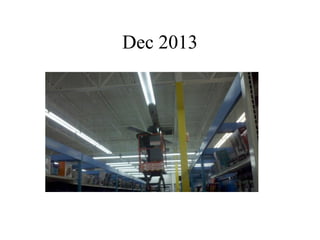
Dec 2013
Oct 2013
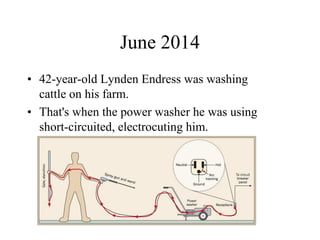
June 2014
• 42-year-old Lynden Endress was washing
cattle on his farm.
• That's when the power washer he was using
short-circuited, electrocuting him.
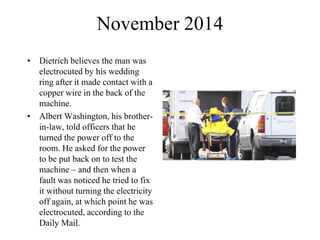
November 2014
• Dietrich believes the man was
electrocuted by his wedding
ring after it made contact with a
copper wire in the back of the
machine.
• Albert Washington, his brother-
in-law, told officers that he
turned the power off to the
room. He asked for the power
to be put back on to test the
machine – and then when a
fault was noticed he tried to fix
it without turning the electricity
off again, at which point he was
electrocuted, according to the
Daily Mail.
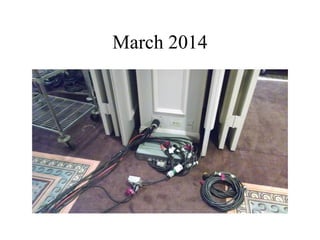
March 2014
Top 10 Most Cited Standards
(General Industry Only)
1. Hazard Communication
2. Respiratory Protection
3. Lockout/Tagout
4. Powered Industrial
Trucks
5. Electrical, Wiring
Methods
6. Machine Guarding
7. Electrical, Systems
Design
8. Powered Transmission
Apparatus
9. Personal Protective
Equipment
10. Abrasive Wheel
Machinery
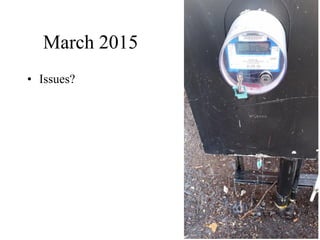
March 2015
• Issues?
Who needs
training?
• 1910.332(a)
• Employees in occupations listed
in Table S-4 face such a risk
and are required to be trained.
Other employees who also may
reasonably be expected to face
comparable risk of injury due to
electric shock or other electrical
hazards must also be trained.
• At a minimum, be trained in
and familiar with the following:
• The skills and techniques
necessary to distinguish
exposed live parts from other
parts of electric equipment.
• The skills and techniques
necessary to determine the
nominal voltage of exposed live
parts, and
• The clearance distances
specified in 1910.333(c) and the
corresponding voltages to
which the qualified person will
be exposed.
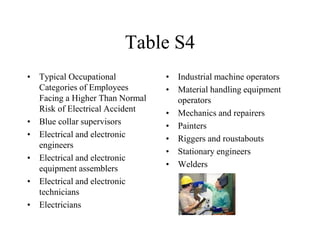
Table S4
• Typical Occupational
Categories of Employees
Facing a Higher Than Normal
Risk of Electrical Accident
• Blue collar supervisors
• Electrical and electronic
engineers
• Electrical and electronic
equipment assemblers
• Electrical and electronic
technicians
• Electricians
• Industrial machine operators
• Material handling equipment
operators
• Mechanics and repairers
• Painters
• Riggers and roustabouts
• Stationary engineers
• Welders
Ohm’s Law
• The equations of Ohm’s Law
are:
• Voltage = Current times
Resistance
• Current equals Voltage divided
by Resistance,
• Resistance equals Voltage
divided by Current.
• 13,800 Volts / 1000 Ohms =
13.8 Amps
• 480 Volts / 0.1 Ohms = 4,800
Amps
• 480 Volts / 0.01 Ohms = 48,000
Amps
Determine the Current
• Voltage is 120 volts. Resistance is 12 ohms.
Current, then, is _______ amps.
• Voltage is 480, resistance is 1 Ohm =
_____ amps
• Voltage is 220 resistance is 2200 Ohm =
_____ amps
Electrical Current Effect
• 1 mA threshold for feeling
• 10-20 mA voluntary let-go of circuit
impossible
• 25 mA onset of muscular contractions
50-200 mA ventricular fibrillation or
cardiac arrest
• E. A. Lacy, Handbook of Electronic Safety Procedures, Prentice- Hall: Englewood Cliffs,
New Jersey (1977)
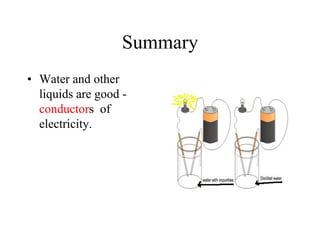
Electricity and Conductors
• To flow, electricity must have a complete
path back to earth
• Electricity flows through conductors
• Water, Metal, the human body can be
conductors
• Insulators are not conductors
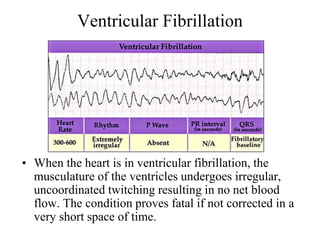
Ventricular Fibrillation
• When the heart is in ventricular fibrillation, the
musculature of the ventricles undergoes irregular,
uncoordinated twitching resulting in no net blood
flow. The condition proves fatal if not corrected in a
very short space of time.
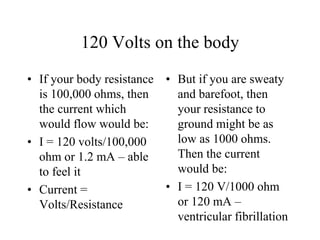
120 Volts on the body
• If your body resistance
is 100,000 ohms, then
the current which
would flow would be:
• I = 120 volts/100,000
ohm or 1.2 mA – able
to feel it
• Current =
Volts/Resistance
• But if you are sweaty
and barefoot, then
your resistance to
ground might be as
low as 1000 ohms.
Then the current
would be:
• I = 120 V/1000 ohm
or 120 mA –
ventricular fibrillation
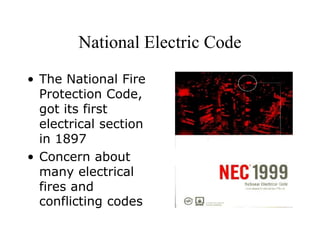
National Electric Code
• The National Fire
Protection Code,
got its first
electrical section
in 1897
• Concern about
many electrical
fires and
conflicting codes
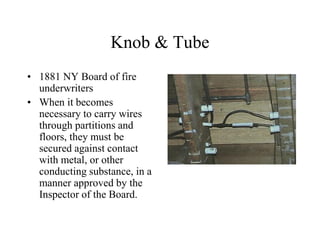
Knob & Tube
• 1881 NY Board of fire
underwriters
• When it becomes
necessary to carry wires
through partitions and
floors, they must be
secured against contact
with metal, or other
conducting substance, in a
manner approved by the
Inspector of the Board.
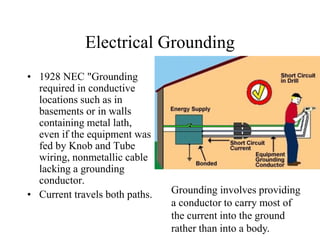
Electrical Grounding
• 1928 NEC "Grounding
required in conductive
locations such as in
basements or in walls
containing metal lath,
even if the equipment was
fed by Knob and Tube
wiring, nonmetallic cable
lacking a grounding
conductor.
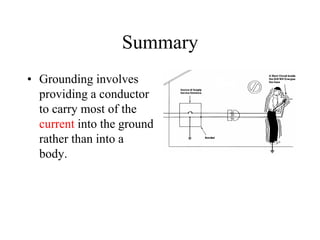
• Current travels both paths. Grounding involves providing
a conductor to carry most of
the current into the ground
rather than into a body.
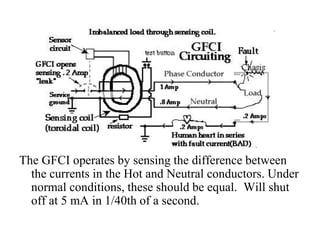
GFCI’s –1971 NEC
The GFCI operates by sensing the difference between
the currents in the Hot and Neutral conductors. Under
normal conditions, these should be equal. Will shut
off at 5 mA in 1/40th of a second.
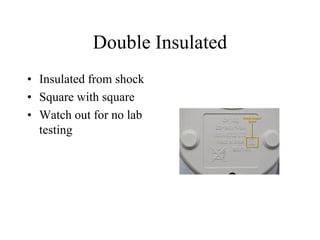
Double Insulated
• Insulated from shock
• Square with square
• Watch out for no lab
testing
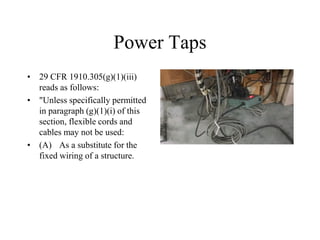
Power Taps
• 29 CFR 1910.305(g)(1)(iii)
reads as follows:
• "Unless specifically permitted
in paragraph (g)(1)(i) of this
section, flexible cords and
cables may not be used:
• (A) As a substitute for the
fixed wiring of a structure.
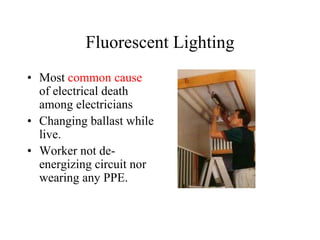
Fluorescent Lighting
• Most common cause
of electrical death
among electricians
• Changing ballast while
live.
• Worker not de-
energizing circuit nor
wearing any PPE.
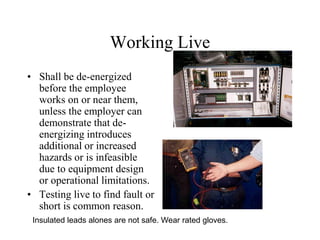
Working Live
• Shall be de-energized
before the employee
works on or near them,
unless the employer can
demonstrate that de-
energizing introduces
additional or increased
hazards or is infeasible
due to equipment design
or operational limitations.
• Testing live to find fault or
short is common reason.
Insulated leads alones are not safe. Wear rated gloves.
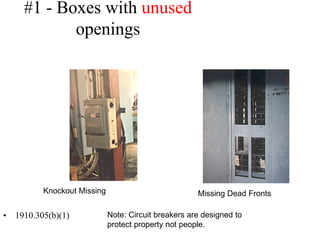
#1 - Boxes with unused
openings
• 1910.305(b)(1)
Knockout Missing Missing Dead Fronts
Note: Circuit breakers are designed to
protect property not people.
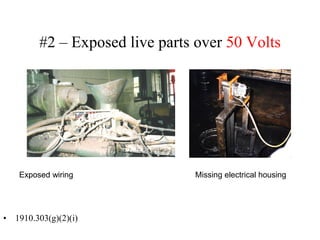
#2 – Exposed live parts over 50 Volts
• 1910.303(g)(2)(i)
Exposed wiring Missing electrical housing
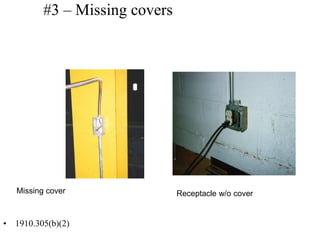
#3 – Missing covers
• 1910.305(b)(2)
Missing cover Receptacle w/o cover
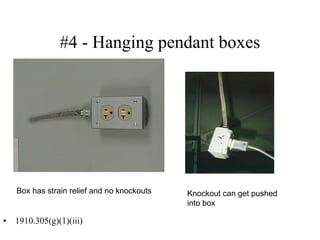
#4 - Hanging pendant boxes
• 1910.305(g)(1)(iii)
Box has strain relief and no knockouts Knockout can get pushed
into box
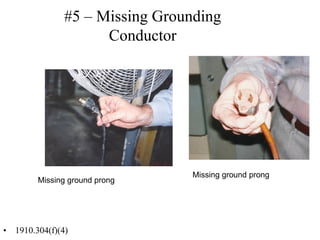
#5 – Missing Grounding
Conductor
• 1910.304(f)(4)
Missing ground prong
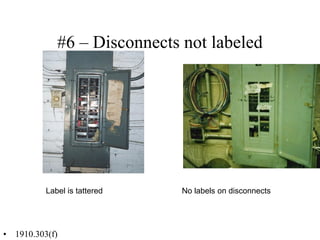
#6 – Disconnects not labeled
• 1910.303(f)
Label is tattered No labels on disconnects
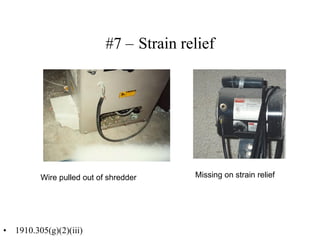
#7 – Strain relief
• 1910.305(g)(2)(iii)
Wire pulled out of shredder Missing on strain relief
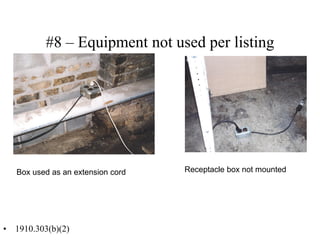
#8 – Equipment not used per listing
• 1910.303(b)(2)
Box used as an extension cord Receptacle box not mounted
Nov 2013
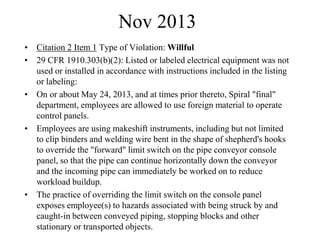
• Citation 2 Item 1 Type of Violation: Willful
• 29 CFR 1910.303(b)(2): Listed or labeled electrical equipment was not
used or installed in accordance with instructions included in the listing
or labeling:
• On or about May 24, 2013, and at times prior thereto, Spiral "final"
department, employees are allowed to use foreign material to operate
control panels.
• Employees are using makeshift instruments, including but not limited
to clip binders and welding wire bent in the shape of shepherd's hooks
to override the "forward" limit switch on the pipe conveyor console
panel, so that the pipe can continue horizontally down the conveyor
and the incoming pipe can immediately be worked on to reduce
workload buildup.
• The practice of overriding the limit switch on the console panel
exposes employee(s) to hazards associated with being struck by and
caught-in between conveyed piping, stopping blocks and other
stationary or transported objects.
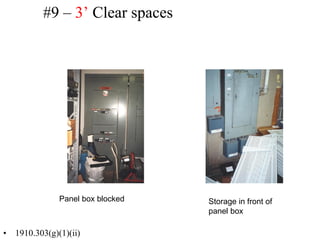
#9 – 3’ Clear spaces
• 1910.303(g)(1)(ii)
Panel box blocked Storage in front of
panel box
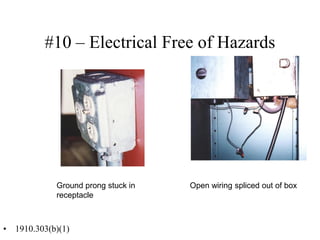
#10 – Electrical Free of Hazards
• 1910.303(b)(1)
Ground prong stuck in
receptacle
Open wiring spliced out of box
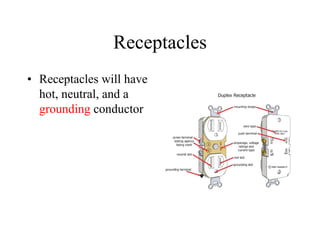
Receptacles
• Receptacles will have
hot, neutral, and a
grounding conductor
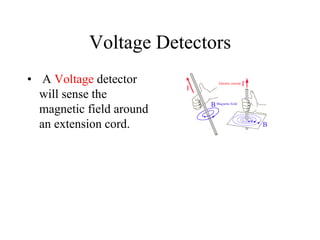
Voltage Detectors
• A Voltage detector
will sense the
magnetic field around
an extension cord.

Insulated Gloves
Electrical gloves can protect the worker who must test circuits live.
Gloves can be bought for work with voltages under 500 volts. These are Class
00 gloves.
Gloves must be sized for each employee.
Test every six months.
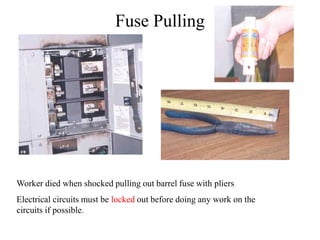
Fuse Pulling
Worker died when shocked pulling out barrel fuse with pliers
Electrical circuits must be locked out before doing any work on the
circuits if possible.
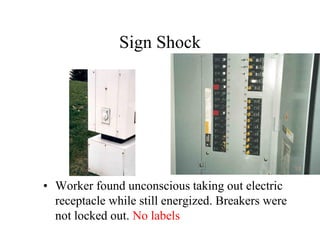
Sign Shock
• Worker found unconscious taking out electric
receptacle while still energized. Breakers were
not locked out. No labels
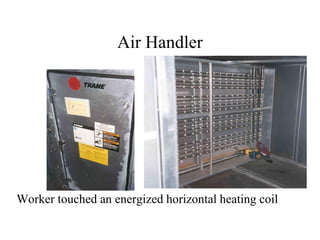
Air Handler
Worker touched an energized horizontal heating coil
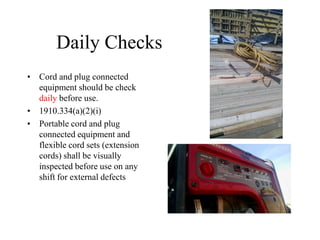
Daily Checks
• Cord and plug connected
equipment should be check
daily before use.
• 1910.334(a)(2)(i)
• Portable cord and plug
connected equipment and
flexible cord sets (extension
cords) shall be visually
inspected before use on any
shift for external defects
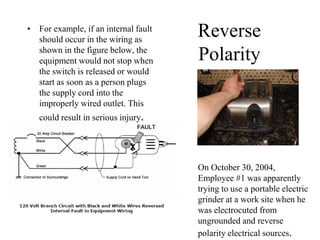
Reverse
Polarity
• For example, if an internal fault
should occur in the wiring as
shown in the figure below, the
equipment would not stop when
the switch is released or would
start as soon as a person plugs
the supply cord into the
improperly wired outlet. This
could result in serious injury.
On October 30, 2004,
Employee #1 was apparently
trying to use a portable electric
grinder at a work site when he
was electrocuted from
ungrounded and reverse
polarity electrical sources.
Capacitors
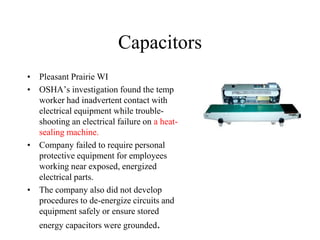
• Pleasant Prairie WI
• OSHA’s investigation found the temp
worker had inadvertent contact with
electrical equipment while trouble-
shooting an electrical failure on a heat-
sealing machine.
• Company failed to require personal
protective equipment for employees
working near exposed, energized
electrical parts.
• The company also did not develop
procedures to de-energize circuits and
equipment safely or ensure stored
energy capacitors were grounded.
Clear Space again
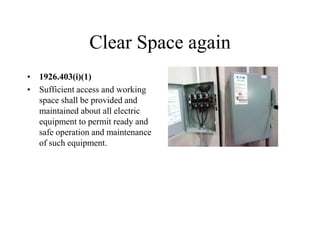
• 1926.403(i)(1)
• Sufficient access and working
space shall be provided and
maintained about all electric
equipment to permit ready and
safe operation and maintenance
of such equipment.
Classified Locations
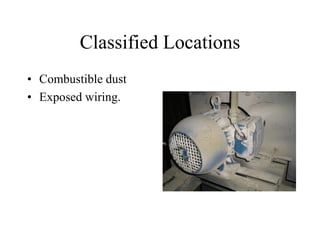
• Combustible dust
• Exposed wiring.
Quiz
• What mA causes muscle contractions? ____
• A GFCI will shut off in ____ of a second.
• When the musculature of the ventricles undergoes
irregular, uncoordinated twitching resulting in no
net blood flow is called _______ _______
• Live parts over ___ volts need to be guarded.
• ___ feet of clear space must be maintained in front
of electrical panels
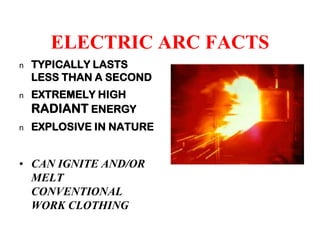
ELECTRIC ARC FACTS
n TYPICALLY LASTS
LESS THAN A SECOND
n EXTREMELY HIGH
RADIANT ENERGY
n EXPLOSIVE IN NATURE
• CAN IGNITE AND/OR
MELT
CONVENTIONAL
WORK CLOTHING
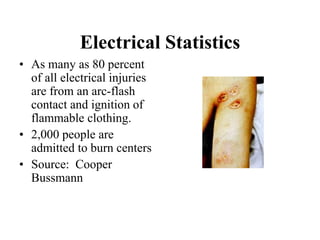
Electrical Statistics
• As many as 80 percent
of all electrical injuries
are from an arc-flash
contact and ignition of
flammable clothing.
• 2,000 people are
admitted to burn centers
• Source: Cooper
Bussmann
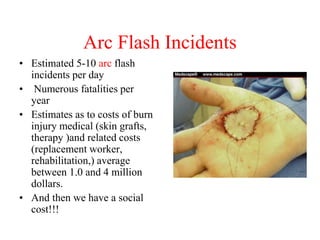
Arc Flash Incidents
• Estimated 5-10 arc flash
incidents per day
• Numerous fatalities per
year
• Estimates as to costs of burn
injury medical (skin grafts,
therapy )and related costs
(replacement worker,
rehabilitation,) average
between 1.0 and 4 million
dollars.
• And then we have a social
cost!!!
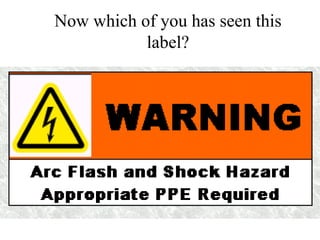
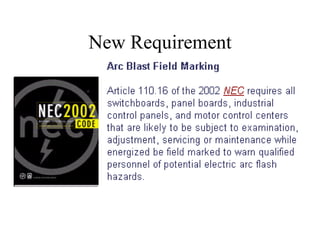
Now which of you has seen this
label?
New Requirement
If the marking is not there.
• The system was turned over without the
appropriate hazard warnings.
• It is not in compliance with the the 2002
National Electrical Code
• If there is an Arc Blast/Flash event what is
your exposure???
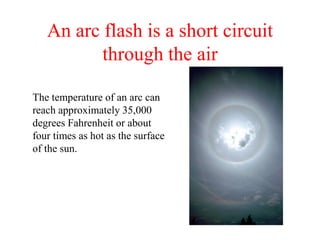
An arc flash is a short circuit
through the air
The temperature of an arc can
reach approximately 35,000
degrees Fahrenheit or about
four times as hot as the surface
of the sun.
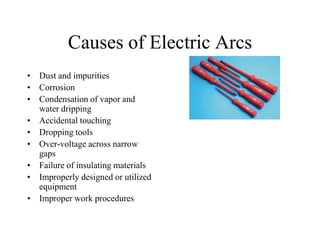
Causes of Electric Arcs
• Dust and impurities
• Corrosion
• Condensation of vapor and
water dripping
• Accidental touching
• Dropping tools
• Over-voltage across narrow
gaps
• Failure of insulating materials
• Improperly designed or utilized
equipment
• Improper work procedures
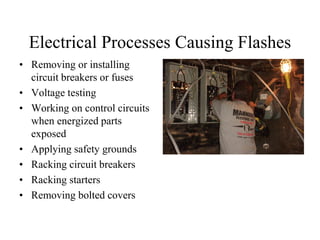
Electrical Processes Causing Flashes
• Removing or installing
circuit breakers or fuses
• Voltage testing
• Working on control circuits
when energized parts
exposed
• Applying safety grounds
• Racking circuit breakers
• Racking starters
• Removing bolted covers
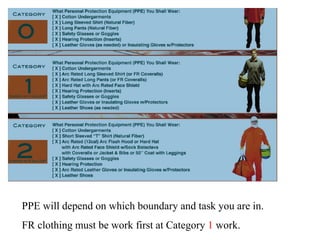
PPE
PPE will depend on which boundary and task you are in.
FR clothing must be work first at Category 1 work.
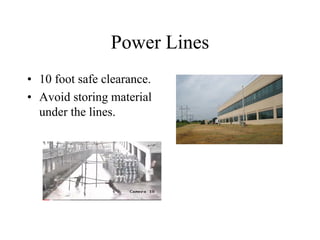
Power Lines
• 10 foot safe clearance.
• Avoid storing material
under the lines.
Summary
• Grounding involves
providing a conductor
to carry most of the
current into the ground
rather than into a
body.
Summary
• Water and other
liquids are good -
conductors of
electricity.
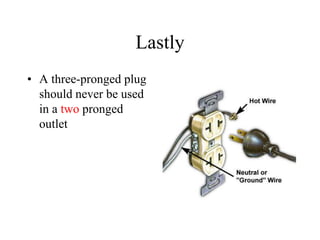
Lastly
• A three-pronged plug
should never be used
in a two pronged
outlet
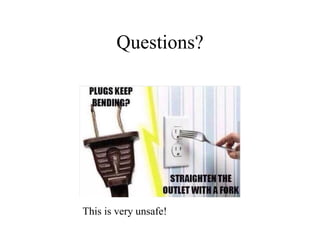
Questions?
This is very unsafe!

Industrial electrical safety

  • 1.
  • 2.
  • 3.
  • 4.
    June 2014 • 42-year-oldLynden Endress was washing cattle on his farm. • That's when the power washer he was using short-circuited, electrocuting him.
  • 5.
    November 2014 • Dietrichbelieves the man was electrocuted by his wedding ring after it made contact with a copper wire in the back of the machine. • Albert Washington, his brother- in-law, told officers that he turned the power off to the room. He asked for the power to be put back on to test the machine – and then when a fault was noticed he tried to fix it without turning the electricity off again, at which point he was electrocuted, according to the Daily Mail.
  • 6.
  • 7.
    Top 10 MostCited Standards (General Industry Only) 1. Hazard Communication 2. Respiratory Protection 3. Lockout/Tagout 4. Powered Industrial Trucks 5. Electrical, Wiring Methods 6. Machine Guarding 7. Electrical, Systems Design 8. Powered Transmission Apparatus 9. Personal Protective Equipment 10. Abrasive Wheel Machinery
  • 8.
  • 9.
    Who needs training? • 1910.332(a) •Employees in occupations listed in Table S-4 face such a risk and are required to be trained. Other employees who also may reasonably be expected to face comparable risk of injury due to electric shock or other electrical hazards must also be trained. • At a minimum, be trained in and familiar with the following: • The skills and techniques necessary to distinguish exposed live parts from other parts of electric equipment. • The skills and techniques necessary to determine the nominal voltage of exposed live parts, and • The clearance distances specified in 1910.333(c) and the corresponding voltages to which the qualified person will be exposed.
  • 10.
    Table S4 • TypicalOccupational Categories of Employees Facing a Higher Than Normal Risk of Electrical Accident • Blue collar supervisors • Electrical and electronic engineers • Electrical and electronic equipment assemblers • Electrical and electronic technicians • Electricians • Industrial machine operators • Material handling equipment operators • Mechanics and repairers • Painters • Riggers and roustabouts • Stationary engineers • Welders
  • 11.
    Ohm’s Law • Theequations of Ohm’s Law are: • Voltage = Current times Resistance • Current equals Voltage divided by Resistance, • Resistance equals Voltage divided by Current. • 13,800 Volts / 1000 Ohms = 13.8 Amps • 480 Volts / 0.1 Ohms = 4,800 Amps • 480 Volts / 0.01 Ohms = 48,000 Amps
  • 12.
    Determine the Current •Voltage is 120 volts. Resistance is 12 ohms. Current, then, is _______ amps. • Voltage is 480, resistance is 1 Ohm = _____ amps • Voltage is 220 resistance is 2200 Ohm = _____ amps
  • 13.
    Electrical Current Effect •1 mA threshold for feeling • 10-20 mA voluntary let-go of circuit impossible • 25 mA onset of muscular contractions 50-200 mA ventricular fibrillation or cardiac arrest • E. A. Lacy, Handbook of Electronic Safety Procedures, Prentice- Hall: Englewood Cliffs, New Jersey (1977)
  • 14.
    Electricity and Conductors •To flow, electricity must have a complete path back to earth • Electricity flows through conductors • Water, Metal, the human body can be conductors • Insulators are not conductors
  • 15.
    Ventricular Fibrillation • Whenthe heart is in ventricular fibrillation, the musculature of the ventricles undergoes irregular, uncoordinated twitching resulting in no net blood flow. The condition proves fatal if not corrected in a very short space of time.
  • 16.
    120 Volts onthe body • If your body resistance is 100,000 ohms, then the current which would flow would be: • I = 120 volts/100,000 ohm or 1.2 mA – able to feel it • Current = Volts/Resistance • But if you are sweaty and barefoot, then your resistance to ground might be as low as 1000 ohms. Then the current would be: • I = 120 V/1000 ohm or 120 mA – ventricular fibrillation
  • 17.
    National Electric Code •The National Fire Protection Code, got its first electrical section in 1897 • Concern about many electrical fires and conflicting codes
  • 18.
    Knob & Tube •1881 NY Board of fire underwriters • When it becomes necessary to carry wires through partitions and floors, they must be secured against contact with metal, or other conducting substance, in a manner approved by the Inspector of the Board.
  • 19.
    Electrical Grounding • 1928NEC "Grounding required in conductive locations such as in basements or in walls containing metal lath, even if the equipment was fed by Knob and Tube wiring, nonmetallic cable lacking a grounding conductor. • Current travels both paths. Grounding involves providing a conductor to carry most of the current into the ground rather than into a body.
  • 20.
    GFCI’s –1971 NEC TheGFCI operates by sensing the difference between the currents in the Hot and Neutral conductors. Under normal conditions, these should be equal. Will shut off at 5 mA in 1/40th of a second.
  • 22.
    Double Insulated • Insulatedfrom shock • Square with square • Watch out for no lab testing
  • 23.
    Power Taps • 29CFR 1910.305(g)(1)(iii) reads as follows: • "Unless specifically permitted in paragraph (g)(1)(i) of this section, flexible cords and cables may not be used: • (A) As a substitute for the fixed wiring of a structure.
  • 24.
    Fluorescent Lighting • Mostcommon cause of electrical death among electricians • Changing ballast while live. • Worker not de- energizing circuit nor wearing any PPE.
  • 25.
    Working Live • Shallbe de-energized before the employee works on or near them, unless the employer can demonstrate that de- energizing introduces additional or increased hazards or is infeasible due to equipment design or operational limitations. • Testing live to find fault or short is common reason. Insulated leads alones are not safe. Wear rated gloves.
  • 26.
    #1 - Boxeswith unused openings • 1910.305(b)(1) Knockout Missing Missing Dead Fronts Note: Circuit breakers are designed to protect property not people.
  • 27.
    #2 – Exposedlive parts over 50 Volts • 1910.303(g)(2)(i) Exposed wiring Missing electrical housing
  • 28.
    #3 – Missingcovers • 1910.305(b)(2) Missing cover Receptacle w/o cover
  • 29.
    #4 - Hangingpendant boxes • 1910.305(g)(1)(iii) Box has strain relief and no knockouts Knockout can get pushed into box
  • 30.
    #5 – MissingGrounding Conductor • 1910.304(f)(4) Missing ground prong Missing ground prong
  • 31.
    #6 – Disconnectsnot labeled • 1910.303(f) Label is tattered No labels on disconnects
  • 32.
    #7 – Strainrelief • 1910.305(g)(2)(iii) Wire pulled out of shredder Missing on strain relief
  • 33.
    #8 – Equipmentnot used per listing • 1910.303(b)(2) Box used as an extension cord Receptacle box not mounted
  • 34.
    Nov 2013 • Citation2 Item 1 Type of Violation: Willful • 29 CFR 1910.303(b)(2): Listed or labeled electrical equipment was not used or installed in accordance with instructions included in the listing or labeling: • On or about May 24, 2013, and at times prior thereto, Spiral "final" department, employees are allowed to use foreign material to operate control panels. • Employees are using makeshift instruments, including but not limited to clip binders and welding wire bent in the shape of shepherd's hooks to override the "forward" limit switch on the pipe conveyor console panel, so that the pipe can continue horizontally down the conveyor and the incoming pipe can immediately be worked on to reduce workload buildup. • The practice of overriding the limit switch on the console panel exposes employee(s) to hazards associated with being struck by and caught-in between conveyed piping, stopping blocks and other stationary or transported objects.
  • 35.
    #9 – 3’Clear spaces • 1910.303(g)(1)(ii) Panel box blocked Storage in front of panel box
  • 36.
    #10 – ElectricalFree of Hazards • 1910.303(b)(1) Ground prong stuck in receptacle Open wiring spliced out of box
  • 37.
    Receptacles • Receptacles willhave hot, neutral, and a grounding conductor
  • 38.
    Voltage Detectors • AVoltage detector will sense the magnetic field around an extension cord.
  • 39.
    Insulated Gloves Electrical glovescan protect the worker who must test circuits live. Gloves can be bought for work with voltages under 500 volts. These are Class 00 gloves. Gloves must be sized for each employee. Test every six months.
  • 40.
    Fuse Pulling Worker diedwhen shocked pulling out barrel fuse with pliers Electrical circuits must be locked out before doing any work on the circuits if possible.
  • 41.
    Sign Shock • Workerfound unconscious taking out electric receptacle while still energized. Breakers were not locked out. No labels
  • 42.
    Air Handler Worker touchedan energized horizontal heating coil
  • 43.
    Daily Checks • Cordand plug connected equipment should be check daily before use. • 1910.334(a)(2)(i) • Portable cord and plug connected equipment and flexible cord sets (extension cords) shall be visually inspected before use on any shift for external defects
  • 44.
    Reverse Polarity • For example,if an internal fault should occur in the wiring as shown in the figure below, the equipment would not stop when the switch is released or would start as soon as a person plugs the supply cord into the improperly wired outlet. This could result in serious injury. On October 30, 2004, Employee #1 was apparently trying to use a portable electric grinder at a work site when he was electrocuted from ungrounded and reverse polarity electrical sources.
  • 45.
    Capacitors • Pleasant PrairieWI • OSHA’s investigation found the temp worker had inadvertent contact with electrical equipment while trouble- shooting an electrical failure on a heat- sealing machine. • Company failed to require personal protective equipment for employees working near exposed, energized electrical parts. • The company also did not develop procedures to de-energize circuits and equipment safely or ensure stored energy capacitors were grounded.
  • 46.
    Clear Space again •1926.403(i)(1) • Sufficient access and working space shall be provided and maintained about all electric equipment to permit ready and safe operation and maintenance of such equipment.
  • 47.
    Classified Locations • Combustibledust • Exposed wiring.
  • 48.
    Quiz • What mAcauses muscle contractions? ____ • A GFCI will shut off in ____ of a second. • When the musculature of the ventricles undergoes irregular, uncoordinated twitching resulting in no net blood flow is called _______ _______ • Live parts over ___ volts need to be guarded. • ___ feet of clear space must be maintained in front of electrical panels
  • 49.
    ELECTRIC ARC FACTS nTYPICALLY LASTS LESS THAN A SECOND n EXTREMELY HIGH RADIANT ENERGY n EXPLOSIVE IN NATURE • CAN IGNITE AND/OR MELT CONVENTIONAL WORK CLOTHING
  • 50.
    Electrical Statistics • Asmany as 80 percent of all electrical injuries are from an arc-flash contact and ignition of flammable clothing. • 2,000 people are admitted to burn centers • Source: Cooper Bussmann
  • 51.
    Arc Flash Incidents •Estimated 5-10 arc flash incidents per day • Numerous fatalities per year • Estimates as to costs of burn injury medical (skin grafts, therapy )and related costs (replacement worker, rehabilitation,) average between 1.0 and 4 million dollars. • And then we have a social cost!!!
  • 52.
    Now which ofyou has seen this label?
  • 53.
  • 54.
    If the markingis not there. • The system was turned over without the appropriate hazard warnings. • It is not in compliance with the the 2002 National Electrical Code • If there is an Arc Blast/Flash event what is your exposure???
  • 55.
    An arc flashis a short circuit through the air The temperature of an arc can reach approximately 35,000 degrees Fahrenheit or about four times as hot as the surface of the sun.
  • 56.
    Causes of ElectricArcs • Dust and impurities • Corrosion • Condensation of vapor and water dripping • Accidental touching • Dropping tools • Over-voltage across narrow gaps • Failure of insulating materials • Improperly designed or utilized equipment • Improper work procedures
  • 57.
    Electrical Processes CausingFlashes • Removing or installing circuit breakers or fuses • Voltage testing • Working on control circuits when energized parts exposed • Applying safety grounds • Racking circuit breakers • Racking starters • Removing bolted covers
  • 58.
  • 59.
    PPE will dependon which boundary and task you are in. FR clothing must be work first at Category 1 work.
  • 60.
    Power Lines • 10foot safe clearance. • Avoid storing material under the lines.
  • 61.
    Summary • Grounding involves providinga conductor to carry most of the current into the ground rather than into a body.
  • 62.
    Summary • Water andother liquids are good - conductors of electricity.
  • 63.
    Lastly • A three-prongedplug should never be used in a two pronged outlet
  • 64.