AS Media Studies;
Narrative Theory
Once upon a time…
Story? Narrative? Plot?
• What is narrative?
• While the term ‘narrative’ certainly is
not used as commonly as ‘story’, most
people know that it refers, in some way.
• We encounter narratives on a daily basis.
Where do we see/hear stories on a
day to day basis?
• TV Programmes
• Novels or short stories
• Films
• Advertisements
• Newspapers or on TV and radio
• Via the internet
• Through talk, ‘gossip’ and chat.
Once upon a time…
• Many of us experience our first story at a very young
age, possibly beginning with the immortal phrase of
countless fairy tales, ‘Once upon a time…’
• What does this phrase really mean to us?
• “Once” =
• “Once” invites us into the narrative world which is
set in the past; indeed, most narratives are
recounted in the past tense.
• “upon a time” =
• Situates us in a world we know is different to our
own, in a time that is not now.
Once upon a time…
• Write down quickly what story you expect to
happen after the line below.
• ‘It was a bright cold day in April, and the clocks
were striking thirteen.’
Film posters and Openings
• Openings are intended to grab and hold the attention
of the receiver of the text. People will lose interest
if it doesn’t capture the attention immediately.
• The extract is from George Orwell’s Nineteen Eighty-
four. The sentence is made intriguing because the
clocks strike ‘thirteen’. This immediately sets up a
puzzle or an ENIGMA CODE as Barthes would call it.
• We would probably expect a science fiction style
narrative (the novel was written in 1949 and is an
alarming vision of a time and place where the world
has different rules.)
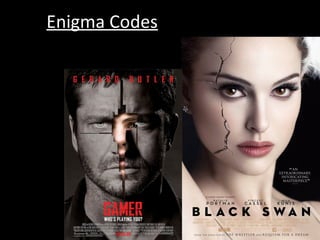
Enigma Codes
Action Codes
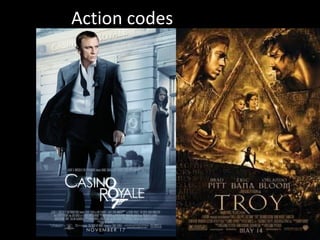
• Barthes also suggests that action codes exist
this term applies to any action that suggestion
further narrative action. For example, a
cowboy draws his gun on an enemy and we
wonder what the resolution of this will be.
•
Action codes
Levi-Strauss and binary
oppositions.
Claude Levi-Strauss, a French theorist (not the
jeans!) gave media studies a number of influential
theories that help us to understand how meaning is
established quickly in openings.
Binary Oppositions create meaning through
establishing what something is not. We understand
the world through a system of power weighted
oppositions.
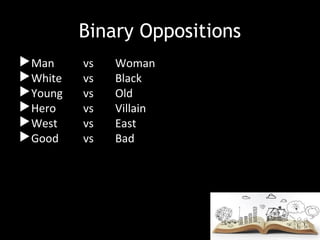
Binary Oppositions
Man vs Woman
White vs Black
Young vs Old
Hero vs Villain
West vs East
Good vs Bad
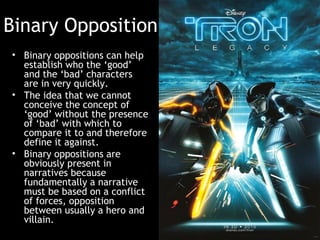
Binary Opposition
• Binary oppositions can help
establish who the ‘good’
and the ‘bad’ characters
are in very quickly.
• The idea that we cannot
conceive the concept of
‘good’ without the presence
of ‘bad’ with which to
compare it to and therefore
define it against.
• Binary oppositions are
obviously present in
narratives because
fundamentally a narrative
must be based on a conflict
of forces, opposition
between usually a hero and
villain.
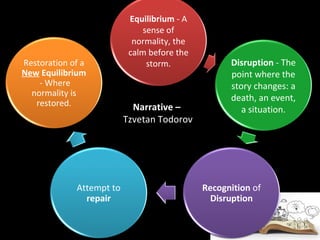
Narrative –Narrative –
Tzvetan Todorov
Equilibrium - A
sense of
normality, the
calm before the
storm. Disruption - The
point where the
story changes: a
death, an event,
a situation.
Recognition of
Disruption
Attempt to
repair
Restoration of a
New Equilibrium
- Where
normality is
restored.
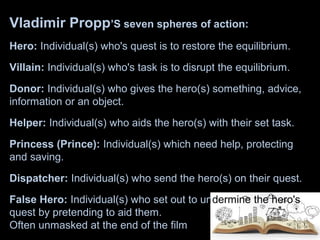
Vladimir Propp’S seven spheres of action:
Hero: Individual(s) who's quest is to restore the equilibrium.
Villain: Individual(s) who's task is to disrupt the equilibrium.
Donor: Individual(s) who gives the hero(s) something, advice,
information or an object.
Helper: Individual(s) who aids the hero(s) with their set task.
Princess (Prince): Individual(s) which need help, protecting
and saving.
Dispatcher: Individual(s) who send the hero(s) on their quest.
False Hero: Individual(s) who set out to undermine the hero's
quest by pretending to aid them.
Often unmasked at the end of the film
Multi-strand Narrative
A multi-strand narrative structure means
there are several narratives running at the
same time. This is very common in
television and radio soaps and ongoing
drama series, such as Holby City, and The
Bill.
Narrative Structure - Endings
• Narrative structure is the way the story or plot
unfolds. Is the story an open or closed structure. A
closed structure means the story ends satisfactorily
as in most films - this is known as closure, with the
girl getting the boy or the hero saving the planet.
• An open ending means there is no final conclusion to
the story - a television has no final ending, it just has
minor endings ( a character gets killed). It is left
open for the story to continue.

Lesson 9 - narrative

  • 1.
    AS Media Studies; NarrativeTheory Once upon a time…
  • 2.
    Story? Narrative? Plot? •What is narrative? • While the term ‘narrative’ certainly is not used as commonly as ‘story’, most people know that it refers, in some way. • We encounter narratives on a daily basis.
  • 3.
    Where do wesee/hear stories on a day to day basis? • TV Programmes • Novels or short stories • Films • Advertisements • Newspapers or on TV and radio • Via the internet • Through talk, ‘gossip’ and chat.
  • 4.
    Once upon atime… • Many of us experience our first story at a very young age, possibly beginning with the immortal phrase of countless fairy tales, ‘Once upon a time…’ • What does this phrase really mean to us? • “Once” = • “Once” invites us into the narrative world which is set in the past; indeed, most narratives are recounted in the past tense. • “upon a time” = • Situates us in a world we know is different to our own, in a time that is not now.
  • 5.
    Once upon atime… • Write down quickly what story you expect to happen after the line below. • ‘It was a bright cold day in April, and the clocks were striking thirteen.’
  • 6.
    Film posters andOpenings • Openings are intended to grab and hold the attention of the receiver of the text. People will lose interest if it doesn’t capture the attention immediately. • The extract is from George Orwell’s Nineteen Eighty- four. The sentence is made intriguing because the clocks strike ‘thirteen’. This immediately sets up a puzzle or an ENIGMA CODE as Barthes would call it. • We would probably expect a science fiction style narrative (the novel was written in 1949 and is an alarming vision of a time and place where the world has different rules.)
  • 7.
  • 8.
    Action Codes • Barthesalso suggests that action codes exist this term applies to any action that suggestion further narrative action. For example, a cowboy draws his gun on an enemy and we wonder what the resolution of this will be. •
  • 9.
  • 10.
    Levi-Strauss and binary oppositions. ClaudeLevi-Strauss, a French theorist (not the jeans!) gave media studies a number of influential theories that help us to understand how meaning is established quickly in openings. Binary Oppositions create meaning through establishing what something is not. We understand the world through a system of power weighted oppositions.
  • 11.
    Binary Oppositions Man vsWoman White vs Black Young vs Old Hero vs Villain West vs East Good vs Bad
  • 12.
    Binary Opposition • Binaryoppositions can help establish who the ‘good’ and the ‘bad’ characters are in very quickly. • The idea that we cannot conceive the concept of ‘good’ without the presence of ‘bad’ with which to compare it to and therefore define it against. • Binary oppositions are obviously present in narratives because fundamentally a narrative must be based on a conflict of forces, opposition between usually a hero and villain.
  • 13.
    Narrative –Narrative – TzvetanTodorov Equilibrium - A sense of normality, the calm before the storm. Disruption - The point where the story changes: a death, an event, a situation. Recognition of Disruption Attempt to repair Restoration of a New Equilibrium - Where normality is restored.
  • 14.
    Vladimir Propp’S sevenspheres of action: Hero: Individual(s) who's quest is to restore the equilibrium. Villain: Individual(s) who's task is to disrupt the equilibrium. Donor: Individual(s) who gives the hero(s) something, advice, information or an object. Helper: Individual(s) who aids the hero(s) with their set task. Princess (Prince): Individual(s) which need help, protecting and saving. Dispatcher: Individual(s) who send the hero(s) on their quest. False Hero: Individual(s) who set out to undermine the hero's quest by pretending to aid them. Often unmasked at the end of the film
  • 15.
    Multi-strand Narrative A multi-strandnarrative structure means there are several narratives running at the same time. This is very common in television and radio soaps and ongoing drama series, such as Holby City, and The Bill.
  • 16.
    Narrative Structure -Endings • Narrative structure is the way the story or plot unfolds. Is the story an open or closed structure. A closed structure means the story ends satisfactorily as in most films - this is known as closure, with the girl getting the boy or the hero saving the planet. • An open ending means there is no final conclusion to the story - a television has no final ending, it just has minor endings ( a character gets killed). It is left open for the story to continue.