Plot and Narrative
What is narrative and plot?
Narrative: Narrative is the art of telling story or an
account of connected events.
Plot: The main events of a film, book, TV programme
and are presented in a connected sequence.
There are key elements that make up a story and these
aspects need to be combined to create a grander product
of the story.
These elements include characters, plot, setting etc.
Narrative is the way that these elements are combined to
create a coherent text.
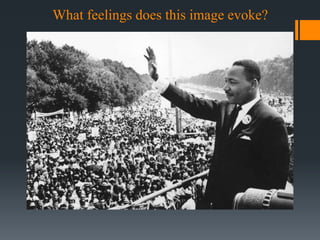
What feelings does this image evoke?
What it shows (in my opinion)
Martin Luther King is shown waving down to hundreds
of people giving him a status of power and influence
over mainly shown by the positioning of MLK and the
followers as well as the vast amount followers in
watching him.
The context of the photograph is that it’s a historical
event of the oppression of black people being rejected
and MLK being victorious against the oppressive force
of America
This image was taken on Algiers Street and was one of
the most iconic image of the 20th century.
Roland Barthes & Action Codes
Barthes specified a multitude of Narrative Codes with
the most relevant being Action/Enigma Codes.
Action Codes allow the audience to understand what is
to come and how to react to what’s going to happen
next.
An example would be two characters talking about what
someone is doing then the film cutting to them.
This action allows the film to transition to a different
storyline completely and prepares the audience for this.
Roland Barthes and Enigma Code
Enigma Codes are where the media text presents the
audience with a question that will be answered by the
end of the media text
An example would be at the beginning of a Detective
Show where a murder victim is shown and the murderer
and his motive is unknown to the audience and will be
revealed through the episode.
Other Narrative Codes:
Symbols and Signs are used as identifiers and clues to
help piece the story slowly together.
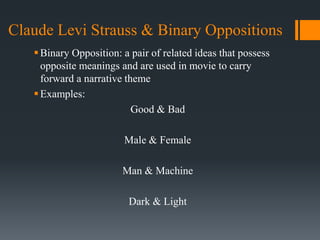
Claude Levi Strauss & Binary Oppositions
Binary Opposition: a pair of related ideas that possess
opposite meanings and are used in movie to carry
forward a narrative theme
Examples:
Good & Bad
Male & Female
Man & Machine
Dark & Light
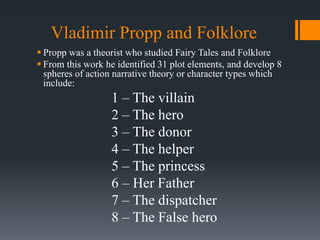
Vladimir Propp and Folklore
 Propp was a theorist who studied Fairy Tales and Folklore
 From this work he identified 31 plot elements, and develop 8
spheres of action narrative theory or character types which
include:
1 – The villain
2 – The hero
3 – The donor
4 – The helper
5 – The princess
6 – Her Father
7 – The dispatcher
8 – The False hero
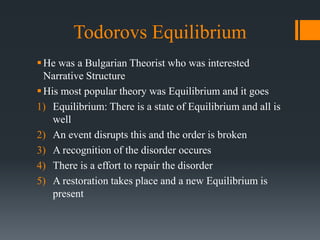
Todorovs Equilibrium
He was a Bulgarian Theorist who was interested
Narrative Structure
His most popular theory was Equilibrium and it goes
1) Equilibrium: There is a state of Equilibrium and all is
well
2) An event disrupts this and the order is broken
3) A recognition of the disorder occures
4) There is a effort to repair the disorder
5) A restoration takes place and a new Equilibrium is
present

Plot and narrative

  • 1.
  • 2.
    What is narrativeand plot? Narrative: Narrative is the art of telling story or an account of connected events. Plot: The main events of a film, book, TV programme and are presented in a connected sequence. There are key elements that make up a story and these aspects need to be combined to create a grander product of the story. These elements include characters, plot, setting etc. Narrative is the way that these elements are combined to create a coherent text.
  • 3.
    What feelings doesthis image evoke?
  • 4.
    What it shows(in my opinion) Martin Luther King is shown waving down to hundreds of people giving him a status of power and influence over mainly shown by the positioning of MLK and the followers as well as the vast amount followers in watching him. The context of the photograph is that it’s a historical event of the oppression of black people being rejected and MLK being victorious against the oppressive force of America This image was taken on Algiers Street and was one of the most iconic image of the 20th century.
  • 5.
    Roland Barthes &Action Codes Barthes specified a multitude of Narrative Codes with the most relevant being Action/Enigma Codes. Action Codes allow the audience to understand what is to come and how to react to what’s going to happen next. An example would be two characters talking about what someone is doing then the film cutting to them. This action allows the film to transition to a different storyline completely and prepares the audience for this.
  • 6.
    Roland Barthes andEnigma Code Enigma Codes are where the media text presents the audience with a question that will be answered by the end of the media text An example would be at the beginning of a Detective Show where a murder victim is shown and the murderer and his motive is unknown to the audience and will be revealed through the episode. Other Narrative Codes: Symbols and Signs are used as identifiers and clues to help piece the story slowly together.
  • 7.
    Claude Levi Strauss& Binary Oppositions Binary Opposition: a pair of related ideas that possess opposite meanings and are used in movie to carry forward a narrative theme Examples: Good & Bad Male & Female Man & Machine Dark & Light
  • 8.
    Vladimir Propp andFolklore  Propp was a theorist who studied Fairy Tales and Folklore  From this work he identified 31 plot elements, and develop 8 spheres of action narrative theory or character types which include: 1 – The villain 2 – The hero 3 – The donor 4 – The helper 5 – The princess 6 – Her Father 7 – The dispatcher 8 – The False hero
  • 9.
    Todorovs Equilibrium He wasa Bulgarian Theorist who was interested Narrative Structure His most popular theory was Equilibrium and it goes 1) Equilibrium: There is a state of Equilibrium and all is well 2) An event disrupts this and the order is broken 3) A recognition of the disorder occures 4) There is a effort to repair the disorder 5) A restoration takes place and a new Equilibrium is present