AS Media
Narrative Theory
What is Narrative?
• Write down a one sentence definition of what you
think it means.
• While the term ‘narrative’ certainly is not used as
commonly as ‘story’, most people know that it refers,
in some way, to stories; in fact stories are endemic to
our lives.
Where do we see/hear narratives?
Task: Make a list of what stories/narratives you have engaged
with today.
• TV Programmes
• Novels or short stories
• Films
• Advertisements
• News stories in papers or on TV and radio
• Via the internet
• Through talk, ‘gossip’ and chat.
Watch “Narrative Analysis in Media Studies”
(3.40 mins) and answer questions on sheet.
•https://www.youtube.com/watch?v=SJfpqVtPHWI
Defining Narrative
• All media texts, fictional and non-fictional, moving image and still image contain
narratives. All media texts tell stories.
• Narratives – in any medium or genre, are ways of structuring and representing
• Narrative is a temporal and spatial mode. In other words, a way of organising
both time and space in relation to each other.
• Narrative is defined as “a chain of events in a cause-effect relationship occurring
in time” (Bordwell & Thompson, Film Art, 1980). ADD TO GLOSSARY
Defining Narrative
• Narrative is ‘a way of organising spatial and temporal events into a cause-effect
chain of events with a beginning, a middle, and end that embodies a judgement
about the nature of events’ (Branigan, 1992).
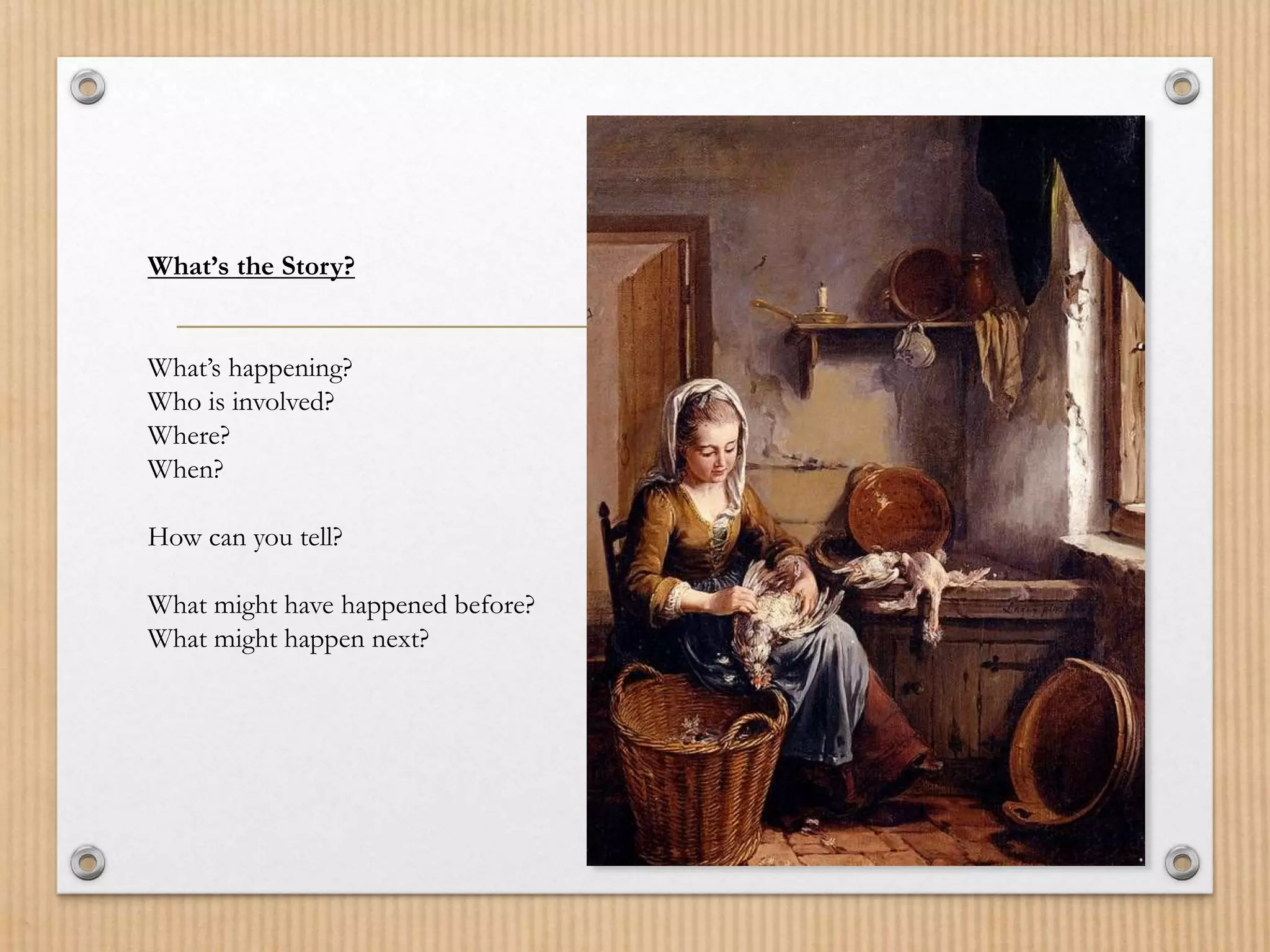
What’s the Story?
What’s happening?
Who is involved?
Where?
When?
How can you tell?
What might have happened before?
What might happen next?
What’s the Story?
What’s happening?
Who is involved?
Where?
When?
How can you tell?
What might have happened before?
What might happen next?
Story? Narrative? Plot?
• In Media, NARRATIVE is the coherence/organisation given to a
series of pieces
• We need narrative to make sense of things and we connect events
and make interpretations based on those connections.
• In everything we seek a beginning, a middle and an end.
• We understand and construct meaning using our experience of
reality and of previous texts.
Story vs Narrative
Story is the irreducible substance of a story
A meets B, something happens, order returns
…while narrative is the way that the story is told to the audience
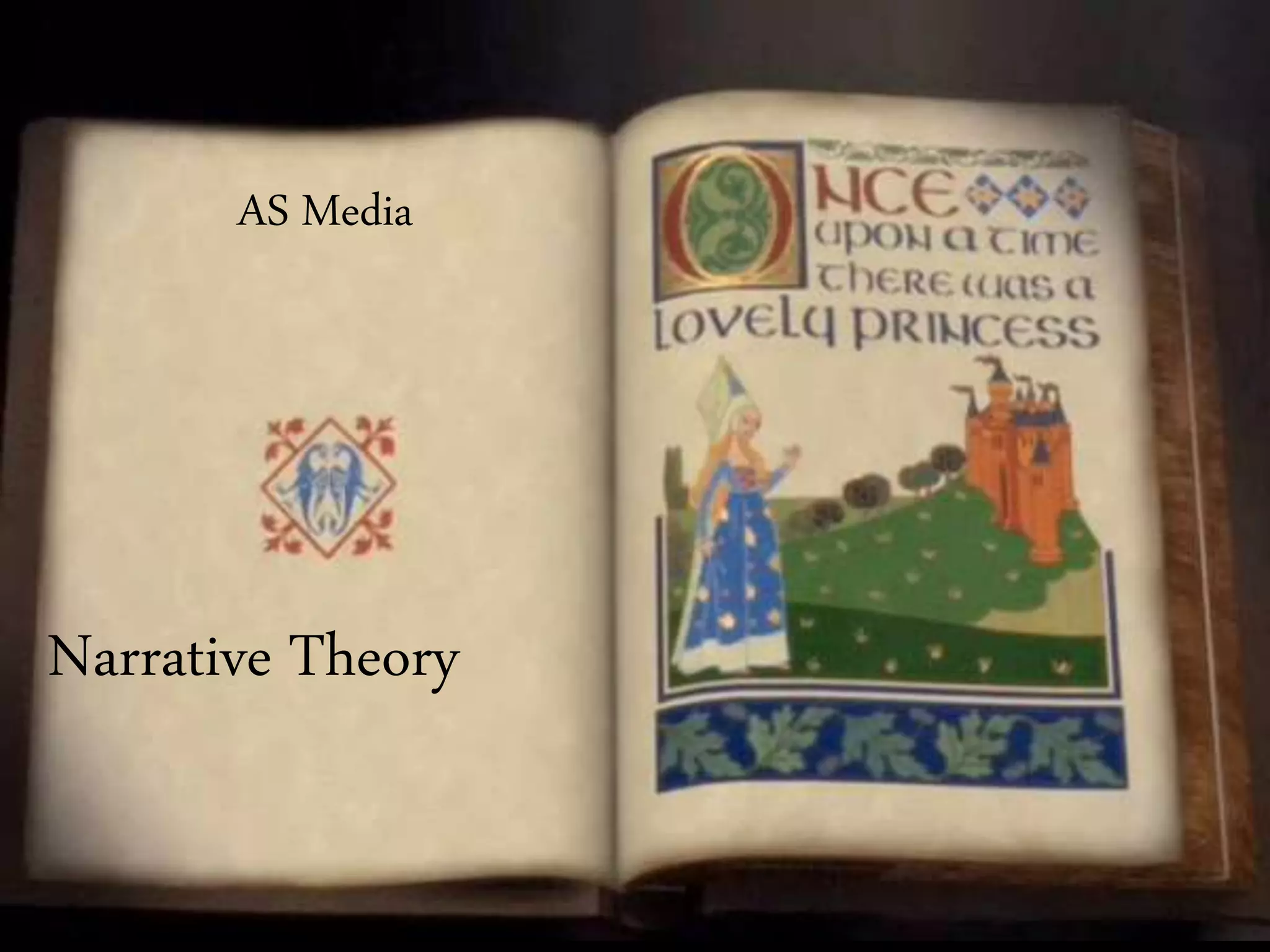
Once upon a time, there was a princess…
• Key Concepts in Communication – Fiske et al (1983)
Story vs Narrative
Or..
THE STORY
a) Crime conceived
b) Crime planned
c) Crime committed
d) Crime discovered
e) Detective investigates
f) Detective identifies criminals
…may be told as
Story vs Narrative
Or..
THE STORY
a) Crime conceived
b) Crime planned
c) Crime committed
d) Crime discovered
e) Detective investigates
f) Detective identifies criminals
…may be told as
THE NARRATIVE
d) Crime discovered
e) Detective investigates
f) Detective identifies criminals
a) Crime conceived
b) Crime planned
c) Crime committed
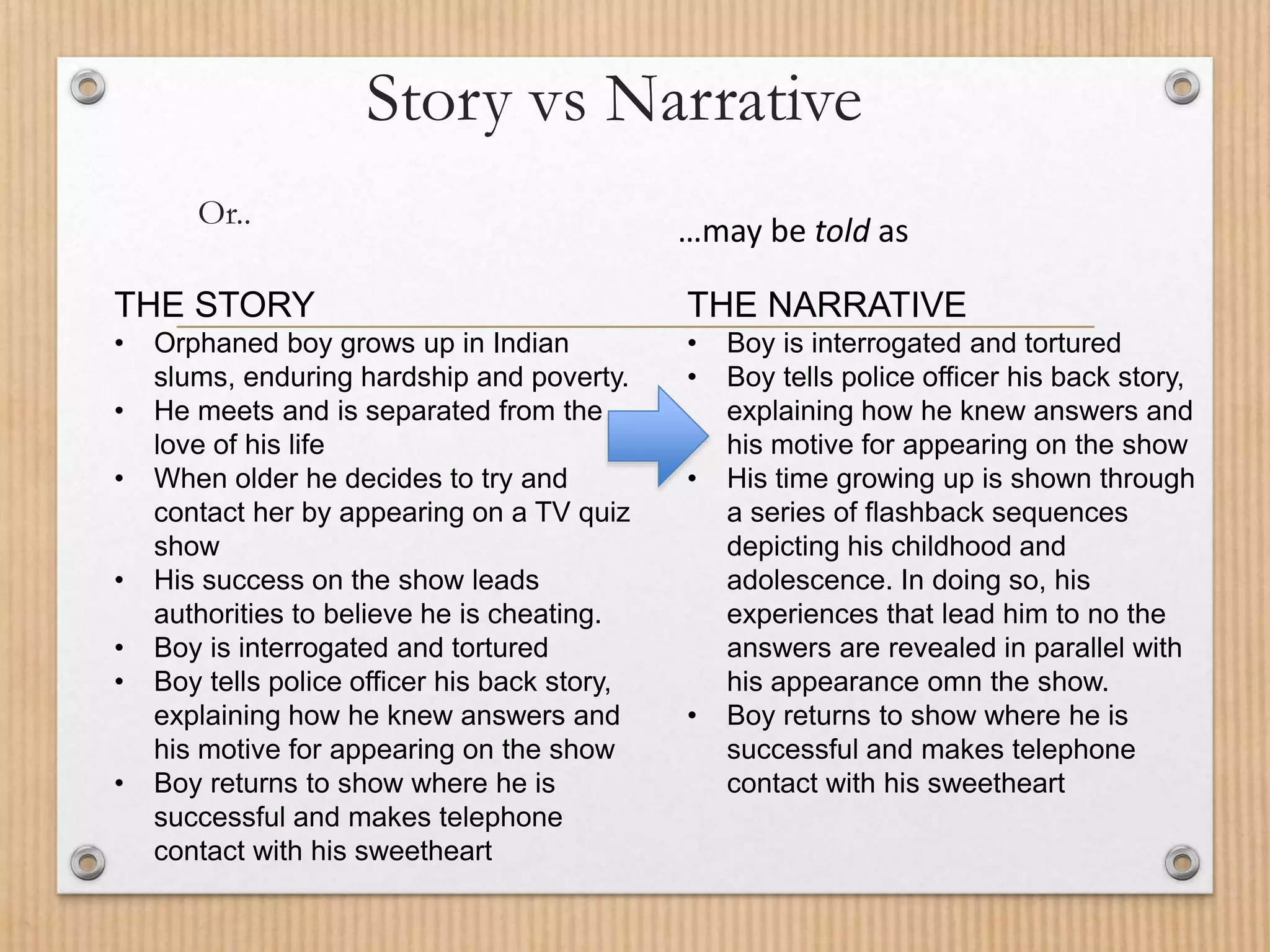
Story vs Narrative
Or..
THE STORY
• Orphaned boy grows up in Indian
slums, enduring hardship and poverty.
• He meets and is separated from the
love of his life
• When older he decides to try and
contact her by appearing on a TV quiz
show
• His success on the show leads
authorities to believe he is cheating.
• Boy is interrogated and tortured
• Boy tells police officer his back story,
explaining how he knew answers and
his motive for appearing on the show
• Boy returns to show where he is
successful and makes telephone
contact with his sweetheart
…may be told as
Story vs Narrative
Or..
THE STORY
• Orphaned boy grows up in Indian
slums, enduring hardship and poverty.
• He meets and is separated from the
love of his life
• When older he decides to try and
contact her by appearing on a TV quiz
show
• His success on the show leads
authorities to believe he is cheating.
• Boy is interrogated and tortured
• Boy tells police officer his back story,
explaining how he knew answers and
his motive for appearing on the show
• Boy returns to show where he is
successful and makes telephone
contact with his sweetheart
…may be told as
THE NARRATIVE
• Boy is interrogated and tortured
• Boy tells police officer his back story,
explaining how he knew answers and
his motive for appearing on the show
• His time growing up is shown through
a series of flashback sequences
depicting his childhood and
adolescence. In doing so, his
experiences that lead him to no the
answers are revealed in parallel with
his appearance omn the show.
• Boy returns to show where he is
successful and makes telephone
contact with his sweetheart
Where do we see/hear narratives?
Task: In pairs, pick an event that has happened to one of you
today. How could you tell this story differently for
1) An Action Film?
2) A News Report?
3) An E4 Reality TV Show?
What is narrative?
When discussing narrative we may look at the following:
• Narrative Structure
• Narrative Codes
• Themes
• Characters
It is necessary to consider and apply traditional theories before
looking at how they may have evolved
Narrative structure
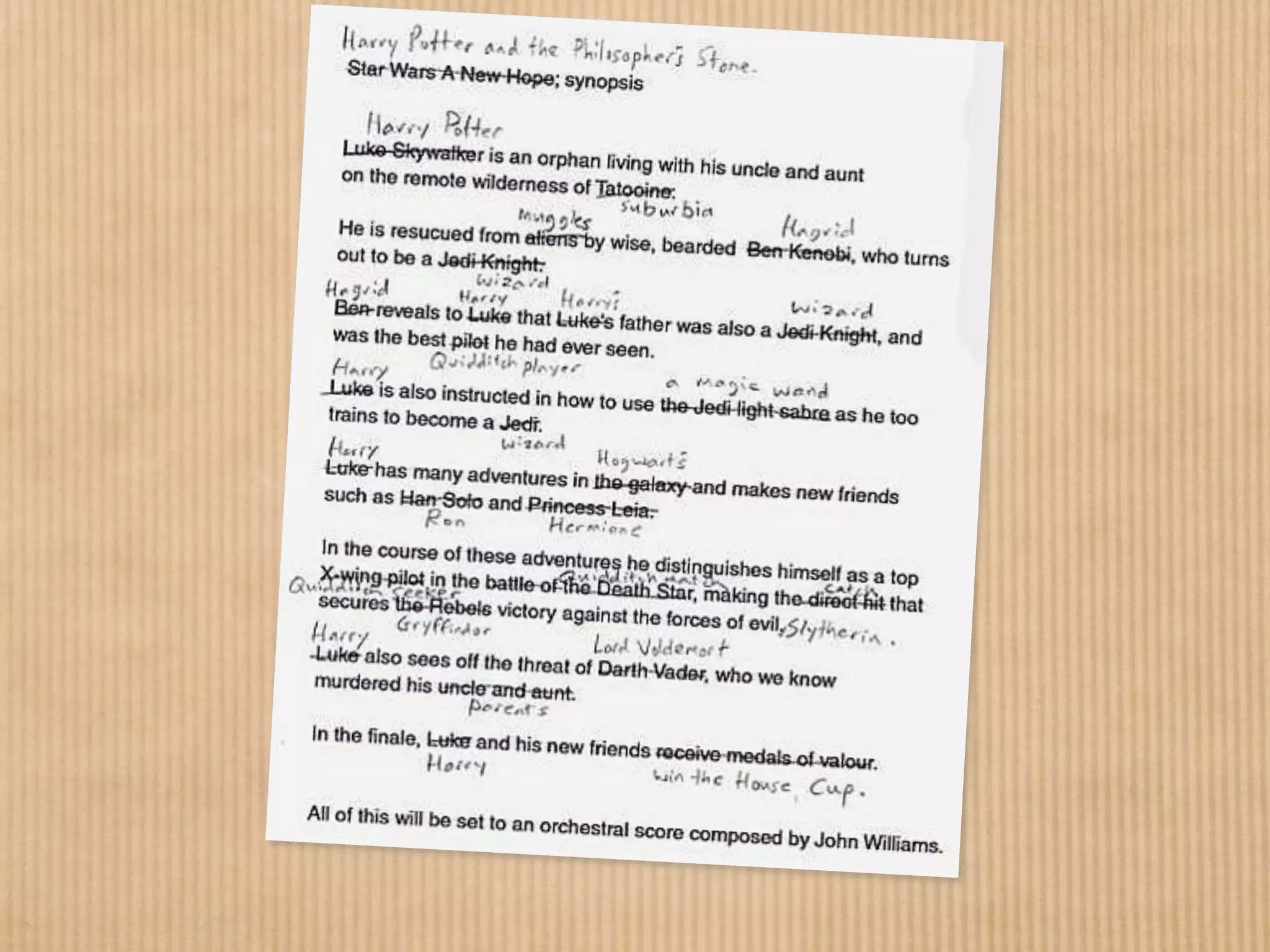
When we look at narrative and narrative structure we can start to see
patterns that repeat. When location and character names are
removed, many stories begin to look the same…
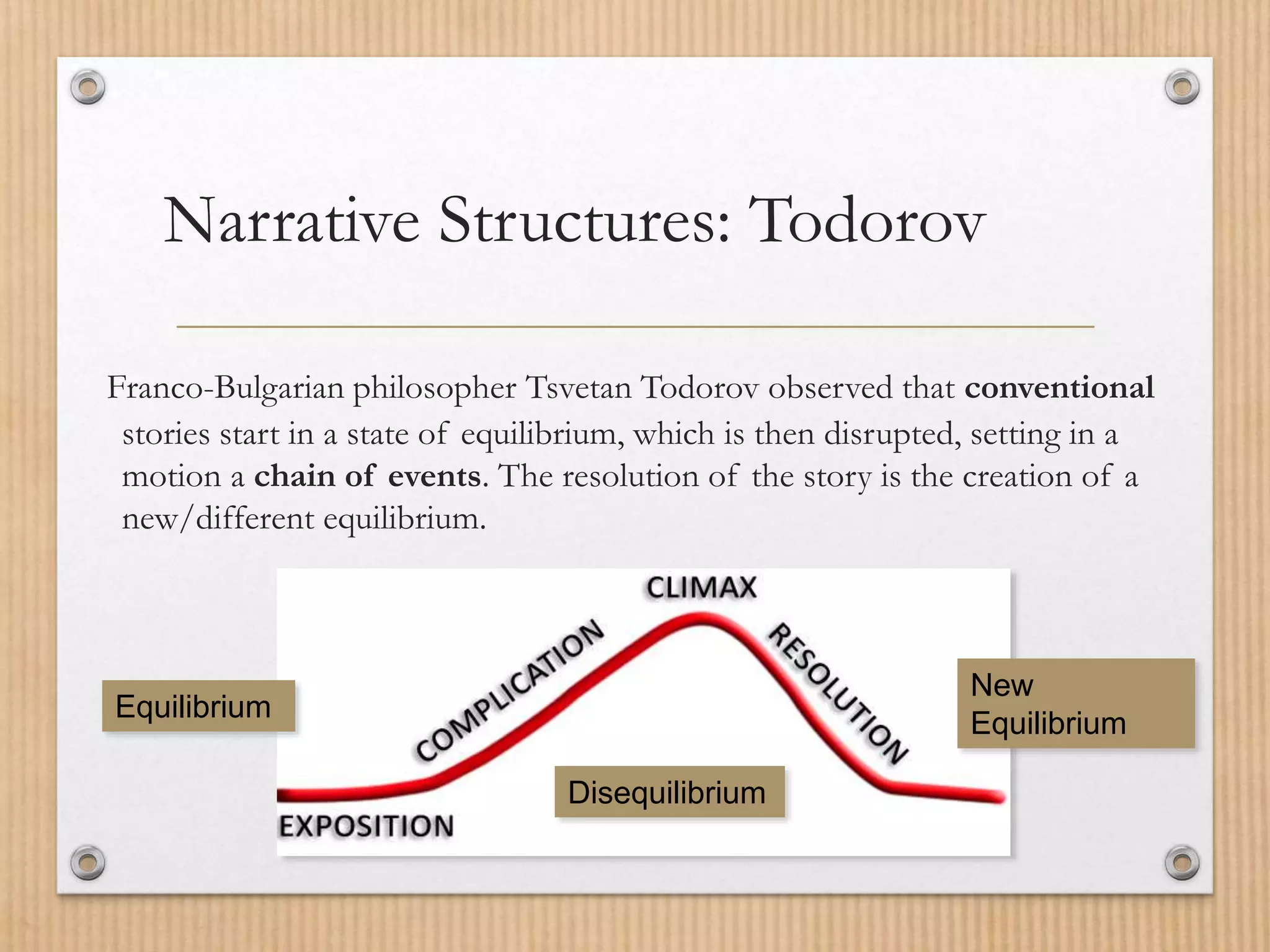
Narrative Structures: Todorov
Franco-Bulgarian philosopher Tsvetan Todorov observed that conventional
stories start in a state of equilibrium, which is then disrupted, setting in a
motion a chain of events. The resolution of the story is the creation of a
new/different equilibrium.
Disequilibrium
Equilibrium
New
Equilibrium
Narrative Structures: Todorov
Tsvetan Todorov suggested that narratives are led by events in a ‘cause
and effect’ format.
The narrative starts with an equilibrium
An action / character disrupts the equilibrium
A quest to restore the equilibrium ensues
The narrative moves to a confrontation/climax
Resolution / equilibrium is restored
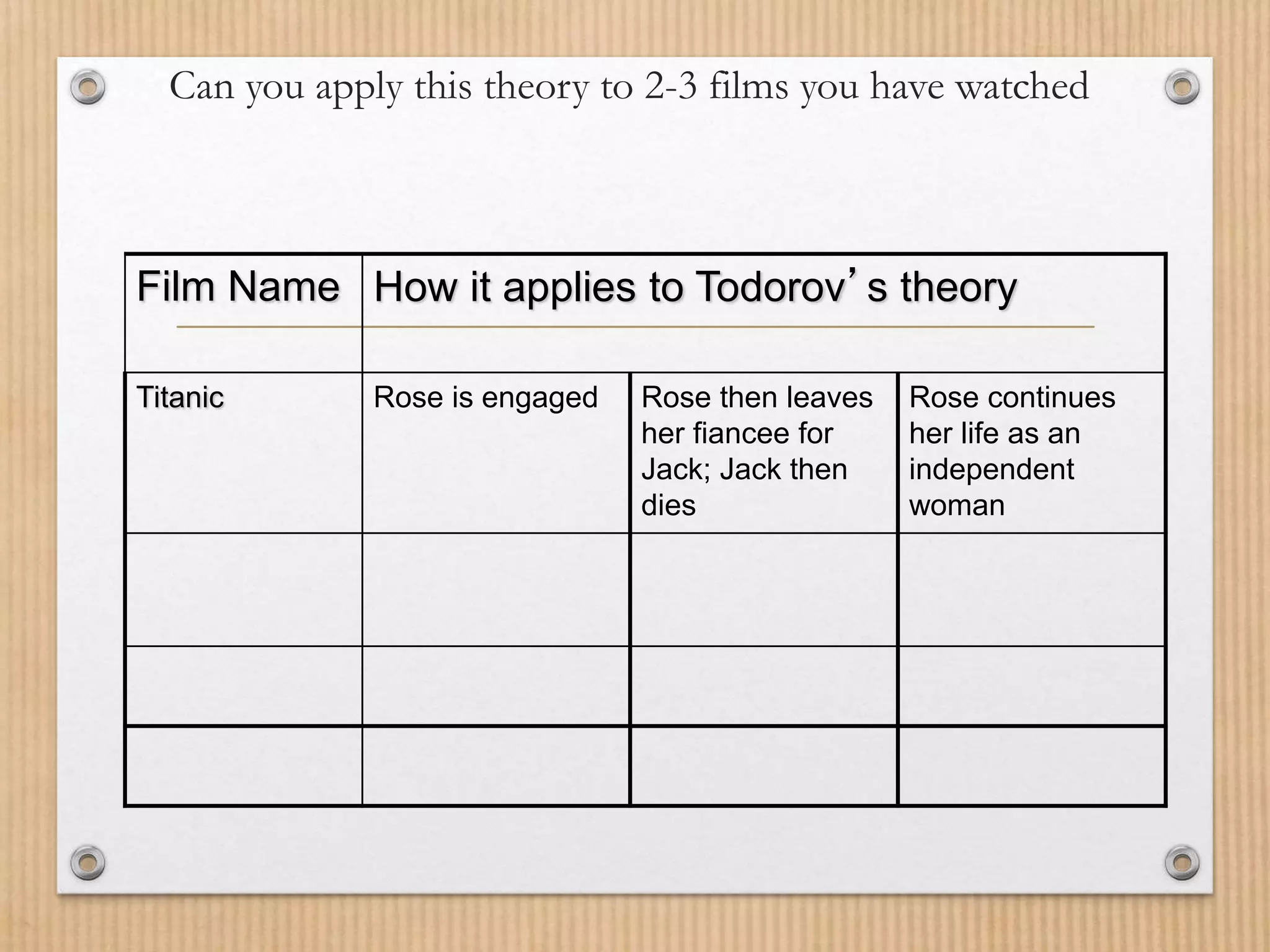
Can you apply this theory to 2-3 films you have watched
Film Name How it applies to Todorov’s theory
Titanic Rose is engaged Rose then leaves
her fiancee for
Jack; Jack then
dies
Rose continues
her life as an
independent
woman
Narrative Structures: Todorov
Texts that conform the audience’s expectations by following this
pattern can be described as ‘ideologically conservative’. They are
‘safe’, do not challenge the audience and are ‘comforting’. Most
mainstream texts are like this.
Other texts may challenge the viewer by not ending with a ‘return
to equilibrium’ and end with the characters in a different, possibly
worse situation than the start. These may be described as ‘ideologically
progressive’ as they promote a change in attitudes.
Some media texts seek to challenge audience expectations by leaving
open-ended or ambiguous narratives that leave the audience to
interpret what they understand by the ending. Narratives that only
have one possible interpretation are said to be ‘closed’.
Todorov: Key Ideas sumarised
All narratives share a basic structure that involves a movement from
one state of equilibrium to another
These two states of equilibrium are separated by a period of
imbalance or disequilibrium
The way in which narratives are resolved can have particular
ideological significance.
Narrative Structures: Todorov
Read the Handout
Telling Stories – The Media’s Use of Narrative
www.curriculum-press.co.uk No.14
Available on Moodle here
https://moodle.strode-
college.ac.uk/moodle/mod/folder/view.php?id=22432
Class activity: On a Post-it note write down a question and answer
based upon the handout to test the rest of the class’s
understanding. Put it on the white board at the front of class.
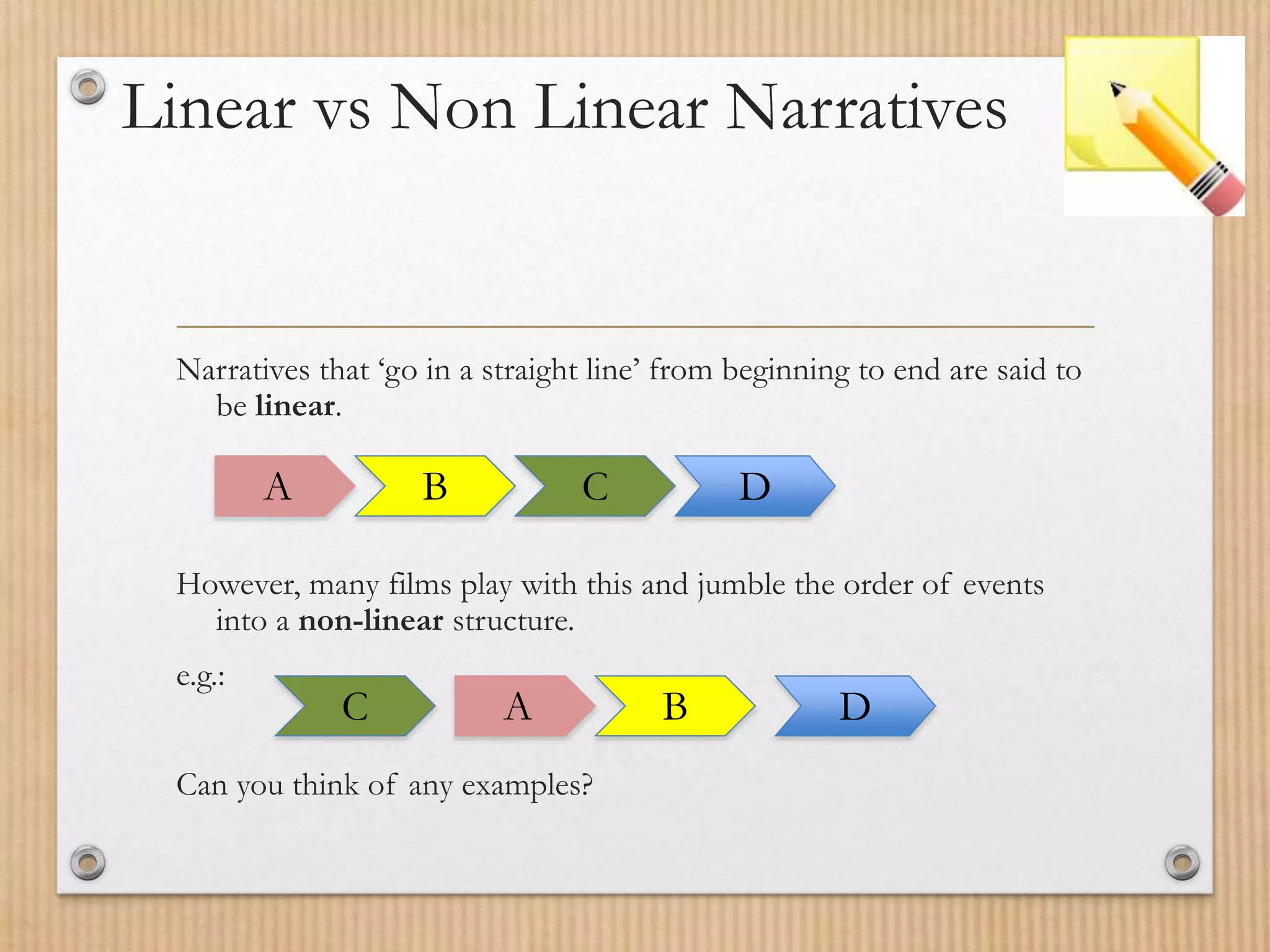
Linear vs Non Linear Narratives
Narratives that ‘go in a straight line’ from beginning to end are said to
be linear.
However, many films play with this and jumble the order of events
into a non-linear structure.
e.g.:
Can you think of any examples?
A B C D
A BC D
Non-linear narratives: Pulp Fiction
If the seven sequences were ordered chronologically, they would run:
4a, 2, 6, 1, 7, 3, 4b, 5.
Sequences 1 and 7 partially overlap and are presented from different points of view; the same is true of
sequences 2 and 6.
1.Prologue—The Diner (i)
2.Prelude to "Vincent Vega and Marsellus Wallace's Wife"
3."Vincent Vega and Marsellus Wallace's Wife"
4.Prelude to "The Gold Watch" (a—flashback, b—present)
5."The Gold Watch"
6."The Bonnie Situation"
7.Epilogue—The Diner (ii)
Circular narratives
Narratives that begin and end at the same point are said to be
circular narratives.
Beginning
Middle
End
These are often used in films/programmes
that start at a climactic event then flashback
to the events building up to it.
It is also common in sitcoms and TV series
where stories do not continue through an
entire series so that audiences can ‘join in’ at
any point (e.g. The Simpsons, Friends, Black
Mirror, Inside No 9).
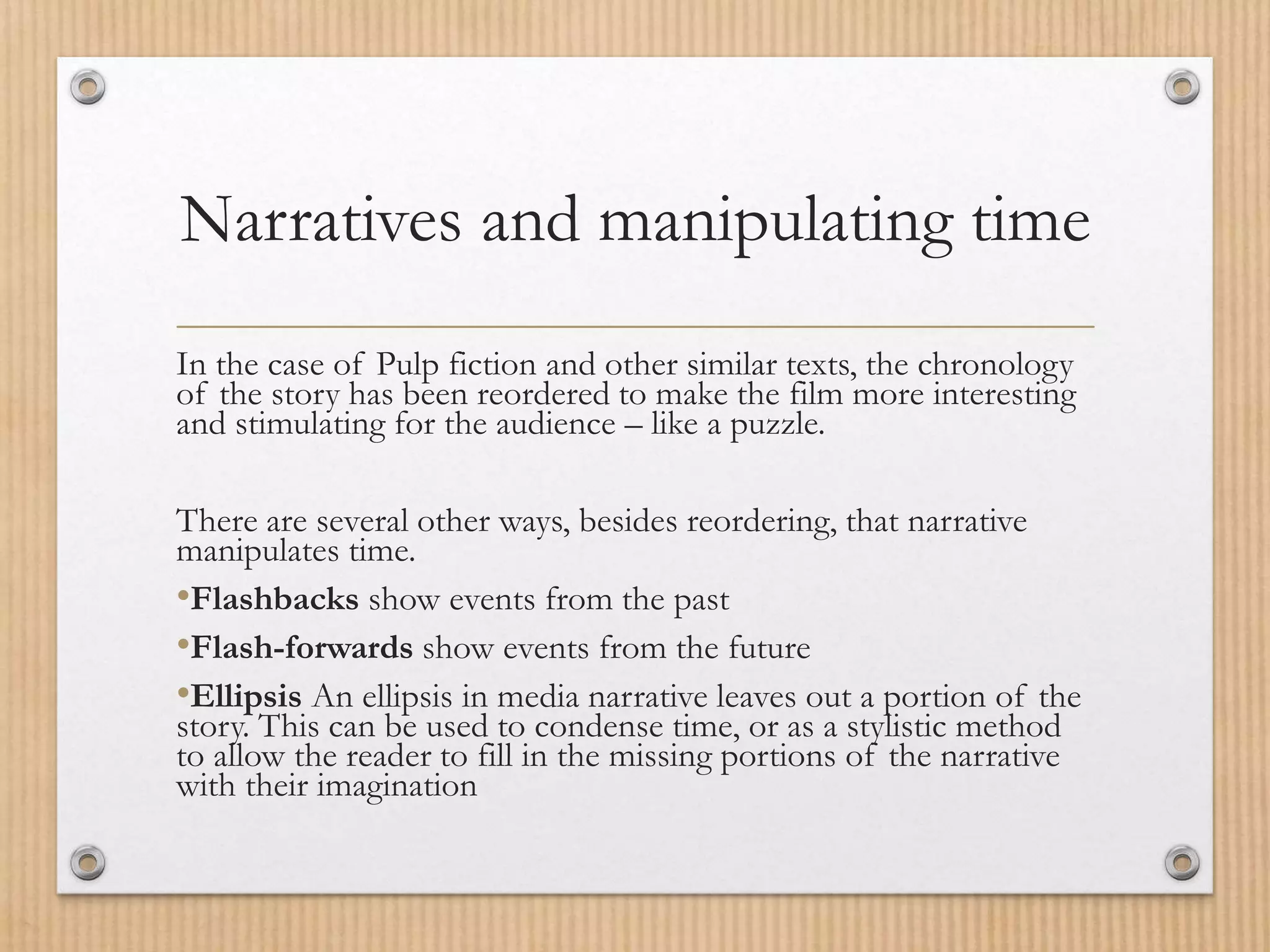
Narratives and manipulating time
In the case of Pulp fiction and other similar texts, the chronology
of the story has been reordered to make the film more interesting
and stimulating for the audience – like a puzzle.
There are several other ways, besides reordering, that narrative
manipulates time.
•Flashbacks show events from the past
•Flash-forwards show events from the future
•Ellipsis An ellipsis in media narrative leaves out a portion of the
story. This can be used to condense time, or as a stylistic method
to allow the reader to fill in the missing portions of the narrative
with their imagination
Narratives and manipulating time
Read Handout Telling A Good Tale – Further Narrative
Techniques Curriculum Press No. 26
Available on Moodle here https://moodle.strode-
college.ac.uk/moodle/mod/folder/view.php?id=22432
Roland Barthes’ Narrative Codes
Action Code: (aka proairetic code) Something the audience knows and doesn't need
explaining e.g. someone being wheeled out on a stretcher tells us they are going to
hospital
Enigma Code: (aka hermeneutic code) something hidden from the audience, a
question/puzzle/enigma the audience wants to answer/solve (creates intrigue)
Semic Code: Something that the audience recognize through connotations
Symbolic Code: Something that symbolizes a more abstract concept e.g. a darker than
usual room of a murder scene could symbolize the depth of darkness and depravity
Cultural Code: (aka referential code) Something that is read with understanding due to
cultural awareness (e.g. youth culture use certain words that are understood by that
culture)
Propp’s Characters
• When analysing narrative we must also consider characters within the narrative
and how they work or ‘function’.
• Vladimir Propp, a Russian critic active in the 1920’s studied the narrative of
folk tales. He noticed folk tales were similar in many areas. They were about
the same basic struggles and they appeared to have stock characters.
• He identified a theory about characters and actions as narrative functions.
• Characters, according to Propp, have a narrative function; they provide a
structure for the text.
• Although his theory can be restrictive and not possible to apply to EVERY
narrative we may find it avoids treating characters as if they are individuals and
reminds us they are merely constructs. Some characters are indeed there just
to progress the narrative.
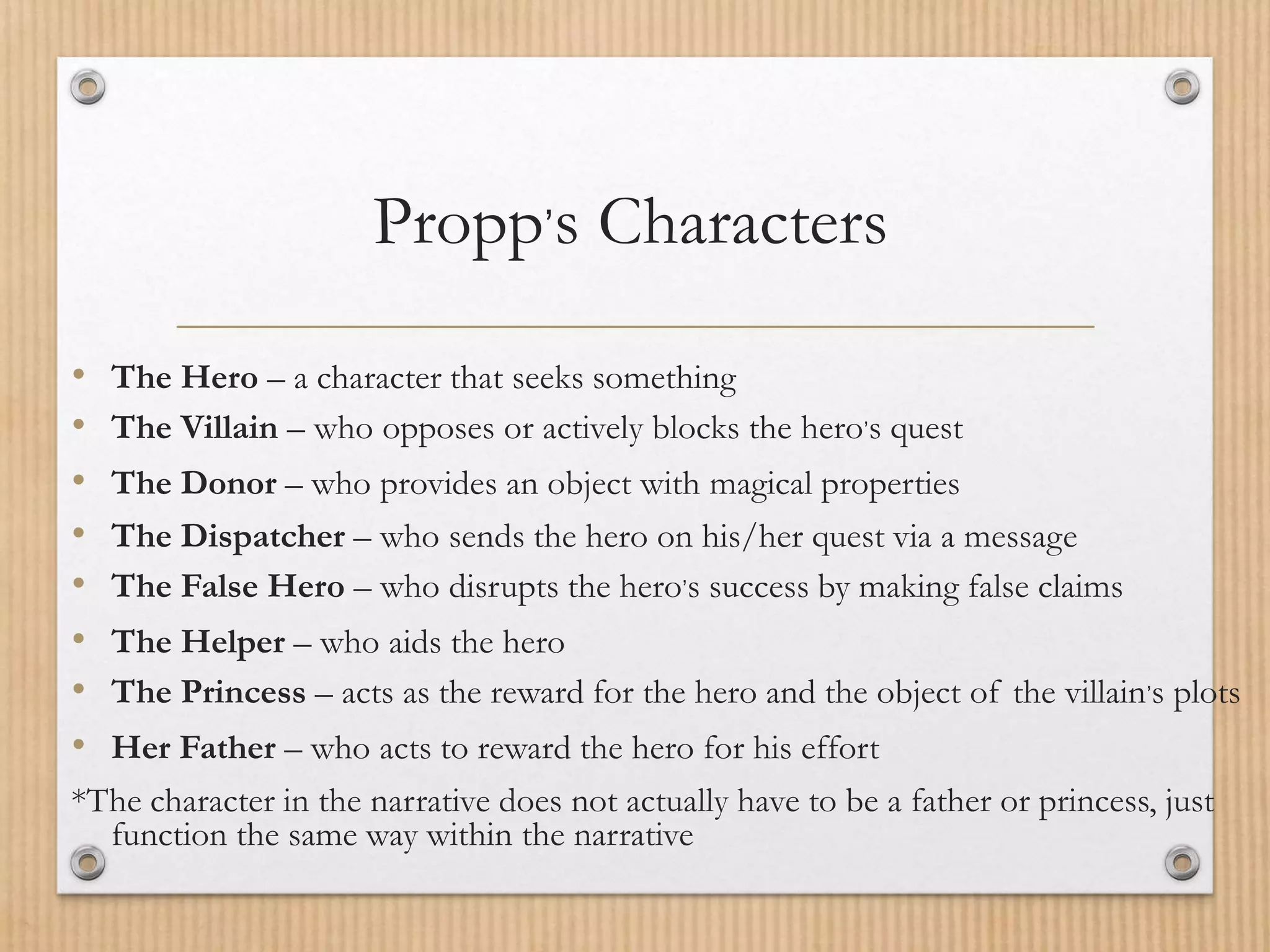
Propp’s Characters
• The Hero – a character that seeks something
• The Villain – who opposes or actively blocks the hero’s quest
• The Donor – who provides an object with magical properties
• The Dispatcher – who sends the hero on his/her quest via a message
• The False Hero – who disrupts the hero’s success by making false claims
• The Helper – who aids the hero
• The Princess – acts as the reward for the hero and the object of the villain’s plots
• Her Father – who acts to reward the hero for his effort
*The character in the narrative does not actually have to be a father or princess, just
function the same way within the narrative
Character
Today’s texts are often more complex and the lead character may not necessarily have ‘heroic’
qualities. e.g. Homer Simpson (The Simpsons), Walter White (Breaking Bad). These may be
called ‘anti-heroes’.
More useful terms than hero/villain can be.
• Protagonist: the leading character or one of the major characters in a play, film, novel, etc.
• Antagonist: a person who actively opposes or is hostile to someone or something; an
adversary
These do not make a moral judgement about the character, just how we should relate to them.
You can have a lead character/protagnoist who is not necessarily ‘good/heroic’ but who the
audience is expected to identify with. Likewise you can have antagnosits whop are not
necessarily ‘evil’ (maybe a police officer just doing their job).
Characters: Archetypes
Archetype is a broader term for other ‘stock characters’ that we commonly
see in the media. e.g.:
•the ‘grumpy old man’,
•the ‘battleaxe / nagging mother-in-law’,
•the ‘under the thumb’, oppressed husband,
•the ‘jack the lad’,
•the ‘all brawn no brains male’,
•the sexually repressed bookish girl,
•The blonde bimbo
•the jock, nerd, etc.
These are like stereotypes. They act as a shorthand, quick way of
communicating a lot of information because the audience already holds a lot
of expectations about them. So when we see the way they are dressed/behave
we make presumptions about their personality and what will happen to them.
Binary Opposites, Narrative & Conflict
All stories are based upon conflict in one way or another
It is this conflict (interests/countries/personalities/intentions/morals/etc) that
leads to the initial equilibrium being disrupted.
Many stories may feature more than one type of conflict.
These conflicts are often the result of friction between two binary opposites.
What kinds of conflict can you think of that feature in media narratives?
Task: Match the cards to identify the different types of story conflict.
Non-Fiction Narratives
It is easy to apply these ideas to films and fictional TV programmes. How might
you do it with others?
For example the narrative of a typical TV News report might look like this
http://www.youtube.com/watch?v=YtGSXMuWMR4
In groups discuss the narrative structure of the following:
• A TV News programme
• A (whole) magazine
• A 1st Person Computer Game
• A football match on TV
• A newspaper article
• A pop song
Narrative: Summary
Narrative can be defined as ‘the way in which the story is told’.
We analyse the narrative structure:
– Todorov – equilibrium/disequilibrium/equilibrium, cause and effect
– Linear or non linear
– Conflict and binary opposites
– The degree to which a narrative conforms to, or challenges traditional structures and audiences
expectations will shape the audience’s response
– Narrative Codes
We consider the themes – what are the topics/issues discussed?
We analyse the characters and their roles:
– Propp’s character types
– Archetypes
– Narrative agency
– Audience positioning

ASY1 media narrative

  • 1.
  • 2.
    What is Narrative? •Write down a one sentence definition of what you think it means. • While the term ‘narrative’ certainly is not used as commonly as ‘story’, most people know that it refers, in some way, to stories; in fact stories are endemic to our lives.
  • 3.
    Where do wesee/hear narratives? Task: Make a list of what stories/narratives you have engaged with today. • TV Programmes • Novels or short stories • Films • Advertisements • News stories in papers or on TV and radio • Via the internet • Through talk, ‘gossip’ and chat.
  • 4.
    Watch “Narrative Analysisin Media Studies” (3.40 mins) and answer questions on sheet. •https://www.youtube.com/watch?v=SJfpqVtPHWI
  • 5.
    Defining Narrative • Allmedia texts, fictional and non-fictional, moving image and still image contain narratives. All media texts tell stories. • Narratives – in any medium or genre, are ways of structuring and representing • Narrative is a temporal and spatial mode. In other words, a way of organising both time and space in relation to each other. • Narrative is defined as “a chain of events in a cause-effect relationship occurring in time” (Bordwell & Thompson, Film Art, 1980). ADD TO GLOSSARY
  • 6.
    Defining Narrative • Narrativeis ‘a way of organising spatial and temporal events into a cause-effect chain of events with a beginning, a middle, and end that embodies a judgement about the nature of events’ (Branigan, 1992).
  • 7.
    What’s the Story? What’shappening? Who is involved? Where? When? How can you tell? What might have happened before? What might happen next?
  • 8.
    What’s the Story? What’shappening? Who is involved? Where? When? How can you tell? What might have happened before? What might happen next?
  • 9.
    Story? Narrative? Plot? •In Media, NARRATIVE is the coherence/organisation given to a series of pieces • We need narrative to make sense of things and we connect events and make interpretations based on those connections. • In everything we seek a beginning, a middle and an end. • We understand and construct meaning using our experience of reality and of previous texts.
  • 10.
    Story vs Narrative Storyis the irreducible substance of a story A meets B, something happens, order returns …while narrative is the way that the story is told to the audience Once upon a time, there was a princess… • Key Concepts in Communication – Fiske et al (1983)
  • 11.
    Story vs Narrative Or.. THESTORY a) Crime conceived b) Crime planned c) Crime committed d) Crime discovered e) Detective investigates f) Detective identifies criminals …may be told as
  • 12.
    Story vs Narrative Or.. THESTORY a) Crime conceived b) Crime planned c) Crime committed d) Crime discovered e) Detective investigates f) Detective identifies criminals …may be told as THE NARRATIVE d) Crime discovered e) Detective investigates f) Detective identifies criminals a) Crime conceived b) Crime planned c) Crime committed
  • 13.
    Story vs Narrative Or.. THESTORY • Orphaned boy grows up in Indian slums, enduring hardship and poverty. • He meets and is separated from the love of his life • When older he decides to try and contact her by appearing on a TV quiz show • His success on the show leads authorities to believe he is cheating. • Boy is interrogated and tortured • Boy tells police officer his back story, explaining how he knew answers and his motive for appearing on the show • Boy returns to show where he is successful and makes telephone contact with his sweetheart …may be told as
  • 14.
    Story vs Narrative Or.. THESTORY • Orphaned boy grows up in Indian slums, enduring hardship and poverty. • He meets and is separated from the love of his life • When older he decides to try and contact her by appearing on a TV quiz show • His success on the show leads authorities to believe he is cheating. • Boy is interrogated and tortured • Boy tells police officer his back story, explaining how he knew answers and his motive for appearing on the show • Boy returns to show where he is successful and makes telephone contact with his sweetheart …may be told as THE NARRATIVE • Boy is interrogated and tortured • Boy tells police officer his back story, explaining how he knew answers and his motive for appearing on the show • His time growing up is shown through a series of flashback sequences depicting his childhood and adolescence. In doing so, his experiences that lead him to no the answers are revealed in parallel with his appearance omn the show. • Boy returns to show where he is successful and makes telephone contact with his sweetheart
  • 15.
    Where do wesee/hear narratives? Task: In pairs, pick an event that has happened to one of you today. How could you tell this story differently for 1) An Action Film? 2) A News Report? 3) An E4 Reality TV Show?
  • 16.
    What is narrative? Whendiscussing narrative we may look at the following: • Narrative Structure • Narrative Codes • Themes • Characters It is necessary to consider and apply traditional theories before looking at how they may have evolved
  • 17.
    Narrative structure When welook at narrative and narrative structure we can start to see patterns that repeat. When location and character names are removed, many stories begin to look the same…
  • 20.
    Narrative Structures: Todorov Franco-Bulgarianphilosopher Tsvetan Todorov observed that conventional stories start in a state of equilibrium, which is then disrupted, setting in a motion a chain of events. The resolution of the story is the creation of a new/different equilibrium. Disequilibrium Equilibrium New Equilibrium
  • 21.
    Narrative Structures: Todorov TsvetanTodorov suggested that narratives are led by events in a ‘cause and effect’ format. The narrative starts with an equilibrium An action / character disrupts the equilibrium A quest to restore the equilibrium ensues The narrative moves to a confrontation/climax Resolution / equilibrium is restored
  • 22.
    Can you applythis theory to 2-3 films you have watched Film Name How it applies to Todorov’s theory Titanic Rose is engaged Rose then leaves her fiancee for Jack; Jack then dies Rose continues her life as an independent woman
  • 23.
    Narrative Structures: Todorov Textsthat conform the audience’s expectations by following this pattern can be described as ‘ideologically conservative’. They are ‘safe’, do not challenge the audience and are ‘comforting’. Most mainstream texts are like this. Other texts may challenge the viewer by not ending with a ‘return to equilibrium’ and end with the characters in a different, possibly worse situation than the start. These may be described as ‘ideologically progressive’ as they promote a change in attitudes. Some media texts seek to challenge audience expectations by leaving open-ended or ambiguous narratives that leave the audience to interpret what they understand by the ending. Narratives that only have one possible interpretation are said to be ‘closed’.
  • 24.
    Todorov: Key Ideassumarised All narratives share a basic structure that involves a movement from one state of equilibrium to another These two states of equilibrium are separated by a period of imbalance or disequilibrium The way in which narratives are resolved can have particular ideological significance.
  • 25.
    Narrative Structures: Todorov Readthe Handout Telling Stories – The Media’s Use of Narrative www.curriculum-press.co.uk No.14 Available on Moodle here https://moodle.strode- college.ac.uk/moodle/mod/folder/view.php?id=22432 Class activity: On a Post-it note write down a question and answer based upon the handout to test the rest of the class’s understanding. Put it on the white board at the front of class.
  • 26.
    Linear vs NonLinear Narratives Narratives that ‘go in a straight line’ from beginning to end are said to be linear. However, many films play with this and jumble the order of events into a non-linear structure. e.g.: Can you think of any examples? A B C D A BC D
  • 27.
    Non-linear narratives: PulpFiction If the seven sequences were ordered chronologically, they would run: 4a, 2, 6, 1, 7, 3, 4b, 5. Sequences 1 and 7 partially overlap and are presented from different points of view; the same is true of sequences 2 and 6. 1.Prologue—The Diner (i) 2.Prelude to "Vincent Vega and Marsellus Wallace's Wife" 3."Vincent Vega and Marsellus Wallace's Wife" 4.Prelude to "The Gold Watch" (a—flashback, b—present) 5."The Gold Watch" 6."The Bonnie Situation" 7.Epilogue—The Diner (ii)
  • 28.
    Circular narratives Narratives thatbegin and end at the same point are said to be circular narratives. Beginning Middle End These are often used in films/programmes that start at a climactic event then flashback to the events building up to it. It is also common in sitcoms and TV series where stories do not continue through an entire series so that audiences can ‘join in’ at any point (e.g. The Simpsons, Friends, Black Mirror, Inside No 9).
  • 29.
    Narratives and manipulatingtime In the case of Pulp fiction and other similar texts, the chronology of the story has been reordered to make the film more interesting and stimulating for the audience – like a puzzle. There are several other ways, besides reordering, that narrative manipulates time. •Flashbacks show events from the past •Flash-forwards show events from the future •Ellipsis An ellipsis in media narrative leaves out a portion of the story. This can be used to condense time, or as a stylistic method to allow the reader to fill in the missing portions of the narrative with their imagination
  • 30.
    Narratives and manipulatingtime Read Handout Telling A Good Tale – Further Narrative Techniques Curriculum Press No. 26 Available on Moodle here https://moodle.strode- college.ac.uk/moodle/mod/folder/view.php?id=22432
  • 31.
    Roland Barthes’ NarrativeCodes Action Code: (aka proairetic code) Something the audience knows and doesn't need explaining e.g. someone being wheeled out on a stretcher tells us they are going to hospital Enigma Code: (aka hermeneutic code) something hidden from the audience, a question/puzzle/enigma the audience wants to answer/solve (creates intrigue) Semic Code: Something that the audience recognize through connotations Symbolic Code: Something that symbolizes a more abstract concept e.g. a darker than usual room of a murder scene could symbolize the depth of darkness and depravity Cultural Code: (aka referential code) Something that is read with understanding due to cultural awareness (e.g. youth culture use certain words that are understood by that culture)
  • 32.
    Propp’s Characters • Whenanalysing narrative we must also consider characters within the narrative and how they work or ‘function’. • Vladimir Propp, a Russian critic active in the 1920’s studied the narrative of folk tales. He noticed folk tales were similar in many areas. They were about the same basic struggles and they appeared to have stock characters. • He identified a theory about characters and actions as narrative functions. • Characters, according to Propp, have a narrative function; they provide a structure for the text. • Although his theory can be restrictive and not possible to apply to EVERY narrative we may find it avoids treating characters as if they are individuals and reminds us they are merely constructs. Some characters are indeed there just to progress the narrative.
  • 33.
    Propp’s Characters • TheHero – a character that seeks something • The Villain – who opposes or actively blocks the hero’s quest • The Donor – who provides an object with magical properties • The Dispatcher – who sends the hero on his/her quest via a message • The False Hero – who disrupts the hero’s success by making false claims • The Helper – who aids the hero • The Princess – acts as the reward for the hero and the object of the villain’s plots • Her Father – who acts to reward the hero for his effort *The character in the narrative does not actually have to be a father or princess, just function the same way within the narrative
  • 34.
    Character Today’s texts areoften more complex and the lead character may not necessarily have ‘heroic’ qualities. e.g. Homer Simpson (The Simpsons), Walter White (Breaking Bad). These may be called ‘anti-heroes’. More useful terms than hero/villain can be. • Protagonist: the leading character or one of the major characters in a play, film, novel, etc. • Antagonist: a person who actively opposes or is hostile to someone or something; an adversary These do not make a moral judgement about the character, just how we should relate to them. You can have a lead character/protagnoist who is not necessarily ‘good/heroic’ but who the audience is expected to identify with. Likewise you can have antagnosits whop are not necessarily ‘evil’ (maybe a police officer just doing their job).
  • 35.
    Characters: Archetypes Archetype isa broader term for other ‘stock characters’ that we commonly see in the media. e.g.: •the ‘grumpy old man’, •the ‘battleaxe / nagging mother-in-law’, •the ‘under the thumb’, oppressed husband, •the ‘jack the lad’, •the ‘all brawn no brains male’, •the sexually repressed bookish girl, •The blonde bimbo •the jock, nerd, etc. These are like stereotypes. They act as a shorthand, quick way of communicating a lot of information because the audience already holds a lot of expectations about them. So when we see the way they are dressed/behave we make presumptions about their personality and what will happen to them.
  • 36.
    Binary Opposites, Narrative& Conflict All stories are based upon conflict in one way or another It is this conflict (interests/countries/personalities/intentions/morals/etc) that leads to the initial equilibrium being disrupted. Many stories may feature more than one type of conflict. These conflicts are often the result of friction between two binary opposites. What kinds of conflict can you think of that feature in media narratives? Task: Match the cards to identify the different types of story conflict.
  • 38.
    Non-Fiction Narratives It iseasy to apply these ideas to films and fictional TV programmes. How might you do it with others? For example the narrative of a typical TV News report might look like this http://www.youtube.com/watch?v=YtGSXMuWMR4 In groups discuss the narrative structure of the following: • A TV News programme • A (whole) magazine • A 1st Person Computer Game • A football match on TV • A newspaper article • A pop song
  • 39.
    Narrative: Summary Narrative canbe defined as ‘the way in which the story is told’. We analyse the narrative structure: – Todorov – equilibrium/disequilibrium/equilibrium, cause and effect – Linear or non linear – Conflict and binary opposites – The degree to which a narrative conforms to, or challenges traditional structures and audiences expectations will shape the audience’s response – Narrative Codes We consider the themes – what are the topics/issues discussed? We analyse the characters and their roles: – Propp’s character types – Archetypes – Narrative agency – Audience positioning