Media Studies
Narrative Theory
One upon a time…
Story? Narrative? Plot?
What is narrative?
Story is the irreducible substance of a story (A meets B, something
happens, order returns), while narrative is the way the story is
related (Once upon a time there was a princess...)"
Key Concepts in Communication - Fiske et al (1983)
While the term ‘narrative’ certainly is not used as commonly as
‘story’, most people know that it refers, in some way, to stories.
Stories are endemic to our lives
We are all storytellers
Where do we see/hear stories on a day
to day basis?
TV Programmes
Novels or short stories
Films
Advertisements
News is papers or on TV and radio
Via the internet
Through talk, ‘gossip’ and chat.
What is narrative then?
Narrative has probably existed as long as human
beings; it is likely that the stone age artists who drew
18,000 year old cave painting in the Ardeche, in
France, expected narratives to be woven around
their images.
Because narrative seems to be such a truly
universal aspect of the human race, it is impossible
to completely discuss relevance to our existence.
In media studies, we need to have a good working
knowledge of narrative theories and debates.
Aristotle and his three unities
1.The unity of action: a play should have one main action
that it follows, with no or few subplots.
2.The unity of place: a play should cover a single physical
space and should not attempt to compress geography,
nor should the stage represent more than one place.
3.The unity of time: the action in a play should take place
over no more than 24 hours.
Gustav Freytag was a 19th Century German dramatist and novelist.
He constructed his theory from the analysis of ancient Greek and
Shakespearean drama.
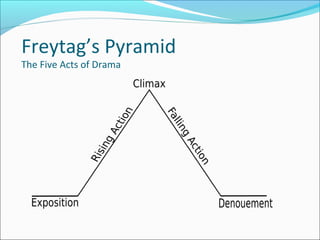
Freytag's dramatic arc is divided into five parts (acts).
 Exposition,
 Rising Action,
 Climax,
 Falling Action &
 Denouement/Catastrophe/Resolution.
Freytag’s Pyramid
The Five Acts of Drama
Freytag’s Pyramid
The Five Acts of Drama
Todorov’s Theory
 Tzvetan Todorov is a Franco-Bulgarian philosopher. He has lived in
France since 1963 writing books and essays about literary theory,
thought history and culture theory.
 Todorov proposed a basic structure for all narratives. He stated that
films and programs begin with an equilibrium, a calm period. Then
agents of disruption cause disequilibrium, a period of unsettlement and
disquiet. This is then followed by a renewed state of peace and
harmony for the protagonists and a new equilibrium brings the chaos to
an end.
 The simplest form of narrative (sometimes referred to as ‘Classic’ or
‘Hollywood’ narrative).
Propp’s Theory
Character Theory
Vladimir Propp’s theory was formed in the early twentieth Century.
His “Morphology of the Folk Tale” was published in Russian in 1928.
It represented a breakthrough in both folkloristics and morphology
and influenced Claude Lévi-Strauss and Roland Barthes.
He studies Russian fairytales (over 100) and discovered that in
stories there were always 8 types of characters evident.
These 8 different character types only do 31 things.
Once you have identified the character type (e.g., the
hero) it’s easy to guess what they will do (save the
maiden, defeat the villain, marry the maiden or whatever)
because each character has a SPHERE OF ACTION.
Propp’s Theory
Character Theory
The villain — struggles against the hero.
The donor — prepares the hero or gives the hero some magical
object.
The (magical) helper — helps the hero in the quest.
The princess or prize — the hero deserves her throughout the story
but is unable to marry her because of an unfair evil, usually because
of the villain. the hero's journey is often ended when he marries the
princess, thereby beating the villain.
Propp’s Theory
Character Theory – The characters
Her father — gives the task to the hero, identifies the false hero,
marries the hero, often sought for during the narrative. Propp noted
that functionally, the princess and the father can not be clearly
distinguished.
The dispatcher — character who makes the lack known and sends
the hero off.
The hero or victim/seeker hero — reacts to the donor, weds the
princess.
False hero — takes credit for the hero’s actions or tries to marry the
princess.
He did not state these characters were all separate
people e.g. the provider could also be the helper.
Propp’s Theory
Character Theory – The characters
Propp's approach has been criticized for removing all
verbal considerations from the analysis, even though the
folktale's form is almost always oral, and also all
considerations of tone, mood, character, and, anything
that differentiates one fairy tale from another.
Propp’s Theory
Character Theory - Criticism
One of the most prominent critics of Propp is the famous
French Structuralist Claude Lévi-Strauss, who used Propp's
monograph on the morphology of the Folktale to demonstrate the
superiority of the Structuralist approach, and the shortcomings of the
Formalist approach.
Defenders of Propp believe that such criticisms are largely
redundant, as Propp's approach was not intended to unearth
meaning in the fairy tales he examined (as may be the case with
Structuralist or Psychoanalytic analysis), nor to find the elements
that differentiate one tale from another, but to unearth the elemental
building blocks that formed the basis of their narrative structure.
Propp’s Theory
Character Theory – Criticism and Defense
Enigma Code
Roland Barthes
Roland Barthes (12 November 1915 – 25 March 1980)
was a French literary theorist, philosopher, critic, and
semiotician.
Barthes's ideas explored a diverse range of fields and he
influenced the development of schools of theory including
structuralism, semiotics, existentialism, social theory,
Marxism, anthropology and post-structuralism.
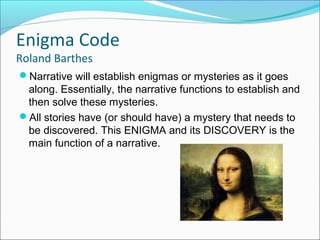
Narrative will establish enigmas or mysteries as it goes
along. Essentially, the narrative functions to establish and
then solve these mysteries.
All stories have (or should have) a mystery that needs to
be discovered. This ENIGMA and its DISCOVERY is the
main function of a narrative.
Enigma Code
Roland Barthes
Levi-Strauss and binary
oppositions.
Claude Levi Strauss, a French theorist (not the jeans)
gave media studies a number of influential theories that
help us to understand how meaning is established
quickly in openings.
Binary Oppositions create meaning through establishing
what something is not. We understand the world through
a system of power weighted oppositions.
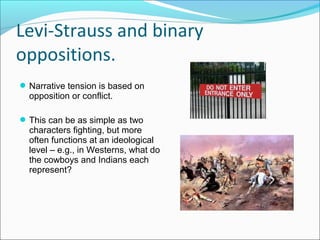
Narrative tension is based on
opposition or conflict.
This can be as simple as two
characters fighting, but more
often functions at an ideological
level – e.g., in Westerns, what do
the cowboys and Indians each
represent?
Levi-Strauss and binary
oppositions.
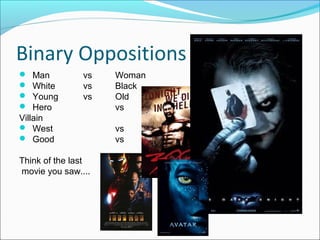
Binary Oppositions
 Man vs Woman
 White vs Black
 Young vs Old
 Hero vs
Villain
 West vs East
 Good vs Bad
Think of the last
movie you saw....
Once upon a time…
Many of us experience our first story at a very young
age, possibly beginning with the immortal phrase of
countless fairy tales, ‘Once upon a time…’
What does this phrase really mean to us?
“Once” =
“Once” invites us into the narrative world which is set
in the past; indeed, most narratives are recounted in
the past tense.
“upon a time” =
Situates us in a world we know is different to our
own, in a time that is not now.
Once upon a time…
Write down quickly what story you expect to happen after the line
below.
‘It was a bright cold day in April, and the clocks were striking
thirteen.’
Openings
Openings are important. They are usually intended
to grab and hold the attention of the receiver of the
text. People will walk out of the cinema, turn over
the TV station and abandon a novel if it doesn’t
capture the attention immediately.
The extract is from George Orwell’s Nineteen
Eighty-four. What makes this sentence intriguing is
that the clocks strike ‘thirteen’. This immediately
sets up a puzzle or an ENIGMA CODE as Barthes
would call it.
We would probably expect a science fiction style
narrative (the novel was written in 1949 and is an
alarming vision of a time and place where the world
has different rules.)
Openings
In media studies, the opening of any film/TV show
has to orientate the audience quickly, giving them
unambiguous signs about such things as:
Who is the hero and the villain (using realistic or
believable characters or ‘types’ of characters)
A recognisable setting
An understandable style
A conventional narrative structure which includes
cause-effect motivation.
These elements are usually determined by the texts
genre.
How are these elements established in the pre-credit
sequence of the 20th
Century Fox drama 24?
Binary Opposition
 Binary oppositions can help establish who the ‘good’ and the ‘bad’
characters are in 24 very quickly.
The teenage girls are having ‘harmless’ fun Vs. the young woman
who is hiding important information = Innocence vs. Evil
 The idea that we cannot conceive the concept of ‘good’ without the
presence of ‘bad’ with which to compare it to and therefore define it
against.
 Binary oppositions are obviously present in narratives because
fundamentally a narrative must be based on a conflict of forces,
opposition between hero and villain.
24 – Season 1, Episode 1Theme of Espionage/Spying
This is established through:
The digital clock – suggests technology and a digital
age.
The use of satellites – as a surveillance device.
The code-card device that Jack suggests contains
secret data – threatening tone.
Helicopter over a familiar city landscape ‘eyes in the
sky’.High angled, establishing shot.
Images of CTU (Crime Terrorist Unit)
Agents – image of man wearing black tie/suit.
The contrast is established between the ‘agents’ and
‘the villains’.
Image of the spot light from the surveillance
helicopter sweeping down into the ‘shadowed’ streets
where unknown activity is taking place.
The streaking fuselage of a plane across the sky –
reminiscent of 9/11.
24
Intrigue in the characters is established through:
The foreboding relationship between the agent in the
suit and tie and Jack. The tone of his voice suggests
impending destruction.
The policewoman holding the gun in the darkened
street – unknown danger
The family unit – is all as it seems?
The split screen depicting various characters and
their activities during this 1 hour in the life of…
The senator’s security man on the phone with Mrs.
Palmer and David Palmer in the background – sense
of foreboding created through the telephone
conversation.
Kim and her friend being chased by two teenagers –
what is their motive?
The mystery woman and mystery man – who are
they? Are they baddies?
The seemingly beautiful man on the plane - who is
he?
Enigma Codes (puzzles we want solved) are
established through:
The use of simultaneous action delivered through
split screen; we see what is happening at Jack and
Terri’s house, we see Jack at CTU and Kim’s
whereabouts on the run all at the same time. This
creates a fuller picture of the implications of each of
the actions.
Split screen showing simultaneous actions of agent
wanting to find stolen information and information
being used by the criminals in the Mojave Desert.
The policewoman – where is she going? Who is she
chasing?
The teenage boys – who are they, what are their
motives?
The burning plane – why has it been blown up?
Why is someone targeting David Palmer? (the
Senator)
Who is the woman on the plane? Who is the man
asking her for information?
24
The music intensifies the enigma and creates a tone
of foreboding and threat.
The ‘technological’ sounding music emphasises the
theme of espionage and digital involvement.
The close-up of the woman burying something in the
sand creates fear and mystery – what is she hiding?
Who is she endangering?
The sound of the plane exploding and accomanying
passenger screams creates fear and tension. This
series of 24 is pre-9/11. This would create great
pathos with a post 9/11 audience.
The flickering digital 24 in the middle of the screen
reminds the audience of the temporal time of the
narrative and plot duration. 24 signifies the day –
will good triumph over evil within this time frame?
24
Therefore:
In the opening of 24 Season 1, Episode 1 pre-credit
sequence established the following in less than 5
minutes:
Enigma codes
Characters, agents, extras
Goodies and baddies – how?
Tone/mood
Genre
The back stories of Jack and Terri, and David Palmer
and family.
The setting of CTU as the show’s ‘base’
Simultaneous action
Real time
The theme of espionage/ spying / surveillance and
the accompanying technology ( a recognisable
theme).
24
The tone and mood of the show is established largely
through the background music; this is a non-diegetic
element of the narrative. This means it is not in the
narrative world, the characters cannot hear the music
unlike the sound of the mobile phones, gun shots,
explosions, which they can hear and is a DIEGETIC
element of the narrative.
The word DIEGESIS means the narrative world; the
world of the story that exists for the characters and
because of them. Voice-over, credits and other over-
laid text are all non-diegetic elements.
24

Narrative theory

  • 1.
  • 2.
    Story? Narrative? Plot? Whatis narrative? Story is the irreducible substance of a story (A meets B, something happens, order returns), while narrative is the way the story is related (Once upon a time there was a princess...)" Key Concepts in Communication - Fiske et al (1983) While the term ‘narrative’ certainly is not used as commonly as ‘story’, most people know that it refers, in some way, to stories. Stories are endemic to our lives We are all storytellers
  • 3.
    Where do wesee/hear stories on a day to day basis? TV Programmes Novels or short stories Films Advertisements News is papers or on TV and radio Via the internet Through talk, ‘gossip’ and chat.
  • 4.
    What is narrativethen? Narrative has probably existed as long as human beings; it is likely that the stone age artists who drew 18,000 year old cave painting in the Ardeche, in France, expected narratives to be woven around their images. Because narrative seems to be such a truly universal aspect of the human race, it is impossible to completely discuss relevance to our existence. In media studies, we need to have a good working knowledge of narrative theories and debates.
  • 5.
    Aristotle and histhree unities 1.The unity of action: a play should have one main action that it follows, with no or few subplots. 2.The unity of place: a play should cover a single physical space and should not attempt to compress geography, nor should the stage represent more than one place. 3.The unity of time: the action in a play should take place over no more than 24 hours.
  • 6.
    Gustav Freytag wasa 19th Century German dramatist and novelist. He constructed his theory from the analysis of ancient Greek and Shakespearean drama. Freytag's dramatic arc is divided into five parts (acts).  Exposition,  Rising Action,  Climax,  Falling Action &  Denouement/Catastrophe/Resolution. Freytag’s Pyramid The Five Acts of Drama
  • 7.
  • 8.
    Todorov’s Theory  TzvetanTodorov is a Franco-Bulgarian philosopher. He has lived in France since 1963 writing books and essays about literary theory, thought history and culture theory.  Todorov proposed a basic structure for all narratives. He stated that films and programs begin with an equilibrium, a calm period. Then agents of disruption cause disequilibrium, a period of unsettlement and disquiet. This is then followed by a renewed state of peace and harmony for the protagonists and a new equilibrium brings the chaos to an end.  The simplest form of narrative (sometimes referred to as ‘Classic’ or ‘Hollywood’ narrative).
  • 9.
    Propp’s Theory Character Theory VladimirPropp’s theory was formed in the early twentieth Century. His “Morphology of the Folk Tale” was published in Russian in 1928. It represented a breakthrough in both folkloristics and morphology and influenced Claude Lévi-Strauss and Roland Barthes. He studies Russian fairytales (over 100) and discovered that in stories there were always 8 types of characters evident.
  • 10.
    These 8 differentcharacter types only do 31 things. Once you have identified the character type (e.g., the hero) it’s easy to guess what they will do (save the maiden, defeat the villain, marry the maiden or whatever) because each character has a SPHERE OF ACTION. Propp’s Theory Character Theory
  • 11.
    The villain —struggles against the hero. The donor — prepares the hero or gives the hero some magical object. The (magical) helper — helps the hero in the quest. The princess or prize — the hero deserves her throughout the story but is unable to marry her because of an unfair evil, usually because of the villain. the hero's journey is often ended when he marries the princess, thereby beating the villain. Propp’s Theory Character Theory – The characters
  • 12.
    Her father —gives the task to the hero, identifies the false hero, marries the hero, often sought for during the narrative. Propp noted that functionally, the princess and the father can not be clearly distinguished. The dispatcher — character who makes the lack known and sends the hero off. The hero or victim/seeker hero — reacts to the donor, weds the princess. False hero — takes credit for the hero’s actions or tries to marry the princess. He did not state these characters were all separate people e.g. the provider could also be the helper. Propp’s Theory Character Theory – The characters
  • 13.
    Propp's approach hasbeen criticized for removing all verbal considerations from the analysis, even though the folktale's form is almost always oral, and also all considerations of tone, mood, character, and, anything that differentiates one fairy tale from another. Propp’s Theory Character Theory - Criticism
  • 14.
    One of themost prominent critics of Propp is the famous French Structuralist Claude Lévi-Strauss, who used Propp's monograph on the morphology of the Folktale to demonstrate the superiority of the Structuralist approach, and the shortcomings of the Formalist approach. Defenders of Propp believe that such criticisms are largely redundant, as Propp's approach was not intended to unearth meaning in the fairy tales he examined (as may be the case with Structuralist or Psychoanalytic analysis), nor to find the elements that differentiate one tale from another, but to unearth the elemental building blocks that formed the basis of their narrative structure. Propp’s Theory Character Theory – Criticism and Defense
  • 15.
    Enigma Code Roland Barthes RolandBarthes (12 November 1915 – 25 March 1980) was a French literary theorist, philosopher, critic, and semiotician. Barthes's ideas explored a diverse range of fields and he influenced the development of schools of theory including structuralism, semiotics, existentialism, social theory, Marxism, anthropology and post-structuralism.
  • 16.
    Narrative will establishenigmas or mysteries as it goes along. Essentially, the narrative functions to establish and then solve these mysteries. All stories have (or should have) a mystery that needs to be discovered. This ENIGMA and its DISCOVERY is the main function of a narrative. Enigma Code Roland Barthes
  • 17.
    Levi-Strauss and binary oppositions. ClaudeLevi Strauss, a French theorist (not the jeans) gave media studies a number of influential theories that help us to understand how meaning is established quickly in openings. Binary Oppositions create meaning through establishing what something is not. We understand the world through a system of power weighted oppositions.
  • 18.
    Narrative tension isbased on opposition or conflict. This can be as simple as two characters fighting, but more often functions at an ideological level – e.g., in Westerns, what do the cowboys and Indians each represent? Levi-Strauss and binary oppositions.
  • 19.
    Binary Oppositions  Manvs Woman  White vs Black  Young vs Old  Hero vs Villain  West vs East  Good vs Bad Think of the last movie you saw....
  • 20.
    Once upon atime… Many of us experience our first story at a very young age, possibly beginning with the immortal phrase of countless fairy tales, ‘Once upon a time…’ What does this phrase really mean to us? “Once” = “Once” invites us into the narrative world which is set in the past; indeed, most narratives are recounted in the past tense. “upon a time” = Situates us in a world we know is different to our own, in a time that is not now.
  • 21.
    Once upon atime… Write down quickly what story you expect to happen after the line below. ‘It was a bright cold day in April, and the clocks were striking thirteen.’
  • 22.
    Openings Openings are important.They are usually intended to grab and hold the attention of the receiver of the text. People will walk out of the cinema, turn over the TV station and abandon a novel if it doesn’t capture the attention immediately. The extract is from George Orwell’s Nineteen Eighty-four. What makes this sentence intriguing is that the clocks strike ‘thirteen’. This immediately sets up a puzzle or an ENIGMA CODE as Barthes would call it. We would probably expect a science fiction style narrative (the novel was written in 1949 and is an alarming vision of a time and place where the world has different rules.)
  • 23.
    Openings In media studies,the opening of any film/TV show has to orientate the audience quickly, giving them unambiguous signs about such things as: Who is the hero and the villain (using realistic or believable characters or ‘types’ of characters) A recognisable setting An understandable style A conventional narrative structure which includes cause-effect motivation. These elements are usually determined by the texts genre. How are these elements established in the pre-credit sequence of the 20th Century Fox drama 24?
  • 24.
    Binary Opposition  Binaryoppositions can help establish who the ‘good’ and the ‘bad’ characters are in 24 very quickly. The teenage girls are having ‘harmless’ fun Vs. the young woman who is hiding important information = Innocence vs. Evil  The idea that we cannot conceive the concept of ‘good’ without the presence of ‘bad’ with which to compare it to and therefore define it against.  Binary oppositions are obviously present in narratives because fundamentally a narrative must be based on a conflict of forces, opposition between hero and villain.
  • 25.
    24 – Season1, Episode 1Theme of Espionage/Spying This is established through: The digital clock – suggests technology and a digital age. The use of satellites – as a surveillance device. The code-card device that Jack suggests contains secret data – threatening tone. Helicopter over a familiar city landscape ‘eyes in the sky’.High angled, establishing shot. Images of CTU (Crime Terrorist Unit) Agents – image of man wearing black tie/suit. The contrast is established between the ‘agents’ and ‘the villains’. Image of the spot light from the surveillance helicopter sweeping down into the ‘shadowed’ streets where unknown activity is taking place. The streaking fuselage of a plane across the sky – reminiscent of 9/11.
  • 26.
    24 Intrigue in thecharacters is established through: The foreboding relationship between the agent in the suit and tie and Jack. The tone of his voice suggests impending destruction. The policewoman holding the gun in the darkened street – unknown danger The family unit – is all as it seems? The split screen depicting various characters and their activities during this 1 hour in the life of… The senator’s security man on the phone with Mrs. Palmer and David Palmer in the background – sense of foreboding created through the telephone conversation. Kim and her friend being chased by two teenagers – what is their motive? The mystery woman and mystery man – who are they? Are they baddies? The seemingly beautiful man on the plane - who is he?
  • 27.
    Enigma Codes (puzzleswe want solved) are established through: The use of simultaneous action delivered through split screen; we see what is happening at Jack and Terri’s house, we see Jack at CTU and Kim’s whereabouts on the run all at the same time. This creates a fuller picture of the implications of each of the actions. Split screen showing simultaneous actions of agent wanting to find stolen information and information being used by the criminals in the Mojave Desert. The policewoman – where is she going? Who is she chasing? The teenage boys – who are they, what are their motives? The burning plane – why has it been blown up? Why is someone targeting David Palmer? (the Senator) Who is the woman on the plane? Who is the man asking her for information? 24
  • 28.
    The music intensifiesthe enigma and creates a tone of foreboding and threat. The ‘technological’ sounding music emphasises the theme of espionage and digital involvement. The close-up of the woman burying something in the sand creates fear and mystery – what is she hiding? Who is she endangering? The sound of the plane exploding and accomanying passenger screams creates fear and tension. This series of 24 is pre-9/11. This would create great pathos with a post 9/11 audience. The flickering digital 24 in the middle of the screen reminds the audience of the temporal time of the narrative and plot duration. 24 signifies the day – will good triumph over evil within this time frame? 24
  • 29.
    Therefore: In the openingof 24 Season 1, Episode 1 pre-credit sequence established the following in less than 5 minutes: Enigma codes Characters, agents, extras Goodies and baddies – how? Tone/mood Genre The back stories of Jack and Terri, and David Palmer and family. The setting of CTU as the show’s ‘base’ Simultaneous action Real time The theme of espionage/ spying / surveillance and the accompanying technology ( a recognisable theme). 24
  • 30.
    The tone andmood of the show is established largely through the background music; this is a non-diegetic element of the narrative. This means it is not in the narrative world, the characters cannot hear the music unlike the sound of the mobile phones, gun shots, explosions, which they can hear and is a DIEGETIC element of the narrative. The word DIEGESIS means the narrative world; the world of the story that exists for the characters and because of them. Voice-over, credits and other over- laid text are all non-diegetic elements. 24