



GLUCOSE TOLERANCE
TEST (GTT)
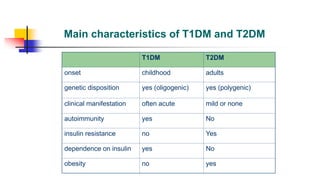
Main characteristics of T1DM and T2DM
T1DM T2DM
onset childhood adults
genetic disposition yes (oligogenic) yes (polygenic)
clinical manifestation often acute mild or none
autoimmunity yes No
insulin resistance no Yes
dependence on insulin yes No
obesity no yes
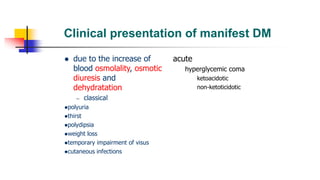
Clinical presentation of manifest DM
 due to the increase of
blood osmolality, osmotic
diuresis and
dehydratation
– classical
polyuria
thirst
polydipsia
weight loss
temporary impairment of visus
cutaneous infections
acute
hyperglycemic coma
ketoacidotic
non-ketoticidotic
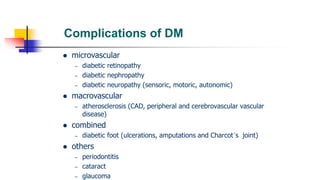
Complications of DM
 microvascular
– diabetic retinopathy
– diabetic nephropathy
– diabetic neuropathy (sensoric, motoric, autonomic)
 macrovascular
– atherosclerosis (CAD, peripheral and cerebrovascular vascular
disease)
 combined
– diabetic foot (ulcerations, amputations and Charcot´s joint)
 others
– periodontitis
– cataract
– glaucoma
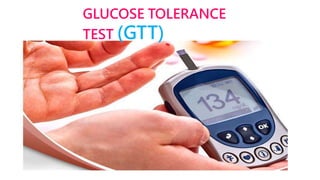
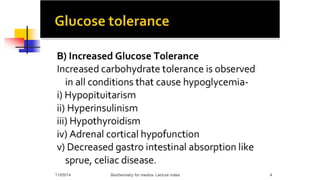
WHAT IS A GLUCOSE TOLERANCE TEST?
- It is a laboratory method to check how the body breaks
down (metabolizes) blood sugar, and how quickly it is
cleared from the blood.
- It is one of the tools used to diagnose prediabetes,
diabetes, insulin resistance and reactive hypoglycemia.
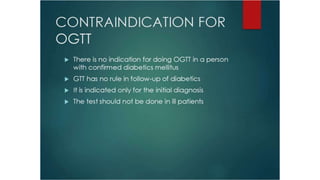
** 2 types of GTT:
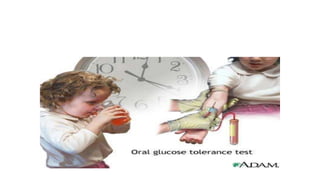
a. Oral Glucose Tolerance Test (OGTT)
- ingestion of glucose solution in 5 minutes.
- most common form of GTT.
- fasting blood sugar (FBS) is measured
before ingestion.
b. Intravenous Glucose Tolerance Test (IGTT)
- glucose is injected into the vein for
three(3)
minutes.
- blood insulin levels are measured before
the injection.
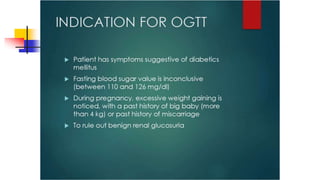
- Most commonly done to check diabetes in:
* obese patients
* pregnant patients (as a screening test during the
24th – 28th weeks of pregnancy)
* patients with non-healing skin infections or
recurrent attacks of skin infections
* patients with family history of diabetes
PREPARATION AND PRECAUTIONS:
1. Do not restrict carbohydrate intake at least three (3)
days prior to the test.
(... balanced diet containing at least 150 – 200 gm
CHO/ day for three (3) days.)
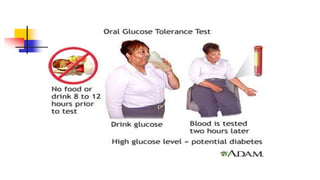
2. Do not eat, drink, smoke or exercise strenuously for
at least 8 hours before the first blood sugar is taken.
3. All medications taken by the subject must be noted
and stopped, if possible, at least three(3) days prior
to the test.
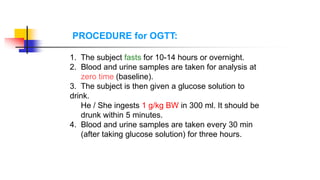
PROCEDURE for OGTT:
1. The subject fasts for 10-14 hours or overnight.
2. Blood and urine samples are taken for analysis at
zero time (baseline).
3. The subject is then given a glucose solution to
drink.
He / She ingests 1 g/kg BW in 300 ml. It should be
drunk within 5 minutes.
4. Blood and urine samples are taken every 30 min
(after taking glucose solution) for three hours.
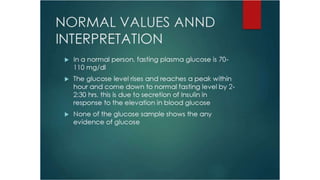
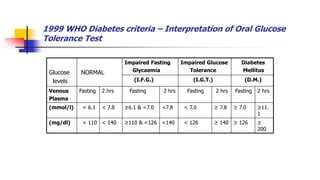
1999 WHO Diabetes criteria – Interpretation of Oral Glucose
Tolerance Test
Glucose
levels
NORMAL
Impaired Fasting
Glycaemia
Impaired Glucose
Tolerance
Diabetes
Mellitus
(I.F.G.) (I.G.T.) (D.M.)
Venous
Plasma
Fasting 2 hrs Fasting 2 hrs Fasting 2 hrs Fasting 2 hrs
(mmol/l) < 6.1 < 7.8 ≥6.1 & <7.0 <7.8 < 7.0 ≥ 7.8 ≥ 7.0 ≥11.
1
(mg/dl) < 110 < 140 ≥110 & <126 <140 < 126 ≥ 140 ≥ 126 ≥
200
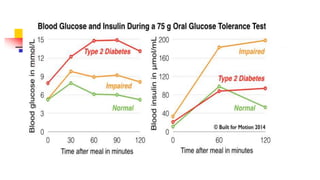
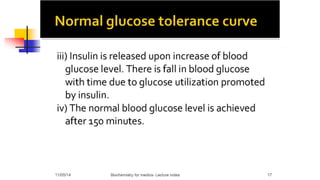
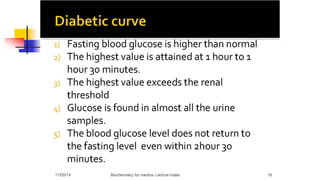
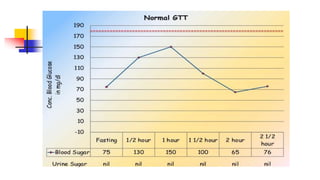
GLUCOSE TOLERANCE TEST

GLUCOSE TOLERANCE TEST

  • 2.
  • 12.
    Main characteristics ofT1DM and T2DM T1DM T2DM onset childhood adults genetic disposition yes (oligogenic) yes (polygenic) clinical manifestation often acute mild or none autoimmunity yes No insulin resistance no Yes dependence on insulin yes No obesity no yes
  • 13.
    Clinical presentation ofmanifest DM  due to the increase of blood osmolality, osmotic diuresis and dehydratation – classical polyuria thirst polydipsia weight loss temporary impairment of visus cutaneous infections acute hyperglycemic coma ketoacidotic non-ketoticidotic
  • 14.
    Complications of DM microvascular – diabetic retinopathy – diabetic nephropathy – diabetic neuropathy (sensoric, motoric, autonomic)  macrovascular – atherosclerosis (CAD, peripheral and cerebrovascular vascular disease)  combined – diabetic foot (ulcerations, amputations and Charcot´s joint)  others – periodontitis – cataract – glaucoma
  • 15.
    WHAT IS AGLUCOSE TOLERANCE TEST? - It is a laboratory method to check how the body breaks down (metabolizes) blood sugar, and how quickly it is cleared from the blood. - It is one of the tools used to diagnose prediabetes, diabetes, insulin resistance and reactive hypoglycemia.
  • 16.
    ** 2 typesof GTT: a. Oral Glucose Tolerance Test (OGTT) - ingestion of glucose solution in 5 minutes. - most common form of GTT. - fasting blood sugar (FBS) is measured before ingestion. b. Intravenous Glucose Tolerance Test (IGTT) - glucose is injected into the vein for three(3) minutes. - blood insulin levels are measured before the injection.
  • 17.
    - Most commonlydone to check diabetes in: * obese patients * pregnant patients (as a screening test during the 24th – 28th weeks of pregnancy) * patients with non-healing skin infections or recurrent attacks of skin infections * patients with family history of diabetes
  • 18.
    PREPARATION AND PRECAUTIONS: 1.Do not restrict carbohydrate intake at least three (3) days prior to the test. (... balanced diet containing at least 150 – 200 gm CHO/ day for three (3) days.) 2. Do not eat, drink, smoke or exercise strenuously for at least 8 hours before the first blood sugar is taken. 3. All medications taken by the subject must be noted and stopped, if possible, at least three(3) days prior to the test.
  • 19.
    PROCEDURE for OGTT: 1.The subject fasts for 10-14 hours or overnight. 2. Blood and urine samples are taken for analysis at zero time (baseline). 3. The subject is then given a glucose solution to drink. He / She ingests 1 g/kg BW in 300 ml. It should be drunk within 5 minutes. 4. Blood and urine samples are taken every 30 min (after taking glucose solution) for three hours.
  • 23.
    1999 WHO Diabetescriteria – Interpretation of Oral Glucose Tolerance Test Glucose levels NORMAL Impaired Fasting Glycaemia Impaired Glucose Tolerance Diabetes Mellitus (I.F.G.) (I.G.T.) (D.M.) Venous Plasma Fasting 2 hrs Fasting 2 hrs Fasting 2 hrs Fasting 2 hrs (mmol/l) < 6.1 < 7.8 ≥6.1 & <7.0 <7.8 < 7.0 ≥ 7.8 ≥ 7.0 ≥11. 1 (mg/dl) < 110 < 140 ≥110 & <126 <140 < 126 ≥ 140 ≥ 126 ≥ 200