MR. JAYESH PATIDAR
www.drjayeshpatidar.blogspot.com
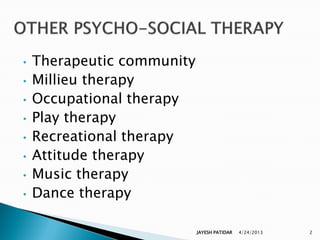
•   Therapeutic community
•   Millieu therapy
•   Occupational therapy
•   Play therapy
•   Recreational therapy
•   Attitude therapy
•   Music therapy
•   Dance therapy

                            JAYESH PATIDAR   4/24/2013   2
THERAPEUTIC
 COMMUNITY

       JAYESH PATIDAR   4/24/2013   3
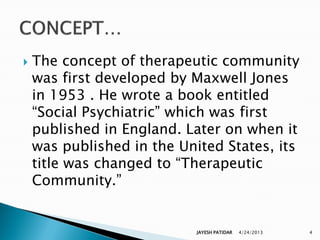
   The concept of therapeutic community
    was first developed by Maxwell Jones
    in 1953 . He wrote a book entitled
    “Social Psychiatric” which was first
    published in England. Later on when it
    was published in the United States, its
    title was changed to “Therapeutic
    Community.”


                            JAYESH PATIDAR   4/24/2013   4
   Stuart & Sundeen defined therapeutic
    community as “a therapy in which
    patient‟s social environment would be
    used to provide a therapeutic
    experience for the patient by involving
    him as an active participant in his own
    care & the daily problems of his
    community.”


                            JAYESH PATIDAR   4/24/2013   5
   To use patient‟s social environment to provide a
    therapeutic experience for him.
   To enable the patient to be an active participant
    in his own care & become involved in daily
    activities of his community.
   To help patients to solve problems, plan activities
    & to develop the necessary rules & regulations
    for the community.
   To increase their independence & gain control
    over many of their own personal activities.
   To enable the patients become aware of how
    their behavior affects others.

                                  JAYESH PATIDAR   4/24/2013   6
 Free communication
 Shared responsibilities
 Active participation
 Involvement in decision making
 Understanding of roles,
  responsibilities, limitations &
  authorities.


                         JAYESH PATIDAR   4/24/2013   7
   Responsibility for treatment belong to the staff
    & client.
   Roles of staff & clients are equalized- may
    discuss either staff behavior or clients
    behavior.
   Democratic environment is fostered.
   Open communication is encouraged
   Focus is on client assets.
   Peer pressure is utilized to reinforce rules &
    regulations.

                                 JAYESH PATIDAR   4/24/2013   8
   Interpersonal interactions are utilized to improve
    communication skills.
   Inappropriate behavior are dealt with as they
    occur.
   Team approach is used.
   Clients are involved in all phases of treatment
   Community government is set up – Use meetings
    to teach standards, values & behavior, explore
    behavior, make decision, use problem solving.
   Two main goals for clients – Learn to set limits,
    Learn psychosocial skills


                                  JAYESH PATIDAR   4/24/2013   9
1.   Daily community Meetings
2.   Patient Government or Ward Council
3.   Staff Meeting or Review
4.   Living & Learning Opportunities


                          JAYESH PATIDAR   4/24/2013   10
 These meetings are composed of 60-90
  patients. All levels of unit staff are involved,
  including administrative personnel. Acute
  patients are involved in the meetings.
 Meetings should be held regularly for 60
  minutes.
 Discussion should focus mainly on day-to-day
  life in the unit.
 During discussion patients‟ feelings & behaviors
  are examined by other members.
 Frank discussion are encouraged, these may take
  place with much outpouring of emotions &
  anger.
                               JAYESH PATIDAR   4/24/2013   11
 The purpose of patient government is to deal
  with practical unit details such as house-keeping
  functions, activity planning & privileges.
 A group of 5-6 patient will have specific
  responsibilities, such as house keeping, physical
  exercise, personal hygiene, meal distribution, a
  group to observe suicidal patients, etc. staff
  members should be available always.
 All decisions should be feedback to the
  community through the community meetings.


                               JAYESH PATIDAR   4/24/2013   12
   A staff meeting should be held following each
    community meeting (patient are excluded & only
    staff are present). In this meeting the staff would
    examine their own responses, expectations, &
    prejudices.

4. Living & Learning Opportunities:
                   Learning opportunities are to be
    provided within the social milieu, which should
    provide realistic learning experiences for the
    patients.


                                   JAYESH PATIDAR   4/24/2013   13
 Schizophrenia
 Substance  abuse disorder
 Antisocial disorder
 Children‟s care taking
  environment


                      JAYESH PATIDAR   4/24/2013   14
   Free communication both within & between staff
    & patient group.
   Communication are directed towards the
    modification of patient‟s attitude, behavior & role
    performance.
   Atmosphere in the community will be democratic
    as opposed to hierarchical, rehabilitative rather
    than custodial, permissive instead of limited &
    controlled.
   Nurses will be more communal with the patient
    instead of displaying all the time therapeutic role.
                                   JAYESH PATIDAR   4/24/2013   15
   Environment will be essentially permissive &
    flexible.
   Patient‟s activities are individualized & the role of
    patients are unspecified & their participation is
    completely voluntary.
   A compulsory daily community meeting that all
    staff members have to attend & all patients are
    encouraged to attend.
   The primary role of staff is to help the patients
    gain new insights & test new behavioral patterns.
   Problems of the patients are discussed & the
    solutions are sought in the small group therapy
    session following each community meeting.

                                    JAYESH PATIDAR   4/24/2013   16
   Patient government or ward council is to deal
    with practical unit details such as privileges &
    house keeping rosters. Staff member is available
    to the patient government, & all decisions are
    fed back to the community through the
    community meetings.
   Staff meeting or review is essential to on-the-
    ward training. It gives opportunity for the staff
    members to examine their own responses,
    expectations & prejudices.
   Feedback is one of the fundamental concepts in
    therapeutic community practice.

                                 JAYESH PATIDAR   4/24/2013   17
 Patient develops harmonious
  relationship with other members of the
  community.
 Gains self-confidence.
 Develop leadership skills.
 Learns to understand & solve problems
  of self & others.
 Become socio-centric.


                         JAYESH PATIDAR   4/24/2013   18
 Learns to live & think collectively with
  the members of the community.
 Lastly therapeutic community provides
  opportunities to participate in the
  formulation of hospital rules &
  regulations that affect patient‟s personal
  liberties like bedtime, meal time,
  weekend permission, control of radio or
  TV, social activities, late night privileges
  etc.

                            JAYESH PATIDAR   4/24/2013   19
 Role blurring between staff & patient.
 Group responsibility can easily
  become nobody‟s responsibility.
 Individual needs & concerns may not
  be met.
 Patient may find the transition to
  community difficulty.


                         JAYESH PATIDAR   4/24/2013   20
   Providing & maintaining a safe & conflict free
    environment through role modeling & group
    leadership.
   Sharing of responsibilities with patients.
   Encouraging patient to participate in decision-
    making functions.
   Assisting patients to assume leadership roles.
   Giving feedback.
   Carrying out supervisory functions.


                                 JAYESH PATIDAR   4/24/2013   21
MILLIEU
THERAPY
     JAYESH PATIDAR   4/24/2013   22
 „Milieu‟ is a French word meaning
  “Middle Place”.
 In English language, milieu means
  “environment” or “setting”, as used in
  psychiatric mental health nursing, it
  refers to the people & all other social
  & physical factors in the environment
  with which the client interacts.


                          JAYESH PATIDAR   4/24/2013   23
   A therapeutic milieu is a 24 – hour environment
    designed to provide a secure retreat for
    individuals whose capacities for coping with
    reality have deteriorated.
   The therapeutic milieu gives them opportunities
    to acquire adaptive coping skills. By offering
    secure, comfortable physical facilities for
    sleeping, dining, bathing & engaging in
    recreational, occupational, social, psychiatric &
    medical therapies, the therapeutic milieu does
    many advantages.

                                  JAYESH PATIDAR   4/24/2013   24
   A therapeutic milieu is a “safe space,” a non-punitive
    atmosphere in which caring is a basic factor.
   In this environment, confrontation may be a positive
    therapeutic tool that can be tolerated by the client.
   Nurses & treatment team members should be aware
    of their own roles in this environment, maintaining
    stability & safety, but minimizing authoritarian
    behavior
   Clients are expected to assume responsibility for
    themselves within the structure of the milieu as much
    as possible.
   Feedback from other clients & the sharing of tasks or
    duties within the treatment program facilitate the
    client‟s growth.
                                    JAYESH PATIDAR   4/24/2013   25
   Shelters clients physically from what they
    perceive as painful, terrifying stressors.
   Protects clients physically from discharges of
    their own & other‟s maladaptive behaviors.
   Supports the physiological existence of clients.
   Provides pleasant, attractive, sensory
    stimulation of clients.
   Educates clients & their families about adaptive,
    effective coping.


                                  JAYESH PATIDAR   4/24/2013   26
1.   Maintaining Safe Environment
2.   The Trust Relationship
3.   Building Self-esteem
4.   Limit-setting


                       JAYESH PATIDAR   4/24/2013   27
The nursing staff should follow the facility‟s
  policies with regard to prevention of routine
  safety hazards & supplement these policies as
  necessary.
For Example;
 Dispose of all needles safety & out of reach of
  client.
 Restrict or monitor the use of matches &
  lighters.
 Do not allow smoking.


                               JAYESH PATIDAR   4/24/2013   28
   Remove mouthwash, aftershave lotions & so
    forth, if substance abuse is suspected.
   Keep sharp objects out of reach of client
   Identify potential weapons & dangerous
    equipment.
   Do not leave medicines unattended or unlocked.
   Keep keys (to unit door, medicines) on your
    person at all times.
   Search packages brought in by visitors, explain
    the reason for such rules briefly, & do not make
    any exceptions.


                                 JAYESH PATIDAR   4/24/2013   29
one of the keys to a therapeutic
environment is the establishment of trust.
Both the client & the nurse must trust that
treatment is desirable & productive. Trust is
the foundation of a therapeutic relationship,
& limit-setting & consistency are its
building blocks.


                           JAYESH PATIDAR   4/24/2013   30
Strategies to help build or enhance
  self-esteem must be individualized &
  built on honesty & on the client‟s
  strengths.
Some general suggestions are:
 Set & maintain limits.
 Accept the client as a person.
 Be non-judgmental at all times.
 Structure the client‟s time & activities.


                           JAYESH PATIDAR   4/24/2013   31
 Have realistic expectations of the
  client & make them clear to the client.
 Initially provide the client with tasks,
  responsibilities & activities that can be
  easily accomplished.
 Never flatter the client.
 Allow the client to make his own
  decisions whenever possible.


                           JAYESH PATIDAR   4/24/2013   32
 Setting & maintaining limits are integral
  to a trust relationship & to a
  therapeutic milieu. Before stating a
  limit explain the reason for limit-
  setting.
 Some basic guidelines for effective
  using limits are:
 State the expectations or the limit as
  clearly, directly & simply as possible.
                          JAYESH PATIDAR   4/24/2013   33
   The consequence that will follow the client‟s
    exceeding the limit also must be clearly stated
    at the outset.
   The consequences should immediately follow
    the client‟s exceeding the limit & must be
    consistent, both over time (each time the limit
    is exceeded) & among staff (each staff
    member must enforce the limit).
   Consequences are essential to setting &
    maintaining limits, they are not an opportunity
    to be punitive to a client.


                                JAYESH PATIDAR   4/24/2013   34
   In conclusion, the nurse works with
    other health professionals in an
    interdisciplinary team; The
    interdisciplinary team works within a
    milieu that is constructed as a
    therapeutic environment, with the aim
    of developing a holistic view of the
    client & providing effective treatment.


                            JAYESH PATIDAR   4/24/2013   35
   Use nursing process to provide comprehensive
    care.
   Provide direct client care
 Manages the day-to-day care of individual clients.
 Assists the client for re-entry into the community.
   Give indirect client care
 Maintains on going communication with other
  mental health team members.
 Enforces rules, policies & regulations of therapeutic
  milieu.
 A schedule, assigns, manages, & evaluates clinical
  work
                                 JAYESH PATIDAR   4/24/2013   36
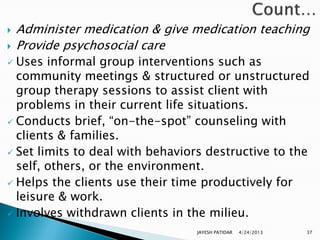
   Administer medication & give medication teaching
   Provide psychosocial care
 Uses informal group interventions such as
  community meetings & structured or unstructured
  group therapy sessions to assist client with
  problems in their current life situations.
 Conducts brief, “on-the-spot” counseling with
  clients & families.
 Set limits to deal with behaviors destructive to the
  self, others, or the environment.
 Helps the clients use their time productively for
  leisure & work.
 Involves withdrawn clients in the milieu.

                                 JAYESH PATIDAR   4/24/2013   37
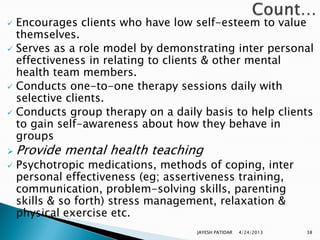
 Encourages clients who have low self-esteem to value
  themselves.
 Serves as a role model by demonstrating inter personal
  effectiveness in relating to clients & other mental
  health team members.
 Conducts one-to-one therapy sessions daily with
  selective clients.
 Conducts group therapy on a daily basis to help clients
  to gain self-awareness about how they behave in
  groups
 Provide   mental health teaching
   Psychotropic medications, methods of coping, inter
    personal effectiveness (eg; assertiveness training,
    communication, problem-solving skills, parenting
    skills & so forth) stress management, relaxation &
    physical exercise etc.
                                     JAYESH PATIDAR   4/24/2013   38
   Encourage clients to help & support each
    other individually & as a group.
   Assist clients to understand each other‟s
    feelings & problems.
   Conduct community meetings.
   Participate freely in milieu activities (i.e,
    exercise, art, craft classes, social function)


                                 JAYESH PATIDAR   4/24/2013   39
OCCUPATIONAL
  THERAPY

       JAYESH PATIDAR   4/24/2013   40
   Occupational therapy is the
    application of goal-oriented,
    purposeful activity in the assessment
    & treatment of individuals with
    psychological, physical or
    developmental disabilities.


                           JAYESH PATIDAR   4/24/2013   41
 “Any activity, which engages a
  person‟s resources of time & energy &
  is composed of skills & values” (Reed
  & Sanderson, 1980).
 “Any goal-directed activity meaningful
  to the individual & providing feedback
  to him about his worth & value as an
  individual & about his inter-
  relatedness to others”.

                         JAYESH PATIDAR   4/24/2013   42
   The aim of the occupational therapist‟s
    intervention is the alleviation of dysfunction &
    the development of maximum functional
    independence in all aspects of living. Specific
    aims of occupational therapy are:
I.    Promotion of recovery
II. Mobilization of total assets of the patient
III. Prevention of hospitalization.
IV. Creation of good habits of work & leisure.
V. Rehabilitation with return of self-confidence.


                                JAYESH PATIDAR   4/24/2013   43
The main goal is to enable the
 patient to achieve a healthy
 balance of occupations through
 the development of skills that will
 allow him to function at a level
 satisfactory to himself & others.


                       JAYESH PATIDAR   4/24/2013   44
   Occupational therapy is provided to
    children, adolescents, adults & elderly
    patients.
   These programs are offered in psychiatric
    hospitals, nursing homes, rehabilitation
    centers, special schools, community group
    homes, community mental health centers,
    day care centers, halfway homes &
    addiction centers.


                              JAYESH PATIDAR   4/24/2013   45
 Helps to develop social skills &
  provide an outlet for self-expression.
 Strengthens ego defenses.
 Develops a more realistic view of the
  self in relation to other.


                         JAYESH PATIDAR   4/24/2013   46
   The client should be involved as much as
    possible in selecting the activity.
   Select an activity that interests or has the
    potential to interest him.
   The activity should utilize the client‟s strengths
    & abilities.
   The activity should be of short duration to foster
    a feeling of accomplishment.
   If possible, the selected activity should provide
    some new experience for the client.


                                  JAYESH PATIDAR   4/24/2013   47
It consists of six stages:
1. Initial evaluation of what patient can do &
    cannot do in a variety of situations over a
    period of time.
2. Development of immediate & long-term goals
    by the patient & therapist together. Goals
    should be concrete & measurable so that it is
    easy to see when they have been attained.
3. Development of therapy plan with planned
    intervention.


                               JAYESH PATIDAR   4/24/2013   48
4.   Implementation of the plan &
     monitoring the progress. The plan is
     followed until the first evaluation. If
     found satisfactory it is continued &
     altered, it not.
5.   Review meetings with patient & all the
     staff involved in treatment.
6.   Setting further goals when immediate
     goals have been achieved; modifying
     the treatment program as relevant.
                             JAYESH PATIDAR   4/24/2013   49
1.   Diversional activity: These activities are
     used to divert one‟s thoughts from life
     stresses or to fill time. For example,
     organized games.

2.   Therapeutic activities: These activities are
     used to attain a specific care plan or goal.
     For example, basket making, carpentry etc.


                                 JAYESH PATIDAR   4/24/2013   50
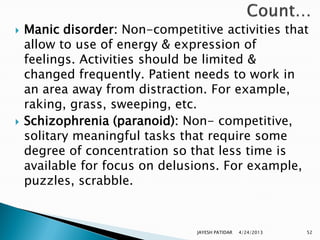
   Anxiety disorder: Simple concrete tasks with
    no more than 3 or 4 steps that can be learnt
    quickly. For example, kitchen tasks, washing,
    sweeping, mopping, mowing lawn & wedding
    gardens.
   Depressive disorder: Simple concrete tasks
    which are achievable; it is important for the
    patient to experience success. Provide positive
    reinforcement after each achievement. For
    example, craft, mowing lawn, wedding
    gardens.
                                JAYESH PATIDAR   4/24/2013   51
   Manic disorder: Non-competitive activities that
    allow to use of energy & expression of
    feelings. Activities should be limited &
    changed frequently. Patient needs to work in
    an area away from distraction. For example,
    raking, grass, sweeping, etc.
   Schizophrenia (paranoid): Non- competitive,
    solitary meaningful tasks that require some
    degree of concentration so that less time is
    available for focus on delusions. For example,
    puzzles, scrabble.


                                JAYESH PATIDAR   4/24/2013   52
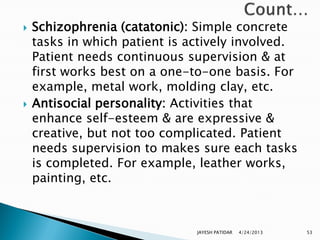
   Schizophrenia (catatonic): Simple concrete
    tasks in which patient is actively involved.
    Patient needs continuous supervision & at
    first works best on a one-to-one basis. For
    example, metal work, molding clay, etc.
   Antisocial personality: Activities that
    enhance self-esteem & are expressive &
    creative, but not too complicated. Patient
    needs supervision to makes sure each tasks
    is completed. For example, leather works,
    painting, etc.


                               JAYESH PATIDAR   4/24/2013   53
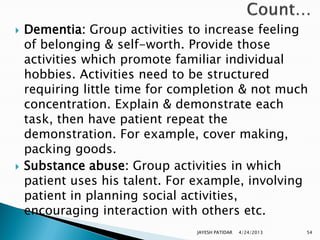
   Dementia: Group activities to increase feeling
    of belonging & self-worth. Provide those
    activities which promote familiar individual
    hobbies. Activities need to be structured
    requiring little time for completion & not much
    concentration. Explain & demonstrate each
    task, then have patient repeat the
    demonstration. For example, cover making,
    packing goods.
   Substance abuse: Group activities in which
    patient uses his talent. For example, involving
    patient in planning social activities,
    encouraging interaction with others etc.
                                JAYESH PATIDAR   4/24/2013   54
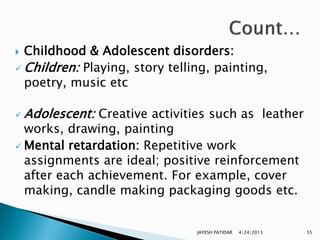
 Childhood & Adolescent disorders:
 Children: Playing, story telling, painting,
  poetry, music etc

 Adolescent:  Creative activities such as leather
  works, drawing, painting
 Mental retardation: Repetitive work
  assignments are ideal; positive reinforcement
  after each achievement. For example, cover
  making, candle making packaging goods etc.


                                JAYESH PATIDAR   4/24/2013   55
PLAY
THERAPY
    JAYESH PATIDAR   4/24/2013   56
   Play is a natural mode of growth &
    development in children. Through play a child
    learns to express his emotions & it serves as
    a tool in the development of the child.


                               JAYESH PATIDAR   4/24/2013   57
   It releases tension & pent-up emotions.
   It allows compensation for loss & failures.
   It improves emotional growth through his
    relationship with other children.
   It provides an opportunity to the child to act
    out his fantasies & conflict, to get rid of
    aggression & to learn positive qualities from
    other children.


                                 JAYESH PATIDAR   4/24/2013   58
   Play therapy gives the therapist a chance to
    explore family relationships of the child &
    discover what difficulties are contributing to
    the child‟s problem.
   Play therapy allows studying hidden aspects
    of the child‟s problems.
   It is possible to obtain a good ideas of the
    intelligence level of the child.
   Through play inter-sibling relationships can
    be adequately studied.


                                 JAYESH PATIDAR   4/24/2013   59
   Individual vs group play therapy: In individual
    therapy the child is allowed to play by himself &
    the therapist‟s attention is focused on this one
    child alone. In group play therapy other children
    are involved.
   Free play vs controlled play therapy: In free play
    the child is given freedom in deciding with what
    toys he wants to play. In controlled play
    therapy, the child is introduced into a scene
    where the situation or setting is already
    established.

                                  JAYESH PATIDAR   4/24/2013   60
   Structured vs unstructured play therapy:
    Structured play therapy involves organizing the
    situation in such a way so as to obtain more
    information. In unstructured play therapy no
    situation is set & no plans are followed.
   Directive vs non-directive play therapy: In
    directive play therapy, the therapist totally sets
    the direction, whereas in non-directive play
    therapy, the child receives no direction. Play
    therapy is generally conducted in a playroom.
    The playroom should be suitably stocked with
    adequate play material, depending upon the
    problems of the child.
                                   JAYESH PATIDAR   4/24/2013   61
RECREATIONAL
  THERAPY

       JAYESH PATIDAR   4/24/2013   62
 Recreation is a form of activity therapy
  used in most psychiatric setting.
 It is planned therapeutic activity that
  enables people with limitations to
  engage in recreational experiences.


                          JAYESH PATIDAR   4/24/2013   63
 To encourage social interaction.
 To decrease withdrawal tendencies
 To provide outlet for feelings.
 To promote socially acceptable
  behavior
 To develop skills, talents & abilities
 To increase physical confidence & a
  feeling of self worth.

                           JAYESH PATIDAR   4/24/2013   64
 Provide a non-threatening & non-
  demanding environment.
 Provide activities that are relaxing &
  without rigid guidelines & time-
  frames.
 Provide activities that are enjoyable &
  self-satisfying.


                          JAYESH PATIDAR   4/24/2013   65
   Motor forms: These can be further divided into
    fundamental & accessory; among the
    fundamental forms are such games as hockey
    & football, while the accessory forms are
    exemplified by play activity & dancing.
   Sensory forms: These can be either visual for
    example, looking at motion pictures, play, etc.,
    or auditory such as listening to a concert.
   Intellectual forms: These include reading,
    debating & so on.


                                 JAYESH PATIDAR   4/24/2013   66
   Anxiety disorder: Aerobic activities like
    walking, jogging, etc.
   Depressive disorder: Non-competitive sports,
    which provide outlet for anger, like jogging,
    walking , running, etc.
   Manic disorder: One-to-one basis individual
    games like shuttle badminton, ball badminton,
    etc.
   Schizophrenia (paranoid): Activities requiring
    concentration like chess, puzzles.

                                JAYESH PATIDAR   4/24/2013   67
   Schizophrenia (catatonic): Social activities to give
    patient contact with reality like dancing, athletics.
   Dementia: Concrete, repetitious craft & projects
    that breed familiarization & comfort.
   Childhood & adolescent disorders: It is better to
    work with the child on a one-to-one basis & give
    him a feeling of importance. Employ activities
    such as playing, story telling & painting.
    Adolescents fare better in groups; provide gross
    motor activities like sports & games to use up
    excess energy.
   Mental Retardation: Activities should be
    according to the patient‟s level of functioning
    such as walking, dancing, swimming, ball
    playing. Etc.
                                                                 68
                                    JAYESH PATIDAR   4/24/2013
ATTITUDE
THERAPY
     JAYESH PATIDAR   4/24/2013   69
Attitude therapy is a form of milieu
therapy in which all staff members
assume a consistent, prescribed
attitude designed to be therapeutic
towards patients.


                        JAYESH PATIDAR   4/24/2013   70
i. When the patient is in the hospital for a long
     time:
• The patient is interviewed to assess his
     emotional state & activity level.
• Family members are interviewed to acquaint
     them with the attitude therapy which will be
     used for the patient.
ii. After this, a staff meeting is held in which all the
     team members are present.

                                   JAYESH PATIDAR   4/24/2013   71
iii. A clinical diagnosis is made by the
  psychiatrist.
iv. A plan of attitude to be adopted for a
  particular patient is discussed with purpose.
v. One Principal Line of Approach at a time by
  all the team members.
                       The attitude therapy is
  basically meaning to change the attitude of
  the patient in specific situations. A general
  attitude which the nurse needs to adopt for
  psychiatric patients is kept in mind.


                              JAYESH PATIDAR   4/24/2013   72
 The patient starts feeling that an
  organized approach is being used for
  his/her treatment.
 Guesswork & haphazard plans by
  individual members of the team are
  reduced.
 The patient‟s problems or conflict are
  solved in less time.


                         JAYESH PATIDAR   4/24/2013   73
 This approach also provides an
  opportunity for the members to explore,
  test & change the therapeutic attitude
  which will bring best results in patient.
 It brings members of the team together
  to plan, work & evaluate each other‟s
  efforts & to discover new ways of
  helping the patient.


                          JAYESH PATIDAR   4/24/2013   74
MUSIC
THERAPY
    JAYESH PATIDAR   4/24/2013   75
   Music therapy is the functional
    application of music towards the
    attainment of specific therapeutic
    goals.


                            JAYESH PATIDAR   4/24/2013   76
 Facilitates emotional expressions
 Improves cognitive skills like learning,
  listening & attention span.
 Social interaction is stimulated.


                          JAYESH PATIDAR   4/24/2013   77
DANCE
THERAPY
    JAYESH PATIDAR   4/24/2013   78
   It is a psychotherapeutic use of
    movement, which furthers the
    emotional & physical integration of
    the individual.


                           JAYESH PATIDAR   4/24/2013   79
 Helps to develop body awareness.
 Facilitates expression of feelings.
 Improves interaction & communication
 Fosters integration of physical, emotional
  & social experiences that results in a
  sense of increased self-confidence &
  contentment.
 Exercise through body movement
  maintains good circulation & muscle
  tone.
                           JAYESH PATIDAR   4/24/2013   80
JAYESH PATIDAR   4/24/2013   81

Other psych0 social therapy

  • 1.
  • 2.
    Therapeutic community • Millieu therapy • Occupational therapy • Play therapy • Recreational therapy • Attitude therapy • Music therapy • Dance therapy JAYESH PATIDAR 4/24/2013 2
  • 3.
    THERAPEUTIC COMMUNITY JAYESH PATIDAR 4/24/2013 3
  • 4.
    The concept of therapeutic community was first developed by Maxwell Jones in 1953 . He wrote a book entitled “Social Psychiatric” which was first published in England. Later on when it was published in the United States, its title was changed to “Therapeutic Community.” JAYESH PATIDAR 4/24/2013 4
  • 5.
    Stuart & Sundeen defined therapeutic community as “a therapy in which patient‟s social environment would be used to provide a therapeutic experience for the patient by involving him as an active participant in his own care & the daily problems of his community.” JAYESH PATIDAR 4/24/2013 5
  • 6.
    To use patient‟s social environment to provide a therapeutic experience for him.  To enable the patient to be an active participant in his own care & become involved in daily activities of his community.  To help patients to solve problems, plan activities & to develop the necessary rules & regulations for the community.  To increase their independence & gain control over many of their own personal activities.  To enable the patients become aware of how their behavior affects others. JAYESH PATIDAR 4/24/2013 6
  • 7.
     Free communication Shared responsibilities  Active participation  Involvement in decision making  Understanding of roles, responsibilities, limitations & authorities. JAYESH PATIDAR 4/24/2013 7
  • 8.
    Responsibility for treatment belong to the staff & client.  Roles of staff & clients are equalized- may discuss either staff behavior or clients behavior.  Democratic environment is fostered.  Open communication is encouraged  Focus is on client assets.  Peer pressure is utilized to reinforce rules & regulations. JAYESH PATIDAR 4/24/2013 8
  • 9.
    Interpersonal interactions are utilized to improve communication skills.  Inappropriate behavior are dealt with as they occur.  Team approach is used.  Clients are involved in all phases of treatment  Community government is set up – Use meetings to teach standards, values & behavior, explore behavior, make decision, use problem solving.  Two main goals for clients – Learn to set limits, Learn psychosocial skills JAYESH PATIDAR 4/24/2013 9
  • 10.
    1. Daily community Meetings 2. Patient Government or Ward Council 3. Staff Meeting or Review 4. Living & Learning Opportunities JAYESH PATIDAR 4/24/2013 10
  • 11.
     These meetingsare composed of 60-90 patients. All levels of unit staff are involved, including administrative personnel. Acute patients are involved in the meetings.  Meetings should be held regularly for 60 minutes.  Discussion should focus mainly on day-to-day life in the unit.  During discussion patients‟ feelings & behaviors are examined by other members.  Frank discussion are encouraged, these may take place with much outpouring of emotions & anger. JAYESH PATIDAR 4/24/2013 11
  • 12.
     The purposeof patient government is to deal with practical unit details such as house-keeping functions, activity planning & privileges.  A group of 5-6 patient will have specific responsibilities, such as house keeping, physical exercise, personal hygiene, meal distribution, a group to observe suicidal patients, etc. staff members should be available always.  All decisions should be feedback to the community through the community meetings. JAYESH PATIDAR 4/24/2013 12
  • 13.
    A staff meeting should be held following each community meeting (patient are excluded & only staff are present). In this meeting the staff would examine their own responses, expectations, & prejudices. 4. Living & Learning Opportunities: Learning opportunities are to be provided within the social milieu, which should provide realistic learning experiences for the patients. JAYESH PATIDAR 4/24/2013 13
  • 14.
     Schizophrenia  Substance abuse disorder  Antisocial disorder  Children‟s care taking environment JAYESH PATIDAR 4/24/2013 14
  • 15.
    Free communication both within & between staff & patient group.  Communication are directed towards the modification of patient‟s attitude, behavior & role performance.  Atmosphere in the community will be democratic as opposed to hierarchical, rehabilitative rather than custodial, permissive instead of limited & controlled.  Nurses will be more communal with the patient instead of displaying all the time therapeutic role. JAYESH PATIDAR 4/24/2013 15
  • 16.
    Environment will be essentially permissive & flexible.  Patient‟s activities are individualized & the role of patients are unspecified & their participation is completely voluntary.  A compulsory daily community meeting that all staff members have to attend & all patients are encouraged to attend.  The primary role of staff is to help the patients gain new insights & test new behavioral patterns.  Problems of the patients are discussed & the solutions are sought in the small group therapy session following each community meeting. JAYESH PATIDAR 4/24/2013 16
  • 17.
    Patient government or ward council is to deal with practical unit details such as privileges & house keeping rosters. Staff member is available to the patient government, & all decisions are fed back to the community through the community meetings.  Staff meeting or review is essential to on-the- ward training. It gives opportunity for the staff members to examine their own responses, expectations & prejudices.  Feedback is one of the fundamental concepts in therapeutic community practice. JAYESH PATIDAR 4/24/2013 17
  • 18.
     Patient developsharmonious relationship with other members of the community.  Gains self-confidence.  Develop leadership skills.  Learns to understand & solve problems of self & others.  Become socio-centric. JAYESH PATIDAR 4/24/2013 18
  • 19.
     Learns tolive & think collectively with the members of the community.  Lastly therapeutic community provides opportunities to participate in the formulation of hospital rules & regulations that affect patient‟s personal liberties like bedtime, meal time, weekend permission, control of radio or TV, social activities, late night privileges etc. JAYESH PATIDAR 4/24/2013 19
  • 20.
     Role blurringbetween staff & patient.  Group responsibility can easily become nobody‟s responsibility.  Individual needs & concerns may not be met.  Patient may find the transition to community difficulty. JAYESH PATIDAR 4/24/2013 20
  • 21.
    Providing & maintaining a safe & conflict free environment through role modeling & group leadership.  Sharing of responsibilities with patients.  Encouraging patient to participate in decision- making functions.  Assisting patients to assume leadership roles.  Giving feedback.  Carrying out supervisory functions. JAYESH PATIDAR 4/24/2013 21
  • 22.
    MILLIEU THERAPY JAYESH PATIDAR 4/24/2013 22
  • 23.
     „Milieu‟ isa French word meaning “Middle Place”.  In English language, milieu means “environment” or “setting”, as used in psychiatric mental health nursing, it refers to the people & all other social & physical factors in the environment with which the client interacts. JAYESH PATIDAR 4/24/2013 23
  • 24.
    A therapeutic milieu is a 24 – hour environment designed to provide a secure retreat for individuals whose capacities for coping with reality have deteriorated.  The therapeutic milieu gives them opportunities to acquire adaptive coping skills. By offering secure, comfortable physical facilities for sleeping, dining, bathing & engaging in recreational, occupational, social, psychiatric & medical therapies, the therapeutic milieu does many advantages. JAYESH PATIDAR 4/24/2013 24
  • 25.
    A therapeutic milieu is a “safe space,” a non-punitive atmosphere in which caring is a basic factor.  In this environment, confrontation may be a positive therapeutic tool that can be tolerated by the client.  Nurses & treatment team members should be aware of their own roles in this environment, maintaining stability & safety, but minimizing authoritarian behavior  Clients are expected to assume responsibility for themselves within the structure of the milieu as much as possible.  Feedback from other clients & the sharing of tasks or duties within the treatment program facilitate the client‟s growth. JAYESH PATIDAR 4/24/2013 25
  • 26.
    Shelters clients physically from what they perceive as painful, terrifying stressors.  Protects clients physically from discharges of their own & other‟s maladaptive behaviors.  Supports the physiological existence of clients.  Provides pleasant, attractive, sensory stimulation of clients.  Educates clients & their families about adaptive, effective coping. JAYESH PATIDAR 4/24/2013 26
  • 27.
    1. Maintaining Safe Environment 2. The Trust Relationship 3. Building Self-esteem 4. Limit-setting JAYESH PATIDAR 4/24/2013 27
  • 28.
    The nursing staffshould follow the facility‟s policies with regard to prevention of routine safety hazards & supplement these policies as necessary. For Example;  Dispose of all needles safety & out of reach of client.  Restrict or monitor the use of matches & lighters.  Do not allow smoking. JAYESH PATIDAR 4/24/2013 28
  • 29.
    Remove mouthwash, aftershave lotions & so forth, if substance abuse is suspected.  Keep sharp objects out of reach of client  Identify potential weapons & dangerous equipment.  Do not leave medicines unattended or unlocked.  Keep keys (to unit door, medicines) on your person at all times.  Search packages brought in by visitors, explain the reason for such rules briefly, & do not make any exceptions. JAYESH PATIDAR 4/24/2013 29
  • 30.
    one of thekeys to a therapeutic environment is the establishment of trust. Both the client & the nurse must trust that treatment is desirable & productive. Trust is the foundation of a therapeutic relationship, & limit-setting & consistency are its building blocks. JAYESH PATIDAR 4/24/2013 30
  • 31.
    Strategies to helpbuild or enhance self-esteem must be individualized & built on honesty & on the client‟s strengths. Some general suggestions are:  Set & maintain limits.  Accept the client as a person.  Be non-judgmental at all times.  Structure the client‟s time & activities. JAYESH PATIDAR 4/24/2013 31
  • 32.
     Have realisticexpectations of the client & make them clear to the client.  Initially provide the client with tasks, responsibilities & activities that can be easily accomplished.  Never flatter the client.  Allow the client to make his own decisions whenever possible. JAYESH PATIDAR 4/24/2013 32
  • 33.
     Setting &maintaining limits are integral to a trust relationship & to a therapeutic milieu. Before stating a limit explain the reason for limit- setting.  Some basic guidelines for effective using limits are:  State the expectations or the limit as clearly, directly & simply as possible. JAYESH PATIDAR 4/24/2013 33
  • 34.
    The consequence that will follow the client‟s exceeding the limit also must be clearly stated at the outset.  The consequences should immediately follow the client‟s exceeding the limit & must be consistent, both over time (each time the limit is exceeded) & among staff (each staff member must enforce the limit).  Consequences are essential to setting & maintaining limits, they are not an opportunity to be punitive to a client. JAYESH PATIDAR 4/24/2013 34
  • 35.
    In conclusion, the nurse works with other health professionals in an interdisciplinary team; The interdisciplinary team works within a milieu that is constructed as a therapeutic environment, with the aim of developing a holistic view of the client & providing effective treatment. JAYESH PATIDAR 4/24/2013 35
  • 36.
    Use nursing process to provide comprehensive care.  Provide direct client care  Manages the day-to-day care of individual clients.  Assists the client for re-entry into the community.  Give indirect client care  Maintains on going communication with other mental health team members.  Enforces rules, policies & regulations of therapeutic milieu.  A schedule, assigns, manages, & evaluates clinical work JAYESH PATIDAR 4/24/2013 36
  • 37.
    Administer medication & give medication teaching  Provide psychosocial care  Uses informal group interventions such as community meetings & structured or unstructured group therapy sessions to assist client with problems in their current life situations.  Conducts brief, “on-the-spot” counseling with clients & families.  Set limits to deal with behaviors destructive to the self, others, or the environment.  Helps the clients use their time productively for leisure & work.  Involves withdrawn clients in the milieu. JAYESH PATIDAR 4/24/2013 37
  • 38.
     Encourages clientswho have low self-esteem to value themselves.  Serves as a role model by demonstrating inter personal effectiveness in relating to clients & other mental health team members.  Conducts one-to-one therapy sessions daily with selective clients.  Conducts group therapy on a daily basis to help clients to gain self-awareness about how they behave in groups  Provide mental health teaching  Psychotropic medications, methods of coping, inter personal effectiveness (eg; assertiveness training, communication, problem-solving skills, parenting skills & so forth) stress management, relaxation & physical exercise etc. JAYESH PATIDAR 4/24/2013 38
  • 39.
    Encourage clients to help & support each other individually & as a group.  Assist clients to understand each other‟s feelings & problems.  Conduct community meetings.  Participate freely in milieu activities (i.e, exercise, art, craft classes, social function) JAYESH PATIDAR 4/24/2013 39
  • 40.
    OCCUPATIONAL THERAPY JAYESH PATIDAR 4/24/2013 40
  • 41.
    Occupational therapy is the application of goal-oriented, purposeful activity in the assessment & treatment of individuals with psychological, physical or developmental disabilities. JAYESH PATIDAR 4/24/2013 41
  • 42.
     “Any activity,which engages a person‟s resources of time & energy & is composed of skills & values” (Reed & Sanderson, 1980).  “Any goal-directed activity meaningful to the individual & providing feedback to him about his worth & value as an individual & about his inter- relatedness to others”. JAYESH PATIDAR 4/24/2013 42
  • 43.
    The aim of the occupational therapist‟s intervention is the alleviation of dysfunction & the development of maximum functional independence in all aspects of living. Specific aims of occupational therapy are: I. Promotion of recovery II. Mobilization of total assets of the patient III. Prevention of hospitalization. IV. Creation of good habits of work & leisure. V. Rehabilitation with return of self-confidence. JAYESH PATIDAR 4/24/2013 43
  • 44.
    The main goalis to enable the patient to achieve a healthy balance of occupations through the development of skills that will allow him to function at a level satisfactory to himself & others. JAYESH PATIDAR 4/24/2013 44
  • 45.
    Occupational therapy is provided to children, adolescents, adults & elderly patients.  These programs are offered in psychiatric hospitals, nursing homes, rehabilitation centers, special schools, community group homes, community mental health centers, day care centers, halfway homes & addiction centers. JAYESH PATIDAR 4/24/2013 45
  • 46.
     Helps todevelop social skills & provide an outlet for self-expression.  Strengthens ego defenses.  Develops a more realistic view of the self in relation to other. JAYESH PATIDAR 4/24/2013 46
  • 47.
    The client should be involved as much as possible in selecting the activity.  Select an activity that interests or has the potential to interest him.  The activity should utilize the client‟s strengths & abilities.  The activity should be of short duration to foster a feeling of accomplishment.  If possible, the selected activity should provide some new experience for the client. JAYESH PATIDAR 4/24/2013 47
  • 48.
    It consists ofsix stages: 1. Initial evaluation of what patient can do & cannot do in a variety of situations over a period of time. 2. Development of immediate & long-term goals by the patient & therapist together. Goals should be concrete & measurable so that it is easy to see when they have been attained. 3. Development of therapy plan with planned intervention. JAYESH PATIDAR 4/24/2013 48
  • 49.
    4. Implementation of the plan & monitoring the progress. The plan is followed until the first evaluation. If found satisfactory it is continued & altered, it not. 5. Review meetings with patient & all the staff involved in treatment. 6. Setting further goals when immediate goals have been achieved; modifying the treatment program as relevant. JAYESH PATIDAR 4/24/2013 49
  • 50.
    1. Diversional activity: These activities are used to divert one‟s thoughts from life stresses or to fill time. For example, organized games. 2. Therapeutic activities: These activities are used to attain a specific care plan or goal. For example, basket making, carpentry etc. JAYESH PATIDAR 4/24/2013 50
  • 51.
    Anxiety disorder: Simple concrete tasks with no more than 3 or 4 steps that can be learnt quickly. For example, kitchen tasks, washing, sweeping, mopping, mowing lawn & wedding gardens.  Depressive disorder: Simple concrete tasks which are achievable; it is important for the patient to experience success. Provide positive reinforcement after each achievement. For example, craft, mowing lawn, wedding gardens. JAYESH PATIDAR 4/24/2013 51
  • 52.
    Manic disorder: Non-competitive activities that allow to use of energy & expression of feelings. Activities should be limited & changed frequently. Patient needs to work in an area away from distraction. For example, raking, grass, sweeping, etc.  Schizophrenia (paranoid): Non- competitive, solitary meaningful tasks that require some degree of concentration so that less time is available for focus on delusions. For example, puzzles, scrabble. JAYESH PATIDAR 4/24/2013 52
  • 53.
    Schizophrenia (catatonic): Simple concrete tasks in which patient is actively involved. Patient needs continuous supervision & at first works best on a one-to-one basis. For example, metal work, molding clay, etc.  Antisocial personality: Activities that enhance self-esteem & are expressive & creative, but not too complicated. Patient needs supervision to makes sure each tasks is completed. For example, leather works, painting, etc. JAYESH PATIDAR 4/24/2013 53
  • 54.
    Dementia: Group activities to increase feeling of belonging & self-worth. Provide those activities which promote familiar individual hobbies. Activities need to be structured requiring little time for completion & not much concentration. Explain & demonstrate each task, then have patient repeat the demonstration. For example, cover making, packing goods.  Substance abuse: Group activities in which patient uses his talent. For example, involving patient in planning social activities, encouraging interaction with others etc. JAYESH PATIDAR 4/24/2013 54
  • 55.
     Childhood &Adolescent disorders:  Children: Playing, story telling, painting, poetry, music etc  Adolescent: Creative activities such as leather works, drawing, painting  Mental retardation: Repetitive work assignments are ideal; positive reinforcement after each achievement. For example, cover making, candle making packaging goods etc. JAYESH PATIDAR 4/24/2013 55
  • 56.
    PLAY THERAPY JAYESH PATIDAR 4/24/2013 56
  • 57.
    Play is a natural mode of growth & development in children. Through play a child learns to express his emotions & it serves as a tool in the development of the child. JAYESH PATIDAR 4/24/2013 57
  • 58.
    It releases tension & pent-up emotions.  It allows compensation for loss & failures.  It improves emotional growth through his relationship with other children.  It provides an opportunity to the child to act out his fantasies & conflict, to get rid of aggression & to learn positive qualities from other children. JAYESH PATIDAR 4/24/2013 58
  • 59.
    Play therapy gives the therapist a chance to explore family relationships of the child & discover what difficulties are contributing to the child‟s problem.  Play therapy allows studying hidden aspects of the child‟s problems.  It is possible to obtain a good ideas of the intelligence level of the child.  Through play inter-sibling relationships can be adequately studied. JAYESH PATIDAR 4/24/2013 59
  • 60.
    Individual vs group play therapy: In individual therapy the child is allowed to play by himself & the therapist‟s attention is focused on this one child alone. In group play therapy other children are involved.  Free play vs controlled play therapy: In free play the child is given freedom in deciding with what toys he wants to play. In controlled play therapy, the child is introduced into a scene where the situation or setting is already established. JAYESH PATIDAR 4/24/2013 60
  • 61.
    Structured vs unstructured play therapy: Structured play therapy involves organizing the situation in such a way so as to obtain more information. In unstructured play therapy no situation is set & no plans are followed.  Directive vs non-directive play therapy: In directive play therapy, the therapist totally sets the direction, whereas in non-directive play therapy, the child receives no direction. Play therapy is generally conducted in a playroom. The playroom should be suitably stocked with adequate play material, depending upon the problems of the child. JAYESH PATIDAR 4/24/2013 61
  • 62.
    RECREATIONAL THERAPY JAYESH PATIDAR 4/24/2013 62
  • 63.
     Recreation isa form of activity therapy used in most psychiatric setting.  It is planned therapeutic activity that enables people with limitations to engage in recreational experiences. JAYESH PATIDAR 4/24/2013 63
  • 64.
     To encouragesocial interaction.  To decrease withdrawal tendencies  To provide outlet for feelings.  To promote socially acceptable behavior  To develop skills, talents & abilities  To increase physical confidence & a feeling of self worth. JAYESH PATIDAR 4/24/2013 64
  • 65.
     Provide anon-threatening & non- demanding environment.  Provide activities that are relaxing & without rigid guidelines & time- frames.  Provide activities that are enjoyable & self-satisfying. JAYESH PATIDAR 4/24/2013 65
  • 66.
    Motor forms: These can be further divided into fundamental & accessory; among the fundamental forms are such games as hockey & football, while the accessory forms are exemplified by play activity & dancing.  Sensory forms: These can be either visual for example, looking at motion pictures, play, etc., or auditory such as listening to a concert.  Intellectual forms: These include reading, debating & so on. JAYESH PATIDAR 4/24/2013 66
  • 67.
    Anxiety disorder: Aerobic activities like walking, jogging, etc.  Depressive disorder: Non-competitive sports, which provide outlet for anger, like jogging, walking , running, etc.  Manic disorder: One-to-one basis individual games like shuttle badminton, ball badminton, etc.  Schizophrenia (paranoid): Activities requiring concentration like chess, puzzles. JAYESH PATIDAR 4/24/2013 67
  • 68.
    Schizophrenia (catatonic): Social activities to give patient contact with reality like dancing, athletics.  Dementia: Concrete, repetitious craft & projects that breed familiarization & comfort.  Childhood & adolescent disorders: It is better to work with the child on a one-to-one basis & give him a feeling of importance. Employ activities such as playing, story telling & painting. Adolescents fare better in groups; provide gross motor activities like sports & games to use up excess energy.  Mental Retardation: Activities should be according to the patient‟s level of functioning such as walking, dancing, swimming, ball playing. Etc. 68 JAYESH PATIDAR 4/24/2013
  • 69.
    ATTITUDE THERAPY JAYESH PATIDAR 4/24/2013 69
  • 70.
    Attitude therapy isa form of milieu therapy in which all staff members assume a consistent, prescribed attitude designed to be therapeutic towards patients. JAYESH PATIDAR 4/24/2013 70
  • 71.
    i. When thepatient is in the hospital for a long time: • The patient is interviewed to assess his emotional state & activity level. • Family members are interviewed to acquaint them with the attitude therapy which will be used for the patient. ii. After this, a staff meeting is held in which all the team members are present. JAYESH PATIDAR 4/24/2013 71
  • 72.
    iii. A clinicaldiagnosis is made by the psychiatrist. iv. A plan of attitude to be adopted for a particular patient is discussed with purpose. v. One Principal Line of Approach at a time by all the team members. The attitude therapy is basically meaning to change the attitude of the patient in specific situations. A general attitude which the nurse needs to adopt for psychiatric patients is kept in mind. JAYESH PATIDAR 4/24/2013 72
  • 73.
     The patientstarts feeling that an organized approach is being used for his/her treatment.  Guesswork & haphazard plans by individual members of the team are reduced.  The patient‟s problems or conflict are solved in less time. JAYESH PATIDAR 4/24/2013 73
  • 74.
     This approachalso provides an opportunity for the members to explore, test & change the therapeutic attitude which will bring best results in patient.  It brings members of the team together to plan, work & evaluate each other‟s efforts & to discover new ways of helping the patient. JAYESH PATIDAR 4/24/2013 74
  • 75.
    MUSIC THERAPY JAYESH PATIDAR 4/24/2013 75
  • 76.
    Music therapy is the functional application of music towards the attainment of specific therapeutic goals. JAYESH PATIDAR 4/24/2013 76
  • 77.
     Facilitates emotionalexpressions  Improves cognitive skills like learning, listening & attention span.  Social interaction is stimulated. JAYESH PATIDAR 4/24/2013 77
  • 78.
    DANCE THERAPY JAYESH PATIDAR 4/24/2013 78
  • 79.
    It is a psychotherapeutic use of movement, which furthers the emotional & physical integration of the individual. JAYESH PATIDAR 4/24/2013 79
  • 80.
     Helps todevelop body awareness.  Facilitates expression of feelings.  Improves interaction & communication  Fosters integration of physical, emotional & social experiences that results in a sense of increased self-confidence & contentment.  Exercise through body movement maintains good circulation & muscle tone. JAYESH PATIDAR 4/24/2013 80
  • 81.
    JAYESH PATIDAR 4/24/2013 81