Interpersonal Interaction
DR ARIF ISMAIL
DEPARTMENT OF ORTHODONTICS
CONTENTS
HOW TO.....
• Understand the nature of relationships.
• Understand how strong interpersonal skills will
magnify your personal power
• Explore your interpersonal behaviours
• Analyse various communication styles and
recognizing your own
• Provide strategies for effectively interacting with
communication styles different from yours
• Build skills in conflict prevention and management,
and
• Consider behavioural standards that guide
relationships
Interpersonal Interaction
DEFINITION
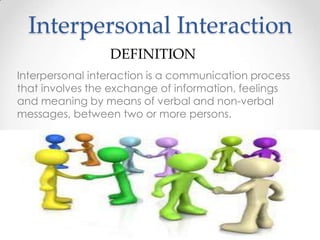
Interpersonal interaction is a communication process
that involves the exchange of information, feelings
and meaning by means of verbal and non-verbal
messages, between two or more persons.
• Dealing with interpersonal relationships is a complex
subject
• The interpersonal relationships between students
and teachers, teachers and other teachers,
teachers and administrators, school staff personnel,
parents, and community members are vital for
creating a positive successful learning environment
for all students.
• No matter how hard you work or how
many brilliant ideas you may have, if
you can’t connect with the people
who work around you, your
professional life will suffer.
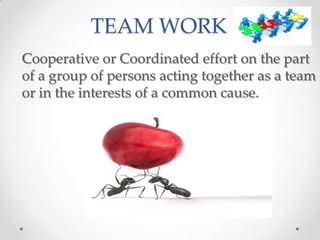
TEAM WORK
Cooperative or Coordinated effort on the part
of a group of persons acting together as a team
or in the interests of a common cause.
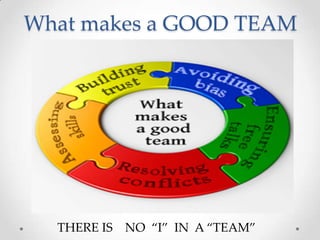
What makes a GOOD TEAM

THERE IS

NO “I” IN A “TEAM”
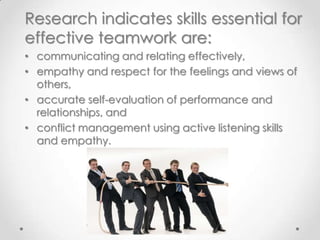
Research indicates skills essential for
effective teamwork are:
• communicating and relating effectively,
• empathy and respect for the feelings and views of
others,
• accurate self-evaluation of performance and
relationships, and
• conflict management using active listening skills
and empathy.
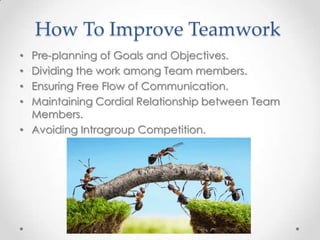
How To Improve Teamwork
Pre-planning of Goals and Objectives.
Dividing the work among Team members.
Ensuring Free Flow of Communication.
Maintaining Cordial Relationship between Team
Members.
• Avoiding Intragroup Competition.
•
•
•
•
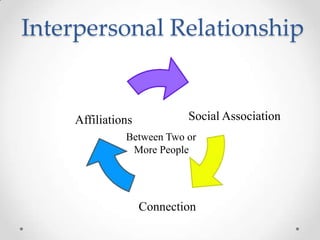
Interpersonal Relationship

Affiliations

Social Association

Between Two or
More People

Connection
Six success elements in
Relationships
It takes a combination of
•
•
•
•
•
•

Self-awareness,
Self confidence,
Positive personal impact,
Outstanding performance,
Communication skills and
Interpersonal competence

to succeed in your career and life.
SELF-AWARENESS
• Becoming self-aware is the first step to improving
our interpersonal effectiveness.
• Most of our behaviours are natural for us.
• We aren't aware of the impact these behaviours
have on others. That leaves us with "blind spots" that
others don't want to mention to us because they
don't want to hurt our feelings, they are afraid of a
reaction from us, or they just don't care.
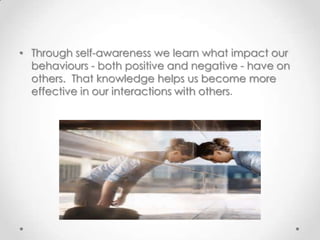
• Through self-awareness we learn what impact our
behaviours - both positive and negative - have on
others. That knowledge helps us become more
effective in our interactions with others.
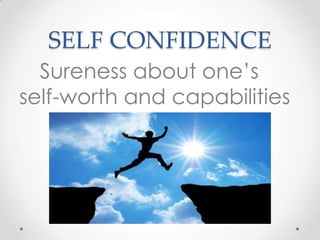
SELF CONFIDENCE
Sureness about one’s
self-worth and capabilities
Positive Personal Impact
• We impact on others through our opinions, the
amount we contribute, the sound of our voice, the
effect of our silence, the expressions we use.
• Personal impact is about other things apart from
your looks of course. Improving your posture,
knowing how to shake hands properly, having good
manners, not fidgeting and controlling your nerves
in meetings, looking friendly and confident.
Outstanding performance
• Outstanding
performance is an
important key to
career and life success
• What ever you do it to
the best of your ability.

• “DO it with thy MIGHT!”
Communication skills
•
•
•
•

Active listening,
Giving and receiving criticism
Dealing with different personality types, and
Non-verbal communication.
Interpersonal Competence
Interpersonally competent people:
• are self aware. They use this awareness to better
understand others and to adapt their behaviour
accordingly.
• build and nurture strong, lasting, mutually beneficial
relationships.
• resolve conflict in a positive manner.
What are Interpersonal
Skills?
• A set of behaviours which allow you to
communicate effectively and unambiguously in a
face-to- face setting
• They can also be thought of as behaviours which
assist progress towards achieving an objective
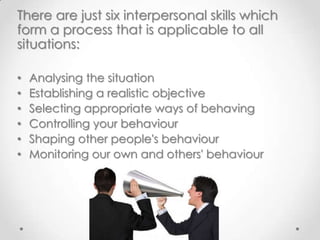
There are just six interpersonal skills which
form a process that is applicable to all
situations:
•
•
•
•
•
•

Analysing the situation
Establishing a realistic objective
Selecting appropriate ways of behaving
Controlling your behaviour
Shaping other people's behaviour
Monitoring our own and others' behaviour
Interpersonal Communications
• Most people want to be understood and accepted
more than anything else in the world.
• Knowing this is the first step toward good
communication. Good communication has two
basic components:
a) You listen to and acknowledge other people's
thoughts and feelings.
b) You express your own thoughts and feelings openly
and directly
Communication Styles
The four styles of communication are:
•
•
•
•

passive
aggressive
passive-aggressive
assertive
• Passive communication involves the inability
or unwillingness to express thoughts and
feelings. Passive people will do something
they don't want to do or make up an excuse
rather than say how they feel.
• The aggressive style of communication
involves overreaction, blaming and
criticizing. Aggressive people try to get their
way through bullying, intimidating or even
physical violence. They do not or will not
consider the rights of others.
• Passive-aggressive is a combination of the
first two styles - they avoid confrontations
(passive), but will be manipulative to get
what they want (aggressive). Passiveaggressive people will sometimes use facial
expressions that don't match how they feel,
i.e. smiling when angry.
• Assertive behaviour involves standing up for
oneself. Assertive people will say what they
think and stand up for their beliefs without
hurting others.
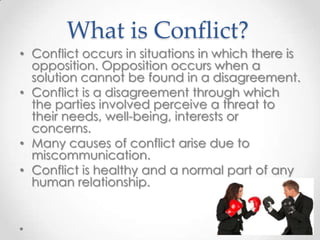
What is Conflict?
• Conflict occurs in situations in which there is
opposition. Opposition occurs when a
solution cannot be found in a disagreement.
• Conflict is a disagreement through which
the parties involved perceive a threat to
their needs, well-being, interests or
concerns.
• Many causes of conflict arise due to
miscommunication.
• Conflict is healthy and a normal part of any
human relationship.
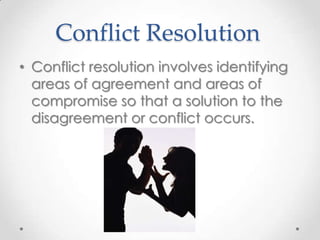
Conflict Resolution
• Conflict resolution involves identifying
areas of agreement and areas of
compromise so that a solution to the
disagreement or conflict occurs.
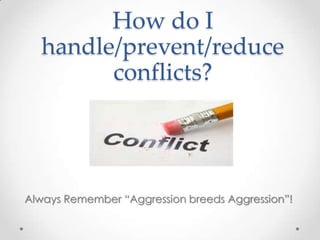
How do I
handle/prevent/reduce
conflicts?

Always Remember “Aggression breeds Aggression”!
There are five methods to
handle conflict :
• Running away
• Being obliging to the other
party
• Defeating the other party
• Winning a little/ losing a little
• Co-operating
Tips for resolving
conflicts
• Make sure that you remain calm at all times.
• Speak with a non-provoking tone of voice;
quietly, slowly, and calmly.
• Listen to the other person carefully without
interrupting them.
• Respect the other person when voicing your
own opinion or point of view.
• Let the other person know that you understand
them fully by asking questions pertaining to his
or her understanding and repeating what the
person is saying.
• Use humour if possible.
• Make sure that what you say is simple, clear and
direct.
• Do not take anything the other person says
personally when he or she is angry, because they
probably do not mean it.
• Make sure that you are not alone just in case the
other person becomes very hostile.
• If you are having a heated argument with another
person, save your feelings and opinions for another
time and place.
• Let the other person know that you do not want to
fight, but that you want to resolve the situation in a
friendly manner.
• Make sure that you apologize for anything you may
have said or done to offend them
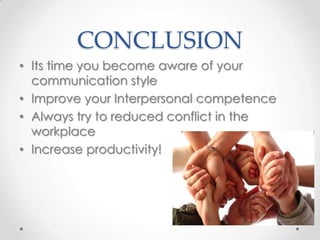
CONCLUSION
• Its time you become aware of your
communication style
• Improve your Interpersonal competence
• Always try to reduced conflict in the
workplace
• Increase productivity!
Interpersonal interaction

Interpersonal interaction

  • 1.
    Interpersonal Interaction DR ARIFISMAIL DEPARTMENT OF ORTHODONTICS
  • 2.
    CONTENTS HOW TO..... • Understandthe nature of relationships. • Understand how strong interpersonal skills will magnify your personal power • Explore your interpersonal behaviours • Analyse various communication styles and recognizing your own • Provide strategies for effectively interacting with communication styles different from yours • Build skills in conflict prevention and management, and • Consider behavioural standards that guide relationships
  • 3.
    Interpersonal Interaction DEFINITION Interpersonal interactionis a communication process that involves the exchange of information, feelings and meaning by means of verbal and non-verbal messages, between two or more persons.
  • 4.
    • Dealing withinterpersonal relationships is a complex subject • The interpersonal relationships between students and teachers, teachers and other teachers, teachers and administrators, school staff personnel, parents, and community members are vital for creating a positive successful learning environment for all students.
  • 5.
    • No matterhow hard you work or how many brilliant ideas you may have, if you can’t connect with the people who work around you, your professional life will suffer.
  • 6.
    TEAM WORK Cooperative orCoordinated effort on the part of a group of persons acting together as a team or in the interests of a common cause.
  • 7.
    What makes aGOOD TEAM THERE IS NO “I” IN A “TEAM”
  • 8.
    Research indicates skillsessential for effective teamwork are: • communicating and relating effectively, • empathy and respect for the feelings and views of others, • accurate self-evaluation of performance and relationships, and • conflict management using active listening skills and empathy.
  • 9.
    How To ImproveTeamwork Pre-planning of Goals and Objectives. Dividing the work among Team members. Ensuring Free Flow of Communication. Maintaining Cordial Relationship between Team Members. • Avoiding Intragroup Competition. • • • •
  • 11.
  • 12.
    Six success elementsin Relationships It takes a combination of • • • • • • Self-awareness, Self confidence, Positive personal impact, Outstanding performance, Communication skills and Interpersonal competence to succeed in your career and life.
  • 13.
    SELF-AWARENESS • Becoming self-awareis the first step to improving our interpersonal effectiveness. • Most of our behaviours are natural for us. • We aren't aware of the impact these behaviours have on others. That leaves us with "blind spots" that others don't want to mention to us because they don't want to hurt our feelings, they are afraid of a reaction from us, or they just don't care.
  • 14.
    • Through self-awarenesswe learn what impact our behaviours - both positive and negative - have on others. That knowledge helps us become more effective in our interactions with others.
  • 15.
    SELF CONFIDENCE Sureness aboutone’s self-worth and capabilities
  • 16.
    Positive Personal Impact •We impact on others through our opinions, the amount we contribute, the sound of our voice, the effect of our silence, the expressions we use. • Personal impact is about other things apart from your looks of course. Improving your posture, knowing how to shake hands properly, having good manners, not fidgeting and controlling your nerves in meetings, looking friendly and confident.
  • 17.
    Outstanding performance • Outstanding performanceis an important key to career and life success • What ever you do it to the best of your ability. • “DO it with thy MIGHT!”
  • 18.
    Communication skills • • • • Active listening, Givingand receiving criticism Dealing with different personality types, and Non-verbal communication.
  • 19.
    Interpersonal Competence Interpersonally competentpeople: • are self aware. They use this awareness to better understand others and to adapt their behaviour accordingly. • build and nurture strong, lasting, mutually beneficial relationships. • resolve conflict in a positive manner.
  • 20.
    What are Interpersonal Skills? •A set of behaviours which allow you to communicate effectively and unambiguously in a face-to- face setting • They can also be thought of as behaviours which assist progress towards achieving an objective
  • 21.
    There are justsix interpersonal skills which form a process that is applicable to all situations: • • • • • • Analysing the situation Establishing a realistic objective Selecting appropriate ways of behaving Controlling your behaviour Shaping other people's behaviour Monitoring our own and others' behaviour
  • 22.
    Interpersonal Communications • Mostpeople want to be understood and accepted more than anything else in the world. • Knowing this is the first step toward good communication. Good communication has two basic components: a) You listen to and acknowledge other people's thoughts and feelings. b) You express your own thoughts and feelings openly and directly
  • 23.
    Communication Styles The fourstyles of communication are: • • • • passive aggressive passive-aggressive assertive
  • 24.
    • Passive communicationinvolves the inability or unwillingness to express thoughts and feelings. Passive people will do something they don't want to do or make up an excuse rather than say how they feel. • The aggressive style of communication involves overreaction, blaming and criticizing. Aggressive people try to get their way through bullying, intimidating or even physical violence. They do not or will not consider the rights of others.
  • 25.
    • Passive-aggressive isa combination of the first two styles - they avoid confrontations (passive), but will be manipulative to get what they want (aggressive). Passiveaggressive people will sometimes use facial expressions that don't match how they feel, i.e. smiling when angry. • Assertive behaviour involves standing up for oneself. Assertive people will say what they think and stand up for their beliefs without hurting others.
  • 26.
    What is Conflict? •Conflict occurs in situations in which there is opposition. Opposition occurs when a solution cannot be found in a disagreement. • Conflict is a disagreement through which the parties involved perceive a threat to their needs, well-being, interests or concerns. • Many causes of conflict arise due to miscommunication. • Conflict is healthy and a normal part of any human relationship.
  • 27.
    Conflict Resolution • Conflictresolution involves identifying areas of agreement and areas of compromise so that a solution to the disagreement or conflict occurs.
  • 28.
    How do I handle/prevent/reduce conflicts? AlwaysRemember “Aggression breeds Aggression”!
  • 29.
    There are fivemethods to handle conflict : • Running away • Being obliging to the other party • Defeating the other party • Winning a little/ losing a little • Co-operating
  • 30.
    Tips for resolving conflicts •Make sure that you remain calm at all times. • Speak with a non-provoking tone of voice; quietly, slowly, and calmly. • Listen to the other person carefully without interrupting them. • Respect the other person when voicing your own opinion or point of view. • Let the other person know that you understand them fully by asking questions pertaining to his or her understanding and repeating what the person is saying. • Use humour if possible.
  • 31.
    • Make surethat what you say is simple, clear and direct. • Do not take anything the other person says personally when he or she is angry, because they probably do not mean it. • Make sure that you are not alone just in case the other person becomes very hostile. • If you are having a heated argument with another person, save your feelings and opinions for another time and place. • Let the other person know that you do not want to fight, but that you want to resolve the situation in a friendly manner. • Make sure that you apologize for anything you may have said or done to offend them
  • 32.
    CONCLUSION • Its timeyou become aware of your communication style • Improve your Interpersonal competence • Always try to reduced conflict in the workplace • Increase productivity!