Digital citizenship involves the safe, responsible, and ethical use of technology. It encompasses 5 key tenets: personal responsibilities, global citizenship, digital citizenship, altruistic service, and environmental stewardship. Being a good digital citizen requires understanding issues like personal finance and relationships, communicating respectfully online, making wise decisions regarding privacy and security, and considering the environmental impact of one's technology use. Teaching digital citizenship in schools is important so students learn to use technology safely and productively.
Digital Citizenship encompasses civic rights and responsibilities online, focusing on safe and ethical technology use.
The 5 tenets of Digital Citizenship include Personal Responsibilities, Global Citizenship, Digital Citizenship, Altruistic Service, and Environmental Stewardship.
Global Digital Citizenship is essential for safe online communication, addressing issues like cyberbullying and the need to educate on online personas.
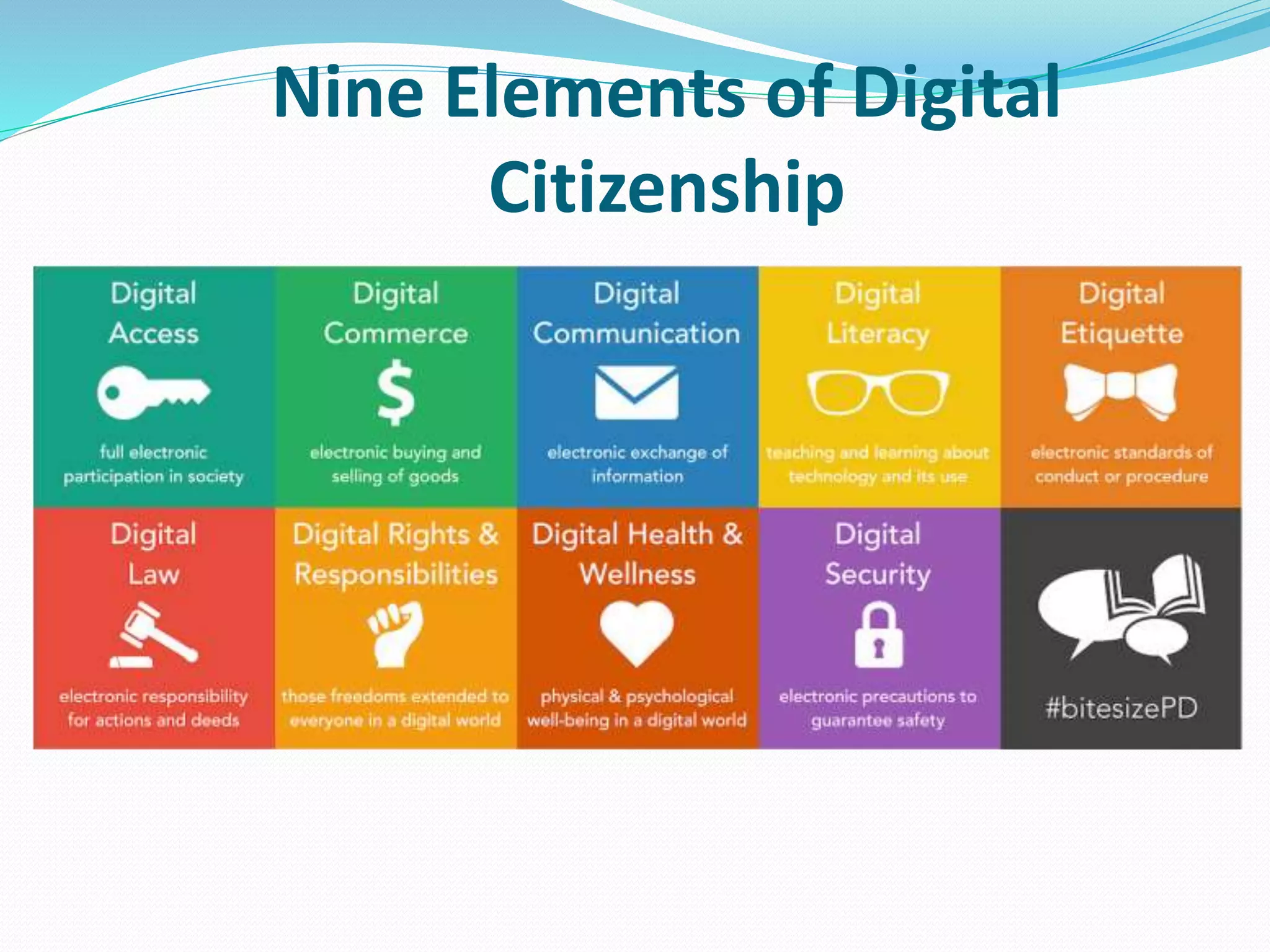
The nine elements include Digital Access, Commerce, Communication, Literacy, Etiquette, Law, Rights & Responsibilities, Health & Wellness, and Security, highlighting essential practices.
-Digital Citizenship isan idea that all persons using
the internet have a civic rights and responsibilities
-It centers around safe, savvy and ethical use of
technology
3.
Tenets of globalDigital Citizenship
- We define the best assets of the global digital citizenship
using 5 tenets: Personal Responsibilities, Global Citizenship,
Digital Citizenship, Altruistic Service and Environmental
Stewardship.
- - These 5 tenets are the essence of what it means to be a
great Global Digital Citizen.
4.
5 Tenets ofGlobal Digital Citizenship
Personal Responsibilities
-this includes demonstrating how we can manage
ourselves in matter such as Personal finance, Ethical and
Moral Boundaries, Personal Health and Wellness and
Relationship of every kind both offline and online.
Global Citizenship
-the Global Digital Citizen understands that technology
has dissolved boundaries between all the world people. We
can now communicate, collaborate and celebrate across all
levels of society. We are all now Global Citizen.
5.
Digital Citizenship
-Digital citizenshipcovers appropriate and exemplary
behavior in or online environment. Its about working
towards making our transparent digital world safe for
ourselves and for others.
Altruistic Service
-Altruism is defined as “having a selfless concern for the
well-being of others.” these include embracing the
opportunity to exercise charity and goodwill for the benefit
of others.
6.
Environmental Stewardship
this practiceis all about common-sense values and an
appreciation for the beauty and majesty that surround us
everyday. This facet o Global Digital Citizenship encourages
exploring how we can practice the conscientious use of
Earth’s resources
7.
Why Do WeNeed to be Global Digital
Citizens?
-Addressing the 21st century skill of digital citizenship is
important; to help students to learn, communicate and
collaborate safely and responsibly. Being a best digital
citizen in the community includes having email etiquette,
reporting and preventing cyber bullying, learning how to
protect private information, etc.
School are now shifting to BYOD (bring your own device)
as a main move for tech integration in the classroom. So,
when students are so close to the tech, they must know or
examine the impact of their online activity. Here are few
crucial reasons why school should make teaching digital
citizenship to their students the first step in the tech
integration process.
8.
Due tothe fact that a lot of young kids embrace technology every day
without examining the consequence of implementation, we must bring
digital citizenship lesson in the curriculum. Students continue to use
devices whether the device has been embraced in their curriculum or
not. They are in touch with technology even after the surveillance of
teacher after school. Therefore, there is a need to teach them digital
citizenship.
Today, with digitalization, employers judge prospective students or
employees for their social media profile. So, it is important to teach
students how to create online personas that project positive and
constructive image.
Cyber-bullying is another reason for teaching digital citizenship. We can
only prevent cyber-bullying by educating students about digital
citizenship. Lack of awareness about digital citizenship can lead to the
cyber-bullying which has grave consequences at times.
Information Search and Analysis is an important aspect of Digital
Citizenship. There are lots of resources available over the Internet and
not all is authentic. Digital citizenship teaches students how to look out,
select, and streamline information and how to choose a real and
authentic source of information.
1. DigitalAccess: full electronic participation in society.
Technology users need to be aware that not everyone
has the same opportunities when it comes to technology.
Working toward equal digital rights and supporting
electronic access is the starting point of Digital Citizenship.
Digital exclusion makes it difficult to grow as a society
increasingly using these tools. Helping to provide and
expand access to technology should be goal of all digital
citizens. Users need to keep in mind that there are some that
may have limited access, so other resources may need to be
provided. To become productive citizens, we need to be
committed to make sure that no one is denied digital access.
11.
2. DigitalCommerce: electronic buying and selling of
goods.
Technology users need to understand that a large share
of market economy is being done electronically. Legitimate
and legal exchanges are occurring, but the buyer or seller
needs to be aware of the issues associated with it. The
mainstream availability of Internet purchases of toys,
clothing, cars, food, etc. has become commonplace to many
users. At the same time, an equal amount of goods and
services which are in conflict with the laws or morals of some
countries are surfacing (which might include activities such
as illegal downloading, pornography, and gambling). Users
need to learn about how to be effective consumers in a new
digital economy.
12.
3. DigitalCommunication: electronic exchange of
information.
One of the significant changes within the digital
revolution is a person’s ability to communicate with other
people. In the 19th century, forms of communication were
limited. In the 21st century, communication options have
exploded to offer a wide variety of choices (e.g., e-mail,
cellular phones, instant messaging). The expanding digital
communication options have changed everything because
people are able to keep in constant communication with
anyone else. Now everyone has the opportunity to
communicate and collaborate with anyone from anywhere
and anytime. Unfortunately, many users have not been taught
how to make appropriate decisions when faced with so many
different digital communication options.
13.
4. DigitalLiteracy: process of teaching and learning
about technology and the use of technology.
While schools have made great progress in the area of
technology infusion, much remains to be done. A renewed
focus must be made on what technologies must be taught as
well as how it should be used. New technologies are finding
their way into the work place that are not being used in
schools. In addition, workers in many different occupations
need immediate information (just-in-time information). This
process requires sophisticated searching and processing skills
(i.e., information literacy). Learners must be taught how to
learn in a digital society. In other words, learners must be
taught to learn anything, anytime, anywhere. Business,
military, and medicine are excellent examples of how
technology is being used differently in the 21st century. As
new technologies emerge, learners need to learn how to use
that technology quickly and appropriately. Digital Citizenship
involves educating people in a new way − these individuals
need a high degree of information literacy skills.
14.
5. DigitalEtiquette: electronic standards of conduct or
procedure.
Technology users often see this area as one of the most
pressing problems when dealing with Digital Citizenship. We
recognize inappropriate behavior when we see it, but before
people use technology they do not learn digital etiquette (i.e.,
appropriate conduct). Many people feel uncomfortable
talking to others about their digital etiquette. Often rules and
regulations are created or the technology is simply banned to
stop inappropriate use.
15.
6. DigitalLaw: electronic responsibility for actions and
deeds
Digital law deals with the ethics of technology within a
society. Unethical use manifests itself in form of theft and/or
crime. Ethical use manifests itself in the form of abiding by
the laws of society. Users need to understand that stealing or
causing damage to other people’s work, identity, or property
online is a crime. There are certain rules of society that users
need to be aware in an ethical society. These laws apply to
anyone who works or plays online. Hacking into others
information, downloading illegal music, plagiarizing,
creating destructive worms, viruses or creating Trojan Horses,
sending spam, or stealing anyone’s identify or property is
unethical.
16.
7. DigitalRights & Responsibilities: those freedoms
extended to everyone in a digital world.
Just as in the American Constitution where there is a Bill
of Rights, there is a basic set of rights extended to every
digital citizen. Digital citizens have the right to privacy, free
speech, etc. Basic digital rights must be addressed, discussed,
and understood in the digital world. With these rights also
come responsibilities as well. Users must help define how the
technology is to be used in an appropriate manner. In a
digital society these two areas must work together for
everyone to be productive.
17.
8. DigitalHealth & Wellness: physical and psychological
well-being in a digital technology world.
Eye safety, repetitive stress syndrome, and sound
ergonomic practices are issues that need to be addressed in a
new technological world. Beyond the physical issues are
those of the psychological issues that are becoming more
prevalent such as Internet addiction. Users need to be taught
that there are inherent dangers of technology. Digital
Citizenship includes a culture where technology users are
taught how to protect themselves through education and
training.
18.
9. DigitalSecurity (self-protection): electronic
precautions to guarantee safety.
In any society, there are individuals who steal, deface, or
disrupt other people. The same is true for the digital
community. It is not enough to trust other members in the
community for our own safety. In our own homes, we put
locks on our doors and fire alarms in our houses to provide
some level of protection. The same must be true for the
digital security. We need to have virus protection, backups of
data, and surge control of our equipment. As responsible
citizens, we must protect our information from outside forces
that might cause disruption or harm.







![Number_Guessing_Game_Dsbsbssbzboc[1].pptx](https://cdn.slidesharecdn.com/ss_thumbnails/numberguessinggamedoc1-251206215042-a076fc05-thumbnail.jpg?width=640&height=640&fit=bounds)


