COLLABORATION IN
   EDUCATION
Have you heard about the
benefits of collaboration in
        education?
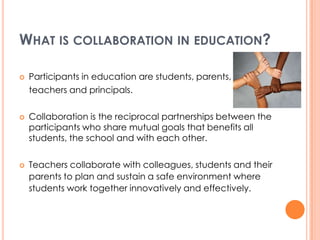
WHAT IS COLLABORATION IN EDUCATION?

   Participants in education are students, parents,
    teachers and principals.

   Collaboration is the reciprocal partnerships between the
    participants who share mutual goals that benefits all
    students, the school and with each other.


   Teachers collaborate with colleagues, students and their
    parents to plan and sustain a safe environment where
    students work together innovatively and effectively.
COLLABORATION AMONG STAKEHOLDERS IN
EDUCATION, PROMOTES STUDENT ACHIEVEMENT


      Student-        Parent-      Teacher-     School
      Teacher        Teacher       Teacher    Administrator
    Collaboration   Partnership   Teamwork      Support
STUDENT-TEACHER
COLLABORATION
WHAT’S INVOLVED IN STUDENT-TEACHER
                COLLABORATION?
   Teachers co-construct lessons and
    methods of assessments with their
    students.

   Students are engaged in the
    planning process by sharing what
    they want to learn, how they want
    to learn and how their learning
    should be assessed.

   When students are engaged in their
    learning process, they are aware of
    what is expected.

   It also allows teachers to develop
    their professional knowledge about
    their students needs and abilities.
"You don't change
                                                                             performance


                                           3 WAYS TEACHERS
                                                                             without changing
                                                                             the instructional
1. Increase the knowledge and skill of                                       core. The
   teachers                                                                  relationship of the
                                                                             teacher and the
                                                                             student in the
2. Change the content                                                        presence of
                                                                             content must be at
                                                                             the center of efforts
3. Alter the relationship of the student                                     to improve


                                           CAN IMPROVE STUDENT PERFORMANCE
                                                                             performance."
   to the teacher and the content
                                                                             Richard Elmore
                                                                             (Usable
                                                                             Knowledge, Harvar
                                                                             d Graduate School
                                                                             of Education)
PARENT-TEACHER
PARTNERSHIP
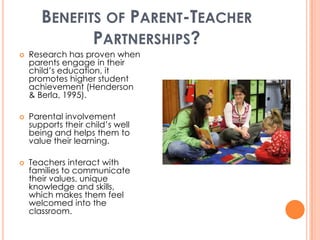
BENEFITS OF PARENT-TEACHER
              PARTNERSHIPS?
   Research has proven when
    parents engage in their
    child’s education, it
    promotes higher student
    achievement (Henderson
    & Berla, 1995).

   Parental involvement
    supports their child’s well
    being and helps them to
    value their learning.

   Teachers interact with
    families to communicate
    their values, unique
    knowledge and skills,
    which makes them feel
    welcomed into the
    classroom.
WAYS TO PROMOTE PARENT
     INVOLVEMENT
Classroom                                             Internet websites:
                                                Articles, books,
Children’s portfolios,          newsletters                                           - TDSB                                 Video/audiotapes of
                                                & magazines
work samples & photos                                                                 - http://www.literacycenter.net/       classroom discussions,
                                                                                                                             Singing and storytelling

  Class-made books
                                                                                                 Technological
                                                                                                                              E-mail, fax, voice-mail
                                       Print Media                                                 Resources

  School newsletters
                                                                    Home-School
                                                                   Communication
               Forum for discussion
                                                                                                                               Math/Reading nights
               of education issues                                                                      Curriculum Night

                                                                                                                                        Volunteer tea

Provincial
and                       School
                                                                                                                   School
district                  Council                                                                                                         Movie nights
updates                  Committee

                                                                                                District/School                        School-wide
    Provide input into                                                                          sponsored                              celebration
    school-based                      Parent information                                        parent workshops           School      of theme work
    decisions                         bulletin board                                                                       Council
                                                                                                                           Committee

                                                                                                                                  Questionnaires
             Field trip volunteer
                                                 Classroom                                     Conferences
                                                                                                                                       Parent-teacher:
                                                                                                                                       at school,
        Classroom helper
                                                                                                                                       through
                                                                                                                                       telephone calls
             In-session open house
                                                      Informal conversations   Parent-teacher-child:        Parent-child:
                                                                               at school, through           student-led at
                           Evening celebrations of                             interactive homeschool       school, student-led
                           child’s learning (e.g.,                             Reading programs and         at home with
                           concerts, plays)                                    back-and-forth books         portfolio or
                                                                                                            questionnaire


                                                                                       Adapted from The Primary Program, p. 179
TEACHER-TEACHER
TEAMWORK
TEACHERS WORKING TOGETHER
               When planning and implementing
                   collaboratively, teachers:
1.   Encounter new ides for grade team members and
     encourage differentiated teaching practices.
2.   Create developmentally appropriate teaching that
     include the whole child through supportive learning
     environments and design and implement learning
     experiences that engages students.
3.   Integrate curriculum to enhance student learning by
     making meaningful connections using a backward
     design approach and being mindful of students’
     equity, diversity, and social and emotional
     development.
4.   Make informed instructional decisions and design next
     steps in student learning.
CONTINUED…..
   Educators work together
    to help students reach
    their full potential by
    inquiring about their
    learning, resulting in the
    teachers’ deepened
    understanding about
    how they learn.
WHY INQUIRE ABOUT STUDENT
             LEARNING?
   Using documentation
    collected, teachers share
    evidence of student
    learning and thinking and
    collaboratively identify
    trends and patterns.
   Using the evidence
    learned, teachers design
    and determine the
    learning opportunities
    that challenge and
    extend current
    understanding.
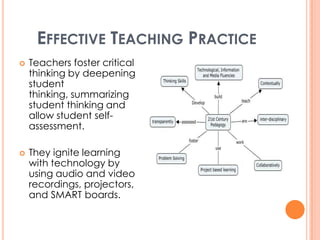
EFFECTIVE TEACHING PRACTICE
   Teachers foster critical
    thinking by deepening
    student
    thinking, summarizing
    student thinking and
    allow student self-
    assessment.

   They ignite learning
    with technology by
    using audio and video
    recordings, projectors,
    and SMART boards.
Promotes team teaching


                                        COLLABORATIVE PROFESSIONAL LEARNING



   Teacher moderation

   Teacher reflection and learning
    opportunities

   Allows for review of student work
    and relevant data

   Supports planning for student
    success

   Focuses on strategies to help
    students who are not making
    progress
SCHOOL ADMINISTRATOR
SUPPORT
HOW SCHOOL ADMINISTRATORS
SUPPORT COLLABORATION IN SCHOOLS
   Principals establish the
    platform that focuses on
    student learning.

   They also promote a
    supportive
    environment, foster
    reflection and encourage
    risk taking experiences.

   Principals “Spend energies
    on supporting
    environments focused on
    teaching and learning”.
(The Learning & Numeracy
Secretariat – Capacity Building
Series, p. 3)
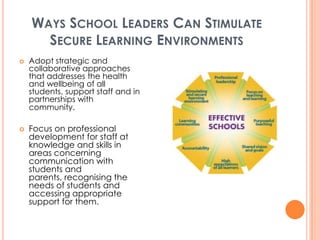
WAYS SCHOOL LEADERS CAN STIMULATE
      SECURE LEARNING ENVIRONMENTS
   Adopt strategic and
    collaborative approaches
    that addresses the health
    and wellbeing of all
    students, support staff and in
    partnerships with
    community.

   Focus on professional
    development for staff at
    knowledge and skills in
    areas concerning
    communication with
    students and
    parents, recognising the
    needs of students and
    accessing appropriate
    support for them.
COLLABORATION IN THE
CLASSROOM & BEYOND
Collaborative Partnerships In Education

Collaborative Partnerships In Education

  • 1.
  • 2.
    Have you heardabout the benefits of collaboration in education?
  • 3.
    WHAT IS COLLABORATIONIN EDUCATION?  Participants in education are students, parents, teachers and principals.  Collaboration is the reciprocal partnerships between the participants who share mutual goals that benefits all students, the school and with each other.  Teachers collaborate with colleagues, students and their parents to plan and sustain a safe environment where students work together innovatively and effectively.
  • 4.
    COLLABORATION AMONG STAKEHOLDERSIN EDUCATION, PROMOTES STUDENT ACHIEVEMENT Student- Parent- Teacher- School Teacher Teacher Teacher Administrator Collaboration Partnership Teamwork Support
  • 5.
  • 6.
    WHAT’S INVOLVED INSTUDENT-TEACHER COLLABORATION?  Teachers co-construct lessons and methods of assessments with their students.  Students are engaged in the planning process by sharing what they want to learn, how they want to learn and how their learning should be assessed.  When students are engaged in their learning process, they are aware of what is expected.  It also allows teachers to develop their professional knowledge about their students needs and abilities.
  • 7.
    "You don't change performance 3 WAYS TEACHERS without changing the instructional 1. Increase the knowledge and skill of core. The teachers relationship of the teacher and the student in the 2. Change the content presence of content must be at the center of efforts 3. Alter the relationship of the student to improve CAN IMPROVE STUDENT PERFORMANCE performance." to the teacher and the content Richard Elmore (Usable Knowledge, Harvar d Graduate School of Education)
  • 8.
  • 9.
    BENEFITS OF PARENT-TEACHER PARTNERSHIPS?  Research has proven when parents engage in their child’s education, it promotes higher student achievement (Henderson & Berla, 1995).  Parental involvement supports their child’s well being and helps them to value their learning.  Teachers interact with families to communicate their values, unique knowledge and skills, which makes them feel welcomed into the classroom.
  • 10.
    WAYS TO PROMOTEPARENT INVOLVEMENT
  • 11.
    Classroom Internet websites: Articles, books, Children’s portfolios, newsletters - TDSB Video/audiotapes of & magazines work samples & photos - http://www.literacycenter.net/ classroom discussions, Singing and storytelling Class-made books Technological E-mail, fax, voice-mail Print Media Resources School newsletters Home-School Communication Forum for discussion Math/Reading nights of education issues Curriculum Night Volunteer tea Provincial and School School district Council Movie nights updates Committee District/School School-wide Provide input into sponsored celebration school-based Parent information parent workshops School of theme work decisions bulletin board Council Committee Questionnaires Field trip volunteer Classroom Conferences Parent-teacher: at school, Classroom helper through telephone calls In-session open house Informal conversations Parent-teacher-child: Parent-child: at school, through student-led at Evening celebrations of interactive homeschool school, student-led child’s learning (e.g., Reading programs and at home with concerts, plays) back-and-forth books portfolio or questionnaire Adapted from The Primary Program, p. 179
  • 12.
  • 13.
    TEACHERS WORKING TOGETHER When planning and implementing collaboratively, teachers: 1. Encounter new ides for grade team members and encourage differentiated teaching practices. 2. Create developmentally appropriate teaching that include the whole child through supportive learning environments and design and implement learning experiences that engages students. 3. Integrate curriculum to enhance student learning by making meaningful connections using a backward design approach and being mindful of students’ equity, diversity, and social and emotional development. 4. Make informed instructional decisions and design next steps in student learning.
  • 14.
    CONTINUED…..  Educators work together to help students reach their full potential by inquiring about their learning, resulting in the teachers’ deepened understanding about how they learn.
  • 15.
    WHY INQUIRE ABOUTSTUDENT LEARNING?  Using documentation collected, teachers share evidence of student learning and thinking and collaboratively identify trends and patterns.  Using the evidence learned, teachers design and determine the learning opportunities that challenge and extend current understanding.
  • 16.
    EFFECTIVE TEACHING PRACTICE  Teachers foster critical thinking by deepening student thinking, summarizing student thinking and allow student self- assessment.  They ignite learning with technology by using audio and video recordings, projectors, and SMART boards.
  • 17.
    Promotes team teaching COLLABORATIVE PROFESSIONAL LEARNING   Teacher moderation  Teacher reflection and learning opportunities  Allows for review of student work and relevant data  Supports planning for student success  Focuses on strategies to help students who are not making progress
  • 18.
  • 19.
    HOW SCHOOL ADMINISTRATORS SUPPORTCOLLABORATION IN SCHOOLS  Principals establish the platform that focuses on student learning.  They also promote a supportive environment, foster reflection and encourage risk taking experiences.  Principals “Spend energies on supporting environments focused on teaching and learning”. (The Learning & Numeracy Secretariat – Capacity Building Series, p. 3)
  • 20.
    WAYS SCHOOL LEADERSCAN STIMULATE SECURE LEARNING ENVIRONMENTS  Adopt strategic and collaborative approaches that addresses the health and wellbeing of all students, support staff and in partnerships with community.  Focus on professional development for staff at knowledge and skills in areas concerning communication with students and parents, recognising the needs of students and accessing appropriate support for them.
  • 21.