Dr Anupam Singh
MODERATOR: Dr Neha Azad
Source of article-
1. Introduction
 Platelets are small, anucleated cytoplasmic bodies
circulating in blood stream.
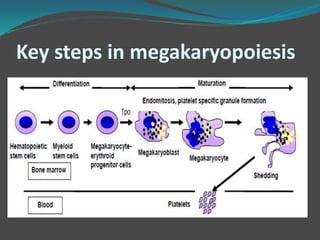
 These cellular fragments are derived from
megakaryocytes in the bone marrow.
 Resting platelets appear small discoid cells (2–4 𝜇m by
0.5 𝜇m), facilitating their margination toward the vessel
wall, where they can constantly survey the integrity of
the vascular endothelium.
Key steps in megakaryopoiesis
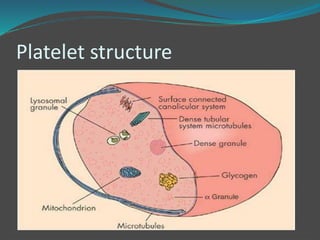
 Platelets contain three major types of granules:
𝛼- Granules- most abundant granules in platelets and are
rapidly exocytosed upon activation to enhance hemostasis
and inflammation.
Dense bodies- contain adenine nucleotides (ADP and
ATP) and serotonin which induce platelet aggregation,
vasoconstriction, cytokine production, and modulators of
inflammation.
Lysosomes- contain glycohydrolases and proteases that
can aid in pathogen clearance, breakdown of extracellular
matrix, and contribute to the clearance of platelet thrombi
and degradation of heparin [1–3].
Platelet structure
 Multiple pathways bring to platelet activation such as-
 Collagen
ADP
Thromboxane A2
Epinephrine
Serotonin
Thrombin.
 Most platelet function tests have been traditionally
used for the diagnosis and management of patients
presenting with bleeding problems.
 This review article discusses currently available clinical
application of platelet function tests, placing emphasis
on essential characteristics.
2. Platelet Function Testing
 Collaboration between clinical and laboratory personnel is
important to obtain a detailed history.
 A review of recent and regular medications is also required.
 Then laboratory testing is initiated, which begins with-
 CBC with peripheral smear examination
 Check for platelet flags-
platelet count,
mean platelet volume (MPV)
platelet distribution width (PDW)
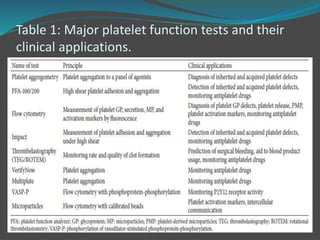
Table 1: Major platelet function tests and their
clinical applications.
2.1. Platelet Aggregometry
 Gold standard of platelet function testing and is still
the most used test for the identification and diagnosis
of platelet function defects.
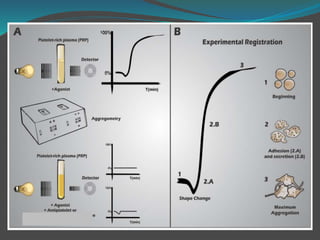
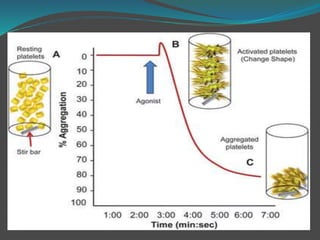
 Platelet rich plasma (PRP) is stirred within a cuvette
located between a light source and a detector.
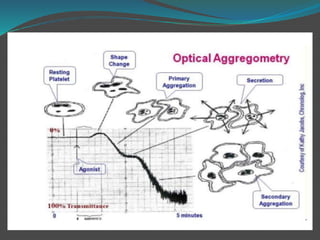
 After addition of a various panel of agonists, such as
collagen, ADP, thrombin, ristocetin, epinephrine, and
arachidonic acid, the platelets aggregate and light
transmission increases.
 The platelet aggregation pattern is thought as a
primary response to an exogenous agonist, followed by
a secondary response to the release of dense granule
contents.
 This biphasic response can be masked if high
concentrations of agonists are added.
 Parameters measured include the rate or slope of
aggregation (%/min) and the maximal amplitude (%)
or percentage of aggregation after a fixed period of
time, usually 6–10min [7–12].
Disadvantages -
Use of PRP instead of the whole blood under relatively
low shear conditions, and, in the absence of red and
white cells, it does not accurately simulate primary
haemostasis.
Requires large sample volume.
Time-consuming
Preanalytical and analytical variables that affect the
LTA results.
 Alternative methods including whole blood
aggregometry or lumiaggregometry have been
introduced, but failed to provide additional diagnostic
information.
 Most widely used test today is the platelet function
analyzer- (PFA-) 100 and PFA-200 devices (Siemens,
Marburg, Germany), which is considered to be a
surrogate in vitro bleeding time.
 The instrument monitors the drop in flow rate, and
the time required to obtain full occlusion of the
aperture is reported as closure time (CT), up to a
maximum of 300 seconds.
 This global platelet function test is-
easy to use
automated
rapid
whole blood is used instead of PRP.
 However, the CT is influenced by platelet count and
hematocrit, and they would have poor specificity for
any particular disorder.
 Normal PFA does not exclude mild vWF deficiency or
mild platelet disorder
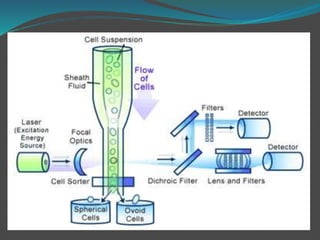
2.2. Flow Cytometry.
 Advantages:
-Small volume of whole blood and
-Independence of platelet count.
 Most commonly used routine flow cytometry tests are
the quantification of the basal platelet GP receptor
status and the determination of the platelet granule
composition.
The most common platelet activation
markers assessed by flow cytometry are --
 P-selectin expression on the platelet surface (as a marker of
𝛼-granule secretion),
 the conformational change of GP IIb/IIIa into its active
state (measured with monoclonal antibody PAC-1),
 platelet-leukocyte conjugates,
 microparticle examination,
 exposure of anionic, negatively charged phospholipids on
the platelet surface (procoagulant activity),
 and phosphorylation of vasodilatorstimulated
phosphoprotein-phosphorylation (VASP-P) (Bio- Cytex,
Marseille, France), as a marker of P2Y12 receptor
activation-dependent signaling [18–20]
2.3. Other Point-of-Care Testing
(POCT).
 Perioperative tools to aid in prediction of bleeding
 monitoring the efficacy of various types of
prohemostatic therapies.
 This review focuses on the clinical utility of two
representative instruments:
 Impact cone and plate analyzer (DiaMed, Cressier,
Switzerland) [2, 18, 19]
 Thrombelastography (TEG) (Hemoscope, Niles, IL,
USA) [7–10, 21, 22]
Impact cone and plate analyzer-
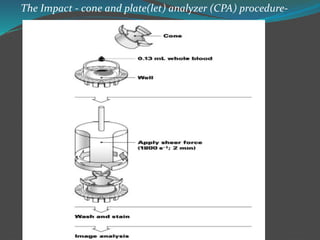
 Originally designed to monitor platelet adhesion to a
polystyrene plate.
 Contains a microscope and performs staining and image
analysis of the platelets that adhere and aggregate under a
high shear rate of 1,800/sec.
 Reported as the percentage of the surface covered by
platelets (surface coverage) and the average size of the
adherent particles.
 The adhesion is dependent on vWF, fibrinogen binding,
and platelets GP Ib and IIb/IIIa.
 The assay is
-Fully automated,
-Simple
-Rapid to use
- Requiring small whole blood.
 Emerging data suggest that the impact cone can detect
numerous platelet defects and vWD and could also be
potentially used as a screening method.
 But the fully automated version of impact cone has
limited use and therefore further studies are required
[2, 7– 10, 18, 19].
The Impact - cone and plate(let) analyzer (CPA) procedure-
Thrombelastography (TEG)-
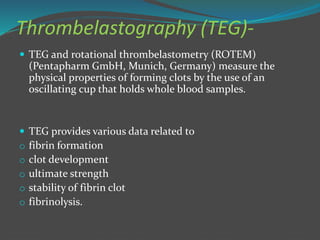
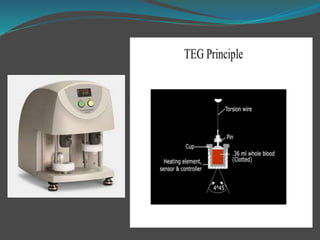
 TEG and rotational thrombelastometry (ROTEM)
(Pentapharm GmbH, Munich, Germany) measure the
physical properties of forming clots by the use of an
oscillating cup that holds whole blood samples.
 TEG provides various data related to
o fibrin formation
o clot development
o ultimate strength
o stability of fibrin clot
o fibrinolysis.
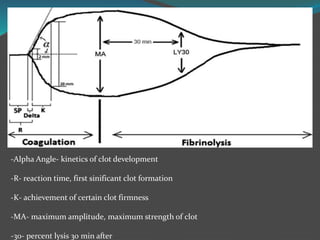
-Alpha Angle- kinetics of clot development
-R- reaction time, first sinificant clot formation
-K- achievement of certain clot firmness
-MA- maximum amplitude, maximum strength of clot
-30- percent lysis 30 min after
3. Monitoring Antiplatelet Therapy
 Modern antiplatelet therapy based on the inhibition of
three major platelet activation pathways-
(1) cyclooxygenase-1 inhibition resulting in
reduction of thromboxane A2,
(2) P2Y12 (ADP) inhibition,
(3) GP IIb/IIIa receptor blockade
 Recently American Heart Association/the American
College of Cardiology Foundation updated the
consensus document and proposed updated cut-off
values for HPR and low platelet reactivity (LPR) to ADP
that might be used in future investigations of
personalized anti platelet therapy.
 LPR to ADP------ higher risk of bleeding
 HPR to ADP----- higher risk of thrombosis
 Therefore, they proposed a therapeutic window
concept for P2Y12 inhibitor therapy [29–31].
 The most widely used platelet function assays, Verify
Now P2Y12 assay (Accumetrics, San Diego, CA, USA)
and, at present, Multiplate analyzer (H. Hoffmann-La
Roche Ltd., Basel, Switzerland) and VASP assay,
 Thus, at the present time, HPR and LPR in the setting
of PCI have been defined by the receiver-operator
characteristic (ROC) curve analyses using the
following criteria, respectively:
(1) >208 and <85 P2Y12 reaction units (PRU) by Verify
Now P2Y12 assay,
(2) >50% and <16% platelet reactivity index (PRI) by
VASP-P, and
(3) >46 and <19 arbitrary aggregation units (AU) in
response to ADP by Multiplate analyzer [29–31].
 However, there are no large-scale clinical studies to
date demonstrating that the adjustment of antiplatelet
therapy based on any of these cut points improves
clinical outcome.
4. Platelet-Derived Microparticles
(PMP)
 Defined as small and anucleoid phospholipid vesicles,
approximately 0.1–1.0 𝜇m in diameter, and derived
from different cell types such as platelets, erythrocytes,
leukocytes, endothelial cells, and vascular smooth
muscle cells [35].
 Under steady-state conditions, MP originating from
platelet and megakaryocytes are the most abundant
microparticles, constituting up to 70–90% of all MP in
circulation [38].
 Increases in PMP levels are observed with-
o Aging
o During pregnancy
o After exercise
o In females
o Acute pulmonary embolism
o heparin induced thrombocytopenia
o arterial thrombosis
o idiopathic thrombocytopenic purpura
o thrombotic thrombocytopenia
o sickle cell disease
o Uremia
o malignancy, and
o rheumatoid arthritis
 May play an important role in the transport and
delivery of bioactive molecules and signals throughout
the body.
 For analysis of PMP, most widely used method today is
flow cytometry.
 Three ISTH SSC (Vascular Biology, Disseminated
Intravascular Coagulation, and Haemostasis
andMalignancy) have initiated a project aiming at
standardization of the enumeration of cellular MP by
flow cytometer.
 This strategy is based on the use of fluorescent
calibrated submicrometer beads, Megamix beads
(BioCytex, Marseille, France), which allow the MP
analysis to be reproducible.
5. Platelet MicroRNAs (miRNA)
 miRNA is a small (21–23 nucleotides) noncoding RNA
regulating approximately 60% of the mammalian
protein coding genes at least in part by translational
repression.
 Although platelets lack a nucleus or genomic DNA,
they are able to translate inherited mRNA into protein.
 Interestingly, platelets inherit essential miRNA
processing proteins in addition to miRNA transcripts
originated from their parent megakaryocytes.
 Microarray screening revealed that miR-126, miR-197,
miR-223, miR-24, and miR-21 are among the most
highly expressed miRNAs in platelets and PMP.
 miR-340 and miR- 624- ↑ in premature coronary
artery disease.
 miR-28- ↑ in myelo proliferative neoplasms.
 miRNA has an established role in haematopoiesis and
megakaryocytopoiesis; therefore, platelet miRNAs
appear to be useful biomarkers and tools for
understanding mechanisms of megakaryocyte and
platelet gene expression.
6. Conclusions
 Most platelet function tests have traditionally been used-
1. For the diagnosis and management of patients presenting
with bleeding problems.
2. Monitoring the efficacy of antiplatelet drugs, with the
aim of predicting the adverse events such as bleeding or
thrombosis in arterial thrombotic diseases.
3. For research work up, because an increasing number of
studies indicate that platelets play an integral role in
intercellular communication, are mediators of
inflammation, and have immunomodulatory activity.
As new potential biomarkers and
technologies arrive at the horizon,
platelet functions testing appears
to take on a new aspect.
Platelet function tests.pptx 2.pptx final

Platelet function tests.pptx 2.pptx final

  • 1.
  • 2.
  • 3.
    1. Introduction  Plateletsare small, anucleated cytoplasmic bodies circulating in blood stream.  These cellular fragments are derived from megakaryocytes in the bone marrow.  Resting platelets appear small discoid cells (2–4 𝜇m by 0.5 𝜇m), facilitating their margination toward the vessel wall, where they can constantly survey the integrity of the vascular endothelium.
  • 4.
    Key steps inmegakaryopoiesis
  • 5.
     Platelets containthree major types of granules: 𝛼- Granules- most abundant granules in platelets and are rapidly exocytosed upon activation to enhance hemostasis and inflammation. Dense bodies- contain adenine nucleotides (ADP and ATP) and serotonin which induce platelet aggregation, vasoconstriction, cytokine production, and modulators of inflammation. Lysosomes- contain glycohydrolases and proteases that can aid in pathogen clearance, breakdown of extracellular matrix, and contribute to the clearance of platelet thrombi and degradation of heparin [1–3].
  • 6.
  • 7.
     Multiple pathwaysbring to platelet activation such as-  Collagen ADP Thromboxane A2 Epinephrine Serotonin Thrombin.
  • 8.
     Most plateletfunction tests have been traditionally used for the diagnosis and management of patients presenting with bleeding problems.  This review article discusses currently available clinical application of platelet function tests, placing emphasis on essential characteristics.
  • 9.
    2. Platelet FunctionTesting  Collaboration between clinical and laboratory personnel is important to obtain a detailed history.  A review of recent and regular medications is also required.  Then laboratory testing is initiated, which begins with-  CBC with peripheral smear examination  Check for platelet flags- platelet count, mean platelet volume (MPV) platelet distribution width (PDW)
  • 10.
    Table 1: Majorplatelet function tests and their clinical applications.
  • 11.
    2.1. Platelet Aggregometry Gold standard of platelet function testing and is still the most used test for the identification and diagnosis of platelet function defects.  Platelet rich plasma (PRP) is stirred within a cuvette located between a light source and a detector.  After addition of a various panel of agonists, such as collagen, ADP, thrombin, ristocetin, epinephrine, and arachidonic acid, the platelets aggregate and light transmission increases.
  • 12.
     The plateletaggregation pattern is thought as a primary response to an exogenous agonist, followed by a secondary response to the release of dense granule contents.  This biphasic response can be masked if high concentrations of agonists are added.  Parameters measured include the rate or slope of aggregation (%/min) and the maximal amplitude (%) or percentage of aggregation after a fixed period of time, usually 6–10min [7–12].
  • 13.
    Disadvantages - Use ofPRP instead of the whole blood under relatively low shear conditions, and, in the absence of red and white cells, it does not accurately simulate primary haemostasis. Requires large sample volume. Time-consuming Preanalytical and analytical variables that affect the LTA results.
  • 14.
     Alternative methodsincluding whole blood aggregometry or lumiaggregometry have been introduced, but failed to provide additional diagnostic information.  Most widely used test today is the platelet function analyzer- (PFA-) 100 and PFA-200 devices (Siemens, Marburg, Germany), which is considered to be a surrogate in vitro bleeding time.
  • 15.
     The instrumentmonitors the drop in flow rate, and the time required to obtain full occlusion of the aperture is reported as closure time (CT), up to a maximum of 300 seconds.  This global platelet function test is- easy to use automated rapid whole blood is used instead of PRP.
  • 16.
     However, theCT is influenced by platelet count and hematocrit, and they would have poor specificity for any particular disorder.  Normal PFA does not exclude mild vWF deficiency or mild platelet disorder
  • 20.
    2.2. Flow Cytometry. Advantages: -Small volume of whole blood and -Independence of platelet count.  Most commonly used routine flow cytometry tests are the quantification of the basal platelet GP receptor status and the determination of the platelet granule composition.
  • 21.
    The most commonplatelet activation markers assessed by flow cytometry are --  P-selectin expression on the platelet surface (as a marker of 𝛼-granule secretion),  the conformational change of GP IIb/IIIa into its active state (measured with monoclonal antibody PAC-1),  platelet-leukocyte conjugates,  microparticle examination,  exposure of anionic, negatively charged phospholipids on the platelet surface (procoagulant activity),  and phosphorylation of vasodilatorstimulated phosphoprotein-phosphorylation (VASP-P) (Bio- Cytex, Marseille, France), as a marker of P2Y12 receptor activation-dependent signaling [18–20]
  • 23.
    2.3. Other Point-of-CareTesting (POCT).  Perioperative tools to aid in prediction of bleeding  monitoring the efficacy of various types of prohemostatic therapies.
  • 24.
     This reviewfocuses on the clinical utility of two representative instruments:  Impact cone and plate analyzer (DiaMed, Cressier, Switzerland) [2, 18, 19]  Thrombelastography (TEG) (Hemoscope, Niles, IL, USA) [7–10, 21, 22]
  • 25.
    Impact cone andplate analyzer-  Originally designed to monitor platelet adhesion to a polystyrene plate.  Contains a microscope and performs staining and image analysis of the platelets that adhere and aggregate under a high shear rate of 1,800/sec.  Reported as the percentage of the surface covered by platelets (surface coverage) and the average size of the adherent particles.  The adhesion is dependent on vWF, fibrinogen binding, and platelets GP Ib and IIb/IIIa.
  • 26.
     The assayis -Fully automated, -Simple -Rapid to use - Requiring small whole blood.  Emerging data suggest that the impact cone can detect numerous platelet defects and vWD and could also be potentially used as a screening method.  But the fully automated version of impact cone has limited use and therefore further studies are required [2, 7– 10, 18, 19].
  • 27.
    The Impact -cone and plate(let) analyzer (CPA) procedure-
  • 28.
    Thrombelastography (TEG)-  TEGand rotational thrombelastometry (ROTEM) (Pentapharm GmbH, Munich, Germany) measure the physical properties of forming clots by the use of an oscillating cup that holds whole blood samples.  TEG provides various data related to o fibrin formation o clot development o ultimate strength o stability of fibrin clot o fibrinolysis.
  • 30.
    -Alpha Angle- kineticsof clot development -R- reaction time, first sinificant clot formation -K- achievement of certain clot firmness -MA- maximum amplitude, maximum strength of clot -30- percent lysis 30 min after
  • 31.
    3. Monitoring AntiplateletTherapy  Modern antiplatelet therapy based on the inhibition of three major platelet activation pathways- (1) cyclooxygenase-1 inhibition resulting in reduction of thromboxane A2, (2) P2Y12 (ADP) inhibition, (3) GP IIb/IIIa receptor blockade
  • 32.
     Recently AmericanHeart Association/the American College of Cardiology Foundation updated the consensus document and proposed updated cut-off values for HPR and low platelet reactivity (LPR) to ADP that might be used in future investigations of personalized anti platelet therapy.  LPR to ADP------ higher risk of bleeding  HPR to ADP----- higher risk of thrombosis
  • 33.
     Therefore, theyproposed a therapeutic window concept for P2Y12 inhibitor therapy [29–31].  The most widely used platelet function assays, Verify Now P2Y12 assay (Accumetrics, San Diego, CA, USA) and, at present, Multiplate analyzer (H. Hoffmann-La Roche Ltd., Basel, Switzerland) and VASP assay,
  • 34.
     Thus, atthe present time, HPR and LPR in the setting of PCI have been defined by the receiver-operator characteristic (ROC) curve analyses using the following criteria, respectively: (1) >208 and <85 P2Y12 reaction units (PRU) by Verify Now P2Y12 assay, (2) >50% and <16% platelet reactivity index (PRI) by VASP-P, and (3) >46 and <19 arbitrary aggregation units (AU) in response to ADP by Multiplate analyzer [29–31].
  • 35.
     However, thereare no large-scale clinical studies to date demonstrating that the adjustment of antiplatelet therapy based on any of these cut points improves clinical outcome.
  • 36.
    4. Platelet-Derived Microparticles (PMP) Defined as small and anucleoid phospholipid vesicles, approximately 0.1–1.0 𝜇m in diameter, and derived from different cell types such as platelets, erythrocytes, leukocytes, endothelial cells, and vascular smooth muscle cells [35].  Under steady-state conditions, MP originating from platelet and megakaryocytes are the most abundant microparticles, constituting up to 70–90% of all MP in circulation [38].
  • 37.
     Increases inPMP levels are observed with- o Aging o During pregnancy o After exercise o In females o Acute pulmonary embolism o heparin induced thrombocytopenia o arterial thrombosis o idiopathic thrombocytopenic purpura o thrombotic thrombocytopenia o sickle cell disease o Uremia o malignancy, and o rheumatoid arthritis
  • 38.
     May playan important role in the transport and delivery of bioactive molecules and signals throughout the body.  For analysis of PMP, most widely used method today is flow cytometry.
  • 39.
     Three ISTHSSC (Vascular Biology, Disseminated Intravascular Coagulation, and Haemostasis andMalignancy) have initiated a project aiming at standardization of the enumeration of cellular MP by flow cytometer.  This strategy is based on the use of fluorescent calibrated submicrometer beads, Megamix beads (BioCytex, Marseille, France), which allow the MP analysis to be reproducible.
  • 40.
    5. Platelet MicroRNAs(miRNA)  miRNA is a small (21–23 nucleotides) noncoding RNA regulating approximately 60% of the mammalian protein coding genes at least in part by translational repression.  Although platelets lack a nucleus or genomic DNA, they are able to translate inherited mRNA into protein.  Interestingly, platelets inherit essential miRNA processing proteins in addition to miRNA transcripts originated from their parent megakaryocytes.
  • 41.
     Microarray screeningrevealed that miR-126, miR-197, miR-223, miR-24, and miR-21 are among the most highly expressed miRNAs in platelets and PMP.  miR-340 and miR- 624- ↑ in premature coronary artery disease.  miR-28- ↑ in myelo proliferative neoplasms.
  • 42.
     miRNA hasan established role in haematopoiesis and megakaryocytopoiesis; therefore, platelet miRNAs appear to be useful biomarkers and tools for understanding mechanisms of megakaryocyte and platelet gene expression.
  • 43.
    6. Conclusions  Mostplatelet function tests have traditionally been used- 1. For the diagnosis and management of patients presenting with bleeding problems. 2. Monitoring the efficacy of antiplatelet drugs, with the aim of predicting the adverse events such as bleeding or thrombosis in arterial thrombotic diseases. 3. For research work up, because an increasing number of studies indicate that platelets play an integral role in intercellular communication, are mediators of inflammation, and have immunomodulatory activity.
  • 44.
    As new potentialbiomarkers and technologies arrive at the horizon, platelet functions testing appears to take on a new aspect.