Prepared by Dr. Anees Al-Saadi
             April 2008
Clinical immunology principles and practice RICH, 2nd edition
Methodological update ANCA.mht
www.medicinenet.com › emedicine.medscape.com/,www.youtube.com
   ANCA auto antibodies related to
    inflammatory disorders.


   van der Woude et al. in 1985 showed ANCA
    related to Wegener's granulomatosis.


             Methodological update ANCA.mht
   Enzymes used in the defense against
    bacteria found in WBCs granules.


   Most reactivities were found molecular
    weights ≈29kD & l4OkD.


             Methodological update ANCA.mht
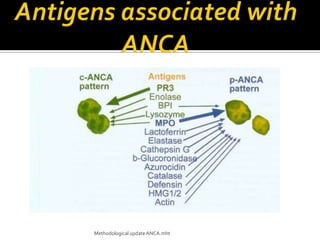
   Two main enzymes in ANCA take part in the
    killing of bacteria by:

     Proteinase 3 (PR3) showing cANCA pattern.


     Myeloperoxidase (MPO) showing pANCA
     pattern.

                Methodological update ANCA.mht
   Molecular weight of 29kD antigen:
     Which is proteinase .
     PR3 is a single protein chain that is glycosylated.
     Is very similar to other serine proteases like
      elastase and cathepsin G.


                Methodological update ANCA.mht
   Myeloperoxidase (MPO)

     MPO is a dimer molecular weight of l4OkD
      consisting of one heavy & light chain .
     It is glycosylated with mannose oligosaccharide
      chains.
     Is cleaved by heating and has a green color .


               Methodological update ANCA.mht
   Many other antigens have been described to
    be associated with ANCA,
     i.e. elastase,
     lactoferrin cathepsin G,
     BPI
     defensins, HMG1/2, catalase etc.


                Methodological update ANCA.mht
Methodological update ANCA.mht
   It is poorly understood how ANCA are developed.

   Two possible mechanisms of ANCA development
    are postulated:

     Theory of molecular mimicry.
     Theory of defective apoptosis.


                 Methodological update ANCA.mht
   Theory of molecular mimicry.                    Theory of defective apoptosis.

       Superantigens have the                          ANCA may be developed
        power to stimulate a strong                      either via ineffective
        immune response . THEY                           apoptosis or ineffective
        have regions that resemble                       removal of apoptotic cell
        self-antigens – this is the                      fragments, leading to the
        theory of molecular mimicry.                     exposure of the immune
                                                         system to molecules
       classical example in post                        normally sequestered inside
        group A streptococcal                            the cells. This theory solves
        rheumatic heart disease,                         the paradox of how it could
        where there is similarity                        be possible for antibodies to
        between M proteins of                            be raised against the
        Streptococcus pyogenes to                        intracellular antigenic
        cardiac myosin and laminin.                      targets of ANCA.[4]

                    Methodological update ANCA.mht
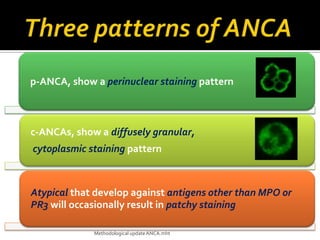
p-ANCA, show a perinuclear staining pattern


c-ANCAs, show a diffusely granular,
cytoplasmic staining pattern


Atypical that develop against antigens other than MPO or
PR3 will occasionally result in patchy staining

             Methodological update ANCA.mht
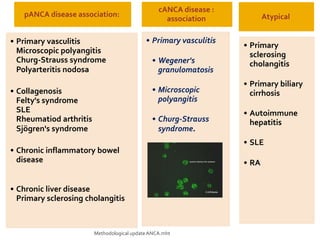
cANCA disease :
   pANCA disease association:                                              Atypical
                                                    association

• Primary vasculitis                         • Primary vasculitis
                                                                    • Primary
  Microscopic polyangitis                                             sclerosing
  Churg-Strauss syndrome                       • Wegener's            cholangitis
  Polyarteritis nodosa                           granulomatosis
                                                                    • Primary biliary
• Collagenosis                                 • Microscopic          cirrhosis
  Felty's syndrome                               polyangitis
  SLE                                                               • Autoimmune
  Rheumatiod arthritis                         • Churg-Strauss        hepatitis
  Sjögren's syndrome                             syndrome.
                                                                    • SLE
• Chronic inflammatory bowel
  disease                                                           • RA


• Chronic liver disease
  Primary sclerosing cholangitis


                         Methodological update ANCA.mht
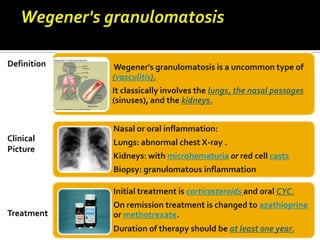
Definition   Wegener's granulomatosis is a uncommon type of
             (vasculitis).
             It classically involves the lungs, the nasal passages
             (sinuses), and the kidneys.


             Nasal or oral inflammation:
Clinical     Lungs: abnormal chest X-ray .
Picture
             Kidneys: with microhematuria or red cell casts
             Biopsy: granulomatous inflammation

             Initial treatment is corticosteroids and oral CYC.
             On remission treatment is changed to azathioprine
Treatment    or methotrexate.
             Duration of therapy should be at least one year.
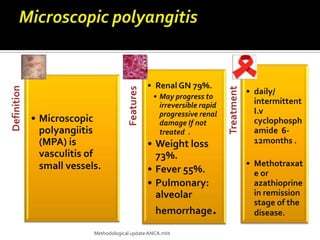
• Renal GN 79%.
Definition


                                        Features


                                                                           Treatment
                                                                                       • daily/
                                                    • May progress to
                                                      irreversible rapid                 intermittent
                                                      progressive renal                  I.v
             • Microscopic                            damage If not                      cyclophosph
               polyangiitis                           treated .                          amide 6-
               (MPA) is                            • Weight loss                         12months .
               vasculitis of                         73%.
               small vessels.                                                          • Methotraxat
                                                   • Fever 55%.                          e or
                                                   • Pulmonary:                          azathioprine
                                                     alveolar                            in remission
                                                                                         stage of the
                                                    hemorrhage.                          disease.

                           Methodological update ANCA.mht
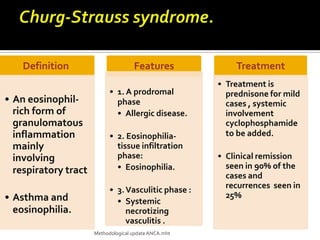
Definition                       Features              Treatment
                                                       • Treatment is
                            • 1. A prodromal             prednisone for mild
• An eosinophil-              phase                      cases , systemic
  rich form of                • Allergic disease.        involvement
  granulomatous                                          cyclophosphamide
  inflammation              • 2. Eosinophilia-           to be added.
  mainly                      tissue infiltration
  involving                   phase:                   • Clinical remission
                              • Eosinophilia.            seen in 90% of the
  respiratory tract                                      cases and
                            • 3. Vasculitic phase :      recurrences seen in
• Asthma and                                             25%
                              • Systemic
  eosinophilia.                  necrotizing
                                 vasculitis .
                      Methodological update ANCA.mht
   The application of ANCA useful in both the
    diagnosis and monitoring of disease activity .


                Applications of Antineutrophil Cytoplasmic Antibody.mht
Microscopic    Wegener's Churg-
                                 Polyangiitis   Granuloma Strauss
ANCA                                            tosis     Syndrome


PR3-ANCA                         40             80%      10%


MPO-ANCA                         50%            20%      60%


Negative                         10%            5%       30%


           Methodological update ANCA.mht
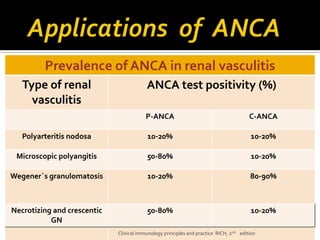
Prevalence of ANCA in renal vasculitis
   Type of renal                         ANCA test positivity (%)
     vasculitis
                                         P-ANCA                                        C-ANCA

   Polyarteritis nodosa                   10-20%                                        10-20%

 Microscopic polyangitis                 50-80%                                         10-20%

Wegener`s granulomatosis                  10-20%                                       80-90%


Necrotizing and crescentic               50-80%                                         10-20%
           GN
                             Clinical immunology principles and practice RICH, 2nd edition
   In Juvenile rheumatoid arthritis :
     Occur in 10-20% of active conditions.
     Showing atypical pattern.
     Does not correlate with clinical parameters.


                    Clinical immunology principles and practice RICH, 2nd edition pr
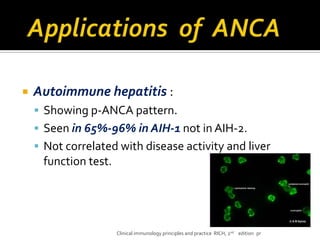
   Autoimmune hepatitis :
     Showing p-ANCA pattern.
     Seen in 65%-96% in AIH-1 not in AIH-2.
     Not correlated with disease activity and liver
     function test.


                      Clinical immunology principles and practice RICH, 2nd edition pr
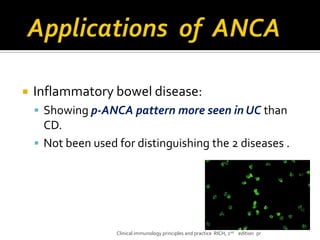
   Inflammatory bowel disease:
     Showing p-ANCA pattern more seen in UC than
      CD.
     Not been used for distinguishing the 2 diseases .


                    Clinical immunology principles and practice RICH, 2nd edition pr
   Drug-induced ANCA:
     Picture of ANCA-associated vasculitis (AAV).
     Propylthiouracil is a well-documented cause of drug-
      induced AAV.
     Other drugs:
      ▪   Hydralazine,sulfasalazine.
      ▪   minocycline, D-penicillamine.
      ▪   ciprofloxacin, phenytoin.
      ▪   clozapine, allopurinol, and pantoprazole.


                     AccessMedicine - ANCA induced by drugs.mht
   Usually of p-ANCA pattern.

   Slow resolving condition.

   Good responding to low dose of
    immunosuppressive agents.


              AccessMedicine - ANCA induced by drugs.mht
   Prognostic significance of ANCAs:

     Increasing ANCA titers do not reliably predict relapse.


     Nevertheless, many clinicians assume that ANCA
     titers are reliable indicators of disease activity !.


                     ANCAClinical Applications of Antineutrophil Cytoplasmic Antibody.mht
www.youtube.com

ANCA

  • 1.
    Prepared by Dr.Anees Al-Saadi April 2008 Clinical immunology principles and practice RICH, 2nd edition Methodological update ANCA.mht www.medicinenet.com › emedicine.medscape.com/,www.youtube.com
  • 2.
    ANCA auto antibodies related to inflammatory disorders.  van der Woude et al. in 1985 showed ANCA related to Wegener's granulomatosis. Methodological update ANCA.mht
  • 3.
    Enzymes used in the defense against bacteria found in WBCs granules.  Most reactivities were found molecular weights ≈29kD & l4OkD. Methodological update ANCA.mht
  • 4.
    Two main enzymes in ANCA take part in the killing of bacteria by:  Proteinase 3 (PR3) showing cANCA pattern.  Myeloperoxidase (MPO) showing pANCA pattern. Methodological update ANCA.mht
  • 5.
    Molecular weight of 29kD antigen:  Which is proteinase .  PR3 is a single protein chain that is glycosylated.  Is very similar to other serine proteases like elastase and cathepsin G. Methodological update ANCA.mht
  • 6.
    Myeloperoxidase (MPO)  MPO is a dimer molecular weight of l4OkD consisting of one heavy & light chain .  It is glycosylated with mannose oligosaccharide chains.  Is cleaved by heating and has a green color . Methodological update ANCA.mht
  • 7.
    Many other antigens have been described to be associated with ANCA,  i.e. elastase,  lactoferrin cathepsin G,  BPI  defensins, HMG1/2, catalase etc. Methodological update ANCA.mht
  • 8.
  • 9.
    It is poorly understood how ANCA are developed.  Two possible mechanisms of ANCA development are postulated:  Theory of molecular mimicry.  Theory of defective apoptosis. Methodological update ANCA.mht
  • 10.
    Theory of molecular mimicry.  Theory of defective apoptosis.  Superantigens have the  ANCA may be developed power to stimulate a strong either via ineffective immune response . THEY apoptosis or ineffective have regions that resemble removal of apoptotic cell self-antigens – this is the fragments, leading to the theory of molecular mimicry. exposure of the immune system to molecules  classical example in post normally sequestered inside group A streptococcal the cells. This theory solves rheumatic heart disease, the paradox of how it could where there is similarity be possible for antibodies to between M proteins of be raised against the Streptococcus pyogenes to intracellular antigenic cardiac myosin and laminin. targets of ANCA.[4] Methodological update ANCA.mht
  • 11.
    p-ANCA, show aperinuclear staining pattern c-ANCAs, show a diffusely granular, cytoplasmic staining pattern Atypical that develop against antigens other than MPO or PR3 will occasionally result in patchy staining Methodological update ANCA.mht
  • 12.
    cANCA disease : pANCA disease association: Atypical association • Primary vasculitis • Primary vasculitis • Primary Microscopic polyangitis sclerosing Churg-Strauss syndrome • Wegener's cholangitis Polyarteritis nodosa granulomatosis • Primary biliary • Collagenosis • Microscopic cirrhosis Felty's syndrome polyangitis SLE • Autoimmune Rheumatiod arthritis • Churg-Strauss hepatitis Sjögren's syndrome syndrome. • SLE • Chronic inflammatory bowel disease • RA • Chronic liver disease Primary sclerosing cholangitis Methodological update ANCA.mht
  • 13.
    Definition Wegener's granulomatosis is a uncommon type of (vasculitis). It classically involves the lungs, the nasal passages (sinuses), and the kidneys. Nasal or oral inflammation: Clinical Lungs: abnormal chest X-ray . Picture Kidneys: with microhematuria or red cell casts Biopsy: granulomatous inflammation Initial treatment is corticosteroids and oral CYC. On remission treatment is changed to azathioprine Treatment or methotrexate. Duration of therapy should be at least one year.
  • 14.
    • Renal GN79%. Definition Features Treatment • daily/ • May progress to irreversible rapid intermittent progressive renal I.v • Microscopic damage If not cyclophosph polyangiitis treated . amide 6- (MPA) is • Weight loss 12months . vasculitis of 73%. small vessels. • Methotraxat • Fever 55%. e or • Pulmonary: azathioprine alveolar in remission stage of the hemorrhage. disease. Methodological update ANCA.mht
  • 15.
    Definition Features Treatment • Treatment is • 1. A prodromal prednisone for mild • An eosinophil- phase cases , systemic rich form of • Allergic disease. involvement granulomatous cyclophosphamide inflammation • 2. Eosinophilia- to be added. mainly tissue infiltration involving phase: • Clinical remission • Eosinophilia. seen in 90% of the respiratory tract cases and • 3. Vasculitic phase : recurrences seen in • Asthma and 25% • Systemic eosinophilia. necrotizing vasculitis . Methodological update ANCA.mht
  • 16.
    The application of ANCA useful in both the diagnosis and monitoring of disease activity . Applications of Antineutrophil Cytoplasmic Antibody.mht
  • 17.
    Microscopic Wegener's Churg- Polyangiitis Granuloma Strauss ANCA tosis Syndrome PR3-ANCA 40 80% 10% MPO-ANCA 50% 20% 60% Negative 10% 5% 30% Methodological update ANCA.mht
  • 18.
    Prevalence of ANCAin renal vasculitis Type of renal ANCA test positivity (%) vasculitis P-ANCA C-ANCA Polyarteritis nodosa 10-20% 10-20% Microscopic polyangitis 50-80% 10-20% Wegener`s granulomatosis 10-20% 80-90% Necrotizing and crescentic 50-80% 10-20% GN Clinical immunology principles and practice RICH, 2nd edition
  • 19.
    In Juvenile rheumatoid arthritis :  Occur in 10-20% of active conditions.  Showing atypical pattern.  Does not correlate with clinical parameters. Clinical immunology principles and practice RICH, 2nd edition pr
  • 20.
    Autoimmune hepatitis :  Showing p-ANCA pattern.  Seen in 65%-96% in AIH-1 not in AIH-2.  Not correlated with disease activity and liver function test. Clinical immunology principles and practice RICH, 2nd edition pr
  • 21.
    Inflammatory bowel disease:  Showing p-ANCA pattern more seen in UC than CD.  Not been used for distinguishing the 2 diseases . Clinical immunology principles and practice RICH, 2nd edition pr
  • 22.
    Drug-induced ANCA:  Picture of ANCA-associated vasculitis (AAV).  Propylthiouracil is a well-documented cause of drug- induced AAV.  Other drugs: ▪ Hydralazine,sulfasalazine. ▪ minocycline, D-penicillamine. ▪ ciprofloxacin, phenytoin. ▪ clozapine, allopurinol, and pantoprazole. AccessMedicine - ANCA induced by drugs.mht
  • 23.
    Usually of p-ANCA pattern.  Slow resolving condition.  Good responding to low dose of immunosuppressive agents. AccessMedicine - ANCA induced by drugs.mht
  • 24.
    Prognostic significance of ANCAs:  Increasing ANCA titers do not reliably predict relapse.  Nevertheless, many clinicians assume that ANCA titers are reliable indicators of disease activity !. ANCAClinical Applications of Antineutrophil Cytoplasmic Antibody.mht
  • 25.