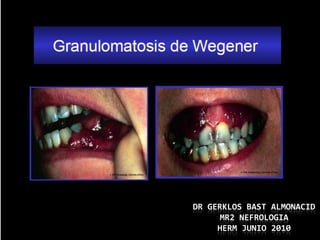
DR GERKLOS BAST ALMONACID
      MR2 NEFROLOGIA
     HERM JUNIO 2010
1.- Inflamacion granulomatosa de tracto
   respiratorio
2.- glomerulonefritis progresiva
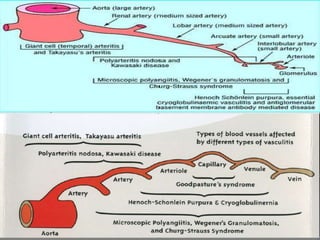
3.- vasculitis necrotizante de arterias y venas de
   mediano y pequeño calibre
ORGANOS COMPROMETIDOS

 95% Pulmón (vasos )  35% oído medio
 90% senos             30% corazón
 85% riñón             20% nervios
 75% nasofaringe,       periféricos
 bazo                  20% SNC
 70% articulaciones
 50% piel
 50% ojos
INCIDENCIA – PREVALENCIA


 Bastante rara
 > Hombres
 Edad 50-60 años
 > 95% Caucasicos


                      Arthritis Rheum 2000 Feb;43(2):414
                      J Watch 2000 Mar 15;20(6):49)
CAUSAS

 Desconocida
 Probablemente inmunologica
PATOGENESIS

 Inmunidad tipo III hipersensibilidad
  mediada por inmunmocomplejos
 Vasculitis necrotizante de arterias y venas de
  mediano y pequeño calibre
 Matriz de metaloproteinasas (MMPs) y sus
  inhibidores endogenos han sido sugeridos en
  rol patologico
 Infeccion con Staphylococcus pueden
  provocar recaidas
CUADRO CLINICO
 Presentaciones comunes
     Sinusitis , descarga nasal crónica
     Pérdida de audición
     Dolor articular
     hemoptisis
     Hematuria microscópica
     Fiebre ( 90 %)

 Ocasionalmente
   Glomerulonefritis, tos, rinitis, otitis, disnea , dolor
      muscular , neuritis, pérdida de peso

                            Tervaert, JW. Anti-neutrophil cytoplasmic antibodies: Current diagnostic
                            and pathophysiological potential. Kidney Int 2004 ; 46:1
DIAGNOSTICO
 1.-Nasal or oral inflammation (painful or
  painless oral ulcers or purulent or bloody
  nasal discharge)
 2.-Abnormal chest radiograph showing
  nodules, fixed infiltrates, or cavities
 3.-Abnormal urinary sediment (microscopic
  hematuria with or without red cell casts)
 4.- Granulomatous inflammation on biopsy of
  an artery or perivascular area
                                   American College of Rheumatology
                                   Arthritis Rheum 2009 Aug;33(8):1101
PRUEBAS A CONSIDERAR
   Hematometría ,creatinina sérica
   Examen completo de orina
   Factor reumatoideo
    ANA
    hepatitis serología
   (ANCA) anti-neutrophil cytoplasmic antibody
   biopsia
     Piel (> rendim), anormalidades en uro análisis
     Biopsia de nervio sural
     Biopsia nasal (vasculitis and inflamación granulomatosa)
 Radiografía de tórax
 Angiografía
 Ecocardiografía
                                             Mayo Clin Proc 2005 Nov;80(11):1435
PRUEBAS SEROLOGICAS
 ANCA – C 90 % G W alta
  sensibilidad y especificidad (1,3)
 ANCA – p negativo (1, 5)
 ANCA –c
  81% sensitivity, 98%
   specificity, 54% VPP and 99% VPN ;
   (2,3,4)
  ELISA para ANCA –PR3 (5)
                          Ann Intern Med 1997 Jun 1;126(11):866
                          Journal Club on the Web 1997 Jun 10)
                          Arthritis Rheum 1998 Sep;41(9):1521
                          Arch Intern Med 2002 Jul 8;162(13):1509
                          (Ann Rheum Dis 2009 Feb;68(2):228 (5)
ANATOMIA PATOLOGICA
 PULMON : vasculitis granulomatosa
  , necrotizante (fibrinoide) , granulomas no
  caseificantes
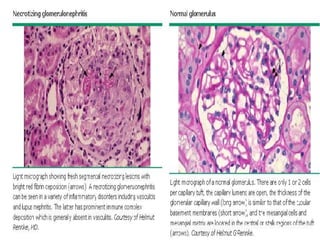
 RIÑÓN : GMN focal y segmentaria con
  progresión a medias lunas GMN necrotizante
 VASOS : infiltrado inflamatorio y fibrosis
 ARTERITIS GRANULOMATOSA :
  predominantemente infiltrado monocítico
  con cell gigantes y formación de granuloma
                    Koderisch, J, et al. Wegener's granulomatosis with renal involvement: Patient
                    survival and correlations between initial renal function, renal histology, therapy
                    and renal outcome. Clin Nephrol 2007; 35:139.
EULAR CLASSIFICATION
     classification of ANCA-associated vasculitis
1.-Localized — Upper and/or lower respiratory tract
   disease without any other systemic involvement or
   constitutional symptoms.
2.-Early systemic — Any, without organ-threatening or
   life-threatening disease.
3.-Generalized — Renal or other organ-threatening
   disease, serum creatinine ≤ 5.6 mg/dL (500
   micromol/L).
4.-Severe — Renal or other vital organ failure, serum
   creatinine ≥ 5.7 mg/dL (500 micromol/L)
5.-Refractory — Progressive disease unresponsive to
   glucocorticoids and cyclophosphamide.
                                 European League Against Rheumatism (EULAR) 2008
                                 EULAR recommendation for the management of
                                 primary small vessel vasculitis. Ann Rheum Dis 2008
TRATAMIENTO
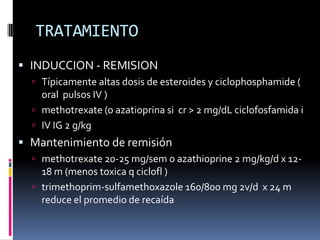
 INDUCCION - REMISION
   Típicamente altas dosis de esteroides y ciclophosphamide (
    oral pulsos IV )
   methotrexate (o azatioprina si cr > 2 mg/dL ciclofosfamida i
   IV IG 2 g/kg
 Mantenimiento de remisión
   methotrexate 20-25 mg/sem o azathioprine 2 mg/kg/d x 12-
    18 m (menos toxica q ciclofl )
   trimethoprim-sulfamethoxazole 160/800 mg 2v/d x 24 m
    reduce el promedio de recaída
SUMMARY AND RECOMMENDATIONS
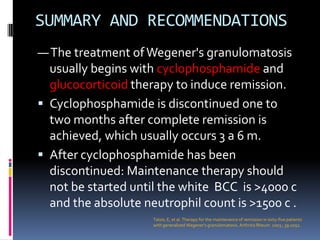
— The treatment of Wegener's granulomatosis
  usually begins with cyclophosphamide and
  glucocorticoid therapy to induce remission.
 Cyclophosphamide is discontinued one to
  two months after complete remission is
  achieved, which usually occurs 3 a 6 m.
 After cyclophosphamide has been
  discontinued: Maintenance therapy should
  not be started until the white BCC is >4000 c
  and the absolute neutrophil count is >1500 c .
                     Tatsis, E, et al. Therapy for the maintenance of remission in sixty-five patients
                     with generalized Wegener's granulomatosis. Arthritis Rheum 2003 ; 39:2052.
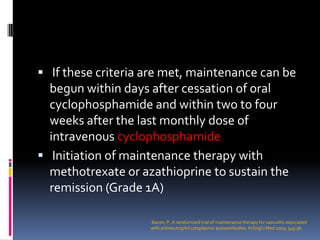
 If these criteria are met, maintenance can be
  begun within days after cessation of oral
  cyclophosphamide and within two to four
  weeks after the last monthly dose of
  intravenous cyclophosphamide
 Initiation of maintenance therapy with
  methotrexate or azathioprine to sustain the
  remission (Grade 1A)

                    Bacon, P. A randomized trial of maintenance therapy for vasculitis associated
                    with antineutrophil cytoplasmic autoantibodies. N Engl J Med 2003; 349:36.
    azathioprine rather than methotrexate for initial
    maintenance therapy GFR < 50 mL/´ (Grade 2B).
       - Azathioprine : initial dose of 2 mg/kg x d The dose
    can be lowered to 1.5 mg/kg x d at one year from the time
    of initiation of induction therapy
       - methotrexate : initial dose 0.3 mg/kg 1 v/sem (max 15
    mg) increased by 2.5 mg x sem - max dose of 25 mg 1 v
    /sem + folic acid (1 to 2 mg/day) or folinic acid (2.5 to 5
    mg/week, 24 hours after methotrexate)
    Maintenance immunosuppressive therapy should be
    continued for 12 to 18 ms.
    Longer term or indefinite maintenance therapy may be
    warranted in patients with multiple relapses.
    glucocorticoid therapy (prednisone or equivalent), using
    the lowest dose required for control of extrarenal
    symptoms (Grade 1C).


                          Bacon, P. A randomized trial of maintenance therapy for vasculitis associated
                          with antineutrophil cytoplasmic autoantibodies. N Engl J Med 2008; 349:36.
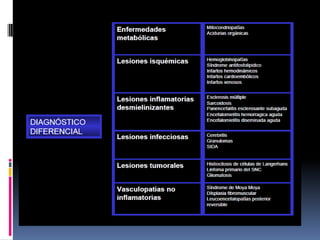
DIAGNOSTICO DIFERENCIAL
   hypersensitivity vasculitis, septic arthritis
    (fungal, tuberculosis), lymphomatoid granulomatosis
   other causes of granulomatous arteritis - Churg-Strauss
    vasculitis, temporal arteritis, Takayasu's arteritis, seronegative
    spondylarthropathy (aortitis)
   other vasculitis of small-to-medium arteries - polyarteritis
    nodosa, inflammatory rheumatic diseases, HBV, HCV, HIV infection
   embolic disease - endocarditis (septic, marantic), atrial
    myxoma, cholesterol embolization
   vessel stenosis or spasm - atherosclerosis, fibromuscular dysplasia, drug-
    induced vasospasm
    (ergotamines, cocaine, phenylpropanolamine), intravascular lymphoma
   vessel thrombosis - disseminated intravascular coagulation
    (DIC), thrombotic thrombocytopenic purpura (TTP), coumadin-associated
    necrosis, antiphospholipid antibody syndrome
   similar syndrome described in 5 adults with autosomal recessive defective
    surface expression of HLA class-I molecules.
   cocaine-induced pseudovasculitis described in case report
                                                        Mayo Clin Proc 2005 May;80(5):671
                                                        Lancet 1999 Nov 6;354(9190):1598
COMPLICACIONES
 Glomerulonefritis          (3)
  rápidamente progresiva    Hemorragia alveolar
  (gnrp)
                            pápulas, ulceras y
 Falla renal                lesiones urticariales
 Sepsis                    uveítis, neuritis óptica
 Anemia normocítica         (2)
  normocrómica              cardiomiopatía dilatada
 CID                        y pericarditis
 Trombo embolismo           enfermedad orbital
  venoso (1)                 inflamatoria (4)
 Compromiso meníngeo
                                 Ann Intern Med 2005 Apr 19;142(8):620
                                 Rheumatology (Oxford) 2008 Apr;47(4):530
                                 Mayo Clin Proc 2000 Aug;75(8):856
                                 Eye 2006 Oct;20(10):1196
RESISTENCIA A LA CICLOFOSFAMIDA
 the first step is to ensure that the
  cyclophosphamide regimen has been
  optimized and, if indicated, plasma exchange
  has been administered.
 Mycophenolate mofetil or rituximab (Grade
  2C).
 mycophenolate mofetil 500 mg 2v/d which is
  increased, if there is no response, by 250 mg
  2v/d c/2 sem to a max dose 500 mg 2v/d
 rituximab : 375 mg/m2 weekly for 4 weeks.
Granulomatosis de wegener

Granulomatosis de wegener

  • 1.
    DR GERKLOS BASTALMONACID MR2 NEFROLOGIA HERM JUNIO 2010
  • 2.
    1.- Inflamacion granulomatosade tracto respiratorio 2.- glomerulonefritis progresiva 3.- vasculitis necrotizante de arterias y venas de mediano y pequeño calibre
  • 3.
    ORGANOS COMPROMETIDOS  95%Pulmón (vasos )  35% oído medio  90% senos  30% corazón  85% riñón  20% nervios  75% nasofaringe, periféricos  bazo  20% SNC  70% articulaciones  50% piel  50% ojos
  • 4.
    INCIDENCIA – PREVALENCIA Bastante rara  > Hombres  Edad 50-60 años  > 95% Caucasicos Arthritis Rheum 2000 Feb;43(2):414 J Watch 2000 Mar 15;20(6):49)
  • 5.
  • 6.
    PATOGENESIS  Inmunidad tipoIII hipersensibilidad mediada por inmunmocomplejos  Vasculitis necrotizante de arterias y venas de mediano y pequeño calibre  Matriz de metaloproteinasas (MMPs) y sus inhibidores endogenos han sido sugeridos en rol patologico  Infeccion con Staphylococcus pueden provocar recaidas
  • 7.
    CUADRO CLINICO  Presentacionescomunes  Sinusitis , descarga nasal crónica  Pérdida de audición  Dolor articular  hemoptisis  Hematuria microscópica  Fiebre ( 90 %)  Ocasionalmente  Glomerulonefritis, tos, rinitis, otitis, disnea , dolor muscular , neuritis, pérdida de peso Tervaert, JW. Anti-neutrophil cytoplasmic antibodies: Current diagnostic and pathophysiological potential. Kidney Int 2004 ; 46:1
  • 10.
    DIAGNOSTICO  1.-Nasal ororal inflammation (painful or painless oral ulcers or purulent or bloody nasal discharge)  2.-Abnormal chest radiograph showing nodules, fixed infiltrates, or cavities  3.-Abnormal urinary sediment (microscopic hematuria with or without red cell casts)  4.- Granulomatous inflammation on biopsy of an artery or perivascular area American College of Rheumatology Arthritis Rheum 2009 Aug;33(8):1101
  • 11.
    PRUEBAS A CONSIDERAR  Hematometría ,creatinina sérica  Examen completo de orina  Factor reumatoideo  ANA  hepatitis serología  (ANCA) anti-neutrophil cytoplasmic antibody  biopsia  Piel (> rendim), anormalidades en uro análisis  Biopsia de nervio sural  Biopsia nasal (vasculitis and inflamación granulomatosa)  Radiografía de tórax  Angiografía  Ecocardiografía Mayo Clin Proc 2005 Nov;80(11):1435
  • 13.
    PRUEBAS SEROLOGICAS  ANCA– C 90 % G W alta sensibilidad y especificidad (1,3)  ANCA – p negativo (1, 5)  ANCA –c  81% sensitivity, 98% specificity, 54% VPP and 99% VPN ; (2,3,4)  ELISA para ANCA –PR3 (5) Ann Intern Med 1997 Jun 1;126(11):866 Journal Club on the Web 1997 Jun 10) Arthritis Rheum 1998 Sep;41(9):1521 Arch Intern Med 2002 Jul 8;162(13):1509 (Ann Rheum Dis 2009 Feb;68(2):228 (5)
  • 15.
    ANATOMIA PATOLOGICA  PULMON: vasculitis granulomatosa , necrotizante (fibrinoide) , granulomas no caseificantes  RIÑÓN : GMN focal y segmentaria con progresión a medias lunas GMN necrotizante  VASOS : infiltrado inflamatorio y fibrosis  ARTERITIS GRANULOMATOSA : predominantemente infiltrado monocítico con cell gigantes y formación de granuloma Koderisch, J, et al. Wegener's granulomatosis with renal involvement: Patient survival and correlations between initial renal function, renal histology, therapy and renal outcome. Clin Nephrol 2007; 35:139.
  • 16.
    EULAR CLASSIFICATION classification of ANCA-associated vasculitis 1.-Localized — Upper and/or lower respiratory tract disease without any other systemic involvement or constitutional symptoms. 2.-Early systemic — Any, without organ-threatening or life-threatening disease. 3.-Generalized — Renal or other organ-threatening disease, serum creatinine ≤ 5.6 mg/dL (500 micromol/L). 4.-Severe — Renal or other vital organ failure, serum creatinine ≥ 5.7 mg/dL (500 micromol/L) 5.-Refractory — Progressive disease unresponsive to glucocorticoids and cyclophosphamide. European League Against Rheumatism (EULAR) 2008 EULAR recommendation for the management of primary small vessel vasculitis. Ann Rheum Dis 2008
  • 18.
    TRATAMIENTO  INDUCCION -REMISION  Típicamente altas dosis de esteroides y ciclophosphamide ( oral pulsos IV )  methotrexate (o azatioprina si cr > 2 mg/dL ciclofosfamida i  IV IG 2 g/kg  Mantenimiento de remisión  methotrexate 20-25 mg/sem o azathioprine 2 mg/kg/d x 12- 18 m (menos toxica q ciclofl )  trimethoprim-sulfamethoxazole 160/800 mg 2v/d x 24 m reduce el promedio de recaída
  • 19.
    SUMMARY AND RECOMMENDATIONS —The treatment of Wegener's granulomatosis usually begins with cyclophosphamide and glucocorticoid therapy to induce remission.  Cyclophosphamide is discontinued one to two months after complete remission is achieved, which usually occurs 3 a 6 m.  After cyclophosphamide has been discontinued: Maintenance therapy should not be started until the white BCC is >4000 c and the absolute neutrophil count is >1500 c . Tatsis, E, et al. Therapy for the maintenance of remission in sixty-five patients with generalized Wegener's granulomatosis. Arthritis Rheum 2003 ; 39:2052.
  • 20.
     If thesecriteria are met, maintenance can be begun within days after cessation of oral cyclophosphamide and within two to four weeks after the last monthly dose of intravenous cyclophosphamide  Initiation of maintenance therapy with methotrexate or azathioprine to sustain the remission (Grade 1A) Bacon, P. A randomized trial of maintenance therapy for vasculitis associated with antineutrophil cytoplasmic autoantibodies. N Engl J Med 2003; 349:36.
  • 21.
    azathioprine rather than methotrexate for initial maintenance therapy GFR < 50 mL/´ (Grade 2B).  - Azathioprine : initial dose of 2 mg/kg x d The dose can be lowered to 1.5 mg/kg x d at one year from the time of initiation of induction therapy  - methotrexate : initial dose 0.3 mg/kg 1 v/sem (max 15 mg) increased by 2.5 mg x sem - max dose of 25 mg 1 v /sem + folic acid (1 to 2 mg/day) or folinic acid (2.5 to 5 mg/week, 24 hours after methotrexate)  Maintenance immunosuppressive therapy should be continued for 12 to 18 ms.  Longer term or indefinite maintenance therapy may be warranted in patients with multiple relapses.  glucocorticoid therapy (prednisone or equivalent), using the lowest dose required for control of extrarenal symptoms (Grade 1C). Bacon, P. A randomized trial of maintenance therapy for vasculitis associated with antineutrophil cytoplasmic autoantibodies. N Engl J Med 2008; 349:36.
  • 22.
    DIAGNOSTICO DIFERENCIAL  hypersensitivity vasculitis, septic arthritis (fungal, tuberculosis), lymphomatoid granulomatosis  other causes of granulomatous arteritis - Churg-Strauss vasculitis, temporal arteritis, Takayasu's arteritis, seronegative spondylarthropathy (aortitis)  other vasculitis of small-to-medium arteries - polyarteritis nodosa, inflammatory rheumatic diseases, HBV, HCV, HIV infection  embolic disease - endocarditis (septic, marantic), atrial myxoma, cholesterol embolization  vessel stenosis or spasm - atherosclerosis, fibromuscular dysplasia, drug- induced vasospasm (ergotamines, cocaine, phenylpropanolamine), intravascular lymphoma  vessel thrombosis - disseminated intravascular coagulation (DIC), thrombotic thrombocytopenic purpura (TTP), coumadin-associated necrosis, antiphospholipid antibody syndrome  similar syndrome described in 5 adults with autosomal recessive defective surface expression of HLA class-I molecules.  cocaine-induced pseudovasculitis described in case report Mayo Clin Proc 2005 May;80(5):671 Lancet 1999 Nov 6;354(9190):1598
  • 24.
    COMPLICACIONES  Glomerulonefritis (3) rápidamente progresiva  Hemorragia alveolar (gnrp)  pápulas, ulceras y  Falla renal lesiones urticariales  Sepsis  uveítis, neuritis óptica  Anemia normocítica (2) normocrómica  cardiomiopatía dilatada  CID y pericarditis  Trombo embolismo  enfermedad orbital venoso (1) inflamatoria (4)  Compromiso meníngeo Ann Intern Med 2005 Apr 19;142(8):620 Rheumatology (Oxford) 2008 Apr;47(4):530 Mayo Clin Proc 2000 Aug;75(8):856 Eye 2006 Oct;20(10):1196
  • 25.
    RESISTENCIA A LACICLOFOSFAMIDA  the first step is to ensure that the cyclophosphamide regimen has been optimized and, if indicated, plasma exchange has been administered.  Mycophenolate mofetil or rituximab (Grade 2C).  mycophenolate mofetil 500 mg 2v/d which is increased, if there is no response, by 250 mg 2v/d c/2 sem to a max dose 500 mg 2v/d  rituximab : 375 mg/m2 weekly for 4 weeks.