Screening for
MRSADr.T.V.Rao MD
23-10-2016 Dr.T.V.Rao MD @ ClinicalMicrobiology 1
What is MRSA?
 MRSA is Staphylococcus aureus with resistance to a specific class of antibiotics, penicillinase-
resistant penicillin's.
 MRSA stands for methicillin-resistant Staphylococcus aureus.
 Staphylococcus aureus is the scientific name for the bacteria that cause ‘staph’ infections,
including:
 most frequently, skin and soft tissue infections, such as boils
 deeper infections, including invasion of the bloodstream and spreading around the body to
cause serious, life threatening infections such as septicemia, abscesses, meningitis and
pneumonia
 MRSA were first reported in 1961 in England.
 It took only a few months from introduction of the first penicillinase-resistant antibiotic to
recognition of infections from MRSA.
What is MRSA? (cont.)
Clinically, MRSA isn’t particularly different than staph without methicillin
resistance.
 Methicillin resistance by itself is not an added risk for the individual having a staph
infection.
 Other antibiotics are still available to treat MRSA infections.
However, MRSA is a concern to medical and public health communities in
general.
 It represents a marked increase in antibiotic resistance in staphylococci.
 Different antibiotics need to be used to treat and prevent it.
• More expensive antibiotics, such as vancomycin, often have more side effects, and increasing their use may result
in additional antibiotic resistance in staphylococci, potentially rendering them in the future very difficult to treat.
• Reducing the number of staph infections caused by MRSA is important in fighting against antibiotic resistance.
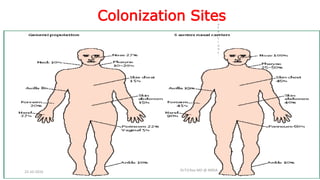
Colonization Sites
Dr.T.V.Rao MD @ MRSA
I
n
f
e
c
t
i
o
n
s
23-10-2016
What are the different kinds of strains
of MRSA?
 MRSA developed from methicillin-susceptible staph because methicillin and
its relatives, such as oxacillin, were widely used and selected for resistant
strains.
 This selection process has happened at least several times in the last 10-30
years.
 In the 1960s, strains of MRSA emerged in hospitals.
• Hospital strains tend to be resistant to additional antibiotics, and often cause
bloodstream infections.
 In the 1990s, new strains of MRSA emerged in the community.
• Community strains tend to produce toxins that lead to skin infections and
abscesses but are less often resistant to other antibiotics.
 Over time, hospital strains have moved to the community while
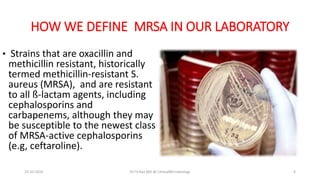
HOW WE DEFINE MRSA IN OUR LABORATORY
• Strains that are oxacillin and
methicillin resistant, historically
termed methicillin-resistant S.
aureus (MRSA), and are resistant
to all ß-lactam agents, including
cephalosporins and
carbapenems, although they may
be susceptible to the newest class
of MRSA-active cephalosporins
(e.g, ceftaroline).
23-10-2016 Dr.T.V.Rao MD @ ClinicalMicrobiology 6
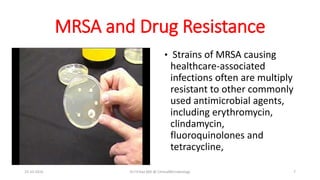
MRSA and Drug Resistance
• Strains of MRSA causing
healthcare-associated
infections often are multiply
resistant to other commonly
used antimicrobial agents,
including erythromycin,
clindamycin,
fluoroquinolones and
tetracycline,
23-10-2016 Dr.T.V.Rao MD @ ClinicalMicrobiology 7
Community associated
Staphylococcus
•Strains causing
community-associated
infections are often
resistant only to ß-
lactam agents and
erythromycin, may be
resistant to
fluoroquinolones
23-10-2016 Dr.T.V.Rao MD @ ClinicalMicrobiology 8
Rationale for MRSA screening
• Colonized patients constitute the main reservoir for
nosocomial transmission
• Colonized patients are only detected by active
surveillance sampling of muco-cutaneous swabs
• Hospitalized patients carrying MRSA are at high risk to
develop a MRSA infection
• High mortality (RR 1.9 vs MSSA, RR > 10 vs no infection)
and prolonged hospital stay (2-13 days) is associated with
MRSA infections
23-10-2016 Dr.T.V.Rao MD @ ClinicalMicrobiology 9
Classification of Risk Factors for
MRSA Infections
• There are certain factors that increase the risk of a person
contracting MRSA.
These factors include:
have previously had MRSA are coming from a high risk environment
(e.g. hospital or nursing home)
1 patients with a chronic wound, e.g. Leg ulcers
2indwelling medical devices e.g. catheter
3 being admitted as an inpatient in another hospital within
the last 6 months drug therapy that reduces the auto-
immune response.
23-10-2016 Dr.T.V.Rao MD @ ClinicalMicrobiology 10
Potential benefits for rapid
MRSA identification
• Patient care – Early appropriate treatment with
improve clinical outcome – Reduced empirical use of
glycopeptides
• Infection control – Early MRSA isolation/cohorting –
Decrease in nosocomial transmission rate – Decrease
in MRSA morbidity and mortality – Cost saving
• Shorter patient stay
Fewer preventive isolation days
• Lower medical liability costs
23-10-2016 Dr.T.V.Rao MD @ ClinicalMicrobiology 11
Who should be screened for
MRSA? NHS
Guidelines• MRSA screening is usually carried out in people who need to be admitted
to hospital for planned or emergency care.
• In particular, it's recommended for certain groups at the highest risk of
becoming infected with MRSA while they're in hospital. These include:
• People who have been infected or colonised (carry the bacteria on their
skin) with MRSA previously
• People being admitted to certain "high-risk" hospital units – including
surgery, cancer, kidney and trauma units
• People who aren't staying in hospital overnight don't usually need to be
routinely screened.
23-10-2016 Dr.T.V.Rao MD @ ClinicalMicrobiology 12
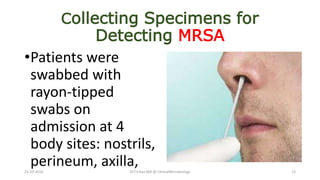
Collecting Specimens for
Detecting MRSA
•Patients were
swabbed with
rayon-tipped
swabs on
admission at 4
body sites: nostrils,
perineum, axilla,23-10-2016 Dr.T.V.Rao MD @ ClinicalMicrobiology 13
How should clinical laboratories test for
MRSA
• In addition to broth microdultion testing, the Clinical
and Laboratory Standards Institute (CLSI),
recommends the cefoxitin disk screen test, the
latex agglutination test for PBP2a, or a plate
containing 6 μg/ml of oxacillin in Mueller-Hinton agar
supplemented with 4% NaCl as alternative methods of
testing for MRSA.. In addition, there are now several
FDA-approved selective chromogenic agars that can
be used for MRSA detection.
23-10-2016 Dr.T.V.Rao MD @ ClinicalMicrobiology 14
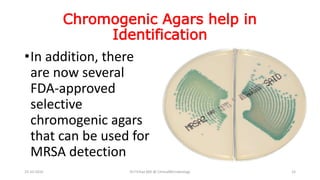
Chromogenic Agars help in
Identification
•In addition, there
are now several
FDA-approved
selective
chromogenic agars
that can be used for
MRSA detection
23-10-2016 Dr.T.V.Rao MD @ ClinicalMicrobiology 15
Why are oxacillin and cefoxitin
tested instead of methicillin?
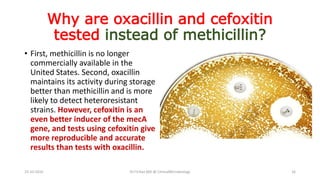
• First, methicillin is no longer
commercially available in the
United States. Second, oxacillin
maintains its activity during storage
better than methicillin and is more
likely to detect heteroresistant
strains. However, cefoxitin is an
even better inducer of the mecA
gene, and tests using cefoxitin give
more reproducible and accurate
results than tests with oxacillin.
23-10-2016 Dr.T.V.Rao MD @ ClinicalMicrobiology 16
If oxacillin and cefoxitin are tested, why are
the isolates called “MRSA” instead of
“ORSA”?
• When resistance was first described in 1961, methicillin was used to
test and treat infections caused by S. aureus. However, oxacillin,
which is in the same class of drugs as methicillin, was chosen as the
agent of choice for testing staphylococci in the early 1990s, and this
was modified to include cefoxitin later. The acronym MRSA is still used
by many to describe these isolates because of its historic role.
Ref 1 CLSI. 2013. Performance standards for antimicrobial susceptibility
testing. CLSI approved standard M100-S23. Clinical and Laboratory
Standards Institute, Wayne, PA.
• 2Bannerman, TL. 2003. Staphylococcus, Micrococcus and other
catalase-positive cocci that grow aerobically. In P.R
23-10-2016 Dr.T.V.Rao MD @ ClinicalMicrobiology 17
How is the mecA gene involved in
the mechanism of resistance?
• Staphylococcal resistance to
oxacillin/methicillin occurs when
an isolate produces an altered
penicillin-binding protein, PBP2a,
which is encoded by the mecA
gene. The variant penicillin-
binding protein binds beta-
lactams with lower avidity, which
results in resistance to this class
of antimicrobial agents.
23-10-2016 Dr.T.V.Rao MD @ ClinicalMicrobiology 18
Are there additional tests to
detect oxacillin/methicillin
resistance?• Nucleic acid amplification tests,
such as the polymerase chain
reaction (PCR), can be used to
detect the mecA gene, is the
most common gene that
mediates oxacillin resistance in
staphylococci. However, mecA
PCR tests will not detect novel
resistance mechanisms such as
mecC or uncommon
phenotypes such as borderline-
resistant oxacillin resistance.
23-10-2016 Dr.T.V.Rao MD @ ClinicalMicrobiology 19
Can Healthy People Get
MRSA?
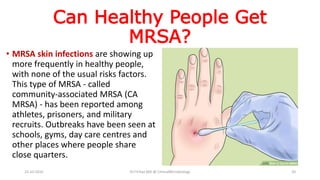
• MRSA skin infections are showing up
more frequently in healthy people,
with none of the usual risks factors.
This type of MRSA - called
community-associated MRSA (CA
MRSA) - has been reported among
athletes, prisoners, and military
recruits. Outbreaks have been seen at
schools, gyms, day care centres and
other places where people share
close quarters.
23-10-2016 Dr.T.V.Rao MD @ ClinicalMicrobiology 20
Who is at risk for MRSA?
those most at risk:
• Spend a lot of time in
crowded places such as
hospitals, schools or
rooms
Share sports equipment
Share personal hygiene
items Play contact sports
Overuse or misuse
antibiotics
23-10-2016 Dr.T.V.Rao MD @ ClinicalMicrobiology 21
What do you understand by
Vancomycin Resistance
• Since 1996, MRSA strains
with decreased
susceptibility to
vancomycin (minimum
inhibitory concentration
[MIC], 4 – 8 μg/ml) and
strains fully resistant to
vancomycin (MIC ≥ 32
μg/ml) have been reported.
23-10-2016 Dr.T.V.Rao MD @ ClinicalMicrobiology 22
How can people protect themselves
from MRSA?
 Collective public vigilance and demands for better application of
infection control standards to reduce healthcare-associated MRSA
In the hospital
 Hand washing before and after seeing each patient
 Care of IV lines
At the personal level
 Wash hands or other body surfaces, especially after skin-to-skin contact with other
people and with healthcare settings
 Avoid sharing potentially contaminated items, such as towels, unwashed clothing
 Clean and cover abrasions/cuts as soon after they occur as possible
 Seek healthcare consultation at the first signs of possible infection
Decolonization
Decolonization entails treatment of persons colonized
with a specific MDRO, usually MRSA, to eradicate
carriage of that organism However, decolonization of
persons carrying MRSA in their nares has proved
possible with several regimens that include topical
mupirocin alone or in combination with orally
administered antibiotics (e.g., rifampin in combination
with trimethoprim- sulfamethoxazole or ciprofloxacin)
plus the use of an antimicrobial soap for bathing(303).
Can Chemical baths help in reducing
MRSA incidence
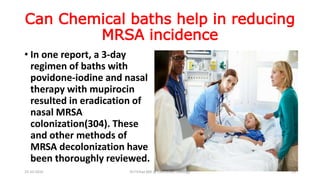
• In one report, a 3-day
regimen of baths with
povidone-iodine and nasal
therapy with mupirocin
resulted in eradication of
nasal MRSA
colonization(304). These
and other methods of
MRSA decolonization have
been thoroughly reviewed.
23-10-2016 Dr.T.V.Rao MD @ ClinicalMicrobiology 25
WHAT REALLY WE NEED TODAY
• Always washing your hands after using the toilet or
commode (many hospitals now routinely offer hand wipes)
• Always washing your hands or cleaning them with a hand
wipe immediately before and after eating a meal
• Following any advice you're given about wound care and
devices that could lead to infection (such as urinary
catheters)
• Reporting any unclean toilet or bathroom facilities to staff –
don't be afraid to talk to staff if you're concerned about
hygiene23-10-2016 Dr.T.V.Rao MD @ MRSA
General Hygiene too Matters
• The hospital
environment, including floors,
toilets and beds, should be kept
as clean and dry as possible.
• Patients with a known or
suspected MRSA infection
should be isolated.
• Patients should only be
transferred between wards
when it is strictly necessary.
23-10-2016 Dr.T.V.Rao MD @ MRSA
In spite of Many Developments in Control of MRSA
HAND WASHING STILL BEST EASIER OPTION
23-10-2016 Dr.T.V.Rao MD @ ClinicalMicrobiology 28
References
• What are the susceptibility patterns of clinical S. aureus isolates? CDC
resources Laboratory Testing for MRSA
• 2MDRO Prevention and Control Healthcare Infection Control Practices
Advisory Committee (HICPAC) CDC
23-10-2016 Dr.T.V.Rao MD @ ClinicalMicrobiology 29
• Program Created by Dr.T.V.Rao MD
for Medical professionals for
improving awareness on Hospital
Associated Infection with spread of
MRSA
•Email
•doctortvrao@gmail
23-10-2016 Dr.T.V.Rao MD @ ClinicalMicrobiology 30

Screening for MRSA

  • 1.
    Screening for MRSADr.T.V.Rao MD 23-10-2016Dr.T.V.Rao MD @ ClinicalMicrobiology 1
  • 2.
    What is MRSA? MRSA is Staphylococcus aureus with resistance to a specific class of antibiotics, penicillinase- resistant penicillin's.  MRSA stands for methicillin-resistant Staphylococcus aureus.  Staphylococcus aureus is the scientific name for the bacteria that cause ‘staph’ infections, including:  most frequently, skin and soft tissue infections, such as boils  deeper infections, including invasion of the bloodstream and spreading around the body to cause serious, life threatening infections such as septicemia, abscesses, meningitis and pneumonia  MRSA were first reported in 1961 in England.  It took only a few months from introduction of the first penicillinase-resistant antibiotic to recognition of infections from MRSA.
  • 3.
    What is MRSA?(cont.) Clinically, MRSA isn’t particularly different than staph without methicillin resistance.  Methicillin resistance by itself is not an added risk for the individual having a staph infection.  Other antibiotics are still available to treat MRSA infections. However, MRSA is a concern to medical and public health communities in general.  It represents a marked increase in antibiotic resistance in staphylococci.  Different antibiotics need to be used to treat and prevent it. • More expensive antibiotics, such as vancomycin, often have more side effects, and increasing their use may result in additional antibiotic resistance in staphylococci, potentially rendering them in the future very difficult to treat. • Reducing the number of staph infections caused by MRSA is important in fighting against antibiotic resistance.
  • 4.
    Colonization Sites Dr.T.V.Rao MD@ MRSA I n f e c t i o n s 23-10-2016
  • 5.
    What are thedifferent kinds of strains of MRSA?  MRSA developed from methicillin-susceptible staph because methicillin and its relatives, such as oxacillin, were widely used and selected for resistant strains.  This selection process has happened at least several times in the last 10-30 years.  In the 1960s, strains of MRSA emerged in hospitals. • Hospital strains tend to be resistant to additional antibiotics, and often cause bloodstream infections.  In the 1990s, new strains of MRSA emerged in the community. • Community strains tend to produce toxins that lead to skin infections and abscesses but are less often resistant to other antibiotics.  Over time, hospital strains have moved to the community while
  • 6.
    HOW WE DEFINEMRSA IN OUR LABORATORY • Strains that are oxacillin and methicillin resistant, historically termed methicillin-resistant S. aureus (MRSA), and are resistant to all ß-lactam agents, including cephalosporins and carbapenems, although they may be susceptible to the newest class of MRSA-active cephalosporins (e.g, ceftaroline). 23-10-2016 Dr.T.V.Rao MD @ ClinicalMicrobiology 6
  • 7.
    MRSA and DrugResistance • Strains of MRSA causing healthcare-associated infections often are multiply resistant to other commonly used antimicrobial agents, including erythromycin, clindamycin, fluoroquinolones and tetracycline, 23-10-2016 Dr.T.V.Rao MD @ ClinicalMicrobiology 7
  • 8.
    Community associated Staphylococcus •Strains causing community-associated infectionsare often resistant only to ß- lactam agents and erythromycin, may be resistant to fluoroquinolones 23-10-2016 Dr.T.V.Rao MD @ ClinicalMicrobiology 8
  • 9.
    Rationale for MRSAscreening • Colonized patients constitute the main reservoir for nosocomial transmission • Colonized patients are only detected by active surveillance sampling of muco-cutaneous swabs • Hospitalized patients carrying MRSA are at high risk to develop a MRSA infection • High mortality (RR 1.9 vs MSSA, RR > 10 vs no infection) and prolonged hospital stay (2-13 days) is associated with MRSA infections 23-10-2016 Dr.T.V.Rao MD @ ClinicalMicrobiology 9
  • 10.
    Classification of RiskFactors for MRSA Infections • There are certain factors that increase the risk of a person contracting MRSA. These factors include: have previously had MRSA are coming from a high risk environment (e.g. hospital or nursing home) 1 patients with a chronic wound, e.g. Leg ulcers 2indwelling medical devices e.g. catheter 3 being admitted as an inpatient in another hospital within the last 6 months drug therapy that reduces the auto- immune response. 23-10-2016 Dr.T.V.Rao MD @ ClinicalMicrobiology 10
  • 11.
    Potential benefits forrapid MRSA identification • Patient care – Early appropriate treatment with improve clinical outcome – Reduced empirical use of glycopeptides • Infection control – Early MRSA isolation/cohorting – Decrease in nosocomial transmission rate – Decrease in MRSA morbidity and mortality – Cost saving • Shorter patient stay Fewer preventive isolation days • Lower medical liability costs 23-10-2016 Dr.T.V.Rao MD @ ClinicalMicrobiology 11
  • 12.
    Who should bescreened for MRSA? NHS Guidelines• MRSA screening is usually carried out in people who need to be admitted to hospital for planned or emergency care. • In particular, it's recommended for certain groups at the highest risk of becoming infected with MRSA while they're in hospital. These include: • People who have been infected or colonised (carry the bacteria on their skin) with MRSA previously • People being admitted to certain "high-risk" hospital units – including surgery, cancer, kidney and trauma units • People who aren't staying in hospital overnight don't usually need to be routinely screened. 23-10-2016 Dr.T.V.Rao MD @ ClinicalMicrobiology 12
  • 13.
    Collecting Specimens for DetectingMRSA •Patients were swabbed with rayon-tipped swabs on admission at 4 body sites: nostrils, perineum, axilla,23-10-2016 Dr.T.V.Rao MD @ ClinicalMicrobiology 13
  • 14.
    How should clinicallaboratories test for MRSA • In addition to broth microdultion testing, the Clinical and Laboratory Standards Institute (CLSI), recommends the cefoxitin disk screen test, the latex agglutination test for PBP2a, or a plate containing 6 μg/ml of oxacillin in Mueller-Hinton agar supplemented with 4% NaCl as alternative methods of testing for MRSA.. In addition, there are now several FDA-approved selective chromogenic agars that can be used for MRSA detection. 23-10-2016 Dr.T.V.Rao MD @ ClinicalMicrobiology 14
  • 15.
    Chromogenic Agars helpin Identification •In addition, there are now several FDA-approved selective chromogenic agars that can be used for MRSA detection 23-10-2016 Dr.T.V.Rao MD @ ClinicalMicrobiology 15
  • 16.
    Why are oxacillinand cefoxitin tested instead of methicillin? • First, methicillin is no longer commercially available in the United States. Second, oxacillin maintains its activity during storage better than methicillin and is more likely to detect heteroresistant strains. However, cefoxitin is an even better inducer of the mecA gene, and tests using cefoxitin give more reproducible and accurate results than tests with oxacillin. 23-10-2016 Dr.T.V.Rao MD @ ClinicalMicrobiology 16
  • 17.
    If oxacillin andcefoxitin are tested, why are the isolates called “MRSA” instead of “ORSA”? • When resistance was first described in 1961, methicillin was used to test and treat infections caused by S. aureus. However, oxacillin, which is in the same class of drugs as methicillin, was chosen as the agent of choice for testing staphylococci in the early 1990s, and this was modified to include cefoxitin later. The acronym MRSA is still used by many to describe these isolates because of its historic role. Ref 1 CLSI. 2013. Performance standards for antimicrobial susceptibility testing. CLSI approved standard M100-S23. Clinical and Laboratory Standards Institute, Wayne, PA. • 2Bannerman, TL. 2003. Staphylococcus, Micrococcus and other catalase-positive cocci that grow aerobically. In P.R 23-10-2016 Dr.T.V.Rao MD @ ClinicalMicrobiology 17
  • 18.
    How is themecA gene involved in the mechanism of resistance? • Staphylococcal resistance to oxacillin/methicillin occurs when an isolate produces an altered penicillin-binding protein, PBP2a, which is encoded by the mecA gene. The variant penicillin- binding protein binds beta- lactams with lower avidity, which results in resistance to this class of antimicrobial agents. 23-10-2016 Dr.T.V.Rao MD @ ClinicalMicrobiology 18
  • 19.
    Are there additionaltests to detect oxacillin/methicillin resistance?• Nucleic acid amplification tests, such as the polymerase chain reaction (PCR), can be used to detect the mecA gene, is the most common gene that mediates oxacillin resistance in staphylococci. However, mecA PCR tests will not detect novel resistance mechanisms such as mecC or uncommon phenotypes such as borderline- resistant oxacillin resistance. 23-10-2016 Dr.T.V.Rao MD @ ClinicalMicrobiology 19
  • 20.
    Can Healthy PeopleGet MRSA? • MRSA skin infections are showing up more frequently in healthy people, with none of the usual risks factors. This type of MRSA - called community-associated MRSA (CA MRSA) - has been reported among athletes, prisoners, and military recruits. Outbreaks have been seen at schools, gyms, day care centres and other places where people share close quarters. 23-10-2016 Dr.T.V.Rao MD @ ClinicalMicrobiology 20
  • 21.
    Who is atrisk for MRSA? those most at risk: • Spend a lot of time in crowded places such as hospitals, schools or rooms Share sports equipment Share personal hygiene items Play contact sports Overuse or misuse antibiotics 23-10-2016 Dr.T.V.Rao MD @ ClinicalMicrobiology 21
  • 22.
    What do youunderstand by Vancomycin Resistance • Since 1996, MRSA strains with decreased susceptibility to vancomycin (minimum inhibitory concentration [MIC], 4 – 8 μg/ml) and strains fully resistant to vancomycin (MIC ≥ 32 μg/ml) have been reported. 23-10-2016 Dr.T.V.Rao MD @ ClinicalMicrobiology 22
  • 23.
    How can peopleprotect themselves from MRSA?  Collective public vigilance and demands for better application of infection control standards to reduce healthcare-associated MRSA In the hospital  Hand washing before and after seeing each patient  Care of IV lines At the personal level  Wash hands or other body surfaces, especially after skin-to-skin contact with other people and with healthcare settings  Avoid sharing potentially contaminated items, such as towels, unwashed clothing  Clean and cover abrasions/cuts as soon after they occur as possible  Seek healthcare consultation at the first signs of possible infection
  • 24.
    Decolonization Decolonization entails treatmentof persons colonized with a specific MDRO, usually MRSA, to eradicate carriage of that organism However, decolonization of persons carrying MRSA in their nares has proved possible with several regimens that include topical mupirocin alone or in combination with orally administered antibiotics (e.g., rifampin in combination with trimethoprim- sulfamethoxazole or ciprofloxacin) plus the use of an antimicrobial soap for bathing(303).
  • 25.
    Can Chemical bathshelp in reducing MRSA incidence • In one report, a 3-day regimen of baths with povidone-iodine and nasal therapy with mupirocin resulted in eradication of nasal MRSA colonization(304). These and other methods of MRSA decolonization have been thoroughly reviewed. 23-10-2016 Dr.T.V.Rao MD @ ClinicalMicrobiology 25
  • 26.
    WHAT REALLY WENEED TODAY • Always washing your hands after using the toilet or commode (many hospitals now routinely offer hand wipes) • Always washing your hands or cleaning them with a hand wipe immediately before and after eating a meal • Following any advice you're given about wound care and devices that could lead to infection (such as urinary catheters) • Reporting any unclean toilet or bathroom facilities to staff – don't be afraid to talk to staff if you're concerned about hygiene23-10-2016 Dr.T.V.Rao MD @ MRSA
  • 27.
    General Hygiene tooMatters • The hospital environment, including floors, toilets and beds, should be kept as clean and dry as possible. • Patients with a known or suspected MRSA infection should be isolated. • Patients should only be transferred between wards when it is strictly necessary. 23-10-2016 Dr.T.V.Rao MD @ MRSA
  • 28.
    In spite ofMany Developments in Control of MRSA HAND WASHING STILL BEST EASIER OPTION 23-10-2016 Dr.T.V.Rao MD @ ClinicalMicrobiology 28
  • 29.
    References • What arethe susceptibility patterns of clinical S. aureus isolates? CDC resources Laboratory Testing for MRSA • 2MDRO Prevention and Control Healthcare Infection Control Practices Advisory Committee (HICPAC) CDC 23-10-2016 Dr.T.V.Rao MD @ ClinicalMicrobiology 29
  • 30.
    • Program Createdby Dr.T.V.Rao MD for Medical professionals for improving awareness on Hospital Associated Infection with spread of MRSA •Email •doctortvrao@gmail 23-10-2016 Dr.T.V.Rao MD @ ClinicalMicrobiology 30