International Relations
Theories
Post-Modernism
Post-StructuralismPost-Structuralism
Post-Colonialism
Dr Vaezade
Sepehr Arefmanesh
Spring 2014
Introduction
Postmodernism is a concept which appears in a wide
variety of disciplines or areas of study including art,
music, film, literature, architecture, and technology and
nowadays has burst into popular usage as a term for
everything from rock music to the whole cultural style
and mood of recent decades.
Postmodernism is a concept which appears in a wide
variety of disciplines or areas of study including art,
music, film, literature, architecture, and technology and
nowadays has burst into popular usage as a term for
everything from rock music to the whole cultural style
and mood of recent decades.
Modernism
Modernism refers to the broad
aesthetic movement in
visual arts, music, literature,
and drama and modernity
refers to a set of
philosophical and ethical
ideas which provide the
basis of the aesthetic aspect
of modernism. Therefore,
“modernity” is older than
“modernism.” For the sake
of simplicity the authors use
modernism for both terms.
There has been a long
debate among scholars on
when exactly modernism
starts and how to
distinguish between what is
modern and what is not
modern.
Modernism refers to the broad
aesthetic movement in
visual arts, music, literature,
and drama and modernity
refers to a set of
philosophical and ethical
ideas which provide the
basis of the aesthetic aspect
of modernism. Therefore,
“modernity” is older than
“modernism.” For the sake
of simplicity the authors use
modernism for both terms.
There has been a long
debate among scholars on
when exactly modernism
starts and how to
distinguish between what is
modern and what is not
modern.
No. Modernism Postmodernism
1.
2.
3.
4.
5.
6.
7.
8.
9.
10.
11.
12.
13.
objective
rational
scientific
global claims
positivist
utopian
central
the best
linear
generalizing
theoretical
abstract
unification
subjective
irrational
anti-scientific
local claims
constructivist
populist
fragmented
better
non-linear
non-generalizing
practical
concrete
diversity
Postmodernism
1.
2.
3.
4.
5.
6.
7.
8.
9.
10.
11.
12.
13.
objective
rational
scientific
global claims
positivist
utopian
central
the best
linear
generalizing
theoretical
abstract
unification
subjective
irrational
anti-scientific
local claims
constructivist
populist
fragmented
better
non-linear
non-generalizing
practical
concrete
diversity
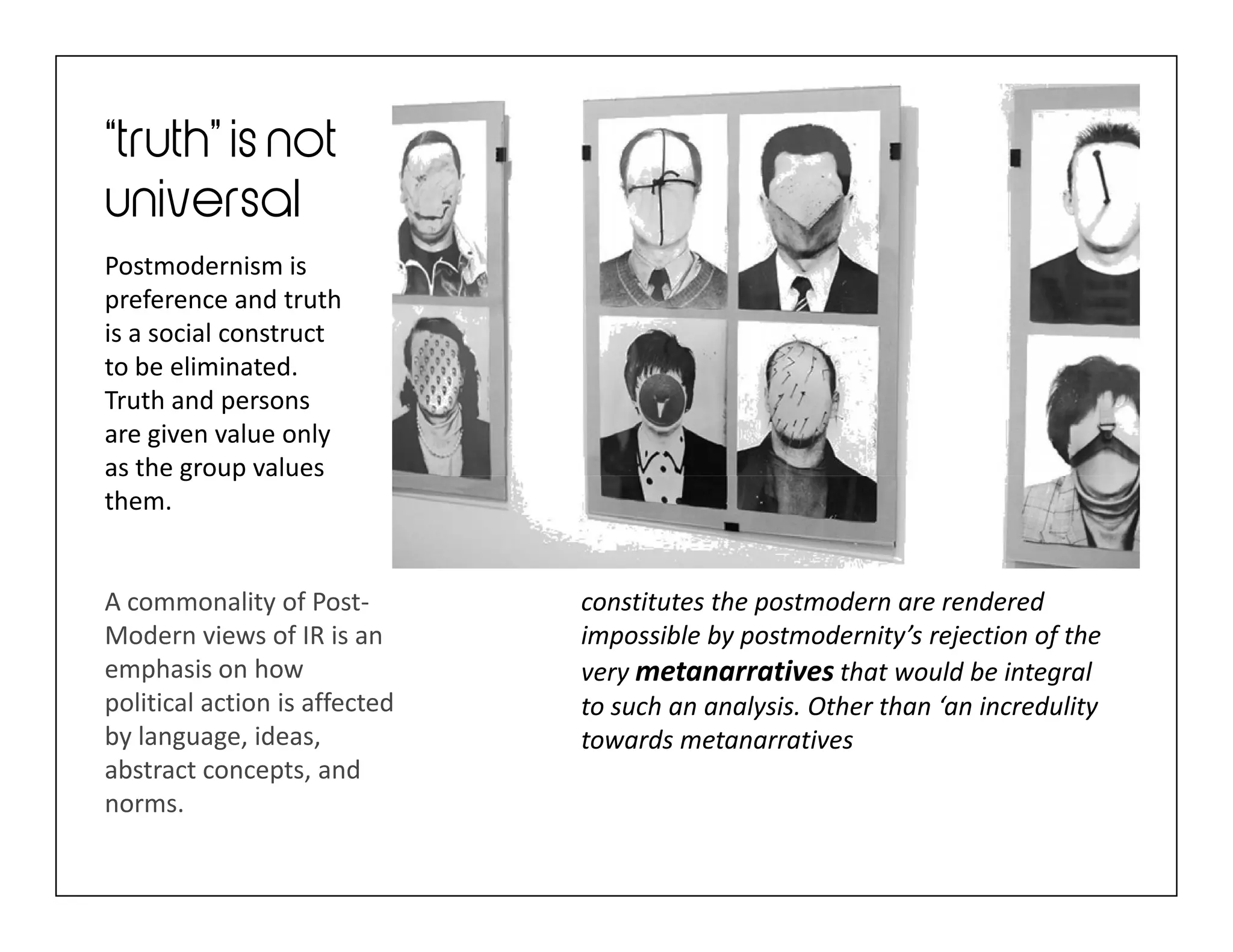
“truth” is not
universal
Postmodernism is
preference and truth
is a social construct
to be eliminated.
Truth and persons
are given value only
as the group values
them.
Postmodernism is
preference and truth
is a social construct
to be eliminated.
Truth and persons
are given value only
as the group values
them.
constitutes the postmodern are rendered
impossible by postmodernity’s rejection of the
very metanarratives that would be integral
to such an analysis. Other than ‘an incredulity
towards metanarratives
A commonality of Post-
Modern views of IR is an
emphasis on how
political action is affected
by language, ideas,
abstract concepts, and
norms.
Actors are missing: women, MNCs,
poor countries, classes, etc.
States are not unitary and thus
not rational – states are
abstractions
Thus, no such thing as national
interest.
Actors are missing: women, MNCs,
poor countries, classes, etc.
States are not unitary and thus
not rational – states are
abstractions
Thus, no such thing as national
interest.
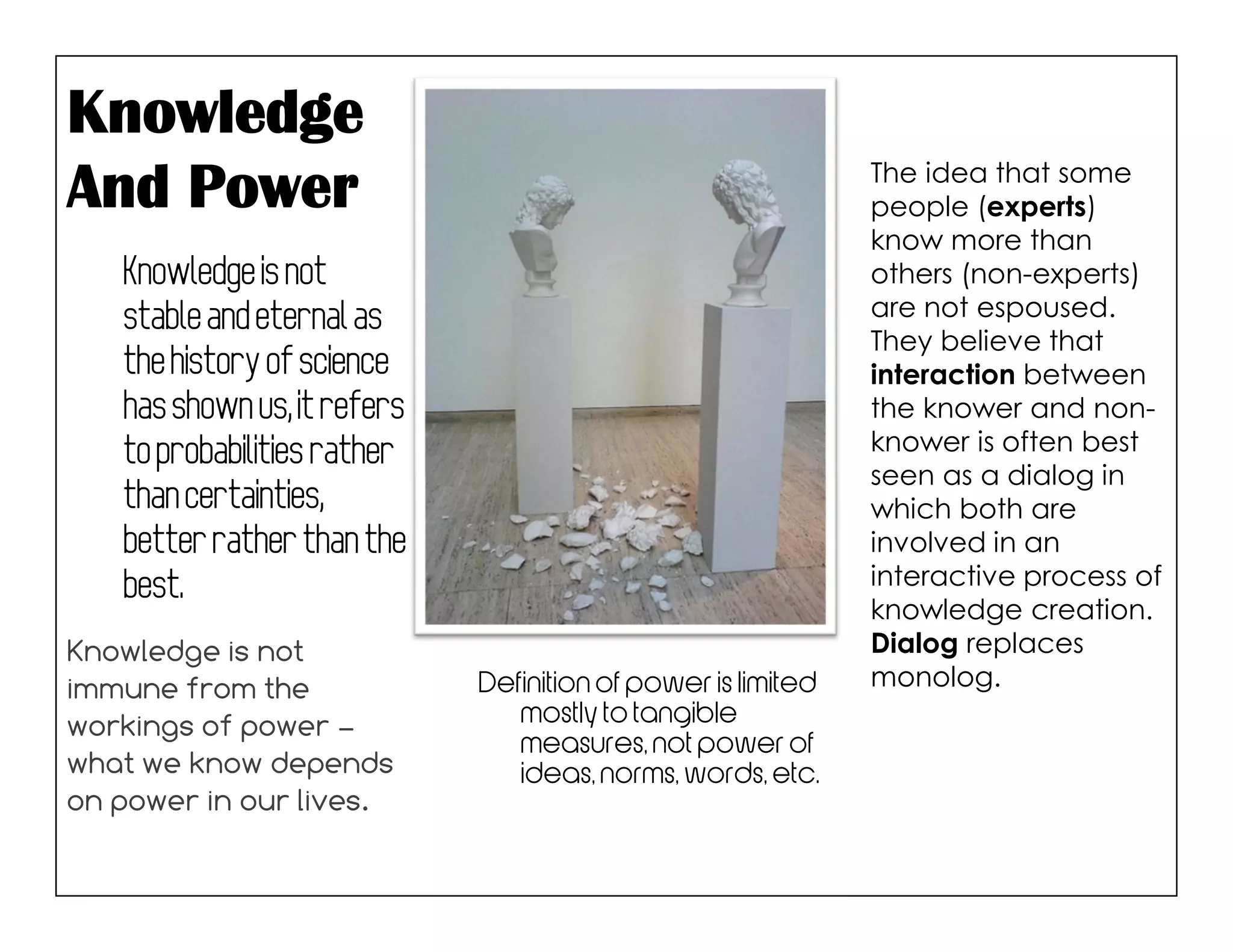
Knowledge
And Power
Knowledgeis not
stableandeternalas
thehistory ofscience
hasshown us,it refers
toprobabilities rather
thancertainties,
betterratherthan the
best.
The idea that some
people (experts)
know more than
others (non-experts)
are not espoused.
They believe that
interaction between
the knower and non-
knower is often best
seen as a dialog in
which both are
involved in an
interactive process of
knowledge creation.
Dialog replaces
monolog.
Knowledge is not
immune from the
workings of power –
what we know depends
on power in our lives.
Knowledgeis not
stableandeternalas
thehistory ofscience
hasshown us,it refers
toprobabilities rather
thancertainties,
betterratherthan the
best.
The idea that some
people (experts)
know more than
others (non-experts)
are not espoused.
They believe that
interaction between
the knower and non-
knower is often best
seen as a dialog in
which both are
involved in an
interactive process of
knowledge creation.
Dialog replaces
monolog.Definition of power is limited
mostly to tangible
measures, not power of
ideas, norms, words, etc.
Post-structuralism P
o
s
t
-
s
t
r
u
c
t
u
r
a
l
i
s
m
P
o
s
t
-
s
t
r
u
c
t
u
r
a
l
i
s
m
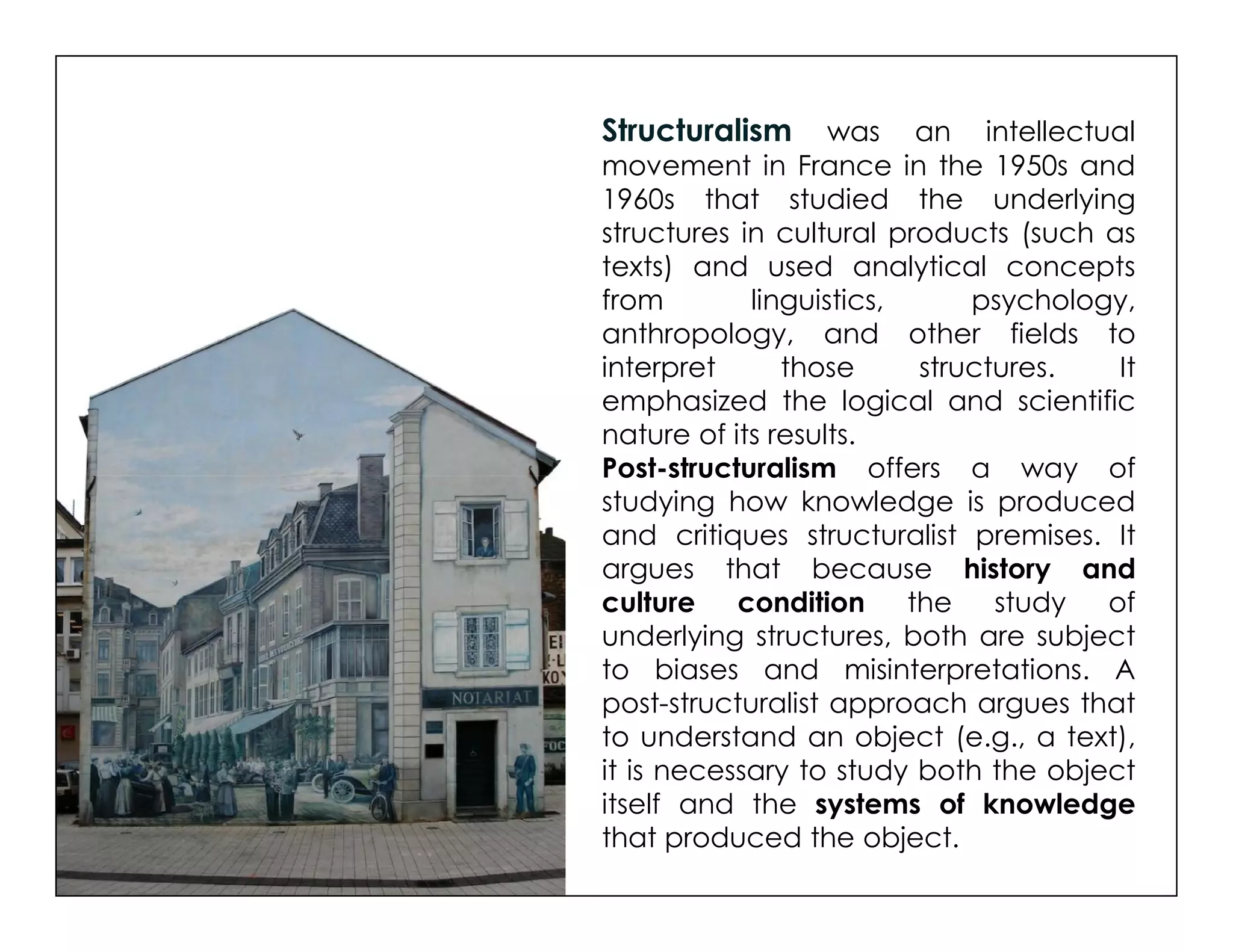
Structuralism was an intellectual
movement in France in the 1950s and
1960s that studied the underlying
structures in cultural products (such as
texts) and used analytical concepts
from linguistics, psychology,
anthropology, and other fields to
interpret those structures. It
emphasized the logical and scientific
nature of its results.
Post-structuralism offers a way of
studying how knowledge is produced
and critiques structuralist premises. It
argues that because history and
culture condition the study of
underlying structures, both are subject
to biases and misinterpretations. A
post-structuralist approach argues that
to understand an object (e.g., a text),
it is necessary to study both the object
itself and the systems of knowledge
that produced the object.
Structuralism was an intellectual
movement in France in the 1950s and
1960s that studied the underlying
structures in cultural products (such as
texts) and used analytical concepts
from linguistics, psychology,
anthropology, and other fields to
interpret those structures. It
emphasized the logical and scientific
nature of its results.
Post-structuralism offers a way of
studying how knowledge is produced
and critiques structuralist premises. It
argues that because history and
culture condition the study of
underlying structures, both are subject
to biases and misinterpretations. A
post-structuralist approach argues that
to understand an object (e.g., a text),
it is necessary to study both the object
itself and the systems of knowledge
that produced the object.
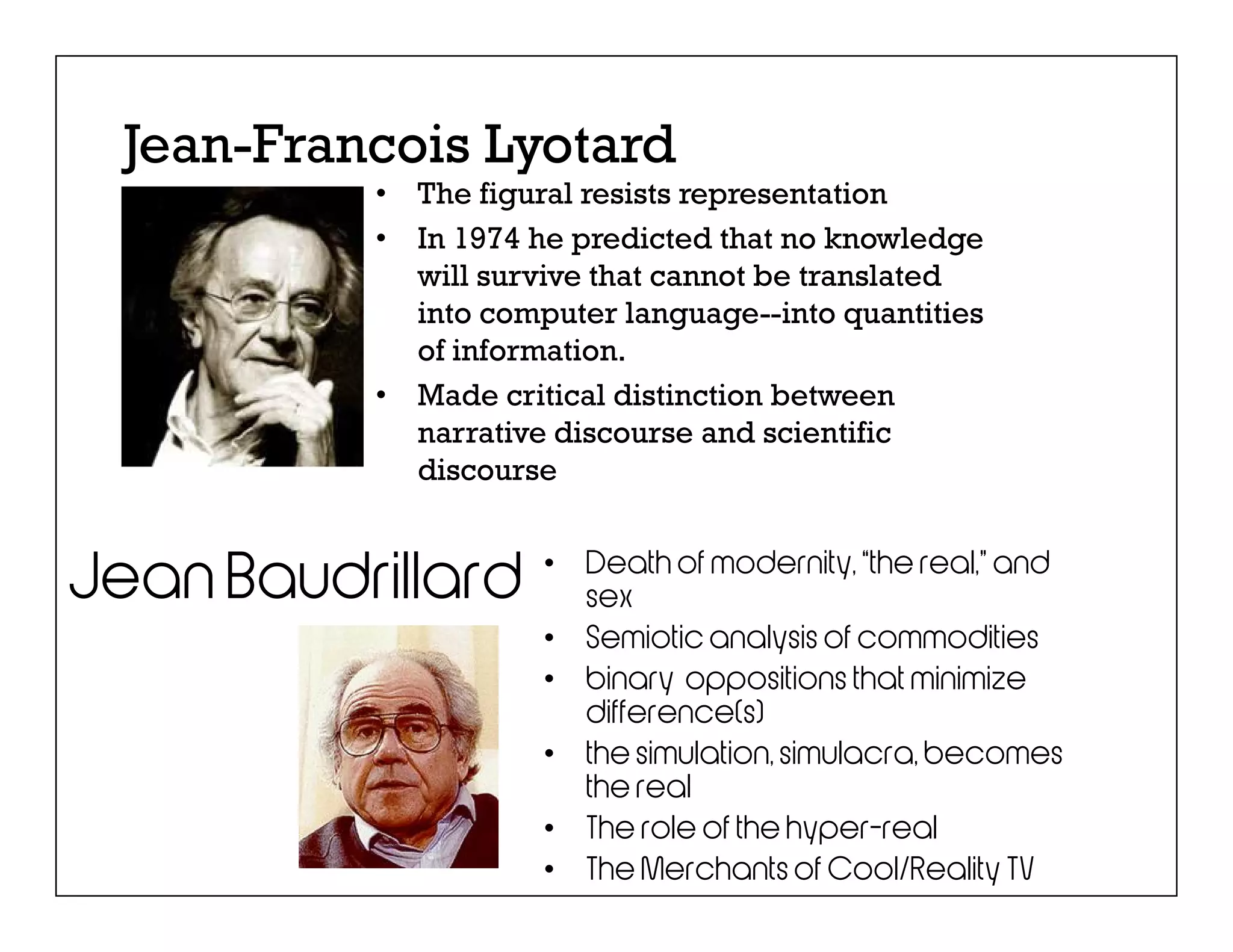
Jean-Francois Lyotard
• The figural resists representation
• In 1974 he predicted that no knowledge
will survive that cannot be translated
into computer language--into quantities
of information.
• Made critical distinction between
narrative discourse and scientific
discourse
• The figural resists representation
• In 1974 he predicted that no knowledge
will survive that cannot be translated
into computer language--into quantities
of information.
• Made critical distinction between
narrative discourse and scientific
discourse
Jean Baudrillard • Death of modernity, “the real,” and
sex
• Semiotic analysis of commodities
• binary oppositions that minimize
difference(s)
• the simulation, simulacra, becomes
the real
• The role of the hyper-real
• The Merchants of Cool/Reality TV
Michel Foucault
View language as the “container” of possible practices
within a discourse (profession).
Speaking is not an innovative activity, but a selection from
a fixed set of practices, governed by rules that are
permissible in the language.
• World is a “text” that must be interpreted.
– World is constructed like a text.
– Cannot refer to anything “real” – only
“interpretive experience”
– Quoting Montaigne: “We need to interpret
interpretations more than to interpret things”
• stable and natural concepts and relations
are artificial concepts.
Jacques Derrida
• World is a “text” that must be interpreted.
– World is constructed like a text.
– Cannot refer to anything “real” – only
“interpretive experience”
– Quoting Montaigne: “We need to interpret
interpretations more than to interpret things”
• stable and natural concepts and relations
are artificial concepts.
Like structuralism, they
rejected the centrality of the self, believing
that it is not the self that creates culture, it
is culture that creates the self;
and unlike
structuralism, they
rejected scientific pretensions and applied
the structural-cultural analysis of human
phenomena to the human sciences
themselves, which are after all human
cultural constructions.
Like structuralism, they
rejected the centrality of the self, believing
that it is not the self that creates culture, it
is culture that creates the self;
and unlike
structuralism, they
rejected scientific pretensions and applied
the structural-cultural analysis of human
phenomena to the human sciences
themselves, which are after all human
cultural constructions.
WhatisPost-colonialism?
What is colonialism?
•An extension of a nations rule over
territory beyond its borders
•a population that is subjected to the
political domination of another
population
WhatisPost-colonialism?
Post-colonial theory deals with the reading and writing
of literature written in previously or currently colonized
countries, or literature written in colonizing countries
which deals with colonization or colonized peoples
- it embraces no single method or school
How does it work?
•Assesses the position of the
colonial or post-colonial subject
•Offers a counter-narrative to
the long tradition of European
imperial narratives considering:
Political oppression
Economic
Social/cultural
oppression
Psychological
oppression
■ What happens after colonization?
* What language do you speak?
* what culture do you follow?
■ Two terms to describe the results of
colonization on those colonized
■ Awareness of culture before
colonized and during colonization
and what emerged as a result.
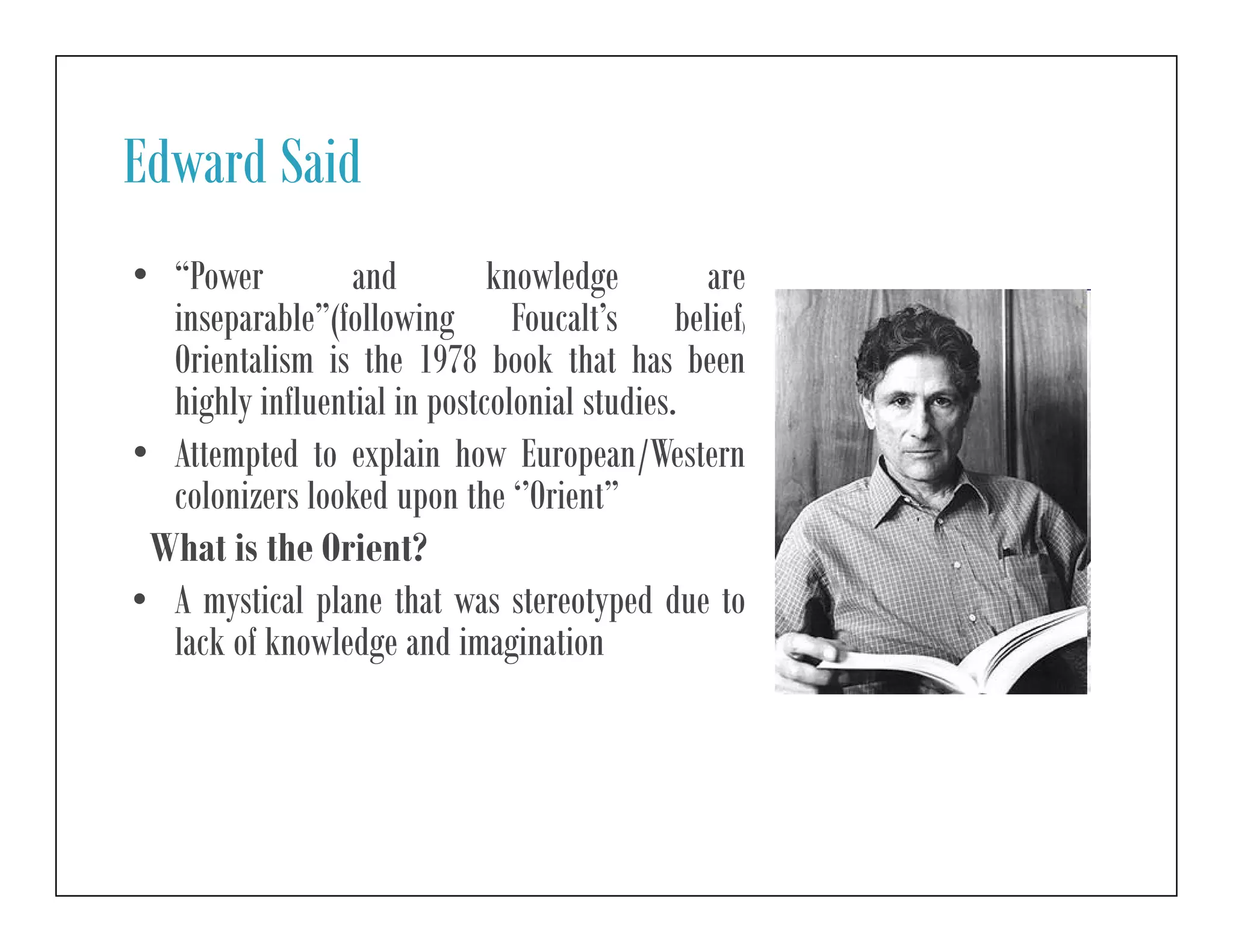
Edward Said
• “Power and knowledge are
inseparable”(following Foucalt’s belief)
Orientalism is the 1978 book that has been
highly influential in postcolonial studies.
• Attempted to explain how European/Western
colonizers looked upon the ‘’Orient”
What is the Orient?
• A mystical plane that was stereotyped due to
lack of knowledge and imagination
• “Power and knowledge are
inseparable”(following Foucalt’s belief)
Orientalism is the 1978 book that has been
highly influential in postcolonial studies.
• Attempted to explain how European/Western
colonizers looked upon the ‘’Orient”
What is the Orient?
• A mystical plane that was stereotyped due to
lack of knowledge and imagination

Postmodernism, post-structuralism, and post-colonialism in IR

  • 1.
  • 2.
    Introduction Postmodernism is aconcept which appears in a wide variety of disciplines or areas of study including art, music, film, literature, architecture, and technology and nowadays has burst into popular usage as a term for everything from rock music to the whole cultural style and mood of recent decades. Postmodernism is a concept which appears in a wide variety of disciplines or areas of study including art, music, film, literature, architecture, and technology and nowadays has burst into popular usage as a term for everything from rock music to the whole cultural style and mood of recent decades.
  • 3.
    Modernism Modernism refers tothe broad aesthetic movement in visual arts, music, literature, and drama and modernity refers to a set of philosophical and ethical ideas which provide the basis of the aesthetic aspect of modernism. Therefore, “modernity” is older than “modernism.” For the sake of simplicity the authors use modernism for both terms. There has been a long debate among scholars on when exactly modernism starts and how to distinguish between what is modern and what is not modern. Modernism refers to the broad aesthetic movement in visual arts, music, literature, and drama and modernity refers to a set of philosophical and ethical ideas which provide the basis of the aesthetic aspect of modernism. Therefore, “modernity” is older than “modernism.” For the sake of simplicity the authors use modernism for both terms. There has been a long debate among scholars on when exactly modernism starts and how to distinguish between what is modern and what is not modern.
  • 4.
    No. Modernism Postmodernism 1. 2. 3. 4. 5. 6. 7. 8. 9. 10. 11. 12. 13. objective rational scientific globalclaims positivist utopian central the best linear generalizing theoretical abstract unification subjective irrational anti-scientific local claims constructivist populist fragmented better non-linear non-generalizing practical concrete diversity Postmodernism 1. 2. 3. 4. 5. 6. 7. 8. 9. 10. 11. 12. 13. objective rational scientific global claims positivist utopian central the best linear generalizing theoretical abstract unification subjective irrational anti-scientific local claims constructivist populist fragmented better non-linear non-generalizing practical concrete diversity
  • 5.
    “truth” is not universal Postmodernismis preference and truth is a social construct to be eliminated. Truth and persons are given value only as the group values them. Postmodernism is preference and truth is a social construct to be eliminated. Truth and persons are given value only as the group values them. constitutes the postmodern are rendered impossible by postmodernity’s rejection of the very metanarratives that would be integral to such an analysis. Other than ‘an incredulity towards metanarratives A commonality of Post- Modern views of IR is an emphasis on how political action is affected by language, ideas, abstract concepts, and norms.
  • 6.
    Actors are missing:women, MNCs, poor countries, classes, etc. States are not unitary and thus not rational – states are abstractions Thus, no such thing as national interest. Actors are missing: women, MNCs, poor countries, classes, etc. States are not unitary and thus not rational – states are abstractions Thus, no such thing as national interest.
  • 7.
    Knowledge And Power Knowledgeis not stableandeternalas thehistoryofscience hasshown us,it refers toprobabilities rather thancertainties, betterratherthan the best. The idea that some people (experts) know more than others (non-experts) are not espoused. They believe that interaction between the knower and non- knower is often best seen as a dialog in which both are involved in an interactive process of knowledge creation. Dialog replaces monolog. Knowledge is not immune from the workings of power – what we know depends on power in our lives. Knowledgeis not stableandeternalas thehistory ofscience hasshown us,it refers toprobabilities rather thancertainties, betterratherthan the best. The idea that some people (experts) know more than others (non-experts) are not espoused. They believe that interaction between the knower and non- knower is often best seen as a dialog in which both are involved in an interactive process of knowledge creation. Dialog replaces monolog.Definition of power is limited mostly to tangible measures, not power of ideas, norms, words, etc.
  • 8.
  • 9.
    Structuralism was anintellectual movement in France in the 1950s and 1960s that studied the underlying structures in cultural products (such as texts) and used analytical concepts from linguistics, psychology, anthropology, and other fields to interpret those structures. It emphasized the logical and scientific nature of its results. Post-structuralism offers a way of studying how knowledge is produced and critiques structuralist premises. It argues that because history and culture condition the study of underlying structures, both are subject to biases and misinterpretations. A post-structuralist approach argues that to understand an object (e.g., a text), it is necessary to study both the object itself and the systems of knowledge that produced the object. Structuralism was an intellectual movement in France in the 1950s and 1960s that studied the underlying structures in cultural products (such as texts) and used analytical concepts from linguistics, psychology, anthropology, and other fields to interpret those structures. It emphasized the logical and scientific nature of its results. Post-structuralism offers a way of studying how knowledge is produced and critiques structuralist premises. It argues that because history and culture condition the study of underlying structures, both are subject to biases and misinterpretations. A post-structuralist approach argues that to understand an object (e.g., a text), it is necessary to study both the object itself and the systems of knowledge that produced the object.
  • 10.
    Jean-Francois Lyotard • Thefigural resists representation • In 1974 he predicted that no knowledge will survive that cannot be translated into computer language--into quantities of information. • Made critical distinction between narrative discourse and scientific discourse • The figural resists representation • In 1974 he predicted that no knowledge will survive that cannot be translated into computer language--into quantities of information. • Made critical distinction between narrative discourse and scientific discourse Jean Baudrillard • Death of modernity, “the real,” and sex • Semiotic analysis of commodities • binary oppositions that minimize difference(s) • the simulation, simulacra, becomes the real • The role of the hyper-real • The Merchants of Cool/Reality TV
  • 11.
    Michel Foucault View languageas the “container” of possible practices within a discourse (profession). Speaking is not an innovative activity, but a selection from a fixed set of practices, governed by rules that are permissible in the language. • World is a “text” that must be interpreted. – World is constructed like a text. – Cannot refer to anything “real” – only “interpretive experience” – Quoting Montaigne: “We need to interpret interpretations more than to interpret things” • stable and natural concepts and relations are artificial concepts. Jacques Derrida • World is a “text” that must be interpreted. – World is constructed like a text. – Cannot refer to anything “real” – only “interpretive experience” – Quoting Montaigne: “We need to interpret interpretations more than to interpret things” • stable and natural concepts and relations are artificial concepts.
  • 12.
    Like structuralism, they rejectedthe centrality of the self, believing that it is not the self that creates culture, it is culture that creates the self; and unlike structuralism, they rejected scientific pretensions and applied the structural-cultural analysis of human phenomena to the human sciences themselves, which are after all human cultural constructions. Like structuralism, they rejected the centrality of the self, believing that it is not the self that creates culture, it is culture that creates the self; and unlike structuralism, they rejected scientific pretensions and applied the structural-cultural analysis of human phenomena to the human sciences themselves, which are after all human cultural constructions.
  • 13.
    WhatisPost-colonialism? What is colonialism? •Anextension of a nations rule over territory beyond its borders •a population that is subjected to the political domination of another population WhatisPost-colonialism? Post-colonial theory deals with the reading and writing of literature written in previously or currently colonized countries, or literature written in colonizing countries which deals with colonization or colonized peoples - it embraces no single method or school
  • 14.
    How does itwork? •Assesses the position of the colonial or post-colonial subject •Offers a counter-narrative to the long tradition of European imperial narratives considering: Political oppression Economic Social/cultural oppression Psychological oppression ■ What happens after colonization? * What language do you speak? * what culture do you follow? ■ Two terms to describe the results of colonization on those colonized ■ Awareness of culture before colonized and during colonization and what emerged as a result.
  • 15.
    Edward Said • “Powerand knowledge are inseparable”(following Foucalt’s belief) Orientalism is the 1978 book that has been highly influential in postcolonial studies. • Attempted to explain how European/Western colonizers looked upon the ‘’Orient” What is the Orient? • A mystical plane that was stereotyped due to lack of knowledge and imagination • “Power and knowledge are inseparable”(following Foucalt’s belief) Orientalism is the 1978 book that has been highly influential in postcolonial studies. • Attempted to explain how European/Western colonizers looked upon the ‘’Orient” What is the Orient? • A mystical plane that was stereotyped due to lack of knowledge and imagination