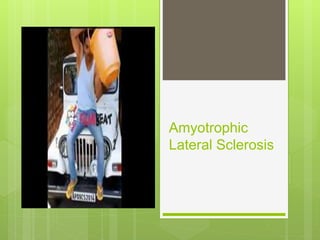



Amyotrophic 
Lateral Sclerosis
Epidemiology 
 Prevalence: 5-7 per 100,000 worldwide 
 More common in men by ratio of 1.5 to 1 
 Ages affected: 50 to 70 years old
Etiology 
 Idiopathic in most cases 
 Autosomal dominant inheritance in 5-10% of 
cases
Pathophysiology 
 Upper and lower motor neuron degeneration 
 Affects anterior horn cells 
 Subtypes 
 Progressive Bulbar Palsy 
 Primary Lateral Sclerosis 
 Spinal Muscular Atrophy
Symptoms 
 Muscle aches and muscle cramps 
 Weakness of distal upper limbs 
 Weakness progresses inferiorly (towards feet) 
 Dysarthria 
 Dysphagia 
 Drooling
Signs 
 Muscle fibrillation and atrophy (upper limbs) 
 Hyperreflexia 
 Spasticity of lower limbs
Diagnosis: 
Electromyogram (EMG) 
 Muscle fibrillation on mechanical stimulation 
 Increased duration and amplitude of action 
potentials
Prognosis 
 Majority of patients die within 1-3 years of 
diagnosis 
 Only 10% survive beyond 5 years
Treatment 
 Riluzole 50 mg bid 
 Anti-glutamate properties 
 Only modest effect at best (extended life 3 
months) 
 Best effect if used early 
 Vitamin E and Vitamin C 
 Immunosuppressants not effective or 
indicated
Supportive Management 
 Treat at ALS center 
 Physical Therapy 
 Occupational Therapy 
 Dietitian 
 Neurologist 
 Symptomatic treatment 
 Progressive Pseudobulbar palsy 
 Spontaneous laugh (Tricyclic Antidepressants)
Sources: 
 Harrison’s 
 Oxford 
 Google 
http://crisbertcualteros.page.tl

Amyotrophic Lateral Sclerosis

  • 1.
  • 2.
    Epidemiology  Prevalence:5-7 per 100,000 worldwide  More common in men by ratio of 1.5 to 1  Ages affected: 50 to 70 years old
  • 3.
    Etiology  Idiopathicin most cases  Autosomal dominant inheritance in 5-10% of cases
  • 4.
    Pathophysiology  Upperand lower motor neuron degeneration  Affects anterior horn cells  Subtypes  Progressive Bulbar Palsy  Primary Lateral Sclerosis  Spinal Muscular Atrophy
  • 5.
    Symptoms  Muscleaches and muscle cramps  Weakness of distal upper limbs  Weakness progresses inferiorly (towards feet)  Dysarthria  Dysphagia  Drooling
  • 6.
    Signs  Musclefibrillation and atrophy (upper limbs)  Hyperreflexia  Spasticity of lower limbs
  • 7.
    Diagnosis: Electromyogram (EMG)  Muscle fibrillation on mechanical stimulation  Increased duration and amplitude of action potentials
  • 8.
    Prognosis  Majorityof patients die within 1-3 years of diagnosis  Only 10% survive beyond 5 years
  • 9.
    Treatment  Riluzole50 mg bid  Anti-glutamate properties  Only modest effect at best (extended life 3 months)  Best effect if used early  Vitamin E and Vitamin C  Immunosuppressants not effective or indicated
  • 10.
    Supportive Management Treat at ALS center  Physical Therapy  Occupational Therapy  Dietitian  Neurologist  Symptomatic treatment  Progressive Pseudobulbar palsy  Spontaneous laugh (Tricyclic Antidepressants)
  • 11.
    Sources:  Harrison’s  Oxford  Google http://crisbertcualteros.page.tl