BiologyBiology
ScienceDepartmentScienceDepartment
DeerfieldHighSchoolDeerfieldHighSchool
BiologyBiology
ScienceDepartmentScienceDepartment
DeerfieldHighSchoolDeerfieldHighSchool
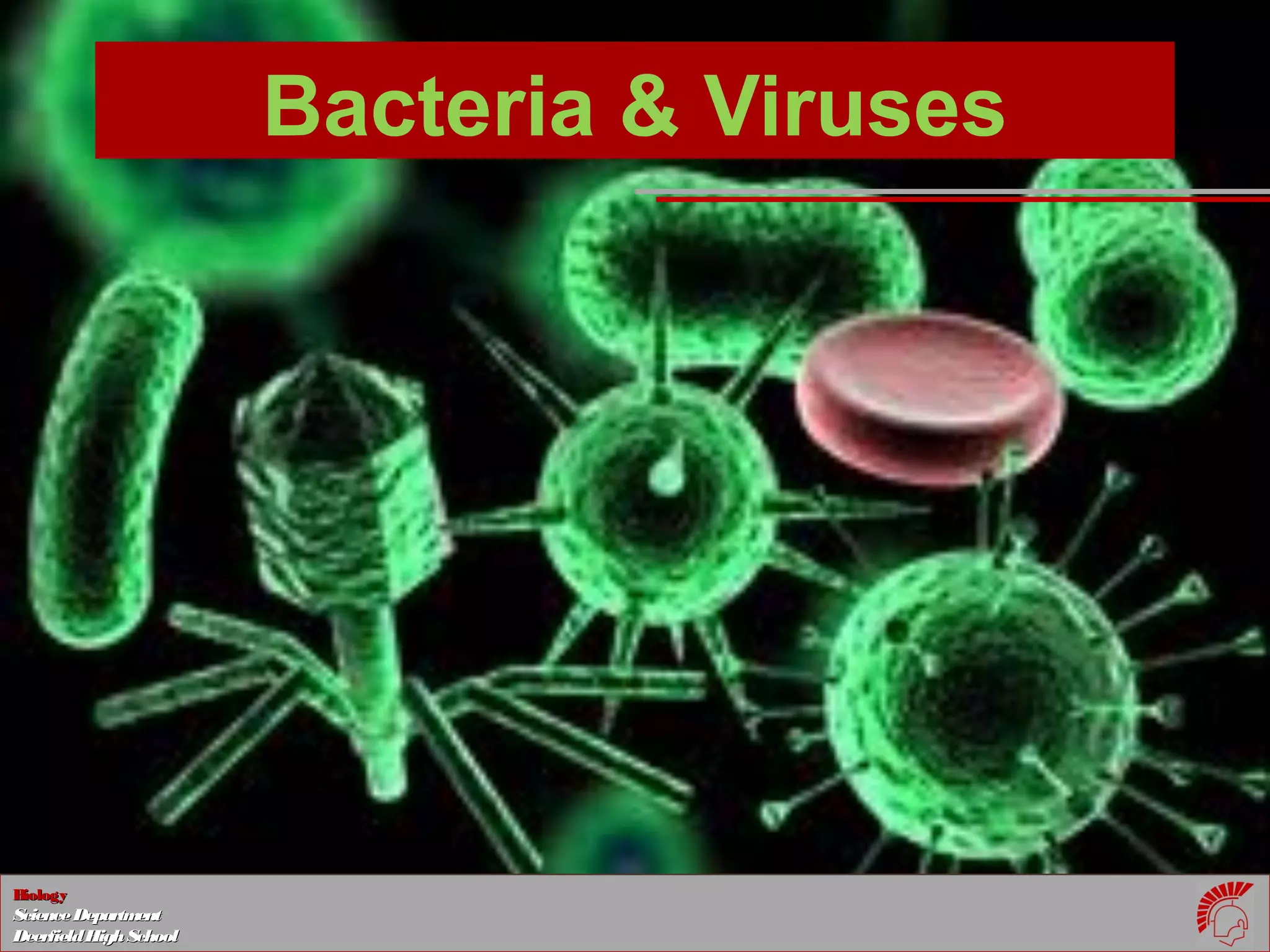
Bacteria & Viruses
BiologyBiology
ScienceDepartmentScienceDepartment
DeerfieldHighSchoolDeerfieldHighSchool
BiologyBiology
ScienceDepartmentScienceDepartment
DeerfieldHighSchoolDeerfieldHighSchool
DO NOW:
Whatarethecharacteristics of viruses?
Bacteria? Whatkingdomdoeachof
thesebelong? Aretheyliving? Whyor
whynot?
BiologyBiology
ScienceDepartmentScienceDepartment
DeerfieldHighSchoolDeerfieldHighSchool
What do you already know?
 What are the differences between
viruses and bacteria?
 Are all bacteria harmful?
 When you get a cold, should you
take an antibiotic to help you get
better?
 What’s the best and easiest thing
to do to avoid getting sick?
BiologyBiology
ScienceDepartmentScienceDepartment
DeerfieldHighSchoolDeerfieldHighSchool
Bacteria
 Bacteriology is the study of bacteria
 Bacteria are prokaryotic, unicellular
organisms containing DNA and ribosomes.
 Bacteria have ALL the characteristics of living
things.
 Bacteria have the greatest percentage of the
biomass on Earth!
BiologyBiology
ScienceDepartmentScienceDepartment
DeerfieldHighSchoolDeerfieldHighSchool
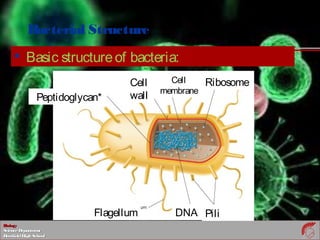
Bacterial Structure
 Basic structureof bacteria:
Ribosome
PiliDNAFlagellum
Peptidoglycan*
Cell
wall
Cell
membrane
BiologyBiology
ScienceDepartmentScienceDepartment
DeerfieldHighSchoolDeerfieldHighSchool
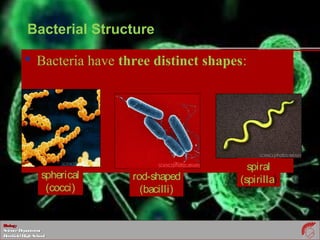
Bacterial Structure
 Bacteria have three distinct shapes:
spherical
(cocci)
rod-shaped
(bacilli)
spiral
(spirilla)
BiologyBiology
ScienceDepartmentScienceDepartment
DeerfieldHighSchoolDeerfieldHighSchool
Bacteria
 Bacteria have a variety of important uses:
– Help make interesting food (buttermilk, yogurt, cheese,
sauerkraut, pickles, and olives, etc…)
– Decompose organic matter (recycle nutrients from dead
organisms; break down sewage into simpler compounds)
– Nitrogen fixation (chemically changes nitrogen gas, N2,
into ammonia, NH3, so plants can make amino acids)
– Human health (bacteria on skin help prevent infection &
bacteria in gut helps digest food & make vitamins)
– Biotechnology (used to make antibiotics, insulin, human
growth hormone, vitamins, and other drugs)
BiologyBiology
ScienceDepartmentScienceDepartment
DeerfieldHighSchoolDeerfieldHighSchool
How Do Pathogenic Bacteria Work?
 Bacteriaproducediseasein oneof two ways:
 Using cells forfood: Thebacteriabreak
down healthy cellsfor food, destroying tissues
 Releasing toxins: Thebacteriaproducea
toxin (poisonousprotein) that isreleased into
thebloodstream whereit can travel
throughout thebody, disrupting normal
activity and damaging tissues
BiologyBiology
ScienceDepartmentScienceDepartment
DeerfieldHighSchoolDeerfieldHighSchool
Bacteria
 A rather vocal minority (less than 1%) of
bacteria cause disease in humans, animals, and
plants.
 Bacteria can cause a variety of diseases:
– Food Poisoning – Scarlet Fever
– Tuberculosis – Whooping Cough
– Cholera – Bacterial Meningitis
– Syphilis – Pneumonia
– Ulcers – Leprosy
– Strep Throat – Tetanus
VIDEO CLIP:
Understanding
Bacteria
BiologyBiology
ScienceDepartmentScienceDepartment
DeerfieldHighSchoolDeerfieldHighSchool
http://www.youtube.com/watch?
v=yToii3-p-NI
BiologyBiology
ScienceDepartmentScienceDepartment
DeerfieldHighSchoolDeerfieldHighSchool
Viruses
 Virology is the study of viruses
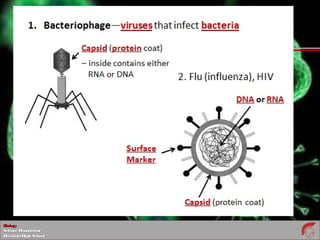
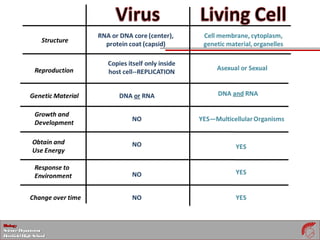
 Viruses are “biological entities” containing
either DNA or RNA that require another
cell to survive.
 Viruses have some, but not all, of the
characteristics of life.
*So are viruses living or non-living?*
 Viruses seem to exist only to make more
viruses!
BiologyBiology
ScienceDepartmentScienceDepartment
DeerfieldHighSchoolDeerfieldHighSchool
BiologyBiology
ScienceDepartmentScienceDepartment
DeerfieldHighSchoolDeerfieldHighSchool
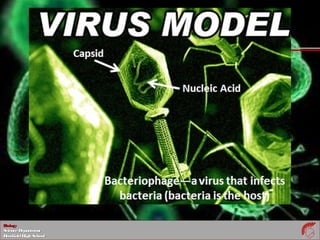
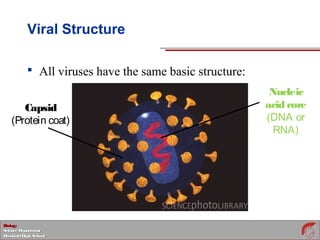
Viral Structure
 All viruses have the same basic structure:
Nucleic
acid core
(DNA or
RNA)
Capsid
(Protein coat)
BiologyBiology
ScienceDepartmentScienceDepartment
DeerfieldHighSchoolDeerfieldHighSchool
BiologyBiology
ScienceDepartmentScienceDepartment
DeerfieldHighSchoolDeerfieldHighSchool
How Do Viruses Work?
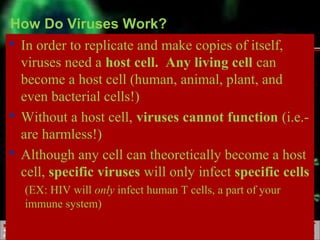
 In order to replicate and make copies of itself,
viruses need a host cell. Any living cell can
become a host cell (human, animal, plant, and
even bacterial cells!)
 Without a host cell, viruses cannot function (i.e.-
are harmless!)
 Although any cell can theoretically become a host
cell, specific viruses will only infect specific cells
(EX: HIV will only infect human T cells, a part of your
immune system)
BiologyBiology
ScienceDepartmentScienceDepartment
DeerfieldHighSchoolDeerfieldHighSchool
How Do Viruses Work?
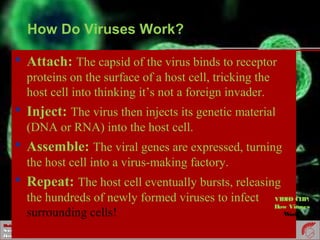
 Attach: The capsid of the virus binds to receptor
proteins on the surface of a host cell, tricking the
host cell into thinking it’s not a foreign invader.
 Inject: The virus then injects its genetic material
(DNA or RNA) into the host cell.
 Assemble: The viral genes are expressed, turning
the host cell into a virus-making factory.
 Repeat: The host cell eventually bursts, releasing
the hundreds of newly formed viruses to infect
surrounding cells!
VIDEO CLIP:
How Viruses
Work
BiologyBiology
ScienceDepartmentScienceDepartment
DeerfieldHighSchoolDeerfieldHighSchool
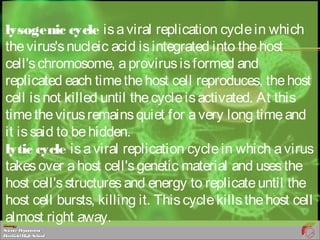
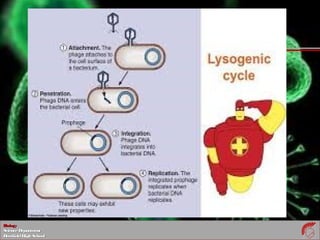
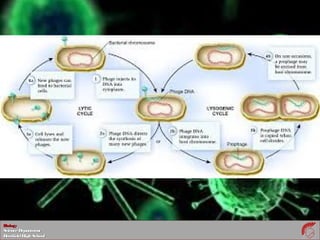
lysogenic cycle isaviral replication cyclein which
thevirus'snucleic acid isintegrated into thehost
cell'schromosome, aprovirusisformed and
replicated each timethehost cell reproduces, thehost
cell isnot killed until thecycleisactivated. At this
timethevirusremainsquiet for avery long timeand
it issaid to behidden.
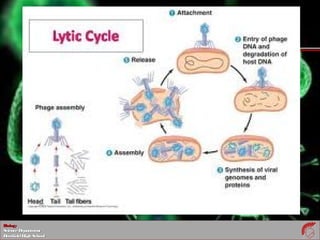
lytic cycle isaviral replication cyclein which avirus
takesover ahost cell'sgenetic material and usesthe
host cell'sstructuresand energy to replicateuntil the
host cell bursts, killing it. Thiscyclekillsthehost cell
almost right away.
BiologyBiology
ScienceDepartmentScienceDepartment
DeerfieldHighSchoolDeerfieldHighSchool
BiologyBiology
ScienceDepartmentScienceDepartment
DeerfieldHighSchoolDeerfieldHighSchool
BiologyBiology
ScienceDepartmentScienceDepartment
DeerfieldHighSchoolDeerfieldHighSchool
Viruses
 Viruses can cause disease in humans, animals, plants,
and even bacteria!
 Viruses can cause a variety of diseases:
– Common cold – Polio
– Hepatitis A, B & C – Influenza
– Herpes – Mumps
– Mononucleosis – Measles
– Warts – Viral Meningitis
– Chickenpox – AIDS VIDEO CLIP:
Viral Disease
BiologyBiology
ScienceDepartmentScienceDepartment
DeerfieldHighSchoolDeerfieldHighSchool
BiologyBiology
ScienceDepartmentScienceDepartment
DeerfieldHighSchoolDeerfieldHighSchool
Protection
 There are a few big ways to protect yourself
against pathogens (disease causing agents)
– Antibiotics (drugs to kill bacteria)
– Antivirals (drugs to treat viruses)
– Vaccination (using your body’s own immune
system to preemptively guard against attack)
BiologyBiology
ScienceDepartmentScienceDepartment
DeerfieldHighSchoolDeerfieldHighSchool
Antibiotics
 Antibiotics can only be used to treat bacterial
infections!
 Target specific structures on bacteria to kill them.
 First made from a fungus (penicillin), now most
are made artificially.
 Unfortunately, antibiotic resistance (where the
antibiotic doesn’t kill the target bacteria anymore)
is becoming a major problem.
BiologyBiology
ScienceDepartmentScienceDepartment
DeerfieldHighSchoolDeerfieldHighSchool
Antivirals
 Antivirals can only be used to treat certain viral
infections!
 Does not “kill” or disarm the virus permanently; only
shortens symptoms by 1-2 days.
 Usually only prescribed to patients with life
threatening symptoms or those that have a greater
chance of developing complications (because of their
age or they have a high-risk medical condition).
 Just like antibiotics, there is evidence of antiviral
resistance too!
BiologyBiology
ScienceDepartmentScienceDepartment
DeerfieldHighSchoolDeerfieldHighSchool
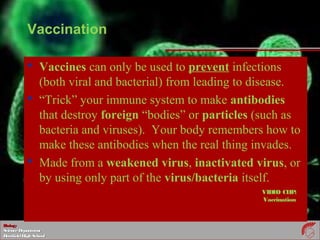
Vaccination
 Vaccines can only be used to prevent infections
(both viral and bacterial) from leading to disease.
 “Trick” your immune system to make antibodies
that destroy foreign “bodies” or particles (such as
bacteria and viruses). Your body remembers how to
make these antibodies when the real thing invades.
 Made from a weakened virus, inactivated virus, or
by using only part of the virus/bacteria itself.
VIDEO CLIP:
Vaccination
BiologyBiology
ScienceDepartmentScienceDepartment
DeerfieldHighSchoolDeerfieldHighSchool
BiologyBiology
ScienceDepartmentScienceDepartment
DeerfieldHighSchoolDeerfieldHighSchool
To Review....
 What are the differences between viruses
and bacteria?
 Are all bacteria harmful? Explain.
 When you get a cold, should you take an
antibiotic to help you get better? Why?
 What’s the best and easiest thing to do to
avoid getting sick?
BiologyBiology
ScienceDepartmentScienceDepartment
DeerfieldHighSchoolDeerfieldHighSchool
http://www.youtube.com/watch?
v=3xRttWuf3wQ
BiologyBiology
ScienceDepartmentScienceDepartment
DeerfieldHighSchoolDeerfieldHighSchool
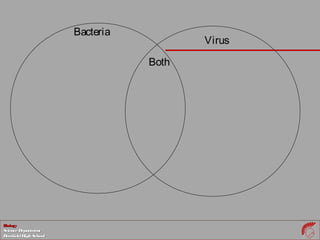
Bacteria
Virus
Both

Bacteria & viruses