Enterprise Risk · Credit Risk · Market Risk · Operational Risk · Regulatory Compliance · Securities Lending
1
JOIN. ENGAGE. LEAD.
10 KEY PRINCIPLES OF OPERATIONAL
RISK MANAGEMENT
By The RMA Operational Risk Council
Enterprise Risk · Credit Risk · Market Risk · Operational Risk · Regulatory Compliance · Securities Lending
2
JOIN. ENGAGE. LEAD.
OPERATIONAL RISK MANAGEMENT IS INTEGRAL
TO BUSINESS MANAGEMENT
Risk management is an integral part of business
management and should be incorporated into
your overall business and financial planning.
Enterprise Risk · Credit Risk · Market Risk · Operational Risk · Regulatory Compliance · Securities Lending
3
JOIN. ENGAGE. LEAD.
CHANGE GENERATES RISK
Rapid changes in
organizational structure
and management
approach will generate
operational risk within
your institution.
Implement changes
in a measured
fashion (not all at
once); they are
more likely to be
successful.
Enterprise Risk · Credit Risk · Market Risk · Operational Risk · Regulatory Compliance · Securities Lending
4
JOIN. ENGAGE. LEAD.
INCORPORATE POTENTIAL RISK OUTCOMES
Develop budgets, profit goals,
and profitability targets by fully
incorporating potential risk
outcomes and the expenses
required to administer risk
controls.
Enterprise Risk · Credit Risk · Market Risk · Operational Risk · Regulatory Compliance · Securities Lending
5
JOIN. ENGAGE. LEAD.
REDUCE SYSTEMIC RISK THROUGH
EXPERIMENTATION
Systemic risk in the
industry is reduced
and risk
management activities
are enhanced if:
you experiment with a
variety of business
models and
organizational
structures suiting your
institution’s size, scale,
and complexity.
Enforcing identical approaches by all participants
increases systemic risk.
Enterprise Risk · Credit Risk · Market Risk · Operational Risk · Regulatory Compliance · Securities Lending
6
JOIN. ENGAGE. LEAD.
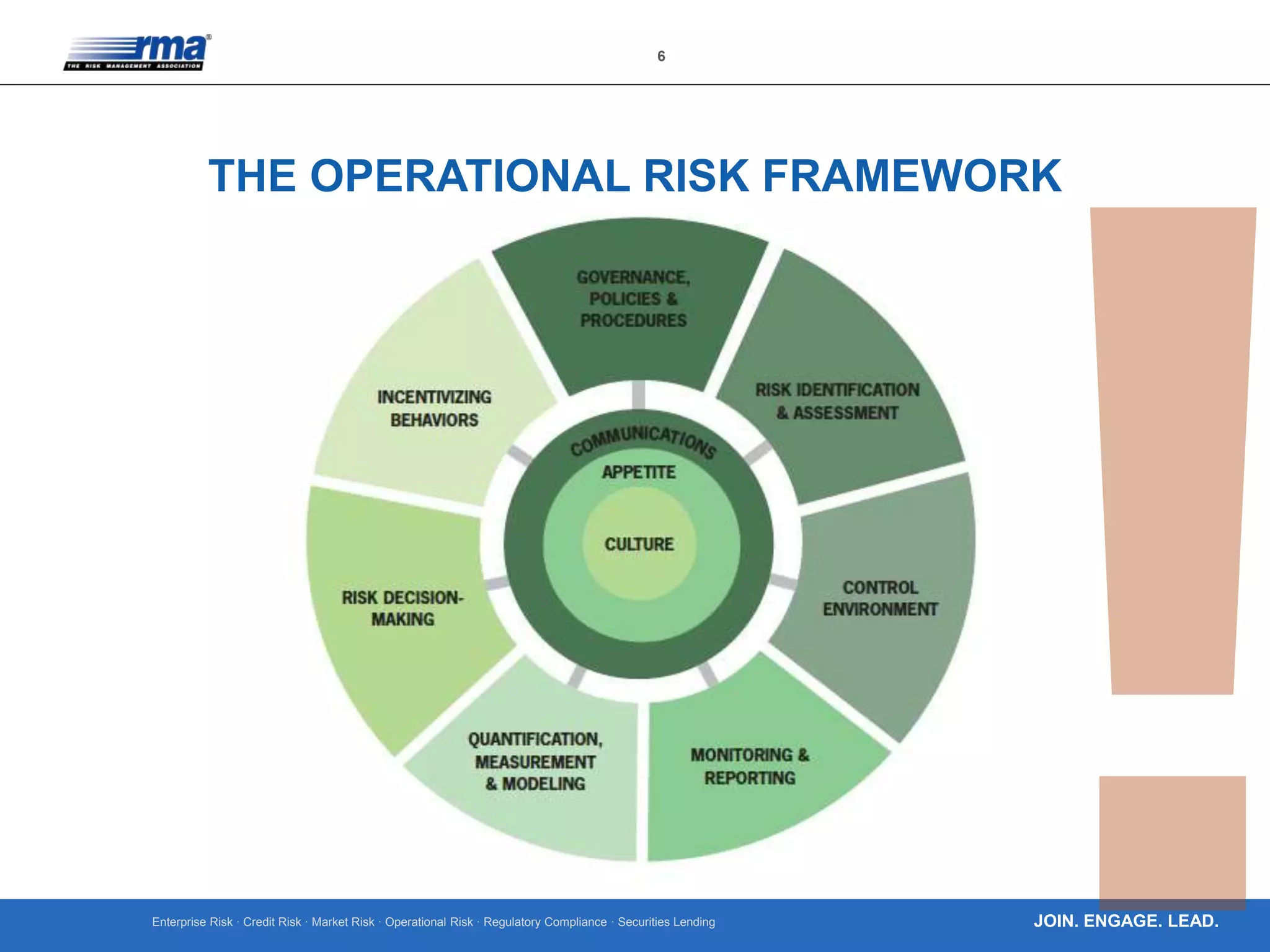
THE OPERATIONAL RISK FRAMEWORK
Enterprise Risk · Credit Risk · Market Risk · Operational Risk · Regulatory Compliance · Securities Lending
7
JOIN. ENGAGE. LEAD.
1. RISK CULTURE
A strong risk culture is the basis for an effective
operational risk management framework:
It requires transparency regarding operational risk
issues throughout your organization, including
leadership and the businesses.
Accordingly, your operational risk management
function must be transparent as well.
Enterprise Risk · Credit Risk · Market Risk · Operational Risk · Regulatory Compliance · Securities Lending
8
JOIN. ENGAGE. LEAD.
1. RISK CULTURE (CONT.)
Your business culture must embrace
the value of risk escalation and
welcome independent challenge of risk
decisions.
Enterprise Risk · Credit Risk · Market Risk · Operational Risk · Regulatory Compliance · Securities Lending
9
JOIN. ENGAGE. LEAD.
1. RISK CULTURE (CONT.)
Solicit multiple points of view
and engage in debate to get
better, more informed
decisions.
Enterprise Risk · Credit Risk · Market Risk · Operational Risk · Regulatory Compliance · Securities Lending
10
JOIN. ENGAGE. LEAD.
1. RISK CULTURE (CONT.)
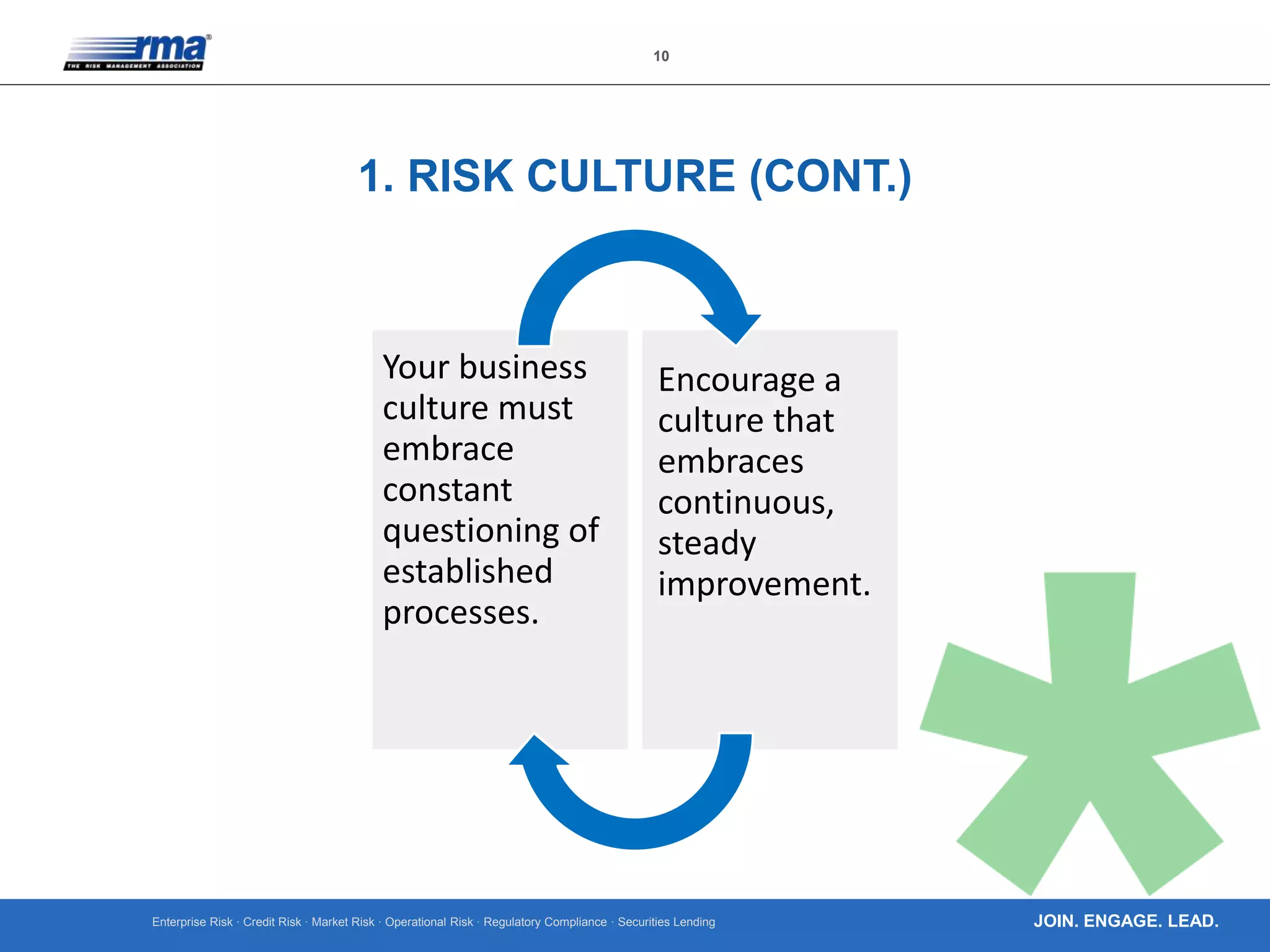
Your business
culture must
embrace
constant
questioning of
established
processes.
Encourage a
culture that
embraces
continuous,
steady
improvement.
Enterprise Risk · Credit Risk · Market Risk · Operational Risk · Regulatory Compliance · Securities Lending
11
JOIN. ENGAGE. LEAD.
1. RISK CULTURE (CONT.)
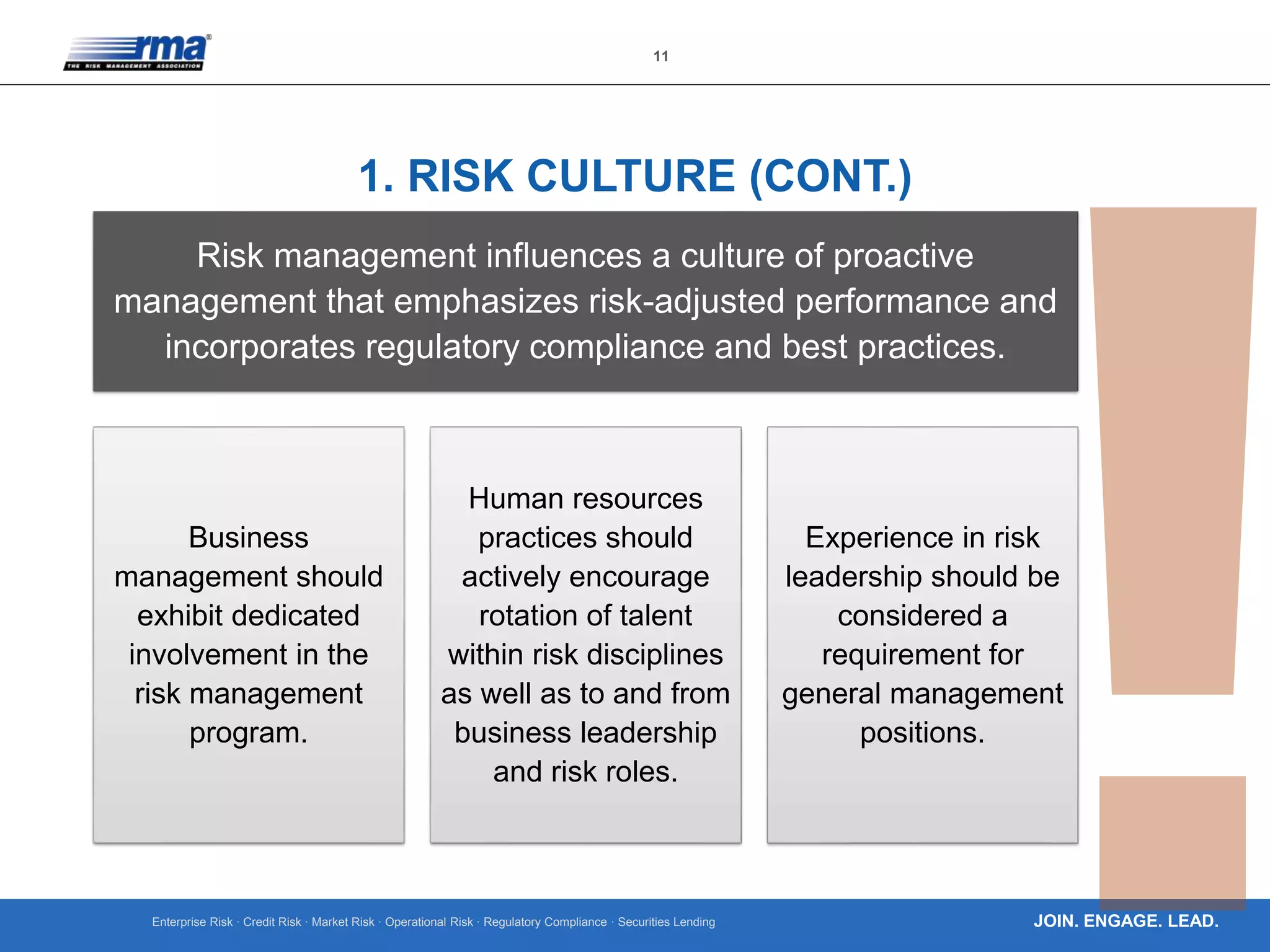
Risk management influences a culture of proactive
management that emphasizes risk-adjusted performance and
incorporates regulatory compliance and best practices.
Business
management should
exhibit dedicated
involvement in the
risk management
program.
Human resources
practices should
actively encourage
rotation of talent
within risk disciplines
as well as to and from
business leadership
and risk roles.
Experience in risk
leadership should be
considered a
requirement for
general management
positions.
Enterprise Risk · Credit Risk · Market Risk · Operational Risk · Regulatory Compliance · Securities Lending
12
JOIN. ENGAGE. LEAD.
1. RISK CULTURE (CONT.)
Develop and implement
training and education
programs to ensure that
your business culture’s
key principles are
properly understood and
consistently applied.
Enterprise Risk · Credit Risk · Market Risk · Operational Risk · Regulatory Compliance · Securities Lending
13
JOIN. ENGAGE. LEAD.
2. RISK APPETITE
Develop and implement a risk
appetite statement and
relevant thresholds and limits
based on your institution’s
business model and
tolerances.
Enterprise Risk · Credit Risk · Market Risk · Operational Risk · Regulatory Compliance · Securities Lending
14
JOIN. ENGAGE. LEAD.
2. RISK APPETITE (CONT.)
Consider internal and external
risk drivers and constraints.
Enterprise Risk · Credit Risk · Market Risk · Operational Risk · Regulatory Compliance · Securities Lending
15
JOIN. ENGAGE. LEAD.
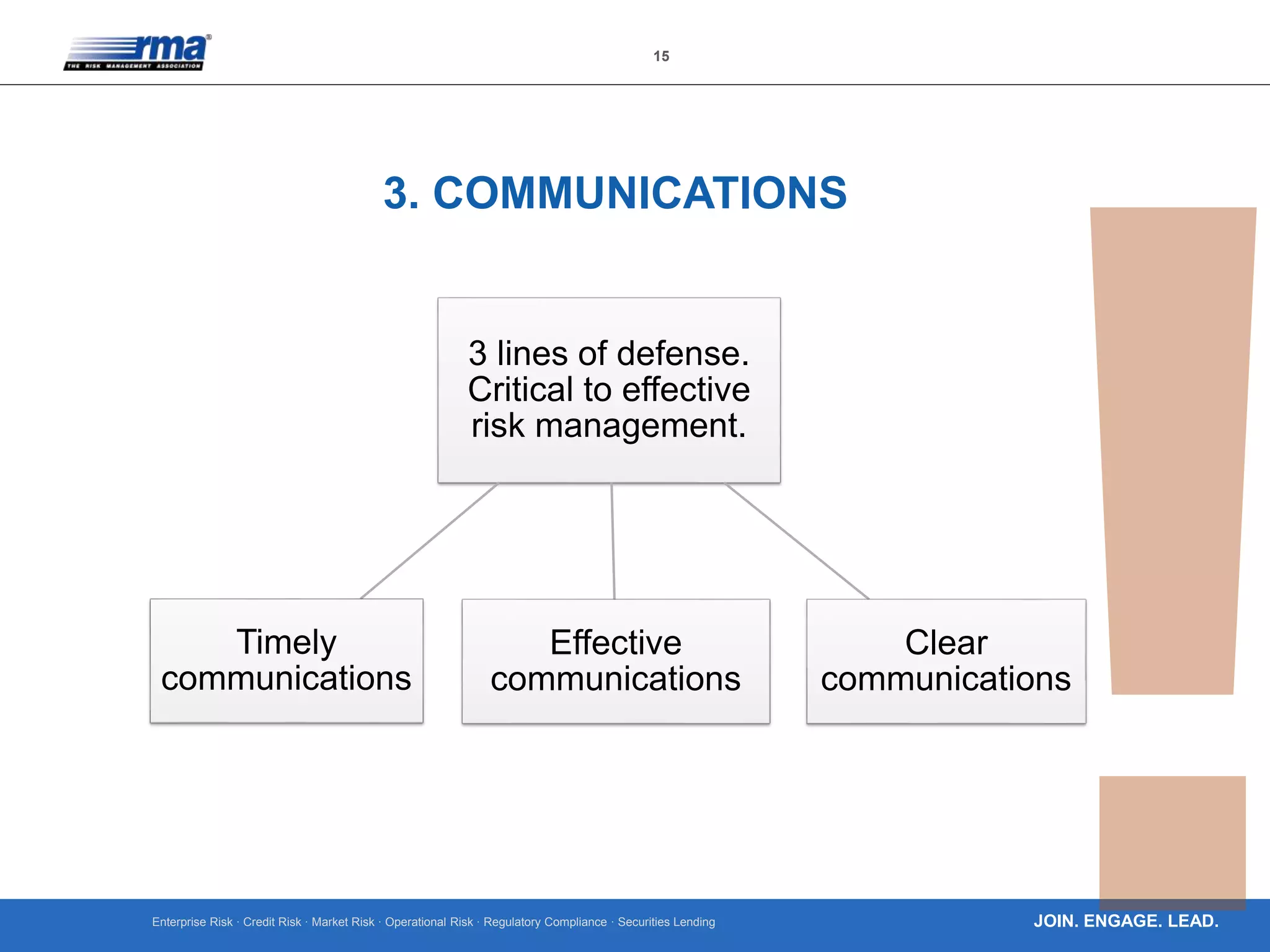
3. COMMUNICATIONS
3 lines of defense.
Critical to effective
risk management.
Timely
communications
Clear
communications
Effective
communications
Enterprise Risk · Credit Risk · Market Risk · Operational Risk · Regulatory Compliance · Securities Lending
16
JOIN. ENGAGE. LEAD.
4. GOVERNANCE, POLICIES, AND PROCEDURES
Ensure accountability through an effective
governance structure that oversees your
institution’s risk and control environment.
Enterprise Risk · Credit Risk · Market Risk · Operational Risk · Regulatory Compliance · Securities Lending
17
JOIN. ENGAGE. LEAD.
4. GOVERNANCE, POLICIES,
AND PROCEDURES (CONT.)
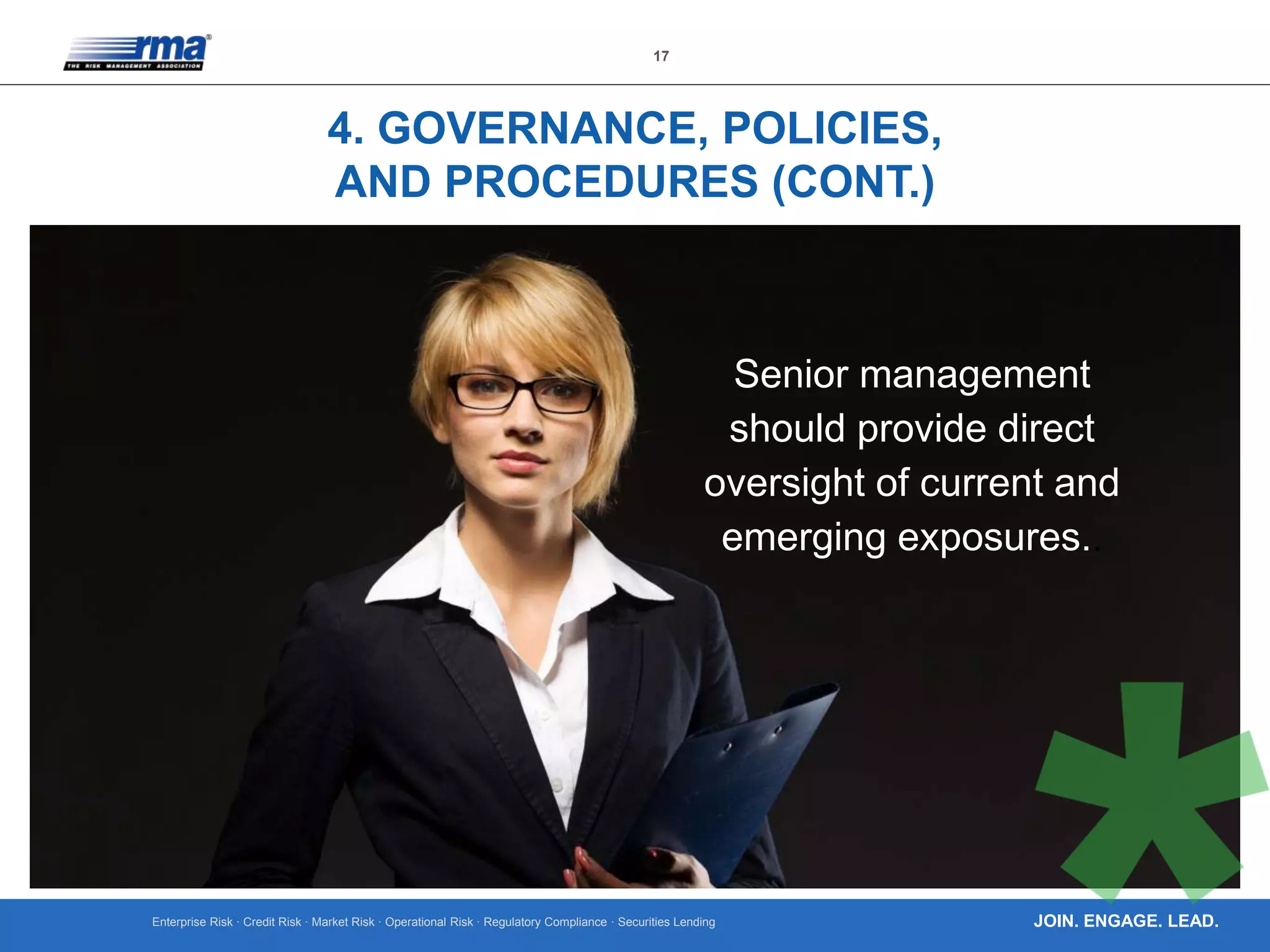
Senior management
should provide direct
oversight of current and
emerging exposures..
Enterprise Risk · Credit Risk · Market Risk · Operational Risk · Regulatory Compliance · Securities Lending
18
JOIN. ENGAGE. LEAD.
4. GOVERNANCE, POLICIES,
AND PROCEDURES (CONT.)
Risk management
should be part of the
normal management
process and
governance.
It should not be made
a separate, adjunct
function.
Enterprise Risk · Credit Risk · Market Risk · Operational Risk · Regulatory Compliance · Securities Lending
19
JOIN. ENGAGE. LEAD.
4. GOVERNANCE, POLICIES,
AND PROCEDURES (CONT.)
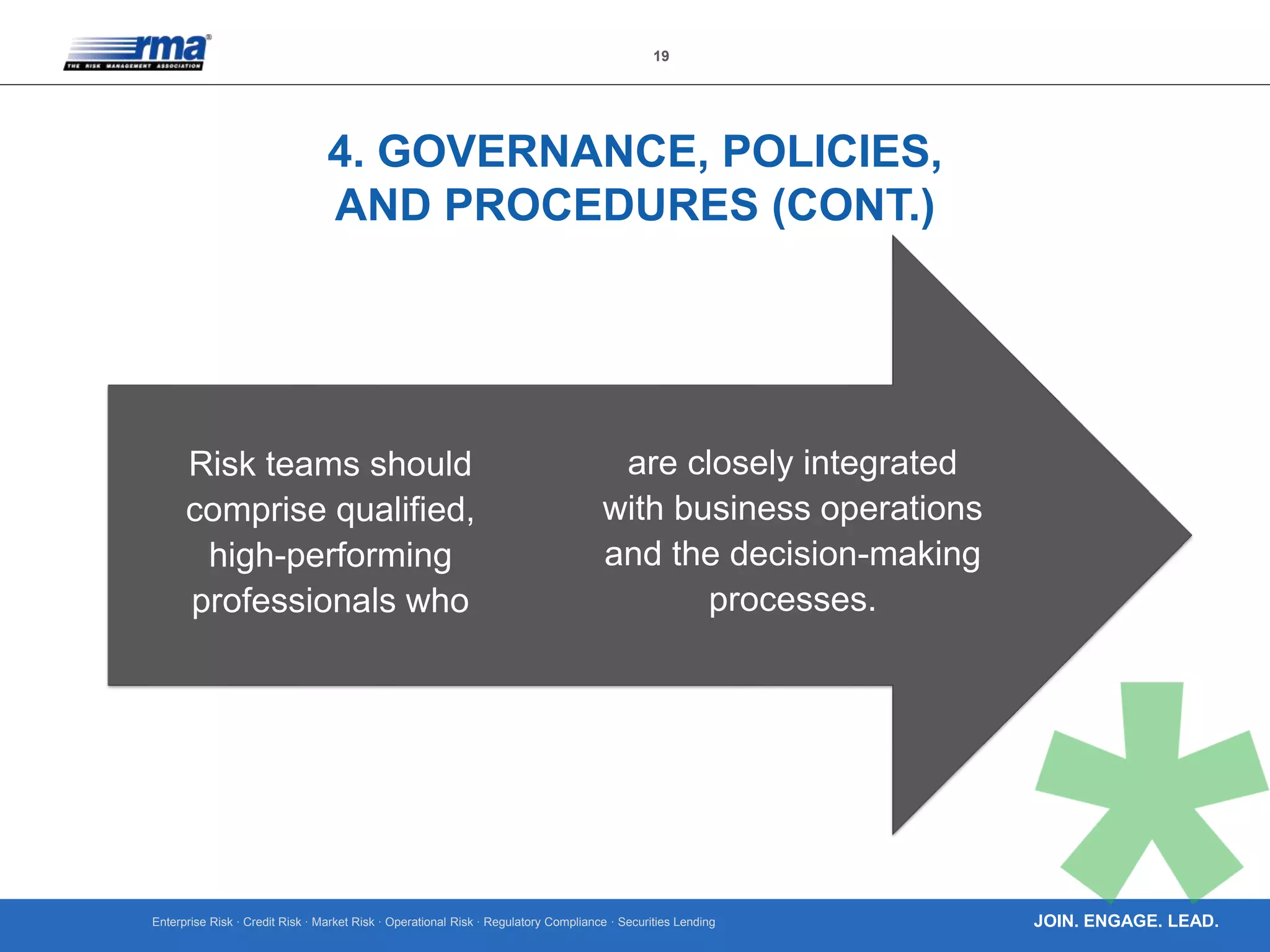
are closely integrated
with business operations
and the decision-making
processes.
Risk teams should
comprise qualified,
high-performing
professionals who
Enterprise Risk · Credit Risk · Market Risk · Operational Risk · Regulatory Compliance · Securities Lending
20
JOIN. ENGAGE. LEAD.
4. GOVERNANCE, POLICIES,
AND PROCEDURES (CONT.)
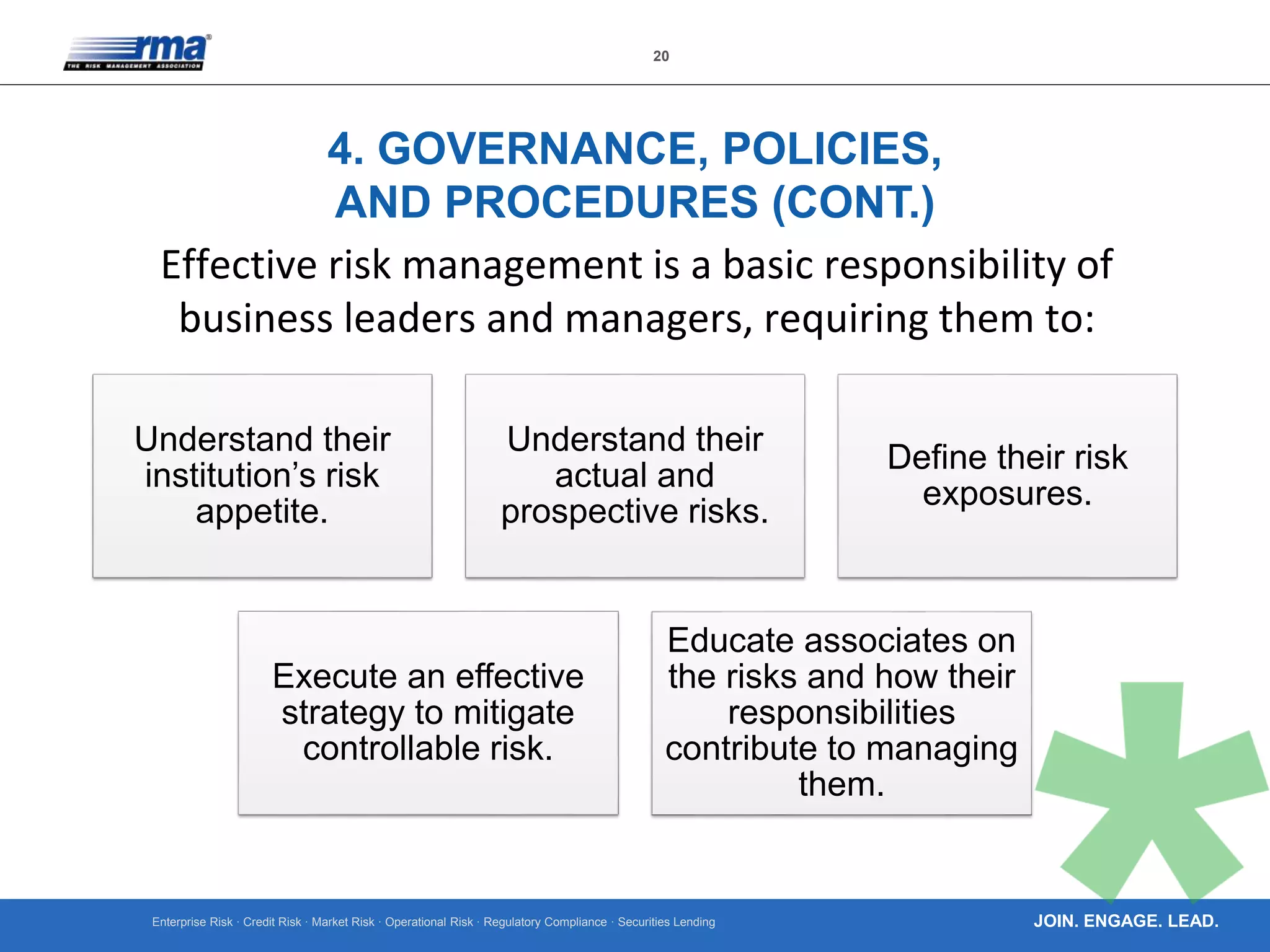
Understand their
institution’s risk
appetite.
Understand their
actual and
prospective risks.
Define their risk
exposures.
Execute an effective
strategy to mitigate
controllable risk.
Educate associates on
the risks and how their
responsibilities
contribute to managing
them.
Effective risk management is a basic responsibility of
business leaders and managers, requiring them to:
Enterprise Risk · Credit Risk · Market Risk · Operational Risk · Regulatory Compliance · Securities Lending
21
JOIN. ENGAGE. LEAD.
4. GOVERNANCE, POLICIES,
AND PROCEDURES (CONT.)
Risk management
defines,
develops,
maintains, and
implements
best-practice tools,
frameworks,
and risk management
processes.
Enterprise Risk · Credit Risk · Market Risk · Operational Risk · Regulatory Compliance · Securities Lending
22
JOIN. ENGAGE. LEAD.
5. RISK IDENTIFICATION AND ASSESSMENT
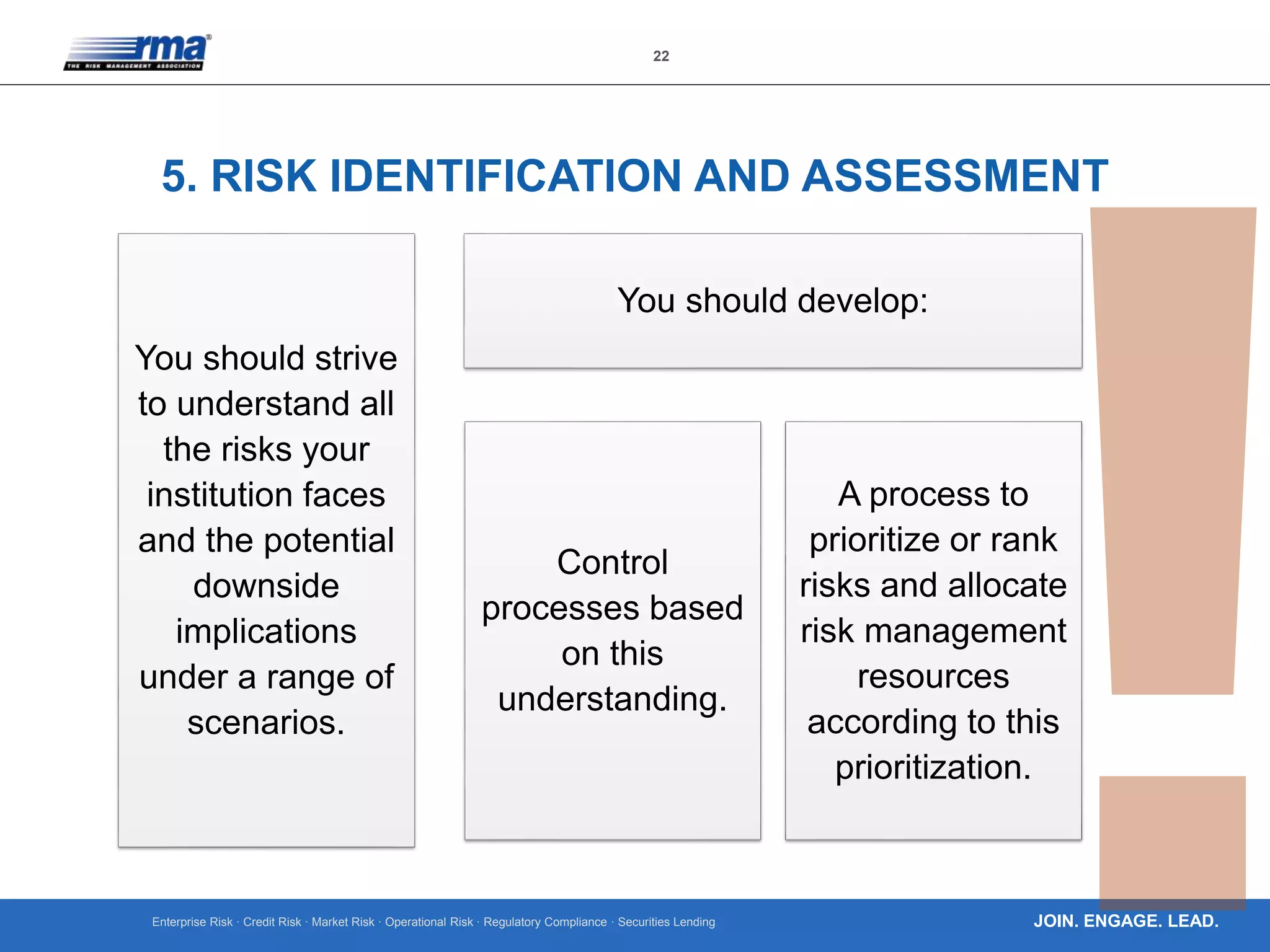
You should strive
to understand all
the risks your
institution faces
and the potential
downside
implications
under a range of
scenarios.
You should develop:
Control
processes based
on this
understanding.
A process to
prioritize or rank
risks and allocate
risk management
resources
according to this
prioritization.
Enterprise Risk · Credit Risk · Market Risk · Operational Risk · Regulatory Compliance · Securities Lending
23
JOIN. ENGAGE. LEAD.
6. CONTROL ENVIRONMENT
Control development is
an outgrowth of risk
analysis.
Risk analysis should not
be an outgrowth of the
control environment.
Enterprise Risk · Credit Risk · Market Risk · Operational Risk · Regulatory Compliance · Securities Lending
24
JOIN. ENGAGE. LEAD.
6. CONTROL ENVIRONMENT (CONT.)
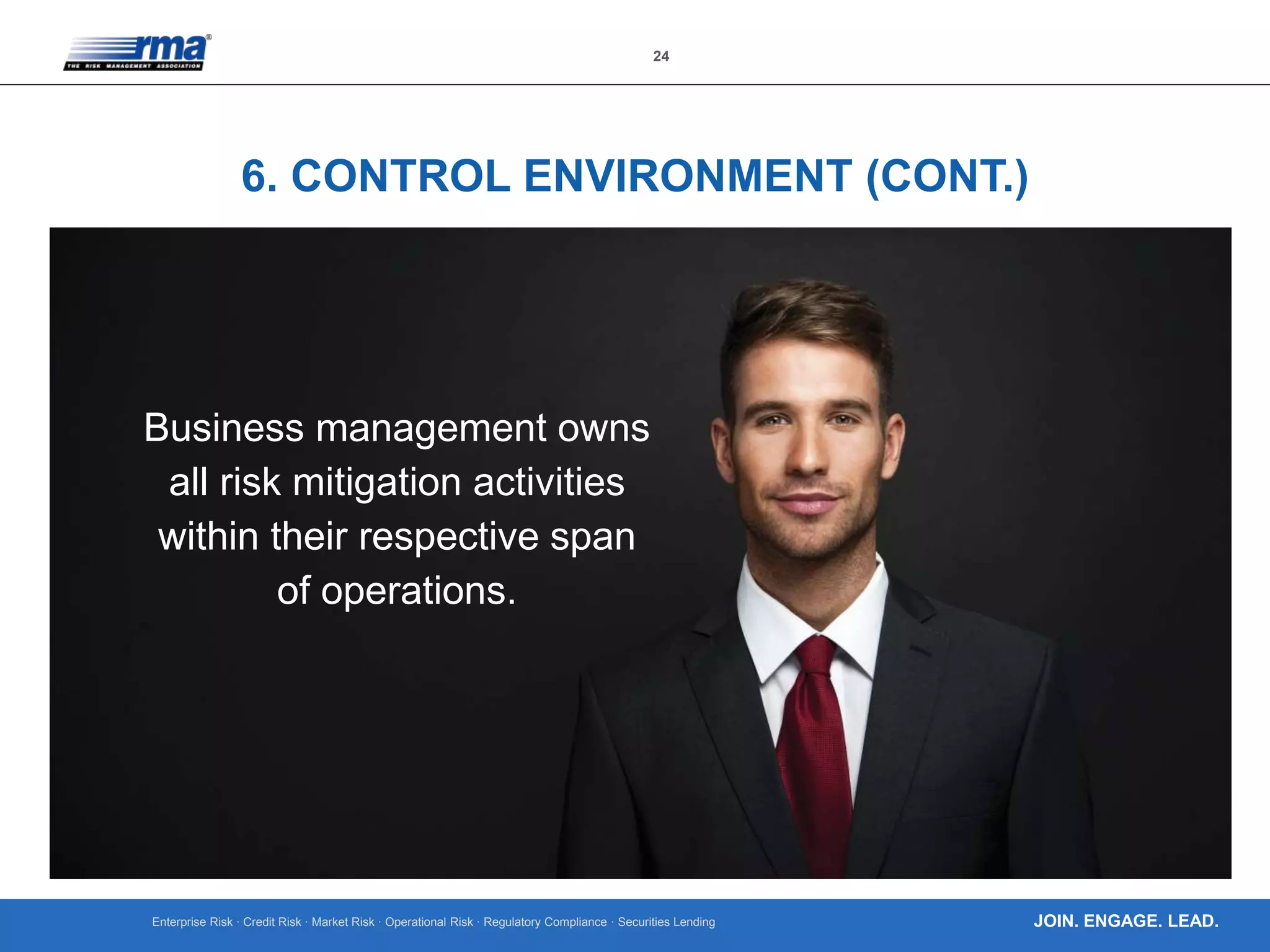
Business management owns
all risk mitigation activities
within their respective span
of operations.
Enterprise Risk · Credit Risk · Market Risk · Operational Risk · Regulatory Compliance · Securities Lending
25
JOIN. ENGAGE. LEAD.
6. CONTROL ENVIRONMENT (CONT.)
The line of business
uses the controls
assessment framework
to identify and document
key controls.
Enterprise Risk · Credit Risk · Market Risk · Operational Risk · Regulatory Compliance · Securities Lending
26
JOIN. ENGAGE. LEAD.
6. CONTROL ENVIRONMENT (CONT.)
The strength of key controls (control design adequacy) is
evaluated using the controls assessment framework’s criteria.
Control groups
provide oversight
of specific risk
types.
A structured
process validates
that key controls
are operating
effectively to meet
business
objectives.
Cross-functional
transparency
exists in instances
where the division
relies on another
division or an
internal/external
service provider for
performing key
controls.
Enterprise Risk · Credit Risk · Market Risk · Operational Risk · Regulatory Compliance · Securities Lending
27
JOIN. ENGAGE. LEAD.
6. CONTROL ENVIRONMENT (CONT.)
Expert practitioners
responsible for executing
operations must have input
into risk analysis and
control design.
There must be clarity on
accountabilities,
responsibilities, and
performance measurement
based on agreed-upon
standards.
Enterprise Risk · Credit Risk · Market Risk · Operational Risk · Regulatory Compliance · Securities Lending
28
JOIN. ENGAGE. LEAD.
6. CONTROL ENVIRONMENT (CONT.)
Risk management activities
dictated solely by remote
oversight functions lacking
detailed execution
experience are highly prone
to error and inefficiency.
Enterprise Risk · Credit Risk · Market Risk · Operational Risk · Regulatory Compliance · Securities Lending
29
JOIN. ENGAGE. LEAD.
7. MONITORING AND REPORTING
Establish and
maintain a
well-developed
risk reporting
structure.
• Place emphasis on risk escalation and risk
communication procedures for both current
and potential operational risks.
• Support reporting of risk data with a sound
and streamlined technology solution.
• Reporting systems need to provide different
articulations of the contents and specific
ways to develop the topics analyzed,
depending on the objectives and recipients
of the reports.
Enterprise Risk · Credit Risk · Market Risk · Operational Risk · Regulatory Compliance · Securities Lending
30
JOIN. ENGAGE. LEAD.
7. MONITORING AND REPORTING (CONT.)
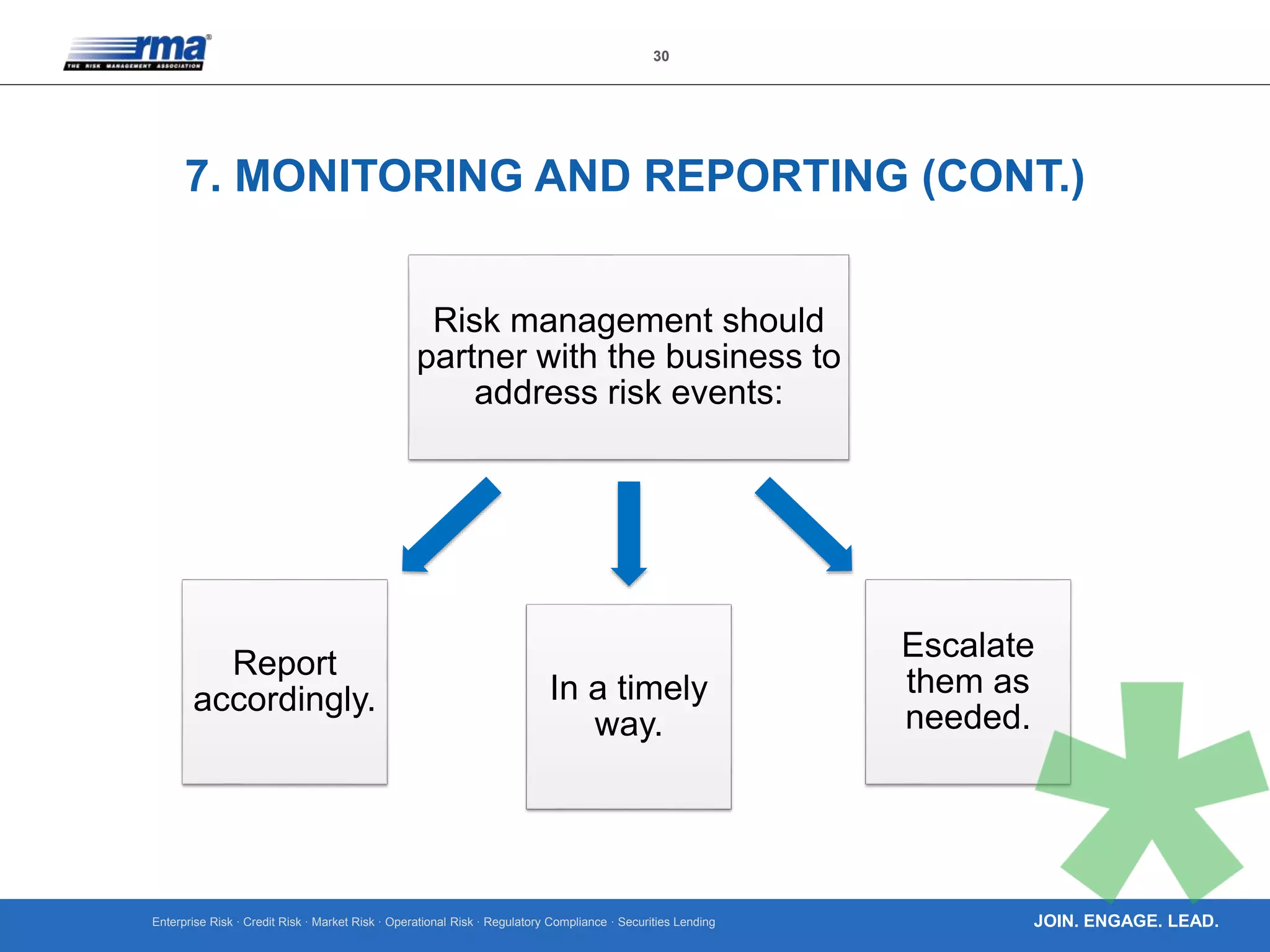
Risk management should
partner with the business to
address risk events:
In a timely
way.
Escalate
them as
needed.
Report
accordingly.
Enterprise Risk · Credit Risk · Market Risk · Operational Risk · Regulatory Compliance · Securities Lending
31
JOIN. ENGAGE. LEAD.
8. QUANTIFICATION, MEASUREMENT, AND
MODELING
Follow a structured
methodology for establishing
and prioritizing the risk
management process
universe and performing risk
assessments based on
inherent risk level.
Enterprise Risk · Credit Risk · Market Risk · Operational Risk · Regulatory Compliance · Securities Lending
32
JOIN. ENGAGE. LEAD.
8. QUANTIFICATION, MEASUREMENT, AND
MODELING (CONT.)
When evaluating the risk level
in a given activity, consider
historical results over long
periods to be an important
indicator of future results,
particularly if the fundamentals
of the business activity and
management approach have
not changed.
Enterprise Risk · Credit Risk · Market Risk · Operational Risk · Regulatory Compliance · Securities Lending
33
JOIN. ENGAGE. LEAD.
8. QUANTIFICATION, MEASUREMENT, AND
MODELING (CONT.)
Use data for analysis and modeling to
support sound operational risk
management practices and business
decisions.
Enterprise Risk · Credit Risk · Market Risk · Operational Risk · Regulatory Compliance · Securities Lending
34
JOIN. ENGAGE. LEAD.
8. QUANTIFICATION, MEASUREMENT, AND
MODELING (CONT.)
A modeled approach is best
suited to transactional-style
risks with sufficient data points
(tail-style conduct risk issues
do not model well).
Enterprise Risk · Credit Risk · Market Risk · Operational Risk · Regulatory Compliance · Securities Lending
35
JOIN. ENGAGE. LEAD.
8. QUANTIFICATION, MEASUREMENT, AND
MODELING (CONT.)
In order to
take action as
needed, you
must have
effective
processes for
measuring
whether key
exposures are:
• Increasing.
• Decreasing.
• Remaining stable.
Enterprise Risk · Credit Risk · Market Risk · Operational Risk · Regulatory Compliance · Securities Lending
36
JOIN. ENGAGE. LEAD.
9. RISK DECISION-MAKING
As part of sound business and strategic decision-making,
assess and consider operational risk implications
to determine whether to:
Manage the risk. Tolerate the risk.
Transfer the risk
(e.g., by insuring
against the risk).
Decline the risk.
Enterprise Risk · Credit Risk · Market Risk · Operational Risk · Regulatory Compliance · Securities Lending
37
JOIN. ENGAGE. LEAD.
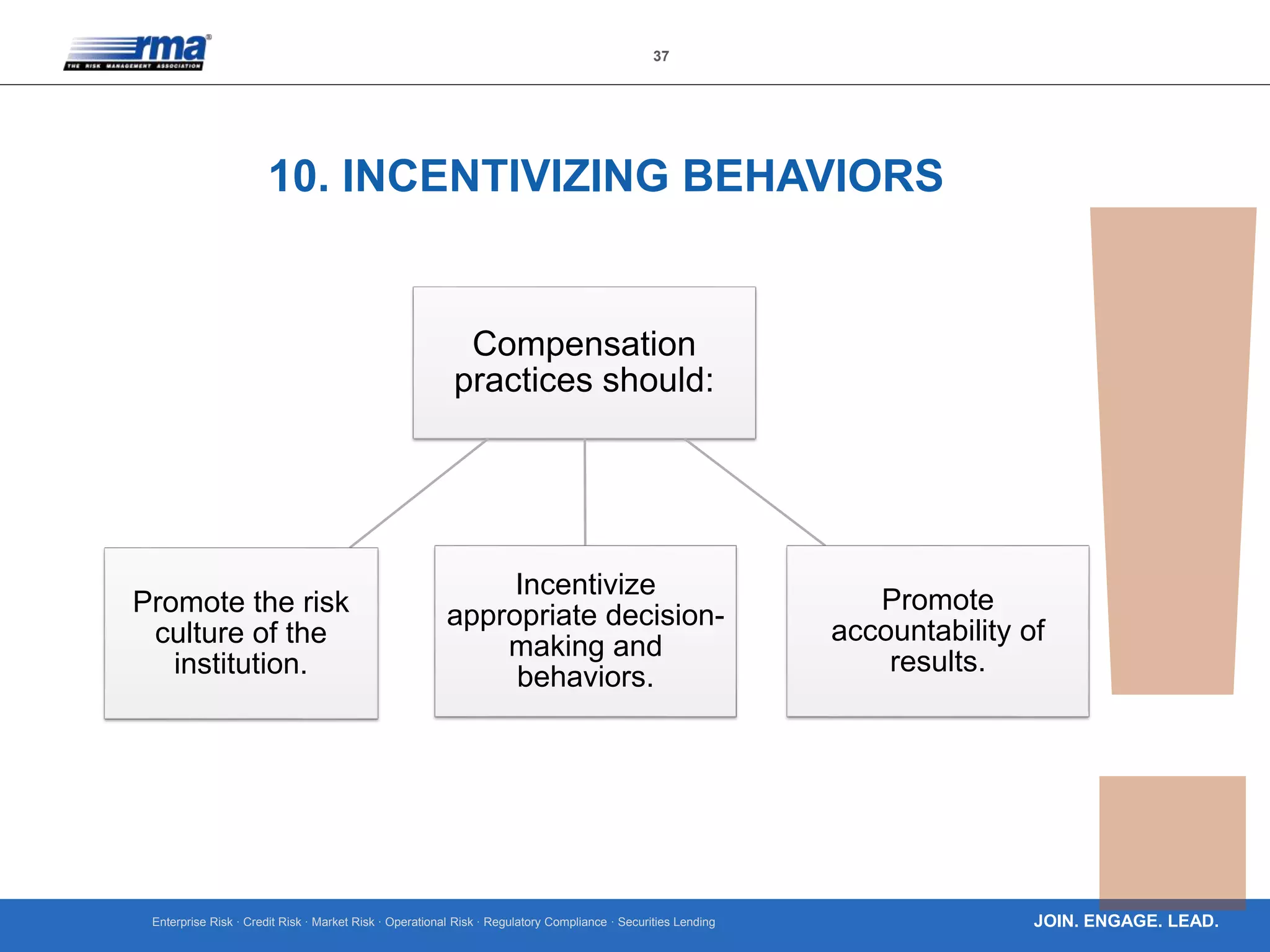
10. INCENTIVIZING BEHAVIORS
Compensation
practices should:
Promote the risk
culture of the
institution.
Promote
accountability of
results.
Incentivize
appropriate decision-
making and
behaviors.
Enterprise Risk · Credit Risk · Market Risk · Operational Risk · Regulatory Compliance · Securities Lending
38
JOIN. ENGAGE. LEAD.
The Operational Risk Council promotes sound
practices in the management of operational risk in
financial services institutions worldwide. It promotes
understanding the causes, events, and effects of
operational risk through the dissemination of sound
risk management methods, tools, and materials.
In support of its mission, the council also sponsors
research, facilitates links between the industry and
regulators, and advocates the professional
development of all those engaged in the
management of operational risk.
ABOUT RMA’S
OPERATIONAL RISK COUNCIL
Enterprise Risk · Credit Risk · Market Risk · Operational Risk · Regulatory Compliance · Securities Lending
39
JOIN. ENGAGE. LEAD.
SHARE THIS PRESENTATION
Visit http://www.rmahq.org for information on risk management
RMA is a member-driven professional association whose sole purpose is
to advance sound risk principles in the financial services industry.
RMA helps its members use sound risk principles to improve institutional
performance and financial stability, and enhance the risk competency of
individuals through information, education, peer sharing, and networking.
Become a member today.

10 Key Principles of Operational Risk Management

  • 1.
    Enterprise Risk ·Credit Risk · Market Risk · Operational Risk · Regulatory Compliance · Securities Lending 1 JOIN. ENGAGE. LEAD. 10 KEY PRINCIPLES OF OPERATIONAL RISK MANAGEMENT By The RMA Operational Risk Council
  • 2.
    Enterprise Risk ·Credit Risk · Market Risk · Operational Risk · Regulatory Compliance · Securities Lending 2 JOIN. ENGAGE. LEAD. OPERATIONAL RISK MANAGEMENT IS INTEGRAL TO BUSINESS MANAGEMENT Risk management is an integral part of business management and should be incorporated into your overall business and financial planning.
  • 3.
    Enterprise Risk ·Credit Risk · Market Risk · Operational Risk · Regulatory Compliance · Securities Lending 3 JOIN. ENGAGE. LEAD. CHANGE GENERATES RISK Rapid changes in organizational structure and management approach will generate operational risk within your institution. Implement changes in a measured fashion (not all at once); they are more likely to be successful.
  • 4.
    Enterprise Risk ·Credit Risk · Market Risk · Operational Risk · Regulatory Compliance · Securities Lending 4 JOIN. ENGAGE. LEAD. INCORPORATE POTENTIAL RISK OUTCOMES Develop budgets, profit goals, and profitability targets by fully incorporating potential risk outcomes and the expenses required to administer risk controls.
  • 5.
    Enterprise Risk ·Credit Risk · Market Risk · Operational Risk · Regulatory Compliance · Securities Lending 5 JOIN. ENGAGE. LEAD. REDUCE SYSTEMIC RISK THROUGH EXPERIMENTATION Systemic risk in the industry is reduced and risk management activities are enhanced if: you experiment with a variety of business models and organizational structures suiting your institution’s size, scale, and complexity. Enforcing identical approaches by all participants increases systemic risk.
  • 6.
    Enterprise Risk ·Credit Risk · Market Risk · Operational Risk · Regulatory Compliance · Securities Lending 6 JOIN. ENGAGE. LEAD. THE OPERATIONAL RISK FRAMEWORK
  • 7.
    Enterprise Risk ·Credit Risk · Market Risk · Operational Risk · Regulatory Compliance · Securities Lending 7 JOIN. ENGAGE. LEAD. 1. RISK CULTURE A strong risk culture is the basis for an effective operational risk management framework: It requires transparency regarding operational risk issues throughout your organization, including leadership and the businesses. Accordingly, your operational risk management function must be transparent as well.
  • 8.
    Enterprise Risk ·Credit Risk · Market Risk · Operational Risk · Regulatory Compliance · Securities Lending 8 JOIN. ENGAGE. LEAD. 1. RISK CULTURE (CONT.) Your business culture must embrace the value of risk escalation and welcome independent challenge of risk decisions.
  • 9.
    Enterprise Risk ·Credit Risk · Market Risk · Operational Risk · Regulatory Compliance · Securities Lending 9 JOIN. ENGAGE. LEAD. 1. RISK CULTURE (CONT.) Solicit multiple points of view and engage in debate to get better, more informed decisions.
  • 10.
    Enterprise Risk ·Credit Risk · Market Risk · Operational Risk · Regulatory Compliance · Securities Lending 10 JOIN. ENGAGE. LEAD. 1. RISK CULTURE (CONT.) Your business culture must embrace constant questioning of established processes. Encourage a culture that embraces continuous, steady improvement.
  • 11.
    Enterprise Risk ·Credit Risk · Market Risk · Operational Risk · Regulatory Compliance · Securities Lending 11 JOIN. ENGAGE. LEAD. 1. RISK CULTURE (CONT.) Risk management influences a culture of proactive management that emphasizes risk-adjusted performance and incorporates regulatory compliance and best practices. Business management should exhibit dedicated involvement in the risk management program. Human resources practices should actively encourage rotation of talent within risk disciplines as well as to and from business leadership and risk roles. Experience in risk leadership should be considered a requirement for general management positions.
  • 12.
    Enterprise Risk ·Credit Risk · Market Risk · Operational Risk · Regulatory Compliance · Securities Lending 12 JOIN. ENGAGE. LEAD. 1. RISK CULTURE (CONT.) Develop and implement training and education programs to ensure that your business culture’s key principles are properly understood and consistently applied.
  • 13.
    Enterprise Risk ·Credit Risk · Market Risk · Operational Risk · Regulatory Compliance · Securities Lending 13 JOIN. ENGAGE. LEAD. 2. RISK APPETITE Develop and implement a risk appetite statement and relevant thresholds and limits based on your institution’s business model and tolerances.
  • 14.
    Enterprise Risk ·Credit Risk · Market Risk · Operational Risk · Regulatory Compliance · Securities Lending 14 JOIN. ENGAGE. LEAD. 2. RISK APPETITE (CONT.) Consider internal and external risk drivers and constraints.
  • 15.
    Enterprise Risk ·Credit Risk · Market Risk · Operational Risk · Regulatory Compliance · Securities Lending 15 JOIN. ENGAGE. LEAD. 3. COMMUNICATIONS 3 lines of defense. Critical to effective risk management. Timely communications Clear communications Effective communications
  • 16.
    Enterprise Risk ·Credit Risk · Market Risk · Operational Risk · Regulatory Compliance · Securities Lending 16 JOIN. ENGAGE. LEAD. 4. GOVERNANCE, POLICIES, AND PROCEDURES Ensure accountability through an effective governance structure that oversees your institution’s risk and control environment.
  • 17.
    Enterprise Risk ·Credit Risk · Market Risk · Operational Risk · Regulatory Compliance · Securities Lending 17 JOIN. ENGAGE. LEAD. 4. GOVERNANCE, POLICIES, AND PROCEDURES (CONT.) Senior management should provide direct oversight of current and emerging exposures..
  • 18.
    Enterprise Risk ·Credit Risk · Market Risk · Operational Risk · Regulatory Compliance · Securities Lending 18 JOIN. ENGAGE. LEAD. 4. GOVERNANCE, POLICIES, AND PROCEDURES (CONT.) Risk management should be part of the normal management process and governance. It should not be made a separate, adjunct function.
  • 19.
    Enterprise Risk ·Credit Risk · Market Risk · Operational Risk · Regulatory Compliance · Securities Lending 19 JOIN. ENGAGE. LEAD. 4. GOVERNANCE, POLICIES, AND PROCEDURES (CONT.) are closely integrated with business operations and the decision-making processes. Risk teams should comprise qualified, high-performing professionals who
  • 20.
    Enterprise Risk ·Credit Risk · Market Risk · Operational Risk · Regulatory Compliance · Securities Lending 20 JOIN. ENGAGE. LEAD. 4. GOVERNANCE, POLICIES, AND PROCEDURES (CONT.) Understand their institution’s risk appetite. Understand their actual and prospective risks. Define their risk exposures. Execute an effective strategy to mitigate controllable risk. Educate associates on the risks and how their responsibilities contribute to managing them. Effective risk management is a basic responsibility of business leaders and managers, requiring them to:
  • 21.
    Enterprise Risk ·Credit Risk · Market Risk · Operational Risk · Regulatory Compliance · Securities Lending 21 JOIN. ENGAGE. LEAD. 4. GOVERNANCE, POLICIES, AND PROCEDURES (CONT.) Risk management defines, develops, maintains, and implements best-practice tools, frameworks, and risk management processes.
  • 22.
    Enterprise Risk ·Credit Risk · Market Risk · Operational Risk · Regulatory Compliance · Securities Lending 22 JOIN. ENGAGE. LEAD. 5. RISK IDENTIFICATION AND ASSESSMENT You should strive to understand all the risks your institution faces and the potential downside implications under a range of scenarios. You should develop: Control processes based on this understanding. A process to prioritize or rank risks and allocate risk management resources according to this prioritization.
  • 23.
    Enterprise Risk ·Credit Risk · Market Risk · Operational Risk · Regulatory Compliance · Securities Lending 23 JOIN. ENGAGE. LEAD. 6. CONTROL ENVIRONMENT Control development is an outgrowth of risk analysis. Risk analysis should not be an outgrowth of the control environment.
  • 24.
    Enterprise Risk ·Credit Risk · Market Risk · Operational Risk · Regulatory Compliance · Securities Lending 24 JOIN. ENGAGE. LEAD. 6. CONTROL ENVIRONMENT (CONT.) Business management owns all risk mitigation activities within their respective span of operations.
  • 25.
    Enterprise Risk ·Credit Risk · Market Risk · Operational Risk · Regulatory Compliance · Securities Lending 25 JOIN. ENGAGE. LEAD. 6. CONTROL ENVIRONMENT (CONT.) The line of business uses the controls assessment framework to identify and document key controls.
  • 26.
    Enterprise Risk ·Credit Risk · Market Risk · Operational Risk · Regulatory Compliance · Securities Lending 26 JOIN. ENGAGE. LEAD. 6. CONTROL ENVIRONMENT (CONT.) The strength of key controls (control design adequacy) is evaluated using the controls assessment framework’s criteria. Control groups provide oversight of specific risk types. A structured process validates that key controls are operating effectively to meet business objectives. Cross-functional transparency exists in instances where the division relies on another division or an internal/external service provider for performing key controls.
  • 27.
    Enterprise Risk ·Credit Risk · Market Risk · Operational Risk · Regulatory Compliance · Securities Lending 27 JOIN. ENGAGE. LEAD. 6. CONTROL ENVIRONMENT (CONT.) Expert practitioners responsible for executing operations must have input into risk analysis and control design. There must be clarity on accountabilities, responsibilities, and performance measurement based on agreed-upon standards.
  • 28.
    Enterprise Risk ·Credit Risk · Market Risk · Operational Risk · Regulatory Compliance · Securities Lending 28 JOIN. ENGAGE. LEAD. 6. CONTROL ENVIRONMENT (CONT.) Risk management activities dictated solely by remote oversight functions lacking detailed execution experience are highly prone to error and inefficiency.
  • 29.
    Enterprise Risk ·Credit Risk · Market Risk · Operational Risk · Regulatory Compliance · Securities Lending 29 JOIN. ENGAGE. LEAD. 7. MONITORING AND REPORTING Establish and maintain a well-developed risk reporting structure. • Place emphasis on risk escalation and risk communication procedures for both current and potential operational risks. • Support reporting of risk data with a sound and streamlined technology solution. • Reporting systems need to provide different articulations of the contents and specific ways to develop the topics analyzed, depending on the objectives and recipients of the reports.
  • 30.
    Enterprise Risk ·Credit Risk · Market Risk · Operational Risk · Regulatory Compliance · Securities Lending 30 JOIN. ENGAGE. LEAD. 7. MONITORING AND REPORTING (CONT.) Risk management should partner with the business to address risk events: In a timely way. Escalate them as needed. Report accordingly.
  • 31.
    Enterprise Risk ·Credit Risk · Market Risk · Operational Risk · Regulatory Compliance · Securities Lending 31 JOIN. ENGAGE. LEAD. 8. QUANTIFICATION, MEASUREMENT, AND MODELING Follow a structured methodology for establishing and prioritizing the risk management process universe and performing risk assessments based on inherent risk level.
  • 32.
    Enterprise Risk ·Credit Risk · Market Risk · Operational Risk · Regulatory Compliance · Securities Lending 32 JOIN. ENGAGE. LEAD. 8. QUANTIFICATION, MEASUREMENT, AND MODELING (CONT.) When evaluating the risk level in a given activity, consider historical results over long periods to be an important indicator of future results, particularly if the fundamentals of the business activity and management approach have not changed.
  • 33.
    Enterprise Risk ·Credit Risk · Market Risk · Operational Risk · Regulatory Compliance · Securities Lending 33 JOIN. ENGAGE. LEAD. 8. QUANTIFICATION, MEASUREMENT, AND MODELING (CONT.) Use data for analysis and modeling to support sound operational risk management practices and business decisions.
  • 34.
    Enterprise Risk ·Credit Risk · Market Risk · Operational Risk · Regulatory Compliance · Securities Lending 34 JOIN. ENGAGE. LEAD. 8. QUANTIFICATION, MEASUREMENT, AND MODELING (CONT.) A modeled approach is best suited to transactional-style risks with sufficient data points (tail-style conduct risk issues do not model well).
  • 35.
    Enterprise Risk ·Credit Risk · Market Risk · Operational Risk · Regulatory Compliance · Securities Lending 35 JOIN. ENGAGE. LEAD. 8. QUANTIFICATION, MEASUREMENT, AND MODELING (CONT.) In order to take action as needed, you must have effective processes for measuring whether key exposures are: • Increasing. • Decreasing. • Remaining stable.
  • 36.
    Enterprise Risk ·Credit Risk · Market Risk · Operational Risk · Regulatory Compliance · Securities Lending 36 JOIN. ENGAGE. LEAD. 9. RISK DECISION-MAKING As part of sound business and strategic decision-making, assess and consider operational risk implications to determine whether to: Manage the risk. Tolerate the risk. Transfer the risk (e.g., by insuring against the risk). Decline the risk.
  • 37.
    Enterprise Risk ·Credit Risk · Market Risk · Operational Risk · Regulatory Compliance · Securities Lending 37 JOIN. ENGAGE. LEAD. 10. INCENTIVIZING BEHAVIORS Compensation practices should: Promote the risk culture of the institution. Promote accountability of results. Incentivize appropriate decision- making and behaviors.
  • 38.
    Enterprise Risk ·Credit Risk · Market Risk · Operational Risk · Regulatory Compliance · Securities Lending 38 JOIN. ENGAGE. LEAD. The Operational Risk Council promotes sound practices in the management of operational risk in financial services institutions worldwide. It promotes understanding the causes, events, and effects of operational risk through the dissemination of sound risk management methods, tools, and materials. In support of its mission, the council also sponsors research, facilitates links between the industry and regulators, and advocates the professional development of all those engaged in the management of operational risk. ABOUT RMA’S OPERATIONAL RISK COUNCIL
  • 39.
    Enterprise Risk ·Credit Risk · Market Risk · Operational Risk · Regulatory Compliance · Securities Lending 39 JOIN. ENGAGE. LEAD. SHARE THIS PRESENTATION Visit http://www.rmahq.org for information on risk management RMA is a member-driven professional association whose sole purpose is to advance sound risk principles in the financial services industry. RMA helps its members use sound risk principles to improve institutional performance and financial stability, and enhance the risk competency of individuals through information, education, peer sharing, and networking. Become a member today.

Editor's Notes

  • #7 Risk culture Risk appetite Communications Governance, policies, and procedures Risk identification and assessment Control environment Monitoring and reporting Quantification, measurement, and modeling Risk decision-making Incentivizing behaviors