Enterprise Risk · Credit Risk · Market Risk · Operational Risk · Regulatory Affairs · Securities Lending
1
JOIN. ENGAGE. LEAD.
MEETING THE CHALLENGE OF
HMDA COMPLIANCE
From The RMA Journal, February 2018
Enterprise Risk · Credit Risk · Market Risk · Operational Risk · Regulatory Affairs · Securities Lending
2
JOIN. ENGAGE. LEAD.
HMDA DATA SET EXPANSION
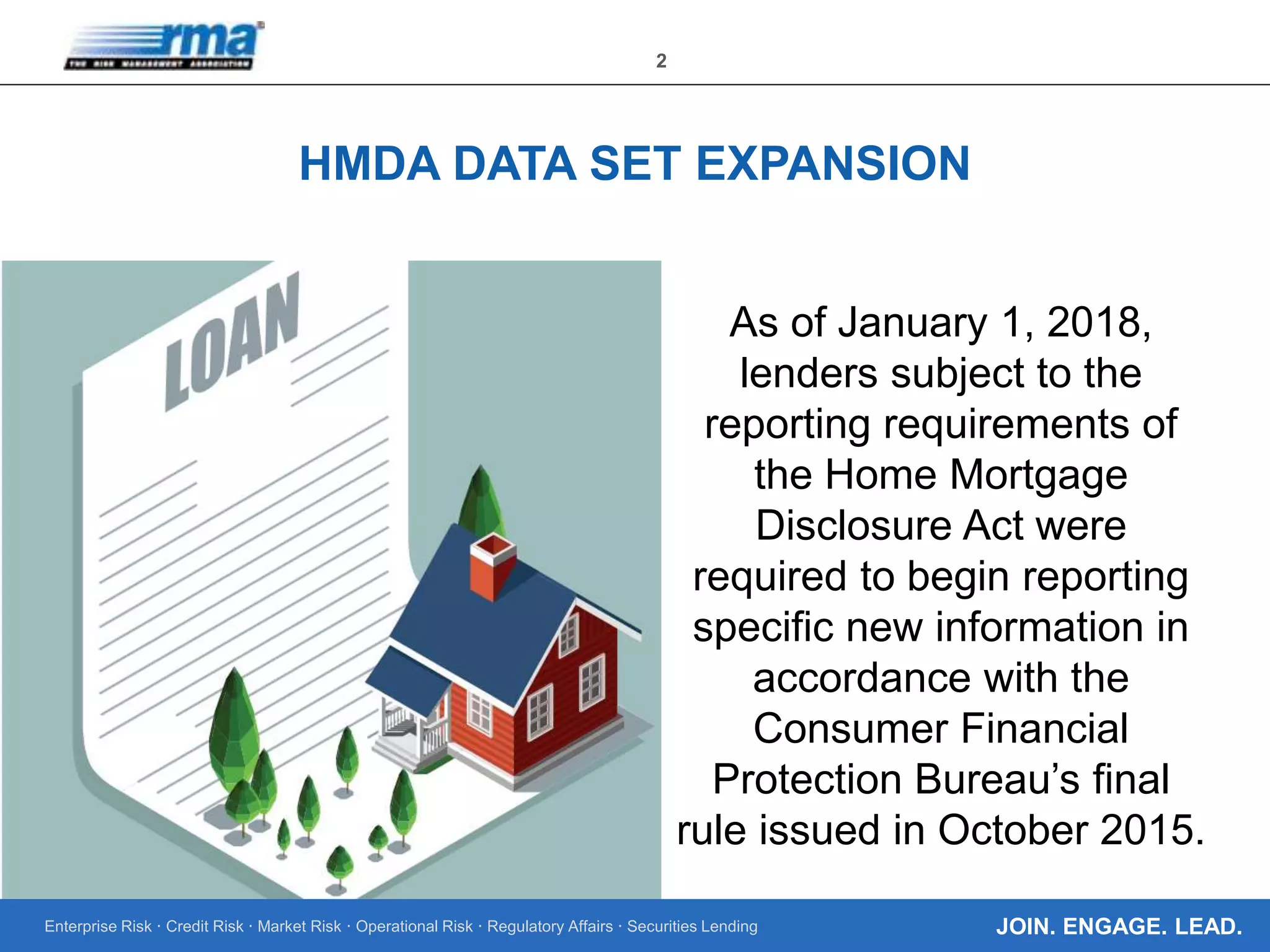
As of January 1, 2018,
lenders subject to the
reporting requirements of
the Home Mortgage
Disclosure Act were
required to begin reporting
specific new information in
accordance with the
Consumer Financial
Protection Bureau’s final
rule issued in October 2015.
Enterprise Risk · Credit Risk · Market Risk · Operational Risk · Regulatory Affairs · Securities Lending
3
JOIN. ENGAGE. LEAD.
HMDA DATA SET EXPANSION (CONT.)
The Dodd-Frank Act directed the
CFPB to expand the HMDA data set
as a way to improve public
understanding of market conditions
and to aid in identifying emerging
risks and potential discriminatory
lending practices in the marketplace.
Enterprise Risk · Credit Risk · Market Risk · Operational Risk · Regulatory Affairs · Securities Lending
4
JOIN. ENGAGE. LEAD.
HMDA DATA SET EXPANSION (CONT.)
The CFPB states that much of the
new reportable data represents
information similar to or the same
as that customarily collected by
lenders for their own:
• Processing.
• Underwriting.
• Pricing of loans.
• Facilitation of the sale of loans
in the secondary market.
Enterprise Risk · Credit Risk · Market Risk · Operational Risk · Regulatory Affairs · Securities Lending
5
JOIN. ENGAGE. LEAD.
HMDA DATA SET EXPANSION (CONT.)
The CFPB has also attempted to align the
final rule’s requirements with well-established
industry standards, including definitions
already in use by a significant portion of the
mortgage market.
Enterprise Risk · Credit Risk · Market Risk · Operational Risk · Regulatory Affairs · Securities Lending
6
JOIN. ENGAGE. LEAD.
HMDA DATA SET EXPANSION (CONT.)
Since issuance of the 2015 final rule, the CFPB has issued
amendments intended to ease the rule’s compliance burden—
particularly for smaller institutions.
To assist lenders in achieving compliance with the new rule, the
CFPB and the prudential regulators have:
• Provided information on their websites.
• Held audio conferences.
• And issued guidance and explanations.
Enterprise Risk · Credit Risk · Market Risk · Operational Risk · Regulatory Affairs · Securities Lending
7
JOIN. ENGAGE. LEAD.
BACKGROUND
Enterprise Risk · Credit Risk · Market Risk · Operational Risk · Regulatory Affairs · Securities Lending
8
JOIN. ENGAGE. LEAD.
BACKGROUND: PURPOSE
The Home Mortgage Disclosure Act was originally
enacted by Congress in 1975.
Its purposes are to:
• Collect information about home mortgages to help determine
whether financial institutions are serving their community’s
housing needs.
• Assist public officials in distributing public-sector investment to
attract private investment in areas where it is needed.
• Help in identifying possible discriminatory lending patterns and
enforcing anti-discrimination laws.
Enterprise Risk · Credit Risk · Market Risk · Operational Risk · Regulatory Affairs · Securities Lending
9
JOIN. ENGAGE. LEAD.
BACKGROUND: REGULATION C
• The 2015 HMDA final rule
amended Regulation C to
incorporate the Dodd-Frank Act’s
HMDA provisions.
• These changes affected which
financial institutions report HMDA
data, which transactions must be
reported, and what data about each
transaction must be recorded and
reported.
Enterprise Risk · Credit Risk · Market Risk · Operational Risk · Regulatory Affairs · Securities Lending
10
JOIN. ENGAGE. LEAD.
BACKGROUND: AMENDMENTS
In 2017 the CFPB issued
amendments to the 2015 rule
that made clarifications and
changed certain requirements
contained in the earlier rule.
Enterprise Risk · Credit Risk · Market Risk · Operational Risk · Regulatory Affairs · Securities Lending
11
JOIN. ENGAGE. LEAD.
BACKGROUND: AMENDMENTS (CONT.)
Beginning in 2018, a bank or savings association is subject
to Regulation C if it originated:
• At least 25 covered closed-end mortgage loans in each
of the two preceding calendar years.
• Or at least 500 covered open-end lines of credit in each
of the two preceding calendar years and meets the
existing Regulation C tests (asset size, location,
federally related, and loan activity tests).
Enterprise Risk · Credit Risk · Market Risk · Operational Risk · Regulatory Affairs · Securities Lending
12
JOIN. ENGAGE. LEAD.
BACKGROUND: STANDARDS
• Generally, reportable
transactions will be based on a
dwelling-secured standard as
opposed to a purpose-based
test.
• Regulation C contains a list of
transactions that are specifically
excluded from rule coverage.
Enterprise Risk · Credit Risk · Market Risk · Operational Risk · Regulatory Affairs · Securities Lending
13
JOIN. ENGAGE. LEAD.
BACKGROUND: DATA COLLECTION
On or after January 1, 2018, covered institutions
will collect the data points specifically identified
in the Dodd-Frank Act, as well as data points
that the CFPB has determined will assist in
achieving HMDA’s purposes.
Enterprise Risk · Credit Risk · Market Risk · Operational Risk · Regulatory Affairs · Securities Lending
14
JOIN. ENGAGE. LEAD.
BACKGROUND: NEW DATA POINTS
Applicant or
borrower age
Credit
score
Automated
underwriting
system
information
Unique loan
identifier
Property
value
Application
channel
Points and
fees
Borrower-paid
origination
charges
Prepayment
penalty
Loan
term
And interest
rate, among
others
New data points include:
The new rule also modifies several existing data points.
Enterprise Risk · Credit Risk · Market Risk · Operational Risk · Regulatory Affairs · Securities Lending
15
JOIN. ENGAGE. LEAD.
BACKGROUND: ASSISTANCE
To assist covered
institutions with respect to
these new and modified
data points, the CFPB has
prepared “Summary of
Reportable HMDA Data:
Regulatory Reference
Chart,” which is available
on its website.
The CFPB has also issued
transition rules to assist
institutions in correcting
incomplete or erroneous
information.
Enterprise Risk · Credit Risk · Market Risk · Operational Risk · Regulatory Affairs · Securities Lending
16
JOIN. ENGAGE. LEAD.
BACKGROUND: REPORTING
The new rule requires covered institutions to report when
they collect information—based on visual observation or
surname—about an applicant’s or borrower’s:
• Ethnicity
• Race
• Sex
The rule allows applicants and borrowers to
self-identify using ethnicity and race subcategories.
Enterprise Risk · Credit Risk · Market Risk · Operational Risk · Regulatory Affairs · Securities Lending
17
JOIN. ENGAGE. LEAD.
BACKGROUND: ELECTRONIC SUBMISSION
The new rule requires electronic submission
of HMDA data using new procedures.
And it adds a quarterly reporting
requirement for larger-volume reporters.
Enterprise Risk · Credit Risk · Market Risk · Operational Risk · Regulatory Affairs · Securities Lending
18
JOIN. ENGAGE. LEAD.
COMPLIANCE
TOOLS AND
ASSISTANCE
Enterprise Risk · Credit Risk · Market Risk · Operational Risk · Regulatory Affairs · Securities Lending
19
JOIN. ENGAGE. LEAD.
COMPLIANCE TOOLS AND ASSISTANCE
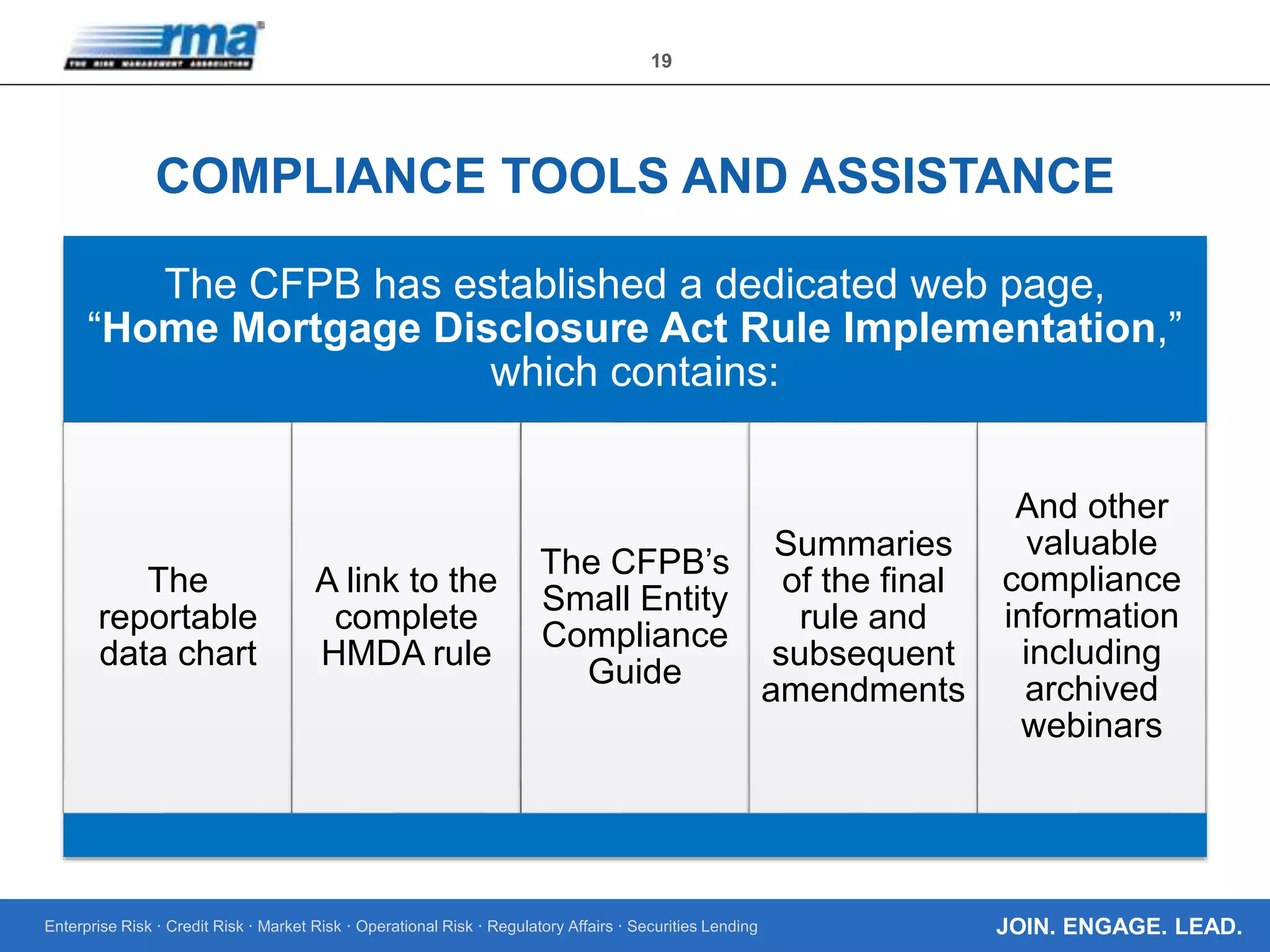
The CFPB has established a dedicated web page,
“Home Mortgage Disclosure Act Rule Implementation,”
which contains:
The
reportable
data chart
A link to the
complete
HMDA rule
The CFPB’s
Small Entity
Compliance
Guide
Summaries
of the final
rule and
subsequent
amendments
And other
valuable
compliance
information
including
archived
webinars
Enterprise Risk · Credit Risk · Market Risk · Operational Risk · Regulatory Affairs · Securities Lending
20
JOIN. ENGAGE. LEAD.
COMPLIANCE TOOLS AND ASSISTANCE (CONT.)
The Federal Financial Institutions Examination
Council (FFIEC) has issued
“Examiner Transaction Testing Guidelines”
for use in assessing the accuracy of the
recorded and reported HMDA data.
Enterprise Risk · Credit Risk · Market Risk · Operational Risk · Regulatory Affairs · Securities Lending
21
JOIN. ENGAGE. LEAD.
COMPLIANCE TOOLS AND ASSISTANCE (CONT.)
These guidelines, which describe the agencies’
procedures for sampling and validating HMDA data,
should help bankers understand the approach that
will be used to assess HMDA data during the
examination process.
Enterprise Risk · Credit Risk · Market Risk · Operational Risk · Regulatory Affairs · Securities Lending
22
JOIN. ENGAGE. LEAD.
COMPLIANCE TOOLS AND ASSISTANCE
The guidelines afford a
consistent, coordinated
approach to interagency
examination and accord
leniency for small reporters
(Loan Application Register
counts of 100 or less).
Enterprise Risk · Credit Risk · Market Risk · Operational Risk · Regulatory Affairs · Securities Lending
23
JOIN. ENGAGE. LEAD.
COMPLIANCE TOOLS AND ASSISTANCE
The banking agencies have issued
“Designated Key HMDA Data Fields,”
a document identifying and designating
37 HMDA data fields as “key.”
The agencies have stated that
examination staffs will focus primary
attention on these data fields during
transaction testing, although additional
data fields may be reviewed in certain
circumstances.
Enterprise Risk · Credit Risk · Market Risk · Operational Risk · Regulatory Affairs · Securities Lending
24
JOIN. ENGAGE. LEAD.
COMPLIANCE TOOLS AND ASSISTANCE
The FFIEC has issued a
Filing Instructions Guide
that provides institutions with
information on such points as how
to format a Loan Application
Register (LAR), which information
to enter into each data field on the
LAR, and how to file HMDA data.
Enterprise Risk · Credit Risk · Market Risk · Operational Risk · Regulatory Affairs · Securities Lending
25
JOIN. ENGAGE. LEAD.
COMPLIANCE TOOLS AND ASSISTANCE
This guide provides information about
each of the 110 reportable data fields and
groups them into 46 data points.
Enterprise Risk · Credit Risk · Market Risk · Operational Risk · Regulatory Affairs · Securities Lending
26
JOIN. ENGAGE. LEAD.
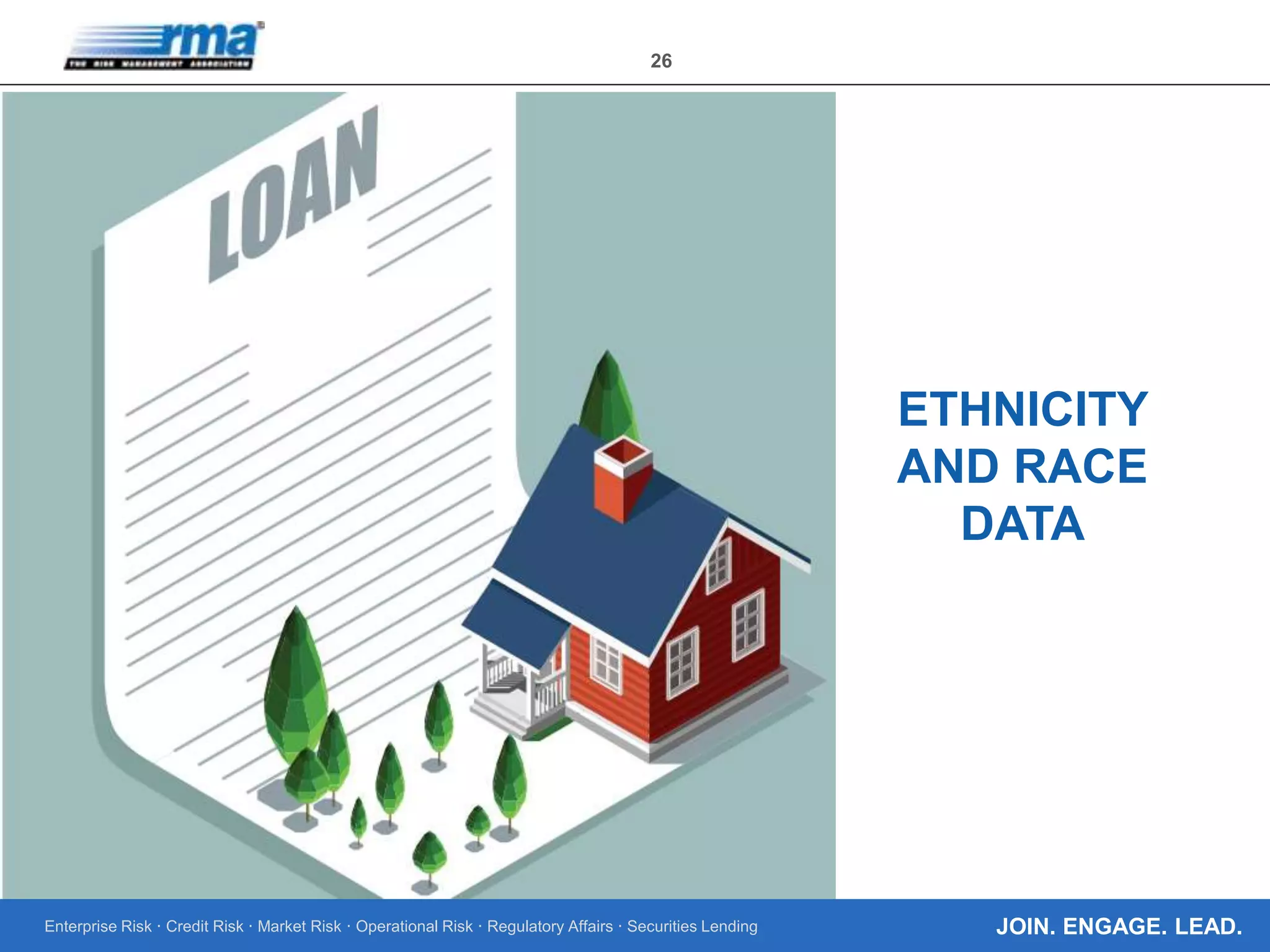
ETHNICITY
AND RACE
DATA
Enterprise Risk · Credit Risk · Market Risk · Operational Risk · Regulatory Affairs · Securities Lending
27
JOIN. ENGAGE. LEAD.
ETHNICITY AND RACE DATA
• Neither the ethnicity data
point nor the race data point
is new, but both have
changed.
• The new rule allows loan
applicants to report
subcategories for Hispanic or
Latino ethnicity, Asian race,
and native Hawaiian or other
Pacific Islander race.
Enterprise Risk · Credit Risk · Market Risk · Operational Risk · Regulatory Affairs · Securities Lending
28
JOIN. ENGAGE. LEAD.
ETHNICITY AND RACE DATA (CONT.)
The final rule also allows
applicants to list a particular
enrolled or principal tribe under
the category American Indian or
Alaska native.
Enterprise Risk · Credit Risk · Market Risk · Operational Risk · Regulatory Affairs · Securities Lending
29
JOIN. ENGAGE. LEAD.
ETHNICITY AND RACE DATA (CONT.)
Applicants may select as
many categories and
subcategories for race
and ethnicity as they
wish.
Financial institutions
must report every
aggregate ethnicity
category selected.
If an applicant also selects
one or more subcategories,
the institution must report
those as well, up to a
maximum of five entries.
Enterprise Risk · Credit Risk · Market Risk · Operational Risk · Regulatory Affairs · Securities Lending
30
JOIN. ENGAGE. LEAD.
REGULATION
B
Enterprise Risk · Credit Risk · Market Risk · Operational Risk · Regulatory Affairs · Securities Lending
31
JOIN. ENGAGE. LEAD.
REGULATION B
The CFPB has amended
Regulation B to give
lenders additional
flexibility in complying
with Regulation B and
Regulation C.
Enterprise Risk · Credit Risk · Market Risk · Operational Risk · Regulatory Affairs · Securities Lending
32
JOIN. ENGAGE. LEAD.
REGULATION B (CONT.)
These amendments clarify that
creditors subject to both regulations
generally satisfy the applicant
information requirements of
Regulation B simply by complying
with Regulation C.
Enterprise Risk · Credit Risk · Market Risk · Operational Risk · Regulatory Affairs · Securities Lending
33
JOIN. ENGAGE. LEAD.
REGULATION B (CONT.)
The amendments also
facilitate the collection and
retention of information on
certain mortgage
applicants’ ethnicity, race,
and sex.
Enterprise Risk · Credit Risk · Market Risk · Operational Risk · Regulatory Affairs · Securities Lending
34
JOIN. ENGAGE. LEAD.
REGULATION B (CONT.)
Additionally, the
amendments:
• Remove from Appendix B a 2004
version of the Uniform Residential
Loan Application (an optional
model form for creditors’ use).
• And add two alternative model
forms.
Enterprise Risk · Credit Risk · Market Risk · Operational Risk · Regulatory Affairs · Securities Lending
35
JOIN. ENGAGE. LEAD.
REGULATION B (CONT.)
The CRA rule changes aim to conform to Regulation C by:
Updating the
definition of “home
mortgage loan” to
mean a “closed-end
mortgage loan” or an
“open-end line of
credit” as defined in
Regulation C.
Removing the term
“home equity loan.”
Changing the content
of the CRA public file.
The banking agencies have also issued a final rule
amending their respective Community Reinvestment Act
regulations.
Enterprise Risk · Credit Risk · Market Risk · Operational Risk · Regulatory Affairs · Securities Lending
36
JOIN. ENGAGE. LEAD.
PRIVACY
ISSUES
Enterprise Risk · Credit Risk · Market Risk · Operational Risk · Regulatory Affairs · Securities Lending
37
JOIN. ENGAGE. LEAD.
PRIVACY ISSUES
The CFPB has issued
proposed policy guidance
pertaining to the public
disclosure of loan-level
HMDA data.
Enterprise Risk · Credit Risk · Market Risk · Operational Risk · Regulatory Affairs · Securities Lending
38
JOIN. ENGAGE. LEAD.
PRIVACY ISSUES (CONT.)
The proposal envisions the modification of
public HMDA data when the release of the
unmodified data creates risks to applicant
and borrower privacy that are not justified by
the benefits of releasing the data to the
public.
Enterprise Risk · Credit Risk · Market Risk · Operational Risk · Regulatory Affairs · Securities Lending
39
JOIN. ENGAGE. LEAD.
PRIVACY ISSUES (CONT.)
The guidance would exclude
certain information from
release, such as application
date, property address, and
credit score.
Enterprise Risk · Credit Risk · Market Risk · Operational Risk · Regulatory Affairs · Securities Lending
40
JOIN. ENGAGE. LEAD.
PRIVACY ISSUES (CONT.)
The guidance
proposes
modification of
other data
points such as:
• Loan amount
• Age
• Property value.
Enterprise Risk · Credit Risk · Market Risk · Operational Risk · Regulatory Affairs · Securities Lending
41
JOIN. ENGAGE. LEAD.
BEST
PRACTICES
Enterprise Risk · Credit Risk · Market Risk · Operational Risk · Regulatory Affairs · Securities Lending
42
JOIN. ENGAGE. LEAD.
BEST PRACTICES
The prudential regulators have
provided RMA with the following
guidance and advice for
institutions striving to achieve and
maintain compliance with HMDA
data collection requirements.
Enterprise Risk · Credit Risk · Market Risk · Operational Risk · Regulatory Affairs · Securities Lending
43
JOIN. ENGAGE. LEAD.
BEST PRACTICES (CONT.)
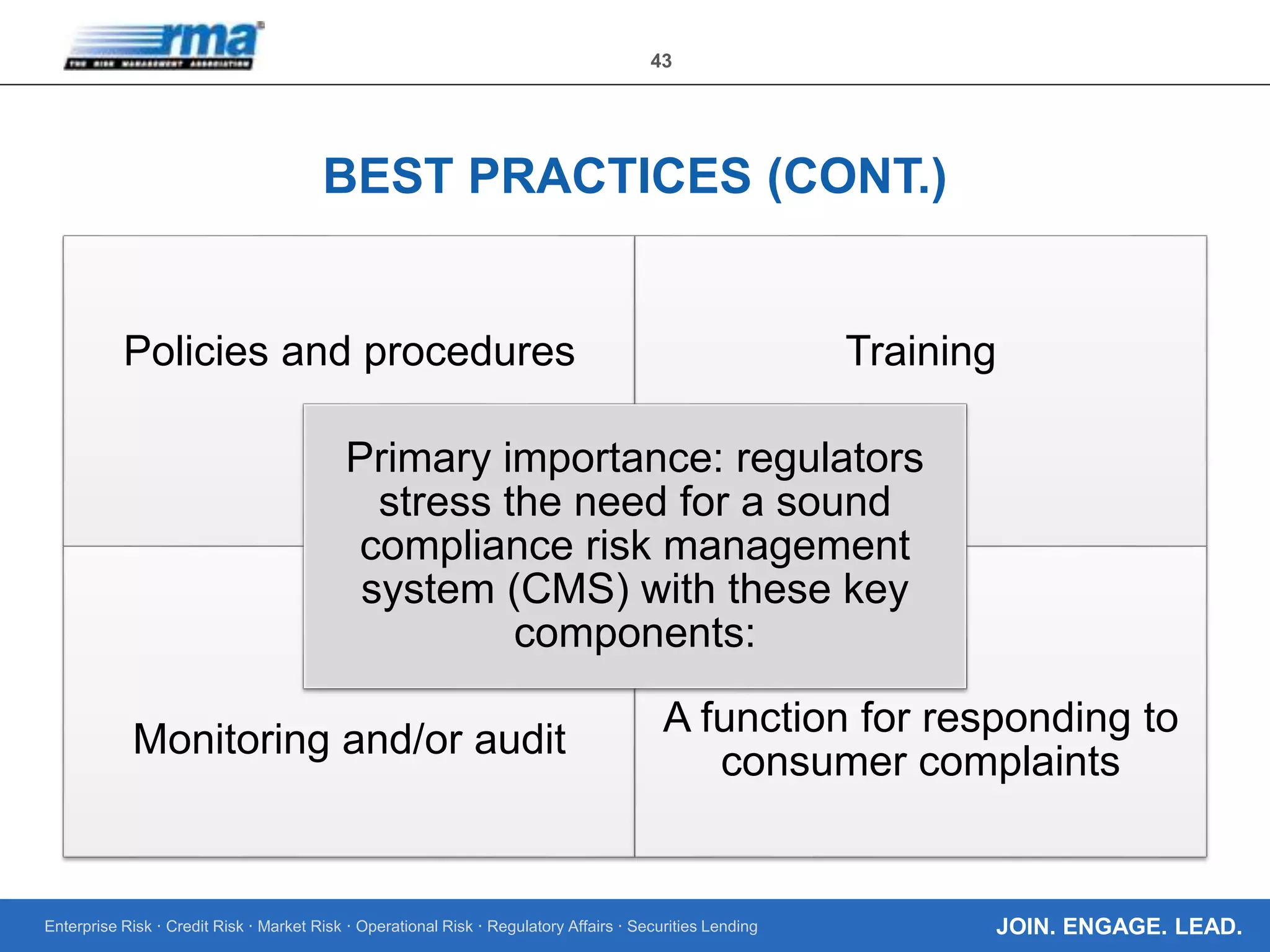
Policies and procedures Training
Monitoring and/or audit
A function for responding to
consumer complaints
Primary importance: regulators
stress the need for a sound
compliance risk management
system (CMS) with these key
components:
Enterprise Risk · Credit Risk · Market Risk · Operational Risk · Regulatory Affairs · Securities Lending
44
JOIN. ENGAGE. LEAD.
BEST PRACTICES (CONT.)
The regulators state that a
CMS should also be dynamic
and adjust on an ongoing
basis, to focus resources
where they are most needed
based on risk to the institution.
Enterprise Risk · Credit Risk · Market Risk · Operational Risk · Regulatory Affairs · Securities Lending
45
JOIN. ENGAGE. LEAD.
BEST PRACTICES (CONT.)
In judging an institution’s commitment to effective HMDA
compliance management, regulators will determine if the
board and management are doing the following:
Performing
satisfactory
oversight of
the
institution’s
CMS.
Providing
adequate
compliance
resources.
Employing
staff generally
able to
ensure
compliance
with HMDA
laws and
regulations.
Conducting
adequate due
diligence and
oversight of
third parties.
Enterprise Risk · Credit Risk · Market Risk · Operational Risk · Regulatory Affairs · Securities Lending
46
JOIN. ENGAGE. LEAD.
BEST PRACTICES (CONT.)
Given the HMDA rule changes, regulators advise that it
would be prudent for boards and management to be
apprised of these activities:
Updated policies
and procedures
regarding HMDA
compliance.
Internal monitoring
efforts designed to
detect and remedy
issues as early in
the process as
possible.
Audits and internal
reviews that detail
HMDA-related
findings and
recommendations.
Enterprise Risk · Credit Risk · Market Risk · Operational Risk · Regulatory Affairs · Securities Lending
47
JOIN. ENGAGE. LEAD.
BEST PRACTICES (CONT.)
Regulators suggest that
institutions conduct internal
research to determine
where within the
organization HMDA-
reportable loans are
originated.
Also, they should review
one-off loan originations to
see if they are
appropriately categorized
and recognized for HMDA
purposes.
Enterprise Risk · Credit Risk · Market Risk · Operational Risk · Regulatory Affairs · Securities Lending
48
JOIN. ENGAGE. LEAD.
BEST PRACTICES (CONT.)
The process of receiving and
accepting loan applications
should also be reviewed for
consistency of approach.
Enterprise Risk · Credit Risk · Market Risk · Operational Risk · Regulatory Affairs · Securities Lending
49
JOIN. ENGAGE. LEAD.
BEST PRACTICES (CONT.)
The regulators also advise that
institutions maintain clear and
consistent practices and
procedures regarding HMDA
data collection and management.
Enterprise Risk · Credit Risk · Market Risk · Operational Risk · Regulatory Affairs · Securities Lending
50
JOIN. ENGAGE. LEAD.
BEST PRACTICES (CONT.)
Banks should consider establishing roles and
responsibilities for:
Data
collection
Data
integrity
File
documentation
Monitoring Reporting
Enterprise Risk · Credit Risk · Market Risk · Operational Risk · Regulatory Affairs · Securities Lending
51
JOIN. ENGAGE. LEAD.
BEST PRACTICES (CONT.)
Banks should also identify adequate
and consistent data collection and
file documentation requirements.
Enterprise Risk · Credit Risk · Market Risk · Operational Risk · Regulatory Affairs · Securities Lending
52
JOIN. ENGAGE. LEAD.
BEST PRACTICES (CONT.)
Along these lines is another important recommendation for
HMDA compliance:
• Oversight of third-party service providers.
Enterprise Risk · Credit Risk · Market Risk · Operational Risk · Regulatory Affairs · Securities Lending
53
JOIN. ENGAGE. LEAD.
BEST PRACTICES (CONT.)
Lastly, regulators emphasize
the importance of employee
training as part of the HMDA
compliance process.
Enterprise Risk · Credit Risk · Market Risk · Operational Risk · Regulatory Affairs · Securities Lending
54
JOIN. ENGAGE. LEAD.
BEST PRACTICES (CONT.)
Institutions should consider
who should be trained for
HMDA and what the training
should include.
Enterprise Risk · Credit Risk · Market Risk · Operational Risk · Regulatory Affairs · Securities Lending
55
JOIN. ENGAGE. LEAD.
BEST PRACTICES (CONT.)
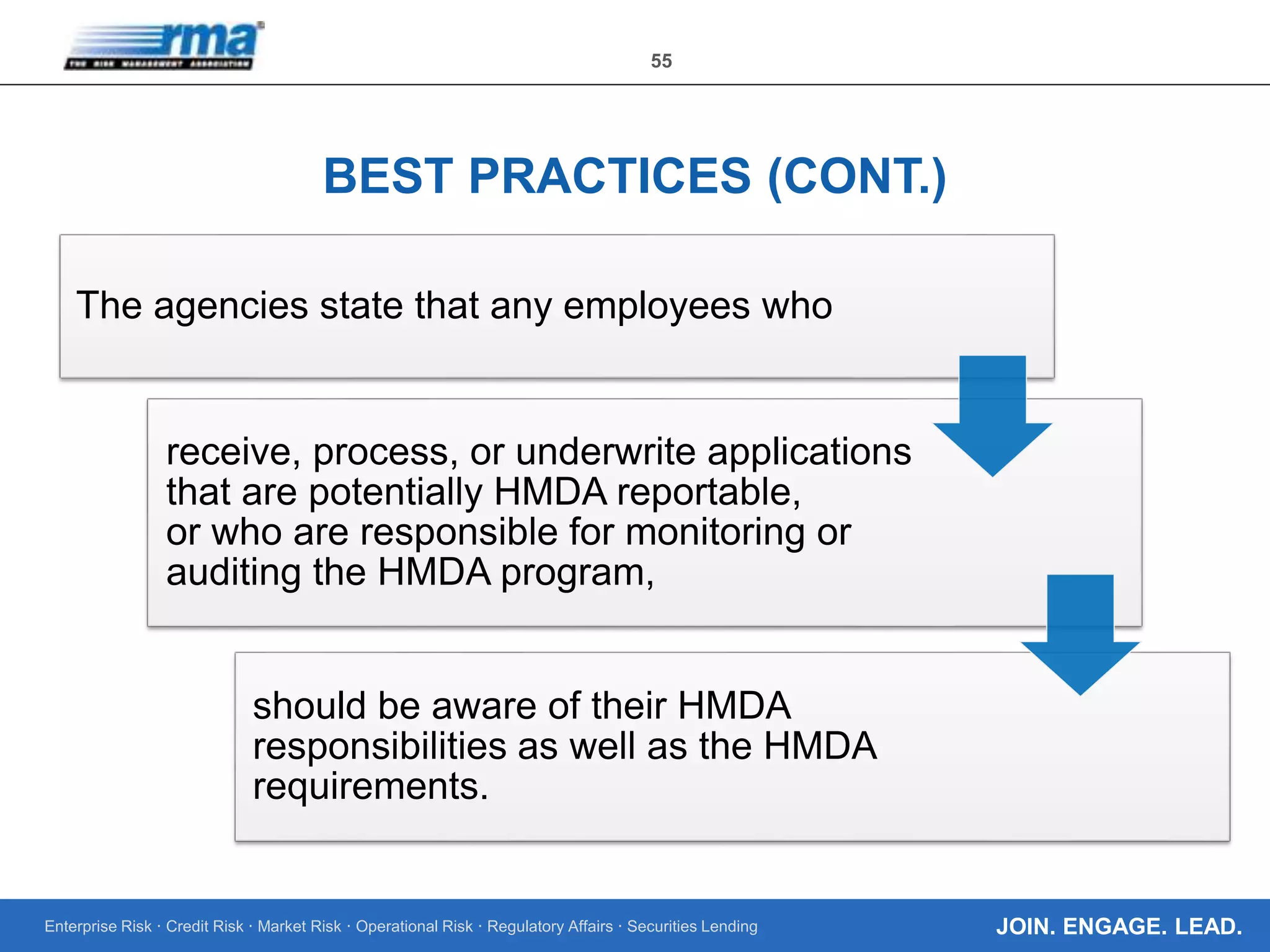
The agencies state that any employees who
receive, process, or underwrite applications
that are potentially HMDA reportable,
or who are responsible for monitoring or
auditing the HMDA program,
should be aware of their HMDA
responsibilities as well as the HMDA
requirements.
Enterprise Risk · Credit Risk · Market Risk · Operational Risk · Regulatory Affairs · Securities Lending
56
JOIN. ENGAGE. LEAD.
LEARN MORE
The RMA Journal is the award-winning magazine published
by The Risk Management Association:
• It is the only professional journal written by risk practitioners for risk
practitioners.
• Each article is peer reviewed by our Editorial Advisory Board prior to
publication.
• Published 10 times a year, The RMA Journal offers practical advice
on managing risk across the enterprise.
Learn more at:
https://www.rmahq.org/thermajournal/
Become an RMA member and get The RMA Journal free.
Enterprise Risk · Credit Risk · Market Risk · Operational Risk · Regulatory Affairs · Securities Lending
57
JOIN. ENGAGE. LEAD.
SHARE THIS PRESENTATION
Visit http://www.rmahq.org for information on risk management.
RMA is a member-driven professional association whose sole
purpose is to advance sound risk principles in the financial services
industry.
RMA helps its members use sound risk principles to improve
institutional performance and financial stability, and enhance the risk
competency of individuals through information, education, peer
sharing, and networking.
Become a member today.

Meeting the Challenge of HMDA Compliance

  • 1.
    Enterprise Risk ·Credit Risk · Market Risk · Operational Risk · Regulatory Affairs · Securities Lending 1 JOIN. ENGAGE. LEAD. MEETING THE CHALLENGE OF HMDA COMPLIANCE From The RMA Journal, February 2018
  • 2.
    Enterprise Risk ·Credit Risk · Market Risk · Operational Risk · Regulatory Affairs · Securities Lending 2 JOIN. ENGAGE. LEAD. HMDA DATA SET EXPANSION As of January 1, 2018, lenders subject to the reporting requirements of the Home Mortgage Disclosure Act were required to begin reporting specific new information in accordance with the Consumer Financial Protection Bureau’s final rule issued in October 2015.
  • 3.
    Enterprise Risk ·Credit Risk · Market Risk · Operational Risk · Regulatory Affairs · Securities Lending 3 JOIN. ENGAGE. LEAD. HMDA DATA SET EXPANSION (CONT.) The Dodd-Frank Act directed the CFPB to expand the HMDA data set as a way to improve public understanding of market conditions and to aid in identifying emerging risks and potential discriminatory lending practices in the marketplace.
  • 4.
    Enterprise Risk ·Credit Risk · Market Risk · Operational Risk · Regulatory Affairs · Securities Lending 4 JOIN. ENGAGE. LEAD. HMDA DATA SET EXPANSION (CONT.) The CFPB states that much of the new reportable data represents information similar to or the same as that customarily collected by lenders for their own: • Processing. • Underwriting. • Pricing of loans. • Facilitation of the sale of loans in the secondary market.
  • 5.
    Enterprise Risk ·Credit Risk · Market Risk · Operational Risk · Regulatory Affairs · Securities Lending 5 JOIN. ENGAGE. LEAD. HMDA DATA SET EXPANSION (CONT.) The CFPB has also attempted to align the final rule’s requirements with well-established industry standards, including definitions already in use by a significant portion of the mortgage market.
  • 6.
    Enterprise Risk ·Credit Risk · Market Risk · Operational Risk · Regulatory Affairs · Securities Lending 6 JOIN. ENGAGE. LEAD. HMDA DATA SET EXPANSION (CONT.) Since issuance of the 2015 final rule, the CFPB has issued amendments intended to ease the rule’s compliance burden— particularly for smaller institutions. To assist lenders in achieving compliance with the new rule, the CFPB and the prudential regulators have: • Provided information on their websites. • Held audio conferences. • And issued guidance and explanations.
  • 7.
    Enterprise Risk ·Credit Risk · Market Risk · Operational Risk · Regulatory Affairs · Securities Lending 7 JOIN. ENGAGE. LEAD. BACKGROUND
  • 8.
    Enterprise Risk ·Credit Risk · Market Risk · Operational Risk · Regulatory Affairs · Securities Lending 8 JOIN. ENGAGE. LEAD. BACKGROUND: PURPOSE The Home Mortgage Disclosure Act was originally enacted by Congress in 1975. Its purposes are to: • Collect information about home mortgages to help determine whether financial institutions are serving their community’s housing needs. • Assist public officials in distributing public-sector investment to attract private investment in areas where it is needed. • Help in identifying possible discriminatory lending patterns and enforcing anti-discrimination laws.
  • 9.
    Enterprise Risk ·Credit Risk · Market Risk · Operational Risk · Regulatory Affairs · Securities Lending 9 JOIN. ENGAGE. LEAD. BACKGROUND: REGULATION C • The 2015 HMDA final rule amended Regulation C to incorporate the Dodd-Frank Act’s HMDA provisions. • These changes affected which financial institutions report HMDA data, which transactions must be reported, and what data about each transaction must be recorded and reported.
  • 10.
    Enterprise Risk ·Credit Risk · Market Risk · Operational Risk · Regulatory Affairs · Securities Lending 10 JOIN. ENGAGE. LEAD. BACKGROUND: AMENDMENTS In 2017 the CFPB issued amendments to the 2015 rule that made clarifications and changed certain requirements contained in the earlier rule.
  • 11.
    Enterprise Risk ·Credit Risk · Market Risk · Operational Risk · Regulatory Affairs · Securities Lending 11 JOIN. ENGAGE. LEAD. BACKGROUND: AMENDMENTS (CONT.) Beginning in 2018, a bank or savings association is subject to Regulation C if it originated: • At least 25 covered closed-end mortgage loans in each of the two preceding calendar years. • Or at least 500 covered open-end lines of credit in each of the two preceding calendar years and meets the existing Regulation C tests (asset size, location, federally related, and loan activity tests).
  • 12.
    Enterprise Risk ·Credit Risk · Market Risk · Operational Risk · Regulatory Affairs · Securities Lending 12 JOIN. ENGAGE. LEAD. BACKGROUND: STANDARDS • Generally, reportable transactions will be based on a dwelling-secured standard as opposed to a purpose-based test. • Regulation C contains a list of transactions that are specifically excluded from rule coverage.
  • 13.
    Enterprise Risk ·Credit Risk · Market Risk · Operational Risk · Regulatory Affairs · Securities Lending 13 JOIN. ENGAGE. LEAD. BACKGROUND: DATA COLLECTION On or after January 1, 2018, covered institutions will collect the data points specifically identified in the Dodd-Frank Act, as well as data points that the CFPB has determined will assist in achieving HMDA’s purposes.
  • 14.
    Enterprise Risk ·Credit Risk · Market Risk · Operational Risk · Regulatory Affairs · Securities Lending 14 JOIN. ENGAGE. LEAD. BACKGROUND: NEW DATA POINTS Applicant or borrower age Credit score Automated underwriting system information Unique loan identifier Property value Application channel Points and fees Borrower-paid origination charges Prepayment penalty Loan term And interest rate, among others New data points include: The new rule also modifies several existing data points.
  • 15.
    Enterprise Risk ·Credit Risk · Market Risk · Operational Risk · Regulatory Affairs · Securities Lending 15 JOIN. ENGAGE. LEAD. BACKGROUND: ASSISTANCE To assist covered institutions with respect to these new and modified data points, the CFPB has prepared “Summary of Reportable HMDA Data: Regulatory Reference Chart,” which is available on its website. The CFPB has also issued transition rules to assist institutions in correcting incomplete or erroneous information.
  • 16.
    Enterprise Risk ·Credit Risk · Market Risk · Operational Risk · Regulatory Affairs · Securities Lending 16 JOIN. ENGAGE. LEAD. BACKGROUND: REPORTING The new rule requires covered institutions to report when they collect information—based on visual observation or surname—about an applicant’s or borrower’s: • Ethnicity • Race • Sex The rule allows applicants and borrowers to self-identify using ethnicity and race subcategories.
  • 17.
    Enterprise Risk ·Credit Risk · Market Risk · Operational Risk · Regulatory Affairs · Securities Lending 17 JOIN. ENGAGE. LEAD. BACKGROUND: ELECTRONIC SUBMISSION The new rule requires electronic submission of HMDA data using new procedures. And it adds a quarterly reporting requirement for larger-volume reporters.
  • 18.
    Enterprise Risk ·Credit Risk · Market Risk · Operational Risk · Regulatory Affairs · Securities Lending 18 JOIN. ENGAGE. LEAD. COMPLIANCE TOOLS AND ASSISTANCE
  • 19.
    Enterprise Risk ·Credit Risk · Market Risk · Operational Risk · Regulatory Affairs · Securities Lending 19 JOIN. ENGAGE. LEAD. COMPLIANCE TOOLS AND ASSISTANCE The CFPB has established a dedicated web page, “Home Mortgage Disclosure Act Rule Implementation,” which contains: The reportable data chart A link to the complete HMDA rule The CFPB’s Small Entity Compliance Guide Summaries of the final rule and subsequent amendments And other valuable compliance information including archived webinars
  • 20.
    Enterprise Risk ·Credit Risk · Market Risk · Operational Risk · Regulatory Affairs · Securities Lending 20 JOIN. ENGAGE. LEAD. COMPLIANCE TOOLS AND ASSISTANCE (CONT.) The Federal Financial Institutions Examination Council (FFIEC) has issued “Examiner Transaction Testing Guidelines” for use in assessing the accuracy of the recorded and reported HMDA data.
  • 21.
    Enterprise Risk ·Credit Risk · Market Risk · Operational Risk · Regulatory Affairs · Securities Lending 21 JOIN. ENGAGE. LEAD. COMPLIANCE TOOLS AND ASSISTANCE (CONT.) These guidelines, which describe the agencies’ procedures for sampling and validating HMDA data, should help bankers understand the approach that will be used to assess HMDA data during the examination process.
  • 22.
    Enterprise Risk ·Credit Risk · Market Risk · Operational Risk · Regulatory Affairs · Securities Lending 22 JOIN. ENGAGE. LEAD. COMPLIANCE TOOLS AND ASSISTANCE The guidelines afford a consistent, coordinated approach to interagency examination and accord leniency for small reporters (Loan Application Register counts of 100 or less).
  • 23.
    Enterprise Risk ·Credit Risk · Market Risk · Operational Risk · Regulatory Affairs · Securities Lending 23 JOIN. ENGAGE. LEAD. COMPLIANCE TOOLS AND ASSISTANCE The banking agencies have issued “Designated Key HMDA Data Fields,” a document identifying and designating 37 HMDA data fields as “key.” The agencies have stated that examination staffs will focus primary attention on these data fields during transaction testing, although additional data fields may be reviewed in certain circumstances.
  • 24.
    Enterprise Risk ·Credit Risk · Market Risk · Operational Risk · Regulatory Affairs · Securities Lending 24 JOIN. ENGAGE. LEAD. COMPLIANCE TOOLS AND ASSISTANCE The FFIEC has issued a Filing Instructions Guide that provides institutions with information on such points as how to format a Loan Application Register (LAR), which information to enter into each data field on the LAR, and how to file HMDA data.
  • 25.
    Enterprise Risk ·Credit Risk · Market Risk · Operational Risk · Regulatory Affairs · Securities Lending 25 JOIN. ENGAGE. LEAD. COMPLIANCE TOOLS AND ASSISTANCE This guide provides information about each of the 110 reportable data fields and groups them into 46 data points.
  • 26.
    Enterprise Risk ·Credit Risk · Market Risk · Operational Risk · Regulatory Affairs · Securities Lending 26 JOIN. ENGAGE. LEAD. ETHNICITY AND RACE DATA
  • 27.
    Enterprise Risk ·Credit Risk · Market Risk · Operational Risk · Regulatory Affairs · Securities Lending 27 JOIN. ENGAGE. LEAD. ETHNICITY AND RACE DATA • Neither the ethnicity data point nor the race data point is new, but both have changed. • The new rule allows loan applicants to report subcategories for Hispanic or Latino ethnicity, Asian race, and native Hawaiian or other Pacific Islander race.
  • 28.
    Enterprise Risk ·Credit Risk · Market Risk · Operational Risk · Regulatory Affairs · Securities Lending 28 JOIN. ENGAGE. LEAD. ETHNICITY AND RACE DATA (CONT.) The final rule also allows applicants to list a particular enrolled or principal tribe under the category American Indian or Alaska native.
  • 29.
    Enterprise Risk ·Credit Risk · Market Risk · Operational Risk · Regulatory Affairs · Securities Lending 29 JOIN. ENGAGE. LEAD. ETHNICITY AND RACE DATA (CONT.) Applicants may select as many categories and subcategories for race and ethnicity as they wish. Financial institutions must report every aggregate ethnicity category selected. If an applicant also selects one or more subcategories, the institution must report those as well, up to a maximum of five entries.
  • 30.
    Enterprise Risk ·Credit Risk · Market Risk · Operational Risk · Regulatory Affairs · Securities Lending 30 JOIN. ENGAGE. LEAD. REGULATION B
  • 31.
    Enterprise Risk ·Credit Risk · Market Risk · Operational Risk · Regulatory Affairs · Securities Lending 31 JOIN. ENGAGE. LEAD. REGULATION B The CFPB has amended Regulation B to give lenders additional flexibility in complying with Regulation B and Regulation C.
  • 32.
    Enterprise Risk ·Credit Risk · Market Risk · Operational Risk · Regulatory Affairs · Securities Lending 32 JOIN. ENGAGE. LEAD. REGULATION B (CONT.) These amendments clarify that creditors subject to both regulations generally satisfy the applicant information requirements of Regulation B simply by complying with Regulation C.
  • 33.
    Enterprise Risk ·Credit Risk · Market Risk · Operational Risk · Regulatory Affairs · Securities Lending 33 JOIN. ENGAGE. LEAD. REGULATION B (CONT.) The amendments also facilitate the collection and retention of information on certain mortgage applicants’ ethnicity, race, and sex.
  • 34.
    Enterprise Risk ·Credit Risk · Market Risk · Operational Risk · Regulatory Affairs · Securities Lending 34 JOIN. ENGAGE. LEAD. REGULATION B (CONT.) Additionally, the amendments: • Remove from Appendix B a 2004 version of the Uniform Residential Loan Application (an optional model form for creditors’ use). • And add two alternative model forms.
  • 35.
    Enterprise Risk ·Credit Risk · Market Risk · Operational Risk · Regulatory Affairs · Securities Lending 35 JOIN. ENGAGE. LEAD. REGULATION B (CONT.) The CRA rule changes aim to conform to Regulation C by: Updating the definition of “home mortgage loan” to mean a “closed-end mortgage loan” or an “open-end line of credit” as defined in Regulation C. Removing the term “home equity loan.” Changing the content of the CRA public file. The banking agencies have also issued a final rule amending their respective Community Reinvestment Act regulations.
  • 36.
    Enterprise Risk ·Credit Risk · Market Risk · Operational Risk · Regulatory Affairs · Securities Lending 36 JOIN. ENGAGE. LEAD. PRIVACY ISSUES
  • 37.
    Enterprise Risk ·Credit Risk · Market Risk · Operational Risk · Regulatory Affairs · Securities Lending 37 JOIN. ENGAGE. LEAD. PRIVACY ISSUES The CFPB has issued proposed policy guidance pertaining to the public disclosure of loan-level HMDA data.
  • 38.
    Enterprise Risk ·Credit Risk · Market Risk · Operational Risk · Regulatory Affairs · Securities Lending 38 JOIN. ENGAGE. LEAD. PRIVACY ISSUES (CONT.) The proposal envisions the modification of public HMDA data when the release of the unmodified data creates risks to applicant and borrower privacy that are not justified by the benefits of releasing the data to the public.
  • 39.
    Enterprise Risk ·Credit Risk · Market Risk · Operational Risk · Regulatory Affairs · Securities Lending 39 JOIN. ENGAGE. LEAD. PRIVACY ISSUES (CONT.) The guidance would exclude certain information from release, such as application date, property address, and credit score.
  • 40.
    Enterprise Risk ·Credit Risk · Market Risk · Operational Risk · Regulatory Affairs · Securities Lending 40 JOIN. ENGAGE. LEAD. PRIVACY ISSUES (CONT.) The guidance proposes modification of other data points such as: • Loan amount • Age • Property value.
  • 41.
    Enterprise Risk ·Credit Risk · Market Risk · Operational Risk · Regulatory Affairs · Securities Lending 41 JOIN. ENGAGE. LEAD. BEST PRACTICES
  • 42.
    Enterprise Risk ·Credit Risk · Market Risk · Operational Risk · Regulatory Affairs · Securities Lending 42 JOIN. ENGAGE. LEAD. BEST PRACTICES The prudential regulators have provided RMA with the following guidance and advice for institutions striving to achieve and maintain compliance with HMDA data collection requirements.
  • 43.
    Enterprise Risk ·Credit Risk · Market Risk · Operational Risk · Regulatory Affairs · Securities Lending 43 JOIN. ENGAGE. LEAD. BEST PRACTICES (CONT.) Policies and procedures Training Monitoring and/or audit A function for responding to consumer complaints Primary importance: regulators stress the need for a sound compliance risk management system (CMS) with these key components:
  • 44.
    Enterprise Risk ·Credit Risk · Market Risk · Operational Risk · Regulatory Affairs · Securities Lending 44 JOIN. ENGAGE. LEAD. BEST PRACTICES (CONT.) The regulators state that a CMS should also be dynamic and adjust on an ongoing basis, to focus resources where they are most needed based on risk to the institution.
  • 45.
    Enterprise Risk ·Credit Risk · Market Risk · Operational Risk · Regulatory Affairs · Securities Lending 45 JOIN. ENGAGE. LEAD. BEST PRACTICES (CONT.) In judging an institution’s commitment to effective HMDA compliance management, regulators will determine if the board and management are doing the following: Performing satisfactory oversight of the institution’s CMS. Providing adequate compliance resources. Employing staff generally able to ensure compliance with HMDA laws and regulations. Conducting adequate due diligence and oversight of third parties.
  • 46.
    Enterprise Risk ·Credit Risk · Market Risk · Operational Risk · Regulatory Affairs · Securities Lending 46 JOIN. ENGAGE. LEAD. BEST PRACTICES (CONT.) Given the HMDA rule changes, regulators advise that it would be prudent for boards and management to be apprised of these activities: Updated policies and procedures regarding HMDA compliance. Internal monitoring efforts designed to detect and remedy issues as early in the process as possible. Audits and internal reviews that detail HMDA-related findings and recommendations.
  • 47.
    Enterprise Risk ·Credit Risk · Market Risk · Operational Risk · Regulatory Affairs · Securities Lending 47 JOIN. ENGAGE. LEAD. BEST PRACTICES (CONT.) Regulators suggest that institutions conduct internal research to determine where within the organization HMDA- reportable loans are originated. Also, they should review one-off loan originations to see if they are appropriately categorized and recognized for HMDA purposes.
  • 48.
    Enterprise Risk ·Credit Risk · Market Risk · Operational Risk · Regulatory Affairs · Securities Lending 48 JOIN. ENGAGE. LEAD. BEST PRACTICES (CONT.) The process of receiving and accepting loan applications should also be reviewed for consistency of approach.
  • 49.
    Enterprise Risk ·Credit Risk · Market Risk · Operational Risk · Regulatory Affairs · Securities Lending 49 JOIN. ENGAGE. LEAD. BEST PRACTICES (CONT.) The regulators also advise that institutions maintain clear and consistent practices and procedures regarding HMDA data collection and management.
  • 50.
    Enterprise Risk ·Credit Risk · Market Risk · Operational Risk · Regulatory Affairs · Securities Lending 50 JOIN. ENGAGE. LEAD. BEST PRACTICES (CONT.) Banks should consider establishing roles and responsibilities for: Data collection Data integrity File documentation Monitoring Reporting
  • 51.
    Enterprise Risk ·Credit Risk · Market Risk · Operational Risk · Regulatory Affairs · Securities Lending 51 JOIN. ENGAGE. LEAD. BEST PRACTICES (CONT.) Banks should also identify adequate and consistent data collection and file documentation requirements.
  • 52.
    Enterprise Risk ·Credit Risk · Market Risk · Operational Risk · Regulatory Affairs · Securities Lending 52 JOIN. ENGAGE. LEAD. BEST PRACTICES (CONT.) Along these lines is another important recommendation for HMDA compliance: • Oversight of third-party service providers.
  • 53.
    Enterprise Risk ·Credit Risk · Market Risk · Operational Risk · Regulatory Affairs · Securities Lending 53 JOIN. ENGAGE. LEAD. BEST PRACTICES (CONT.) Lastly, regulators emphasize the importance of employee training as part of the HMDA compliance process.
  • 54.
    Enterprise Risk ·Credit Risk · Market Risk · Operational Risk · Regulatory Affairs · Securities Lending 54 JOIN. ENGAGE. LEAD. BEST PRACTICES (CONT.) Institutions should consider who should be trained for HMDA and what the training should include.
  • 55.
    Enterprise Risk ·Credit Risk · Market Risk · Operational Risk · Regulatory Affairs · Securities Lending 55 JOIN. ENGAGE. LEAD. BEST PRACTICES (CONT.) The agencies state that any employees who receive, process, or underwrite applications that are potentially HMDA reportable, or who are responsible for monitoring or auditing the HMDA program, should be aware of their HMDA responsibilities as well as the HMDA requirements.
  • 56.
    Enterprise Risk ·Credit Risk · Market Risk · Operational Risk · Regulatory Affairs · Securities Lending 56 JOIN. ENGAGE. LEAD. LEARN MORE The RMA Journal is the award-winning magazine published by The Risk Management Association: • It is the only professional journal written by risk practitioners for risk practitioners. • Each article is peer reviewed by our Editorial Advisory Board prior to publication. • Published 10 times a year, The RMA Journal offers practical advice on managing risk across the enterprise. Learn more at: https://www.rmahq.org/thermajournal/ Become an RMA member and get The RMA Journal free.
  • 57.
    Enterprise Risk ·Credit Risk · Market Risk · Operational Risk · Regulatory Affairs · Securities Lending 57 JOIN. ENGAGE. LEAD. SHARE THIS PRESENTATION Visit http://www.rmahq.org for information on risk management. RMA is a member-driven professional association whose sole purpose is to advance sound risk principles in the financial services industry. RMA helps its members use sound risk principles to improve institutional performance and financial stability, and enhance the risk competency of individuals through information, education, peer sharing, and networking. Become a member today.