Planning an Integrated Thematic
Social Studies Curriculum Unit
EDMU 523
History/Social Science Standards
• What History/Social Sciences academic
content standards are addressed in the unit?
• Include the strands, standard number, and
description for each standard addressed in the unit in
history/social sciences, science, visual and
performing arts, health, and/or P.E.
• What Common Core State Standards (CCSS)
in English Language Arts and Mathematics are
addressed in this unit?
Appropriate Themes
• How can I give my students direct
experience of this topic?
• Think of possible fieldtrip – either real or
virtual.
• Reflect children’s interests, abilities and
issues of concern: How will I hook them in?
• Involve concepts and skills at the right level
of challenge for the age group
• Topic should be complex and interesting
enough to be explored at some depth
What Enduring Understandings do you
want students to gain?
• What are the essential questions for this unit
of study?
• Brainstorm the purpose and goals
• Gather the resources and materials
• Create a graphic organizer or curriculum
map
• Ask the children:
• What do you want to know?
• What would you like to learn?
Criteria for Theme Selection
Topic must provide active learning and direct, hands-
on experiences
•Children can explore it with their senses.
•Concept is developmentally appropriate
•Concept can be organized to move from:
• Simple to complex
• Concrete to abstract
•Interesting, meaningful, and worth knowing about.
•Help children acquire understanding and appreciation of
themselves, others, and the world in which they live.
Thematic Planning
• Organize curriculum around a California
Social Studies theme
• Umbrella overarching interest area
• Integrates different developmental and subject areas
• Contributes to child’s growing understanding of
his/her place in time and space
• Provides opportunities for child to learn by doing and
have direct experiences with the topic
• Helps students understand that learning is connected to
their lives.
California
Social Studies Themes
Grades 3-6
•Grade Three—Continuity and Change
•Grade Four—California: A Changing State
•Grade Five—United States History and
Geography: Making a New Nation
•Grade Six—World History and Geography:
Ancient Civilizations
Continuity and Change
• Our Local History: Discovering Our Past and Our
Traditions
• Our Nation’s History: Meeting People, Ordinary and
Extraordinary, Through Biography, Story, Folktale, and
Legend
Consider your own local community history, legends, geography,
economy, significant leaders, local Native American tribes, etc.
3
California: A Changing State
• The Physical Setting: California and Beyond
• Pre-Columbian Settlements and People
• Exploration and Colonial History
• Missions, Ranchos, and the Mexican War for
Independence
• Gold Rush, Statehood, and the Westward Movement
• The Period of Rapid Population Growth, Large-Scale
Agriculture,-
• and Linkage to the Rest of the United States
• Modern California: Immigration, Technology, & Cities
4
United States History and Geography:
Making a New Nation
• The Land & People Before Columbus
• Age of Exploration
• Settling the Colonies –The Virginia Settlement
• Life in New England –The Middle Colonies
• Settling the Trans-Appalachian West
• The War for Independence-
• Life in the Young Republic
• The New Nation’s Westward Expansion-
• Linking Past to Present: The American People, Then &
Now
5
World History and Geography:
Ancient Civilizations
• Early Humankind and the Development of Human
Societies
• The Beginnings of Civilization in the Near East and
Africa:
• Mesopotamia, Egypt, and Kush
• The Foundation of Western Ideas: The Ancient
Hebrews and Greeks
• West Meets East: The Early Civilizations of India
and China
• East Meets West: Rome
6
Outline for an Integrated Thematic
Unit Plan
• Title: Kid Grabbing Topic
• Concept: What is the big idea
from social studies you want
students to understand? What
is the essential question?
• Rationale/Relevance:
• Why is this important for
students to know?
• Why are the outcomes of
this unit important in the
real world?
• Unit Objectives: Major
Understandings
• Resources: Books, Articles,
Websites, Multimedia, etc.
• Content Standards and
Common Core State
Standards
Assignment Requirements
• Create a two week history-social science based unit that
integrates a majority of subject areas.
• Unit should reflect the content standards for the grade level
selected
• Unit should include lessons that utilize a:
• Variety of intelligences
• Different levels of thinking (Depth of Knowledge)
• Adaptations based on Universal Design for Learning (UDL)
• Utilize technology appropriately (TPACK framework)
• The unit should be designed for one grade level 3-6.
Assignment Requirements
• Mindmap, Graphic Organizer, or Curriculum Map for the Unit
Plan – week 4
• At least 4 lessons
• A final performance-based final assessment with a rubric.
• Include the following:
• Graphic Organizer/Curriculum Map
• Prezi presentation – Introduction to the Unit Week 5
• Week 6 Google Classroom
• Fieldtrip Lesson Preparation
• The unit should include:
• Primary Source/s Lesson Plan
• Visual or Performing Arts Lesson Plan
• CCSS ELA and Math Lesson Plan
• Project-based Culminating Project: Lesson Plan with Summative Rubric
Fieldtrip Ideas
• Design a fieldtrip related to your thematic unit.
• Provide the title and the location or web address of
your fieldtrip location.
• Summarize the experience
• What will students do?
• How will you organize the real or virtual experience?
• Describe student learning activities and essential
questions to be investigated.
• Describe the key history-social science concepts that
you think this virtual experience addresses.
Graphic Organizer,
Mind Map, Infographic
• Brainstorm social studies unit topic
and provide a visual of possible
subtopics for your thematic unit.
• Plan thematic integration of subject
matter with history/social science
strands.
• Begin process of organizing a 2-week
unit to meet needs of all students
focusing on the multiple intelligences
and diverse learning styles.
• Due in Week 4
Mind Map of Possible Activities
Civics
Constitution
Field Trips Simulations
Drama
Geography
Maps
CCSS
ELA or
Math
EconomicsPrimary
Sources
Books and
Poems
Visual or
Performing
Arts
Hands-on
Activities
THEME
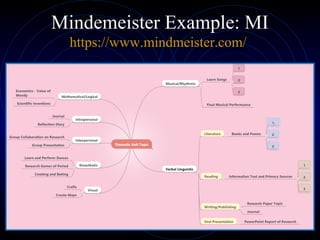
Mindmeister Example: MI
https://www.mindmeister.com/
Curriculum Map – 4 Lessons
• Shows the sequence of lessons, content areas addressed in
each lesson, multiple intelligences utilized, and level of
depth of knowledge.
• Lessons should progress in a logical sequence and connect
with unit objectives
• Lessons should reflect a variety of content areas, multiple
intelligences, and levels of depth of knowledge.
Social Studies Lesson Plans
Lesson Plans with Formative/Summative
Assessments
•Primary Source Lesson
•Visual or Performing Arts Lesson
•Common Core (CCSS) in English Language Arts
•Additional integrated lessons in math, science, health, PE
•Capstone Project-based Lesson: hands-on student learning activity: project,
presentation, publication, or performance. The project-based final lesson
should include the summative authentic assessment rubric.
Lesson Plan Activities
• Use primary sources (physical or virtual)
• Finding Primary Sources: Library of Congress
• Library of Congress Themed Resources
• Integrate literature (books, stories,
poems, plays) and informational text
(nonfiction writing in narrative or non-
narrative form that is intended to inform.)
• Incorporate the use of technology and
digital media for research, publication, or
presentation.
• Include hands-on student learning
activities.
Visual and Performing Arts Lesson
• Music
• Drama – Theatre
• Dance
• Visual Arts
Lesson Planning with
Common Core State Standards
• Two of the lessons should
meet a Common Core State
Standard (CCSS) in English
Language Arts and a CCSS
in Mathematics.
• Use of Informational Text –
Content-Rich Non-fiction
• Student Research Using the
Internet
• Use of Media and Technology
• Multimedia Publishing
Key Questions
• What learning experiences and activities will students
engage in?
• How will students be grouped during the lesson?
• What materials, technology, and resources will you
use during this lesson?
• How will you engage and motivate students to learn
the subject matter content?
• How will you differentiate your learning activities for
a diverse student population and assure that all
students have access to Common Core and curriculum
content standards?
Activities
• Introduction
• How will you introduce the study to children?
• What activities will you do to determine prior knowledge?
• Activities to Build Understanding
• Activities that encourage exploration
• Activities that build skill
• Activities that develop understanding
• Culmination Activities
• Activities help children express and generalize what
they’ve learned
• Activities to bring closure to the unit
• The first lesson should hook students into the topic
and connect to their prior knowledge. (Prezi)
• Focus on the history-social science curriculum
strands in knowledge and cultural understanding
(history, geography, economics, culture, politics,
ethics) or democratic understanding and civic values).
Anticipatory Set
Lesson Format:
Instructional Strategies
• Anticipatory Set
• How will you interest “hook” students in the lesson, help
them see the purpose and connect with prior knowledge?
• How will you help build student understanding of the
concept or skill?
• What teaching or instructional strategies will you use?
• Target Vocabulary, Key Concepts, Graphic Organizers,
Contextual Cues, Modeling, Questioning, Reframing, Media
and Technology?
• What technology will be used by the teacher and for
what purpose?
Lesson Topic and Standards
• Topic:
• Grade Level History-Social Science Content
Standard:
• Common Core State Standard/s
• English Language Arts in History and Social Studies,
Mathematics, Next Generation Science
• Integrated Subject Matter Content Standard/s
• Literature, Visual Arts, Performing Arts, Math,
Science, PE, Health
Learning Objectives and DOK Levels
• Lesson Objective(s):
• Learners will demonstrate their understanding of
_______by doing ____
• Must be measurable.
• Depth of Knowledge (DoK) Level:
• Recall – Skill/Concept – Strategic Thinking –
Extended Thinking
• Resources/Materials Needed:
• What information or literary texts, digital resources,
and materials will be used in this lesson?
DOK – Depth of Knowledge
Depth of Knowledge (DOK)
Assessment and Adaptations
• Formative Assessment: Progress Monitoring
• How will you gain understanding of students’ prior knowledge at the
beginning of the lesson?
• How will you monitor student progress during the lesson?
• How will you assess student understanding at the end of the lesson?
• Independent Practice
• What will students do to continue practicing and applying what they have
learned?
• Adaptations
• Describe the adaptations you could make in the lesson for English
learners, gifted students or students with special needs and explain why
those adaptations would be appropriate?
• Adaptations could be made to any of the aspects of the lesson described
above.
Formative Assessments
• How do you document children’s
learning?
• How do you know if children understand
the big ideas of your unit?
• Documentation for Progress-Monitoring
• Graphic Organizers
• Exit Slip
• Whiteboards
• Quick Write
• Draw It!
• Clickers
• Apps: Socrative, Kahoot, Peardeck, Nearpod
Apps and Tools for Formative
Assessment
• 56 Formative Assessments – Google Doc
• 56 Formative Assessments for Social
Studies
• Growing the List: 50 Digital Education
Tools and Apps for Formative Assessment
Success
• 5 Fantastic, Fast, Formative Assessment
Tools from Edutopia
• Assessment Apps for Teachers
Summative Authentic Assessment
• Describe the assessment tool (project, presentation,
performance etc…).
• Do Not use a test!
• Describe what students are being asked to do, how they
are to complete the task, and the time frame allotted to
complete the task.
• Develop a rubric that will be used to evaluate student
performance on the final assessment.
• Make sure you design an assessment that addressed the
objectives of the unit.
• Allows teacher to focus on what expectations
he/she have for student work
• Provides alternative grading system for
performance assessment, portfolios, projects,
web assignments, etc.
• Can measure a variety of categories in any
content area
• Teacher can determine criteria and scale - rather
than be subject to standardized testing scores.
Rubrics for Assessment
Rubric Table
Example
Adaptations:
Universal Design for Learning
• Multiple Means of Representation
• How can you present information and content in different
ways?
• Multiple Means of Action and Expression
• How can you differentiate the ways that students can express
what they know?
• Multiple Means of Engagement
• How can you stimulate interest and motivation for learning?
Media and Technology
TPACK: Technology, Pedagogy, and Content
Knowledge
• What media or technology will be used by the
teacher?
• What media or technology will be used by the
students?
• How will this promote student learning?
• What is the purpose of using this technology?
• knowledge building
• knowledge expression
TPACK Framework
• Technology
Used by
Teacher
• Technology
Used by
Students:
• Knowledge
Building
• Knowledge
Expression
Annotated Bibliography of Resources
• Resource Books
• Literature Connections- At least 1 literature book
or stories/poems that connect to the theme
• Informational Text Connections - At least one
informational text that connect to the theme
• Primary Sources
• Videos/DVDs or other media
• Digital Resources and Websites (At least 5 sites)
• Possible Guest Speakers (Give job titles)
Signature Assignment in LiveText
• Submit in LiveText: http://www.livetext.com
• Options for Creating Unit Plan:
• Create one complete document (preferably pdf) and
submit that pdf as the LiveText assignment
• Create multiple documents and files and submit all of
them one by one in LiveText
• Create your thematic unit in LiveText by copying the
template. Insert files in appropriate sections and
submit the LiveText document
• Tutorial: https://sites.google.com/site/livetexttutorials/copying-a-
livetext-project-template-to-your-computer

Thematic Unit

  • 1.
    Planning an IntegratedThematic Social Studies Curriculum Unit EDMU 523
  • 2.
    History/Social Science Standards •What History/Social Sciences academic content standards are addressed in the unit? • Include the strands, standard number, and description for each standard addressed in the unit in history/social sciences, science, visual and performing arts, health, and/or P.E. • What Common Core State Standards (CCSS) in English Language Arts and Mathematics are addressed in this unit?
  • 3.
    Appropriate Themes • Howcan I give my students direct experience of this topic? • Think of possible fieldtrip – either real or virtual. • Reflect children’s interests, abilities and issues of concern: How will I hook them in? • Involve concepts and skills at the right level of challenge for the age group • Topic should be complex and interesting enough to be explored at some depth
  • 4.
    What Enduring Understandingsdo you want students to gain? • What are the essential questions for this unit of study? • Brainstorm the purpose and goals • Gather the resources and materials • Create a graphic organizer or curriculum map • Ask the children: • What do you want to know? • What would you like to learn?
  • 5.
    Criteria for ThemeSelection Topic must provide active learning and direct, hands- on experiences •Children can explore it with their senses. •Concept is developmentally appropriate •Concept can be organized to move from: • Simple to complex • Concrete to abstract •Interesting, meaningful, and worth knowing about. •Help children acquire understanding and appreciation of themselves, others, and the world in which they live.
  • 6.
    Thematic Planning • Organizecurriculum around a California Social Studies theme • Umbrella overarching interest area • Integrates different developmental and subject areas • Contributes to child’s growing understanding of his/her place in time and space • Provides opportunities for child to learn by doing and have direct experiences with the topic • Helps students understand that learning is connected to their lives.
  • 7.
    California Social Studies Themes Grades3-6 •Grade Three—Continuity and Change •Grade Four—California: A Changing State •Grade Five—United States History and Geography: Making a New Nation •Grade Six—World History and Geography: Ancient Civilizations
  • 8.
    Continuity and Change •Our Local History: Discovering Our Past and Our Traditions • Our Nation’s History: Meeting People, Ordinary and Extraordinary, Through Biography, Story, Folktale, and Legend Consider your own local community history, legends, geography, economy, significant leaders, local Native American tribes, etc. 3
  • 9.
    California: A ChangingState • The Physical Setting: California and Beyond • Pre-Columbian Settlements and People • Exploration and Colonial History • Missions, Ranchos, and the Mexican War for Independence • Gold Rush, Statehood, and the Westward Movement • The Period of Rapid Population Growth, Large-Scale Agriculture,- • and Linkage to the Rest of the United States • Modern California: Immigration, Technology, & Cities 4
  • 10.
    United States Historyand Geography: Making a New Nation • The Land & People Before Columbus • Age of Exploration • Settling the Colonies –The Virginia Settlement • Life in New England –The Middle Colonies • Settling the Trans-Appalachian West • The War for Independence- • Life in the Young Republic • The New Nation’s Westward Expansion- • Linking Past to Present: The American People, Then & Now 5
  • 11.
    World History andGeography: Ancient Civilizations • Early Humankind and the Development of Human Societies • The Beginnings of Civilization in the Near East and Africa: • Mesopotamia, Egypt, and Kush • The Foundation of Western Ideas: The Ancient Hebrews and Greeks • West Meets East: The Early Civilizations of India and China • East Meets West: Rome 6
  • 12.
    Outline for anIntegrated Thematic Unit Plan • Title: Kid Grabbing Topic • Concept: What is the big idea from social studies you want students to understand? What is the essential question? • Rationale/Relevance: • Why is this important for students to know? • Why are the outcomes of this unit important in the real world? • Unit Objectives: Major Understandings • Resources: Books, Articles, Websites, Multimedia, etc. • Content Standards and Common Core State Standards
  • 13.
    Assignment Requirements • Createa two week history-social science based unit that integrates a majority of subject areas. • Unit should reflect the content standards for the grade level selected • Unit should include lessons that utilize a: • Variety of intelligences • Different levels of thinking (Depth of Knowledge) • Adaptations based on Universal Design for Learning (UDL) • Utilize technology appropriately (TPACK framework) • The unit should be designed for one grade level 3-6.
  • 14.
    Assignment Requirements • Mindmap,Graphic Organizer, or Curriculum Map for the Unit Plan – week 4 • At least 4 lessons • A final performance-based final assessment with a rubric. • Include the following: • Graphic Organizer/Curriculum Map • Prezi presentation – Introduction to the Unit Week 5 • Week 6 Google Classroom • Fieldtrip Lesson Preparation • The unit should include: • Primary Source/s Lesson Plan • Visual or Performing Arts Lesson Plan • CCSS ELA and Math Lesson Plan • Project-based Culminating Project: Lesson Plan with Summative Rubric
  • 15.
    Fieldtrip Ideas • Designa fieldtrip related to your thematic unit. • Provide the title and the location or web address of your fieldtrip location. • Summarize the experience • What will students do? • How will you organize the real or virtual experience? • Describe student learning activities and essential questions to be investigated. • Describe the key history-social science concepts that you think this virtual experience addresses.
  • 16.
    Graphic Organizer, Mind Map,Infographic • Brainstorm social studies unit topic and provide a visual of possible subtopics for your thematic unit. • Plan thematic integration of subject matter with history/social science strands. • Begin process of organizing a 2-week unit to meet needs of all students focusing on the multiple intelligences and diverse learning styles. • Due in Week 4
  • 17.
    Mind Map ofPossible Activities Civics Constitution Field Trips Simulations Drama Geography Maps CCSS ELA or Math EconomicsPrimary Sources Books and Poems Visual or Performing Arts Hands-on Activities THEME
  • 18.
  • 19.
    Curriculum Map –4 Lessons • Shows the sequence of lessons, content areas addressed in each lesson, multiple intelligences utilized, and level of depth of knowledge. • Lessons should progress in a logical sequence and connect with unit objectives • Lessons should reflect a variety of content areas, multiple intelligences, and levels of depth of knowledge.
  • 21.
    Social Studies LessonPlans Lesson Plans with Formative/Summative Assessments •Primary Source Lesson •Visual or Performing Arts Lesson •Common Core (CCSS) in English Language Arts •Additional integrated lessons in math, science, health, PE •Capstone Project-based Lesson: hands-on student learning activity: project, presentation, publication, or performance. The project-based final lesson should include the summative authentic assessment rubric.
  • 22.
    Lesson Plan Activities •Use primary sources (physical or virtual) • Finding Primary Sources: Library of Congress • Library of Congress Themed Resources • Integrate literature (books, stories, poems, plays) and informational text (nonfiction writing in narrative or non- narrative form that is intended to inform.) • Incorporate the use of technology and digital media for research, publication, or presentation. • Include hands-on student learning activities.
  • 23.
    Visual and PerformingArts Lesson • Music • Drama – Theatre • Dance • Visual Arts
  • 24.
    Lesson Planning with CommonCore State Standards • Two of the lessons should meet a Common Core State Standard (CCSS) in English Language Arts and a CCSS in Mathematics. • Use of Informational Text – Content-Rich Non-fiction • Student Research Using the Internet • Use of Media and Technology • Multimedia Publishing
  • 25.
    Key Questions • Whatlearning experiences and activities will students engage in? • How will students be grouped during the lesson? • What materials, technology, and resources will you use during this lesson? • How will you engage and motivate students to learn the subject matter content? • How will you differentiate your learning activities for a diverse student population and assure that all students have access to Common Core and curriculum content standards?
  • 26.
    Activities • Introduction • Howwill you introduce the study to children? • What activities will you do to determine prior knowledge? • Activities to Build Understanding • Activities that encourage exploration • Activities that build skill • Activities that develop understanding • Culmination Activities • Activities help children express and generalize what they’ve learned • Activities to bring closure to the unit
  • 27.
    • The firstlesson should hook students into the topic and connect to their prior knowledge. (Prezi) • Focus on the history-social science curriculum strands in knowledge and cultural understanding (history, geography, economics, culture, politics, ethics) or democratic understanding and civic values). Anticipatory Set
  • 28.
    Lesson Format: Instructional Strategies •Anticipatory Set • How will you interest “hook” students in the lesson, help them see the purpose and connect with prior knowledge? • How will you help build student understanding of the concept or skill? • What teaching or instructional strategies will you use? • Target Vocabulary, Key Concepts, Graphic Organizers, Contextual Cues, Modeling, Questioning, Reframing, Media and Technology? • What technology will be used by the teacher and for what purpose?
  • 29.
    Lesson Topic andStandards • Topic: • Grade Level History-Social Science Content Standard: • Common Core State Standard/s • English Language Arts in History and Social Studies, Mathematics, Next Generation Science • Integrated Subject Matter Content Standard/s • Literature, Visual Arts, Performing Arts, Math, Science, PE, Health
  • 30.
    Learning Objectives andDOK Levels • Lesson Objective(s): • Learners will demonstrate their understanding of _______by doing ____ • Must be measurable. • Depth of Knowledge (DoK) Level: • Recall – Skill/Concept – Strategic Thinking – Extended Thinking • Resources/Materials Needed: • What information or literary texts, digital resources, and materials will be used in this lesson?
  • 31.
    DOK – Depthof Knowledge
  • 32.
  • 33.
    Assessment and Adaptations •Formative Assessment: Progress Monitoring • How will you gain understanding of students’ prior knowledge at the beginning of the lesson? • How will you monitor student progress during the lesson? • How will you assess student understanding at the end of the lesson? • Independent Practice • What will students do to continue practicing and applying what they have learned? • Adaptations • Describe the adaptations you could make in the lesson for English learners, gifted students or students with special needs and explain why those adaptations would be appropriate? • Adaptations could be made to any of the aspects of the lesson described above.
  • 34.
    Formative Assessments • Howdo you document children’s learning? • How do you know if children understand the big ideas of your unit? • Documentation for Progress-Monitoring • Graphic Organizers • Exit Slip • Whiteboards • Quick Write • Draw It! • Clickers • Apps: Socrative, Kahoot, Peardeck, Nearpod
  • 35.
    Apps and Toolsfor Formative Assessment • 56 Formative Assessments – Google Doc • 56 Formative Assessments for Social Studies • Growing the List: 50 Digital Education Tools and Apps for Formative Assessment Success • 5 Fantastic, Fast, Formative Assessment Tools from Edutopia • Assessment Apps for Teachers
  • 36.
    Summative Authentic Assessment •Describe the assessment tool (project, presentation, performance etc…). • Do Not use a test! • Describe what students are being asked to do, how they are to complete the task, and the time frame allotted to complete the task. • Develop a rubric that will be used to evaluate student performance on the final assessment. • Make sure you design an assessment that addressed the objectives of the unit.
  • 37.
    • Allows teacherto focus on what expectations he/she have for student work • Provides alternative grading system for performance assessment, portfolios, projects, web assignments, etc. • Can measure a variety of categories in any content area • Teacher can determine criteria and scale - rather than be subject to standardized testing scores. Rubrics for Assessment
  • 38.
  • 39.
  • 40.
    Adaptations: Universal Design forLearning • Multiple Means of Representation • How can you present information and content in different ways? • Multiple Means of Action and Expression • How can you differentiate the ways that students can express what they know? • Multiple Means of Engagement • How can you stimulate interest and motivation for learning?
  • 41.
    Media and Technology TPACK:Technology, Pedagogy, and Content Knowledge • What media or technology will be used by the teacher? • What media or technology will be used by the students? • How will this promote student learning? • What is the purpose of using this technology? • knowledge building • knowledge expression
  • 42.
    TPACK Framework • Technology Usedby Teacher • Technology Used by Students: • Knowledge Building • Knowledge Expression
  • 43.
    Annotated Bibliography ofResources • Resource Books • Literature Connections- At least 1 literature book or stories/poems that connect to the theme • Informational Text Connections - At least one informational text that connect to the theme • Primary Sources • Videos/DVDs or other media • Digital Resources and Websites (At least 5 sites) • Possible Guest Speakers (Give job titles)
  • 44.
    Signature Assignment inLiveText • Submit in LiveText: http://www.livetext.com • Options for Creating Unit Plan: • Create one complete document (preferably pdf) and submit that pdf as the LiveText assignment • Create multiple documents and files and submit all of them one by one in LiveText • Create your thematic unit in LiveText by copying the template. Insert files in appropriate sections and submit the LiveText document • Tutorial: https://sites.google.com/site/livetexttutorials/copying-a- livetext-project-template-to-your-computer