TEACHING AND LEARNING WITH TECHNOLOGY:
AN INTRODUCTION
INTRODUCTION
If there is one thing that changed the world so fast, it is
TECHNOLOGY. While there exists technology in the past as
non-digital technology, the current digital technology has been
a factor that shrunk the world and made it flat. It has provided
a new environment for learning, new ways teachers teach and
also the new ways of how learners learn. In the beginning, it
has created a divide between the digital natives and the digital
immigrants. However as the years go by, such divide has
become narrower and even blurred. This has led to the new
educational revolution in teaching and learning which has been
triggered by technology and resulted to better learning
outcomes in the 21" century.
ICT COMPETENCY STANDARDS FOR
PHILIPPINE PRE-SERVICE TEACHER
EDUCATION
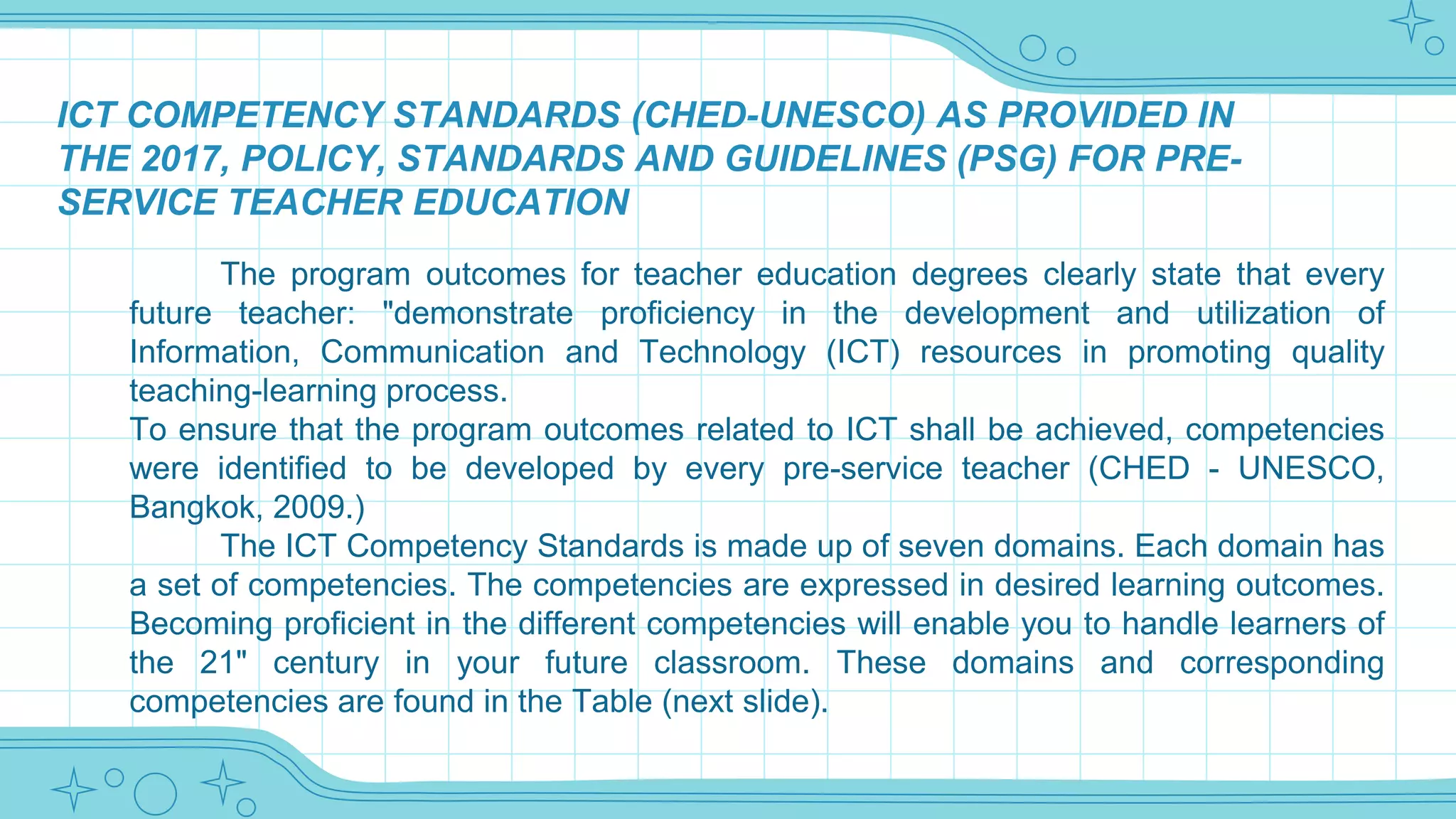
ICT COMPETENCY STANDARDS (CHED-UNESCO) AS PROVIDED IN
THE 2017, POLICY, STANDARDS AND GUIDELINES (PSG) FOR PRE-
SERVICE TEACHER EDUCATION
The program outcomes for teacher education degrees clearly state that every
future teacher: "demonstrate proficiency in the development and utilization of
Information, Communication and Technology (ICT) resources in promoting quality
teaching-learning process.
To ensure that the program outcomes related to ICT shall be achieved, competencies
were identified to be developed by every pre-service teacher (CHED - UNESCO,
Bangkok, 2009.)
The ICT Competency Standards is made up of seven domains. Each domain has
a set of competencies. The competencies are expressed in desired learning outcomes.
Becoming proficient in the different competencies will enable you to handle learners of
the 21" century in your future classroom. These domains and corresponding
competencies are found in the Table (next slide).
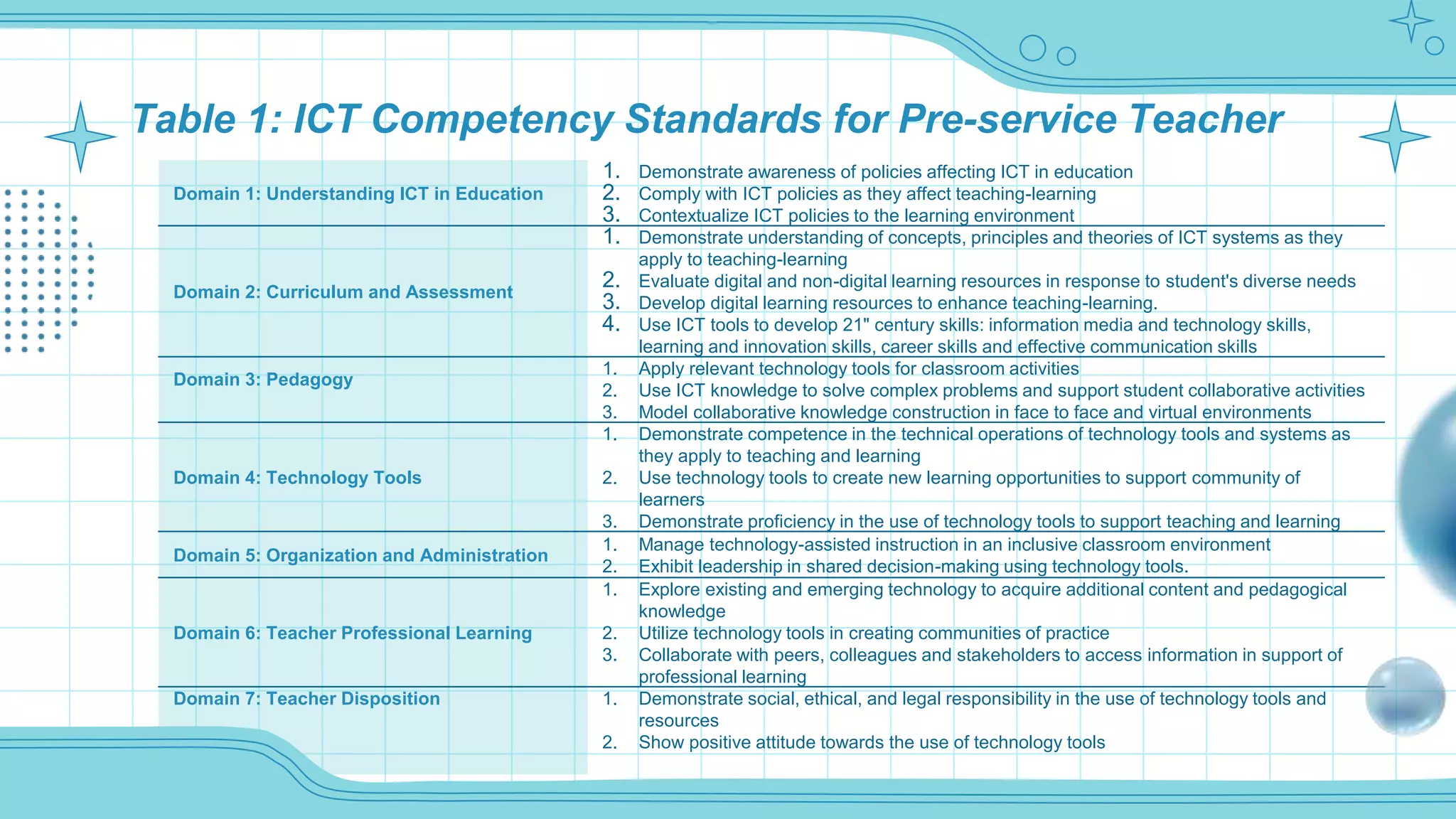
Table 1: ICT Competency Standards for Pre-service Teacher
Domain 1: Understanding ICT in Education
1. Demonstrate awareness of policies affecting ICT in education
2. Comply with ICT policies as they affect teaching-learning
3. Contextualize ICT policies to the learning environment
Domain 2: Curriculum and Assessment
1. Demonstrate understanding of concepts, principles and theories of ICT systems as they
apply to teaching-learning
2. Evaluate digital and non-digital learning resources in response to student's diverse needs
3. Develop digital learning resources to enhance teaching-learning.
4. Use ICT tools to develop 21" century skills: information media and technology skills,
learning and innovation skills, career skills and effective communication skills
Domain 3: Pedagogy
1. Apply relevant technology tools for classroom activities
2. Use ICT knowledge to solve complex problems and support student collaborative activities
3. Model collaborative knowledge construction in face to face and virtual environments
Domain 4: Technology Tools
1. Demonstrate competence in the technical operations of technology tools and systems as
they apply to teaching and learning
2. Use technology tools to create new learning opportunities to support community of
learners
3. Demonstrate proficiency in the use of technology tools to support teaching and learning
Domain 5: Organization and Administration
1. Manage technology-assisted instruction in an inclusive classroom environment
2. Exhibit leadership in shared decision-making using technology tools.
Domain 6: Teacher Professional Learning
1. Explore existing and emerging technology to acquire additional content and pedagogical
knowledge
2. Utilize technology tools in creating communities of practice
3. Collaborate with peers, colleagues and stakeholders to access information in support of
professional learning
Domain 7: Teacher Disposition 1. Demonstrate social, ethical, and legal responsibility in the use of technology tools and
resources
2. Show positive attitude towards the use of technology tools
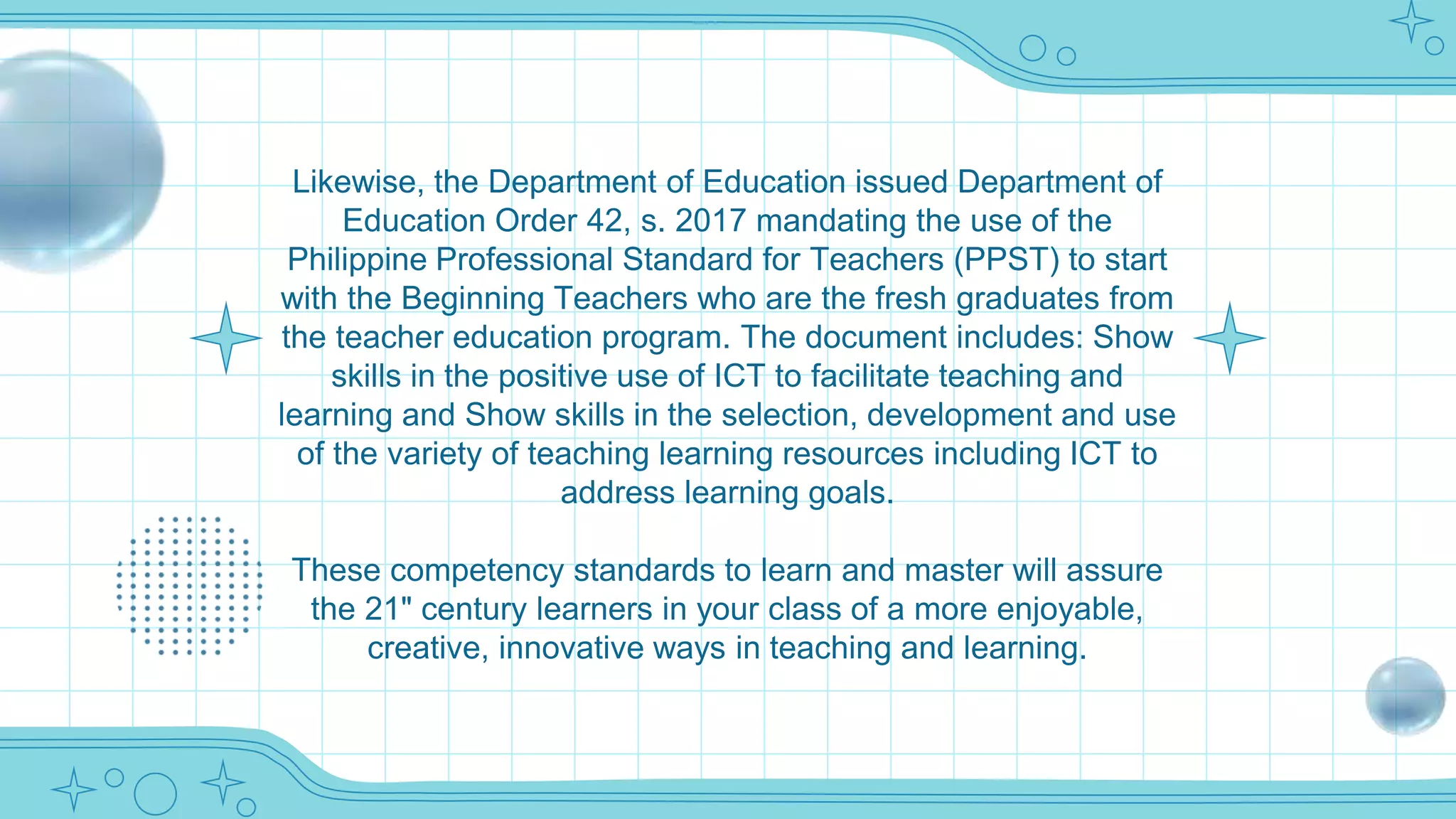
Likewise, the Department of Education issued Department of
Education Order 42, s. 2017 mandating the use of the
Philippine Professional Standard for Teachers (PPST) to start
with the Beginning Teachers who are the fresh graduates from
the teacher education program. The document includes: Show
skills in the positive use of ICT to facilitate teaching and
learning and Show skills in the selection, development and use
of the variety of teaching learning resources including ICT to
address learning goals.
These competency standards to learn and master will assure
the 21" century learners in your class of a more enjoyable,
creative, innovative ways in teaching and learning.
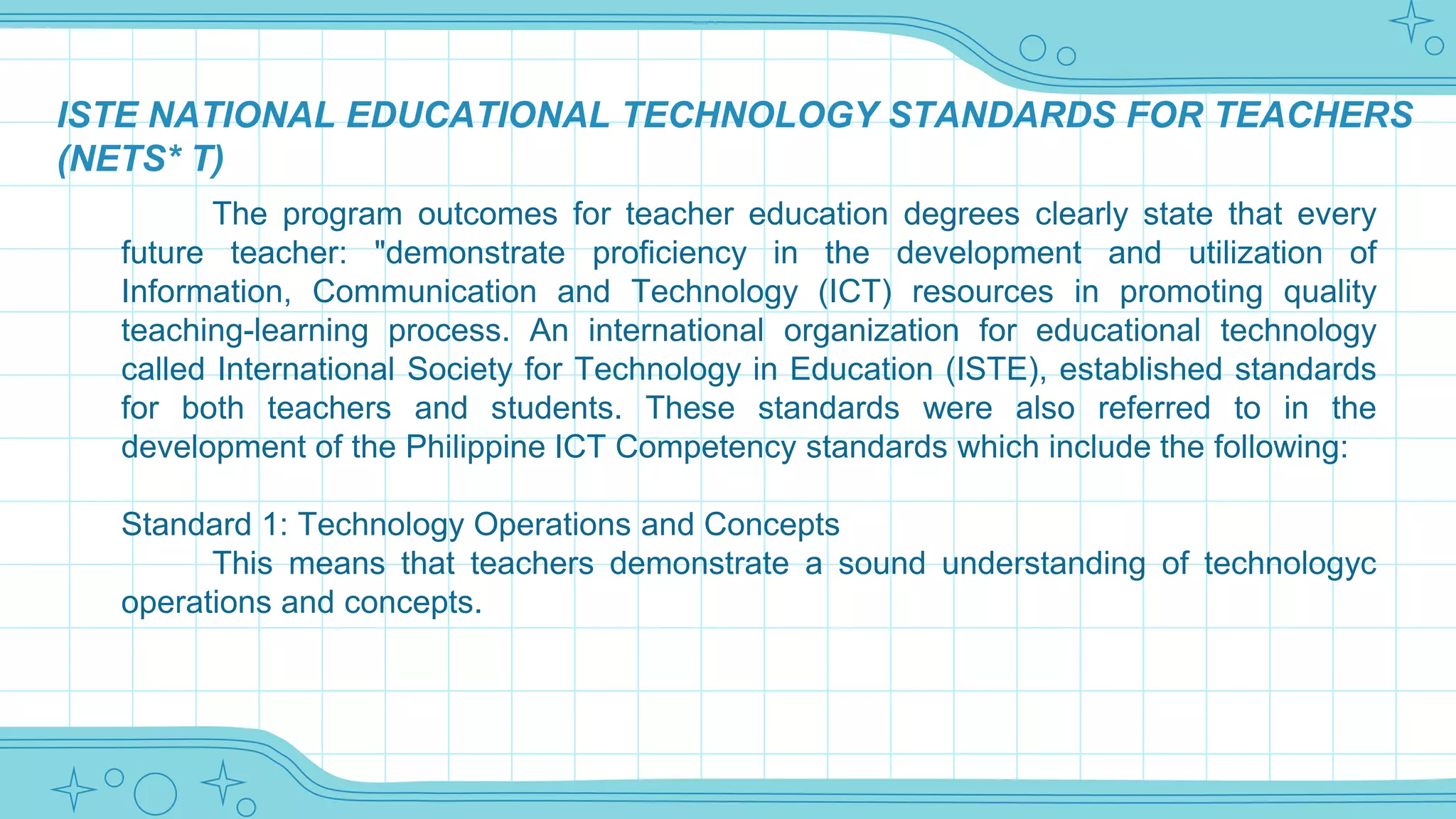
ISTE NATIONAL EDUCATIONAL TECHNOLOGY STANDARDS FOR TEACHERS
(NETS* T)
The program outcomes for teacher education degrees clearly state that every
future teacher: "demonstrate proficiency in the development and utilization of
Information, Communication and Technology (ICT) resources in promoting quality
teaching-learning process. An international organization for educational technology
called International Society for Technology in Education (ISTE), established standards
for both teachers and students. These standards were also referred to in the
development of the Philippine ICT Competency standards which include the following:
Standard 1: Technology Operations and Concepts
This means that teachers demonstrate a sound understanding of technologyc
operations and concepts.
ISTE NATIONAL EDUCATIONAL TECHNOLOGY STANDARDS FOR TEACHERS
(NETS* T)
Standard 2: Planning and Designing Learning Environment and Experiences
This standard implies that teachers utilize the use of technology to plan and
design effective learning environments and experiences.
Standard 3: Teaching. Learning and Curriculum
Teachers should be mindful that in the implementation of curriculum plan. they
have to include strategies for applying technology to maximize student learning.
Standard 4: Assessment and Evaluation
Teachers apply technology to facilitate a variety of effective assessment and
evaluation strategies to collect and analyze data, interpret results, and communicate
findings to improve instructional practice and maximize student learning.
ISTE NATIONAL EDUCATIONAL TECHNOLOGY STANDARDS FOR TEACHERS
(NETS* T)
Standard 5: Productivity and Professional Practice
Teachers use technology to engage in on-going professional development and
lifelong learning in support of student learning, increase productivity and to build
community of learners.
Standard 6: Social, Ethical, Legal and Human Issues
Teachers understand the social, ethical, legal and human issues surrounding the
use of technology in support of student learning who come from diverse background,
affirm diversity, promote safe and healthy use of technology resources and facilitate
access to technology resources for all students.
Likewise, ISTE also developed standards needed for students. These standards
will be used as a guide by teachers to plan technology-based activities in which
students achieve success in learning, communication and life skills.
ISTE NATIONAL EDUCATIONAL TECHNOLOGY STANDARDS FOR STUDENTS
(NETS* S)
From how technology teachers facilitate learners, outcomes of student learning
should indicate that the following standards have been complied with.
Standard 1: Creativity and Innovation
This standard will produce students who demonstrate creative thinking. construct
knowledge, develop innovative products and processes using technology from existing
knowledge.
Standard 2: Communication and Collaboration
This standard requires students to use digital media and environments to
communicate and work collaboratively to support individual learning and contribute to
the learning of others. This includes the use of variety of media and formats for global
awareness with learners from other cultures.
ISTE NATIONAL EDUCATIONAL TECHNOLOGY STANDARDS FOR STUDENTS
(NETS* S)
Standard 3: Research and Information Fluency
Students are expected to apply digital tools to gather, evaluate and use
information and plan strategies for inquiry. This standard expects the student to locate,
organize, analyze, evaluate, synthesize and ethically use information from a variety of
sources and media.
Standard 4: Critical Thinking, Problem-Solving and Decision Making
This standard expects the students to use critical thinking skills to plan and
conduct research, manage projects, solve problems and make informed decisions
using appropriate digital tools.
ISTE NATIONAL EDUCATIONAL TECHNOLOGY STANDARDS FOR STUDENTS
(NETS* S)
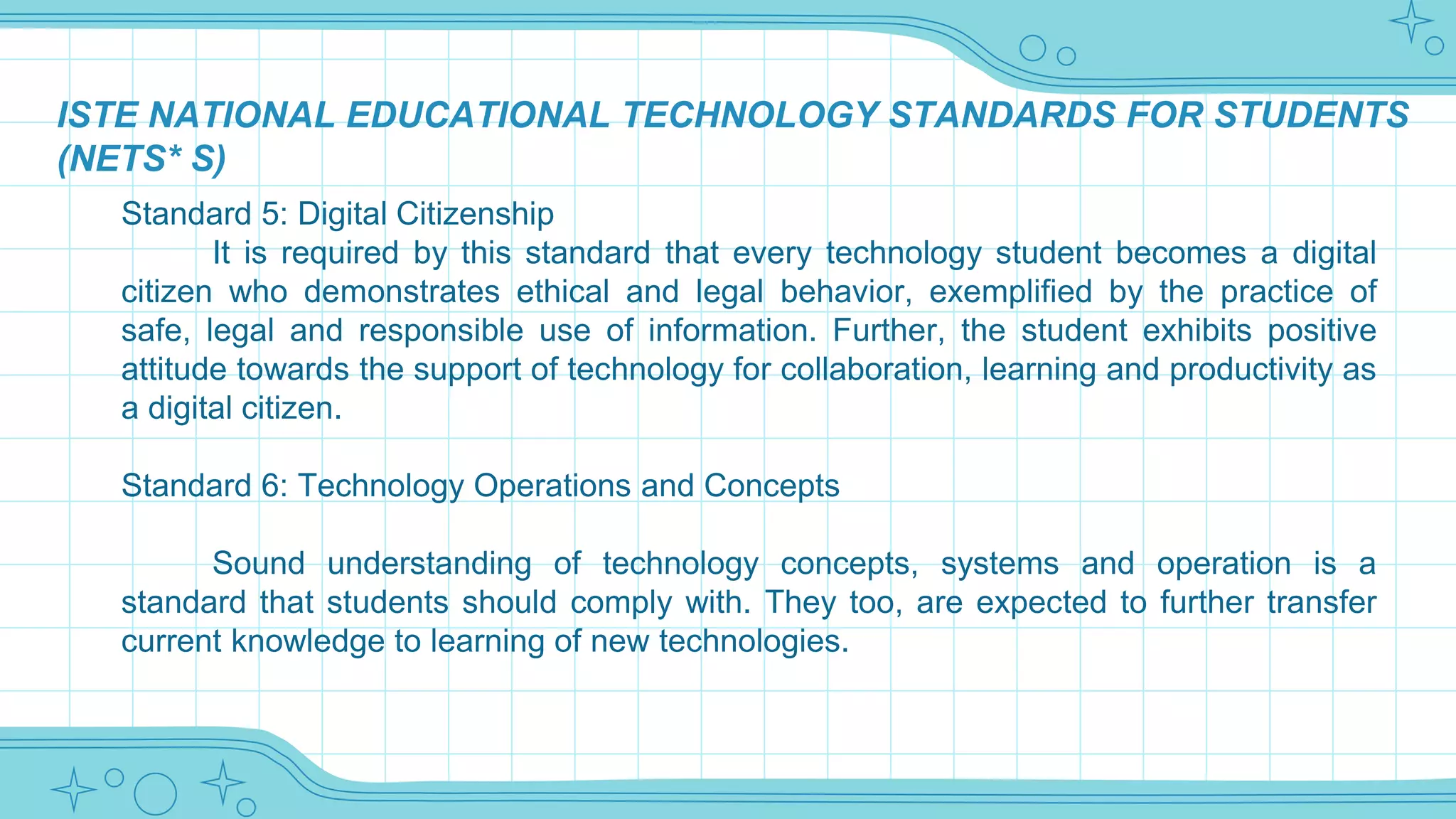
Standard 5: Digital Citizenship
It is required by this standard that every technology student becomes a digital
citizen who demonstrates ethical and legal behavior, exemplified by the practice of
safe, legal and responsible use of information. Further, the student exhibits positive
attitude towards the support of technology for collaboration, learning and productivity as
a digital citizen.
Standard 6: Technology Operations and Concepts
Sound understanding of technology concepts, systems and operation is a
standard that students should comply with. They too, are expected to further transfer
current knowledge to learning of new technologies.
As pre-service teacher education students now. you will have
to master the knowledge and skills (Learning to Know) for the
standards for students. However since you will become
teachers in the future, you should harness the same
knowledge and skills to become (Learning to Become) future
teachers.
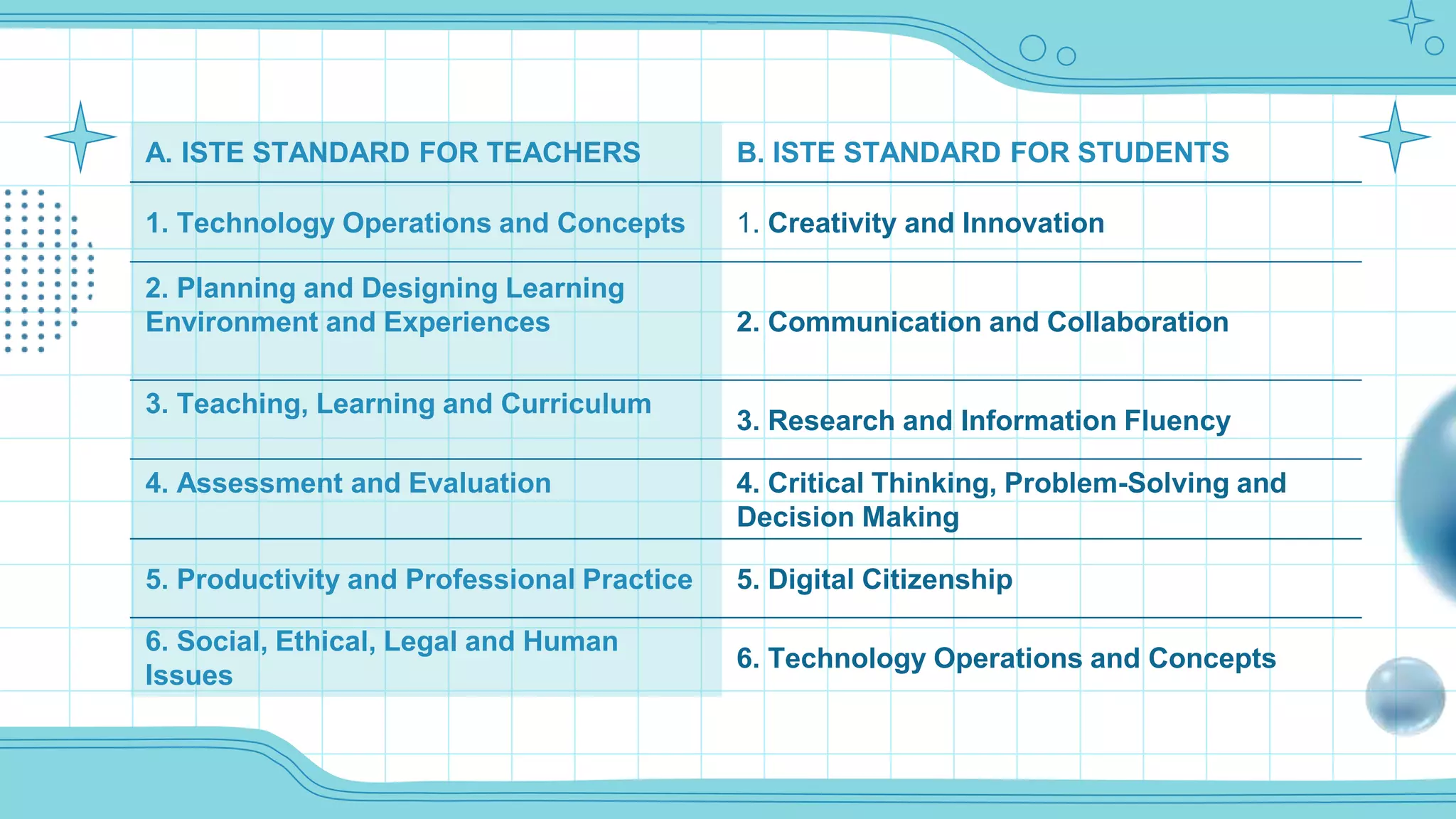
A. ISTE STANDARD FOR TEACHERS B. ISTE STANDARD FOR STUDENTS
1. Technology Operations and Concepts 1. Creativity and Innovation
2. Planning and Designing Learning
Environment and Experiences 2. Communication and Collaboration
3. Teaching, Learning and Curriculum
3. Research and Information Fluency
4. Assessment and Evaluation 4. Critical Thinking, Problem-Solving and
Decision Making
5. Productivity and Professional Practice 5. Digital Citizenship
6. Social, Ethical, Legal and Human
Issues
6. Technology Operations and Concepts

Module 1 Lesson 1 ICT Competency Standards for Philippine Pre-Service Teacher Education.pptx

  • 2.
    TEACHING AND LEARNINGWITH TECHNOLOGY: AN INTRODUCTION
  • 3.
    INTRODUCTION If there isone thing that changed the world so fast, it is TECHNOLOGY. While there exists technology in the past as non-digital technology, the current digital technology has been a factor that shrunk the world and made it flat. It has provided a new environment for learning, new ways teachers teach and also the new ways of how learners learn. In the beginning, it has created a divide between the digital natives and the digital immigrants. However as the years go by, such divide has become narrower and even blurred. This has led to the new educational revolution in teaching and learning which has been triggered by technology and resulted to better learning outcomes in the 21" century.
  • 4.
    ICT COMPETENCY STANDARDSFOR PHILIPPINE PRE-SERVICE TEACHER EDUCATION
  • 5.
    ICT COMPETENCY STANDARDS(CHED-UNESCO) AS PROVIDED IN THE 2017, POLICY, STANDARDS AND GUIDELINES (PSG) FOR PRE- SERVICE TEACHER EDUCATION The program outcomes for teacher education degrees clearly state that every future teacher: "demonstrate proficiency in the development and utilization of Information, Communication and Technology (ICT) resources in promoting quality teaching-learning process. To ensure that the program outcomes related to ICT shall be achieved, competencies were identified to be developed by every pre-service teacher (CHED - UNESCO, Bangkok, 2009.) The ICT Competency Standards is made up of seven domains. Each domain has a set of competencies. The competencies are expressed in desired learning outcomes. Becoming proficient in the different competencies will enable you to handle learners of the 21" century in your future classroom. These domains and corresponding competencies are found in the Table (next slide).
  • 6.
    Table 1: ICTCompetency Standards for Pre-service Teacher Domain 1: Understanding ICT in Education 1. Demonstrate awareness of policies affecting ICT in education 2. Comply with ICT policies as they affect teaching-learning 3. Contextualize ICT policies to the learning environment Domain 2: Curriculum and Assessment 1. Demonstrate understanding of concepts, principles and theories of ICT systems as they apply to teaching-learning 2. Evaluate digital and non-digital learning resources in response to student's diverse needs 3. Develop digital learning resources to enhance teaching-learning. 4. Use ICT tools to develop 21" century skills: information media and technology skills, learning and innovation skills, career skills and effective communication skills Domain 3: Pedagogy 1. Apply relevant technology tools for classroom activities 2. Use ICT knowledge to solve complex problems and support student collaborative activities 3. Model collaborative knowledge construction in face to face and virtual environments Domain 4: Technology Tools 1. Demonstrate competence in the technical operations of technology tools and systems as they apply to teaching and learning 2. Use technology tools to create new learning opportunities to support community of learners 3. Demonstrate proficiency in the use of technology tools to support teaching and learning Domain 5: Organization and Administration 1. Manage technology-assisted instruction in an inclusive classroom environment 2. Exhibit leadership in shared decision-making using technology tools. Domain 6: Teacher Professional Learning 1. Explore existing and emerging technology to acquire additional content and pedagogical knowledge 2. Utilize technology tools in creating communities of practice 3. Collaborate with peers, colleagues and stakeholders to access information in support of professional learning Domain 7: Teacher Disposition 1. Demonstrate social, ethical, and legal responsibility in the use of technology tools and resources 2. Show positive attitude towards the use of technology tools
  • 7.
    Likewise, the Departmentof Education issued Department of Education Order 42, s. 2017 mandating the use of the Philippine Professional Standard for Teachers (PPST) to start with the Beginning Teachers who are the fresh graduates from the teacher education program. The document includes: Show skills in the positive use of ICT to facilitate teaching and learning and Show skills in the selection, development and use of the variety of teaching learning resources including ICT to address learning goals. These competency standards to learn and master will assure the 21" century learners in your class of a more enjoyable, creative, innovative ways in teaching and learning.
  • 8.
    ISTE NATIONAL EDUCATIONALTECHNOLOGY STANDARDS FOR TEACHERS (NETS* T) The program outcomes for teacher education degrees clearly state that every future teacher: "demonstrate proficiency in the development and utilization of Information, Communication and Technology (ICT) resources in promoting quality teaching-learning process. An international organization for educational technology called International Society for Technology in Education (ISTE), established standards for both teachers and students. These standards were also referred to in the development of the Philippine ICT Competency standards which include the following: Standard 1: Technology Operations and Concepts This means that teachers demonstrate a sound understanding of technologyc operations and concepts.
  • 9.
    ISTE NATIONAL EDUCATIONALTECHNOLOGY STANDARDS FOR TEACHERS (NETS* T) Standard 2: Planning and Designing Learning Environment and Experiences This standard implies that teachers utilize the use of technology to plan and design effective learning environments and experiences. Standard 3: Teaching. Learning and Curriculum Teachers should be mindful that in the implementation of curriculum plan. they have to include strategies for applying technology to maximize student learning. Standard 4: Assessment and Evaluation Teachers apply technology to facilitate a variety of effective assessment and evaluation strategies to collect and analyze data, interpret results, and communicate findings to improve instructional practice and maximize student learning.
  • 10.
    ISTE NATIONAL EDUCATIONALTECHNOLOGY STANDARDS FOR TEACHERS (NETS* T) Standard 5: Productivity and Professional Practice Teachers use technology to engage in on-going professional development and lifelong learning in support of student learning, increase productivity and to build community of learners. Standard 6: Social, Ethical, Legal and Human Issues Teachers understand the social, ethical, legal and human issues surrounding the use of technology in support of student learning who come from diverse background, affirm diversity, promote safe and healthy use of technology resources and facilitate access to technology resources for all students. Likewise, ISTE also developed standards needed for students. These standards will be used as a guide by teachers to plan technology-based activities in which students achieve success in learning, communication and life skills.
  • 11.
    ISTE NATIONAL EDUCATIONALTECHNOLOGY STANDARDS FOR STUDENTS (NETS* S) From how technology teachers facilitate learners, outcomes of student learning should indicate that the following standards have been complied with. Standard 1: Creativity and Innovation This standard will produce students who demonstrate creative thinking. construct knowledge, develop innovative products and processes using technology from existing knowledge. Standard 2: Communication and Collaboration This standard requires students to use digital media and environments to communicate and work collaboratively to support individual learning and contribute to the learning of others. This includes the use of variety of media and formats for global awareness with learners from other cultures.
  • 12.
    ISTE NATIONAL EDUCATIONALTECHNOLOGY STANDARDS FOR STUDENTS (NETS* S) Standard 3: Research and Information Fluency Students are expected to apply digital tools to gather, evaluate and use information and plan strategies for inquiry. This standard expects the student to locate, organize, analyze, evaluate, synthesize and ethically use information from a variety of sources and media. Standard 4: Critical Thinking, Problem-Solving and Decision Making This standard expects the students to use critical thinking skills to plan and conduct research, manage projects, solve problems and make informed decisions using appropriate digital tools.
  • 13.
    ISTE NATIONAL EDUCATIONALTECHNOLOGY STANDARDS FOR STUDENTS (NETS* S) Standard 5: Digital Citizenship It is required by this standard that every technology student becomes a digital citizen who demonstrates ethical and legal behavior, exemplified by the practice of safe, legal and responsible use of information. Further, the student exhibits positive attitude towards the support of technology for collaboration, learning and productivity as a digital citizen. Standard 6: Technology Operations and Concepts Sound understanding of technology concepts, systems and operation is a standard that students should comply with. They too, are expected to further transfer current knowledge to learning of new technologies.
  • 14.
    As pre-service teachereducation students now. you will have to master the knowledge and skills (Learning to Know) for the standards for students. However since you will become teachers in the future, you should harness the same knowledge and skills to become (Learning to Become) future teachers.
  • 15.
    A. ISTE STANDARDFOR TEACHERS B. ISTE STANDARD FOR STUDENTS 1. Technology Operations and Concepts 1. Creativity and Innovation 2. Planning and Designing Learning Environment and Experiences 2. Communication and Collaboration 3. Teaching, Learning and Curriculum 3. Research and Information Fluency 4. Assessment and Evaluation 4. Critical Thinking, Problem-Solving and Decision Making 5. Productivity and Professional Practice 5. Digital Citizenship 6. Social, Ethical, Legal and Human Issues 6. Technology Operations and Concepts