Basic Concepts in Child
and Adolescent
Development
Mr. Rodel Bryan C. Valdez
WHY STUDY CHILDREN’S
DEVELOPMENT?
• The physical, cognitive, social, and
emotional growth that takes place in the
first years of a child’s life sets the
foundation for success or failure in
learning and life.
• With the knowledge that you have, you
can better identify, interpret, and respond
to a child’s individual differences.
Whatever your field, you’ll be prepared to
respond effectively to the needs,
challenges, and capacities of children and
their families, helping them get the best
start in life.
What is development?
• a progressive series of orderly, coherent
changes (Hurlock, 1972)
• the integration of constitutional and
learned changes which make up an
individual’s ever developing personality
(Maier, 1969)
What is growth?
• generally refers to change in body
structure including the size of muscles,
size of brain, and the appearance of
secondary sex characteristics
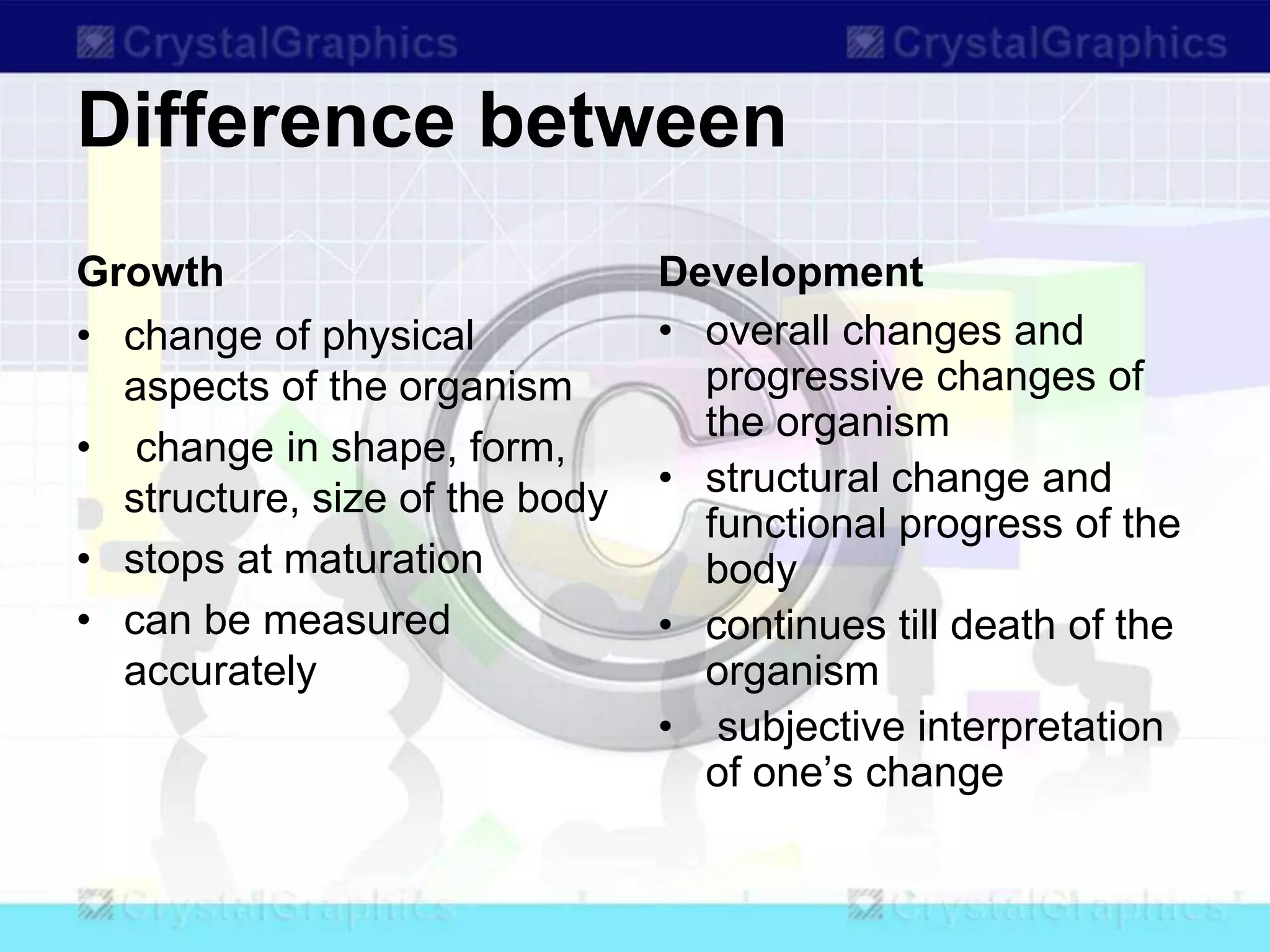
Difference between
Growth
• change of physical
aspects of the organism
• change in shape, form,
structure, size of the body
• stops at maturation
• can be measured
accurately
Development
• overall changes and
progressive changes of
the organism
• structural change and
functional progress of the
body
• continues till death of the
organism
• subjective interpretation
of one’s change
What is childhood?
• Childhood refers to the time or state of
being a child, the early stage in the
existence or development of something.
• It connotes a time of innocence, where
one is free from responsibility but
vulnerable to forces in his environment.
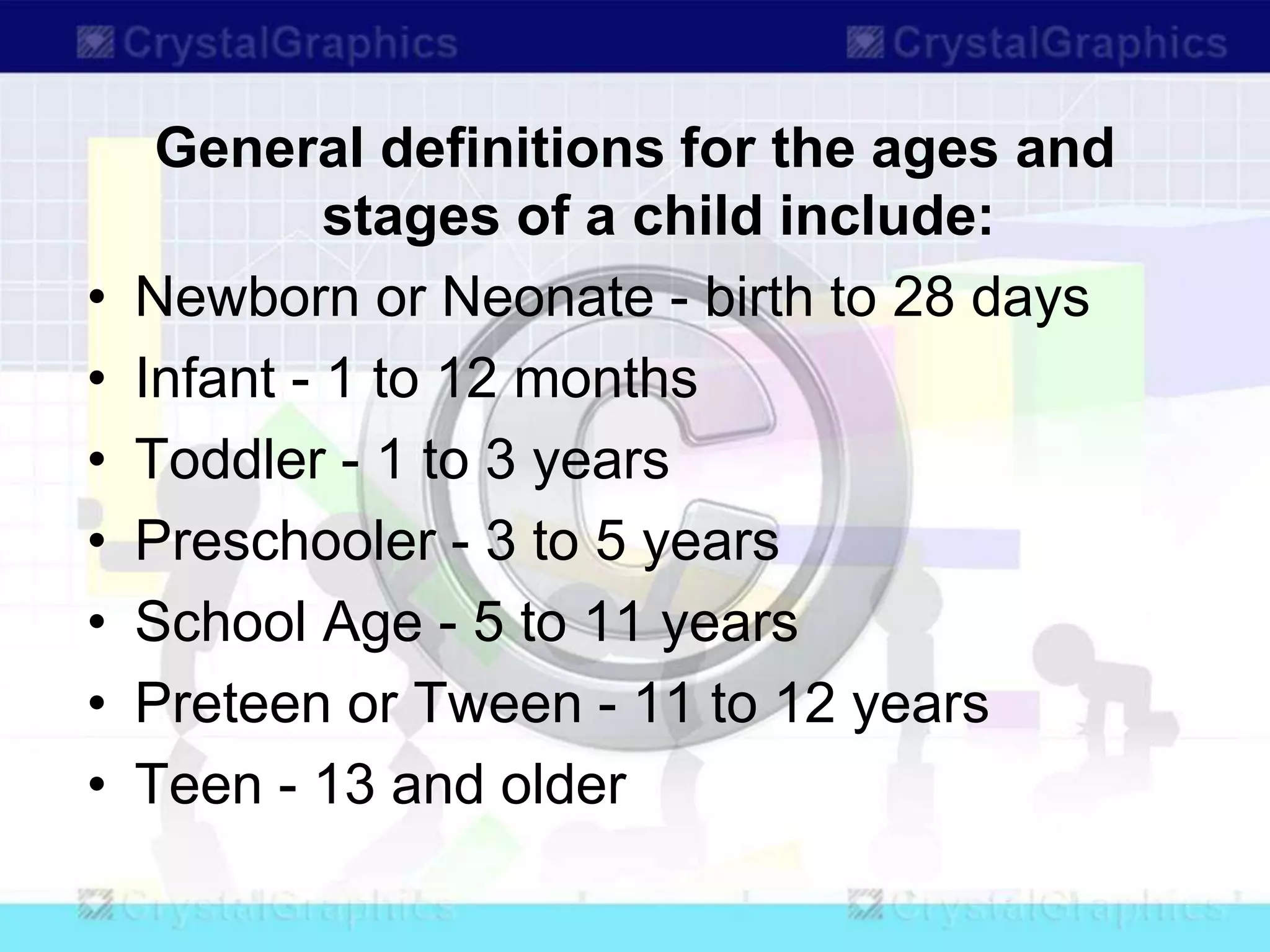
General definitions for the ages and
stages of a child include:
• Newborn or Neonate - birth to 28 days
• Infant - 1 to 12 months
• Toddler - 1 to 3 years
• Preschooler - 3 to 5 years
• School Age - 5 to 11 years
• Preteen or Tween - 11 to 12 years
• Teen - 13 and older
What is adolescence?
• From the Latin word “adolescere” which
means “to grow up”
• It is the period of psychological and social
transition between childhood (juvenile)
and adulthood (adult).
• The age of adolescence vary by culture. The
World Health Organization (WHO) defines
adolescence as the period of life between 10
and 19 years of age.
• In US, adolescence begins between ages 12
and 14 and ends at 19 or 20.
• Philippines consider those aged 15-24 years as
young adults and those aged 15-19 years
as adolescents
PRINCIPLES OF GROWTH AND
DEVELOPMENT
• Growth and
development are
influenced by
maturational,
environmental, and
genetic factors.
• All humans follow the same pattern of
growth and development. There are
sequences in growth and development
that even individual differences cannot
change.
• The sequence is
predictable although
the time of onset,
the length of each
stage, and the
effects of each
stage vary from one
person to another.
• Learning can either help or hinder the
maturation process, depending on what is
learned.
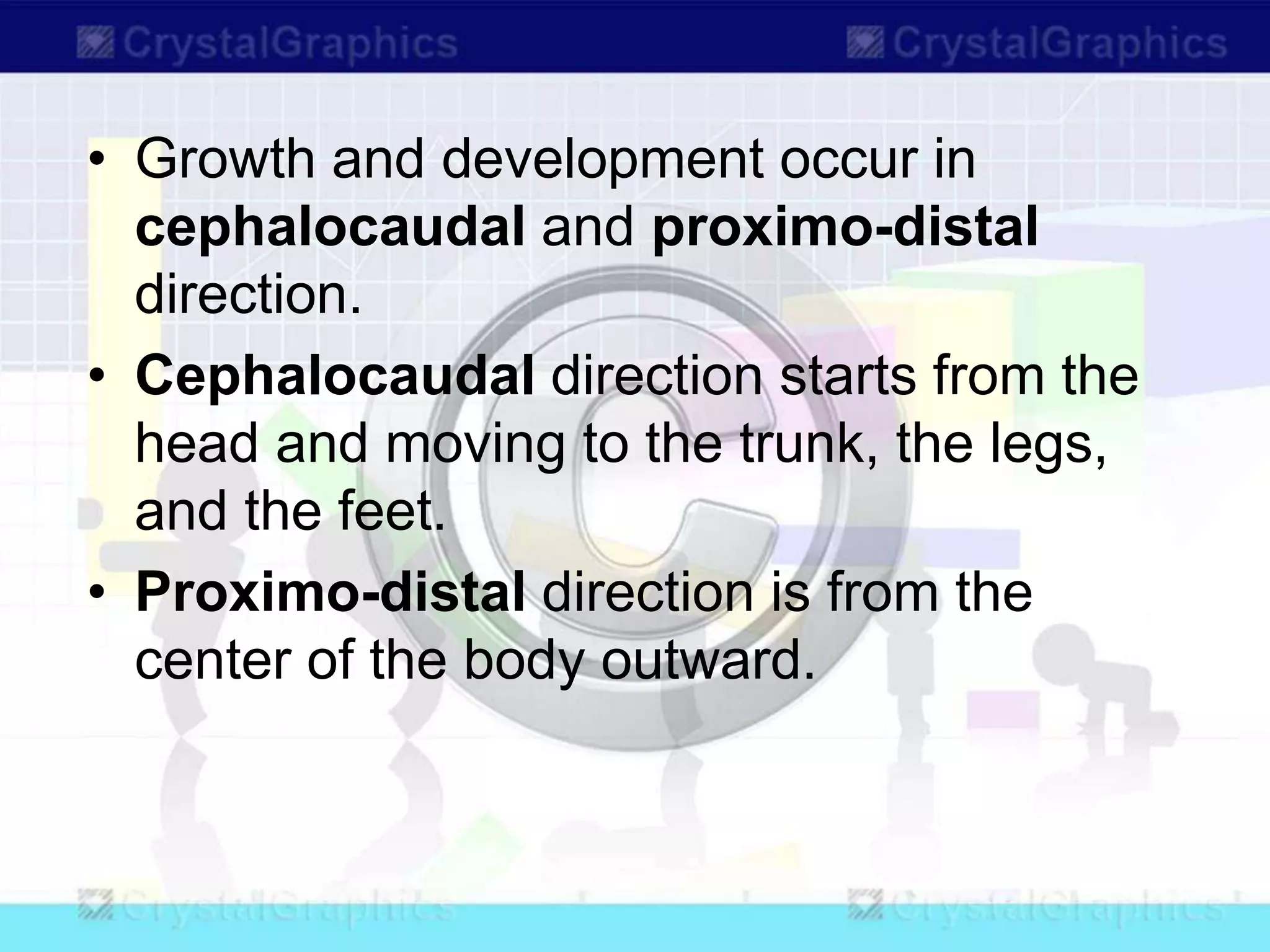
• Growth and development occur in
cephalocaudal and proximo-distal
direction.
• Cephalocaudal direction starts from the
head and moving to the trunk, the legs,
and the feet.
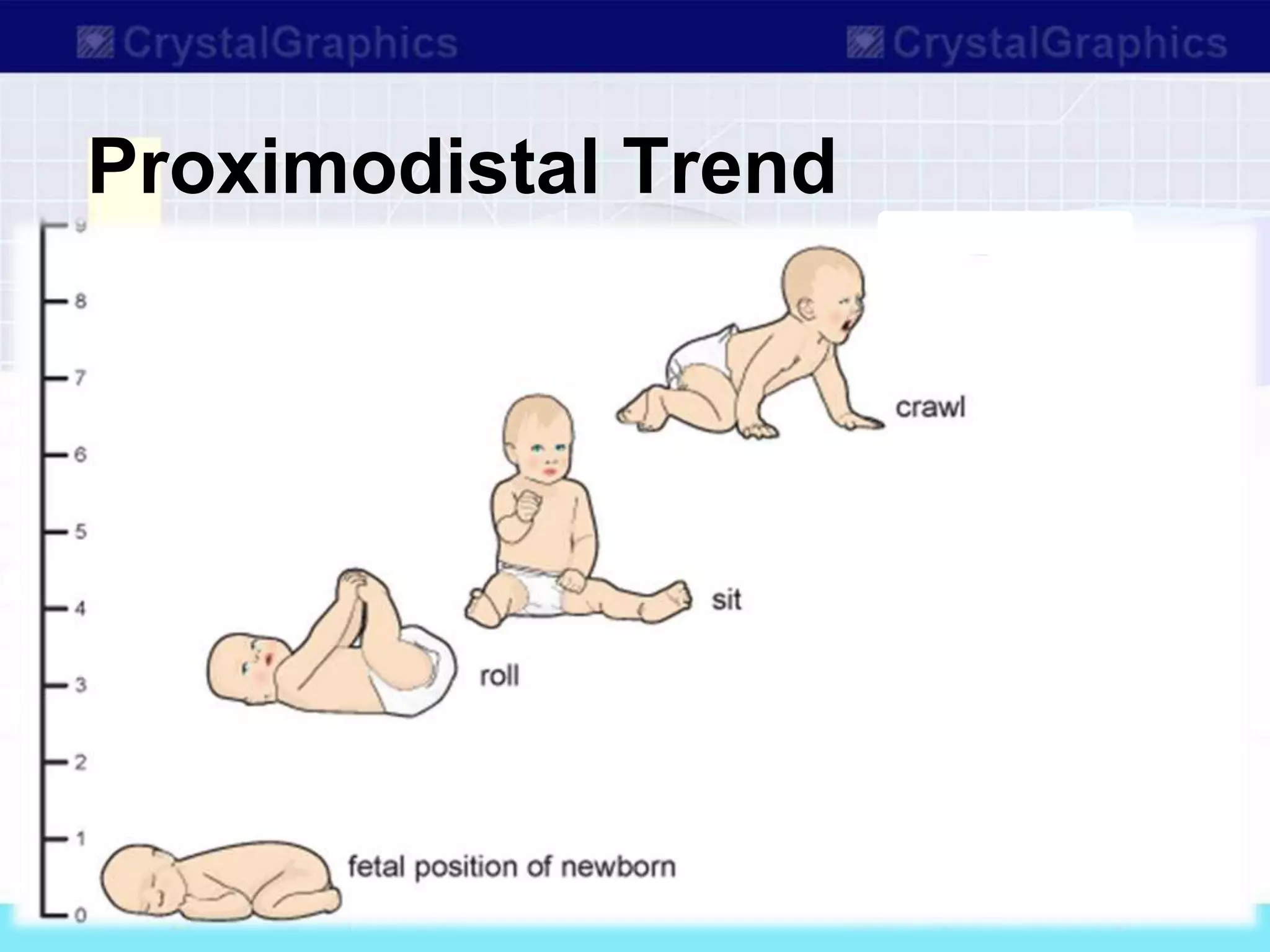
• Proximo-distal direction is from the
center of the body outward.
Cephalocaudal Trend
Proximodistal Trend
• The child grows as
though seeking a
target to be
reached by using
any available
resources.
Sources:
• Acero, Victorina D., et al. Child and Adolescent Development.
Manila: Rex Bookstore, 2008.
• Meece, Judith L. Child and Adolescent Development for Educators.
USA: McGraw-Hill Companies, Inc., 1997.
• Lupdag, Anselmo D. Educational Psychology. Metro Manila:
National Bookstore, 1984.
• http://www.slideshare.net/bembem12/principles-of-growth-and-
development
• http://www.erikson.edu/prospective-students/the-experience/why-
child-development/
• http://kidedotals.com/book/iii-principles-human-development-and-
their-educational-implications/567/2012-05-08-1238

Basic concepts in child and adolescent development1

  • 1.
    Basic Concepts inChild and Adolescent Development Mr. Rodel Bryan C. Valdez
  • 3.
  • 4.
    • The physical,cognitive, social, and emotional growth that takes place in the first years of a child’s life sets the foundation for success or failure in learning and life.
  • 5.
    • With theknowledge that you have, you can better identify, interpret, and respond to a child’s individual differences. Whatever your field, you’ll be prepared to respond effectively to the needs, challenges, and capacities of children and their families, helping them get the best start in life.
  • 6.
    What is development? •a progressive series of orderly, coherent changes (Hurlock, 1972) • the integration of constitutional and learned changes which make up an individual’s ever developing personality (Maier, 1969)
  • 7.
    What is growth? •generally refers to change in body structure including the size of muscles, size of brain, and the appearance of secondary sex characteristics
  • 8.
    Difference between Growth • changeof physical aspects of the organism • change in shape, form, structure, size of the body • stops at maturation • can be measured accurately Development • overall changes and progressive changes of the organism • structural change and functional progress of the body • continues till death of the organism • subjective interpretation of one’s change
  • 9.
    What is childhood? •Childhood refers to the time or state of being a child, the early stage in the existence or development of something. • It connotes a time of innocence, where one is free from responsibility but vulnerable to forces in his environment.
  • 10.
    General definitions forthe ages and stages of a child include: • Newborn or Neonate - birth to 28 days • Infant - 1 to 12 months • Toddler - 1 to 3 years • Preschooler - 3 to 5 years • School Age - 5 to 11 years • Preteen or Tween - 11 to 12 years • Teen - 13 and older
  • 11.
    What is adolescence? •From the Latin word “adolescere” which means “to grow up” • It is the period of psychological and social transition between childhood (juvenile) and adulthood (adult).
  • 12.
    • The ageof adolescence vary by culture. The World Health Organization (WHO) defines adolescence as the period of life between 10 and 19 years of age. • In US, adolescence begins between ages 12 and 14 and ends at 19 or 20. • Philippines consider those aged 15-24 years as young adults and those aged 15-19 years as adolescents
  • 13.
    PRINCIPLES OF GROWTHAND DEVELOPMENT
  • 14.
    • Growth and developmentare influenced by maturational, environmental, and genetic factors.
  • 15.
    • All humansfollow the same pattern of growth and development. There are sequences in growth and development that even individual differences cannot change.
  • 16.
    • The sequenceis predictable although the time of onset, the length of each stage, and the effects of each stage vary from one person to another.
  • 17.
    • Learning caneither help or hinder the maturation process, depending on what is learned.
  • 18.
    • Growth anddevelopment occur in cephalocaudal and proximo-distal direction. • Cephalocaudal direction starts from the head and moving to the trunk, the legs, and the feet. • Proximo-distal direction is from the center of the body outward.
  • 19.
  • 20.
  • 21.
    • The childgrows as though seeking a target to be reached by using any available resources.
  • 22.
    Sources: • Acero, VictorinaD., et al. Child and Adolescent Development. Manila: Rex Bookstore, 2008. • Meece, Judith L. Child and Adolescent Development for Educators. USA: McGraw-Hill Companies, Inc., 1997. • Lupdag, Anselmo D. Educational Psychology. Metro Manila: National Bookstore, 1984. • http://www.slideshare.net/bembem12/principles-of-growth-and- development • http://www.erikson.edu/prospective-students/the-experience/why- child-development/ • http://kidedotals.com/book/iii-principles-human-development-and- their-educational-implications/567/2012-05-08-1238